 Entrar
The Cyber Express Weekly Roundup: Exploited Entra ID Flaw, AI Agent Risks, and Global Cybercrime Crackdown

The Americas carried the heaviest ransomware burden of any region on the planet in the first half of 2026. According to Cyble Research and Intelligence Labs (CRIL), North and South America combined experienced 2,188 documented ransomware attacks between January and June 2026.
That single figure — 2,188 attacks — represents more than 57% of the 3,836 ransomware incidents CRIL tracked worldwide, making the Americas the undisputed center of gravity for global ransomware operations.
But the Americas is not a single threat theatre — it is two. North America alone absorbed 1,981 attacks, driven by a mature, multi-group Ransomware-as-a-Service (RaaS) economy competing for market share. South America, by contrast, recorded 207 attacks concentrated around a much smaller set of operators, with one group — The Gentlemen — claiming nearly a quarter of all regional incidents outright. Understanding the Americas means understanding both halves of that story: a saturated northern market and a consolidating southern one.
Security leaders operating across the hemisphere cannot apply a single threat model to both sub-regions. The data shows meaningfully different attacker behavior, concentration, and monetization strategy north and south of the equator.
| Metric | North America | South America |
| Ransomware Attacks | 1,981 | 207 |
| Dominant Ransomware Actor | Qilin (370 attacks) | The Gentlemen (46 attacks) |
| Top Targeted Sector | Construction | IT & ITES |
| Top Targeted Nation | United States (1,721) | Brazil (71) |
| Distinct Ransomware Groups Active | 50+ | 30+ |
| % of Attacks from Top 3 Groups | ~40% (Qilin, Akira, INC Ransom) | ~57.5% (The Gentlemen, Qilin, LockBit) |
Why the split matters: North America's threat landscape is a genuine marketplace — dozens of RaaS operators compete for affiliate loyalty, and no single group commands more than a fifth of total volume. South America's landscape is more consolidated, with three groups controlling well over half of all attacks.
For defenders, that means North American organizations need broad-spectrum threat intelligence covering a long tail of active groups, while South American organizations can build highly specific defenses against a short list of named adversaries.
Across both sub-regions combined, five ransomware operators account for the overwhelming share of documented activity: Qilin, Akira, INC Ransom, Dragonforce, and The Gentlemen. Together, these five groups are linked to roughly 1,148 of the Americas' 2,188 attacks — approximately 52.5% of all regional ransomware activity.
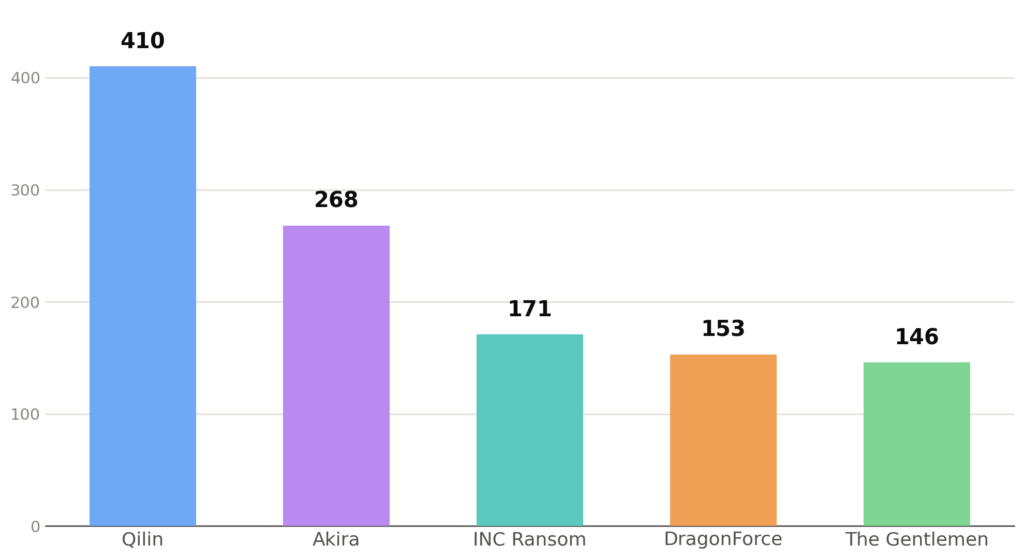
Attack Volume: 410 documented incidents across the Americas (370 in North America, 40 in South America) — 18.7% of the regional total.
Qilin is the single most prolific ransomware actor operating in the hemisphere, and its dominance is not evenly spread — it is concentrated hardest in the United States.
Geographic Concentration:
Worldwide Sectoral Targeting: Qilin's targeting logic is deliberate rather than opportunistic:
Operational Characteristics:
Qilin's affiliate model is built for scale. Initial access brokers handle reconnaissance and compromise, mid-tier operators manage lateral movement, and dedicated crews execute encryption and exfiltration. This compartmentalization lets Qilin run dozens of concurrent operations across the United States without any single point of failure. The group's near-total dominance of the American ransomware market (323 of 1,721 US attacks) suggests either an unusually large affiliate roster or a payout structure attractive enough to pull operators away from competing platforms.
Why Qilin Dominates:
Americas Security Implications: Any organization in construction, professional services, manufacturing, or healthcare operating in the US or Canada should treat Qilin as a primary named threat, not a generic ransomware risk.
Attack Volume: 268 documented incidents, almost entirely concentrated in North America — 12.2% of the regional total
Akira is the second most active group in the Americas, and unlike Qilin, its footprint is almost exclusively North American. CRIL's data shows Akira's South American presence is negligible to date.
Geographic Concentration:
Worldwide Sectoral Targeting:
Operational Characteristics:
Akira has built a reliable playbook around compromising small-to-medium-sized businesses through unpatched public-facing network devices, then pivoting into construction and manufacturing environments where downtime tolerance is lowest. The group's consistency — rather than explosive growth — is its defining trait; it has neither the explosive scale of Qilin nor the geographic diversification of The Gentlemen, but it reliably executes against the same target profile month after month.
Americas Security Implications: North American SMBs in construction, manufacturing, and professional services should assume Akira is actively scanning for exposed remote access infrastructure. Its South American absence should not be mistaken for permanence — RaaS groups expand geographically once North American markets saturate.
Attack Volume: 171 documented incidents (164 in North America, 7 in South America) — 7.8% of the regional total
INC Ransom distinguishes itself through sector specialization rather than volume. The group shows a clear, repeated preference for Professional Services organizations — particularly law firms — leveraging the sensitive, high-stakes nature of legal client data.
Geographic Concentration:
Worldwide Sectoral Targeting:
Operational Characteristics:
INC Ransom's rapid operational pace and consistent targeting of law firms, healthcare providers, and transportation/energy operators reflects a strategy built entirely around double-extortion leverage. The sensitivity of the data matters more than the size of the victim. A regional law firm holding privileged client communications is, to INC Ransom, a more valuable target than a much larger manufacturer with less sensitive data.
Americas Security Implications: Law firms, accounting practices, and consulting shops across the US, Canada, and Brazil should assume INC Ransom is actively targeting client confidentiality as leverage — not just encrypting file servers for disruption.
Attack Volume: 153 documented incidents (148 in North America, 5 in South America) — 7.0% of the regional total
Dragonforce maintains an aggressive operational tempo focused heavily on the United States, with a strategy that suggests supply-chain-aware targeting rather than random opportunism.
Geographic Concentration:
Worldwide Sectoral Targeting:
Operational Characteristics:
Dragonforce's manufacturing and construction focus mirrors Qilin's and Akira's playbooks, but its concentration in the US combined with limited-but-present South American activity hints at interest in transnational manufacturing supply chains. North American organizations with manufacturing partners or subsidiaries in Latin America should treat this as a lateral-access risk, not just a direct-targeting one.
Americas Security Implications: Manufacturers and construction firms with cross-border operations — a common structure across USMCA supply chains — should extend Dragonforce-specific monitoring to subsidiaries and vendors, not just headquarters networks.
Attack Volume: 146 documented incidents (100 in North America, 46 in South America) — 6.7% of the regional total, but the single most active ransomware group in South America specifically.
While The Gentlemen rank fifth across the combined Americas, they are the #1 threat actor in South America on their own — responsible for roughly 22% of every ransomware attack recorded in that sub-region.
Geographic Concentration:
Worldwide Sectoral Targeting:
Operational Characteristics:
The Gentlemen are a relatively new operator that has achieved outsized scale in a short window, and their South American concentration is the most important regional signal in this dataset. Unlike Qilin or Akira — which built North American dominance first and are only beginning to diversify — The Gentlemen appear to have prioritized South America as a primary theatre from early in their operational life, an unusual strategic choice that may reflect lower defensive maturity, less aggressive law enforcement cooperation, or simply less competitive pressure from other RaaS operators in the sub-region.
Americas Security Implications: South American organizations — especially in healthcare, manufacturing, and IT services — should treat The Gentlemen as their single highest-priority named adversary. North American organizations should not discount them either; 100 US-focused attacks is a substantial footprint for a group still building its brand.
Three additional groups warrant inclusion in any Americas threat model:
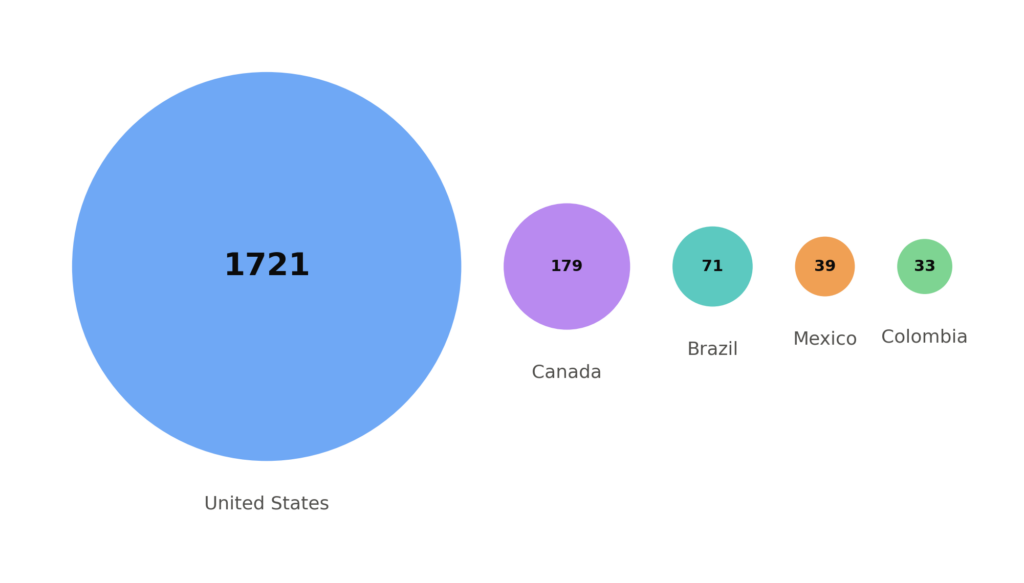
Attack Volume: 1,721 ransomware attacks — 78.7% of all Americas ransomware activity, and roughly 45% of every ransomware attack recorded worldwide.
No other country on Earth comes close to the volume of ransomware activity absorbed by the United States in H1 2026. The country functions as the default target for nearly every major RaaS operator active today.
Threat Actor Concentration:
Sectoral Breakdown: Manufacturing, Professional Services, Construction, and Healthcare bear the brunt, consistent with the broader North American pattern of operationally sensitive, low-downtime-tolerance industries.
The scale of the US economy, its dense concentration of mid-market manufacturers, law firms, and healthcare providers, and its comparatively high ransom-payment history combine to make it the most economically rational target for every major ransomware operator. US organizations also frequently anchor cross-border supply chains stretching into Canada, Mexico, and South America — meaning a US compromise can cascade into lateral access against hemispheric partners.
Defensive Priority: US organizations across construction, manufacturing, professional services, and healthcare should assume Qilin, Akira, INC Ransom, Dragonforce, Play, and The Gentlemen are all actively scanning for exploitable entry points into their networks simultaneously — not sequentially.
Attack Volume: 179 ransomware attacks — 8.2% of the regional total.
Canada's threat profile closely tracks the United States, reflecting deep economic integration and shared supply chains rather than a distinct targeting logic of its own.
Sectoral Breakdown: Manufacturing, professional services, and construction dominate, mirroring the US pattern almost directly.
Canadian organizations are frequently subsidiaries, suppliers, or joint-venture partners of US enterprises, which means the same RaaS groups saturating the US market extend naturally northward. Cross-border manufacturing in particular creates lateral access opportunities that Dragonforce and Akira appear well-positioned to exploit.
Defensive Priority: Canadian organizations should not assume distance from US headquarters provides insulation — the same threat actors, exploiting the same vulnerability classes, are already active on both sides of the border.
Attack Volume: 71 ransomware attacks — 3.2% of the regional total, but the largest single concentration in South America.
Brazil represents South America's most complex threat environment, combining traditional ransomware pressure with a maturing, sophisticated financial malware ecosystem.
Threat Actor Concentration: The Gentlemen (15 attacks), LockBit, and a fragmented tail of smaller operators.
Sectoral Breakdown: Government & Law Enforcement, BFSI, and Healthcare are the most consistently targeted sectors.
Beyond ransomware, Brazil emerged in H1 2026 as a focal point for new Android banking trojan families — TCLBANKER and BTMOB RAT — which use self-propagation, evasion techniques, and Malware-as-a-Service (MaaS) distribution models to target banking and cryptocurrency users directly. Brazil also suffered an alleged 250-million-record breach of Serasa, one of the country's largest credit bureaus, alongside an access sale allegedly targeting the Central Bank of Brazil — a listing that, if genuine, represents one of the most significant initial-access offerings tracked anywhere in the report.
Defensive Priority: Brazilian financial institutions should treat mobile banking malware and ransomware as converging risks rather than separate problems — the same underground economy is monetizing both. Government and BFSI entities should assume access-broker listings referencing critical national infrastructure require immediate incident-response-level validation, not routine monitoring.
Attack Volume: 39 ransomware attacks — 1.8% of the regional total.
Mexico's attack volume is meaningfully lower than the US, Canada, or Brazil, but its position within North American manufacturing supply chains — accelerated by ongoing nearshoring trends — makes it a nation to watch closely rather than dismiss.
As global manufacturers continue relocating production closer to the US market, Mexican facilities increasingly sit inside the same supply chains that Dragonforce, Akira, and Qilin already target aggressively north of the border. Lower current attack volume may reflect earlier-stage targeting rather than lower risk — a pattern security teams should not mistake for durable safety.
Defensive Priority: Manufacturers with Mexican operations should extend the same OT/IT segmentation and vulnerability management discipline applied to US and Canadian facilities to their Mexican sites, rather than treating them as lower priority.
Attack Volume: 33 ransomware attacks — 1.5% of the regional total.
Colombia's ransomware volume is modest, but the country stands out for the density of ideologically motivated activity layered on top of financially driven attacks.
Groups such as Anonymous Colombia (#OpColombia) ran active campaigns throughout H1 2026 blending website defacement, DDoS attacks, and data leak activity — consistent with the broader South American pattern in which hacktivist-branded channels frequently overlap with financially motivated cybercrime infrastructure.
Defensive Priority: Colombian government and law enforcement entities — the most frequently targeted sector across South America overall — should treat hacktivist claims as credible threat intelligence signals rather than dismissing them as purely ideological noise.
Attack Volume: The second most heavily impacted sector in North America.
Professional services firms — law, accounting, and consulting practices — are one of the top jobs on North America's ransomware target list, driven overwhelmingly by INC Ransom and AiLock's aggressive targeting of client-confidential data.
Notable Incident Pattern: AiLock's activity stood out for a coordinated wave of victim disclosures on a single day — March 3, 2026 — a pattern consistent with mass-exploitation of a shared vulnerability rather than individually researched targeting.
Defensive Recommendations:
Attack Volume: Construction and Manufacturing rank first and third in North America; combined, they represent the largest share of Qilin, Akira, Dragonforce, and The Gentlemen's worldwide targeting.
Constructions and manufacturing share a common vulnerability across the Americas: both operate on tight, contractually enforced timelines where downtime translates directly into cascading financial penalties.
Defensive Recommendations:
Attack Volume: One of the top four most heavily impacted sectors in South America.
Healthcare organizations across the Americas — but particularly in South America — face a threat dynamic distinct from financial pressure alone: ransomware attacks against hospitals directly endanger patient safety.
Defensive Recommendations:
Attack Volume: 33% of all North American initial access listings — the second-most targeted sector in the region's access brokerage market.
A distinctive Americas finding: initial access brokers targeting the region show unusually strong interest in Agriculture & Livestock, second only to Technology.
North America's food supply chain increasingly depends on connected logistics, cold-chain monitoring, and precision agriculture technology — creating an attack surface that did not meaningfully exist a decade ago. Access brokers appear to be positioning themselves ahead of ransomware operators, selling footholds into agricultural operations before ransomware crews weaponize them. This mirrors a pattern seen elsewhere globally but is particularly pronounced in North America's access brokerage data.
Defensive Recommendations:
Unlike most hacktivist channels tracked in this report, SOLDADOS DIGITALES – UNIÓN AMERICANA operates across both North and South America, making it one of the few genuinely hemispheric threat actors identified in H1 2026 — a significant finding given how regionally siloed most hacktivist activity tends to be.
Combined Hacktivism Metrics (North + South America):
Notable Collectives by Sub-Region:
The Convergence Problem: As with hacktivist activity documented elsewhere in CRIL's global dataset, several Americas-based channels marketed as ideological collectives function as hybrid operations — logging DDoS attacks and defacement claims alongside stolen-data brokerage and DDoS-for-hire services. Security teams should treat these channels as credible threat intelligence sources rather than dismissing their claims as purely political theater.
If You're in Professional Services:
If You're in Manufacturing or Construction:
If You're in Healthcare:
If You're in BFSI:
If You're in Agriculture & Livestock:
If You're in Government & Law Enforcement (South America specifically):
Based on CRIL's H1 2026 regional data, Americas security leaders should prioritize defensive investment in the following sequence.
Phase 1: Critical Infrastructure Protection (30 days)
Phase 2: Data Protection (60 days)
Phase 3: Operational Resilience (90 days)
Phase 4: Threat Hunting and Detection (Ongoing)
The Americas is not just the largest ransomware theatre in the world by volume — it is two distinct threat environments operating under a single regional label. North America hosts a saturated, competitive RaaS marketplace where no single group dominates outright. South America is consolidating around a smaller set of operators, led decisively by The Gentlemen.
Key Takeaways:
For security leaders across North and South America, the strategic imperative is the same even where the tactical details diverge: know which named actors are active in your specific country and sector, prioritize risk-based patching over blanket cycles, treat data exfiltration as inevitable rather than optional, and build recovery infrastructure that assumes an attack will happen — not one that hopes it won't. The data confirms the Americas will remain the world's most heavily targeted ransomware region through the remainder of 2026. The only open question is how prepared each organization chooses to be.
How many ransomware attacks hit the Americas in H1 2026?
2,188 documented ransomware attacks were observed across North and South America in H1 2026, according to Cyble Research and Intelligence Labs (CRIL) findings.
Which ransomware group is most active in the Americas in H1 2026?
Qilin is the most active group across the combined Americas, with 410 documented attacks (370 in North America, 40 in South America). Within South America specifically, however, The Gentlemen — not Qilin — is the dominant actor.
How many ransomware attacks hit North America in H1 2026?
CRIL recorded 1,981 ransomware attacks in North America during H1 2026, representing roughly 52% of all ransomware activity tracked worldwide.
How many ransomware attacks targeted the US in H1 2026? Is it the highest?
Yes. CRIL observed 1,721 ransomware attacks targeted at the US — which is 78.7% of the American continent (North and South, both), and nearly 45% of every ransomware attack recorded worldwide.
Which sector was the most targeted in South America?
IT & ITES remained the most targeted sector in South America for H1 2026.
Ransomware actors targeted which country the most in South America?
Brazil. With 71 attacks, it was the prime target of ransomware actors in H1 2026.
Is Brazil a significant ransomware target?
Yes. Brazil recorded 71 ransomware attacks — the highest total in South America — and additionally faced an alleged 250 million record breach at credit bureau Serasa, an access sale allegedly targeting the Central Bank of Brazil, and new Android banking trojan families (TCLBANKER, BTMOB RAT) targeting financial and cryptocurrency users.
What is the most targeted industry in the Americas?
Construction tops North America's target list, while IT & ITES, Healthcare, and Professional Services top South America's. Across the whole Americas, Construction and Manufacturing remain consistently high-risk due to their low tolerance for operational downtime.
The post Ransomware Threats in the Americas H1 2026: Dissecting the Regional Attack Patterns and Dominant Actors appeared first on Cyble.
Europe faced a ransomware onslaught in the first half of 2026 that sets a troubling precedent for the remainder of the year. According to Cyble Research and Intelligence Labs (CRIL), the region experienced 866 documented ransomware attacks, 51 confirmed data breach incidents, and 7 initial access sales between January and June 2026. These figures represent not just a volume problem, but a fundamental shift in how threat actors are organizing, targeting, and monetizing their operations within European territory.
What distinguishes the ransomware threats in Europe from other global regions is the concentration of power among a small number of highly sophisticated threat actors. While the threat ecosystem encompasses dozens of groups, five dominant ransomware operators account for approximately 55% of all documented activity. This concentration creates predictability—European security leaders can now identify, profile, and build specific defensive strategies against known adversaries.
Attack Volume: 158 documented incidents (18.2% of regional total)
Qilin stands as the dominant ransomware threat actor targeting Europe, commanding operational superiority through sophisticated affiliate management, rapid exploit weaponization, and industry-specific targeting intelligence.
Geographic Concentration:
Worldwide Sectoral Targeting: Qilin demonstrates deliberate sectoral selection rather than opportunistic targeting:
Operational Characteristics:
Qilin's dominance stems from understanding European organizational economics. Construction projects operate under time-sensitive contracts with contractually-defined penalties for delay. A single day of downtime on a €50 million construction project can trigger cascading costs exceeding €100,000. This economic reality translates directly into ransom payment likelihood, making Qilin's targeting strategy rational and highly effective.
The group maintains an extensive affiliate network capable of concurrent operations across multiple European nations. Evidence suggests Qilin has compartmentalized its operations: initial access brokers handle reconnaissance and network compromise, mid-tier operators manage lateral movement and privilege escalation, and final-stage operators execute encryption and exfiltration. This division of labor enables rapid scaling and reduces attribution risk.
Why Qilin Dominates:
European Security Implications: Organizations in construction, professional services, and manufacturing should treat Qilin as their primary threat actor concern. Defensive strategies must prioritize data exfiltration prevention, network segmentation, and immutable backup infrastructure.
Attack Volume: 144 documented incidents (16.6% of regional total)
The Gentlemen represent an emerging threat actor that has achieved remarkable scale in a relatively short operational window. Unlike established groups that evolved from other cybercriminal operations, The Gentlemen appear purpose-built for ransomware-as-a-service operations.
Geographic Concentration:
Worldwide Sectoral Targeting:
Operational Characteristics:
The Gentlemen's rapid emergence and sustained growth suggest significant operational funding and technical sophistication. The group's geographic diversification—maintaining European dominance while aggressively expanding into Asia-Pacific—indicates either organizational scale or partnerships with regional threat actors.
Notably, The Gentlemen's Thailand targeting (35 incidents) suggests supply-chain attack sophistication. By compromising manufacturing and logistics operations in Thailand, the group can leverage these beachheads for downstream attacks against Western European organizations. This cross-continental supply-chain targeting represents a significant evolution in ransomware operational sophistication.
Key Distinction: While Qilin focuses on maximizing ransom payments from individual targets, The Gentlemen appear to prioritize operational scale and geographic expansion. This suggests the group may be building toward either:
European Security Implications: The Gentlemen's emergence signals market competition is intensifying. Organizations should monitor this group's operational evolution closely, as aggressive growth often precedes operational mistakes that create defensive opportunities.
Attack Volume: 61 documented incidents (7.0% of regional total)
LockBit's presence in European targeting represents a significant finding given sustained law enforcement pressure and multiple platform disruption attempts. Despite being targeted by coordinated international takedown operations, LockBit maintained operational capability throughout H1 2026.
Geographic Concentration:
Worldwide Sectoral Targeting:
Operational Resilience:
LockBit's continued operations despite international enforcement actions demonstrate several critical lessons:
The group's continued viability suggests that law enforcement actions, while disruptive, are insufficient to eliminate established RaaS operations. Organizations cannot rely on law enforcement intervention as a defensive strategy; they must assume LockBit and similar groups will remain operational threats indefinitely.
European Security Implications: LockBit should remain on European security teams' active threat monitoring lists. The group maintains technical sophistication, access to critical zero-day exploits, and demonstrated willingness to target European critical infrastructure.
Attack Volume: 59 documented incidents (6.8% of regional total)
Akira represents a secondary-tier ransomware group with focused European operations. The group demonstrates strong preference for Manufacturing and Construction sectors, suggesting industry-specific expertise or targeted affiliate recruitment.
Geographic Concentration:
Worldwide Sectoral Targeting:
Operational Profile:
Akira's disproportionate North American presence (268 attacks) with lower European activity (59 attacks) suggests the group may have established affiliate networks in North America with secondary capacity for European operations. The strong manufacturing and construction focus mirrors Qilin's strategy, indicating these sectors offer superior ransom payment likelihood across multiple geographic markets.
European Security Implications: While not as immediately threatening as Qilin or The Gentlemen, Akira's persistent operations warrant inclusion in threat modeling exercises. European manufacturing and construction organizations should monitor Akira's affiliate recruitment channels and tactical innovations.
Attack Volume: 54 documented incidents (6.2% of regional total)
Dragonforce rounds out the top-five European threat actors with apparent specialization in Manufacturing and Technology sectors, suggesting possible supply-chain attack capabilities.
Geographic Concentration:
Worldwide Sectoral Targeting:
Operational Pattern:
Dragonforce's heavy US focus with secondary European operations suggests the group may be leveraging North American-based supply chains to gain access to European targets. Manufacturing supply chains are deeply interconnected across transatlantic partners; compromising US manufacturers could provide lateral access into European operations.
European Security Implications: European manufacturing organizations should implement aggressive third-party risk management programs, particularly for US-based suppliers. Dragonforce's supply-chain sophistication suggests the group may bypass direct targeting in favor of compromising upstream vendors.
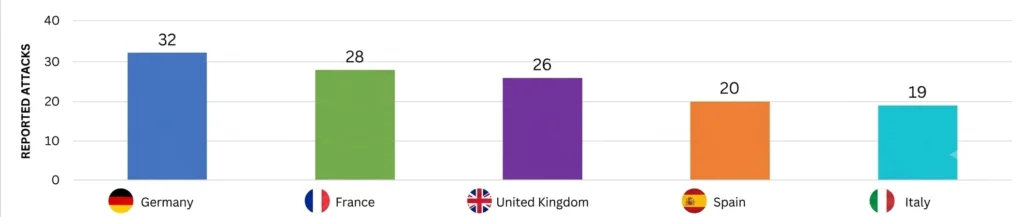
Attack Volume: 155 ransomware attacks (17.9% of regional total)
Germany's position as Europe's manufacturing powerhouse places it at the center of ransomware targeting campaigns. The nation's industrial sector—encompassing automotive, machinery, chemicals, and precision manufacturing—represents the most valuable ransomware target set in Europe.
Threat Actor Concentration:
Sectoral Breakdown:
German organizations represent an optimal target combination: high asset value, supply-chain criticality, strong operational technology integration, and proven willingness to pay ransoms to maintain production schedules. Additionally, Germany's federal structure creates jurisdictional complexity that may slow law enforcement response.
The nation's Mittelstand (mid-market manufacturing firms) are particularly vulnerable—large enough to justify ransom payments, but sometimes lacking enterprise-grade security infrastructure.
Defensive Priority: German manufacturing organizations should assume Qilin, The Gentlemen, Akira, and Dragonforce all maintain active operations targeting their sector. Network segmentation between IT and operational technology (OT) environments should be elevated to critical priority.
Attack Volume: 138 ransomware attacks (15.9% of regional total)
The UK faces a different threat profile than Germany, driven primarily by London's position as a global financial services hub. While manufacturing is targeted, Banking, Financial Services, and Insurance (BFSI) organizations command disproportionate attention.
Threat Actor Concentration:
Sectoral Breakdown:
London's financial services ecosystem manages trillions in assets, making it extraordinarily valuable to data-exfiltrating threat actors. BFSI organizations hold customer financial data, internal financial records, and strategic information that commands premium prices on dark web marketplaces.
Additionally, regulatory requirements (FCA, PRA, etc.) create pressure for rapid ransom payment to avoid breach notification delays that could trigger regulatory sanctions.
Data Exfiltration Risk: The UK's status as a financial services hub makes it particularly vulnerable to data-centric attack strategies. Organizations should assume that successful breach attempts will include aggressive data exfiltration alongside encryption deployment.
Defensive Priority: UK BFSI organizations must implement robust data loss prevention (DLP), encryption for data in transit and at rest, and aggressive monitoring for unauthorized data access or exfiltration attempts.
Attack Volume: 119 ransomware attacks (13.7% of regional total)
France experiences balanced threat distribution across multiple sectors, reflecting both its manufacturing capacity and significant professional services sector.
Threat Actor Concentration:
Sectoral Breakdown:
As Europe's second-largest economy, France is attractive to ransomware operators across multiple sectors. The nation's professional services sector (legal, accounting, consulting) is particularly valuable for data exfiltration, while manufacturing remains a consistent target.
Defensive Priority: French organizations should implement sector-specific defensive strategies: professional services firms should prioritize client data protection and DLP, while manufacturing organizations should focus on OT segmentation and operational resilience.
Attack Volume: 115 ransomware attacks (13.3% of regional total)
Italy faces concentrated targeting in construction and manufacturing sectors, with particular pressure on small-to-medium enterprises in industrial regions.
Threat Actor Concentration:
Sectoral Breakdown:
Italy's construction industry is particularly vulnerable to ransom attacks due to tight project timelines and significant financial exposure. The nation's manufacturing sector, while sophisticated, sometimes operates with legacy infrastructure that creates exploitation opportunities.
Defensive Priority: Italian construction and manufacturing organizations should prioritize incident response readiness, backup infrastructure resilience, and supply-chain risk management.
Attack Volume: 87 ransomware attacks (10.0% of regional total)
Spain experiences lower absolute attack volume than Germany, UK, France, or Italy, but faces concentrated pressure in manufacturing and professional services sectors.
Threat Actor Concentration:
Sectoral Breakdown:
Regional Observation: Spain's lower attack volume may reflect either lower overall ransomware targeting or more effective defensive implementations. Spanish security teams should not interpret lower numbers as reduced threat but rather as a baseline for future comparison.
Attack Volume: 107 documented incidents (58% of all sector targeting across regions – not just in Europe – analyzed)
Construction organizations face disproportionate ransomware targeting across the entire European region. This concentration reflects understood economic vulnerabilities that threat actors exploit with precision.
European Construction Risk Mapping:
Defensive Recommendations for Construction:
Attack Volume: 86 documented incidents
Professional services firms (law, accounting, consulting) face sophisticated targeting driven by data exfiltration opportunities rather than operational disruption pressure.
European Professional Services Risk:
Key Finding: Professional services firms experience disproportionate data breach incidents (exfiltration with confirmed leak activity) compared to other sectors. Of the 51 total data breach incidents across Europe and UK, professional services represents a concentrated target.
Defensive Recommendations:
Attack Volume: 123 documented incidents
European manufacturing organizations face sophisticated, supply-chain-aware threat actors who understand production dependencies and downtime economics.
Geographic Manufacturing Risk Concentration:
Critical Vulnerability Pattern: Manufacturing organizations are disproportionately targeting known, exploitable vulnerabilities in critical infrastructure appliances (network appliances, security tools, identity systems). Rather than deploying zero-days, threat actors exploit patched vulnerabilities that organizations have not implemented.
Defensive Recommendations:
Attack Volume: 35 documented incidents
Healthcare organizations face a unique threat dynamic where ransomware directly endangers patient safety, creating existential operational pressure distinct from financial threats.
European Healthcare Risk Distribution:
Critical Finding: Healthcare organizations experience disproportionately high data breach incident rates, suggesting organized threat actors specifically target health information exfiltration.
Defensive Recommendations:
Confirmed Data Breaches: 51 Incidents Across Europe and UK
While ransomware attacks total 866, only 51 incidents resulted in confirmed data breaches and leaks (5.9% confirmation rate). This apparent low percentage masks a critical operational truth: organizations cannot distinguish between encryption-only attacks and data exfiltration scenarios until exfiltration attempts or threats emerge.
Data Breach Distribution by Sector:
| Sector | Confirmed Breaches | Percentage |
| BFSI | 9 | 17.6% |
| Telecom | 9 | 17.6% |
| Retail | 8 | 15.7% |
| Government & LEA | 6 | 11.8% |
| Media & Entertainment | 5 | 9.8% |
| Technology | 4 | 7.8% |
| Healthcare | 4 | 7.8% |
| Automotive | 3 | 5.9% |
| Construction | 2 | 3.9% |
| Education | 1 | 2.0% |
| Others | 6 | 11.8% |
Critical Observation: BFSI and Telecom sectors experience disproportionate data breach incidents, suggesting these industries are specifically targeted for data exfiltration rather than operational disruption. The strategic implication is clear: threat actors targeting financial and telecommunications organizations prioritize data monetization over ransom payment.
Primary Exfiltration Actors:
| Actor | Confirmed Leak Posts | Targeting Pattern |
| tanaka | 6 | Industry-agnostic, global operations |
| kazutlg | 4 | BFSI and Professional Services focus |
| aslan1 | 2 | Government and Technology sectors |
| darkcybervault | 2 | Retail and Professional Services |
| breach3d | 2 | Technology focus |
| frog | 2 | Diverse sector targeting |
| ken6k | 2 | BFSI concentration |
| max9898 | 2 | Retail and Technology |
| worldrdp | 2 | Technology sector |
| zyad2drkwb | 2 | Government targeting |
| zoozkooz | 2 | Diverse sector |
| mr_x1 | 1 | Retail focus |
| ventuuas | 1 | Professional Services |
| Others | 18 | Distributed diverse targeting |
Strategic Finding: While Qilin, The Gentlemen, and LockBit dominate ransomware attack volume, data exfiltration is fragmented across numerous smaller actors, including tanaka (6 posts), kazutlg (4 posts), and dozens of single-incident operators. This suggests a mature data brokerage ecosystem where extracted data is resold to specialized exfiltration actors.
Dark Web Data Marketplace Activity:
Implication: Organizations can no longer assume encrypted data is "lost forever" if backups are restored. Exfiltrated data will be monetized regardless of whether organizations pay ransoms. Data loss prevention becomes as critical as ransomware detection.
H1 2026 witnessed increasing overlap between geopolitically motivated hacktivism and financially motivated cybercrime, particularly among pro-Russian collectives targeting NATO-aligned European nations.
NoName057(16) - The Pro-Russian DDoS Coalition
Operational Evolution: NoName057(16) began as a purely activist collective claiming ideological motivation (anti-NATO, pro-Russia). By H1 2026, the group had evolved to include data exfiltration and monetization—suggesting either organizational evolution or infiltration by financially motivated threat actors.
Strategic Implication: European organizations cannot compartmentalize threat modeling. A geopolitically motivated attack that begins as a DDoS campaign can transition into ransomware deployment when exfiltration opportunities present themselves.
Prioritized Defensive Roadmap
Based on CRIL's H1 2026 regional data, European security leaders should prioritize defensive investments in the following sequence:
Phase 1: Critical Infrastructure Protection (30 days)
Phase 2: Data Protection (60 days)
Phase 3: Operational Resilience (90 days)
Phase 4: Threat Hunting and Detection (Ongoing)
If You're in Construction:
If You're in Professional Services:
If You're in Manufacturing:
If You're in BFSI:
If You're in Healthcare:
Europe and the UK face a mature, organized ransomware ecosystem dominated by five sophisticated threat actors who have developed deep understanding of regional economic vulnerabilities. The threat is not random or opportunistic—it is strategic, targeted, and evolved.
Key Takeaways:
For European security leaders, the path forward is to understand your regional threat actors, prioritize critical infrastructure protection, implement robust data protection measures, and establish resilient backup and recovery infrastructure. The threat is severe, but it is also understood and defensible. The question is not whether European organizations will face ransomware attacks in the remainder of 2026 and beyond—the data confirms they will. The question is whether they will be prepared.
The post Ransomware Threats in Europe H1 2026: A Deep Dive into Regional Attack Patterns and Dominant Threat Actors appeared first on Cyble.



Strip away the geopolitics, the hacktivist noise, and the espionage headlines, and one number from the first half of 2026 stands out above everything else: 1,721. That's how many ransomware attacks hit organizations in the United States between January and June, according to new research from Cyble Research and Intelligence Labs (CRIL). It's not just the highest total of any country tracked in the report — it's more than the next nine most-targeted countries combined.
Canada, in second place worldwide, recorded 179 attacks. Germany logged 155. The United Kingdom, 138. Add up the rest of the global top 10 — France, Italy, Spain, Thailand, India and Brazil — and the total still falls more than 600 attacks short of the U.S. figure alone. Out of 3,836 ransomware attacks CRIL tracked worldwide this half, roughly 45% landed on American soil.
Widen the lens slightly and the picture holds. North America as a whole recorded 1,981 ransomware attacks in H1 2026 — more than half of every ransomware incident Cyble observed globally — alongside 35 data breach and leak incidents and 9 initial access sale listings. The report describes the region as home to "a mature, persistently active RaaS ecosystem operating at high volume across a wide range of industries and geographies."
Two ransomware-as-a-service operators did much of the damage. Qilin, the single most prolific gang worldwide, claimed 370 of those North American attacks on its own — nearly 19% of the regional total. Akira followed with 268, and INC Ransom added another 164. Together, Qilin and Akira alone accounted for more than half of all recorded ransomware activity across the region, a level of concentration that points to a small number of highly organized affiliate networks doing the bulk of the damage rather than a diffuse swarm of opportunists.
Professional Services bore the brunt of North American ransomware activity, with INC Ransom showing a marked preference for law firms and other high-value services with sensitive client data. Construction, Manufacturing and Healthcare followed close behind.
One operator, AiLock, stood out for a coordinated wave of victim disclosures that all landed on the same day — March 3 — a pattern consistent with a mass-exploitation campaign rather than isolated intrusions. LockBit, despite years of law enforcement pressure and takedown attempts, kept up a steady tempo against public-sector and educational targets throughout the period, showcasing how difficult the group has been to fully dismantle.
On the data breach side, Technology and financial services (BFSI) were the most frequently targeted sectors in North America, together accounting for roughly 43% of incidents — a reflection of how much intellectual property and monetizable personal data those industries hold.
Notably, Agriculture & Livestock emerged as a significant target for initial access brokers, accounting for a third of all access listings tied to the region. Cyble flags this as a sign of "growing risk in the food supply chain," an area that has historically drawn less attention from ransomware operators than finance or healthcare.
The initial access market itself was strikingly concentrated: two sellers, tracked under the handles "redpin" and "xpl0itrs," accounted for nearly all listings targeting North American organizations. Threat actors also continued to lean on known and zero-day vulnerabilities in widely deployed enterprise platforms — including products from Ivanti and Palo Alto Networks — as their preferred way into corporate networks.
North America wasn't spared the hacktivism wave sweeping the rest of the world either. Collectives including SOLDADOS DIGITALES – UNIÓN AMERICANA and LYSTIC TEAM #ID drove roughly 56 data leak or dump posts and touched about 360 unique domains across the region, with Government, Technology, financial services and telecommunications entities most frequently in the crosshairs.
Cyble's broader findings suggest many groups marketing themselves as ideologically driven hacktivists are, in practice, running side businesses in stolen data brokerage and DDoS-for-hire services — a blurring of motive that complicates how defenders triage the threat.
The scale of the U.S. numbers doesn't necessarily mean American companies have weaker defenses than their global peers — the concentration also reflects the sheer size and digital density of the U.S. economy, and its outsized share of the high-value targets ransomware affiliates chase. But the data does argue for a shift in posture.
Cyble's broader recommendations — treating data exfiltration, not just encryption, as the primary risk; prioritizing patches for the recurring vendor list; and monitoring initial access markets as a leading indicator rather than an afterthought — apply nowhere more urgently than in a country absorbing this much of the world's ransomware volume on its own.
The investigation into the Odido cyberattack has uncovered possible involvement of Dutch nationals, according to Dutch police, as authorities continue to investigate the ShinyHunters ransomware-linked attack that exposed the personal data of approximately 6.39 million customers. Law enforcement has urged the public to come forward with information as investigators work to identify those responsible for one of the country's largest telecom data breaches.
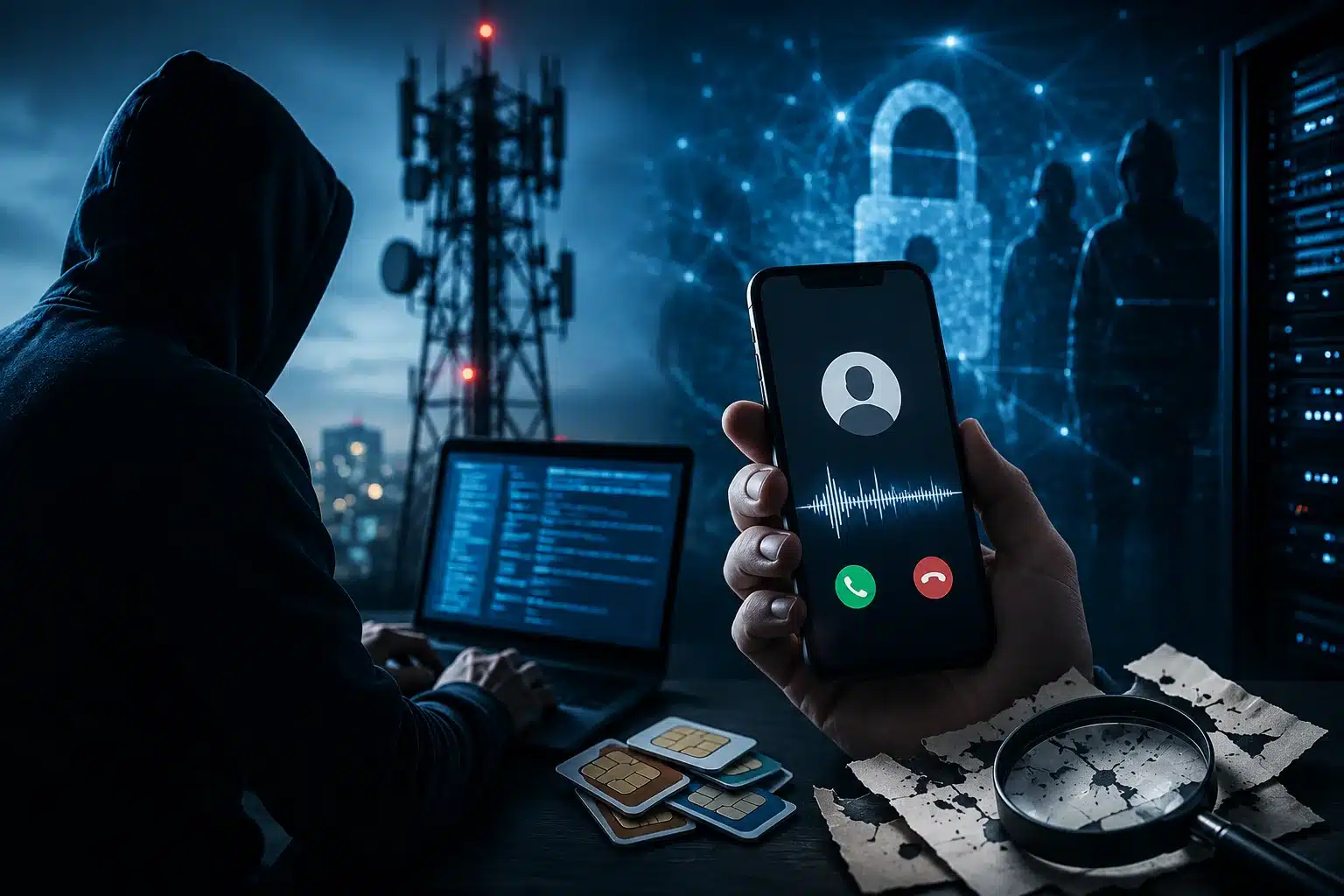
The cyberattack took place on February 5 and 6 after attackers allegedly used voice phishing (vishing) to deceive Odido's customer service team.
According to the company, the attackers posed as members of its internal IT staff, gaining unauthorized access before exfiltrating customer data. Odido said its teams detected the unauthorized access immediately on both occasions and revoked the attackers' access, but the incident still resulted in a large-scale data breach.
Under the direction of the National Public Prosecution Service, the High Tech Crime Team (THTC) of the National Investigation and Intervention Unit launched an extensive investigation into the breach.
Authorities said investigators have found strong indications that Dutch criminals may have been involved. One key lead centers on a phone call made shortly before the breach in which a Dutch-speaking man allegedly impersonated an Odido IT employee while speaking with customer service representatives. Police are continuing efforts to identify the caller and have indicated that his voice could be made public if necessary.
Investigators believe people within cybercrime circles may have information about those responsible and are encouraging anyone with relevant details to contact law enforcement.
Odido attributed the attack to the cybercriminal group ShinyHunters, which the company said carried out the social engineering campaign.
Chief Executive Officer Søren Abildgaard acknowledged the incident in a public statement, apologizing to customers and outlining the company's commitment to strengthening its cybersecurity capabilities. He said Odido would continue investing in security, improve data protection practices, expand customer support, and share lessons learned from the incident.
The CEO also explained why the company refused to pay the ransom demand. According to Odido, paying cybercriminals would reward illegal activity and could encourage future attacks against other Dutch organizations. The company said the decision was made following guidance from authorities, despite knowing that stolen data could eventually be published.
Odido confirmed that approximately 6.39 million active and former customers of Odido and its Ben brand were affected by the breach. Customers of Simpel were not impacted.
The exposed information varied by individual and included names, addresses, mobile phone numbers, customer numbers, email addresses, IBAN numbers, dates of birth, identification details, nationality, and gender.
The company clarified that My Odido account passwords, call records, location data, billing information, and scans of identity documents were not compromised.
Odido also addressed reports claiming customer passwords had been leaked, stating that login passwords remain securely encrypted and were never accessible during the attack. Instead, a separate telephone verification field known as "password_c," used as a customer challenge code, was included for a limited number of customers. The company has since discontinued using that verification method.
Following the breach, Odido increased customer support by adding more than 140 service agents and introduced additional security measures. These include its "Check je Gesprek" verification service, allowing customers to confirm whether communications claiming to be from Odido are legitimate, along with access to the F-Secure digital security service.
The telecom provider said all customers identified as affected have been notified by email or SMS, while customer service teams continue assisting users with questions related to their specific data exposure.
Meanwhile, Dutch authorities expect investigations into the Odido cyberattack to continue for several months. Police have also warned that cyberattacks targeting businesses and institutions are becoming increasingly common, urging organizations to strengthen cybersecurity defenses and encouraging citizens to remain vigilant against follow-on fraud and phishing attempts.
Accenture confirmed a breach after a hacker claimed 35GB of source code and cloud keys were stolen, raising questions for cloud and security teams.
The post Hacker Claims Accenture Breach Exposed Source Code, SSH Keys, and Azure Tokens appeared first on TechRepublic.
ShinyHunters claims it stole 297GB of data from the Council of Europe, including payroll and medical records, but the organization has not confirmed a breach.
The post ShinyHunters Claims Council of Europe HR Data, Threatens Leak appeared first on TechRepublic.

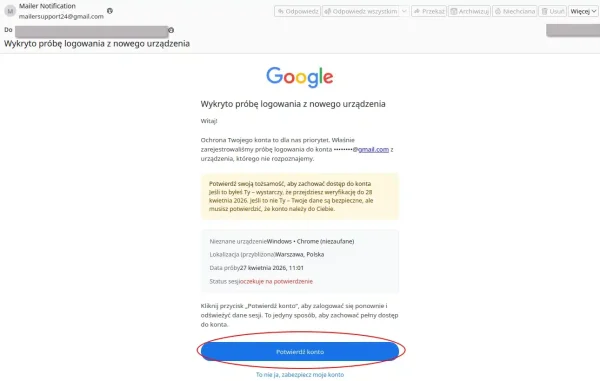 Image Source: CERT Polska[/caption]
The group also conducts campaigns against specific professional sectors and geographic regions. In some cases, phishing emails are sent to unintended recipients because attackers attempt to guess email addresses based on names and affiliations.
Image Source: CERT Polska[/caption]
The group also conducts campaigns against specific professional sectors and geographic regions. In some cases, phishing emails are sent to unintended recipients because attackers attempt to guess email addresses based on names and affiliations.
 Source: CERT Polska[/caption]
ServiceNow released a security update on June 5, 2026, addressing the issue across hosted customer environments.
“On June 5, 2026, ServiceNow applied a security update to hosted customer instances. The update concerned a security issue that could allow an unauthenticated user, in certain circumstances, to gain greater access to ServiceNow instances than intended.”
To reduce the risk associated with the ServiceNow flaw, the company modified endpoint configurations to ensure access is restricted to authenticated users only. At the time of disclosure, the issue had not yet been assigned a CVE identifier.
The vulnerability initially surfaced through Reddit discussions, where users raised concerns about potential exposure and questioned the internal response timeline.
The issue primarily impacted customers using the Australia platform release and some instances running pre-Australia configurations with specific changes.
“The security issue pertains to customers who are on the Australia platform release or made certain configuration changes to instances on releases prior to Australia.”
ServiceNow stressed that the incident was limited in scope and not a systemic issue affecting its entire customer base.
A company spokesperson reiterated that communication efforts focused on a small subset of impacted customers rather than a broad population.
The ServiceNow flaw also sparked debate on Reddit regarding disclosure timelines and internal awareness.
One user, “d3s7iny,” claimed their security team had previously reported the vulnerability and alleged that ServiceNow had known about the issue since April 7, 2026. The post suggested the issue had been treated as non-urgent and scheduled for a later fix.
While these claims circulated widely online, they remain unverified and have not been confirmed by ServiceNow.
ServiceNow’s advisory confirmed that multiple bug bounty submissions were received shortly before the patch was released.
Between June 3 and June 4, 2026, customers reported a potential security issue through bug bounty channels that aligned with earlier internal findings.
The company also referenced a confidential report submitted on April 22, 2026, which described similar behavior affecting instance data access under specific conditions.
These overlapping reports contributed to the eventual identification and remediation of the ServiceNow flaw.
ServiceNow has since issued a public clarification, stating that the observed activity came from security researchers and customer investigation teams, not from malicious exploitation.
An official notification is available on the company’s trust portal: https://trust.servicenow.com/notifications/1205429e-fea3-4cbf-b37b-8cd3a4e07aef
The company emphasized that no customer data was retained or misused during the process and that the vulnerability was addressed through a targeted security update.

"This is effectively a Mini Shai-Hulud campaign: it uses the same core tactics of install-time execution, credential harvesting, CI/CD targeting, encrypted exfiltration, and potential downstream propagation," Socket said.
"It commits the encrypted result envelope through the GitHub API," Socket said. "The commit message can include: IfYouInvalidateThisTokenItWillNukeTheComputerOfTheOwner:."Researchers from OX Security identified the first commit containing the phrase "Miasma: The Spreading Blight" on May 29, 2026. This suggests either that the malware variant had already been active by that date or that attackers began testing the campaign around that time.
"runOn": "folderOpen" to ensure automatic execution whenever a project is opened."Because the malware includes background execution and potential developer-tool persistence mechanisms, uninstalling the npm package or deleting node_modules should not be considered sufficient cleanup," Socket explained.The company also urged organizations operating CI/CD pipelines to suspend affected workflows, invalidate any build artifacts created during the exposure period, and review whether software releases, container images, npm packages, or deployment artifacts were generated after installation of the malicious package.


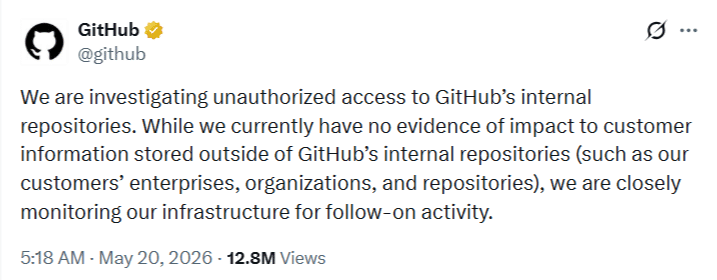 Image Source: X[/caption]
In a statement shared on X, formerly Twitter, GitHub said:
“We are investigating unauthorized access to GitHub’s internal repositories. While we currently have no evidence of impact to customer information stored outside of GitHub’s internal repositories (such as our customers’ enterprises, organizations, and repositories), we are closely monitoring our infrastructure for follow-on activity.”
The company further stated:
“If any impact is discovered, we will notify customers via established incident response and notification channels.”
GitHub said the breach originated after an employee’s system was infected through a poisoned VS Code extension. The company described the incident as “detected and contained,” emphasizing that the compromise was restricted to internal repositories and did not extend to customer-owned data.
As part of its response to the GitHub cyberattack, the company rotated critical credentials on the same day the breach was discovered, prioritizing the most sensitive secrets first. GitHub also acknowledged that TeamPCP’s claim of stealing around 3,800 repositories was “directionally consistent” with the company’s own internal assessment regarding the scope of the intrusion.
The platform hosts code for more than 100 million developers globally, making the cyberattack on GitHub particularly significant within the software development and cybersecurity communities. GitHub said it plans to release a more detailed report once the investigation is complete.
Image Source: X[/caption]
In a statement shared on X, formerly Twitter, GitHub said:
“We are investigating unauthorized access to GitHub’s internal repositories. While we currently have no evidence of impact to customer information stored outside of GitHub’s internal repositories (such as our customers’ enterprises, organizations, and repositories), we are closely monitoring our infrastructure for follow-on activity.”
The company further stated:
“If any impact is discovered, we will notify customers via established incident response and notification channels.”
GitHub said the breach originated after an employee’s system was infected through a poisoned VS Code extension. The company described the incident as “detected and contained,” emphasizing that the compromise was restricted to internal repositories and did not extend to customer-owned data.
As part of its response to the GitHub cyberattack, the company rotated critical credentials on the same day the breach was discovered, prioritizing the most sensitive secrets first. GitHub also acknowledged that TeamPCP’s claim of stealing around 3,800 repositories was “directionally consistent” with the company’s own internal assessment regarding the scope of the intrusion.
The platform hosts code for more than 100 million developers globally, making the cyberattack on GitHub particularly significant within the software development and cybersecurity communities. GitHub said it plans to release a more detailed report once the investigation is complete.
 Image Source: X[/caption]
Unlike threat actors that depend heavily on zero-day vulnerabilities, TeamPCP has reportedly built its operations around automation and the exploitation of known weaknesses and cloud misconfigurations. Researchers say the group combines these methods into a scalable and largely self-propagating attack framework.
Beginning in late 2025, TeamPCP launched extensive scanning campaigns targeting exposed Docker APIs, Kubernetes control planes, Ray dashboards, and Redis services. Once access is achieved, compromised systems are integrated into a distributed infrastructure used for proxying internet traffic, performing additional scans, hosting command-and-control infrastructure, deploying ransomware, and conducting unauthorized cryptomining operations.
Image Source: X[/caption]
Unlike threat actors that depend heavily on zero-day vulnerabilities, TeamPCP has reportedly built its operations around automation and the exploitation of known weaknesses and cloud misconfigurations. Researchers say the group combines these methods into a scalable and largely self-propagating attack framework.
Beginning in late 2025, TeamPCP launched extensive scanning campaigns targeting exposed Docker APIs, Kubernetes control planes, Ray dashboards, and Redis services. Once access is achieved, compromised systems are integrated into a distributed infrastructure used for proxying internet traffic, performing additional scans, hosting command-and-control infrastructure, deploying ransomware, and conducting unauthorized cryptomining operations.


"First, we have identified a small number of additional accounts that were compromised as part of this incident," the company noted.
But the main concern is the next finding: "Second, we have uncovered a small number of customer accounts with evidence of prior compromise that is independent of and predates this incident, potentially as a result of social engineering, malware, or other methods."
The company did not disclose who were the attackers, what was the motive, or the impact on customers, and is yet to respond to these queries from The Cyber Express. It only stated: "In both cases, we have notified the affected customers."
Meanwhile, Rauch said, Vercel had notified other suspected victims and encouraged them to rotate credentials and adopt best practices.

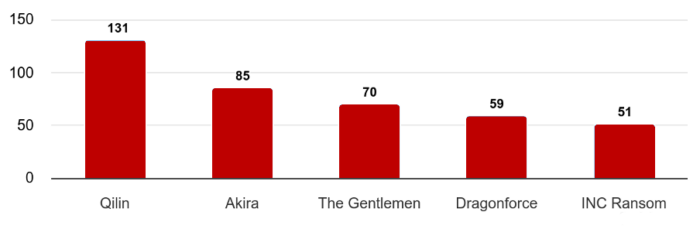 One of the most defining aspects of the March 2026 threat landscape was the scale of ransomware attacks. CRIL recorded 702 ransomware incidents globally, underscoring the continued dominance of ransomware as a primary attack vector.
Among the most active threat groups were Qilin, Akira, The Gentlemen, Dragonforce, and INC Ransom. Collectively, these actors were responsible for over 56% of all observed ransomware activity, reflecting their operational maturity and extensive affiliate networks.
Industries most affected by ransomware attacks included:
One of the most defining aspects of the March 2026 threat landscape was the scale of ransomware attacks. CRIL recorded 702 ransomware incidents globally, underscoring the continued dominance of ransomware as a primary attack vector.
Among the most active threat groups were Qilin, Akira, The Gentlemen, Dragonforce, and INC Ransom. Collectively, these actors were responsible for over 56% of all observed ransomware activity, reflecting their operational maturity and extensive affiliate networks.
Industries most affected by ransomware attacks included:
