The FBI raided 40 Texas homes over a North Korean scheme that used fake IT workers to target 70 US companies and generate $3 million.
The Justice Department (DoJ) announced coordinated enforcement actions this week targeting North Korea’s long-running scheme to place fake IT workers inside American companies. Two US nationals were arrested, 14 people charged across two separate indictments, and the FBI searched more than 40 residences in Texas, seizing approximately 187 laptops and KVM switch devices.
The Texas operation, called Operation Lonestar Roundup, ran between September 21 and 25. The seized devices are the same laptops American companies shipped to their newly hired remote employees, not knowing those IT workers were North Korean intelligence agents using stolen US identities.
“Today the Department of Justice announced coordinated actions against the Democratic People’s Republic of North Korea (DPRK) government’s schemes to fund its regime through remote information technology (IT) work for U.S. companies.” states DoJ. “These actions include an indictment, two arrests, searches of multiple known or suspected “laptop farms” in Texas pursuant to “Operation Lonestar Roundup,” and the seizure of approximately 187 computer devices used by DPRK IT workers.”
The scheme was simple. North Korean IT workers applied for remote jobs using stolen or fake identities. They used VPNs and proxy servers to make it look like they were working from the United States. American helpers received the laptops provided by employers and installed remote access software so the North Korean workers could use them. These helpers were paid for their role, while the money earned from the jobs was sent back to North Korea through accounts controlled by the regime.
According to an indictment from the Northern District of Ohio, the scheme ran from 2019 to mid-2025 and targeted more than 70 US companies across 17 states. The companies operated in sectors including healthcare, communications, cybersecurity support, retail, and manufacturing.
“In total, the scheme impacted more than 70 U.S. company employers and generated approximately $3 million in revenue for IT workers.” SoJ states.”The revenue is believed to have been sent to sanctioned entities controlled by the DPRK. Victim employers included companies in the health care, communications, cyber support, retail, and manufacturing sectors across Ohio, sixteen additional states, and the District of Columbia.”
The North Korean IT workers earned about $3 million, which prosecutors believe was sent to North Korean entities subject to international sanctions.
The authorities warn the scheme is evolving in response to better detection.
“Increasingly, North Korean IT workers are turning to recruiting American facilitators to counter improved private sector detections and law enforcement actions.” states DoJ. “These workers are hiring facilitators to complete a wider variety of tasks, and in some cases subcontracting entire jobs to third-party foreign nationals. “
That’s not just using Americans as props. It’s actively outsourcing parts of the operation to people inside the US, which makes attribution harder and interception more complicated.
Some IT workers are now subcontracting entire jobs to third-party foreign nationals. Others are hiring facilitators to handle a wider range of tasks beyond just managing the laptops. CrowdStrike, which helped the FBI investigate, tracks the group behind this operation as Famous Chollima and describes the laptop farm infrastructure as vital to overcoming the physical and legal barriers of operating from outside the US.
“These laptop farms enabled FAMOUS CHOLLIMA operatives to pose as legitimate remote workers and siphon illicit wages back to their regime while maintaining persistent access to victim organizations. Working alongside the FBI, CrowdStrike’s threat intelligence into the adversary and their operations, and technical analysis helped make these disruptions possible.” states CrowdStrike.
“This operation marks the beginning of a broader U.S. law enforcement effort to dismantle FAMOUS CHOLLIMA’s U.S. infrastructure. CrowdStrike’s Counter Adversary Operations team intends to remain an integral part of that effort.”
The FBI’s separate public service announcement puts the operation in broader context: “thousands of North Korean state-controlled IT workers” are currently embedded at Western companies, posing what the agency calls a significant national security and intellectual property theft insider threat. North Korean IT workers have individually earned up to $300,000 per year under these schemes, and the collective revenue is measured in hundreds of millions annually, flowing directly to designated entities including the North Korean Ministry of Defense.
This is the fifth round of enforcement actions announced since June 2025 under the DOJ’s DPRK RevGen Domestic Enabler Initiative (June 2025, November 2025, April 2026, and May 2026). The initiative targets people in the United States who help North Korean IT workers carry out these schemes.
According to CrowdStrike, North Korean hackers were responsible for about half of all documented hands-on cyber intrusions over the past year. The regime is also targeting cryptocurrency exchanges and open-source software projects. In 2025 alone, North Korean attackers stole at least $2 billion in cryptocurrency.
The DOJ released a list of email addresses used in these operations, including accounts like randyryang@gmail.com and dev.jerryyang@gmail.com, which companies can add to their screening indicators. The FBI’s public service announcement includes detailed mitigation guidance on spotting DPRK IT worker applications. The red flags are consistent: inconsistencies in work history, reluctance to appear on video, requests to redirect laptop deliveries, and payment accounts that route through intermediaries.
“Threats posed by nation-states like North Korea are a stark reminder that our adversaries will go to great measures to exploit our nation’s economic strength to further and fuel their own nefarious agendas,” said U.S. Attorney David M. Toepfer for the Northern District of Ohio. “We are thankful to FBI Cleveland for their incredible work and persistence to put a stop to these bad actors. These charges serve as an urgent alert to all U.S. companies to remain vigilant in their hiring practices.”
North Korean IT workers are paying Americans to help them get and keep remote jobs at U.S. companies, the FBI said in an updated FBI public service announcement. At the same time, the Justice Department announced charges, two arrests, and the seizure of about 187 computer devices linked to the scheme.
The FBI said these workers use stolen identities, extort victims, and threaten physical violence to demand payments. North Korea's government receives an estimated 85 to 90 percent of the revenue they generate, money that helps fund its nuclear weapons and other military programs.
How North Korean IT Workers Use American Facilitators
According to the FBI, North Korean IT workers are hiring Americans for a growing list of tasks. These include appearing on camera, sitting for job interviews, verifying fake identities, lending social media or professional networking accounts, shipping packages, completing urinalysis tests or fingerprint submissions, and keeping work laptops online from their homes.
[caption id="attachment_114769" align="aligncenter" width="600"] Image Source: FBI Cyber Division[/caption]
The FBI said some workers deliberately target people under financial stress, looking for those more likely to follow instructions without questions if paid. Taking part in these activities is illegal.
Home setups that host company laptops, known as laptop farms, have helped the workers hide their locations for years. The FBI said they now run more laptop farms with fewer laptops at each to avoid single points of failure. Some also land remote IT jobs and then subcontract the work to freelancers in Pakistan, India, Nigeria, or nearby countries for a fraction of the salary.
Extortion, Threats, and Identity Theft
Identity theft sits at the center of the scheme. Most names and addresses given to employers come from stolen identities, and workers often buy accounts from identity verification providers to check that stolen details will pass background checks.
The FBI said that after being fired, some workers made death threats against former managers and their families to collect more money. Others threatened to leak sensitive corporate data unless paid large lump sums. Some hired U.S.-based facilitators to show up in person at victim companies to intimidate staff.
The workers also target jobs requiring U.S. government security clearances, positions with cleared defense contractors, and active-duty U.S. military members to host laptops.
Justice Department Charges Linked to North Korean IT Workers
In Ohio, a four-count indictment charges a scheme that ran from 2019 to around July 2025. U.S. nationals Michael James Bostelle of Pennsylvania and Juan Cecilio Pena Carrillo of Texas were arrested. Ten China-based individuals were also charged, and two more defendants remain under seal.
Prosecutors say the scheme affected more than 70 U.S. employers and generated about $3 million, believed to have gone to sanctioned DPRK-controlled entities. Victims included health care, communications, cyber support, retail, and manufacturing firms across Ohio, 16 other states, and the District of Columbia.
Under Operation Lonestar Roundup, the FBI carried out searches and other actions at more than 40 Texas residences between Sept. 21 and Sept. 25. Agents seized about 187 laptops and KVM devices. Cybersecurity firm CrowdStrike tracks the group as "Famous Chollima.
FBI Cyber Division Assistant Director Brett Leatherman said 14 individuals have been charged and called close coordination with the private sector central to the operation.
What Companies Should Know About North Korean IT Workers
The FBI said no single red flag reliably identifies North Korean IT workers. It recommends an "identity in depth" approach, using layered checks throughout employment. Warning signs include remote desktop tools such as AnyDesk and TeamViewer, KVM over IP devices like TinyPilot and PiKVM, unrelated software on work devices, and frequent changes in bank accounts or addresses.
Using E-Verify, requiring a U.S. passport, and live identity checks can add friction, the FBI said, while relying only on name ban lists may block real applicants.
Individuals who receive threats should call 911. Victims or anyone approached can contact a local FBI field office and file a complaint at www.ic3.gov. The State Department has offered rewards of up to $5 million for information that disrupts North Korea's illicit financial activities.
We’re taking a maximalist stance (“PQ everything!”), because as an infrastructure provider to the world, we want to give our customers the peace of mind that using Cloudflare ensures that their traffic is future-proofed against quantum adversaries.
But how does one accomplish such a massive migration at an organization of our size and scale? After all, cryptography is the base layer for almost all of the world’s digital systems, including the software services and the networking protocols that power our platform.
To drive our PQ migration, we have three key goals.
First, we want to help our product and engineering teams understand how cryptography is being used and how they should be upgrading it. This should cover both the upgrades to post-quantum encryption and to post-quantum authentication. Many of our products have already been upgraded to post-quantum encryption over TLS 1.3, but we still want to cover the long tail of TLS connections, as well as upgrade any other uses of public-key encryption. Meanwhile, it’s still earlydays for our deployment of post-quantum authentication.
Next, we want to provide progress metrics for the migration. These might include per-repository and per-product counts of the use of classical and post-quantum cryptography.
Finally, we want to surface prerequisites early. If our products or platform rely on protocols that don’t yet have a PQ migration plan (because PQ variants of the system have not yet been considered, because PQ standards do not exist or lack consensus, or because software libraries or other key ecosystem components do not yet have PQ support), then we need to know now. That way we can work with the relevant stakeholders, standards bodies and ecosystems to help drive their PQ migration plans, so that we can meet our own 2029 PQ migration timeline.
This post is the story of how we’re going about this. We explain how we turned to AI to help us solve some of our problems and how we’re developing an internal tool called CryptoLabe to help us. CryptoLabe is named after the mariner’s astrolabe, a navigation instrument refined by Portuguese navigators. Just as an astrolabe helped sailors determine where they were and chart a course, CryptoLabe helps us discover cryptography in our code, understand how it is used, and chart a path to post-quantum migration.
CryptoLabe is highly specialized to our internal systems (our repositories, our ticketing systems, and internal documentation processes) and still evolving as we continue its development, so we aren’t making it available to customers. Nevertheless, we are sharing our learnings so that other organizations can build upon our efforts as they work through their own PQ migration journey.
The scale of the problem
The software that powers most Cloudflare products lives inside our single centralized source control management platform. This means we can find most uses of cryptography across our platform by just looking through our codebase.
While the centralization of our codebase is a marked advantage for us, we still need to contend with three challenges that come with the scale of this problem. First, our code is spread across many repositories. Second, cryptography rarely announces itself plainly in the code. Instead, it hides in
shared libraries that a repository imports but may or may not actually call
upstream and protocol defaults, like a TLS 1.3 listener that is configured to negotiate a classical key exchange such as X25519 rather than post-quantum X25519MLKEM768
configuration files that select algorithms far away from the code that uses them, like a TLS responder whose key exchange protocols are pinned in a YAML file stored in a different repository
code paths that are dead, test-only, or on a path to being deprecated
Third, cryptography discovery is about more than just pattern matching. Grepping for certain algorithm names (e.g. “RSA” or “X25519”) overcounts, because it finds cryptography in unused code. Grepping also undercounts, because it misses defaults and indirect uses in dependencies and configuration. Most importantly, it can't tell you how the cryptography is used. A classical ECDSA signature could be part of a JWT, IPsec, TLS, or SSH, and each has a completely different migration path. Many uses also depend on the other side of the connection: a TLS server may support both post-quantum key exchange and classical key exchange; the one it chooses to use would depend on the client.
Turning to AI
It turns out that AI is pretty good at doing more than just grepping. A model can search a codebase, follow evidence across files, and return structured analysis. It can also enrich findings by pulling information from other sources, like our internal documentation and ticketing systems. In fact, AI can even explain how cryptography is being used and how it should be updated. We’ve been putting that idea to the test as we develop CryptoLabe.
As we said before, our first two goals are to (1) discover and understand the use of cryptography in our codebase, and also (2) to get metrics on the state of our PQ migration. Towards these goals, our current implementation of CryptoLabe performs scans in two stages, as shown in the figure below.
The first “discovery” stage starts by mapping the repository. It then searches for cryptography through source, configuration, manifests, lockfiles, scripts, tests, and documentation. Among other things, the scan looks for the use of cryptography like key agreement, signatures, asymmetric encryption, PKI, tokens, credentials, hardware security module integrations, and more. This discovery stage produces a set of "raw observations."
Each raw observation feeds a run of the second stage. This “analysis” stage first re-checks the observation against the source code. It then investigates how the cryptographic operation is used at runtime, what role the repository plays, and which internal or external parties it depends on. When necessary, it can inspect related code in other repositories to complete the analysis. Finally, it takes a pass over its own conclusions, searching for missing or conflicting evidence such as configuration overrides, test-only code, or incorrect assumptions about runtime behavior.
Next, the model assigns a classification to the finding. If there is not enough evidence to assign a classification, the model assigns More evidence needed, External dependency, or Unknown rather than guessing.
This is the current list of classifications used by CryptoLabe, containing catch-all classifiers which will likely be refined as we proceed through our migration. (As an example, we could refine our classifiers by splitting the “encryption” classifier into key agreement and HPKE; you get the idea.)
This is a catch-all category that finds use of an RSA signature or elliptic-curve (ECDSA) signature in anything, for example a certificate, a TLS handshake, another protocol handshake. These signatures are broken by Shor's algorithm.
Classical token
We found a lot of RS256 or ES256 JWT tokens, so we created a special classification for them. These are JWTs that use classical RSA and ECDSA signatures; RFC 9964 defines a post-quantum replacement using ML-DSA.
PQ-ready hybrid key exchange
Finds hybrid post-quantum key exchange in TLS 1.3, i.e. X25519MLKEM768. This is the most prevalent use of PQ encryption in our codebase.
PQ-ready
Finds other uses of post-quantum cryptography that are not X25519MLKEM768 in TLS 1.3, like ML-DSA.
Finally, it generates a report that serves two audiences: (1) product managers who need to understand what the migration means for their product, and (2) engineers that need enough detail to execute the migration.
Here’s a (cropped) view of one of our reports:
While we’ve been iteratively reviewing findings against the source code and with relevant engineers, we do not yet have a ground-truth dataset for reproducibly comparing different versions of the prompts we’ve tried for CryptoLabe.
CryptoLabe runs across two Cloudflare Workers. There’s a scanner Worker that runs the scans. And there’s an inventory Worker that serves the dashboard, exposes the API, and stores everything in a D1 database. The two communicate through Service Bindings. A scan starts when someone requests it from the dashboard, and the inventory Worker passes the request to the scanner.
Orchestrating a scan
We need a way to keep a scan alive and on track from start to finish, without building our own job orchestration system. We did this with Agents SDK. Each repository gets its own persistent coordinator built on a Durable Object (DO). A bounded queue in front of the coordinators limits how many scans run at once. When a scan's turn comes, the coordinator tracks its progress and handles cancellation, retries, and recovery.
The coordinator doesn't do the analysis itself. It hands the work to Cloudflare Workflows, so that they can persist progress and automatically retry failed steps. The coordinator moves each repository through four stages:
discovery Workflow (the first scanning stage that produces raw observations)
deep analysis Workflow (the second stage, run on each raw observation)
merge Workflow (that builds a list of findings for a given repository, including combining repeated or similar finds)
publish workflow (that hands results back to the inventory Worker)
The first two workflows need the model to have access to the repository's code. We want this access to be isolated, so we don’t risk damaging the codebase. That’s why CryptoLabe downloads the repository once, at an exact commit, at the start of each scan, and then stores that snapshot in R2. Each Workflow then restores the snapshot into a fresh, short-lived Cloudflare Sandbox, an isolated container. The model then works with the Sandbox through a small set of read-only tools on an immutable snapshot of the code, even if the codebase changes while the scan is still running.
Calling the model at scale
If we want to scan through all of our (many!) repositories, we have to worry about both cost and capacity.
For cost, the model loop sends its requests through AI Gateway to cost-effective open-weight models hosted on Workers AI. Putting the model behind AI Gateway also makes it easy to switch models as better or cheaper ones become available.
Capacity became a problem once we scanned many repositories at once. Bursts of model requests began triggering HTTP 429 (rate limit) responses from AI Gateway, and scans retrying independently only made the bursts worse. We solved this with a single, global Durable Object that paces every model request across all scans, including retries. When any scan hits a rate limit, the cooldown is shared and all scans back off together, so concurrent scans share the available capacity instead of competing for it.
Prerequisites and hard cases
Let’s now get into our third goal: surfacing prerequisites and hard cases early.
A lot of ink has been spilled about ecosystem readiness for the PQ migration, and we are now going to spill some more. As everyone knows, a PQ migration cannot happen in a vacuum. For migration to succeed, post-quantum cryptography must be supported in relevant software libraries (e.g. BoringSSL) and across parties that participate in the ecosystem (e.g. clients, browsers, origins, cloud proxies, certificate authorities, etc.). Standards are also an important indicator of ecosystem support, although a standard that is still in “draft” state does not necessarily mean deployment cannot proceed. As an example, we deployed X25519MLKEM768 in TLS 1.3 back in 2022 when it was still a “draft” at the Internet Engineering Task Force (IETF) while it was only finalized as RFC 10024 in 2026.
Either way, our point is that in order to upgrade a system to PQ cryptography, we need to understand its dependencies and level of ecosystem support.
That’s why CryptoLabe uses the concept of “prerequisites” to highlight findings that cannot be immediately remediated by an individual product team working alone.
A prerequisite can be something as straightforward as “we are currently blocked on migrating to post-quantum JWTs.” We say this is straightforward because there is already a standard (RFC 9964) for post-quantum JWTs. Nevertheless, if our software libraries don’t yet support validating post-quantum JWTs, or if we’re using a token issuer that does not yet issue post-quantum JWTs, we can’t go company-wide and ask each of our product teams to start PQ-ing their JWTs. This migration is blocked until we solve its core prerequisites. CryptoLabe lets us group together findings that (likely) have the same prerequisite, which also helps us decide how to prioritize resolving these prerequisites.
For example, the snapshot below shows the six findings from CryptoLabe that have post-quantum SAML as a prerequisite. (SAML is a protocol for single sign-on (SSO).)
On the other hand, there may be uses of cryptography that lack even a basic level of ecosystem support. We’ve been calling these “hard cases.” To find them, we wrote a separate prompt that ignores “vanilla” uses of cryptography (e.g. ordinary TLS between internal systems) and instead looks for custom cryptographic protocols, keys, or signatures used in size-constrained fields, cryptography built into hardware, specialized cryptographic constructions (like blind signatures), protocols without a PQ standard, and dependencies on external parties that do not yet support PQ cryptography.
This prompt is shorter and simpler than those used for CryptoLabe, since its only job is to find hard cases. In our qualitative review, we found that it got better results when it ran in one fell swoop against all our repositories, while also taking in context from our internal ticketing and documentation system.
Here’s an example of a “hard case” we found: a certificate carried in an HTTP header. Post-quantum certificates and signatures are larger than their classical counterparts, so if the header (or an intermediary, or the application processing the header) assumes a certificate has a certain size, changing the signature algorithm may break the system. Our next step is to determine whether this code will remain in use in the long term. If it will, we need to measure the relevant size limits and decide how to accommodate the larger certificate.
An important lesson here is that no single scan finds everything. Our repository-by-repository scans were effective at discovering common uses of cryptography. Meanwhile, this targeted scan worked better for “hard cases” because it ignored well-understood cryptography and had more context about each product and its dependencies.
The bottom line is that different approaches find different things, and every finding still needs to be checked by the engineers who understand how the system actually works.
Sharing our prompts
We’ve been messing around with the best way to write prompts for CryptoLabe for the last several months. We don’t yet have a ground-truth dataset for comparing one prompt’s performance against another, and we are not convinced we have 100% coverage of all uses of cryptography in our codebase. Instead, we have iterated by running scans, reviewing findings with the engineers that maintain the repositories, investigating misses that came up during these reviews and revising the prompts. Nevertheless, we decided to publish selected prompts, so other teams can learn from and adapt our approach. These prompts are starting points, not a standalone version of CryptoLabe, and the quality of their results will depend on the model, tools, context, and engineering review available.
Thinking through your own PQ migration
At Cloudflare, we’re taking a maximalist approach to our PQ migration because of our goal of acting as a provider of post-quantum cryptography for customers and the Internet at large. But most organizations do not need to start by finding every use of cryptography in every repository in every one of their products. In fact, most organizations should not be doing this, because at this time it's a waste of precious resources.
Before scanning a single repository, you can protect traffic in bulk wherever possible. If your websites run through Cloudflare, we protect your data in transit with post-quantum encryption already today; check this out with our new PQ visibility features. Our SASE platform, Cloudflare One, provides post-quantum encryption for private network traffic. Post-quantum encryption is provided at no additional cost and without requiring you to upgrade every origin server or private application on your enterprise network. This gives you a compensating control while you work through discovering and understanding the use of cryptography inside your own systems.
An exhaustive cryptographic inventory is not a prerequisite for action. Instead, organizations should first identify the systems whose compromise would matter most, discover their use of cryptography, and then PQ that cryptography in priority order. Here is one way to begin:
Choose a repository for one important system. Start with something that handles sensitive or long-lived data, authenticates users or software, or is exposed to the public Internet.
Run cryptography discovery against that repository. We hope our description of CryptoLabe will be helpful to this effort!
Validate the results. Ask the team who owns the system to validate the results of cryptography discovery and confirm that the cryptography finding is needed long term and needs to be upgraded to PQ. It’s important to remember that it might not need to be immediately upgraded to PQ if there is another compensating control in place.
Prioritize action. Figure out what upgrades you can make now and what upgrades are blocked. Record shared prerequisites that need help from a library, vendor, standards group, or another part of your organization. Prioritize your findings and make a plan for addressing the highest-impact systems and prerequisites first.
That gives you the beginning of a PQ transition plan, without requiring a complete map of every cryptographic operation in your organization. CryptoLabe is still ever-evolving, but its scans and results have been illuminating to us as we plan our migration. We hope these shared learnings will be useful as you continue to work through your own PQ migration.
Acknowledgements: Many people across Cloudflare provided feedback on and contributed to CryptoLabe, including Davide Marquês, Peter Wu, Phil Schmieder, JP Aumasson, Andrew Galloni, Christopher Patton, Luke Valenta, Mari Galicer, Vânia Gonçalves, and the Client, Tunnel and Gateway teams who reviewed reports produced by the tool.
North Korea-linked WaterPlum runs the Contagious Interview campaign, infecting over 30,000 devices using a fake job interview.
On September 18, Japan’s National Police Agency, the FBI, the US Department of Defense’s Cyber Crime Center, and intelligence agencies from Australia and Germany published a joint advisory about a group called WaterPlum, better known as Contagious Interview. The name says it all. The job interview is the infection vector.
The numbers in the advisory are hard to shrug off. At least 30,000 devices infected across more than 100 countries, funds or credentials stolen from over 7,000 cryptocurrency wallets, and a total of 1.7 billion yen, roughly $10.71 million, funneled back to North Korea. The victims are almost always the same type: freelance developers and specialists in blockchain and Web3 work.
Japan’s NPA and the FBI assess that both WaterPlum operators and some North Korean IT workers report to the same place, the 313 General Bureau of the Munitions Industry Department, under the Workers’ Party’s Central Committee. That’s not a loose affiliation. It’s an org chart.
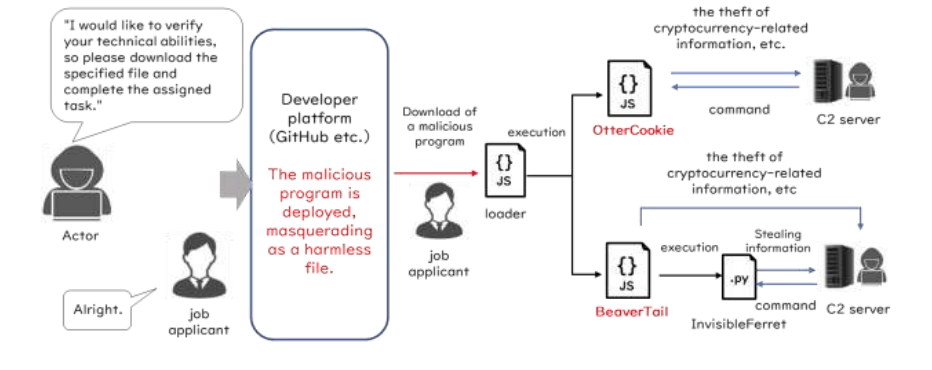
The trap itself is almost embarrassingly simple. WaterPlum actors pose as recruiters or hiring managers, often impersonating real AI, crypto, or NFT companies, and reach out on social media, job boards, and freelance platforms. Candidates get invited to a technical interview, then told to download a file to complete a coding test or fix a supposed bug on the video call.
“WaterPlum actors pose as prospective employers to target software developers and IT professionals worldwide under the pretext of attractive job opportunities. They often impersonate legitimate Artificial Intelligence (AI), cryptocurrency, or Non-Fungible Token (NFT) companies and have also used recruiting services.” reads the joint advisory. “WaterPlum actors have infected at least 30,000 devices in more than 100 countries and exfiltrated funds or account credentials from over 7,000 cryptocurrency wallets. WaterPlum actors have transferred 1.7 billion Japanese yen (JPY) (equivalent to 10.71 million USD) of cryptocurrency assets to the Democratic People’s Republic of Korea (DPRK).”
That file is never what it claims to be. The advisory names five malware families riding inside these downloads, BeaverTail, InvisibleFerret, OtterCookie, OtterCandy, and StoatWaffle, each doing its own piece of the job: one steals browser credentials, another opens a backdoor, another sets up a remote access trojan to move deeper into the machine. Once inside, the goal is straightforward: drain the wallet, then look for whatever else might be worth stealing.
What happens next goes beyond one stolen wallet. The report notes that a successful infection can give WaterPlum a way into the victim’s employer, opening the door to espionage, stolen source code, and further movement inside a company’s systems. Stolen ID photos get reused too, letting North Korean IT workers impersonate the victim to land more paying contracts elsewhere.
That last part connects to a separate but related scheme covered in the same advisory: North Korean IT workers using so-called “laptop farms.” These are physical locations, often just someone’s house, where a local facilitator plugs in company-issued laptops and lets a North Korean worker operate them remotely over VPN. The worker gets a Western-looking identity and a legitimate-sounding job. The facilitator gets a cut.
“Beyond immediate credential theft, successful infections provide WaterPlum actors opportunities to infiltrate organizations employing targeted developers, enabling espionage, intellectual property theft, and additional lateral movement in corporate environments. Stolen ID images can also be used by North Korean IT workers to impersonate victims and generate foreign currency.” continues the report. “Other sensitive data targeted for exfiltration includes:
Authentication data stored in web browsers (ID, password, etc.);
Cryptocurrency-wallet data (private key, seed phrase, etc.); and
Any files or data of interest to the actors on a PC or in shared folders (ID pictures of driver’s licenses, passports, etc.)”
Here’s a simpler and more natural version, while keeping the same details:
Japan says this is no longer just a theoretical threat. Authorities have already shut down the country’s first known “laptop farm,” run by a local facilitator who had moved several hundred million yen in cryptocurrency out of Japan. In the US, the FBI says it continues to prosecute people who help North Korean IT workers operate this way, across several states and under different charges.
The advisory also describes a case involving a Japanese crypto exchange that spotted one of these applicants in May 2025. His resume listed an unusually wide range of skills across more than a dozen technologies. He claimed to be Malaysian, raised in Finland, and fluent in Malay and Chinese, but struggled with basic English questions that did not fit his claimed background. The company rejected him, avoiding any damage.
Other red flags recruiters have picked up on read like a checklist for a bad Zoom call: the applicant glancing sideways as if reading a script, background voices that shouldn’t be there, video that keeps freezing at convenient moments, a firm preference for getting paid in crypto, sometimes to someone else’s account entirely.
Not every North Korean IT worker sticks to quiet fraud, either. One extorted a client over a payment dispute and leaked the company’s proprietary code online out of spite. Another, hired for basic website maintenance, defaced the site and knocked it offline instead. Petty, but the effect on the client was anything but.
The advisory draws one more thread together: WaterPlum’s cyberattack operators and North Korea’s IT worker network aren’t running in parallel. They’ve been caught using the same IP addresses to access laptop farms, register on freelance platforms, and apply for that same crypto exchange job. Same infrastructure, two revenue streams, one regime cashing the checks.
“The techniques described in this advisory are only examples; actors continuously evolve and refine their methods.” concludes the advisory. “Stay informed by monitoring alerts from domestic and international security agencies and by reviewing reports published by security vendors.”
A North Korean cyber actor group known as WaterPlum, also referred to as "Contagious Interview," has infected at least 30,000 devices across more than 100 countries. The group has been stealing cryptocurrency from IT professionals worldwide.
A joint advisory was issued on September 18, 2026, by Japan's National Police Agency and National Cybersecurity Office, the US FBI and Department of Defense Cyber Crime Center, Australia's Signals Directorate, and Germany's Federal Intelligence Service and Federal Office for the Protection of the Constitution.
How WaterPlum Hackers Operate
The agencies assess that WaterPlum actors and certain North Korean IT workers operate under the 313 General Bureau of the Munitions Industry Department, part of the Workers' Party of Korea's Central Committee. The group poses as prospective employers, targeting software developers and IT professionals by impersonating artificial intelligence, cryptocurrency, or non-fungible token companies, and by using recruiting services.
During fake technical interviews, victims are instructed to download files to complete coding assignments or fix errors on video calls. These files carry malicious Node Package Manager packages embedded with BeaverTail malware, InvisibleFerret, OtterCookie, OtterCandy, or StoatWaffle. Once installed, the malware grants backdoor access, allowing Remote Access Trojans to maintain persistence while infostealers exfiltrate wallet credentials, browser passwords, clipboard data, keystrokes, and identification documents to command-and-control servers.
Scale of the Cryptocurrency Theft
Between December 2025 and July 2026, WaterPlum exfiltrated funds or credentials from over 7,000 cryptocurrency wallets, transferring 1.7 billion Japanese yen, equivalent to 10.71 million USD, to North Korea. Primary targets included web designers, engineers, and specialists in blockchain and Web3 technologies.
Role of Laptop Farms
The advisory also details how North Korean IT workers generate foreign currency through "laptop farms," locations, often an enabler's residence, where employment computers are remotely controlled by workers based in North Korea, China, Russia, and occasionally Africa or Southeast Asia.
Enablers supply identification images, bank accounts, and internet connections, then forward payments to the workers after taking a cut. Japanese authorities dismantled a laptop farm for the first time domestically, uncovering evidence of several hundred million yen transferred abroad in cryptocurrency.
A related case involved a suspected North Korean applicant at a Japanese cryptocurrency exchange in May 2025, who submitted a forged resume, accessed the recruitment portal via VPN, and displayed mismatched language skills during a video interview. The company declined to hire the applicant, and no damage occurred.
Warning Signs and Recommended Countermeasures
The agencies list red flags including refusal of in-person meetings, requests for cryptocurrency payment, background voices during calls, and repeated video freezes.
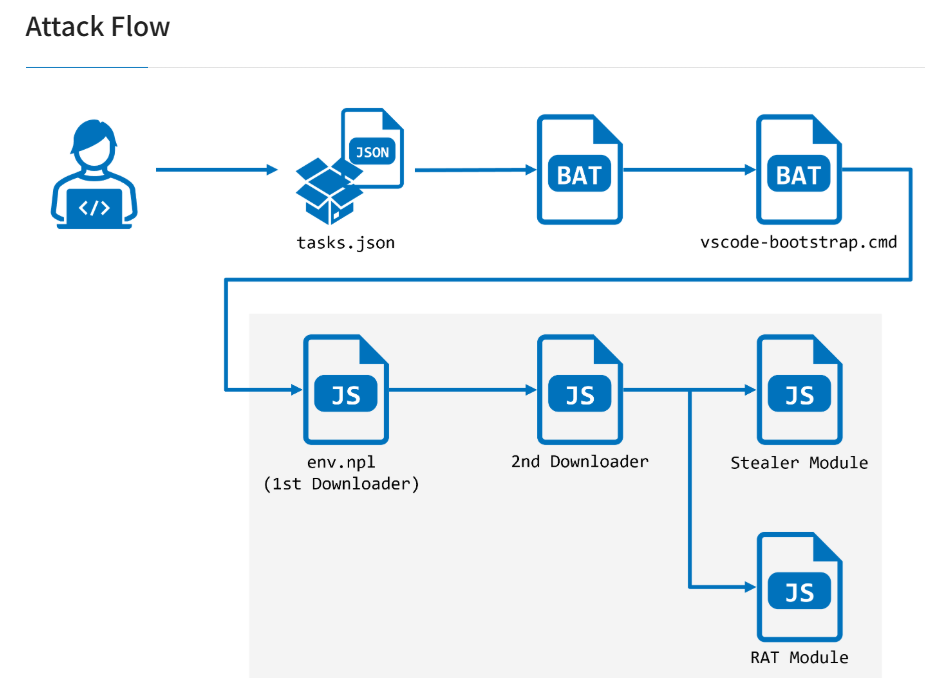
Recommended defenses include avoiding execution of untrusted code outside a sandbox, treating VSCode projects with caution using "Restricted Mode," deploying Endpoint Detection and Response tools, and immediately disconnecting compromised devices from the internet.
Victims are advised to assume wallet data has been exposed, create new wallets on separate devices, and perform full operating system resets.
International Cooperation Continues
The FBI stated it continues to prosecute US-based facilitators who assist North Korean IT workers, while Japanese and American authorities pledged ongoing cooperation to expose revenue-generation schemes benefiting the Kim regime. The advisory noted that WaterPlum and North Korean IT worker operations shared overlapping IP addresses across laptop farms, crowdsourcing platforms, and job applications, indicating coordinated infrastructure.
Companies and individual IT professionals are urged to review the tactics outlined in the advisory and strengthen hiring verification processes to prevent further infiltration.
As more teams — and now agents — build applications on Cloudflare's Developer Platform, having the right access controls is crucial to allow you to ship safely. After all, the last thing you want is for an agent to make a change in production, just because it was granted more access than it needs.
Now, you can give a teammate or agent access to a specific Worker, so that they can only make changes to that application and no other resources in your account. Moreover, we’re giving you four new roles, so you can limit exactly what they can do:
Role
What it allows you to do
When to use it
Metadata Read-Only
View resource lists, settings, and observability data like metrics, logs, and traces, without access to product content.
When you want to give a team member or agent access to observability data, so it can debug issues. But you don’t want to give them access to your source code.
Content Read-Only
Read product content, such as Worker code or D1 database content, without the ability to modify it.
When you want to give a team member or agent access to the source code. But you don’t want them to be able to make any changes to your Worker.
Editor
Read and write product content, and update settings. Cannot create or delete resources.
When you want to give a team member, agent, or your CI/CD system the ability to deploy changes to your Worker. But you want to prevent them from being able to delete the Worker.
Admin
Full control over resources, including creating, renaming, deleting, and granting access to other users.
When you want to give a team member or agent full access to your Worker, including the ability to delete it. But you don’t want to grant access to any other Workers or resources in your account.
The new roles are available today, for all customers. You can assign them to a specific user, so when they log into the dashboard, they will only see the Worker you have given them access to. Or, you can create an API token with the scoped access, which you can give to your agent to ensure they only have access to that one application.
Here’s an example of how to create an API token with permissions per Worker:
Roles designed for how teams build
When defining these roles, we wanted to strike the right balance. Overly broad roles force you to grant more access than intended, undermining the principle of least privilege, while providing too many individual permissions makes it difficult to know which ones to grant. We landed on four roles that reflect the levels of access you may want to give a person or agent: enough to debug a resource without exposing its content, read the content without changing it, make changes without being able to delete the resource, or fully manage it.
We plan to use these same roles as we bring resource-level access controls to other Developer Platform products, including D1, R2, and KV. Each role can be applied at one of three scopes. For example, if you set the “metadata read-only” control, here’s what that would look like at different levels:
Developer Platform level: Access to metadata for all Developer Platform resources.
Product level: Access to metadata for every resource of one product, such as every Worker.
Resource level: Access to metadata for one specific resource, such as one Worker.
The role and scope determine what someone can do and which resources they can do it to. Let’s take a look at how this would look in some common Workers workflows.
Debug without exposing source code
To debug an issue, an engineer or agent might need to look at a Worker’s settings, metrics, logs, and traces to understand what went wrong. But they do not need to see the Worker’s code or make changes to it.
Metadata Read-Only gives them access to that information without exposing the Worker’s source code. They can query analytics through the GraphQL API, access logs, and inspect traces and other observability data. Those requests only return data for the Workers they have access to. If an agent is scoped to one Worker, it can use the Cloudflare APIs to investigate an issue without seeing data from any other Worker in the account.
As we bring these roles to more Developer Platform products, we plan to preserve that separation. Someone could inspect settings and observability data for a D1 database or R2 bucket without being able to read the values in the database or the files in the bucket.
Review code without changing it
A teammate or code review agent may need to read the code running in a Worker to understand how it works, investigate a bug, or review a proposed change. But that does not mean they should be able to deploy new code or update the Worker’s settings.
Content Read-Only provides that separation. It lets them retrieve and review the Worker’s code without being able to modify or deploy it. When scoped to an individual Worker, they can read only that Worker’s code, rather than the code for every Worker in the account.
Once supported for other Developer Platform products, Content Read-Only will work the same way: someone could read the data stored in a D1 database, KV namespace, or R2 bucket without being able to modify it.
Let CI deploy without giving it full control
A CI/CD workflow only needs access to the application it deploys. It should not be able to change another Worker or delete its own and take the application offline.
With Worker-level access controls, each workflow can have its own API token with the Editor role, scoped to one Worker. If the workflow is misconfigured or its token is exposed, the impact remains contained: it can deploy changes to that Worker, but it cannot delete it or touch any other application in your account.
Delete a Worker with Admin access
Admin is the highest level of access you can grant. It allows you to delete an application. You can still scope the role to an individual Worker, so that access does not extend to every Worker in the account.
Routes & Custom Domains
You can add routes or Custom Domains to a Worker to specify which hostnames are routed to that application. For example, this configuration in your Wrangler file sends traffic for example.com to the Worker:
Because changing that route could redirect production traffic or take the application offline, access to the Worker alone is not enough. To add, change, or remove a route or Custom Domain, you need both Editor access to the Worker and Workers Routes permission for the zone.
Requiring Workers Routes permission, rather than broader access to the zone, means someone can manage how traffic reaches a Worker without being able to change unrelated settings for the domain.
However, once a route is configured, you can continue deploying new versions of the Worker without access to the connected zone or resource, as long as the deployment does not change that connection. This allows your CI/CD system to deploy the application without also giving it access to your domains, databases, or storage.
Workers permissions extend to Durable Objects
Durable Objects do not have their own roles or permissions. Instead, access to a Durable Object is determined by your access to the Worker that implements it. To give someone access to a Durable Object, grant them the appropriate role for that Worker.
Metadata Read-Only gives them access to Durable Object metrics, logs, and traces, but not the data stored in the object. Because Durable Objects Data Studio can query and modify that stored data directly, accessing it requires the Editor role.
Better errors that tell you and your agents which permissions you need
When you give someone narrowly scoped permissions, they may eventually try to perform an operation they do not have access to. When that happens, the error should tell them what permission they need, so they don’t get stuck.
Instead of returning only a generic 403 Forbidden response, our APIs now include a link to the relevant API documentation, where you can see exactly which permissions are required to make the request. This way, you and your agent can figure out exactly the right level of access that’s needed without granting broader permissions than necessary.
Available now
Worker-level access controls are available today for all customers. You can configure them in the Cloudflare dashboard, through the API, or with Terraform.
To give a team member access to a specific Worker, go to Manage Account > Members, select the member, and create a policy with the role and Worker scope they need.
Manage team access with user groups
If several people on the same team or project need the same access, you can create a User Group instead of assigning permissions to each person individually. Assign the policy to the group, then add the relevant members. Everyone in that group will automatically inherit that policy.
Replacing legacy permissions for Workers
Previously, we used the following roles and permissions to manage access to Workers. Now that we are rolling out a consistent set of roles across the Developer Platform, we recommend using the new roles going forward.
Legacy Role
Member/API Token
Recommended new role
Workers Platform (Read-Only)
Member
Developer Platform Content Read-Only
Workers Platform Admin
Member
Developer Platform Admin
Workers Scripts Read
API Token
Content Read-Only
Workers Scripts Edit
API Token
Editor
Workers CI Read
API Token
Content Read-Only
Workers CI Edit
API Token
Editor
Workers Observability Read
API Token
Metadata Read-Only
Workers Observability Edit
API Token
Editor
Workers Observability Telemetry Edit
API Token
Editor
Workers Tail Read
API Token
Metadata Read-Only
There is no deprecation date for the legacy roles and permissions. Existing assignments will continue to work, and we will provide advance notice before any deprecation. That said, we recommend starting to move to the new roles, since they're the ones that support granular, resource-level access.
What’s next?
Worker-level access is the first step toward a more consistent authorization model across Cloudflare's Developer Platform.
Next, we are bringing the same resource-level access controls to more Developer Platform products, including resources like KV namespaces and D1 databases. Instead of granting someone access to every bucket or every database in an account, you will be able to scope access to the specific resource they need and pair that scope with the right role.
The same roles introduced for Workers will apply across these resources.
Your scanner just flagged 4,000 new vulnerabilities, 78 of them critical. Which one do you fix first?
To answer that question, Cloudflare is announcing early access to Vulnerability Discovery and Remediation, now part of Cloudflare Managed Defense. Vulnerability Discovery and Remediation is a new, invitation-only Cloudflare service that helps customers detect and mitigate vulnerabilities in their codebases.
Through the OpenAI Daybreak Defense Network, we use OpenAI Daybreak models, including GPT-5.6 Cyber, for reconnaissance, hunting, and validation against codebases that you authorize us to access. If we detect a vulnerability, we will then propose solutions to you, automatically checking each proposed patch and any accompanying proposed mitigation before presenting them for review. Importantly, you are in the driver’s seat: while we may propose code patches and other mitigations, you decide whether they are implemented.
Choosing what to fix first has always been hard. It's getting harder. Large language models can now surface weaknesses across a codebase in minutes, which means the number of findings keeps climbing. But the real problem is speed. Attackers can use AI to accelerate parts of vulnerability discovery and exploitation, giving security teams and developers less time to decide what matters and act on it.
Imagine that your scanner tells you there's a vulnerability in a handler. It doesn't tell you whether that code is deployed. It doesn't tell you whether anyone is actually hitting that route, what security activity surrounds it, or what controls you already have in place. You have to prioritize the finding without evidence of its production exposure or the protections already in place.
This is where we can help. With our global network, we can see which routes are active, how much traffic they carry, and what security events surround them. When customers enable Vulnerability Discovery and Remediation with Web Application Firewall (WAF), we can also see what rules are already applied and are actively blocking attacks. That context turns a generic finding into a specific priority: this vulnerability is in code that's live, on a route that's heavily used, with recent attack activity and no existing protection. And we can help you mitigate that vulnerability by proposing custom WAF mitigations and code patches tailored to your systems.
If this sounds familiar, it should. In “Build your own vulnerability harness”, we described the model-agnostic pipeline we use to scan Cloudflare's fleet, adversarially validate every finding, and turn raw model output into fixes engineers can trust. That internal system is one pillar of Vulnerability Discovery and Remediation. The harness gave us a way to find bugs at fleet scale. Vulnerability Discovery and Remediation brings that discovery process to the code the customer authorizes us to inspect, then connects the findings to production traffic, security events, and the edge controls that can act on them.
This diagram provides an overview of our process, which we explain in more detail below.
Adding context to a vulnerability harness
Our solution works across Cloudflare Workers and proxied applications. The process of detecting vulnerabilities begins with the collection of a traffic and security data snapshot from Web Assets and WAF. The snapshot shows which routes are active, how much traffic they receive, and whether recent security events are associated with them. For instance, a path exhibiting a high volume of detection triggers may also be considered critical for security context purposes. Web Assets and WAF itself serve as the first and second pillar of Vulnerability Discovery and Remediation respectively.
Next, we use source code vulnerability analysis to identify potential weaknesses in code. But that analysis does not show which routes reach it, how much traffic those routes receive, whether they receive suspicious requests, or which protections already apply. We treat routes carrying a high volume of requests as hot paths. Source code deployed to these routes undergoes stricter security profiling. Together, these signals provide evidence about how the API is used and where a vulnerability may be exposed.
For Workers, we retrieve the most recent source version of the Worker and its configured routes to identify the endpoints the Worker serves. Next, we match the Worker's routes to Web Assets and request metadata from Workers Observability, tying the exact source under review to the endpoints it handles in production. This collected network context stays available throughout the investigation, allowing agents to pull it when they need it.
Our vulnerability harness then starts up. It begins by using the Reconnaissance agent to map request paths to the parts of the codebase that handle them. Reconnaissance uses that map to send hunter agents into specific sections of the customer-authorized code, where they look for vulnerabilities and pull in relevant network context as needed. That context can help the hunter agents pay more attention to code behind an active or recently targeted route, but it does not establish that a vulnerability exists. Every vulnerability finding has to be corroborated by evidence in the source code.
Once the hunters return their findings, the validation stage checks the proposed mitigations before assigning each vulnerability an initial risk rating based on source code. The network evidence we collect can raise that rating further when, for example, the affected endpoint carries significant traffic or shows signs of active probing.
The result is a prioritized list of findings, each with a recommended code patch and, when the evidence supports it, a Cloudflare WAF Custom rule that can reduce exposure while the code fix is reviewed. If you have authorized our VDR to defend your zone, we will deploy the rules, scoped conservatively around the method, path, and other request details needed to reach the vulnerable code. If a route pattern contains only variables and wildcards, we do not suggest a rule. We would rather miss a possible connection than claim one the evidence cannot support.
The HTTP method override bypass example above shows how these signals work together. The harness maps the source finding to the production route, uses traffic and security activity to prioritize it, and scopes a proposed WAF rule around the requests that can reach the vulnerable code. That rule can reduce exposure while engineering reviews and ships the code patch.
Where the model runs
When you authorize an investigation, Vulnerability Discovery and Remediation runs the harness on Cloudflare and sends model prompts from Workers through Cloudflare AI Gateway to OpenAI Daybreak models on OpenAI's servers. GPT-5.6 Cyber is used during reconnaissance, hunting, and validation, and its responses return to the harness so the workflow can continue on Cloudflare. No model inference runs at Cloudflare's edge, and the model cannot apply any patch or rule it proposes.
We keep each investigation narrow by limiting it to the source code and evidence the customer authorizes. Before that context reaches the model, Vulnerability Discovery and Remediation removes what the investigation does not need and applies the redaction controls configured for the engagement. The harness treats source code, logs, and request metadata as evidence to inspect, rather than instructions to follow.
Tool access follows the same boundary: each call is logged and checked against the investigation's access policy before it runs, and every patch or rule proposal must pass checks implemented outside the model. If one of those checks fails, the workflow stops before the proposal reaches customer review.
Nothing is presented for review until it has cleared the checks and our team validates the output. For an edge-defense suggestion, that means validating the rule syntax and running it against synthetic fixtures that represent expected requests, rather than against customer traffic. If a check fails or the result remains ambiguous, we hold the output back and route it for diagnosis.
Passing those checks still does not change your environment. After validation by our team, Vulnerability Discovery and Remediation prepares the source code patch and WAF rule.
Join early access
Vulnerability Discovery and Remediation is available to selected customers by invitation during early access through our Managed Defense team. Each engagement starts with one application whose codebase the customer authorizes us to investigate. To connect the findings to production, Vulnerability Discovery and Remediation uses authorized read access to the Web Assets operation inventory, the relevant WAF controls, and Workers Trace Events Logpush where available. The investigation is semi-automated, but you review every result before deciding whether to test or deploy a change.
If you're interested in learning more, talk to your Cloudflare account team.
We at Cloudflare have aggressively adopted Model Context Protocol (MCP) as a core part of our AI strategy. This shift has moved well beyond our engineering organization, with employees across product, sales, marketing, and finance teams now using agentic workflows to drive efficiency in their daily tasks. But the adoption of agentic workflow with MCP is not without its security risks. These range from authorization sprawl, prompt injection, and supply chain risks. To secure this broad company-wide adoption, we have integrated a suite of security controls from both our Cloudflare One (SASE) platform and our Cloudflare Developer platform, allowing us to govern AI usage with MCP without slowing down our workforce.
In this blog we’ll walk through our own best practices for securing MCP workflows, by putting different parts of our platform together to create a unified security architecture for the era of autonomous AI. We’ll also share two new concepts that support enterprise MCP deployments:
Remote MCP servers provide better visibility and control
MCP is an open standard that enables developers to build a two-way connection between AI applications and the data sources they need to access. In this architecture, the MCP client is the integration point with the LLM or other AI agent, and the MCP server sits between the MCP client and the corporate resources.
The separation between MCP clients and MCP servers allows agents to autonomously pursue goals and take actions while maintaining a clear boundary between the AI (integrated at the MCP client) and the credentials and APIs of the corporate resource (integrated at the MCP server).
Our workforce at Cloudflare is constantly using MCP servers to access information in various internal resources, including our project management platform, our internal wiki, documentation and code management platforms, and more.
Very early on, we realized that locally-hosted MCP servers were a security liability. Local MCP server deployments may rely on unvetted software sources and versions, which increases the risk of supply chain attacks or tool injection attacks. They prevent IT and security administrators from administrating these servers, leaving it up to individual employees and developers to choose which MCP servers they want to run and how they want to keep them up to date. This is a losing game.
Instead, we have a centralized team at Cloudflare that manages our MCP server deployment across the enterprise. This team built a shared MCP platform inside our monorepo that provides governed infrastructure out of the box. When an employee wants to expose an internal resource via MCP, they first get approval from our AI governance team, and then they copy a template, write their tool definitions, and deploy, all the while inheriting default-deny write controls with audit logging, auto-generated CI/CD pipelines, and secrets management for free. This means standing up a new governed MCP server is minutes of scaffolding. The governance is baked into the platform itself, which is what allowed adoption to spread so quickly.
Our CI/CD pipeline deploys them as remote MCP servers on custom domains on Cloudflare’s developer platform. This gives us visibility into which MCPs servers are being used by our employees, while maintaining control over software sources. As an added bonus, every remote MCP server on the Cloudflare developer platform is automatically deployed across our global network of data centers, so MCP servers can be accessed by our employees with low latency, regardless of where they might be in the world.
Cloudflare Access provides authentication
Some of our MCP servers sit in front of public resources, like our Cloudflare documentation MCP server or Cloudflare Radar MCP server, and thus we want them to be accessible to anyone. But many of the MCP servers used by our workforce are sitting in front of our private corporate resources. These MCP servers require user authentication to ensure that they are off limits to everyone but authorized Cloudflare employees. To achieve this, our monorepo template for MCP servers integrates Cloudflare Access as the OAuth provider. Cloudflare Access secures login flows and issues access tokens to resources, while acting as an identity aggregator that verifies end user single-sign on (SSO), multifactor authentication (MFA), and a variety of contextual attributes such as IP addresses, location, or device certificates.
MCP server portals centralize discovery and governance
MCP server portals unify governance and control for all AI activity.
As the number of our remote MCP servers grew, we hit a new wall: discovery. We wanted to make it easy for every employee (especially those that are new to MCP) to find and work with all the MCP servers that are available to them. Our MCP server portals product provided a convenient solution. The employee simply connects their MCP client to the MCP server portal, and the portal immediately reveals every internal and third-party MCP servers they are authorized to use.
Beyond this, our MCP server portals provide centralized logging, consistent policy enforcement and data loss prevention (DLP guardrails). Our administrators can see who logged into what MCP portal and create DLP rules that prevent certain data, like personally identifiable data (PII), from being shared with certain MCP servers.
We can also create policies that control who has access to the portal itself, and what tools from each MCP server should be exposed. For example, we could set up one MCP server portal that is only accessible to employees that are part of our finance group that exposes just the read-only tools for the MCP server in front of our internal code repository. Meanwhile, a different MCP server portal, accessible only to employees on their corporate laptops that are in our engineering team, could expose more powerful read/write tools to our code repository MCP server.
An overview of our MCP server portal architecture is shown above. The portal supports both remote MCP servers hosted on Cloudflare, and third-party MCP servers hosted anywhere else. What makes this architecture uniquely performant is that all these security and networking components run on the same physical machine within our global network. When an employee's request moves through the MCP server portal, a Cloudflare-hosted remote MCP server, and Cloudflare Access, their traffic never needs to leave the same physical machine.
Code Mode with MCP server portals reduces costs
After months of high-volume MCP deployments, we’ve paid out our fair share of tokens. We’ve also started to think most people are doing MCP wrong.
The standard approach to MCP requires defining a separate tool for every API operation that is exposed via an MCP server. But this static and exhaustive approach quickly exhausts an agent’s context window, especially for large platforms with thousands of endpoints.
We previously wrote about how we used server-side Code Mode to power Cloudflare’s MCP server, allowing us to expose the thousands of end-points in Cloudflare API while reducing token use by 99.9%. The Cloudflare MCP server exposes just two tools: a search tool lets the model write JavaScript to explore what’s available, and an execute tool lets it write JavaScript to call the tools it finds. The model discovers what it needs on demand, rather than receiving everything upfront.
We like this pattern so much, we had to make it available for everyone. So we have now launched the ability to use the “Code Mode” pattern with MCP server portals. Now you can front all of your MCP servers with a centralized portal that performs audit controls and progressive tool disclosure, in order to reduce token costs.
Here is how it works. Instead of exposing every tool definition to a client, all of your underlying MCP servers collapse into just two MCP portal tools: portal_codemode_search and portal_codemode_execute. The search tool gives the model access to a codemode.tools() function that returns all the tool definitions from every connected upstream MCP server. The model then writes JavaScript to filter and explore these definitions, finding exactly the tools it needs without every schema being loaded into context. The execute tool provides a codemode proxy object where each upstream tool is available as a callable function. The model writes JavaScript that calls these tools directly, chaining multiple operations, filtering results, and handling errors in code. All of this runs in a sandboxed environment on the MCP server portal powered by Dynamic Workers.
Here is an example of an agent that needs to find a Jira ticket and update it with information from Google Drive. It first searches for the right tools:
The model now knows the exact tool names and parameters it needs, without the full schemas of tools ever entering its context. It then writes a single execute call to chain the operations together:
This is just two tool calls. The first discovers what's available, the second does the work. Without Code Mode, this same workflow would have required the model to receive the full schemas of every tool from both MCP servers upfront, and then make three separate tool invocations.
Let’s put the savings in perspective: when our internal MCP server portal is connected to just four of our internal MCP servers, it exposes 52 tools that consume approximately 9,400 tokens of context just for their definitions. With Code Mode enabled, those 52 tools collapse into 2 portal tools consuming roughly 600 tokens, a 94% reduction. And critically, this cost stays fixed. As we connect more MCP servers to the portal, the token cost of Code Mode doesn’t grow.
Code Mode can be activated on an MCP server portal by adding a query parameter to the URL. Instead of connecting to your portal over its usual URL (e.g. https://myportal.example.com/mcp), you attach ?codemode=search_and_execute to the URL (e.g. https://myportal.example.com/mcp?codemode=search_and_execute).
AI Gateway provides extensibility and cost controls
We aren’t done yet. We plug AI Gateway into our architecture by positioning it on the connection between the MCP client and the LLM. This allows us to quickly switch between various LLM providers (to prevent vendor lock-in) and to enforce cost controls (by limiting the number of tokens each employee can burn through). The full architecture is shown below.
Cloudflare Gateway discovers and blocks shadow MCP
Now that we’ve provided governed access to authorized MCP servers, let’s look into dealing with unauthorized MCP servers. We can perform shadow MCP discovery using Cloudflare Gateway. Cloudflare Gateway is our comprehensive secure web gateway that provides enterprise security teams with visibility and control over their employees’ Internet traffic.
We can use the Cloudflare Gateway API to perform a multi-layer scan to find remote MCP servers that are not being accessed via an MCP server portal. This is possible using a variety of existing Gateway and Data Loss Prevention (DLP) selectors, including:
Using the Gateway httpRequestURI selector to scan for MCP-specific URL paths like /mcp and /mcp/sse
Using DLP-based body inspection to find MCP traffic, even if that traffic uses URI that do not contain the telltale mentions of mcp or sse. Specifically, we use the fact that MCP uses JSON-RPC over HTTP, which means every request contains a "method" field with values like "tools/call", "prompts/get", or "initialize." Here are some regex rules that can be used to detect MCP traffic in the HTTP body:
The Gateway API supports additional automation. For example, one can use the custom DLP profile we defined above to block traffic, or redirect it, or just to log and inspect MCP payloads. Put this together, and Gateway can be used to provide comprehensive detection of unauthorized remote MCP servers accessed via an enterprise network.
For more information on how to build this out, see this tutorial.
Public-facing MCP Servers are protected with AI Security for Apps
So far, we’ve been focused on protecting our workforce’s access to our internal MCP servers. But, like many other organizations, we also have public-facing MCP servers that our customers can use to agentically administer and operate Cloudflare products. These MCP servers are hosted on Cloudflare’s developer platform. (You can find a list of individual MCPs for specific products here, or refer back to our new approach for providing more efficient access to the entire Cloudflare API using Code Mode.)
We believe that every organization should publish official, first-party MCP servers for their products. The alternative is that your customers source unvetted servers from public repositories where packages may contain dangerous trust assumptions, undisclosed data collection, and any range of unsanctioned behaviors. By publishing your own MCP servers, you control the code, update cadence, and security posture of the tools your customers use.
Since every remote MCP server is an HTTP endpoint, we can put it behind the Cloudflare Web Application Firewall (WAF). Customers can enable the AI Security for Apps feature within the WAF to automatically inspect inbound MCP traffic for prompt injection attempts, sensitive data leakage, and topic classification. Public facing MCPs are protected just as any other web API.
The future of MCP in the enterprise
We hope our experience, products, and reference architectures will be useful to other organizations as they continue along their own journey towards broad enterprise-wide adoption of MCP.
We’ve secured our own MCP workflows by:
Offering our developers a templated framework for building and deploying remote MCP servers on our developer platform using Cloudflare Access for authentication
Ensuring secure, identity-based access to authorized MCP servers by connecting our entire workforce to MCP server portals
Controlling costs using AI Gateway to mediate access to the LLMs powering our workforce’s MCP clients, and using Code Mode in MCP server portals to reduce token consumption and context bloat
Discovering shadow MCP usage by Cloudflare Gateway
For organizations advancing on their own enterprise MCP journeys, we recommend starting by putting your existing remote and third-party MCP servers behind Cloudflare MCP server portals and enabling Code Mode to start benefitting for cheaper, safer and simpler enterprise deployments of MCP.
Acknowledgements: This reference architecture and blog represents this work of many people across many different roles and business units at Cloudflare. This is just a partial list of contributors: Ann Ming Samborski, Kate Reznykova, Mike Nomitch, James Royal, Liam Reese, Yumna Moazzam, Simon Thorpe, Rian van der Merwe, Rajesh Bhatia, Ayush Thakur, Gonzalo Chavarri, Maddy Onyehara, and Haley Campbell.
* This post was updated at 11:45 a.m. Pacific time to clarify that the use case described here is a proof of concept and a personal project. Some sections have been updated for clarity.
Matrix is the gold standard for decentralized, end-to-end encrypted communication. It powers government messaging systems, open-source communities, and privacy-focused organizations worldwide.
For the individual developer, however, the appeal is often closer to home: bridging fragmented chat networks (like Discord and Slack) into a single inbox, or simply ensuring your conversation history lives on infrastructure you control. Functionally, Matrix operates as a decentralized, eventually consistent state machine. Instead of a central server pushing updates, homeservers exchange signed JSON events over HTTP, using a conflict resolution algorithm to merge these streams into a unified view of the room's history.
But there is a "tax" to running it. Traditionally, operating a Matrix homeserver has meant accepting a heavy operational burden. You have to provision virtual private servers (VPS), tune PostgreSQL for heavy write loads, manage Redis for caching, configure reverse proxies, and handle rotation for TLS certificates. It’s a stateful, heavy beast that demands to be fed time and money, whether you’re using it a lot or a little.
We wanted to see if we could eliminate that tax entirely.
Spoiler: We could. In this post, we’ll explain how we ported a Matrix homeserver to Cloudflare Workers. The resulting proof of concept is a serverless architecture where operations disappear, costs scale to zero when idle, and every connection is protected by post-quantum cryptography by default. You can view the source code and deploy your own instance directly from Github.
From Synapse to Workers
Our starting point was Synapse, the Python-based reference Matrix homeserver designed for traditional deployments. PostgreSQL for persistence, Redis for caching, filesystem for media.
Porting it to Workers meant questioning every storage assumption we’d taken for granted.
The challenge was storage. Traditional homeservers assume strong consistency via a central SQL database. Cloudflare Durable Objects offers a powerful alternative. This primitive gives us the strong consistency and atomicity required for Matrix state resolution, while still allowing the application to run at the edge.
We ported the core Matrix protocol logic — event authorization, room state resolution, cryptographic verification — in TypeScript using the Hono framework. D1 replaces PostgreSQL, KV replaces Redis, R2 replaces the filesystem, and Durable Objects handle real-time coordination.
Here’s how the mapping worked out:
From monolith to serverless
Moving to Cloudflare Workers brings several advantages for a developer: simple deployment, lower costs, low latency, and built-in security.
Easy deployment: A traditional Matrix deployment requires server provisioning, PostgreSQL administration, Redis cluster management, TLS certificate renewal, load balancer configuration, monitoring infrastructure, and on-call rotations.
With Workers, deployment is simply: wrangler deploy. Workers handles TLS, load balancing, DDoS protection, and global distribution.
Usage-based costs: Traditional homeservers cost money whether anyone is using them or not. Workers pricing is request-based, so you pay when you’re using it, but costs drop to near zero when everyone’s asleep.
Lower latency globally: A traditional Matrix homeserver in us-east-1 adds 200ms+ latency for users in Asia or Europe. Workers, meanwhile, run in 300+ locations worldwide. When a user in Tokyo sends a message, the Worker executes in Tokyo.
Built-in security: Matrix homeservers can be high-value targets: They handle encrypted communications, store message history, and authenticate users. Traditional deployments require careful hardening: firewall configuration, rate limiting, DDoS mitigation, WAF rules, IP reputation filtering.
Workers provide all of this by default.
Post-quantum protection
Cloudflare deployed post-quantum hybrid key agreement across all TLS 1.3 connections in October 2022. Every connection to our Worker automatically negotiates X25519MLKEM768 — a hybrid combining classical X25519 with ML-KEM, the post-quantum algorithm standardized by NIST.
Classical cryptography relies on mathematical problems that are hard for traditional computers but trivial for quantum computers running Shor’s algorithm. ML-KEM is based on lattice problems that remain hard even for quantum computers. The hybrid approach means both algorithms must fail for the connection to be compromised.
Following a message through the system
Understanding where encryption happens matters for security architecture. When someone sends a message through our homeserver, here’s the actual path:
The sender’s client takes the plaintext message and encrypts it with Megolm — Matrix’s end-to-end encryption. This encrypted payload then gets wrapped in TLS for transport. On Cloudflare, that TLS connection uses X25519MLKEM768, making it quantum-resistant.
The Worker terminates TLS, but what it receives is still encrypted — the Megolm ciphertext. We store that ciphertext in D1, index it by room and timestamp, and deliver it to recipients. But we never see the plaintext. The message “Hello, world” exists only on the sender’s device and the recipient’s device.
When the recipient syncs, the process reverses. They receive the encrypted payload over another quantum-resistant TLS connection, then decrypt locally with their Megolm session keys.
Two layers, independent protection
This protects via two encryption layers that operate independently:
The transport layer (TLS) protects data in transit. It’s encrypted at the client and decrypted at the Cloudflare edge. With X25519MLKEM768, this layer is now post-quantum.
The application layer (Megolm E2EE) protects message content. It’s encrypted on the sender’s device and decrypted only on recipient devices. This uses classical Curve25519 cryptography.
Who sees what
Any Matrix homeserver operator — whether running Synapse on a VPS or this implementation on Workers — can see metadata: which rooms exist, who’s in them, when messages were sent. But no one in the infrastructure chain can see the message content, because the E2EE payload is encrypted on sender devices before it ever hits the network. Cloudflare terminates TLS and passes requests to your Worker, but both see only Megolm ciphertext. Media in encrypted rooms is encrypted client-side before upload, and private keys never leave user devices.
What traditional deployments would need
Achieving post-quantum TLS on a traditional Matrix deployment would require upgrading OpenSSL or BoringSSL to a version supporting ML-KEM, configuring cipher suite preferences correctly, testing client compatibility across all Matrix apps, monitoring for TLS negotiation failures, staying current as PQC standards evolve, and handling clients that don’t support PQC gracefully.
With Workers, it’s automatic. Chrome, Firefox, and Edge all support X25519MLKEM768. Mobile apps using platform TLS stacks inherit this support. The security posture improves as Cloudflare’s PQC deployment expands — no action required on our part.
The storage architecture that made it work
The key insight from porting Tuwunel was that different data needs different consistency guarantees. We use each Cloudflare primitive for what it does best.
D1 for the data model
D1 stores everything that needs to survive restarts and support queries: users, rooms, events, device keys. Over 25 tables covering the full Matrix data model.
CREATE TABLE events (
	event_id TEXT PRIMARY KEY,
	room_id TEXT NOT NULL,
	sender TEXT NOT NULL,
	event_type TEXT NOT NULL,
	state_key TEXT,
	content TEXT NOT NULL,
	origin_server_ts INTEGER NOT NULL,
	depth INTEGER NOT NULL
);
D1’s SQLite foundation meant we could port Tuwunel’s queries with minimal changes. Joins, indexes, and aggregations work as expected.
We learned one hard lesson: D1’s eventual consistency breaks foreign key constraints. A write to rooms might not be visible when a subsequent write to events checks the foreign key. We removed all foreign keys and enforce referential integrity in application code.
KV for ephemeral state
OAuth authorization codes live for 10 minutes, while refresh tokens last for a session.
// Store OAuth code with 10-minute TTL
kv.put(&format!("oauth_code:{}", code), &token_data)?
	.expiration_ttl(600)
	.execute()
	.await?;
KV’s global distribution means OAuth flows work fast regardless of where users are located.
R2 for media
Matrix media maps directly to R2, so you can upload an image, get back a content-addressed URL – and egress is free.
Durable Objects for atomicity
Some operations can’t tolerate eventual consistency. When a client claims a one-time encryption key, that key must be atomically removed. If two clients claim the same key, encrypted session establishment fails.
Durable Objects provide single-threaded, strongly consistent storage:
#[durable_object]
pub struct UserKeysObject {
	state: State,
	env: Env,
}

impl UserKeysObject {
	async fn claim_otk(&self, algorithm: &str) -> Result<Option<Key>> {
    	// Atomic within single DO - no race conditions possible
    	let mut keys: Vec<Key> = self.state.storage()
        	.get("one_time_keys")
        	.await
        	.ok()
        	.flatten()
        	.unwrap_or_default();

    	if let Some(idx) = keys.iter().position(|k| k.algorithm == algorithm) {
        	let key = keys.remove(idx);
        	self.state.storage().put("one_time_keys", &keys).await?;
        	return Ok(Some(key));
    	}
    	Ok(None)
	}
}
We use UserKeysObject for E2EE key management, RoomObject for real-time room events like typing indicators and read receipts, and UserSyncObject for to-device message queues. The rest flows through D1.
Complete end-to-end encryption, complete OAuth
Our implementation supports the full Matrix E2EE stack: device keys, cross-signing keys, one-time keys, fallback keys, key backup, and dehydrated devices.
Modern Matrix clients use OAuth 2.0/OIDC instead of legacy password flows. We implemented a complete OAuth provider, with dynamic client registration, PKCE authorization, RS256-signed JWT tokens, token refresh with rotation, and standard OIDC discovery endpoints.
Point Element or any Matrix client at the domain, and it discovers everything automatically.
Sliding Sync for mobile
Traditional Matrix sync transfers megabytes of data on initial connection, draining mobile battery and data plans.
Sliding Sync lets clients request exactly what they need. Instead of downloading everything, clients get the 20 most recent rooms with minimal state. As users scroll, they request more ranges. The server tracks position and sends only deltas.
Combined with edge execution, mobile clients can connect and render their room list in under 500ms, even on slow networks.
The comparison
For a homeserver serving a small team:
Traditional (VPS)
Workers
Monthly cost (idle)
$20-50
<$1
Monthly cost (active)
$20-50
$3-10
Global latency
100-300ms
20-50ms
Time to deploy
Hours
Seconds
Maintenance
Weekly
None
DDoS protection
Additional cost
Included
Post-quantum TLS
Complex setup
Automatic
*Based on public rates and metrics published by DigitalOcean, AWS Lightsail, and Linode as of January 15, 2026.
The economics improve further at scale. Traditional deployments require capacity planning and over-provisioning. Workers scale automatically.
The future of decentralized protocols
We started this as an experiment: could Matrix run on Workers? It can—and the approach can work for other stateful protocols, too.
By mapping traditional stateful components to Cloudflare’s primitives — Postgres to D1, Redis to KV, mutexes to Durable Objects — we can see that complex applications don't need complex infrastructure. We stripped away the operating system, the database management, and the network configuration, leaving only the application logic and the data itself.
Workers offers the sovereignty of owning your data, without the burden of owning the infrastructure.
I have been experimenting with the implementation and am excited for any contributions from others interested in this kind of service.
Ready to build powerful, real-time applications on Workers? Get started withCloudflare Workers and exploreDurable Objects for your own stateful edge applications. Join ourDiscord community to connect with other developers building at the edge.
The Astro Technology Company, creators of the Astro web framework, is joining Cloudflare.
Astro is the web framework for building fast, content-driven websites. Over the past few years, we’ve seen an incredibly diverse range of developers and companies use Astro to build for the web. This ranges from established brands like Porsche and IKEA, to fast-growing AI companies like Opencode and OpenAI. Platforms that are built on Cloudflare, like Webflow Cloud and Wix Vibe, have chosen Astro to power the websites their customers build and deploy to their own platforms. At Cloudflare, we use Astro, too — for our developer docs, website, landing pages, blog, and more. Astro is used almost everywhere there is content on the Internet.
By joining forces with the Astro team, we are doubling down on making Astro the best framework for content-driven websites for many years to come. The best version of Astro — Astro 6 — is just around the corner, bringing a redesigned development server powered by Vite. The first public beta release of Astro 6 is now available, with GA coming in the weeks ahead.
We are excited to share this news and even more thrilled for what it means for developers building with Astro. If you haven’t yet tried Astro — give it a spin and run npm create astro@latest.
What this means for Astro
Astro will remain open source, MIT-licensed, and open to contributions, with a public roadmap and open governance. All full-time employees of The Astro Technology Company are now employees of Cloudflare, and will continue to work on Astro. We’re committed to Astro’s long-term success and eager to keep building.
Astro wouldn’t be what it is today without an incredibly strong community of open-source contributors. Cloudflare is also committed to continuing to support open-source contributions, via the Astro Ecosystem Fund, alongside industry partners including Webflow, Netlify, Wix, Sentry, Stainless and many more.
From day one, Astro has been a bet on the web and portability: Astro is built to run anywhere, across clouds and platforms. Nothing changes about that. You can deploy Astro to any platform or cloud, and we’re committed to supporting Astro developers everywhere.
There are many web frameworks out there — so why are developers choosing Astro?
Astro has been growing rapidly:
Why? Many web frameworks have come and gone trying to be everything to everyone, aiming to serve the needs of both content-driven websites and web applications.
The key to Astro’s success: Instead of trying to serve every use case, Astro has stayed focused on five design principles. Astro is…
Content-driven: Astro was designed to showcase your content.
Server-first: Websites run faster when they render HTML on the server.
Fast by default: It should be impossible to build a slow website in Astro.
Easy to use: You don’t need to be an expert to build something with Astro.
Developer-focused: You should have the resources you need to be successful.
Astro’s Islands Architecture is a core part of what makes all of this possible. The majority of each page can be fast, static HTML — fast and simple to build by default, oriented around rendering content. And when you need it, you can render a specific part of a page as a client island, using any client UI framework. You can even mix and match multiple frameworks on the same page, whether that’s React.js, Vue, Svelte, Solid, or anything else:
Bringing back the joy in building websites
The more Astro and Cloudflare started talking, the clearer it became how much we have in common. Cloudflare’s mission is to help build a better Internet — and part of that is to help build a faster Internet. Almost all of us grew up building websites, and we want a world where people have fun building things on the Internet, where anyone can publish to a site that is truly their own.
When Astro first launched in 2021, it had become painful to build great websites — it felt like a fight with build tools and frameworks. It sounds strange to say it, with the coding agents and powerful LLMs of 2026, but in 2021 it was very hard to build an excellent and fast website without being a domain expert in JavaScript build tooling. So much has gotten better, both because of Astro and in the broader frontend ecosystem, that we take this almost for granted today.
The Astro project has spent the past five years working to simplify web development. So as LLMs, then vibe coding, and now true coding agents have come along and made it possible for truly anyone to build — Astro provided a foundation that was simple and fast by default. We’ve all seen how much better and faster agents get when building off the right foundation, in a well-structured codebase. More and more, we’ve seen both builders and platforms choose Astro as that foundation.
We’ve seen this most clearly through the platforms that both Cloudflare and Astro serve, that extend Cloudflare to their own customers in creative ways using Cloudflare for Platforms, and have chosen Astro as the framework that their customers build on.
When you deploy to Webflow Cloud, your Astro site just works and is deployed across Cloudflare’s network. When you start a new project with Wix Vibe, behind the scenes you’re creating an Astro site, running on Cloudflare. And when you generate a developer docs site using Stainless, that generates an Astro project, running on Cloudflare, powered by Starlight — a framework built on Astro.
Each of these platforms is built for a different audience. But what they have in common — beyond their use of Cloudflare and Astro — is they make it fun to create and publish content to the Internet. In a world where everyone can be both a builder and content creator, we think there are still so many more platforms to build and people to reach.
Astro 6 — new local dev server, powered by Vite
Astro 6 is coming, and the first open beta release is now available. To be one of the first to try it out, run:
npm create astro@latest -- --ref next
Or to upgrade your existing Astro app, run:
npx @astrojs/upgrade beta
Astro 6 brings a brand new development server, built on the Vite Environments API, that runs your code locally using the same runtime that you deploy to. This means that when you run astro dev with the Cloudflare Vite plugin, your code runs in workerd, the open-source Cloudflare Workers runtime, and can use Durable Objects, D1, KV, Agents and more. This isn’t just a Cloudflare feature: Any JavaScript runtime with a plugin that uses the Vite Environments API can benefit from this new support, and ensure local dev runs in the same environment, with the same runtime APIs as production.
Live Content Collections in Astro are also stable in Astro 6 and out of beta. These content collections let you update data in real time, without requiring a rebuild of your site. This makes it easy to bring in content that changes often, such as the current inventory in a storefront, while still benefitting from the built-in validation and caching that come with Astro’s existing support for content collections.
There’s more to Astro 6, including Astro’s most upvoted feature request — first-class support for Content Security Policy (CSP) — as well as simpler APIs, an upgrade to Zod 4, and more.
Doubling down on Astro
We're thrilled to welcome the Astro team to Cloudflare. We’re excited to keep building, keep shipping, and keep making Astro the best way to build content-driven sites. We’re already thinking about what comes next beyond V6, and we’d love to hear from you.
To keep up with the latest, follow the Astro blog and join the Astro Discord. Tell us what you’re building!
In April, we shared our vision for a global virtual private cloud on Cloudflare, a way to unlock your applications from regionally constrained clouds and on-premise networks, enabling you to build truly cross-cloud applications.
Today, we’re announcing the first milestone of our Workers VPC initiative: VPC Services. VPC Services allow you to connect to your APIs, containers, virtual machines, serverless functions, databases and other services in regional private networks via Cloudflare Tunnels from your Workers running anywhere in the world.
Once you set up a Tunnel in your desired network, you can register each service that you want to expose to Workers by configuring its host or IP address. Then, you can access the VPC Service as you would any other Workers service binding — Cloudflare’s network will automatically route to the VPC Service over Cloudflare’s network, regardless of where your Worker is executing:
export default {
  async fetch(request, env, ctx) {
    // Perform application logic in Workers here

    // Call an external API running in a ECS in AWS when needed using the binding
    const response = await env.AWS_VPC_ECS_API.fetch("http://internal-host.com");

    // Additional application logic in Workers
    return new Response();
  },
};
Workers VPC is now available to everyone using Workers, at no additional cost during the beta, as is Cloudflare Tunnels. Try it out now. And read on to learn more about how it works under the hood.
Connecting the networks you trust, securely
Your applications span multiple networks, whether they are on-premise or in external clouds. But it’s been difficult to connect from Workers to your APIs and databases locked behind private networks.
We have previously described how traditional virtual private clouds and networks entrench you into traditional clouds. While they provide you with workload isolation and security, traditional virtual private clouds make it difficult to build across clouds, access your own applications, and choose the right technology for your stack.
A significant part of the cloud lock-in is the inherent complexity of building secure, distributed workloads. VPC peering requires you to configure routing tables, security groups and network access-control lists, since it relies on networking across clouds to ensure connectivity. In many organizations, this means weeks of discussions and many teams involved to get approvals. This lock-in is also reflected in the solutions invented to wrangle this complexity: Each cloud provider has their own bespoke version of a “Private Link” to facilitate cross-network connectivity, further restricting you to that cloud and the vendors that have integrated with it.
With Workers VPC, we’re simplifying that dramatically. You set up your Cloudflare Tunnel once, with the necessary permissions to access your private network. Then, you can configure Workers VPC Services, with the tunnel and hostname (or IP address and port) of the service you want to expose to Workers. Any request made to that VPC Service will use this configuration to route to the given service within the network.
This ensures that, once represented as a Workers VPC Service, a service in your private network is secured in the same way other Cloudflare bindings are, using the Workers binding model. Let’s take a look at a simple VPC Service binding example:
Like other Workers bindings, when you deploy a Worker project that tries to connect to a VPC Service, the access permissions are verified at deploy time to ensure that the Worker has access to the service in question. And once deployed, the Worker can use the VPC Service binding to make requests to that VPC Service — and only that service within the network.
That’s significant: Instead of exposing the entire network to the Worker, only the specific VPC Service can be accessed by the Worker. This access is verified at deploy time to provide a more explicit and transparent service access control than traditional networks and access-control lists do.
This is a key factor in the design of Workers bindings: de facto security with simpler management and making Workers immune to Server-Side Request Forgery (SSRF) attacks. We’ve gone deep on the binding security model in the past, and it becomes that much more critical when accessing your private networks.
Notably, the binding model is also important when considering what Workers are: scripts running on Cloudflare’s global network. They are not, in contrast to traditional clouds, individual machines with IP addresses, and do not exist within networks. Bindings provide secure access to other resources within your Cloudflare account – and the same applies to Workers VPC Services.
A peek under the hood
So how do VPC Services and their bindings route network requests from Workers anywhere on Cloudflare’s global network to regional networks using tunnels? Let’s look at the lifecycle of a sample HTTP Request made from a VPC Service’s dedicated fetch() request represented here:
It all starts in the Worker code, where the .fetch() function of the desired VPC Service is called with a standard JavaScript Request (as represented with Step 1). The Workers runtime will use a Cap’n Proto remote-procedure-call to send the original HTTP request alongside additional context, as it does for many other Workers bindings.
The Binding Worker of the VPC Service System receives the HTTP request along with the binding context, in this case, the Service ID of the VPC Service being invoked. The Binding Worker will proxy this information to the Iris Service within an HTTP CONNECT connection, a standard pattern across Cloudflare’s bindings to place connection logic to Cloudflare’s edge services within Worker code rather than the Workers runtime itself (Step 2).
The Iris Service is the main service for Workers VPC. Its responsibility is to accept requests for a VPC Service and route them to the network in which your VPC Service is located. It does this by integrating with Apollo, an internal service of Cloudflare One. Apollo provides a unified interface that abstracts away the complexity of securely connecting to networks and tunnels, across various layers of networking.
To integrate with Apollo, Iris must complete two tasks. First, Iris will parse the VPC Service ID from the metadata and fetch the information of the tunnel associated with it from our configuration store. This includes the tunnel ID and type from the configuration store (Step 3), which is the information that Iris needs to send the original requests to the right tunnel.
Second, Iris will create the UDP datagrams containing DNS questions for the A and AAAA records of the VPC Service’s hostname. These datagrams will be sent first, via Apollo. Once DNS resolution is completed, the original request is sent along, with the resolved IP address and port (Step 4). That means that steps 4 through 7 happen in sequence twice for the first request: once for DNS resolution and a second time for the original HTTP Request. Subsequent requests benefit from Iris’ caching of DNS resolution information, minimizing request latency.
In Step 5, Apollo receives the metadata of the Cloudflare Tunnel that needs to be accessed, along with the DNS resolution UDP datagrams or the HTTP Request TCP packets. Using the tunnel ID, it determines which datacenter is connected to the Cloudflare Tunnel. This datacenter is in a region close to the Cloudflare Tunnel, and as such, Apollo will route the DNS resolution messages and the Original Request to the Tunnel Connector Service running in that datacenter (Step 5).
The Tunnel Connector Service is responsible for providing access to the Cloudflare Tunnel to the rest of Cloudflare’s network. It will relay the DNS resolution questions, and subsequently the original request to the tunnel over the QUIC protocol (Step 6).
Finally, the Cloudflare Tunnel will send the DNS resolution questions to the DNS resolver of the network it belongs to. It will then send the original HTTP Request from its own IP address to the destination IP and port (Step 7). The results of the request are then relayed all the way back to the original Worker, from the datacenter closest to the tunnel all the way to the original Cloudflare datacenter executing the Worker request.
What VPC Service allows you to build
This unlocks a whole new tranche of applications you can build on Cloudflare. For years, Workers have excelled at the edge, but they've largely been kept "outside" your core infrastructure. They could only call public endpoints, limiting their ability to interact with the most critical parts of your stack—like a private accounts API or an internal inventory database. Now, with VPC Services, Workers can securely access those private APIs, databases, and services, fundamentally changing what's possible.
This immediately enables true cross-cloud applications that span Cloudflare Workers and any other cloud like AWS, GCP or Azure. We’ve seen many customers adopt this pattern over the course of our private beta, establishing private connectivity between their external clouds and Cloudflare Workers. We’ve even done so ourselves, connecting our Workers to Kubernetes services in our core datacenters to power the control plane APIs for many of our services. Now, you can build the same powerful, distributed architectures, using Workers for global scale while keeping stateful backends in the network you already trust.
It also means you can connect to your on-premise networks from Workers, allowing you to modernize legacy applications with the performance and infinite scale of Workers. More interesting still are some emerging use cases for developer workflows. We’ve seen developers run cloudflared on their laptops to connect a deployed Worker back to their local machine for real-time debugging. The full flexibility of Cloudflare Tunnels is now a programmable primitive accessible directly from your Worker, opening up a world of possibilities.
The path ahead of us
VPC Services is the first milestone within the larger Workers VPC initiative, but we’re just getting started. Our goal is to make connecting to any service and any network, anywhere in the world, a seamless part of the Workers experience. Here’s what we’re working on next:
Deeper network integration. Starting with Cloudflare Tunnels was a deliberate choice. It's a highly available, flexible, and familiar solution, making it the perfect foundation to build upon. To provide more options for enterprise networking, we're going to be adding support for standard IPsec tunnels, Cloudflare Network Interconnect (CNI), and AWS Transit Gateway, giving you and your teams more choices and potential optimizations. Crucially, these connections will also become truly bidirectional, allowing your private services to initiate connections back to Cloudflare resources such as pushing events to Queues or fetching from R2.
Expanded protocol and service support. The next step beyond HTTP is enabling access to TCP services. This will first be achieved by integrating with Hyperdrive. We're evolving the previous Hyperdrive support for private databases to be simplified with VPC Services configuration, avoiding the need to add Cloudflare Access and manage security tokens. This creates a more native experience, complete with Hyperdrive's powerful connection pooling. Following this, we will add broader support for raw TCP connections, unlocking direct connectivity to services like Redis caches and message queues from Workers ‘connect()’.
Ecosystem compatibility. We want to make connecting to a private service feel as natural as connecting to a public one. To do so, we will be providing a unique autogenerated hostname for each Workers VPC Service, similar to Hyperdrive’s connection strings. This will make it easier to use Workers VPC with existing libraries and object–relational mapping libraries that may require a hostname (e.g., in a global ‘fetch()’ call or a MongoDB connection string). Workers VPC Service hostname will automatically resolve and route to the correct VPC Service, just as the ‘fetch()’ command does.
Get started with Workers VPC
We’re excited to release Workers VPC Services into open beta today. We’ve spent months building out and testing our first milestone for Workers to private network access. And we’ve refined it further based on feedback from both internal teams and customers during the closed beta.
Now, we’re looking forward to enabling everyone to build cross-cloud apps on Workers with Workers VPC, available for free during the open beta. With Workers VPC, you can bring your apps on private networks to region Earth, closer to your users and available to Workers across the globe.
The world is in a race to build its first quantum computer capable of solving practical problems not feasible on even the largest conventional supercomputers. While the quantum computing paradigm promises many benefits, it also threatens the security of the Internet by breaking much of the cryptography we have come to rely on.
To mitigate this threat, Cloudflare is helping to migrate the Internet to Post-Quantum (PQ) cryptography. Today, about 50% of traffic to Cloudflare's edge network is protected against the most urgent threat: an attacker who can intercept and store encrypted traffic today and then decrypt it in the future with the help of a quantum computer. This is referred to as the harvest now, decrypt laterthreat.
However, this is just one of the threats we need to address. A quantum computer can also be used to crack a server's TLS certificate, allowing an attacker to impersonate the server to unsuspecting clients. The good news is that we already have PQ algorithms we can use for quantum-safe authentication. The bad news is that adoption of these algorithms in TLS will require significant changes to one of the most complex and security-critical systems on the Internet: the Web Public-Key Infrastructure (WebPKI).
The central problem is the sheer size of these new algorithms: signatures for ML-DSA-44, one of the most performant PQ algorithms standardized by NIST, are 2,420 bytes long, compared to just 64 bytes for ECDSA-P256, the most popular non-PQ signature in use today; and its public keys are 1,312 bytes long, compared to just 64 bytes for ECDSA. That's a roughly 20-fold increase in size. Worse yet, the average TLS handshake includes a number of public keys and signatures, adding up to 10s of kilobytes of overhead per handshake. This is enough to have a noticeable impact on the performance of TLS.
That makes drop-in PQ certificates a tough sell to enable today: they don’t bring any security benefit before Q-day — the day a cryptographically relevant quantum computer arrives — but they do degrade performance. We could sit and wait until Q-day is a year away, but that’s playing with fire. Migrations always take longer than expected, and by waiting we risk the security and privacy of the Internet, which is dear to us.
It's clear that we must find a way to make post-quantum certificates cheap enough to deploy today by default for everyone — not just those that can afford it. In this post, we'll introduce you to the plan we’ve brought together with industry partners to the IETF to redesign the WebPKI in order to allow a smooth transition to PQ authentication with no performance impact (and perhaps a performance improvement!). We'll provide an overview of one concrete proposal, called Merkle Tree Certificates (MTCs), whose goal is to whittle down the number of public keys and signatures in the TLS handshake to the bare minimum required.
But talk is cheap. We knowfromexperience that, as with any change to the Internet, it's crucial to test early and often. Today we're announcing our intent to deploy MTCs on an experimental basis in collaboration with Chrome Security. In this post, we'll describe the scope of this experiment, what we hope to learn from it, and how we'll make sure it's done safely.
The WebPKI today — an old system with many patches
Why does the TLS handshake have so many public keys and signatures?
Let's start with Cryptography 101. When your browser connects to a website, it asks the server to authenticate itself to make sure it's talking to the real server and not an impersonator. This is usually achieved with a cryptographic primitive known as a digital signature scheme (e.g., ECDSA or ML-DSA). In TLS, the server signs the messages exchanged between the client and server using its secret key, and the client verifies the signature using the server's public key. In this way, the server confirms to the client that they've had the same conversation, since only the server could have produced a valid signature.
If the client already knows the server's public key, then only 1 signature is required to authenticate the server. In practice, however, this is not really an option. The web today is made up of around a billion TLS servers, so it would be unrealistic to provision every client with the public key of every server. What's more, the set of public keys will change over time as new servers come online and existing ones rotate their keys, so we would need some way of pushing these changes to clients.
This scaling problem is at the heart of the design of all PKIs.
Trust is transitive
Instead of expecting the client to know the server's public key in advance, the server might just send its public key during the TLS handshake. But how does the client know that the public key actually belongs to the server? This is the job of a certificate.
A certificate binds a public key to the identity of the server — usually its DNS name, e.g., cloudflareresearch.com. The certificate is signed by a Certification Authority (CA) whose public key is known to the client. In addition to verifying the server's handshake signature, the client verifies the signature of this certificate. This establishes a chain of trust: by accepting the certificate, the client is trusting that the CA verified that the public key actually belongs to the server with that identity.
Clients are typically configured to trust many CAs and must be provisioned with a public key for each. Things are much easier however, since there are only 100s of CAs instead of billions. In addition, new certificates can be created without having to update clients.
These efficiencies come at a relatively low cost: for those counting at home, that's +1 signature and +1 public key, for a total of 2 signatures and 1 public key per TLS handshake.
That's not the end of the story, however. As the WebPKI has evolved, so have these chains of trust grown a bit longer. These days it's common for a chain to consist of two or more certificates rather than just one. This is because CAs sometimes need to rotatetheir keys, just as servers do. But before they can start using the new key, they must distribute the corresponding public key to clients. This takes time, since it requires billions of clients to update their trust stores. To bridge the gap, the CA will sometimes use the old key to issue a certificate for the new one and append this certificate to the end of the chain.
That's +1 signature and +1 public key, which brings us to 3 signatures and 2 public keys. And we still have a little ways to go.
Trust but verify
The main job of a CA is to verify that a server has control over the domain for which it’s requesting a certificate. This process has evolved over the years from a high-touch, CA-specific process to a standardized, mostly automated process used for issuing most certificates on the web. (Not all CAs fully support automation, however.) This evolution is marked by a number of security incidents in which a certificate was mis-issued to a party other than the server, allowing that party to impersonate the server to any client that trusts the CA.
Automation helps, but attacks are still possible, and mistakes are almost inevitable. Earlier this year, several certificates for Cloudflare's encrypted 1.1.1.1 resolver were issued without our involvement or authorization. This apparently occurred by accident, but it nonetheless put users of 1.1.1.1 at risk. (The mis-issued certificates have since been revoked.)
Ensuring mis-issuance is detectable is the job of the Certificate Transparency (CT) ecosystem. The basic idea is that each certificate issued by a CA gets added to a public log. Servers can audit these logs for certificates issued in their name. If ever a certificate is issued that they didn't request itself, the server operator can prove the issuance happened, and the PKI ecosystem can take action to prevent the certificate from being trusted by clients.
Major browsers, including Firefox and Chrome and its derivatives, require certificates to be logged before they can be trusted. For example, Chrome, Safari, and Firefox will only accept the server's certificate if it appears in at least two logs the browser is configured to trust. This policy is easy to state, but tricky to implement in practice:
Operating a CT log has historically been fairly expensive. Logs ingest billions of certificates over their lifetimes: when an incident happens, or even just under high load, it can take some time for a log to make a new entry available for auditors.
Clients can't really audit logs themselves, since this would expose their browsing history (i.e., the servers they wanted to connect to) to the log operators.
The solution to both problems is to include a signature from the CT log along with the certificate. The signature is produced immediately in response to a request to log a certificate, and attests to the log's intent to include the certificate in the log within 24 hours.
Per browser policy, certificate transparency adds +2 signatures to the TLS handshake, one for each log. This brings us to a total of 5 signatures and 2 public keys in a typical handshake on the public web.
The future WebPKI
The WebPKI is a living, breathing, and highly distributed system. We've had to patch it a number of times over the years to keep it going, but on balance it has served our needs quite well — until now.
Previously, whenever we needed to update something in the WebPKI, we would tack on another signature. This strategy has worked because conventional cryptography is so cheap. But 5 signatures and 2 public keys on average for each TLS handshake is simply too much to cope with for the larger PQ signatures that are coming.
The good news is that by moving what we already have around in clever ways, we can drastically reduce the number of signatures we need.
Crash course on Merkle Tree Certificates
Merkle Tree Certificates (MTCs) is a proposal for the next generation of the WebPKI that we are implementing and plan to deploy on an experimental basis. Its key features are as follows:
All the information a client needs to validate a Merkle Tree Certificate can be disseminated out-of-band. If the client is sufficiently up-to-date, then the TLS handshake needs just 1 signature, 1 public key, and 1 Merkle tree inclusion proof. This is quite small, even if we use post-quantum algorithms.
The MTC specification makes certificate transparency a first class feature of the PKI by having each CA run its own log of exactly the certificates they issue.
Let's poke our head under the hood a little. Below we have an MTC generated by one of our internal tests. This would be transmitted from the server to the client in the TLS handshake:
Looks like your average PEM encoded certificate. Let's decode it and look at the parameters:
$ openssl x509 -in merkle-tree-cert.pem -noout -text
Certificate:
    Data:
        Version: 3 (0x2)
        Serial Number: 531 (0x213)
        Signature Algorithm: 1.3.6.1.4.1.44363.47.0
        Issuer: 1.3.6.1.4.1.44363.47.1=44363.48.3
        Validity
            Not Before: Oct 21 15:33:26 2025 GMT
            Not After : Oct 28 15:33:26 2025 GMT
        Subject: CN=cloudflareresearch.com
        Subject Public Key Info:
            Public Key Algorithm: id-ecPublicKey
                Public-Key: (256 bit)
                pub:
                    04:70:ed:e1:96:87:b4:22:ef:fb:dc:a9:cd:9c:5c:
                    ef:1e:9e:ab:1b:6d:d7:11:74:7b:76:c8:3c:a1:5f:
                    94:37:45:99:d8:80:e3:5c:24:4f:28:46:b5:bf:84:
                    60:d8:fc:eb:82:5a:c4:4e:33:90:c7:b3:36:51:0c:
                    92:6d:bf:88:27
                ASN1 OID: prime256v1
                NIST CURVE: P-256
        X509v3 extensions:
            X509v3 Key Usage: critical
                Digital Signature
            X509v3 Extended Key Usage:
                TLS Web Server Authentication
            X509v3 Subject Alternative Name:
                DNS:cloudflareresearch.com, DNS:static-ct.cloudflareresearch.com
    Signature Algorithm: 1.3.6.1.4.1.44363.47.0
    Signature Value:
        00:00:00:00:00:00:02:00:00:00:00:00:00:00:02:58:00:e0:
        44:be:03:a5:bd:6a:b7:f2:9e:39:77:4c:16:4c:f8:06:e5:e1:
        55:c0:93:21:c6:79:83:3c:dd:5b:e6:57:89:c0:75:b3:4c:ec:
        75:8a:0b:53:a0:ca:1c:07:0c:1a:92:dd:c7:7c:a2:23:5d:83:
        0e:e4:23:43:38:af:43:20:a8:66:44:34:95:87:ea:2b:f0:0f:
        16:52:bb:ea:67:67:1e:89:36:4f:90:d4:05:55:89:46:f1:b7:
        b6:68:84:d3:57:31:ae:2b:c3:79:31:86:85:9d:24:ed:cf:25:
        a4:5c:fd:8f:f6:76:14:55:dd:67:2e:df:d6:8c:25:0d:52:48:
        c8:e3:fe:f9:7c:e6:a5:30:52:a5:b5:c7:3a:89:a5:c1:f6:4b:
        5b:95:ef:70:b8:91:fc:61:0f:6d:16:de:39:e9:a0:59:49:2b:
        34:71:7c:2a:16:da:c7:af:de:f7:01:94:10:c4:62:d1:f5:00:
        87:bd:e8:a2:f4:df:3b:35:79:27:0e:fc:cc:43:e7:60:5a:df:
        df:06:e8:d3:7e:eb:b3:bf:7b:25:43:0f:34:9a:26:c0:d3:6d:
        5d:0c:28:bc:87:58:58:15:00:00
While some of the parameters probably look familiar, others will look unusual. On the familiar side, the subject and public key are exactly what we might expect: the DNS name is cloudflareresearch.com and the public key is for a familiar signature algorithm, ECDSA-P256. This algorithm is not PQ, of course — in the future we would put ML-DSA-44 there instead.
On the unusual side, OpenSSL appears to not recognize the signature algorithm of the issuer and just prints the raw OID and bytes of the signature. There's a good reason for this: the MTC does not have a signature in it at all! So what exactly are we looking at?
The trick to leave out signatures is that a Merkle Tree Certification Authority (MTCA) produces its signatureless certificates in batches rather than individually. In place of a signature, the certificate has an inclusion proof of the certificate in a batch of certificates signed by the MTCA.
To understand how inclusion proofs work, let's think about a slightly simplified version of the MTC specification. To issue a batch, the MTCA arranges the unsigned certificates into a data structure called a Merkle tree that looks like this:
Each leaf of the tree corresponds to a certificate, and each inner node is equal to the hash of its children. To sign the batch, the MTCA uses its secret key to sign the head of the tree. The structure of the tree guarantees that each certificate in the batch was signed by the MTCA: if we tried to tweak the bits of any one of the certificates, the treehead would end up having a different value, which would cause the signature to fail.
An inclusion proof for a certificate consists of the hash of each sibling node along the path from the certificate to the treehead:
Given a validated treehead, this sequence of hashes is sufficient to prove inclusion of the certificate in the tree. This means that, in order to validate an MTC, the client also needs to obtain the signed treehead from the MTCA.
This is the key to MTC's efficiency:
Signed treeheads can be disseminated to clients out-of-band and validated offline. Each validated treehead can then be used to validate any certificate in the corresponding batch, eliminating the need to obtain a signature for each server certificate.
During the TLS handshake, the client tells the server which treeheads it has. If the server has a signatureless certificate covered by one of those treeheads, then it can use that certificate to authenticate itself. That's 1 signature,1 public key and 1 inclusion proof per handshake, both for the server being authenticated.
Now, that's the simplified version. MTC proper has some more bells and whistles. To start, it doesn’t create a separate Merkle tree for each batch, but it grows a single large tree, which is used for better transparency. As this tree grows, periodically (sub)tree heads are selected to be shipped to browsers, which we call landmarks. In the common case browsers will be able to fetch the most recent landmarks, and servers can wait for batch issuance, but we need a fallback: MTC also supports certificates that can be issued immediately and don’t require landmarks to be validated, but these are not as small. A server would provision both types of Merkle tree certificates, so that the common case is fast, and the exceptional case is slow, but at least it’ll work.
Experimental deployment
Ever since early designs for MTCs emerged, we’ve been eager to experiment with the idea. In line with the IETF principle of “running code”, it often takes implementing a protocol to work out kinks in the design. At the same time, we cannot risk the security of users. In this section, we describe our approach to experimenting with aspects of the Merkle Tree Certificates design without changing any trust relationships.
Let’s start with what we hope to learn. We have lots of questions whose answers can help to either validate the approach, or uncover pitfalls that require reshaping the protocol — in fact, an implementation of an early MTC draft by Maximilian Pohl and Mia Celeste did exactly this. We’d like to know:
What breaks? Protocol ossification (the tendency of implementation bugs to make it harder to change a protocol) is an ever-present issue with deploying protocol changes. For TLS in particular, despite having built-in flexibility, time after time we’ve found that if that flexibility is not regularly used, there will be buggy implementations and middleboxes that break when they see things they don’t recognize. TLS 1.3 deployment took years longer than we hoped for this very reason. And more recently, the rollout of PQ key exchange in TLS caused the Client Hello to be split over multiple TCP packets, something that many middleboxes weren't ready for.
What is the performance impact? In fact, we expect MTCs to reduce the size of the handshake, even compared to today's non-PQ certificates. They will also reduce CPU cost: ML-DSA signature verification is about as fast as ECDSA, and there will be far fewer signatures to verify. We therefore expect to see a reduction in latency. We would like to see if there is a measurable performance improvement.
What fraction of clients will stay up to date? Getting the performance benefit of MTCs requires the clients and servers to be roughly in sync with one another. We expect MTCs to have fairly short lifetimes, a week or so. This means that if the client's latest landmark is older than a week, the server would have to fallback to a larger certificate. Knowing how often this fallback happens will help us tune the parameters of the protocol to make fallbacks less likely.
In order to answer these questions, we are implementing MTC support in our TLS stack and in our certificate issuance infrastructure. For their part, Chrome is implementing MTC support in their own TLS stack and will stand up infrastructure to disseminate landmarks to their users.
As we've done in past experiments, we plan to enable MTCs for a subset of our free customers with enough traffic that we will be able to get useful measurements. Chrome will control the experimental rollout: they can ramp up slowly, measuring as they go and rolling back if and when bugs are found.
Which leaves us with one last question: who will run the Merkle Tree CA?
Bootstrapping trust from the existing WebPKI
Standing up a proper CA is no small task: it takes years to be trusted by major browsers. That’s why Cloudflare isn’t going to become a “real” CA for this experiment, and Chrome isn’t going to trust us directly.
Instead, to make progress on a reasonable timeframe, without sacrificing due diligence, we plan to "mock" the role of the MTCA. We will run an MTCA (on Workers based on our StaticCT logs), but for each MTC we issue, we also publish an existing certificate from a trusted CA that agrees with it. We call this the bootstrap certificate. When Chrome’s infrastructure pulls updates from our MTCA log, they will also pull these bootstrap certificates, and check whether they agree. Only if they do, they’ll proceed to push the corresponding landmarks to Chrome clients. In other words, Cloudflare is effectively just “re-encoding” an existing certificate (with domain validation performed by a trusted CA) as an MTC, and Chrome is using certificate transparency to keep us honest.
Conclusion
With almost 50% of our traffic already protected by post-quantum encryption, we’re halfway to a fully post-quantum secure Internet. The second part of our journey, post-quantum certificates, is the hardest yet though. A simple drop-in upgrade has a noticeable performance impact and no security benefit before Q-day. This means it’s a hard sell to enable today by default. But here we are playing with fire: migrations always take longer than expected. If we want to keep an ubiquitously private and secure Internet, we need a post-quantum solution that’s performant enough to be enabled by default today.
Merkle Tree Certificates (MTCs) solves this problem by reducing the number of signatures and public keys to the bare minimum while maintaining the WebPKI's essential properties. We plan to roll out MTCs to a fraction of free accounts by early next year. This does not affect any visitors that are not part of the Chrome experiment. For those that are, thanks to the bootstrap certificates, there is no impact on security.
We’re excited to keep the Internet fast and secure, and will report back soon on the results of this experiment: watch this space! MTC is evolving as we speak, if you want to get involved, please join the IETF PLANTS mailing list.
Cloudflare launched fifteen years ago with a mission to help build a better Internet. Over that time the Internet has changed and so has what it needs from teams like ours. In this year’s Founder’s Letter, Matthew and Michelle discussed the role we have played in the evolution of the Internet, from helping encryption grow from 10% to 95% of Internet traffic to more recent challenges like how people consume content.
This year’s themes focused on helping prepare the Internet for a new model of monetization that encourages great content to be published, fostering more opportunities to build community both inside and outside of Cloudflare, and evergreen missions like making more features available to everyone and constantly improving the speed and security of what we offer.
We shipped a lot of new things this year. In case you missed the dozens of blog posts, here is a breakdown of everything we announced during Birthday Week 2025.
To support a diverse and open Internet, we are now sponsoring Ladybird (an independent browser) and Omarchy (an open-source Linux distribution and developer environment).
We are opening our office doors in four major cities (San Francisco, Austin, London, and Lisbon) as free hubs for startups to collaborate and connect with the builder community.
We are removing cost as a barrier for the next generation by giving students with .edu emails 12 months of free access to our paid developer platform features.
We are partnering with Coinbase to create the x402 Foundation, encouraging the adoption of the x402 protocol to allow clients and services to exchange value on the web using a common language
Our Automatic SSL/TLS system has upgraded over 6 million domains to more secure encryption modes by default and will soon automatically enable post-quantum connections.
We made our CSAM Scanning Tool easier to adopt by removing the need to create and provide unique credentials, helping more site owners protect their platforms.
Updates across Workers and beyond for a more powerful developer platform – such as support for larger and more concurrent Container images, support for external models from OpenAI and Anthropic in AI Search (previously AutoRAG), and more.
A deep-dive into how we’ve hardened the Workers runtime with new defense-in-depth security measures, including V8 sandboxes and hardware-assisted memory protection keys.
We announced the Cloudflare Email Service private beta, allowing developers to reliably send and receive transactional emails directly from Cloudflare Workers.
The TCP Connection Time (Trimean) graph shows that we are the fastest TCP connection time in 40% of measured ISPs – and the fastest across the top networks.
It turns out we've all been using MCP wrong. Most agents today use MCP by exposing the "tools" directly to the LLM. We tried something different: Convert the MCP tools into a TypeScript API, and then ask an LLM to write code that calls that API. The results are striking.
Come build with us!
Helping build a better Internet has always been about more than just technology. Like the announcements about interns or working together in our offices, the community of people behind helping build a better Internet matters to its future. This week, we rolled out our most ambitious set of initiatives ever to support the builders, founders, and students who are creating the future.
For founders and startups, we are thrilled to welcome Cohort #6 to the Workers Launchpad, our accelerator program that gives early-stage companies the resources they need to scale. But we’re not stopping there. We’re opening our doors, literally, by launching new physical hubs for startups in our San Francisco, Austin, London, and Lisbon offices. These spaces will provide access to mentorship, resources, and a community of fellow builders.
We’re also investing in the next generation of talent. We announced free access to the Cloudflare developer platform for all students, giving them the tools to learn and experiment without limits. To provide a path from the classroom to the industry, we also announced our goal to hire 1,111 interns in 2026 — our biggest commitment yet to fostering future tech leaders.
And because a better Internet is for everyone, we’re extending our support to non-profits and public-interest organizations, offering them free access to our production-grade developer tools, so they can focus on their missions.
Whether you're a founder with a big idea, a student just getting started, or a team working for a cause you believe in, we want to help you succeed.
Until next year
Thank you to our customers, our community, and the millions of developers who trust us to help them build, secure, and accelerate the Internet. Your curiosity and feedback drive our innovation.
It’s been an incredible 15 years. And as always, we’re just getting started!
(Watch the full conversation on our show ThisWeekinNET.com about what we launched during Birthday Week 2025 here.)
As a serverless cloud provider, we run your code on our globally distributed infrastructure. Being able to run customer code on our network means that anyone can take advantage of our global presence and low latency. Workers isn’t just efficient though, we also make it simple for our users. In short: You write code. We handle the rest.
Part of 'handling the rest' is making Workers as secure as possible. We have previously written about our security architecture. Making Workers secure is an interesting problem because the whole point of Workers is that we are running third party code on our hardware. This is one of the hardest security problems there is: any attacker has the full power available of a programming language running on the victim's system when they are crafting their attacks.
This is why we are constantly updating and improving the Workers Runtime to take advantage of the latest improvements in both hardware and software. This post shares some of the latest work we have been doing to keep Workers secure.
Some background first: Workers is built around the V8 JavaScript runtime, originally developed for Chromium-based browsers like Chrome. This gives us a head start, because V8 was forged in an adversarial environment, where it has always been under intense attack and scrutiny. Like Workers, Chromium is built to run adversarial code safely. That's why V8 is constantly being tested against the best fuzzers and sanitizers, and over the years, it has been hardened with new technologies like Oilpan/cppgc and improved static analysis.
We use V8 in a slightly different way, though, so we will be describing in this post how we have been making some changes to V8 to improve security in our use case.
Hardware-assisted security improvements from Memory Protection Keys
Modern CPUs from Intel, AMD, and ARM have support for memory protection keys, sometimes called PKU, Protection Keys for Userspace. This is a great security feature which increases the power of virtual memory and memory protection.
Traditionally, the memory protection features of the CPU in your PC or phone were mainly used to protect the kernel and to protect different processes from each other. Within each process, all threads had access to the same memory. Memory protection keys allow us to prevent specific threads from accessing memory regions they shouldn't have access to.
V8 already uses memory protection keys for the JIT compilers. The JIT compilers for a language like JavaScript generate optimized, specialized versions of your code as it runs. Typically, the compiler is running on its own thread, and needs to be able to write data to the code area in order to install its optimized code. However, the compiler thread doesn't need to be able to run this code. The regular execution thread, on the other hand, needs to be able to run, but not modify, the optimized code. Memory protection keys offer a way to give each thread the permissions it needs, but no more. And the V8 team in the Chromium project certainly aren't standing still. They describe some of their future plans for memory protection keys here.
In Workers, we have some different requirements than Chromium. The security architecture for Workers uses V8 isolates to separate different scripts that are running on our servers. (In addition, we have extra mitigations to harden the system against Spectre attacks). If V8 is working as intended, this should be enough, but we believe in defense in depth: multiple, overlapping layers of security controls.
That's why we have deployed internal modifications to V8 to use memory protection keys to isolate the isolates from each other. There are up to 15 different keys available on a modern x64 CPU and a few are used for other purposes in V8, so we have about 12 to work with. We give each isolate a random key which is used to protect its V8 heap data, the memory area containing the JavaScript objects a script creates as it runs. This means security bugs that might previously have allowed an attacker to read data from a different isolate would now hit a hardware trap in 92% of cases. (Assuming 12 keys, 92% is about 11/12.)
The illustration shows an attacker attempting to read from a different isolate. Most of the time this is detected by the mismatched memory protection key, which kills their script and notifies us, so we can investigate and remediate. The red arrow represents the case where the attacker got lucky by hitting an isolate with the same memory protection key, represented by the isolates having the same colors.
However, we can further improve on a 92% protection rate. In the last part of this blog post we'll explain how we can lift that to 100% for a particular common scenario. But first, let's look at a software hardening feature in V8 that we are taking advantage of.
The V8 sandbox, a software-based security boundary
Over the past few years, V8 has been gaining another defense in depth feature: the V8 sandbox. (Not to be confused with the layer 2 sandbox which Workers have been using since the beginning.) The V8 sandbox has been a multi-year project that has been gaining maturity for a while. The sandbox project stems from the observation that many V8 security vulnerabilities start by corrupting objects in the V8 heap memory. Attackers then leverage this corruption to reach other parts of the process, giving them the opportunity to escalate and gain more access to the victim's browser, or even the entire system.
V8's sandbox project is an ambitious software security mitigation that aims to thwart that escalation: to make it impossible for the attacker to progress from a corruption on the V8 heap to a compromise of the rest of the process. This means, among other things, removing all pointers from the heap. But first, let's explain in as simple terms as possible, what a memory corruption attack is.
Memory corruption attacks
A memory corruption attack tricks a program into misusing its own memory. Computer memory is just a store of integers, where each integer is stored in a location. The locations each have an address, which is also just a number. Programs interpret the data in these locations in different ways, such as text, pixels, or pointers. Pointers are addresses that identify a different memory location, so they act as a sort of arrow that points to some other piece of data.
Here's a concrete example, which uses a buffer overflow. This is a form of attack that was historically common and relatively simple to understand: Imagine a program has a small buffer (like a 16-character text field) followed immediately by an 8-byte pointer to some ordinary data. An attacker might send the program a 24-character string, causing a "buffer overflow." Because of a vulnerability in the program, the first 16 characters fill the intended buffer, but the remaining 8 characters spill over and overwrite the adjacent pointer.
See below for how such an attack would now be thwarted.
Now the pointer has been redirected to point at sensitive data of the attacker's choosing, rather than the normal data it was originally meant to access. When the program tries to use what it believes is its normal pointer, it's actually accessing sensitive data chosen by the attacker.
This type of attack works in steps: first create a small confusion (like the buffer overflow), then use that confusion to create bigger problems, eventually gaining access to data or capabilities the attacker shouldn't have. The attacker can eventually use the misdirection to either steal information or plant malicious data that the program will treat as legitimate.
This was a somewhat abstract description of memory corruption attacks using a buffer overflow, one of the simpler techniques. For some much more detailed and recent examples, see this description from Google, or this breakdown of a V8 vulnerability.
Compressed pointers in V8
Many attacks are based on corrupting pointers, so ideally we would remove all pointers from the memory of the program. Since an object-oriented language's heap is absolutely full of pointers, that would seem, on its face, to be a hopeless task, but it is enabled by an earlier development. Starting in 2020, V8 has offered the option of saving memory by using compressed pointers. This means that, on a 64-bit system, the heap uses only 32 bit offsets, relative to a base address. This limits the total heap to maximally 4 GiB, a limitation that is acceptable for a browser, and also fine for individual scripts running in a V8 isolate on Cloudflare Workers.
An artificial object with various fields, showing how the layout differs in a compressed vs. an uncompressed heap. The boxes are 64 bits wide.
If the whole of the heap is in a single 4 GiB area then the first 32 bits of all pointers will be the same, and we don't need to store them in every pointer field in every object. In the diagram we can see that the object pointers all start with 0x12345678, which is therefore redundant and doesn't need to be stored. This means that object pointer fields and integer fields can be reduced from 64 to 32 bits.
We still need 64 bit fields for some fields like double precision floats and for the sandbox offsets of buffers, which are typically used by the script for input and output data. See below for details.
Integers in an uncompressed heap are stored in the high 32 bits of a 64 bit field. In the compressed heap, the top 31 bits of a 32 bit field are used. In both cases the lowest bit is set to 0 to indicate integers (as opposed to pointers or offsets).
Conceptually, we have two methods for compressing and decompressing, using a base address that is divisible by 4 GiB:
// Decompress a 32 bit offset to a 64 bit pointer by adding a base address.
void* Decompress(uint32_t offset) { return base + offset; }
// Compress a 64 bit pointer to a 32 bit offset by discarding the high bits.
uint32_t Compress(void* pointer) { return (intptr_t)pointer & 0xffffffff; }
This pointer compression feature, originally primarily designed to save memory, can be used as the basis of a sandbox.
From compressed pointers to the sandbox
The biggest 32-bit unsigned integer is about 4 billion, so the Decompress() function cannot generate any pointer that is outside the range [base, base + 4 GiB]. You could say the pointers are trapped in this area, so it is sometimes called the pointer cage. V8 can reserve 4 GiB of virtual address space for the pointer cage so that only V8 objects appear in this range. By eliminating all pointers from this range, and following some other strict rules, V8 can contain any memory corruption by an attacker to this cage. Even if an attacker corrupts a 32 bit offset within the cage, it is still only a 32 bit offset and can only be used to create new pointers that are still trapped within the pointer cage.
The buffer overflow attack from earlier no longer works because only the attacker's own data is available in the pointer cage.
To construct the sandbox, we take the 4 GiB pointer cage and add another 4 GiB for buffers and other data structures to make the 8 GiB sandbox. This is why the buffer offsets above are 33 bits, so they can reach buffers in the second half of the sandbox (40 bits in Chromium with larger sandboxes). V8 stores these buffer offsets in the high 33 bits and shifts down by 31 bits before use, in case an attacker corrupted the low bits.
Cloudflare Workers have made use of compressed pointers in V8 for a while, but for us to get the full power of the sandbox we had to make some changes. Until recently, all isolates in a process had to be one single sandbox if you were using the sandboxed configuration of V8. This would have limited the total size of all V8 heaps to be less than 4 GiB, far too little for our architecture, which relies on serving 1000s of scripts at once.
That's why we commissioned Igalia to add isolate groups to V8. Each isolate group has its own sandbox and can have 1 or more isolates within it. Building on this change we have been able to start using the sandbox, eliminating a whole class of potential security issues in one stroke. Although we can place multiple isolates in the same sandbox, we are currently only putting a single isolate in each sandbox.
The layout of the sandbox. In the sandbox there can be more than one isolate, but all their heap pages must be in the pointer cage: the first 4 GiB of the sandbox. Instead of pointers between the objects, we use 32 bit offsets. The offsets for the buffers are 33 bits, so they can reach the whole sandbox, but not outside it.
Virtual memory isn't infinite, there's a lot going on in a Linux process
At this point, we were not quite done, though. Each sandbox reserves 8 GiB of space in the virtual memory map of the process, and it must be 4 GiB aligned for efficiency. It uses much less physical memory, but the sandbox mechanism requires this much virtual space for its security properties. This presents us with a problem, since a Linux process 'only' has 128 TiB of virtual address space in a 4-level page table (another 128 TiB are reserved for the kernel, not available to user space).
At Cloudflare, we want to run Workers as efficiently as possible to keep costs and prices down, and to offer a generous free tier. That means that on each machine we have so many isolates running (one per sandbox) that it becomes hard to place them all in a 128 TiB space.
Knowing this, we have to place the sandboxes carefully in memory. Unfortunately, the Linux syscall, mmap, does not allow us to specify the alignment of an allocation unless you can guess a free location to request. To get an 8 GiB area that is 4 GiB aligned, we have to ask for 12 GiB, then find the aligned 8 GiB area that must exist within that, and return the unused (hatched) edges to the OS:
If we allow the Linux kernel to place sandboxes randomly, we end up with a layout like this with gaps. Especially after running for a while, there can be both 8 GiB and 4 GiB gaps between sandboxes:
Sadly, because of our 12 GiB alignment trick, we can't even make use of the 8 GiB gaps. If we ask the OS for 12 GiB, it will never give us a gap like the 8 GiB gap between the green and blue sandboxes above. In addition, there are a host of other things going on in the virtual address space of a Linux process: the malloc implementation may want to grab pages at particular addresses, the executable and libraries are mapped at a random location by ASLR, and V8 has allocations outside the sandbox.
The latest generation of x64 CPUs supports a much bigger address space, which solves both problems, and Linux kernels are able to make use of the extra bits with five level page tables. A process has to opt into this, which is done by a single mmap call suggesting an address outside the 47 bit area. The reason this needs an opt-in is that some programs can't cope with such high addresses. Curiously, V8 is one of them.
This isn't hard to fix in V8, but not all of our fleet has been upgraded yet to have the necessary hardware. So for now, we need a solution that works with the existing hardware. We have modified V8 to be able to grab huge memory areas and then use mprotect syscalls to create tightly packed 8 GiB spaces for sandboxes, bypassing the inflexible mmap API.
Putting it all together
Taking control of the sandbox placement like this actually gives us a security benefit, but first we need to describe a particular threat model.
We assume for the purposes of this threat model that an attacker has an arbitrary way to corrupt data within the sandbox. This is historically the first step in many V8 exploits. So much so that there is a special tier in Google's V8 bug bounty program where you may assume you have this ability to corrupt memory, and they will pay out if you can leverage that to a more serious exploit.
However, we assume that the attacker does not have the ability to execute arbitrary machine code. If they did, they could disable memory protection keys. Having access to the in-sandbox memory only gives the attacker access to their own data. So the attacker must attempt to escalate, by corrupting data inside the sandbox to access data outside the sandbox.
You will recall that the compressed, sandboxed V8 heap only contains 32 bit offsets. Therefore, no corruption there can reach outside the pointer cage. But there are also arrays in the sandbox — vectors of data with a given size that can be accessed with an index. In our threat model, the attacker can modify the sizes recorded for those arrays and the indexes used to access elements in the arrays. That means an attacker could potentially turn an array in the sandbox into a tool for accessing memory incorrectly. For this reason, the V8 sandbox normally has guard regions around it: These are 32 GiB virtual address ranges that have no virtual-to-physical address mappings. This helps guard against the worst case scenario: Indexing an array where the elements are 8 bytes in size (e.g. an array of double precision floats) using a maximal 32 bit index. Such an access could reach a distance of up to 32 GiB outside the sandbox: 8 times the maximal 32 bit index of four billion.
We want such accesses to trigger an alarm, rather than letting an attacker access nearby memory. This happens automatically with guard regions, but we don't have space for conventional 32 GiB guard regions around every sandbox.
Instead of using conventional guard regions, we can make use of memory protection keys. By carefully controlling which isolate group uses which key, we can ensure that no sandbox within 32 GiB has the same protection key. Essentially, the sandboxes are acting as each other's guard regions, protected by memory protection keys. Now we only need a wasted 32 GiB guard region at the start and end of the huge packed sandbox areas.
With the new sandbox layout, we use strictly rotating memory protection keys. Because we are not using randomly chosen memory protection keys, for this threat model the 92% problem described above disappears. Any in-sandbox security issue is unable to reach a sandbox with the same memory protection key. In the diagram, we show that there is no memory within 32 GiB of a given sandbox that has the same memory protection key. Any attempt to access memory within 32 GiB of a sandbox will trigger an alarm, just like it would with unmapped guard regions.
The future
In a way, this whole blog post is about things our customers don't need to do. They don't need to upgrade their server software to get the latest patches, we do that for them. They don't need to worry whether they are using the most secure or efficient configuration. So there's no call to action here, except perhaps to sleep easy.
However, if you find work like this interesting, and especially if you have experience with the implementation of V8 or similar language runtimes, then you should consider coming to work for us. We are recruiting both in the US and in Europe. It's a great place to work, and Cloudflare is going from strength to strength.

 Entrar


 Image Source: FBI