Em junho de 2026, descobrimos um malware incomum que tem como alvo… centrais multimídia automotivas baseadas em Android. Este é o primeiro caso documentado de malware distribuído para centrais multimídia automotivas por meio de um serviço de atualização automática de firmware. Já abordamos diversos incidentes de cibersegurança automotiva, mas, em geral, eles envolviam vazamentos de dados na infraestrutura digital das fabricantes ou testes conduzidos por pesquisadores de segurança.
No entanto, este caso envolve malware que cibercriminosos estão distribuindo ativamente. Os objetivos são cometer fraude publicitária e criar uma botnet de proxies formada por centrais multimídia automotivas infectadas. Neste artigo, explicamos o que é uma central multimídia automotiva, como os invasores infectam esses dispositivos e o que isso pode significar para os motoristas.
O que é uma central multimídia automotiva?
Primeiro, vamos esclarecer o que é exatamente uma central multimídia automotiva. O termo pode parecer técnico, mas, na realidade, a maioria dos motoristas interage com uma delas sempre que usa o carro. A central multimídia é o sistema de infoentretenimento do veículo, geralmente centrado em uma tela usada para controlar a navegação, a música e outras funções do veículo. Nos carros modernos, as centrais multimídia automotivas costumam estar conectadas à Internet.
As fabricantes usam frequentemente o Android nas centrais multimídia por sua praticidade, já que o sistema foi desenvolvido para atender a diferentes usos automotivos e oferece diversas vantagens:
muitas opções de personalização da interface;
facilidade para desenvolver aplicativos;
a possibilidade de adicionar aplicativos e componentes próprios ao sistema;
um grande ecossistema de aplicativos já existente.
No entanto, essas mesmas vantagens também criam riscos, pois os aplicativos podem ser maliciosos em vez de legítimos. E foi exatamente isso que aconteceu neste caso: usando um aplicativo malicioso, invasores incorporaram veículos a uma botnet. Veja como isso aconteceu…
Como os invasores infectam as centrais multimídia automotivas e qual malware utilizam?
Primeiro, é importante observar que esse malware não afeta todas as centrais multimídia automotivas, mas apenas aquelas que utilizam software desenvolvido pela empresa chinesa DoFun. A empresa desenvolve firmware, aplicativos e serviços de nuvem para sistemas de infoentretenimento automotivos baseados em Android e, de acordo com seu site, atende a mais de 30 milhões de proprietários de veículos em todo o mundo.
Para distribuir o malware para o sistema de infoentretenimento de um veículo, os invasores usam o TWCore, um aplicativo de sistema legítimo responsável pelas atualizações de software nas centrais multimídia automotivas da DoFun. Em condições normais, o TWCore obtém da nuvem da desenvolvedora informações sobre os arquivos que precisam ser baixados e instalados no dispositivo. Esses arquivos são, principalmente, atualizações de software já instalado na central multimídia, mas o mesmo mecanismo pode ser usado para instalar novos aplicativos. E é exatamente isso que os invasores exploram: eles usam o TWCore para instalar o JarService (um dropper de cavalo de Troia malicioso) nas centrais multimídia automotivas.
O JarService é essencialmente um aplicativo “vazio”. Ou seja, ele não tem uma interface de usuário e não tenta se passar por um serviço legítimo. A ausência de uma interface faz todo sentido neste caso: os invasores não precisam convencer o usuário a instalar o malware manualmente, e nenhuma interação do usuário é necessária.
O código do JarService contém, de forma criptografada, a carga útil da próxima etapa, além de informações sobre sua versão e ponto de entrada. A função do JarService é descriptografar esses dados e iniciar a próxima etapa da infecção: um módulo malicioso de download. Depois de iniciado, o módulo de download se conecta ao servidor de comando e controle (C2) dos invasores e envia informações sobre o malware instalado. Em resposta, o servidor fornece um link para a carga útil da próxima etapa. O módulo de download obtém essa carga útil, descriptografa-a e a executa.
Neste caso, o malware instala um tipo de malware conhecido como “clicker”, usado para aumentar fraudulentamente o número de impressões de anúncios. Depois de ser executado, o malware entra em contato regularmente com o servidor C2 e envia informações sobre o dispositivo infectado, incluindo seu modelo, resolução de tela, endereço MAC e detalhes da rede Wi-Fi conectada. Em troca, o malware pode receber vários comandos dos invasores. Por exemplo, ele pode fazer solicitações HTTP e abrir páginas da Web. Mas, mais importante ainda, pode baixar e executar código malicioso adicional no sistema de infoentretenimento do veículo comprometido.
Os invasores usam esse recurso para instalar um módulo malicioso chamado zhima, que adiciona a central multimídia infectada a uma botnet. A botnet resultante é usada para operar um serviço conhecido como proxy residencial, permitindo que os invasores direcionem seu tráfego por meio dos dispositivos infectados ao realizar ataques e outras atividades maliciosas.
Quem está por trás do malware e o que os invasores pretendem alcançar?
Os invasores infectam centrais multimídia automotivas com malware principalmente para expandir a botnet. Uma investigação realizada por especialistas da Kaspersky constatou que a operação está associada à plataforma maliciosa BADBOX e, mais especificamente, a um dos agentes de ameaça ligados a ela: o MoYu Group. Indícios no código do malware, juntamente com semelhanças em relação à infraestrutura anteriormente atribuída ao MoYu Group, apontam para o envolvimento do grupo. A própria BADBOX reúne uma série de atividades maliciosas voltadas à infecção de dispositivos Android e à exploração clandestina de seus recursos.
Os invasores, então, ganham dinheiro monetizando o acesso a recursos que pertencem a outras pessoas. Ao investigar a infraestrutura da botnet, nossos especialistas descobriram vínculos entre o MoYu Group e os serviços PXYEDGE e ProxyForU, que oferecem serviços de proxy residencial. Esses serviços permitem que clientes de todo o mundo direcionem seu tráfego de Internet por meio de dispositivos conectados à botnet e, assim, acessem a Internet usando os endereços IP desses dispositivos. Isso sugere que as centrais multimídia automotivas infectadas já podem estar sendo usadas como parte dessa infraestrutura.
Como o malware afeta os usuários?
Em primeiro lugar, o malware consome parte dos recursos computacionais da central multimídia automotiva. A carga adicional pode fazer com que o sistema de infoentretenimento do veículo fique mais lento ou menos estável. Ao mesmo tempo, é muito provável que a velocidade da conexão de Internet do dispositivo infectado também diminua, pois os invasores podem direcionar grandes volumes de tráfego por meio dele.
Também vale destacar que o malware não se limita a oferecer funcionalidade de proxy. Ele pode receber comandos dos invasores, além de baixar e executar código malicioso adicional. Como resultado, as consequências de uma infecção podem variar de acordo com a carga útil que os operadores da botnet decidirem instalar no dispositivo.
Conclusão
Este caso demonstra mais uma vez que ataques a todos os tipos de dispositivos conectados à Internet, de decodificadores de TV a sistemas de infoentretenimento automotivo, não são apenas uma possibilidade teórica, mas uma realidade concreta. Os invasores estão constantemente procurando novos dispositivos cujos recursos possam explorar para seus próprios fins. Por isso, a proteção contra malware é importante muito além de computadores e smartphones.
Nossos especialistas informaram a desenvolvedora sobre o esquema de distribuição do malware que identificaram, e ela corrigiu os problemas de segurança identificados.
Uma análise técnica completa do malware está disponível na Securelist.
Que outros métodos os invasores podem usar para comprometer um veículo e quais riscos eles representam para os motoristas? Leia mais em nossas publicações:
While monitoring Android threats in June 2026, we discovered a new piece of Android malware. What struck us as unusual was that it installed like an ordinary user app yet made no attempt to disguise itself as legitimate software: it had no user interface at all. This led us to suspect the app might be reaching users’ devices without their knowledge. Further investigation confirmed that hypothesis and allowed us to reconstruct the entire infection chain.
Key findings:
We identified new Android malware: a multi-stage downloader whose ultimate purpose is ad fraud and creation of a proxy botnet.
The malware spread through the built-in updaters of Android-based automotive head unit firmware. This is the first documented case of malware found on a car head unit with an infection chain specific to that type of device.
We attribute this activity, with high confidence, to the MoYu Group, an actor linked to the BADBOX botnet.
Kaspersky solutions detect the threats described below under the following detection names:
HEUR:Trojan-Dropper.AndroidOS.Agent.vu
HEUR:Trojan-Downloader.AndroidOS.Agent.ov
HEUR:Trojan-Proxy.AndroidOS.Zhima.*
HEUR:Trojan.AndroidOS.Vo1d.*
Head unit firmware overview
A head unit is a system that combines multimedia functions with partial control over certain vehicle functions. Head units may come as part of a car’s factory equipment or as an aftermarket upgrade. The main attack vectors for these systems are compromise via physical access and vulnerabilities in the head unit’s OS or components, both of which we’ve covered previously.
In some cases, head units run on Android, primarily because it’s convenient for manufacturers: Android’s source code already accounts for use cases within automotive head units. Android also allows manufacturers to add their own system applications during the build process, which they can use for a range of purposes: customizing the UI, adding system components tailored to the vendor’s needs, and more.
Most apps developed for Android devices can also run on an Android-based head unit, and that is true for malware as well. That said, it’s hard to imagine certain categories of smartphone-targeted malware being used to attack a head unit. Banking Trojans are a good example: since mobile banking is used almost exclusively on smartphones, infecting a head unit with a banking Trojan would be a waste of the attacker’s resources.
It’s worth noting that head units often include SIM card slots and can connect to the internet, enabling features like navigation and software updates. Since a head unit typically holds nothing of value to an attacker, one of the more likely attack scenarios using “classic” Android malware is infecting the device to recruit it into a botnet – similar to attacks on IoT devices.
During our research, we found exactly that kind of malware. The design of firmware for DoFun head units enabled attackers to distribute malware. We notified the vendor about the distribution scheme, and they subsequently reported fixing the security issues.
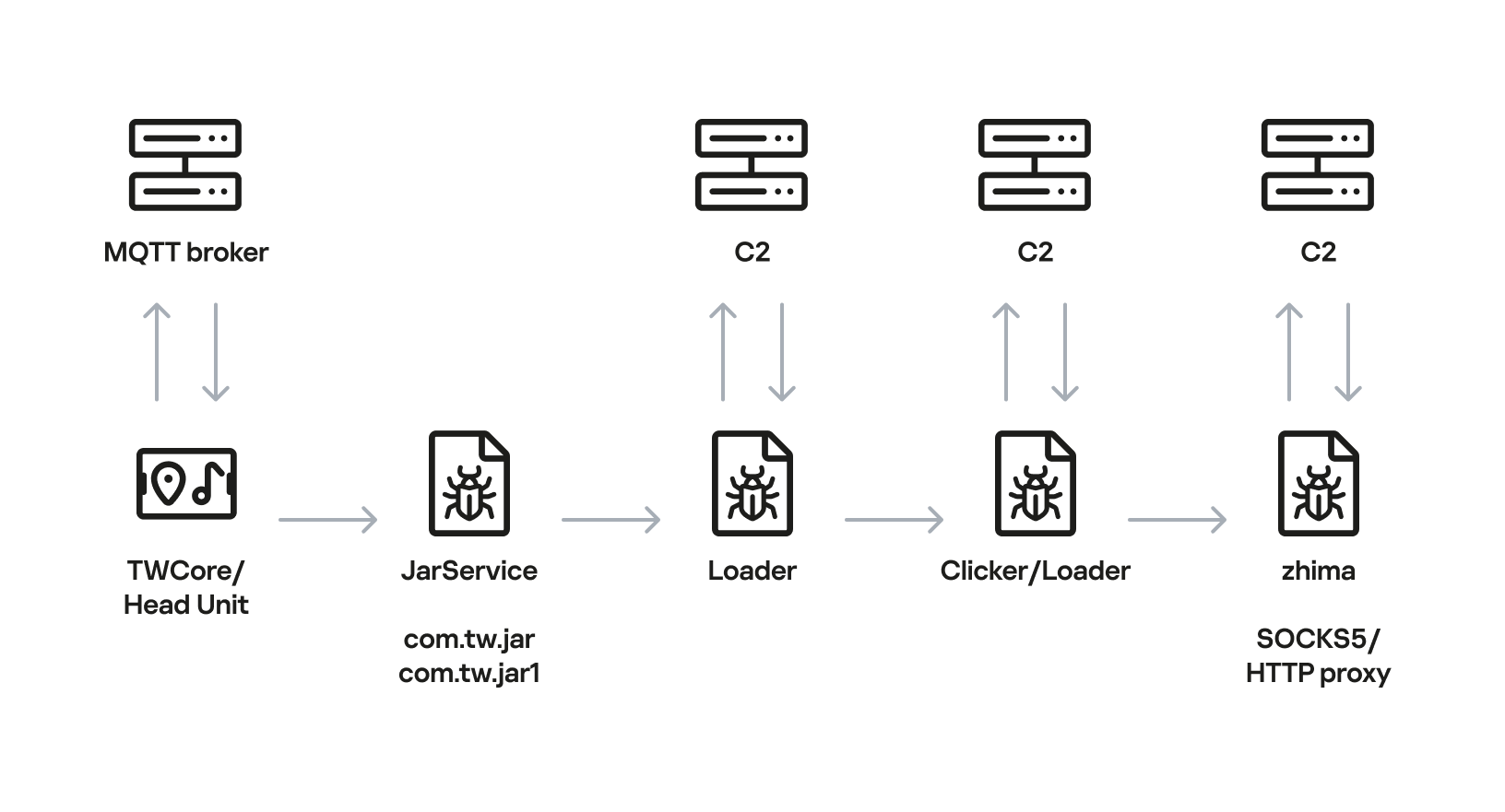
Below is the entire infection chain:
Head unit infection scheme
Let’s look at exactly how these head units became infected.
The TWCore app
TWCore is a legitimate system application responsible for collecting analytics data and updating the head unit software. Let’s take a closer look at how the update function works.
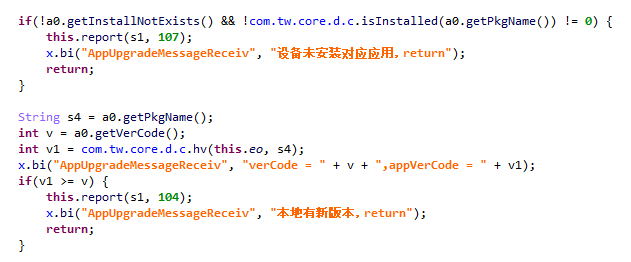
The process is fairly simple. An MQTT message broker hosted on the subdomain cardoor[.]cn sends a message containing information about the APK files that need to be downloaded and installed on the head unit. Notably, the object describing this message includes an installNotExists field, a Boolean flag that can be set to true or false. This flag allows TWCore to install apps that weren’t originally present on the device.
TWCore only checks whether an app is already installed on the device when installNotExists = false
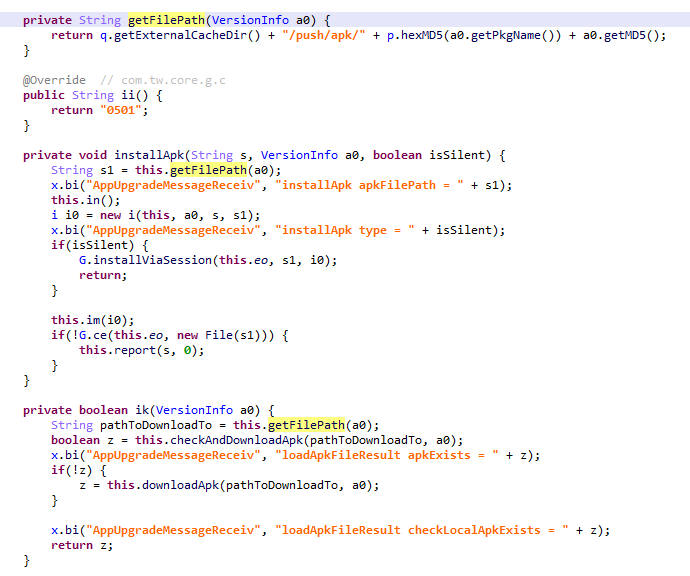
The APK file is downloaded to <TWCore external cache dir>/push/apk/ for installation.
The path TWCore uses to download APK files
Our telemetry revealed previously unknown malware at these file paths. On top of that, our data indicates that in every observed case, the malware was installed by an app with the package name com.tw.core, which matches the TWCore package name.
Next, we’ll break down the malware installed by TWCore: the JarService dropper.
Stage 1: the JarService dropper
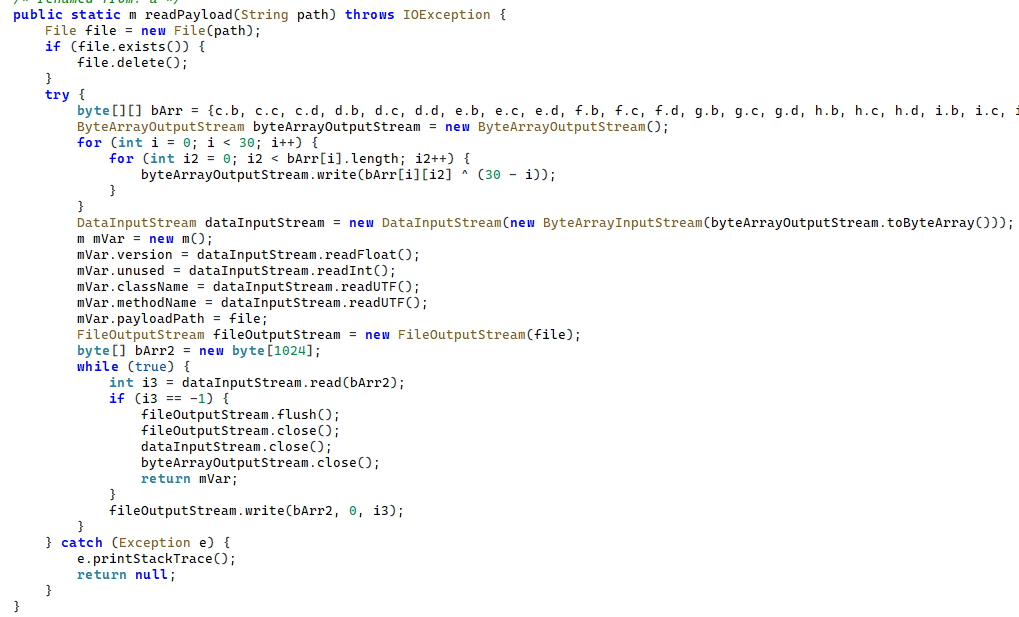
As mentioned earlier, JarService is a small dropper app with no UI of any kind. It decrypts data stored as encrypted blocks within the Trojan’s code. Each block is XOR-encrypted with a single-byte key that shifts linearly from block to block. The decrypted data contains serialized information about the payload version and entry point, along with the malware’s own code for further loading.
Decrypting and deserializing information about the stage 2 payload
In the version of JarService we analyzed, the entry point for the next-stage payload was the wa method of the com.c.j.qbh class.
Stage 2: the loader
This stage’s payload is a malicious loader. Its code contains encrypted strings that are later used as class names to execute the stage 3 payload using the reflection mechanism. The loader sends implant information to one of the attackers’ servers via a POST request. Example of a request to the C2 server:
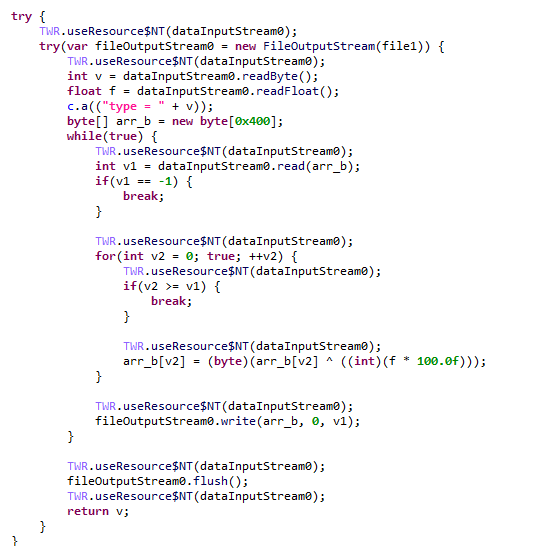
The Trojan uses the link in the dexUrl field of the data object to download serialized data for loading the next stage. This data begins with a single-byte integer, a key used to decrypt the strings in the loader’s code. Immediately following this number is a four-byte floating-point value used to XOR-decrypt the stage 3 payload, which itself is located after these keys.
Decrypting the stage 3 payload
In the decrypted payload, the entry point is the init method of the com.ast.sdk.BillingMain class, shown in the screenshot below.
Entry point of the stage 3 payload
While analyzing this stage, we noticed that the download link for the next-stage payload includes a version number. We decided to try other version numbers to retrieve different payload versions, and ultimately obtained seven distinct variants, which we list under “Indicators of Compromise” at the end of this report. The earliest version, numbered 3.57, uses a different decoding algorithm than the one described above. This may indicate that an earlier version of the infection chain used a different loader between JarService and the stage 3 payload.
Stage 3: clicker / reverse proxy loader
In this stage, the malware sends a POST request to /cpc/api/task every 90 minutes by default, containing information about the infected device (display resolution, device model, the SSID of the connected Wi-Fi network, MAC address, and so on) along with the Trojan’s configuration version. If the configuration is outdated, the C2 server returns an updated configuration containing new C2 addresses and new paths for sending HTTP requests. An example of a response is shown below. Note that at the time of our research, the most up-to-date configuration version was 3.82.
If the configuration version doesn’t need updating, the C2 server instead returns integer command identifiers, which the attackers refer to as productId. The Trojan maps each identifier to command information, which it stores as a serialized JSON object using the SharedPreferences API. Each identifier also has its own version, expressed as a UNIX timestamp. If the C2 response includes an unknown productId or one whose version is outdated, the malware sends a GET request to the attackers’ server at /cpc/api/xml to retrieve the command contents for all such identifiers. The C2 server responds with command information for each unknown identifier. An example of a response is shown below.
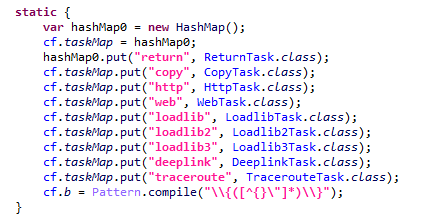
The command information includes a tagName field, which is the command name. The code maps each name to the corresponding class responsible for executing it.
List of executable commands
At the time of our research, the attackers had implemented nine commands. The table below lists command names, brief descriptions, and arguments. The functionality of these commands suggests that the malware can be used to display ads, commit ad fraud (serving as a clicker), and download additional malicious code.
Command name
Description
Arguments
return
Return a value from SharedPreferences.
key: the key whose value should be returned
copy
Set the contents of the clipboard.
text: the key whose value from SharedPreferences is returned as the clipboard contents url: a link for downloading gzip-compressed data (optional); this data is then concatenated with the value of the text key, with (5 spaces) used as a separator
http
Make a POST/GET HTTP request to a specified resource and, if instructed, save the response in SharedPreferences under a specified key.
url: the resource address method: the HTTP method name (optional) startLabel: a marker for the start of the data to save from the resource (optional) endLabel: a marker for the end of the data to save from the resource (optional) valueLabel: the key under which to save the value (optional) header: a dictionary of headers for the HTTP request (optional) content: the content of the POST request (optional)
web
Open a link in the WebView and execute arbitrary JavaScript code within it.
url: the link to open in the WebView js: base64-encoded JavaScript code to execute in the WebView; used when the url parameter is empty or absent corejs: JavaScript code to execute when the resource loads in the WebView (optional) param: a string dictionary of parameters for launching the WebView client: if this key is present, WebViewClient is used to handle redirects manually time: task timeout
loadlib
Not fully implemented at the time of publishing this report.
–
loadlib2
Download and execute arbitrary code.
url: the address to download the payload from name: the name of the module being downloaded md5: the MD5 hash of the payload clear: a comma-separated list of payload names to delete (optional) params: an array of parameters to launch the payload with className: the class name of the payload entry point method: the name of the virtual method at the payload entry point cmethod: the name of the static method used to instantiate the entry-point class (optional) thread: a flag; the payload runs in a separate thread if this flag is not set reload: a flag that, when set, restarts already loaded modules
loadlib3
Not fully implemented at the time of publishing this report.
–
deeplink
Open a resource in the browser.
url: a link to the resource
traceroute
Check resource availability via an ICMP ping.
host: comma-separated list of resources to check
However, attackers use only a relatively small subset of these commands in real-world attacks. As shown in the example C2 response above, at the time of publishing this report the attackers were using the loadlib2 and http commands. The payload downloaded via the loadlib2 command is a reverse proxy module named “zhima”, which researchers from the Nokia Deepfield Emergency Response Team independently discovered in TV set-top boxes around the same time as we did and also described in their report. This confirms that the attackers’ ultimate goal is building a proxy botnet.
While investigating this stage of the attack chain, we noticed that the zhima download link also included a version number. As with the previous stage, we tried other possible version numbers and found eight variants of the zhima module, the earliest of which was version 57. The complete list of identified zhima modules is provided under “Indicators of Compromise” below.
Attribution
While analyzing the complete infection chain, we noticed that the stage 2 loader created a thread with the meaningful name mosdk-host-loader. We decided to investigate what mosdk referred to in that name. This led us to a malicious app installed on various TV set-top boxes with the package name com.abc.nexus (3AD4BF5A86D26FFBF09CAE42AF330A98). It consists of several components (including a dropper similar to JarService), each used by the attackers to covertly monetize the device’s computing power. Each malicious component in the app corresponds to its own service, and the service containing the launch code for the JarService-like dropper is named AdmoyuService. In light of this and the name of the malicious thread found in the payload code, we concluded that moyu in the service name referred to MoYu Group, one of the actors linked to the BADBOX malware platform, which had been described by researchers at HUMAN. This assessment is further supported by extensive overlap between the malware’s network infrastructure and that of MoYu Group, which was independently identified by researchers from the Nokia Deepfield Emergency Response Team around the same time as our own research. Based on these similar naming patterns and prominent infrastructure overlap between the activity of MoYu Group and the attacks described in this report, we attribute it to the same actor with high confidence.
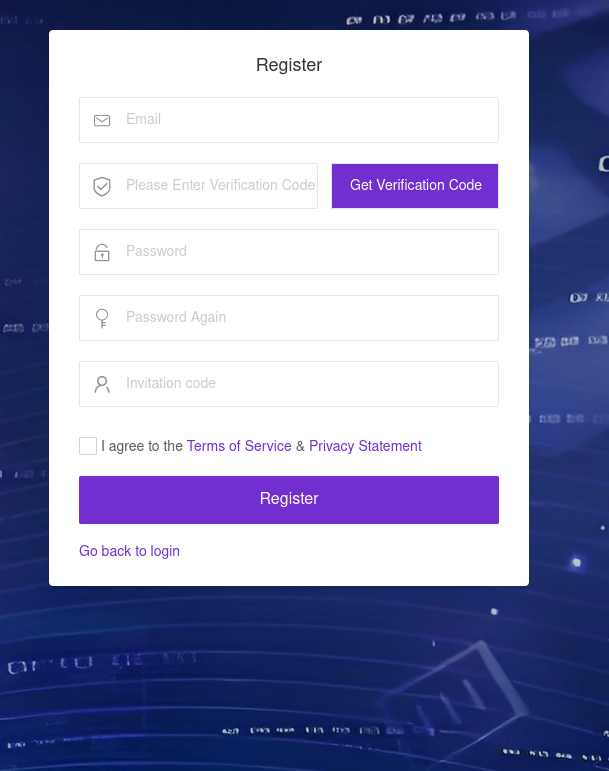
While investigating the malware downloaded by TWCore, we noticed that the domain admin.uipoxy[.]com resolved to the IP address 128.14.210[.]58, one of the C2 servers for the zhima reverse proxy module. It appears that the URL hxxp://admin.uipoxy[.]com/proxy/u/login hosts the zhima admin panel. Interestingly, this panel allows anyone to register as long as they have a valid invite code.
The malware operator registration page
During registration, users are prompted to review the terms of use and privacy policy. Both documents are hosted on links under the pxyedge[.]com domain, which belongs to PXYEDGE, a vendor specializing in the sale of residential proxies.
We found several similarities in the authentication APIs across all of these sites:
The sign-in page was hosted on an admin.* subdomain.
The sign-in page was located at /proxy/u/login.
The signup page was located at /proxy/register?channelKey=<invitation code>.
Based on this, we believe these services are connected to MoYu Group.
Conclusion
Despite efforts by cybersecurity professionals and law enforcement to shut down the BADBOX botnet, individual actors linked to it continue their malicious activity, infecting devices worldwide. Delivery methods for this kind of malware vary widely, from downloads via pre-installed backdoors to infected builds of IPTV apps. The case examined here demonstrates an even more sophisticated delivery method: distribution through the legitimate update functionality of a system application. Attackers are also actively expanding into new platforms. This malware is the first known malicious app targeting head units, which means these platforms now require protection against malware as well.
Netflix, Apple TV+, Disney+, Hulu, Amazon Prime, YouTube Premium… Hoje em dia, as famílias que seguem a lei costumam pagar, em média, de cinco a dez assinaturas apenas para assistir ao conteúdo que desejam, com gastos mensais facilmente ultrapassando a casa dos cem dólares. Não é surpresa, portanto, que as redes sociais e os marketplaces on-line estejam registrando um aumento na demanda por “caixas mágicas”. Surgidas no final de 2025, essas TV boxes Android prometem desbloquear milhares de canais e oferecer acesso gratuito a serviços de streaming mediante um único pagamento.
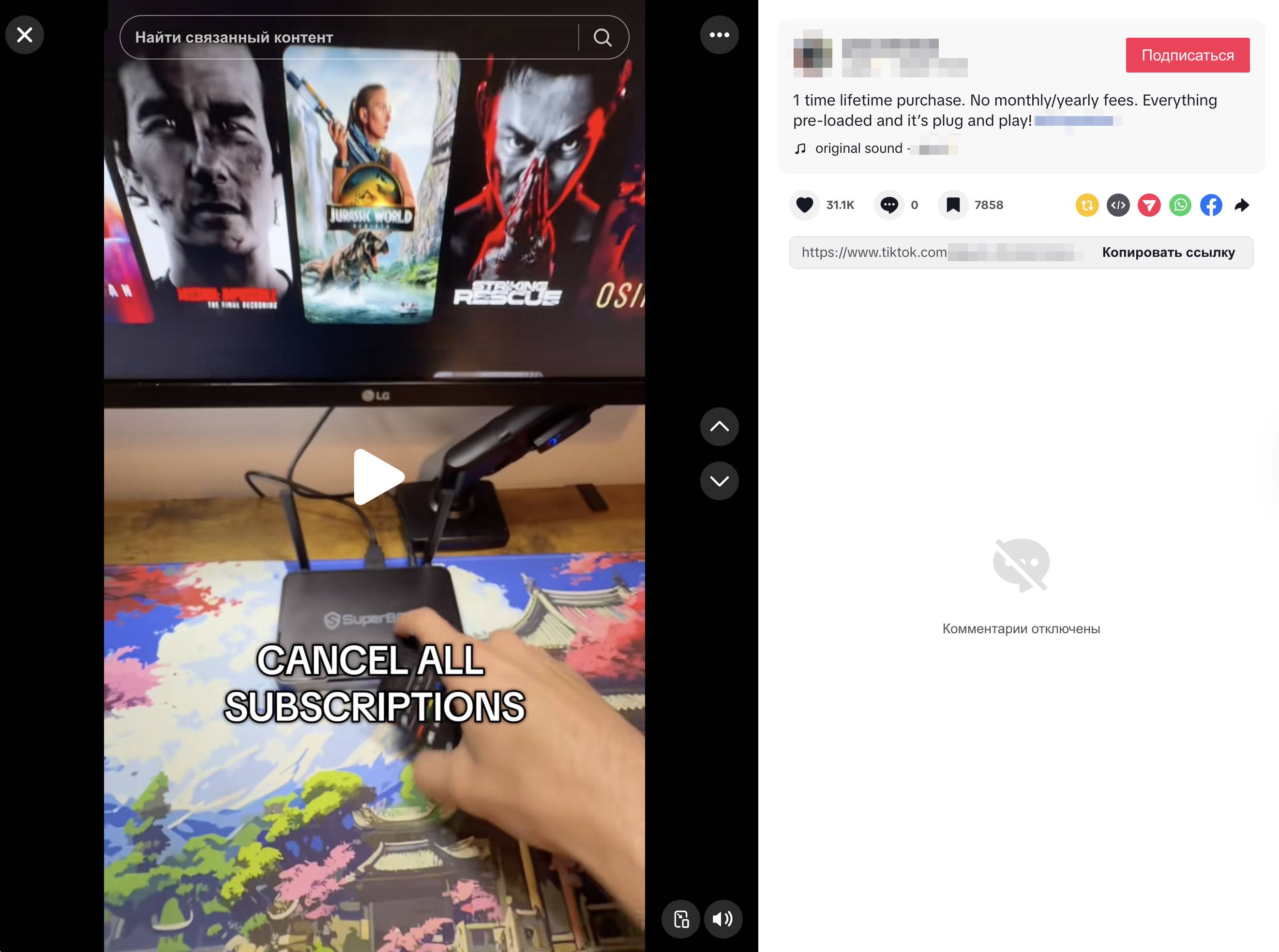
Os anúncios desses dispositivos estão inundando o TikTok e o Instagram: influenciadores sorridentes tiram os SuperBoxes da caixa, conectam-nos à TV e navegam por inúmeros canais. Parece a solução perfeita contra o alto preço das assinaturas, certo? Mas, na prática, essa é uma das formas mais fáceis de permitir a entrada de uma botnet na sua rede doméstica.
Um vídeo promocional no TikTok explicando como é ótimo quando tudo é grátis simplesmente cancelar todas as suas assinaturas
O que há de errado com essas TV boxes baratas?
Já surgiram vários relatos sobre TV boxes maliciosas, mas agora sua divulgação atingiu uma escala realmente alarmante.
No final de 2025, analistas examinaram vários modelos do SuperBox, um dispositivo popular disponível nas principais lojas de varejo e marketplaces on-line. As descobertas foram muito preocupantes: logo após serem ligados, os dispositivos começaram a enviar solicitações aos servidores do aplicativo de mensagens chinês Tencent QQ e ao serviço de proxy Grass, efetivamente disponibilizando a largura de banda da Internet do usuário para terceiros.
Dentro do firmware, os pesquisadores descobriram aplicativos completamente incomuns em um reprodutor de mídia: um scanner de rede, um analisador de tráfego e ferramentas de sequestro de DNS. Com isso, o dispositivo não apenas transmite conteúdo pirata, mas também vasculha a rede local em busca de outros alvos (incluindo interfaces industriais SCADA) e fica pronto para participar de ataques DDoS. Também foi descoberto que os SuperBoxes contêm pastas com o nome revelador “secondstage”, um forte indício de malware em vários estágios.
Mais recentemente, em abril de 2026, o podcast Darknet Diaries publicou uma entrevista com um pesquisador de segurança conhecido pelo pseudônimo D3ada55, que compartilhou diversos detalhes preocupantes sobre essas caixas, incluindo o fato de que elas ainda eram vendidas livremente em plataformas como Amazon, Walmart e Best Buy.
A evolução da infecção: do BADBOX ao Keenadu
O caso do SuperBox está longe de ser a única ocorrência em que os dispositivos Android foram transformados em nós de botnet ou vendidos com infecções de fábrica. Aqui estão os casos mais recentes:
BADBOX 2.0. Em julho de 2025, a Google processou os operadores de uma botnet que comprometeu mais de 10 milhões de dispositivos Android, principalmente TV boxes, tablets e projetores baratos que não tinham certificação do Google Play Protect. Conforme informamos anteriormente, o BADBOX 2.0 tem como alvo TV boxes e opera tanto como uma rede proxy quanto como uma plataforma de fraude publicitária.
Kimwolf. Em dezembro de 2025, a equipe do QiAnXin XLab descobriu uma botnet DDoS que havia sequestrado cerca de 1,8 milhão de dispositivos Android. O hardware infectado incluía modelos genéricos de fabricantes pouco conhecidos que usavam nomes chamativos como TV BOX, SuperBox, XBOX, SmartTV e outros. O alcance da infecção foi enorme, com dispositivos comprometidos distribuídos para o mundo todo. Os países mais atingidos foram o Brasil, Índia, Estados Unidos, Argentina, África do Sul, Filipinas e México.
Keenadu. Nossos especialistas descobriram esse malware à espreita no firmware de dispositivos novos em novembro de 2025, mas ele só chamou atenção depois de publicarmos um estudo sobre ele em fevereiro de 2026. O Keenadu se disfarça de componente legítimo do sistema, até mesmo entrando em aplicativos de desbloqueio facial e potencialmente concedendo aos invasores acesso a dados biométricos, informações bancárias e mensagens pessoais.
Todas essas histórias compartilham a mesma origem: o cavalo de Troia Triada, documentado pela primeira vez pelos nossos pesquisadores em 2016 e apelidado na época de “um dos cavalos de Troia móveis mais avançados”. Ao longo da última década, ele evoluiu de um malware comum para um backdoor modular integrado diretamente ao firmware durante a fabricação.
Como o esquema de infecção funciona
Os fabricantes de TV boxes baratas cortam gastos em tudo: certificação do Google Play Protect, auditorias de firmware e atualizações de segurança. Muitos desses dispositivos são executados no Android Open Source Project sem nenhuma garantia de segurança. Em algum lugar ao longo da cadeia de suprimentos, seja na fábrica, por meio de um intermediário ou em uma distribuidora, um backdoor é injetado na imagem do firmware. Nossos especialistas suspeitam que o próprio fabricante pode nem estar ciente do comprometimento.
A escala da infecção transforma milhões de caixas idênticas na base perfeita para uma botnet: cada dispositivo comprometido representa um endereço IP exclusivo que pode ser alugado para terceiros. Operadores de botnet, como o Kimwolf, lucram com isso não apenas por meio de ataques DDoS distribuídos, mas também revendendo a largura de banda de smart TVs e TV boxes infectadas.
O que isso significa para você
Uma TV box infectada fica na sala de estar, conectada ao Wi-Fi doméstico. Isso significa que ela pode detectar smartphones com aplicativos bancários, unidades de armazenamento conectadas à rede (NAS) com arquivos da família, câmeras IP, fechaduras inteligentes, computadores de trabalho e qualquer outro dispositivo conectado à sua rede Wi-Fi.
Com esse tipo de vetor de acesso inicial dentro da sua rede doméstica, um invasor pode interceptar tráfego não criptografado, falsificar solicitações de DNS, verificar portas e procurar vulnerabilidades em dispositivos vizinhos. Além disso, seu endereço IP pode ser usado para atividades fraudulentas. Como resultado, na melhor das hipóteses, seu IP acabará entrando em listas de bloqueio, e serviços legítimos começarão a barrar seu acesso por atividade suspeita; na pior, autoridades podem bater à sua porta.
Como identificar um gadget potencialmente perigoso
Você deve ficar alerta se um dispositivo:
For vendido sob uma marca sem nome ou genérica, como T95, X96Q, MX10, TV BOX, SuperBox ou similares
Promete acesso vitalício gratuito a serviços premium pagos mediante um único pagamento
Exige que você desative o Google Play Protect ou instale APKs de terceiros durante a configuração inicial
Não tem uma certificação do Play Protect
É promovido por meio de campanhas agressivas de spam nas redes sociais
Como evitar hospedar um nó de botnet
Compre TV boxes certificadas com Google Play Protect ou adquira dispositivos diretamente de operadoras de telecomunicações e provedores de Internet confiáveis.
Isole todos os dispositivos domésticos inteligentes. Configure uma rede Wi-Fi separada no roteador da sua casa para TV boxes, câmeras, alto-falantes inteligentes, aspiradores robóticos e dispositivos semelhantes, mantendo smartphones, unidades NAS e computadores na rede principal. Isso evita que o malware se espalhe para seus dispositivos mais importantes.
Atualize o firmware com frequência em todos os dispositivos, e não se esqueça do roteador, pois ele também representa um elo vulnerável na cadeia.
Remova todos os aplicativos da TV box Android que não foram instalados por você, especialmente lojas de aplicativos alternativas, “impulsionadores” de Wi-Fi e “limpadores de sistema”.
Monitore o tráfego da sua rede. Roteadores modernos e o Kaspersky Premium conseguem exibir os destinos de conexão de cada dispositivo. Conexões frequentes entre um reprodutor de mídia e servidores na China representam um forte sinal de alerta de segurança.
Instale o Kaspersky Premium em todos os seus dispositivos, pois ele protege contra cavalos de Troia e bloqueia páginas de phishing usadas para distribuir arquivos APK infectados.
Não desative o Google Play Protect e evite instalar APKs de fontes duvidosas, pois esse é o principal vetor de infecção usado para burlar a loja oficial de aplicativos.
Em caso de dúvida, devolva a TV box. Não vale a pena arriscar sua biometria, dados bancários ou a reputação do seu endereço IP por causa de um dispositivo de streaming barato.
Quer saber como proteger seus dispositivos domésticos inteligentes? Leia mais nas nossas postagens relacionadas:
The global financial sector is facing a sharp rise in Financial Services DDoS Attacks, with cybercriminals increasingly targeting banks, payment systems, and online financial platforms through larger, longer, and more attacks, according to new research from Akamai.
In its latest State of the Internet (SOTI) Security report titled AI-Empowered Botnets and API Visibility Gaps: Attack Trends in Financial Services, research warned that AI-powered botnets and politically motivated hacktivist groups are intensifying the cyber threat landscape for the banking and financial services industry.
Researchers found that Financial Services DDoS Attacks have become more persistent and operationally disruptive, particularly across Layers 3 and 4 web and API infrastructure.
Financial Services DDoS Attacks Top the Chart
According to the report, financial services organizations are now the most targeted industry for web and API distributed denial-of-service attacks.
Akamai revealed that the median duration of global Layers 3 and 4 Financial Services DDoS Attacks has increased by 738% since 2024. The company attributed the surge to AI-powered attack infrastructure and growing hacktivist activity, including campaigns linked to pro-Iran cyber groups.
Security researchers said attackers are increasingly focusing on:
Online banking systems
Real-time payment platforms
API infrastructure
Customer-facing financial applications
The report noted that while financial institutions continue expanding digital banking and payment services, the growing reliance on APIs and cloud-connected infrastructure has also expanded the attack surface available to threat actors.
API-Related Cyber Risks Emerging as Major Security Weakness
One of the strongest findings in the report involved API-related cyber risks.
According to reserach’s 2026 API Security Impact Study, 96% of financial service leaders surveyed reported at least one API security incident within the past year. That figure was the highest recorded among all industries included in the research.
The report also found that:
60% of all web attacks in 2025 targeted banking institutions
83% of attacks against API endpoints focused on financial organizations
Researchers warned that APIs are increasingly becoming high-value targets because they support critical services such as digital payments, account management, authentication systems, and mobile banking applications.
Steve Winterfeld, Advisory Chief Information Security Officer at Akamai, said APIs are now central to modern cyberattacks against financial institutions.
“Cybercriminals and hacktivists continue to escalate DDoS from nuisance attacks to a sustained siege encompassing both hacktivism and cybercrime, and financial services are in the crosshairs,” Winterfeld said.
He added that artificial intelligence is accelerating existing cybersecurity threats rather than replacing them.
AI Botnets Driving DDoS Campaigns
The report highlighted how AI-driven infrastructure is helping attackers automate and scale malicious operations more effectively.
Researchers observed a 147% surge in advanced bot activity during late 2025. In one case study referenced by Akamai, nearly 96% of all traffic reaching a targeted website was identified as malicious scraping bot activity.
The company warned that AI-powered botnets are making Financial Services DDoS Attacks more difficult to detect and mitigate because attackers can dynamically adapt attack patterns and traffic behavior.
These botnets are also being used to:
Cybersecurity experts have increasingly warned that AI-enabled automation allows threat actors to launch large-scale attacks with fewer technical resources.
Attack Patterns Differ Across Global Regions
Research also identified major regional differences in cyberattack patterns targeting financial institutions.
The report found:
Europe, the Middle East, and Africa accounted for 62% of Layers 3 and 4 DDoS attacks
Asia-Pacific experienced 52% of Layer 7 DDoS attacks
North America recorded the highest volume of web attacks at 44%
Researchers said these differences reflect varying attacker strategies, infrastructure deployment patterns, and regional cybersecurity maturity levels.
The report also revealed that nearly 80% of financial institutions experienced ransomware attacks during the past two years. However, fewer than half of surveyed organizations reported adopting advanced cybersecurity technologies capable of handling modern attack methods.
Growing Pressure on Financial Sector Cybersecurity
The latest findings add to growing concerns around operational resilience within the global financial industry.
As banks and financial institutions continue accelerating digital transformation initiatives, cybersecurity teams are being forced to defend increasingly complex environments that rely heavily on APIs, cloud platforms, automated infrastructure, and third-party integrations.
Research said organizations must improve visibility into APIs, strengthen DDoS mitigation strategies, and modernize threat detection capabilities to address the evolving threat landscape.
The SOTI report also includes guidance on DNS security, DDoS mitigation practices, AI architecture security considerations, and insights from financial sector cybersecurity experts, including contributions from the FS-ISAC.
The statistics in this report are based on detection verdicts returned by Kaspersky products unless otherwise stated. The information was provided by Kaspersky users who consented to sharing statistical data.
Quarterly figures
In Q1 2026:
Kaspersky products blocked more than 343 million attacks that originated with various online resources.
Web Anti-Virus responded to 50 million unique links.
File Anti-Virus blocked nearly 15 million malicious and potentially unwanted objects.
2938 new ransomware variants were detected.
More than 77,000 users experienced ransomware attacks.
14% of all ransomware victims whose data was published on threat actors’ data leak sites (DLS) were victims of Clop.
More than 260,000 users were targeted by miners.
Ransomware
Quarterly trends and highlights
Law enforcement success
In January 2026, it was reported that the FBI had seized the domains of the RAMP cybercrime forum, a major platform used extensively by ransomware developers to advertise their RaaS programs and to recruit affiliates. There has been no official statement from the FBI, nor is it clear if RAMP servers were seized. In a post on an external website, a RAMP moderator mentioned law enforcement agencies gaining control over the forum. The takedown disrupted a key element of the RaaS ecosystem, creating ripple effects for ransomware operators, affiliates, and initial access brokers.
A man suspected of links to the Phobos group was apprehended in Poland. He was charged with the creation, acquisition, and distribution of software designed for unlawfully obtaining information, including data that facilitates unauthorized access to information stored within a computer system.
In March, a Phobos ransomware administrator pleaded guilty to the creation and distribution of the Trojan, which had been used in international attacks dating back to at least November 2020.
In March, the U.S. Department of Justice charged a man who had acted as a negotiator for ransomware groups. The company he worked for specializes in cyberincident investigations. The prosecution alleges the suspect colluded with the BlackCat threat actor to share privileged insights into the ongoing progress of negotiations. Additionally, the suspect is alleged to have had a prior direct role in BlackCat attacks, serving as an affiliate for the RaaS operation.
In a separate development this March, a U.S. court sentenced an initial access broker associated with the Yanluowang ransomware group to 81 months of imprisonment. According to the U.S. Department of Justice, the convict facilitated dozens of ransomware attacks across the United States, resulting in over $9 million in actual loss and more than $24 million in intended loss.
Vulnerabilities and attacks
The Interlock group has been heavily exploiting the CVE-2026-20131 zero-day vulnerability in Cisco Secure FMC firewall management software since at least January 26, 2026. The vulnerability enabled arbitrary Java code execution with root privileges on the affected device. This campaign demonstrates the ongoing reliance on zero-day vulnerabilities for initial access, a focus on network appliances as high-value entry points, and the rapid weaponization of new vulnerabilities within the ransomware ecosystem.
The most prolific groups
This section highlights the most prolific ransomware gangs by number of victims added to each group’s DLS. This quarter, the Clop ransomware (14.42%) returned to the top of the rankings, displacing Qilin (12.34%), which had held the leading position in the previous reporting period. Following closely is a new threat actor, The Gentlemen (9.25%). Emerging no later than July 2025, the group had already surpassed the activity levels of mainstays such as Akira (7.25%) and INC Ransom (6.13%).
Number of each group’s victims according to its DLS as a percentage of all groups’ victims published on all the DLSs under review during the reporting period (download)
Number of new variants
In Q1 2026, Kaspersky solutions detected six new ransomware families and 2938 new modifications. Volumes have returned to Q3 2025 levels following a surge in Q4 2025.
Number of new ransomware modifications, Q1 2025 — Q1 2026 (download)
Number of users attacked by ransomware Trojans
Throughout Q1, our solutions protected 77,319 unique users from ransomware. Ransomware activity was highest in March, with 35,056 unique users encountering such attacks during the month.
Number of unique users attacked by ransomware Trojans, Q1 2026 (download)
Attack geography
TOP 10 countries and territories attacked by ransomware Trojans
Country/territory*
%**
1
Pakistan
0.79
2
South Korea
0.64
3
China
0.52
4
Tajikistan
0.40
5
Libya
0.38
6
Turkmenistan
0.36
7
Iraq
0.35
8
Bangladesh
0.33
9
Rwanda
0.30
10
Cameroon
0.28
* Excluded are countries and territories with relatively few (under 50,000) Kaspersky users.
** Unique users whose computers were attacked by ransomware Trojans as a percentage of all unique users of Kaspersky products in the country/territory.
TOP 10 most common families of ransomware Trojans
Name
Verdict
%*
1
(generic verdict)
Trojan-Ransom.Win32.Gen
33.90
2
(generic verdict)
Trojan-Ransom.Win32.Crypren
6.38
3
WannaCry
Trojan-Ransom.Win32.Wanna
5.87
4
(generic verdict)
Trojan-Ransom.Win32.Encoder
4.68
5
(generic verdict)
Trojan-Ransom.Win32.Agent
3.80
6
LockBit
Trojan-Ransom.Win32.Lockbit
2.80
7
(generic verdict)
Trojan-Ransom.Win32.Phny
1.99
8
(generic verdict)
Trojan-Ransom.MSIL.Agent
1.96
9
(generic verdict)
Trojan-Ransom.Python.Agent
1.93
10
(generic verdict)
Trojan-Ransom.Win32.Crypmod
1.89
* Unique Kaspersky users attacked by the specific ransomware Trojan family as a percentage of all unique users attacked by this type of threat.
Miners
Number of new variants
In Q1 2026, Kaspersky solutions detected 3485 new modifications of miners.
Number of new miner modifications, Q1 2026 (download)
Number of users attacked by miners
In Q1, we detected attacks using miner programs on the computers of 260,588 unique Kaspersky users worldwide.
Number of unique users attacked by miners, Q1 2026 (download)
Attack geography
TOP 10 countries and territories attacked by miners
Country/territory*
%**
1
Senegal
3.19
2
Turkmenistan
3.06
3
Mali
2.63
4
Tanzania
1.62
5
Bangladesh
1.06
6
Ethiopia
0.95
7
Panama
0.88
8
Afghanistan
0.79
9
Kazakhstan
0.77
10
Bolivia
0.75
* Excluded are countries and territories with relatively few (under 50,000) Kaspersky users.
** Unique users whose computers were attacked by miners as a percentage of all unique users of Kaspersky products in the country/territory.
Attacks on macOS
In Q1 2026, Google uncovered a new cryptocurrency theft campaign. The scammers directed victims to a fraudulent video call, prompting them to execute malicious scripts under the guise of technical support fixes for connection problems.
In March, researchers with GTIG and iVerify reported the discovery of an in-the-wild exploit chain targeting both iOS and macOS devices. The exploit kit was apparently marketed on the dark web, providing threat actors with a suite of spyware capabilities alongside specialized cryptocurrency exfiltration modules. The exploit was delivered via drive-by downloads when victims visited various compromised websites. Our analysis confirmed that the toolkit included an updated version of a component previously identified in the Operation Triangulation attack chain.
Devices running macOS were similarly impacted by the high-profile supply chain attack targeting the Axios npm package, a widely used HTTP client for JavaScript. The installation of the infected package led to the deployment of a backdoor on macOS devices.
TOP 20 threats to macOS
Unique users* who encountered this malware as a percentage of all attacked users of Kaspersky security solutions for macOS (download)
* Data for the previous quarter may differ slightly from previously published data due to some verdicts being retrospectively revised.
The share of PasivRobber spyware attacks is beginning to decline, giving way to more traditional adware and Monitor-class software capable of tracking user activity. The popular Amos stealer also maintains its presence within the TOP 20.
Geography of threats to macOS
TOP 10 countries and territories by share of attacked users
Country/territory
%* Q4 2025
%* Q1 2026
China
1.28
1.97
France
1.18
1.07
Brazil
1.13
0.98
Mexico
0.72
0.52
Germany
0.71
0.45
The Netherlands
0.62
0.75
Hong Kong
0.49
0.53
India
0.42
0.48
Russian Federation
0.34
0.37
Thailand
0.24
0.27
* Unique users who encountered threats to macOS as a percentage of all unique Kaspersky users in the country/territory.
IoT threat statistics
This section presents statistics on attacks targeting Kaspersky IoT honeypots. The geographic data on attack sources is based on the IP addresses of attacking devices.
In Q1 2026, the share of devices attacking Kaspersky honeypots via the SSH protocol saw a significant increase compared to the previous reporting period.
Distribution of attacked services by number of unique IP addresses of attacking devices (download)
The distribution of attacks between Telnet and SSH maintained the ratio observed in Q4 2025.
Distribution of attackers’ sessions in Kaspersky honeypots (download)
TOP 10 threats delivered to IoT devices
Share of each threat delivered to an infected device as a result of a successful attack, out of the total number of threats delivered (download)
The primary shifts in the IoT threat distribution are linked to the activity of various Mirai botnet variants, although members of this family continue to account for the majority of the list. Furthermore, a new variant, Mirai.kl, surfaced in the rankings. We also observed a significant decline in NyaDrop botnet activity during Q1.
Attacks on IoT honeypots
The United States, the Netherlands, and Germany accounted for the highest proportions of SSH-based attacks during this period.
Country/territory
Q4 2025
Q1 2026
United States
16.10%
23.74%
The Netherlands
15.78%
17.57%
Germany
12.07%
10.34%
Panama
7.72%
6.34%
India
5.32%
6.05%
Romania
4.05%
5.82%
Australia
1.62%
4.61%
Vietnam
4.21%
3.50%
Russian Federation
3.79%
2.35%
Sweden
2.25%
2.09%
China continues to account for the largest proportion of Telnet attacks, though there was a marked increase in activity originating from Pakistan.
Country/territory
Q4 2025
Q1 2026
China
53.64%
39.54%
Pakistan
14.27%
27.31%
Russian Federation
8.20%
8.25%
Indonesia
8.58%
6.71%
India
4.85%
4.66%
Brazil
0.06%
3.30%
Argentina
0.02%
2.51%
Nigeria
1.22%
1.38%
Thailand
0.01%
0.55%
Sweden
0.54%
0.55%
Attacks via web resources
The statistics in this section are based on detection verdicts by Web Anti-Virus, which protects users when suspicious objects are downloaded from malicious or infected web pages. These malicious pages are purposefully created by cybercriminals. Websites that host user-generated content, such as message boards, as well as compromised legitimate sites, can become infected.
TOP 10 countries and territories that served as sources of web-based attacks
The following statistics show the distribution by country/territory of the sources of internet attacks blocked by Kaspersky products on user computers (web pages redirecting to exploits, sites containing exploits and other malicious programs, botnet C&C centers, and so on). One or more web-based attacks could originate from each unique host.
To determine the geographic source of web attacks, we matched the domain name with the real IP address where the domain is hosted, then identified the geographic location of that IP address (GeoIP).
In Q1 2026, Kaspersky solutions blocked 343,823,407 attacks launched from internet resources worldwide. Web Anti-Virus was triggered by 49,983,611 unique URLs.
Web-based attacks by country/territory, Q1 2026 (download)
Countries and territories where users faced the greatest risk of online infection
To assess the risk of malware infection via the internet for users’ computers in different countries and territories, we calculated the share of Kaspersky users in each location on whose computers Web Anti-Virus was triggered during the reporting period. The resulting data provides an indication of the aggressiveness of the environment in which computers operate in different countries and territories.
This ranked list includes only attacks by malicious objects classified as Malware. Our calculations leave out Web Anti-Virus detections of potentially dangerous or unwanted programs, such as RiskTool or adware.
Country/territory*
%**
1
Venezuela
9.33
2
Hungary
8.16
3
Italy
7.58
4
Tajikistan
7.48
5
India
7.21
6
Greece
7.13
7
Portugal
7.10
8
France
7.05
9
Belgium
6.83
10
Slovakia
6.80
11
Vietnam
6.62
12
Bosnia and Herzegovina
6.57
13
Canada
6.56
14
Serbia
6.50
15
Tunisia
6.36
16
Qatar
6.01
17
Spain
5.95
18
Germany
5.95
19
Sri Lanka
5.89
20
Brazil
5.88
* Excluded are countries and territories with relatively few (under 10,000) Kaspersky users.
** Unique users targeted by web-based Malware attacks as a percentage of all unique users of Kaspersky products in the country/territory.
On average during the quarter, 4.73% of users’ computers worldwide were subjected to at least one Malware web attack.
Local threats
Statistics on local infections of user computers are an important indicator. They include objects that penetrated the target computer by infecting files or removable media, or initially made their way onto the computer in non-open form. Examples of the latter are programs in complex installers and encrypted files.
Data in this section is based on analyzing statistics produced by anti-virus scans of files on the hard drive at the moment they were created or accessed, and the results of scanning removable storage media. The statistics are based on detection verdicts from the On-Access Scan (OAS) and On-Demand Scan (ODS) modules of File Anti-Virus and include detections of malicious programs located on user computers or removable media connected to the computers, such as flash drives, camera memory cards, phones, or external hard drives.
In Q1 2026, our File Anti-Virus detected 15,831,319 malicious and potentially unwanted objects.
Countries and territories where users faced the highest risk of local infection
For each country and territory, we calculated the percentage of Kaspersky users whose computers had the File Anti-Virus triggered at least once during the reporting period. This statistic reflects the level of personal computer infection in different countries and territories around the world.
Note that this ranked list includes only attacks by malicious objects classified as Malware. Our calculations leave out File Anti-Virus detections of potentially dangerous or unwanted programs, such as RiskTool or adware.
Country/territory*
%**
1
Turkmenistan
47.96
2
Tajikistan
31.48
3
Cuba
31.03
4
Yemen
29.59
5
Afghanistan
28.47
6
Burundi
26.93
7
Uzbekistan
24.81
8
Syria
23.08
9
Nicaragua
21.97
10
Cameroon
21.60
11
China
21.09
12
Mozambique
21.02
13
Algeria
20.64
14
Democratic Republic of the Congo
20.63
15
Bangladesh
20.44
16
Mali
20.35
17
Republic of the Congo
20.23
18
Madagascar
20.00
19
Belarus
19.78
20
Tanzania
19.52
* Excluded are countries and territories with relatively few (under 10,000) Kaspersky users.
** Unique users on whose computers local Malware threats were blocked, as a percentage of all unique users of Kaspersky products in the country/territory.
On average worldwide, Malware local threats were detected at least once on 11.55% of users’ computers during Q1.
China-sponsored threat groups like Salt Typhoon and Flax Typhoon are increasingly relying on multiple massive botnets comprising edge and IoT devices to run their cyber espionage and network intrusion campaigns, CISA and other security agencies say. The use of such "covert networks" makes it more difficult to detect and mitigate their campaigns.

 Entrar