❌

Visualização de leitura

Two Canadians Accused of Turning US University Supercomputers Into Crypto Miners

university supercomputer hacking

For more than three years, computers at several American universities were allegedly doing work their owners never asked for. According to a federal indictment, two Canadian men broke into campus networks, stole passwords and quietly used the machines to mine cryptocurrency for themselves. One of them is now in the United States to face charges in the university supercomputer hacking case. The other is still fighting extradition in Canada. U.S. Attorney Michael DiGiacomo announced that a federal grand jury has indicted Ryan James Roach, 35, of Saskatchewan, and Mathiew James Stubbings, 41, of Ontario. Both face charges of conspiracy to obtain information from and cause damage to a protected computer, obtaining information from a protected computer, and intentional damage to a protected computer. The charges carry a maximum penalty of 10 years in prison and a $250,000 fine.

Why the University Supercomputer Hacking Targeted Campuses

The indictment points to a clear reason for the choice of targets. Roach and Stubbings allegedly went after educational institutions in the United States that had supercomputers. The scheme relied on processing power. Once inside, the pair allegedly forced victim computers to run cryptocurrency mining software, putting the machines' computing power to work for their own financial gain. Machines built for heavy computation made the scheme more profitable. Victims included educational institutions in New York, Tennessee, North Carolina and Massachusetts. Some of the damaged computers belonged to a higher education institution in the Western District of New York, where the case is being prosecuted.

How the Alleged Scheme Worked

According to the indictment, the scheme ran from June 2016 to December 2019 and followed a set pattern. The pair allegedly researched security weaknesses in victim networks before getting in. They accessed computers without authorization and deployed malware to take control. They then stole login credentials and sent the data to servers they controlled. Once inside a network, they allegedly used sophisticated techniques and tools to carry out reconnaissance and expand their access. The stolen login credentials were stored on their servers, the same servers that sent out malware and mining software to victim machines. The indictment says Roach and Stubbings damaged 10 or more protected computers within a one-year period, causing a loss of at least $5,000.

How They Allegedly Stayed Hidden

The case also shows the effort the pair allegedly put into avoiding detection. They used virtual private servers in multiple countries, registered under false names. Those servers delivered malware and mining software to victim computers and held the stolen credentials. To conceal their identities further, they allegedly used a server and compromised computers belonging to one victim to gain access to another. That meant intrusions could appear to come from a victim's own systems instead of from the people behind them.

Where the University Supercomputer Hacking Case Stands

Roach was extradited from Canada to the United States on October 28. He was arraigned before U.S. Magistrate Judge Mark W. Pedersen and held pending a detention hearing on November 3. Extradition proceedings for Stubbings are continuing in Canada. The investigation was carried out by the Federal Bureau of Investigation, under the direction of Special Agent-in-Charge Allen D. Davis II, and the Department of Justice's Computer Crime and Intellectual Property Section. The Justice Department's Office of International Affairs helped secure Roach's arrest and extradition. Assistant U.S. Attorney Meghan K. McGuire is prosecuting the case.

What Is Still Unclear

The indictment leaves several details open. It does not say how much cryptocurrency the pair allegedly mined, how many institutions were affected in total, or which universities were targeted beyond their states. The loss figure stated in the charges, at least $5,000, is the legal threshold tied to the damage count, not a full estimate of the harm. An indictment is an accusation, not proof. Both men are presumed innocent unless and until proven guilty.

Applebee’s customer data exposed by password left in app

Applebee’s has fixed a security flaw that exposed customers’ personal information after a researcher discovered a database password embedded in the restaurant chain’s Android app.

The researcher, Robert Wiggins, found the password with help from AI. It gave him access to an internal Applebee’s customer database. A password written directly into an app’s code or configuration is known as a hardcoded credential. Anyone who extracts it may be able to use it to access the system.

The exposed database contained:

  • Names, email addresses, and email-verification status
  • Dates of birth, phone numbers, and ZIP codes
  • Veteran status
  • Account-creation dates and login counts
  • IP addresses from customers’ most recent logins, which can indicate their approximate location

TechCrunch independently checked Wiggins’ findings. It created an Applebee’s account with dummy information, which Wiggins successfully retrieved from the database.

According to TechCrunch, Wiggins could not find a suitable way to report the issue to Applebee’s or its parent company, Dine Brands, so he asked the publication to help contact them. TechCrunch held its story until the fix was confirmed. Applebee’s confirmed on October 29 that it had addressed the issue.

It’s unclear how many customers’ records were in the database. Dine Brands says it has not found evidence of unauthorized access, but its investigation is ongoing.

How to stay safe

The database fields described by TechCrunch did not include payment card details or account passwords. That does not tell us whether anyone accessed the database before the fix, so customers should watch for targeted scams.

Names, email addresses, phone numbers, and other personal details could help scammers make messages look relevant and convincing.

  • Be wary of unexpected Applebee’s-themed emails, texts, or calls. Be especially skeptical of messages offering refunds or compensation, warning that your account will be closed, or asking you to “verify” payment details.
  • Check security notices through a route you trust. Open the app directly or visit Applebee’s website yourself rather than following a link in an unexpected message. If necessary, contact the company using details you find independently.
  • Unsure whether a message is a scam? Check it with Malwarebytes’ Scam Guard for an assessment and advice on what to do next.
  • When sharing personal information, consider why the company needs it and whether you trust it to keep the information safe.

Link Checker

Unsure where a link goes? We’ll check it.


OLVX Marketplace Dismantled After Joint FBI-North Macedonia Probe

OLVX marketplace

The OLVX marketplace, an illicit online platform used to sell stolen personal data, login credentials and cybercrime tools, has been dismantled following a coordinated investigation by North Macedonia’s Ministry of Interior and the US Federal Bureau of Investigation (FBI). Authorities have filed criminal charges against a 20-year-old suspect from the Tetovo area, alleging involvement in computer fraud, misuse of personal data and the production and distribution of child sexual abuse material. According to North Macedonia’s Ministry of Interior, the Cybercrime and Digital Forensics Sector submitted the charges against E.A., from the village of Golema Rečica, to the Basic Public Prosecutor’s Office in Tetovo. The investigation focused on the suspect’s alleged administration of the OLVX marketplace, which operated between 2023 and 2025. The operation began after the FBI provided intelligence that prompted a joint investigation into the platform and its associated criminal activities.

OLVX Marketplace Offered More Than 1,500 Stolen Login Credentials

Evidence gathered during the investigation indicated that the suspect administered domains and websites associated with OLVX between 2023 and 2025. The platform functioned as a cybercrime marketplace, where users could buy and sell stolen digital information, software tools and services intended to facilitate criminal activity. The marketplace primarily served cybercriminals seeking personal information and stolen login credentials that could provide access to victims’ online accounts and computer networks. During its operation, more than 1,500 sets of stolen login credentials were offered for sale, according to the authorities. The platform also used a cryptocurrency-based payment arrangement. Rather than operating an escrow service, as many underground marketplaces do, OLVX allowed users to load funds onto the site and use those funds to pay one another. The arrangement provided an alternative payment mechanism for transactions conducted through the platform.

Telegram Group Allegedly Offered Cybercrime Tools

The investigation also examined the suspect’s alleged activities on Telegram. Authorities said that between 2025 and 2026, the suspect administered an illicit online group called ONEMILI, which offered software tools and services designed to facilitate cybercrime. These included fraudulent refund schemes, according to the Ministry of Interior. Investigators also obtained evidence indicating that the suspect had acquired and possessed child sexual abuse material (CSAM) for personal use through Telegram. The allegations form part of the criminal charges filed with the prosecutor’s office. The available information does not specify whether the suspect has been arrested or whether court proceedings have begun.

FBI Investigation Highlights Cross-Border Cybercrime Enforcement

The operation marks the first jointly coordinated cybercrime operation between North Macedonia’s Ministry of Interior and the FBI, according to the ministry. The case demonstrates how intelligence sharing between law enforcement agencies can support investigations into online platforms operating across jurisdictions. Authorities have increasingly targeted illicit online marketplaces that facilitate the exchange of stolen information, cybercrime tools and tactics. Over the past five years, law enforcement agencies have taken down dozens of such marketplaces, which have become focal points for cybercriminals trading data and services. In a separate development, Microsoft announced the takedown of three popular Chinese phishing sites used by cybercriminals to send hundreds of millions of malicious messages impersonating more than 75,000 organizations worldwide. Although the cases involve different platforms and activities, both illustrate law enforcement and technology companies’ efforts to disrupt online infrastructure used for cybercrime. The North Macedonia investigation highlights the role of international cooperation in identifying platform administrators and disrupting services linked to the trade in stolen data. The Ministry of Interior said its Cybercrime and Digital Forensics Sector would continue working to combat cybercrime, protect personal data and improve digital safety.

Kerala Police Signs MoU With Cyble to Use Threat Intelligence in Cybercrime Probes

Kerala Police Signs MoU With Cyble

A new Kerala Police MoU will bring threat intelligence into cybercrime investigations in the state. Cyble, an AI-native cybersecurity company, has signed a three-year Memorandum of Understanding with Kerala Police that covers intelligence support, investigative assistance and capacity building. The agreement was signed through Cyble's Indian subsidiary, Cyble Infosec India Private Limited. It will support the Kerala Police Cyber Operations wing and Cyberdome in identifying and investigating emerging cyber threats. The announcement was made on October 12, 2026.

Why the Kerala Police MoU Focuses on Threat Intelligence

According to Cyble, cybercriminals increasingly use underground online forums and illicit marketplaces to trade stolen credentials, distribute leaked data, coordinate ransomware operations and facilitate fraud. Identifying these activities before they cause harm requires timely intelligence and effective collaboration between technology providers and law enforcement agencies. [caption id="attachment_114716" align="aligncenter" width="600"]Kerala Police MoU Image Source: Cyble[/caption]

What MoU Covers

Under the MoU, Cyble will support Kerala Police with intelligence relevant to cybercrime investigations. This includes compromised credentials, ransomware activity, data leaks, phishing and fraud infrastructure, and the impersonation of government and police brands. The collaboration has three other parts:
  • No-cost evaluation access to select Cyble platforms.
  • Training for police officers in open-source intelligence (OSINT) and dark web investigations.
  • Joint research into emerging threats such as AI-enabled fraud, deepfakes, mule account networks and investment scams.
Public awareness initiatives will also form part of the collaboration. “Effective cybercrime investigations require timely intelligence, especially when criminal activity originates across borders and moves through hidden online networks,” said Beenu Arora, Co-Founder and CEO of Cyble. “Kerala Police has taken a proactive approach to cyber policing through Cyberdome. Through this collaboration, we aim to help investigators access relevant threat intelligence, strengthen their investigative capabilities, and better understand emerging threats targeting citizens and institutions.” Ankit Asokan, IPS, Kerala Police, said: “Cybercrime investigations increasingly require access to timely intelligence on threats that may originate beyond conventional online channels. This collaboration will support Cyberdome and our officers with relevant intelligence, strengthen investigative capabilities, and contribute to efforts to protect citizens from evolving cyber threats.”

Aim of the Kerala Police MoU

The MoU reflects a shared focus on strengthening cybercrime response through collaboration, intelligence sharing and knowledge development. By combining Cyble's threat intelligence capabilities with Kerala Police's investigative expertise, the partnership aims to support more informed investigations and improve awareness of emerging cyber risks. Cyble describes itself as an AI-native cybersecurity company that helps governments and enterprises identify, prioritize and respond to cyber threats. It is headquartered in Cupertino, California, and serves customers globally, with offices in regions including Australia, Malaysia, Singapore, the Middle East and India.

Fake Netflix, Coca-Cola, and FIFA job scams target marketers

Attackers are impersonating major companies and recruiters to target marketing professionals, using trusted services and browser tricks to make the scam look legitimate.

A BleepingComputer article detailing the campaign found at least 34 domains impersonating high-value companies, including Netflix, Coca-Cola, Adidas, and FIFA.

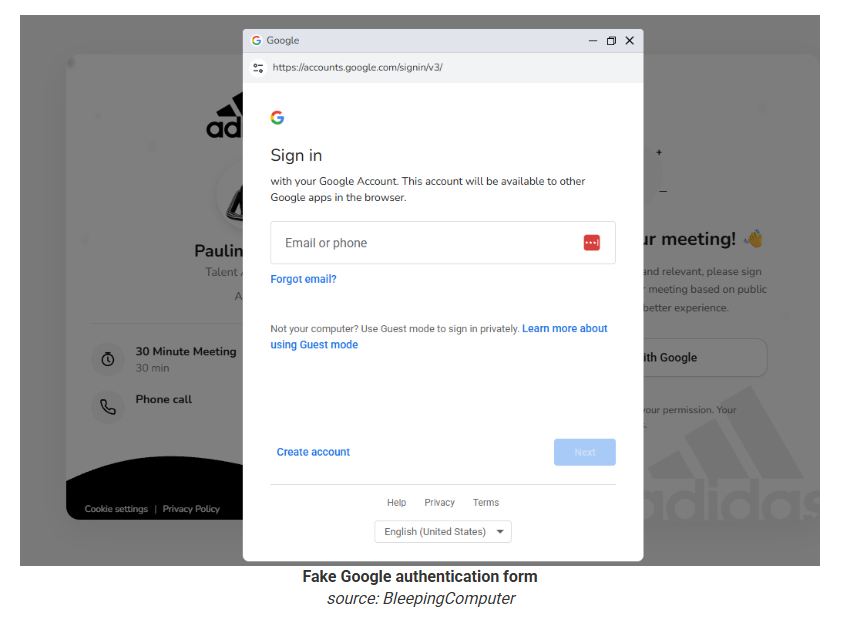
The lure is a fake job interview or scheduling request from a “recruiter” representing one of these major companies. The impersonating website then shows the victim a fake Google sign-in pop-up built inside the page, rather than a real browser window.

Example of sign-in window

To avoid detection, the attackers route victims through a chain of legitimate services before they reach the phishing site. So, instead of going straight from A to D, you go A → B → C → D. In phishing, attackers use this to make the final malicious site look less suspicious, because the victim passes through legitimate-looking services first.

“The operation is abusing the legitimate cloud-based PeopleForce human resources platform and a domain associated with the Salesforce Marketing Cloud service before redirecting the recipient to a malicious landing page.”

BleepingComputer noted that the campaign has been running for at least five months and primarily targets people in marketing roles. We know from our own investigations that job-themed phishing is extremely common and is likely especially effective while entry-level positions remain highly competitive and AI continues to shape the job market.

How to stay safe

Campaigns like these show how AI-enabled scams reshape scams, identity theft, and the ways attackers exploit trust.

As Stefan Dasic wrote in a post about a similar campaign that phished for Facebook credentials:

“The best protection isn’t spotting the fake—it’s knowing that no legitimate hiring process will ever require you to authenticate through an unfamiliar page, whether it’s dressed up as Google, Facebook, or anything else. When in doubt, close the tab, go to the company’s website yourself, and apply the old-fashioned way.”

Other useful tips include:

  • Don’t click links or open attachments in unsolicited job offers.
  • Use a password manager. It won’t autofill your Google username and password on a fake website.
  • Use an up-to-date, real-time anti-malware solution with web protection.

Pro tip: Malwarebytes Scam Guard would have helped identify this attack as a scam.


Something feel off? Check it before you click.  

Malwarebytes Scam Guard helps you analyze suspicious links, texts, and screenshots instantly.  

Available with Malwarebytes Premium Security for all your devices, and in the Malwarebytes app for iOS and Android.  

Try it free → 

May 2026 Dark Web Issue Trend Report

Notes the May 2026 Dark Web Issue Trend Report summarizes the Major Issues that occurred on the deep web and dark web. it stated that due to the nature of the sources, some of the information cannot be fully verified for factual accuracy. Major Issues Hasan’s BreachForums experienced a moderator split, with HasanBroker being ousted […]

Inside AD CS Escalation: Unpacking Advanced Misuse Techniques and Tools

Unit 42 analyzes AD CS exploitation through template misconfigurations and shadow credential misuse while offering behavioral detection for defenders.

The post Inside AD CS Escalation: Unpacking Advanced Misuse Techniques and Tools appeared first on Unit 42.

FBI, Indonesian Authorities Team to Take Down Site Ripping Off Users for Millions 

Phishing still hooks users around the world and coaxes them to hand over credentials. But on occasion the good guys take them down, like the FBI in collaboration with Indonesian law enforcement did with W3LLStore marketplace. 

The post FBI, Indonesian Authorities Team to Take Down Site Ripping Off Users for Millions  appeared first on Security Boulevard.

Banning Routers Won’t Secure the Internet

Washington’s push to ban foreign-made Wi-Fi routers may sound tough on cybersecurity, but like earlier bans on foreign drones and telecom gear it risks becoming security theater that ignores the real problem: Millions of unpatched devices already sitting on American networks.

The post Banning Routers Won’t Secure the Internet appeared first on Security Boulevard.

How to Setup Credentials for Windows to Use DigiCert KeyLocker & SMCTL?

Before you can securely sign software or automate code signing in your Windows environment, you will need to configure your credentials for DigiCert® KeyLocker and the Signing Manager Command-Line Tool (SMCTL). Your credentials create a trusted connection between your local signing tools and DigiCert ONE to ensure that only authorized users are able to access… Read More How to Setup Credentials for Windows to Use DigiCert KeyLocker & SMCTL?

The post How to Setup Credentials for Windows to Use DigiCert KeyLocker & SMCTL? appeared first on SignMyCode - Resources.

The post How to Setup Credentials for Windows to Use DigiCert KeyLocker & SMCTL? appeared first on Security Boulevard.

❌