❌

Visualização de leitura

Australian Data Breach Incidents Up 66% as AI Sharpens Scams

ASD Cyber Threat Report

Australians filed a cybercrime report about every six minutes over the past year, and artificial intelligence is making the attacks behind those reports faster and more convincing. That is the main finding of the ASD Cyber Threat Report 2025-26. It is the seventh annual assessment from the Australian Signals Directorate’s Australian Cyber Security Centre (ASD’s ACSC).

In FY2025-26, the agency received more than 82,000 cybercrime reports through ReportCyber. It responded to over 1,500 cyber security incidents, up more than 20% on the previous year and 36% over five years. It also notified Australian entities of potentially malicious activity more than 4,400 times, almost 80% more than in FY2024-25.

What the ASD Cyber Threat Report Says About AI

The report calls AI the defining force in the threat environment this year. In his foreword, Deputy Prime Minister and Defence Minister Richard Marles wrote that AI is helping malicious actors find vulnerabilities faster and exploit them at greater scale, speed and sophistication. He also noted that new threats have emerged in recent weeks from the unintended actions of AI agents and from model testing.

ASD’s ACSC makes one clear distinction. AI has not created new kinds of threats. It has amplified and sped up existing ones. AI-enabled cyber threats are most visible in social engineering. Attackers are using AI to write phishing emails with no spelling or grammar errors and to automate targeted spearphishing. The Australian Securities and Investments Commission has also seen a sharp rise in scams that use deepfake videos of celebrities and politicians.

The time defenders have to respond is also shrinking. The agency has previously observed that most vulnerabilities are exploited within two weeks, and some within 48 hours of a patch being released. It expects AI-driven tools to shorten that window further over the next 12 months. Publicly reported vulnerabilities (CVEs) rose 30%. Old flaws are still a problem too: ASD’s ACSC recorded the successful exploitation of a vulnerability first identified in 2008.

Incident Severity Grows in ASD Cyber Threat Report Data

Only one Category 2 incident was recorded this year. However, extensive compromises rose from 26 to 40. ASD’s ACSC identified 362 incidents after proactively notifying organisations. A single notification about cPanel vulnerabilities, sent to 340 entities in May 2026, led to more than 60 confirmed incidents.

The number of ransomware incidents held steady at 139, but extensive ransomware incidents rose from 16 to 24. Health Care, Professional, Scientific and Technical Services, and Manufacturing remained the most affected sectors. Data breaches made up 98 incidents, a 66% increase on the previous year. Separately, the Office of the Australian Information Commissioner received 1,205 breach notifications in 2025. That is the highest yearly total since its Notifiable Data Breaches scheme began in 2018.

The financial impact is rising for businesses. The average self-reported cost of cybercrime per business report rose 16% to $93,500. For medium-sized businesses, it rose 45% to $141,300. The average cost for individuals stayed at $33,000. Identity fraud remained the most reported cybercrime, although reports fell 18%.

Stolen access is now a major entry point. Compromised accounts and credentials were among the most frequently reported incident categories, and phishing appeared in 39% of incidents. Government survey research cited in the report found that 55% of Australians reuse passwords across multiple accounts.

State Actors and Critical Infrastructure in the ASD Cyber Threat Report

State-sponsored actors continued to target Australian government, business and individuals to gain sensitive information. The report says these actors are increasingly pre-positioning inside networks to enable future disruption. Marles wrote that the line separating state-sponsored espionage from sabotage and cybercrime is becoming increasingly blurred.

In April 2026, ASD’s ACSC and international partners highlighted a shift by China-nexus actors. These actors are moving towards large covert networks built from compromised home and small office routers, Internet of Things devices and smart devices.

Critical infrastructure accounted for 154 incidents, or 10% of the total, a decrease of almost 7%. Phishing was the leading initial access technique at 36%, and Financial and Insurance Services was the most affected critical infrastructure division at 30%.

What the Threat Report Asks Organisations to Do

In October 2026, ASD’s ACSC released the Essentials series. It evolves the Essential Eight into a principles-based framework with three chapters: Enterprise IT, Operational Technology and Cloud.

Under its Cyber Action Year, the agency is pushing five priorities:

  • Replacing or mitigating legacy technology.
  • Implementing best-practice event logging.
  • Managing supply chain risk.
  • Preparing for AI-enabled threats.
  • Preparing for post-quantum cryptography, including ceasing the use of traditional asymmetric cryptography by the end of 2030 or sooner.

The report also urges organisations to patch faster. For individuals, it recommends reviewing privacy settings and enabling multi-factor authentication or passkeys.

Suspicious activity, incidents and vulnerabilities can be reported at cyber.gov.au or through the Australian Cyber Security Hotline on 1300 CYBER1 (1300 292 371).

FBI, CISA Warn SafePay Ransomware Has Hit 600+ Victims

SafePay ransomware

The FBI, CISA and international partners have issued a warning about SafePay ransomware, a group that has impacted at least 600 victims across multiple critical infrastructure sectors since August 2024. Published on October 20, 2026, the joint cybersecurity advisory describes SafePay as among the most active ransomware groups in 2026, with operations affecting organizations in North America, South America, Europe and Australia.

The advisory was released by the FBI, the Cybersecurity and Infrastructure Security Agency (CISA), the United States Secret Service, Germany’s Landeskriminalamt Rheinland-Pfalz, the United Kingdom’s National Crime Agency and the UK’s North West Regional Organised Crime Unit. It draws on investigations conducted as recently as August 2026.

How SafePay Ransomware Gains Initial Access

According to the agencies, SafePay actors break into networks by stealing or guessing passwords, running brute force attacks, using phishing and exploiting VPN access. The group uses IP addresses from the VPN provider Mullvad and phished account profiles to exploit two flaws in edge devices: CVE-2020-3259 and CVE-2023-20269.

The actors also use automated scripts to exploit three vulnerabilities in internet-exposed systems: CVE-2023-27532, CVE-2024-40711 and CVE-2024-40766.

Living Off the Land Inside Victim Networks

Once inside, SafePay actors establish persistence by gaining administrative privileges on existing accounts or creating new ones. They rely on built-in tools such as PsExec, Windows Remote Management and Remote Desktop Protocol to execute commands and move laterally.

To find valuable files, the group has used ShareFinder.ps1 and SharpShares.exe to enumerate network shares. Before moving laterally, the actors commonly disable security software. In some cases, they changed system users’ passwords, locking legitimate users out. The advisory also notes the use of a User Account Control bypass, token impersonation and the credential dumper Mimikatz.

Data Exfiltration Before Encryption

Data exfiltration is a central part of the group’s playbook. SafePay actors compress files using 7-Zip, WinRAR, FileZilla and RClone, then move stolen data out through WinSCP, RClone, OneDrive and the Backblaze command-line tool b2.exe. Remote desktop tools such as AnyDesk and TeamViewer have been installed to transfer ransomware onto victim systems.

To block recovery, the actors halt the Volume Shadow Copy Service and reset network attached storage holding backups to factory settings.

Files are then encrypted using a hybrid scheme combining the ChaCha20 stream cipher with RSA public-key cryptography. Encrypted files carry the .SafePay extension and, according to the advisory, cannot be recovered without the decryption key.

The group typically demands a portion of company revenue in cryptocurrency. A ransom note left on the desktop or root directory directs victims to a TOR chat portal, using a victim ID to log in. A representative also makes phone calls to pressure victims. If payment is refused, stolen data is posted to SafePay’s leak site. The ransomware may delete itself after encryption.

SafePay Ransomware Advisory: Recommended Defenses

To reduce the risk of ransomware attacks from SafePay, the agencies urge organizations to prioritize patching known exploited vulnerabilities, especially on firewalls and other internet-facing systems. They recommend requiring multifactor authentication for webmail, VPNs and accounts that access critical systems.

Other measures include passwords of 15 to 64 characters, account lockouts after failed logins, offline backups that are encrypted and immutable, network segmentation, least privilege access and time-based admin access. The advisory also recommends restricting command-line and scripting permissions.

The advisory lists IP addresses, file names, hashes and hostnames observed between November 2024 and August 2026. The agencies advise verifying these indicators before blocking, as some IP addresses may later be reassigned to benign services.

The authoring agencies do not encourage paying ransom, noting payment does not guarantee file recovery. Incidents can be reported to the FBI’s Internet Crime Complaint Center, a local FBI or Secret Service field office, or CISA. In the UK, victims can report through Report Fraud or their local police force.

Cloudflare
Verify you are human
loading
Checking your browser before accessing this site.
Click to verify →
Then you will be redirected to the requested content.
Ray ID: 8f3a2c1b9d4e5f6a · Performance & security by Cloudflare

site-verification-ok

US Puts $10 Million Bounty on Alleged Iranian Cyber Chief

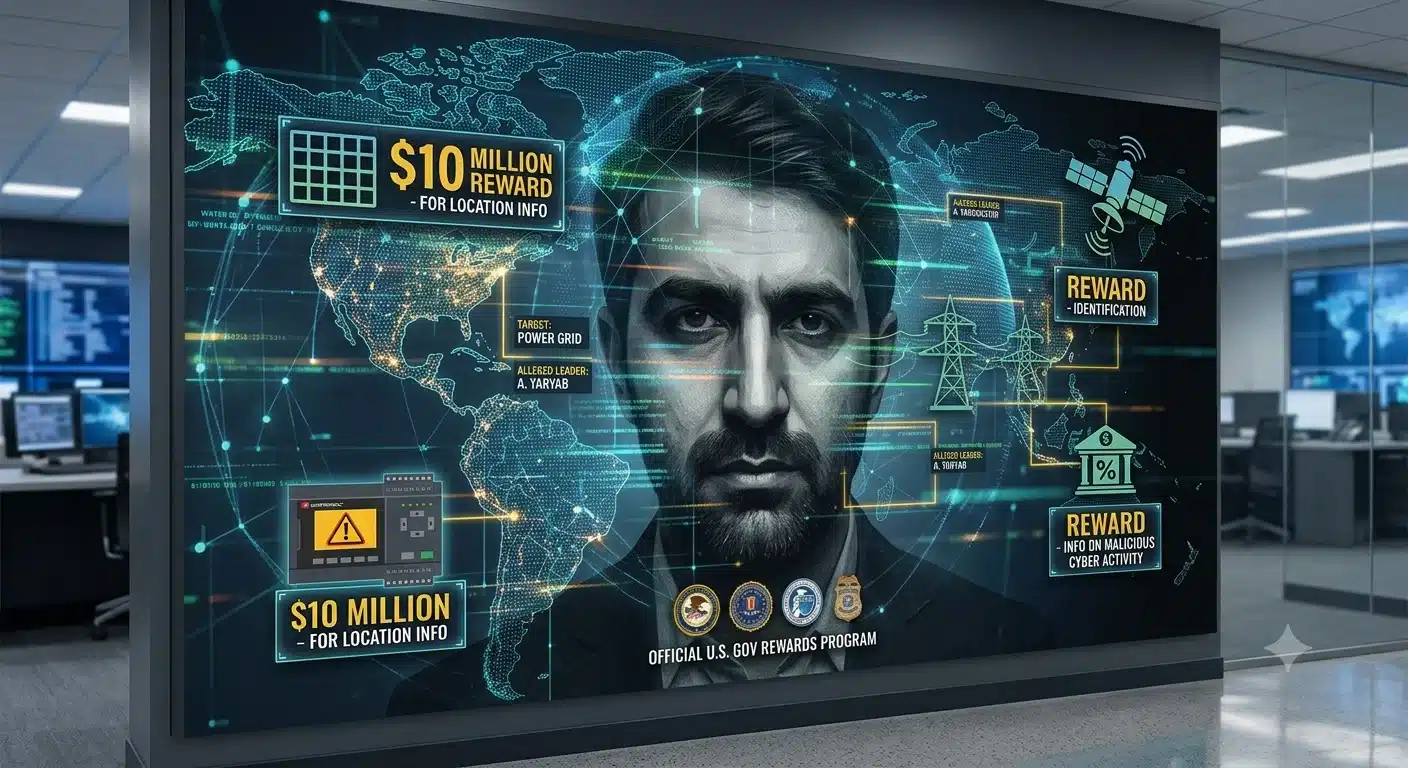
$10 Million Reward for Amir Yaryab

The U.S. State Department has posted a $10 million reward for Amir Yaryab, a senior Iranian official accused of leading the Islamic Revolutionary Guard Corps Cyber-Electronic Command (IRGC-CEC) Cyber Operations Command and directing multiple hacking groups targeting critical infrastructure across the United States, Europe and the Middle East. According to the Rewards for Justice program, Yaryab allegedly oversees cyber operations conducted by IRGC-CEC-affiliated groups including CyberAv3ngers, Dadeh Afzar Arman (DAA) and Mehrsam Andisheh Saz Nik (MASN). U.S. officials accuse these groups of using malware and conducting cyber and cyber-enabled information operations against civilian infrastructure worldwide.

$10 Million Reward for Amir Yaryab

The $10 million reward for Amir Yaryab seeks information leading to his identification or location. The offer applies to individuals acting at the direction or under the control of a foreign government who participate in malicious cyber activities against U.S. critical infrastructure in violation of the Computer Fraud and Abuse Act. [caption id="attachment_113961" align="aligncenter" width="600"]$10 million reward for Amir Yaryab Image Source: https://rewardsforjustice.net/[/caption] Yaryab is also accused of directing Shahid Hemmat and Shahid Shushtari, two groups linked to cyberattacks against U.S. organizations. The sectors allegedly targeted include defense, news, shipping, travel, energy, financial services and telecommunications. The six Iranian officials named in the advisory are linked to Iran's Islamic Revolutionary Guard Corps and its Cyber-Electronic Command.

Iranian Cyberattacks Target PLCs

The allegations also involve attacks against programmable logic controllers (PLCs), highlighting concerns around Iranian cyberattacks targeting industrial systems rather than focusing only on data theft. U.S. officials said Iranian-linked hackers compromised industrial control systems, specifically targeting the Vision series of PLCs manufactured by Israel-based Unitronics. These devices are used across water and wastewater, energy, food and beverage, manufacturing and healthcare sectors. The attackers exploited default credentials on the devices and left anti-Israel messages. Some of the compromises reportedly rendered the PLCs inoperative. The CyberAv3ngers group, which is linked to the IRGC-CEC, claimed responsibility for attacks against Unitronics Vision PLCs in October 2023. Beginning in November 2023, the group compromised default credentials in PLCs across the United States and left messages on the devices' digital screens.

CyberAv3ngers Attacks Critical Infrastructure

CyberAv3ngers has also claimed responsibility for attacks affecting other infrastructure. In October 2023, the group claimed it had breached ORPAK Systems, a provider of gas station solutions in Israel. The group said it had obtained the company's database and intended to publish it through its Telegram channel. The attack was reported to have disconnected 200 gasoline pumps from the system in the occupied Palestinian territories. In December 2023, CyberAv3ngers also claimed to possess and sell 1TB of data allegedly linked to Israel's electricity infrastructure. The group advertised the dataset for 5 Bitcoin, with an initial 100GB portion also offered at the same price.

U.S. Agencies Warn of PLC Cyberattacks

Concerns over critical infrastructure attacks involving PLCs continued into 2026. A joint advisory issued on April 7 by the FBI, CISA, NSA and other agencies warned that Iran-linked threat actors were actively exploiting internet-facing PLCs. The advisory said several organizations had experienced operational disruptions and financial losses after attackers interfered with industrial processes. The developments come amid broader U.S. actions against Iranian-linked cyber activity. The Justice Department accused Iran-connected hackers of breaching employee email accounts associated with the Department of Labor, the Federal Energy Regulatory Commission and multiple United Nations organizations. The Treasury Department also sanctioned Iranian nationals over cyberattacks targeting critical infrastructure. The State Department's reward offer places Amir Yaryab and the alleged activities of IRGC-CEC-linked groups at the center of the U.S. effort to identify individuals responsible for malicious cyber activity targeting critical infrastructure.

CISA, FBI Urge Clearer Communication During Major Outages

outage communications

The CISA and FBI, along with cybersecurity agencies from Australia, Canada, New Zealand and the U.K., have released new guidance on outage communications for service providers dealing with major IT and OT outages. The guide calls for prompt, factual and audience-specific communication during disruptions caused by malicious cyber activity or non-malicious events.

Titled “Communicating Under Pressure: Best Practices for Service Providers,” the guidance says effective communication is critical to limiting operational impact when IT and OT outages affect customers, network defenders, critical infrastructure owners and operators, and the public. It recommends that organizations clearly communicate what is known, what remains unknown and what is still under investigation, while providing frequent updates as circumstances change.

Outage Communications Should Start With Facts

The agencies recommend that service providers establish an outage communications plan before an incident occurs. The plan should define incident thresholds, escalation paths, target audiences and procedures for status pages, customer and partner notices, and regulatory communications. Organizations are also advised to establish cross-functional incident teams involving engineering and operations, communications, legal, risk and compliance, and customer support.

The guidance calls for clearly defined roles, including an incident lead, communications lead and spokesperson. It also recommends parallel workstreams so technical teams can focus on diagnosing and remediating the root cause while communications teams manage external messaging and leadership handles strategy and regulatory requirements.

For organizations responding to cyber incidents, the guidance places particular emphasis on balancing transparency with operational security. If malicious activity is suspected or confirmed, external communications should not compromise investigations, containment efforts or other response activities. Organizations are also advised against making premature conclusions when the root cause remains under investigation.

Service Providers Urged to Tailor Messages

The guidance recommends segmenting communications for technical teams, executives and the public. Audiences can include enterprise IT teams and security operations centers, employees and customers, government partners and regulators, critical infrastructure owners and operators, as well as the media and general public.

During an outage, organizations should lead with a concise summary covering affected systems, user impact, scope and the known cause without speculation. The agencies also advise against vague descriptions such as “service degradation” and recommend messaging that can be understood quickly during high-pressure situations.

Transparency is another central principle. Service providers are advised to state what they know and do not know, use a single source of truth such as a status page, and focus communications on actionable guidance rather than reputation management. Customers should be told what actions they need to take or clearly informed when no action is required.

The guidance also calls for continuous, time-stamped updates that show the incident timeline, actions taken, and recovery milestones. Organizations should maintain a single status page and align external messaging with legal, contractual and sector-specific reporting obligations.

Agencies ultimately frame effective outage communications around five principles: immediate acknowledgement, technical and actionable information, transparency, accountability, and continuous updates. For service providers, the guidance positions communication as an important part of incident response, alongside technical remediation and recovery.

US, South Korea Warn of Growing Gunra Ransomware Threat

U.S. and South Korean authorities warn about the growing Gunra ransomware threat as the operation expands its capabilities and affiliate network.

The post US, South Korea Warn of Growing Gunra Ransomware Threat appeared first on TechRepublic.

Researcher: Flaw In Fleet Management Service Exposes 250k Commercial Vehicles To Attack

A quarter million commercial vehicles in India and sensitive data on tens of thousands of drivers were vulnerable to attacks because of flaws in widely used fleet management software maintained by a VE Commercial Vehicles, a joint venture between the Volvo Group and Eicher Motors, a security researcher has revealed.

The post Researcher: Flaw In Fleet Management Service Exposes 250k Commercial Vehicles To Attack appeared first on The Security Ledger with Paul F. Roberts.

Talos: Attackers Refine Phishing Playbook To Target Critical Infrastructure

Phishing played a part in more than half of all incident response engagements undertaken by Talos, Cisco's threat research organization, during the second quarter of 2026, with healthcare organizations and manufacturing firms among the top targets.

The post Talos: Attackers Refine Phishing Playbook To Target Critical Infrastructure appeared first on The Security Ledger with Paul F. Roberts.

Edge Devices Are Your Cyber Underbelly. Here’s Why.

In this episode of the podcast, host Paul Roberts interviews Nishawn Smagh of the firm GreyNoise Intelligence about the findings of their State of the Edge report, an analysis of GreyNoise data on risks stemming from compromised edge devices such as broadband routers, VPN gateways, smart home devices and more. Shawn and Paul talk about how attackers are turning edge devices into their favorite entry point, and strategies for organizations to counter the growing risk of compromised edge devices.

The post Edge Devices Are Your Cyber Underbelly. Here’s Why. appeared first on The Security Ledger with Paul F. Roberts.

💾

Residential Proxy Risks: Understanding Google’s Latest Action Against 2 Million Strong NetNut

Google announced that it helped take down NetNut, a 2 million strong malicious residential proxy network. The incident highlights the growing risks posed by residential proxy networks that quietly conscript consumer devices into services used by cybercriminals and nation-state actors alike.

The post Residential Proxy Risks: Understanding Google’s Latest Action Against 2 Million Strong NetNut appeared first on The Security Ledger with Paul F. Roberts.

Insights from CISA’s red team findings and the evolution of EDR

A recent CISA red team assessment of a United States critical infrastructure organization revealed systemic vulnerabilities in modern cybersecurity. Among the most pressing issues was a heavy reliance on endpoint detection and response (EDR) solutions, paired with a lack of network-level protections.

These findings underscore a familiar challenge: Why do organizations place so much trust in EDR alone, and what must change to address its shortcomings?

EDR’s double-edged sword

A cornerstone of cyber resilience strategy, EDR solutions are prized for their ability to monitor endpoints for malicious activity. But as the CISA report demonstrated, this reliance can become a liability when paired with inadequate network defenses. Here’s why:

  1. Tunnel vision on endpoints: EDR excels at identifying threats on individual devices but struggles with network-wide attacks. This leaves gaps when hackers exploit lateral movement or unusual data transfers — activities that often require network-level visibility to detect.
  2. Playing catch-up with threats: Traditional EDR tools depend on recognizing known indicators of compromise (IOCs). Advanced attackers can easily sidestep these tools by using novel techniques or blending in with legitimate activity.
  3. Blind spots in legacy systems: Legacy environments often go unnoticed by EDR, giving attackers free rein. In the CISA case, these systems allowed the red team to persist for months undetected.
  4. Overwhelmed defenders: Even when EDR generates alerts, security teams can become desensitized by a flood of notifications. As seen in the CISA assessment, critical warnings can slip through the cracks simply because defenders are too stretched to respond.

Common EDR pain points

The challenges highlighted in the CISA report mirror broader issues organizations face with EDR:

  • Detection without context: EDR tools often spot anomalies on endpoints but fail to connect the dots across the broader network. This lack of context can leave organizations blind to coordinated attacks.
  • Weak network integration: Without network-layer defenses, EDR struggles to identify malicious activities like unusual traffic patterns or data exfiltration, key tactics in advanced breaches.
  • Fragmented systems: Many organizations operate a patchwork of security tools, leaving critical gaps in coverage and making it harder to correlate data across endpoints, networks and cloud environments.
Explore threat detection and response services

The next evolution of EDR

Recognizing these shortcomings, cybersecurity is rapidly evolving beyond traditional EDR. Here’s how:

  1. Extended detection and response (XDR): XDR takes EDR to the next level by integrating endpoint, network and cloud data into a single platform. This broader scope allows organizations to see the full attack picture and respond more effectively.
  2. AI-driven insights: Cutting-edge EDR solutions now harness machine learning to detect subtle behavioral anomalies. By identifying deviations from normal activity, these tools catch threats even when no IOCs exist.
  3. Zero trust security: Zero trust architectures take endpoint defense a step further by ensuring no device or user is trusted by default. This integration of endpoint, identity and network security reduces dependence on EDR alone.
  4. Network visibility: Modern EDR tools are incorporating network traffic analysis to close the gaps identified in the CISA report. Monitoring traffic for anomalies, such as unusual data flows or external connections, bolsters defenses.
  5. Cloud-native solutions: As businesses embrace hybrid and cloud environments, EDR is evolving to provide seamless coverage across on-premises and cloud systems, addressing vulnerabilities in these critical areas.

Why do gaps persist?

Even with these advancements, many organizations struggle to fully address EDR’s limitations:

  • Resource strains: Small security teams often lack the bandwidth or expertise to implement and manage advanced solutions like XDR.
  • Budget constraints: Upgrading to integrated platforms or modernizing legacy systems can be costly.
  • Legacy challenges: Outdated environments remain vulnerable, acting as weak points that attackers can exploit.
  • Leadership missteps: As the CISA report pointed out, organizations sometimes deprioritize known vulnerabilities, leaving critical gaps unaddressed.

Building a more resilient future

The CISA red team findings are a wake-up call: Endpoint protection alone is no longer enough. To outsmart today’s sophisticated adversaries, organizations must adopt a layered defense strategy that integrates endpoint, network and cloud security. Solutions like XDR, zero trust principles and advanced behavioral analysis offer a path forward — but they require strategic investments and cultural shifts.

The post Insights from CISA’s red team findings and the evolution of EDR appeared first on Security Intelligence.

Is the water safe? The state of critical infrastructure cybersecurity

On September 25, CISA issued a stark reminder that critical infrastructure remains a primary target for cyberattacks. Vulnerable systems in industrial sectors, including water utilities, continue to be exploited due to poor cyber hygiene practices. Using unsophisticated methods like brute-force attacks and leveraging default passwords, threat actors have repeatedly managed to compromise operational technology (OT) and industrial control systems (ICS).

Attacks on the industrial sector have been particularly costly. The 2024 IBM Cost of a Data Breach report found the average total cost of a data breach in the industrial sector was $5.56 million — an 18% increase for the industry compared to 2023. This represents the highest data breach cost increase of all industries surveyed in the report, rising by an average of $830,000 per breach over last year.

Ongoing vulnerabilities pose a serious threat to public safety and national security, especially as water systems and other critical infrastructure providers remain underprepared in the current threat landscape. Let’s take a closer look at the current state of critical infrastructure security, highlighting recent incidents, efforts to address vulnerabilities and the need for further collaboration between the government and private sectors.

Arkansas City Water Treatment Facility attacked

The cybersecurity incident at the Arkansas City Water Treatment Facility on September 22 exemplifies the growing risks. While city officials emphasized that the water supply remained safe and no disruption to service occurred, the breach still forced the facility to switch to manual operations. The incident is currently under investigation, with local authorities and cybersecurity experts collaborating to resolve the issue and prevent further attacks. But the Arkansas City breach is not an isolated incident; it mirrors a larger trend of attacks on water systems.

CISA has issued multiple warnings regarding the susceptibility of water and wastewater systems to cyber threats. Intruders often exploit outdated and unsecured OT and ICS environments, where systems are exposed to the internet or still using default credentials. This means cyber criminals can gain access using relatively simple techniques, which raises concerns about the overall preparedness of critical infrastructure operators.

CISA warnings and hacktivist activity

CISA’s September alert is not the first indication of the heightened threat to water and other critical infrastructure providers. Earlier in 2024, the agency warned that Russia-affiliated hacktivists were actively targeting ICS and OT environments in U.S. critical infrastructure facilities. Water systems, dams and sectors, such as energy and food, were particularly vulnerable to these attacks.

The situation worsened with the rise of the Cyber Army of Russia Reborn, a hacktivist group tied to Advanced Persistent Threat 44 (APT44), commonly known as Sandworm. The group has been quite busy exploiting weak cybersecurity postures of smaller water systems that lack adequate cyber defense resources.

According to Keith Lunden of Mandiant, “We expect these attacks to continue for the foreseeable future given the lack of dedicated cybersecurity personnel for many small- and mid-sized organizations operating OT.” Unfortunately, hacktivist groups have exploited these gaps with relative ease. And without rapid intervention, these attacks will likely continue.

Read the Threat Intelligence Index

The State and Local Cybersecurity Grant Program (SLCGP)

Amidst the growing cyber threats, the U.S. Department of Homeland Security (DHS) has recognized the need for more support for state and local government cybersecurity. In fiscal year 2024, DHS announced the allocation of $280 million in grant funding for the State and Local Cybersecurity Grant Program (SLCGP). This funding aims to assist state, local, tribal and territorial governments in enhancing their cyber resilience. A special emphasis has been placed on protecting critical infrastructure systems like water utilities, energy grids and emergency services.

These grants will help organizations improve monitoring systems, patch vulnerabilities and implement critical cybersecurity measures such as multi-factor authentication and regular system audits. In states like Michigan, for example, government agencies are already working with local water utilities to provide cybersecurity training and support. The DHS funding could greatly expand these efforts, offering a much-needed boost to the security posture of critical infrastructure providers.

The Cyberspace Solarium Commission

In 2019, the Cyberspace Solarium Commission (CSC) was established by the U.S. Congress to develop a national cyber defense strategy. Currently, approximately 80% of its recommendations have been implemented. However, a final push is needed to address critical gaps, particularly regarding private-sector collaboration and insurance reforms.

One major challenge is identifying the “minimum security burdens” for systemically important entities critical to national security. This would ensure that high-priority infrastructure providers, such as key transportation systems and water utilities, receive the necessary support to prevent catastrophic events.

The CSC also highlighted the need to develop an economic continuity plan for cyber events. This would be nothing less than an incident response and resilience plan to protect the U.S. economy in the face of a major cyberattack. The commission also emphasized the need for better information sharing between government agencies, private industries and international partners to protect critical infrastructure from evolving cyber threats.

During a recent panel discussion, Senator Angus King, co-chair of CSC 2.0, pointed to the difficulties of building trust between the government and private sectors. Private entities own and operate the majority of the nation’s critical infrastructure, but historical tensions make collaboration challenging. King noted that the situation mirrors early tensions that existed between state officials and CISA. Nonetheless, the collaboration between private industry and government is essential to address the growing threat to critical infrastructure.

The state of critical infrastructure cybersecurity

The cybersecurity posture of U.S. critical infrastructure remains a concern. As seen in attacks like the Arkansas City Water Treatment Facility and other incidents targeting internet service providers, threat actors are increasingly focusing on essential services. These attacks are not limited to small municipalities. Larger-scale infrastructure providers, including ISPs and managed service providers, have also been targets.

The FBI recently disclosed that China-linked hackers compromised more than 260,000 network devices, underscoring the scale of the problem. Meanwhile, attacks attributed to the Chinese government have targeted ISPs and managed service providers through vulnerabilities in Versa Networks’ SD-WAN software, demonstrating the growing sophistication of these threats.

While the U.S. government is actively working to improve critical infrastructure cybersecurity, the attacks on water treatment systems and other essential services clearly reveal that more needs to be done. The DHS grant program and the recommendations of the Cyberspace Solarium Commission represent critical steps in this effort, but collaboration between government, private industry and international partners will be key to building a resilient defense against evolving threats.

The safety of critical infrastructure remains a pressing concern. Recent events should serve as a wake-up call for operators, policymakers and the public to take action before a cyberattack occurs that impacts human life and health. Undoubtedly, the threats are real — and any meaningful response requires a concerted effort.

The post Is the water safe? The state of critical infrastructure cybersecurity appeared first on Security Intelligence.

DHS: Guidance for AI in critical infrastructure

At the end of 2024, we’ve reached a moment in artificial intelligence (AI) development where government involvement can help shape the trajectory of this extremely pervasive technology.

In the most recent example, the Department of Homeland Security (DHS) has released what it calls a “first-of-its-kind” framework designed to ensure the safe and secure deployment of AI across critical infrastructure sectors. The framework could be the catalyst for what could become a comprehensive set of regulatory measures, as it brings into focus the significant role AI will play in securing key infrastructure systems.

As Secretary Alejandro N. Mayorkas put it, “AI offers a once-in-a-generation opportunity to improve the strength and resilience of U.S. critical infrastructure, and we must seize it while minimizing its potential harms. The framework, if widely adopted, will go a long way to better ensure the safety and security of critical services that deliver clean water, consistent power, internet access and more.”

Mayorkas’ statement underscores the urgency of getting it right, as today’s decisions will profoundly shape how AI impacts vital systems in the future.

Key features of the DHS AI framework

The framework lays out clear roles and responsibilities for the parties involved in AI development and deployment for critical infrastructure.

Risk management guidance: DHS suggests an approach that incorporates ongoing risk management, advising stakeholders to continually identify, assess and mitigate potential AI risks. The recommendation includes adopting transparent mechanisms to track AI decisions that could impact essential services.

Ethical standards for developers: The guidelines stress the importance of incorporating ethical considerations into AI design, and make a push for responsible practices that minimize harm and ensure equitable treatment.

Collaboration across sectors: Recognizing the interconnected nature of infrastructure, DHS is promoting collaboration between public and private sectors to share best practices and vulnerabilities effectively. Information sharing is always a great way to minimize the risks brought about by both deliberate attacks and unintended failures.

Incident response preparedness: The framework also outlines how AI developers and operators should prepare for potential incidents; clear protocols must be in place to quickly address issues before they escalate.

Explore AI cybersecurity solutions

What are the responsibilities of AI developers?

One of the most notable aspects of the DHS report is the explicit focus on the responsibilities of AI developers.

The guidelines set a new precedent by outlining clear expectations, especially for those creating AI tools meant to operate in or interact with critical infrastructure.

This focus on developers is particularly important because they are at the forefront of creating technology that directly influences critical systems. The decisions made during the design, development and deployment phases can have significant consequences and impact everything from public safety to national security. By giving developers a structured set of responsibilities, DHS is hoping to create a culture of accountability and foresight in the AI community.

As such, AI developers are encouraged to take the following actions to align with the new guidelines.

Design with risk in mind: Developers are urged to build AI systems that prioritize safety and resilience from the ground up, especially when the technology is intended to interact with critical services like power grids or communication networks. This means integrating fail-safes, conducting stress tests and simulating potential failure scenarios during the design phase.

Adopt explainable AI practices: Transparency is crucial for AI developers. The framework urges the adoption of explainable AI techniques that allow human operators to understand why certain decisions were made. This practice boosts trust while also providing an audit trail that can be useful in identifying the root causes of any issues that arise.

Collaborate for broader impact: Developers should not just work alone but actively engage with a broader community of stakeholders, including policymakers, users and other tech creators. After all, collaboration helps ensure that AI tools are safe, reliable and ready to operate under real-world conditions.

By following these guidelines, developers can help build AI systems that meet technical standards and also align with societal values and safety requirements. The focus on explainable AI, risk-based design and collaboration creates a balanced approach that can maximize the benefits of AI and minimize its potential downsides.

Why does this matter now?

The release of the AI framework is a good reminder that AI technology is not evolving in a vacuum. Today, AI is more pervasive than ever before, but its use in critical infrastructure demands the highest level of care and responsibility. With the focus on developers as important players in minimizing risks, the DHS is creating an environment where AI can thrive without compromising essential public services.

It’s important to note that the responsibility for secure AI extends beyond the developer stage. Tech organizations will play a key role as well. Arvind Krishna, Chairman and CEO of IBM, says, “The DHS Roles and Responsibilities Framework for Artificial Intelligence in Critical Infrastructure is a powerful tool to help guide the responsible deployment of AI across America’s critical infrastructure, and IBM is proud to support its development. We look forward to continuing to work with the Department to promote shared and individual responsibilities in the advancement of trusted AI systems.”

Secretary Mayorkas echoes those sentiments, adding, “The choices organizations and individuals involved in creating AI make today will determine the impact this technology will have in our critical infrastructure tomorrow.”

The secretary’s words capture the essence of why this framework matters: We need to shape the future of AI in a way that protects and enhances the services that are foundational to our society.

The post DHS: Guidance for AI in critical infrastructure appeared first on Security Intelligence.

❌