 Entrar

Japan Plans Major Cyber Hunt to Detect Hidden Attacks on Critical Infrastructure



The AI-Powered Intelligence for Cyber Defense initiative was formally launched Tuesday at DRONA Cyber Solutions' Command and Control Centre, where the companies presented a live technical demonstration showing how an intrusion attempt can be detected, investigated and contained.
The launch comes as India faces a growing cybercrime burden. India recorded 28.15 lakh cybercrime cases in 2025, a 24 percent increase over the previous year, with reported losses reaching ₹22,495 crore. The government's 1930 cybercrime helpline received 32.4 million calls during the year. Of the complaints filed, 55,484 were converted into FIRs. While large enterprises and banks increasingly have dedicated security teams, budgets and incident response capabilities, many manufacturers, hospital chains, schools and mid-sized businesses, particularly across Tier-2 and Tier-3 cities, continue to operate without comparable security resources.
The final containment action was authorised by a human analyst rather than executed automatically. The demonstration brought together multiple capabilities. Cyble Vision provided the initial detection through continuous monitoring of criminal marketplaces and leak sites.
Cyble Hawk supported the investigative process and attribution, while Cyble Titan handled endpoint enforcement, using hardware-level integrity checks to support its assessment. DRONA analysts remained at the centre of the process, making decisions that the system was deliberately not permitted to make independently. Mandar Patil, Executive Vice President at Cyble, said the initiative was designed to address a longstanding gap between threat detection and action for mid-sized businesses.
"India is not short of alerts. It is short of what happens next," Patil said. "We have spent a long time in this industry watching mid-sized businesses get told about a threat and then having nowhere to take that information. What we are launching today is not another alert. It is a complete chain — intelligence before the attack, investigation that would stand up to scrutiny, enforcement on the device, and a person accountable for the decision at the end of it."Dhruv Pandit, Co-Founder and CEO of DRONA Cyber Solutions, said the initiative reflects the operational needs of organisations that require immediate action rather than another security dashboard.
"A factory owner calling us at two in the morning does not want to be shown a dashboard," Pandit said. "He wants to know what happened, he wants it contained, and he wants someone to take responsibility for what happens next."
The session brought together speakers from Cyble and DRONA Cyber Solutions to examine areas including dark web threat intelligence, government and PSU cybersecurity projects, digital forensics and incident response (DFIR), and the transition of threat intelligence from information to action.
Mandar Patil and Augustin Kurian of Cyble discussed the dark web threat intelligence landscape. Prathmesh Pawar spoke about government and PSU cybersecurity projects, while Brijesh Kapadiya addressed DFIR and Vijay Mali discussed moving threat intelligence from information to action. The keynote was delivered by Prof. Dr. Kapil Kumar, Coordinator, Department of Biochemistry and Forensic Science.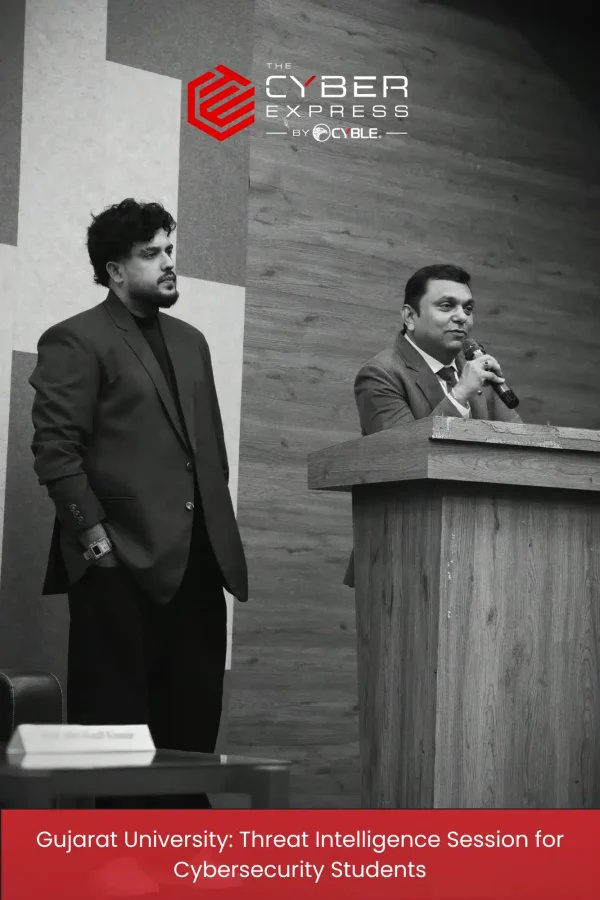
The session highlighted several practical aspects of cybersecurity work. The dark web was discussed not simply as a hidden part of the internet, but as a structured ecosystem requiring dedicated intelligence-gathering and threat-discovery methods. DFIR was presented as an area where speed and process are as important as technical expertise.
Another key takeaway was the importance of turning threat intelligence into action. Rather than treating intelligence as information alone, the session focused on how it can inform practical security decisions.
Patil told students that the cybersecurity industry faces a shortage of professionals with practical skills in analysing and validating threat intelligence."The gap this industry has is not a gap of ideas. It is a gap of people who know how to do the work," Patil said. "What separates a useful analyst from an alert-reader is the ability to ask whether a piece of intelligence is actually true before you act on it."Augustin Kurian, Editor-in-Chief of The Cyber Express, told students that threat intelligence and journalism share an emphasis on verification.
Every story we publish about a breach, a ransomware group or a leaked database starts exactly where today's demonstration started — with intelligence somebody had to go and find, verify, and decide was worth acting on," Kurian said. The instinct we have tried to build at The Cyber Express is the same instinct a good analyst needs: do not report, and do not act on, what you have not verified.The programme also involved technical and production teams supporting the session. Screen, sound and lighting were handled by the technical team under the guidance and supervision of Aditya More, while Misha Alagiya, Kavya Maharaja, Pathak Ami, Omi and Nandini supported stage management and photography.
"India's exposure is too large for any single partnership to take credit for solving," Patil said. "What matters is whether more of these collaborations exist a year from now, and whether the businesses we are talking about today — the ones without a security team — actually have somewhere to turn."
The AI-Powered Intelligence for Cyber Defense initiative will be delivered through DRONA's Ahmedabad command centre, with the companies indicating an intent to extend the service model to customers elsewhere in India over time.
The initiative also folds into DRONA's existing Cyber Yodha Campaign, a national programme aimed at building 50 integrated cybersecurity command centre labs and training more than 100,000 defenders.
When More Tools Create More Problems For years, organizations have approached cybersecurity with a simple mindset-add more tools to strengthen defenses. Firewalls, endpoint solutions, intrusion detection systems, and monitoring platforms have all been layered together to create what appears to be a comprehensive security posture. Yet, despite this growing investment, security outcomes have not improved
The post Why Traditional Security Tools Fail-and How Unified AI Platforms Solve the Problem appeared first on Seceon Inc.
The post Why Traditional Security Tools Fail-and How Unified AI Platforms Solve the Problem appeared first on Security Boulevard.

The latest shutdown may be temporary, but the damage at CISA is not. Staffing cuts, stalled leadership and political crossfire have hollowed out what was once a bright spot in federal cybersecurity. When institutions built on trust and coordination lose people and mission clarity, the risks extend far beyond Washington.
The post CISA on Life Support appeared first on Security Boulevard.
Effectively navigating and utilizing a Threat Intelligence Platform (TIP) can feel complex, particularly for those doing so for the first time. From triaging alerts to investigating threats and producing finished intelligence, the variety of features and workflows can be daunting. That’s why we’ve introduced the “Getting Started" module - an intuitive guide designed to walk users through each step, ensuring that both newcomers and experienced professionals can maximize the platform's capabilities with ease and efficiency.

The nature of cyber warfare has evolved rapidly over the last decade, forcing the world’s governments and industries to reimagine their cybersecurity strategies. While deterrence and reactive defenses once dominated the conversation, the emergence of cyber persistence — actively hunting down threats before they materialize — has become the new frontier. This shift, spearheaded by the United States and rapidly adopted by its allies, highlights the realization that defense alone is no longer enough to secure cyberspace.
The momentum behind this proactive cyber strategy can be found in America’s Defend Forward initiative, the rise of cyber persistence among U.S. allies and the successful takedowns of infamous groups like LockBit ransomware. Meanwhile, the broader implications of this shift are revealed in the U.S. Department of State’s focus on digital solidarity in contrast to digital sovereignty.
The idea of cyber persistence, as opposed to cyber deterrence, is reshaping global cybersecurity efforts. Traditional deterrence theory, which aims to dissuade adversaries through the promise of retaliation, has failed to address the complexities of cyber criminal behavior. Malicious cyber actors, including state-sponsored entities and organized crime groups, continue to exploit vulnerabilities, which leads to critical infrastructure compromise, sensitive data theft and government or corporate network disruption.
In response, the U.S. Department of Defense 2023 Cyber Strategy reinforced the country’s commitment to “Defend Forward,” a proactive approach designed to directly disrupt adversaries’ operations. This strategy empowers cybersecurity forces to identify malicious activities before they escalate, track adversaries and take action to prevent or mitigate attacks. U.S. allies like the United Kingdom, Japan, Canada and the Netherlands have subsequently adopted similar strategies. They’ve all come to realize that cyberspace requires constant vigilance and operational persistence to stay ahead of evolving threats.
As the U.S. DoD outlines, engaging adversaries early in planning is essential to creating a more secure cyberspace. This involves tracking the capabilities and intentions of malicious actors and degrading their ability to act. Such a proactive stance requires cooperation, coordination and trust among allies. This is especially true since cyber campaigns often involve joint operations where one nation may invite another into its networks to assist in defense.
Increasingly, nations like the UK and the Netherlands are taking proactive measures to combat cyber threats by operationalizing cyber persistence. For example, the UK’s National Cyber Strategy highlights the importance of actively tackling adversaries’ cyber dependencies and emphasizing the need for persistent engagement in cyberspace. Further examples of this shift include Japan’s efforts to introduce active cyber defense and Canada’s participation in “Hunt Forward” operations. Both aim to actively search for and disarm malicious actors.
NATO has also acknowledged the necessity of a more proactive cyber stance. The 2022 NATO Strategic Concept recognizes that cyberspace is “contested at all times.” The document explicitly states that the cumulative effect of cyber activities could reach the level of an armed attack, potentially triggering NATO’s mutual defense obligations under Article 5. This signals the acceptance of cyber persistence as a critical aspect of national and collective security.
While deterrence remains a core strategy for nuclear and conventional warfare, it is becoming clear that in cyberspace, persistence — constantly identifying, mitigating and neutralizing threats — is critical to preventing large-scale cyber incidents.
Explore IBM X-Force Red offensive security servicesThe February 2024 takedown of the LockBit ransomware group under Operation Cronos serves as a prime example of how persistent cyber strategies can effectively neutralize significant threats. LockBit, one of the most prolific Ransomware-as-a-Service (RaaS) groups, was responsible for approximately a quarter of all ransomware attacks in 2023. This included attacks on hospitals and other critical services during the COVID-19 pandemic.
Operation Cronos, a coordinated international effort, resulted in significant arrests, sanctions and the seizure of LockBit’s operational infrastructure. This was not just a technical takedown but a broader effort to undermine the group’s viability. Law enforcement agencies managed to access LockBit’s internal communications, expose its affiliates and disrupt its financial networks. This cumulative disruption severely damaged the group’s reputation, making it difficult for them to regain support within the cyber crime community.
While LockBit’s ringleader, known as “LockBitSupp,” has tried to claim the group’s resurgence, analysis shows that the law enforcement operation has had lasting effects. The exposure of the group’s inner workings has sowed distrust among affiliates, with many distancing themselves from the group. The takedown’s success demonstrates the power of cyber persistence, as it involved not only technical measures but also strategic psychological operations aimed at eroding the group’s support base.
At the heart of the United States’ international cyber strategy lies the concept of digital solidarity, which stands in stark contrast to the protectionist policies of digital sovereignty. Digital solidarity promotes collaboration and mutual support among nations, emphasizing the need for a secure, inclusive and resilient digital ecosystem. This strategy, unveiled in the U.S. Department of State’s 2024 International Cyberspace and Digital Policy Strategy, advocates for building international coalitions, aligning regulatory frameworks and fostering a free flow of data across borders.
The key pillars of digital solidarity include promoting an inclusive digital ecosystem, aligning governance approaches to data and advancing responsible state behavior in cyberspace. These efforts aim to ensure that all nations, especially emerging economies, have access to secure digital infrastructure and that global cooperation can thwart cyber threats through shared intelligence and mutual defense efforts.
In contrast, digital sovereignty emphasizes national control over digital infrastructure and data. Countries that adopt this stance seek to protect their digital assets by restricting foreign access to their markets and mandating data localization. While proponents argue that this approach can reduce dependence on foreign technology and enhance security, critics warn that it fragments the global digital ecosystem and makes it harder to respond collectively to cyber threats.
The tension between digital solidarity and digital sovereignty has significant implications for global cybersecurity. As the world’s digital infrastructure becomes more interconnected, the U.S. and its allies argue that collaboration, not isolation, is the key to addressing the complex cyber challenges of the future.
The shift from deterrence to persistence in cyberspace represents a new era of proactive cyber defense. By identifying vulnerabilities, disrupting adversaries’ operations and engaging in continuous cyber campaigns, the U.S. and its allies are reshaping the way nations approach cybersecurity.
Operations like the LockBit takedown underscore the effectiveness of this strategy. Plus, the emphasis on digital solidarity highlights the importance of international cooperation in creating a safer and more resilient digital ecosystem. As cyber threats continue to evolve, the persistence approach will likely become a cornerstone of modern cybersecurity. The goal is to ensure that nations can stay ahead of their adversaries and secure the future of cyberspace.
The post Taking the fight to the enemy: Cyber persistence strategy gains momentum appeared first on Security Intelligence.
