❌

Visualização de leitura

October 2026 Cyber Attacks Statistics Infographic

Thirty-one days, 438 incidents, one attack every 100 minutes. This infographic distills October 2026 into a single scroll. Cyber Crime was the loudest motive, while nearly half of all attacks left their motivation unknown. Malware led the arsenal, exploited public-facing applications opened the most doors, and Information & Communication took the brunt of targeting.

Russian APT29 Targets Mobile Users with Watering Hole Attacks

Russia-linked group APT29 targeted iOS and Android users through hijacked websites and a compromised analytics service.

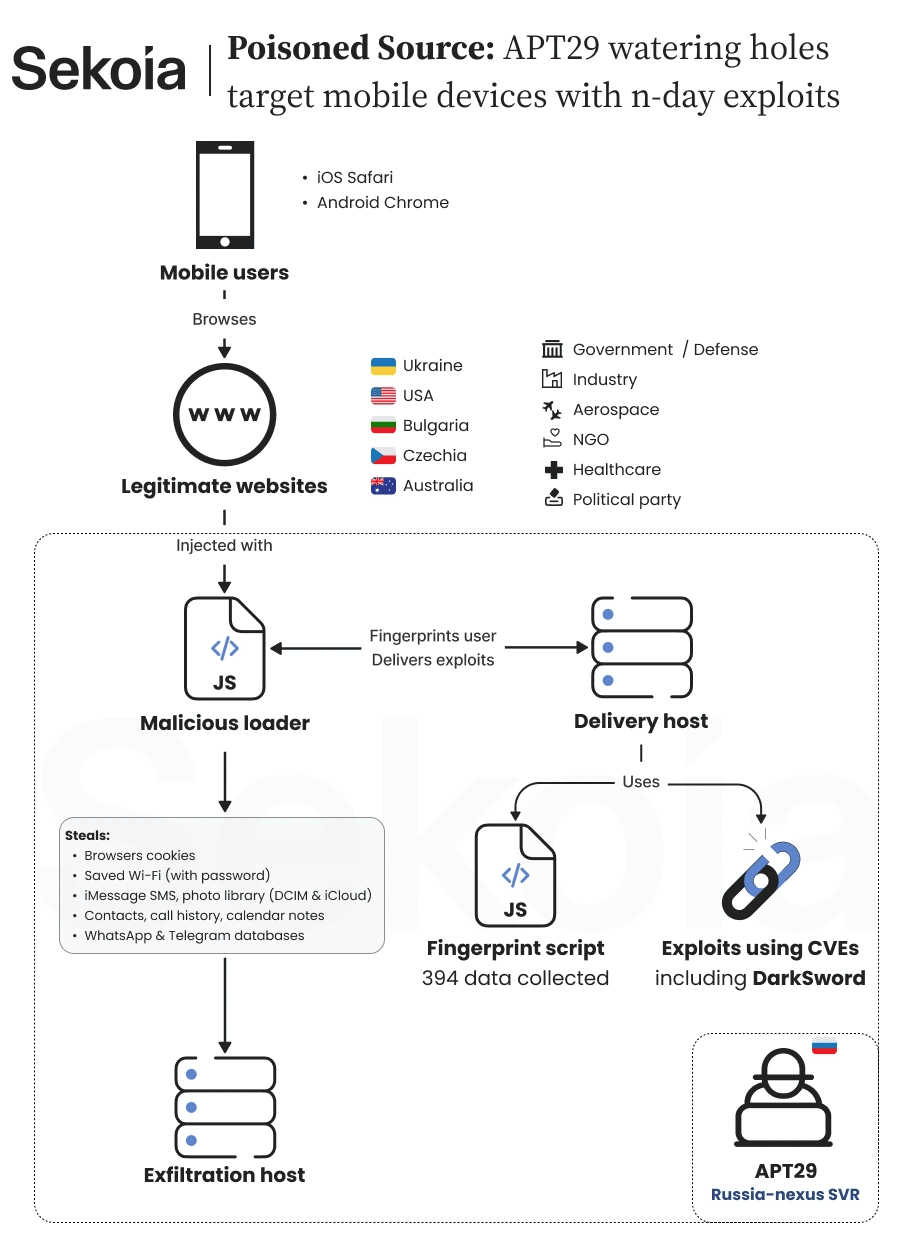
Sekoia says a large-scale watering hole campaign is going after iOS and Android users, and it links the campaign to APT29 (aka SVR group, Cozy Bear, Nobelium, BlueBravo, Midnight Blizzard, and The Dukes), the Russian group tied to the SVR foreign intelligence service. A watering hole is a site that attackers poison so visitors infect themselves.

Sekoia found the campaign in mid-October 2026. It involved hacked or cloned high-profile websites in the US, Ukraine, the Czech Republic and Bulgaria. There’s also a supply-chain attack on a Ukrainian web analytics service, Plerdy, loaded by thousands of websites, most of them Ukrainian.

The attackers used three different methods to reach victims, but all led to the same malicious payload. They injected JavaScript into hacked websites, created fake websites that copied legitimate ones and secretly added malicious code, and compromised the Plerdy analytics service to infect websites using its script.

APT29 Watering Hole

Sekoia first spotted the campaign on the website of a Ukrainian gas production company. Other compromised sites included a major US chemical industry association, a European far-right political party and a Bulgarian website linked to the military. In the Bulgarian case, attackers modified an existing JavaScript library without changing the website’s visible pages. Researchers found no clear pattern in the targeted organizations, although they believe some websites may have been selected to reach specific individuals.

Sekoia also identified two fake websites designed to impersonate legitimate services. One copied America250, the US initiative marking the country’s 250th anniversary, while another reproduced the website of Raffles London at The OWO, a luxury hotel close to the UK Ministry of Defence and Downing Street.

“The second website, theowo[.]club, now offline, acted as a reverse proxy for the website of Raffles London at The OWO, a prestigious luxury hotel housed in the historic Old War Office building.” reads the report published by Sekoia. “The hotel’s location is particularly noteworthy because of its proximity to some of the United Kingdom’s most sensitive government institutions, including the Ministry of Defence and 10 Downing Street, the official residence and office of the British Prime Minister.”

The hotel connection is particularly interesting because Ukrainian President Volodymyr Zelensky reportedly stayed there during a visit to London on October 14. Sekoia believes the fake website may have been used to target diplomatic delegations through spear-phishing, but stresses that this remains an unconfirmed possibility.

Between August 27 and September 3, 2026, the attackers compromised the Plerdy tracker at a.plerdy[.]com. For a week, visitors loaded both Plerdy’s script and the attackers’ profiling script. Several affected sites relate to the military and military recruitment, including army, special forces and military equipment websites.

“Between 27 August and 3 September 2026, the intrusion set compromised the Ukrainian Plerdy analytics tracker hosted under the domain a.plerdy[.]com, which is loaded by thousands of websites, the large majority of them Ukrainian.” reads the report. “It remains unclear whether the attackers intended to target visitors to specific websites or sought to compromise as many unpatched mobile devices as possible, indiscriminately exfiltrating data before selectively identifying and exploiting information of interest.”

Sekoia can’t say whether the aim was specific visitors or as many unpatched phones as possible, with the sorting done later. It also considers that the attackers may have used Plerdy after failing to inject code directly into Ukrainian high-value sites that relied on it. The Plerdy payload pointed to a load-balancing domain that sent traffic across several delivery servers.

The profiling script, which the attackers call UltimateFingerprinter, is attached to a minified AngularJS library that makes up 98 percent of a 2.3 MB file. Sekoia thinks that bulk might stop analysis by large language models, or make the script look legitimate. The script runs 61 collectors that build 394 fields, then sends them to a server that decides whether to answer with exploit code.

Strangely, almost none of that data matters. Only implausible screen sizes, like 99999, or a device reporting zero touch points block delivery. Sekoia doesn’t know why the attackers collect so much and sees no sign the data was used later.

Sekoia pulled three exploit chains from the delivery server. Class A hits iOS 16.7 and steals cookies. Class B hits iOS 18.5 and takes full device data. Class C hits Android Chrome versions 139 to 145, minus 143 for reasons Sekoia can’t explain, and steals Chrome cookies and Wi-Fi passwords.

“During the investigation, we tested different browser profiles against the fingerprinting endpoint at static[.]flux-telemetry[.]com in order to retrieve the exploits served to visitors.” states the report. “This allowed us to retrieve three complete exploit chains (afternamed A, B and C), along with their final payloads, targeting both Android and iOS. Here is a summary of what we found:”

Class B is DarkSword, which Sekoia describes as a suspected iOS exploit kit from a commercial surveillance vendor, uploaded to VirusTotal in September 2026. It takes text messages and iMessages, Mail indexes, voicemail, WhatsApp and Telegram databases, Keychain passwords and tokens, account credentials and Wi-Fi keys. It also takes contacts, call history, calendar, notes, Safari history and cookies, location caches, Health data, photos and iCloud Drive.

The Android payload, which Sekoia calls AndroSnitch, collects Chrome cookies, saved logins and history, plus Wi-Fi settings. It stops on one phone model, the Samsung Galaxy S25 Ultra. It resembles a 2024 payload that Google TAG documented, called AndroSnatch, but the sample is too small to prove lineage. The iOS cookie chains set a marker cookie meant to block reinfection for a day, but a coding mistake makes it expire in a minute.

All stolen data goes to ad.starx-net[.]com:8881/telemetry/v12. None of the chains persist on the device. All of them rely on known flaws, and none uses a zero-day.

For attribution, Sekoia has several threads. A CERT said a compromised site’s backend files held traces matching a private report on a 2025 APT29 watering hole campaign, and Google TAG said the framework resembles an APT29 campaign against Mongolian government websites in 2024. Victims also skew to Europe and the US with a focus on Ukraine, infrastructure sits across multiple hosters, and a hacked Czech far-right site fits APT29’s record of targeting European political parties. It rates the link moderate to high confidence, and it’s coordinating with the CERTs of affected countries.

The campaign shows how exploit kits move down the market. Sekoia says state-backed groups keep reusing frameworks from commercial surveillance vendors such as DarkSword, and that packaged exploit chains lower the cost and skill needed for advanced mobile attacks. It expects such reuse to become more frequent.

The good news is that Sekoia’s attackers don’t have fresh tricks. Every flaw was fixed by its vendor before the campaign began, and none works against fully updated devices.

“None of them contain zero-days or work against fully updated devices. Each flaw was resolved by the respective vendor before this campaign began. This operation targets unpatched devices using n-days; a user running an up-to-date operating system is safe from these attacks.” concludes the report.

“This watering hole campaign, which we assess with moderate to high confidence to be linked to APT29, combines multiple web delivery vectors with n-day mobile exploit chains targeting Android and iOS devices. Across the directly compromised websites, no single sectoral targeting pattern emerges from our analysis. While the victimology shows a focus on Ukraine and the United States, the inclusion of unrelated entities such as an Australian medical clinic complicates a broad strategic interpretation. However, we assess that these websites may have been selected to profile and infect specific individuals of interest based on targeting intelligence to which we do not have visibility. The operators adapted by deploying Adversary-in-the-Middle-ish to intercept visitors associated with diplomatic or high-profile events.”

Follow me on Twitter: @securityaffairs and Facebook and Mastodon

Pierluigi Paganini

(SecurityAffairs – hacking, APT29)

November 2026 Cyber Attacks Timeline

Follow the cyber attacks of November 2026 as they happen. This live HACKMAGEDDON dashboard is updated every day with newly vetted incidents. It shows the leading motivations, attack vectors, targeted sectors and countries on an interactive map, plus a filterable, searchable timeline linking to each source.

Hackers Send Fake Nuclear Threat Alerts to Ukrainian and Russian Citizens

Hackers reportedly hit Ukraine ‘s and Russia ‘s emergency alert apps, sending fake nuclear and attack warnings and raising concerns over public safety.

Ukraine and Russia both said on Sunday night that hackers had compromised their emergency alert apps and used them to send fake warnings about air raids and other attacks, including nuclear threats. The BBC reported the incident, but neither side’s claims have been independently confirmed.

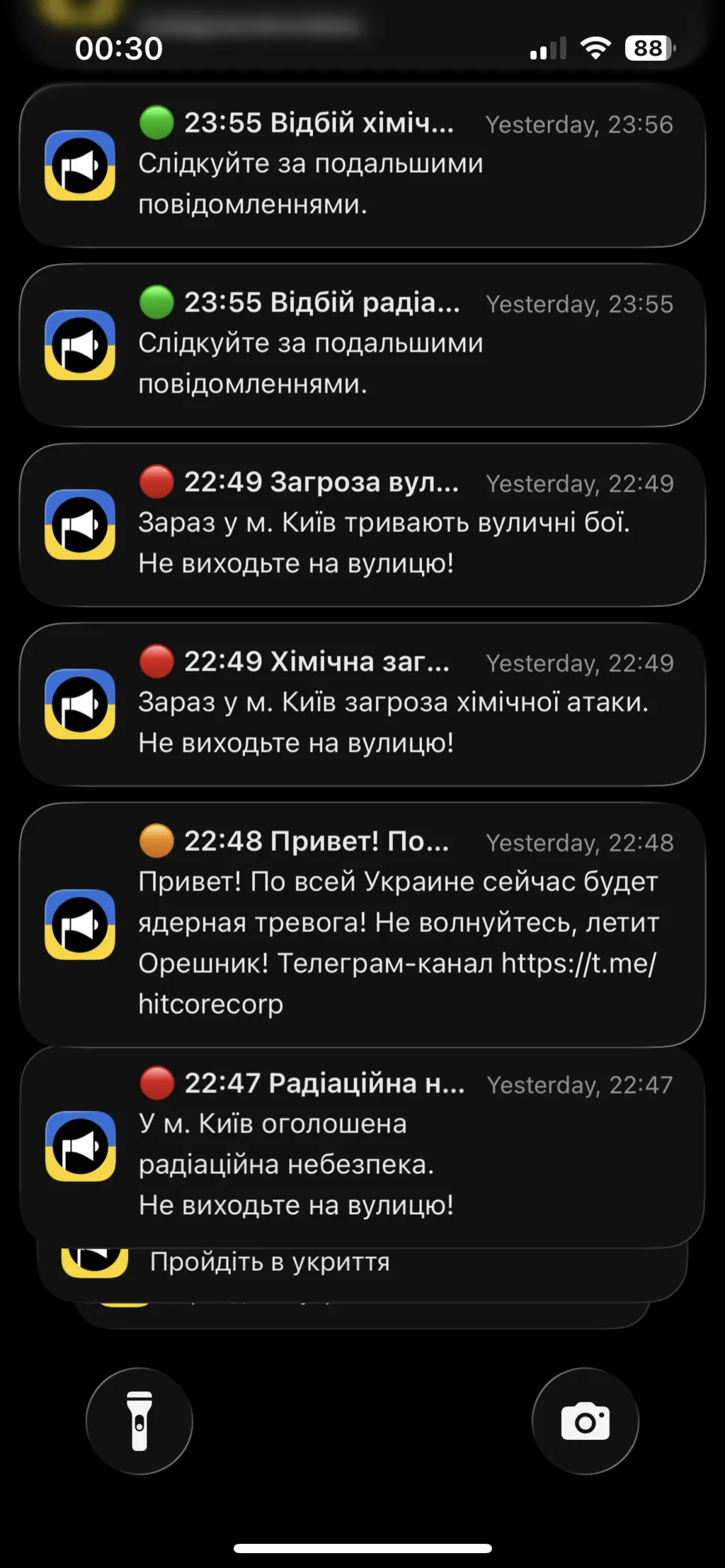
Shortly before 11 p.m. local time (9 p.m. GMT), Ukraine’s widely used Air Alarm app sent the highest-level air raid warnings across the country. Some people, including residents of Kyiv, also received alerts about possible radiation, chemical attacks and street fighting. A message posted on Telegram said the app had likely been targeted by a cyberattack, confirmed there was no radiation threat and urged people to remain calm.

“Shortly before 23:00 local time (21:00 GMT), Ukraine’s widely usedair raid app sent red-level air raid warnings nation-wide, with additional warnings of radiation, chemical attacks, and street fighting sent to some residents in areas including Kyiv.” reports BBC.

“The Air Alarm application has probably been subjected to hostile interference. There is no radiation threat! Stay calm and follow our updates on our channel.” an alert on Telegram read.

The false alerts started at about 22:47 with a message that a radiation threat had been declared in Kyiv. At 22:48 came a message in Russian saying a nuclear alert would cover all of Ukraine and not to worry because “it’s Oreshnik flying”. Oreshnik is a Russian intermediate-range ballistic missile that can carry nuclear or conventional warheads, and Russia has the world’s biggest nuclear arsenal, with President Vladimir Putin repeatedly hinting he’s open to using every weapon available.

Two more alerts arrived at 22:49. One, in Ukrainian, warned of a chemical attack on Kyiv and told people not to go outside, and the other said street fighting was taking place in the city. Red, orange and green messages reached phones, and at 23:53 users got all-clear messages, each declaring one of the Kyiv threats over.

A Ukrainian intelligence body, which the BBC calls the Central Intelligence Agency, said there had been a failure in the app and urged people to use other sources of information. It added that the alerts triggered a radiation hazard signal on loudspeakers in the Lviv region, with no real threat.

“The Air Alert app is supported by the Ministry of Digital Transformation of Ukraine, and informs users instantly about the beginning and end of defence alerts. The ministry said it temporarily disabled the app for maintenance after it had “apparently been compromised”. states BBC.

“While the false alerts were quickly contained, cybersecurity experts suggested it was a new line in apparent Russian cyberattacks.”

The temporary shutdown of the Air Alert app also carries significant risks, even if it lasts only a short time. During an outage, users may not receive timely warnings about incoming attacks, leaving them with less time to reach shelters or take protective measures. This is particularly dangerous in a country where missile and drone attacks can happen with little warning.

The incident also highlights a difficult security trade-off: disabling a compromised alert system may prevent attackers from spreading false warnings, but it can temporarily remove a critical channel for delivering real emergency information. Any shutdown therefore needs reliable backup channels, such as sirens, official messaging services and other emergency communication systems.

Regional leaders tried to calm people. Svitlana Onyshchuk, head of the Ivano-Frankivsk region, said everything was calm, even though the app had shown a red-level alert for her region from 22:50 to 23:57. Natalya Zabolotna, her counterpart in Vinnytsia, confirmed a cyberattack on the app and warned people not to click the link in the message, which could be phishing.

Ukraine’s Centre for Countering Disinformation has advice for when the app isn’t working: turn on smartphone notifications, pay attention to sirens, and read only official sources. Oleksander Merezhko, chair of the foreign affairs committee in the Ukrainian parliament and a member of President Zelensky’s Servant of the People party, said the attack caused no panic. Ukrainians, especially in Kyiv, are used to practically non-stop alerts, he told the BBC, and the message in Russian aroused suspicion at once. The attackers picked a language that gave them away.

A few hours later, Russia’s ministry of emergency situations said its own app had suffered “a massive cyberattack” that sent fake information to the public. Ukrainian outlet UNN reported that the hack sent fake nuclear threat alerts inside Russia, citing Atesh, a partisan Ukrainian group operating in Russian-held territory. A screenshot Atesh shared on Telegram, described as purported, claimed nuclear warheads mounted on Ukrainian P1-Sun attack drones had been launched at all regions of Russia, opened with a “risk of getting lively” warning and told residents to stock up on three weeks of food and hide. The alert also had profanities.

Russia said it was still restoring the app but claimed the hack had not affected its wider alert system. It said people could still receive warnings through sirens, loudspeakers, text messages, TV and radio. The false alerts appeared minutes before a local ceasefire in Ukraine’s Kherson region ended on Sunday night. The truce had allowed civilians to leave Russian-occupied Oleshky. Although the fake warnings were quickly stopped, experts see the attack as a worrying escalation.

“I think it’s the first time it’s happened to an official Ukrainian information app, but I suspect it won’t be the last,” Herbert Lin, a senior research scholar for cyber policy and security at Stanford University, told BBC World Service’s Newsday programme.

Follow me on Twitter: @securityaffairs and Facebook and Mastodon

Pierluigi Paganini

(SecurityAffairs – hacking, Ukraine)

Italy ’s Parliament Under Cyber Pressure: Why the Attack on the Chamber Matters

Italy ’s Parliament cyberattack highlights hybrid warfare risks and the need for transparency, stronger defenses and accountability.

The cyberattack targeting email accounts at Italy’s Chamber of Deputies, including a parliamentary account assigned to Prime Minister Giorgia Meloni, raises questions that go well beyond the security of individual inboxes. At a time when European institutions face growing cyber pressure, the incident highlights how access to political communications can become part of a broader hybrid warfare strategy.

The Chamber confirmed that its IT systems had been targeted and said it had activated security measures in cooperation with Italy’s National Cybersecurity Agency (ACN). According to reports, three parliamentary email accounts were affected, including those associated with Meloni, former Justice undersecretary Andrea Delmastro and lawmaker Paolo Formentini.

Palazzo Chigi clarified that the account assigned to Meloni was not the one she uses for government communications. That distinction matters, but it does not settle the broader security questions raised by the incident. The public information available so far does not provide a complete technical account of what happened, what level of access the attackers may have obtained, or whether any information was taken.

The Chamber described the incident as having no emergency implications, adding that attacks of this kind occur daily. It also confirmed that similar attempts and pressure on IT systems had intensified in recent days, affecting other Italian, European and international institutions.

This combination of statements deserves closer scrutiny. Cyberattacks may be a daily occurrence, but their frequency does not make every incident routine or harmless. The significance of an attack depends on the target, the access obtained, the information exposed and the wider strategic context.

An email account is more than a channel for exchanging messages. It can reveal professional relationships, contacts, ongoing discussions, schedules and the way an institution operates. Depending on the level of access obtained, an attacker may also find documents, personal information or details that could help target other officials.

A compromised account can provide a starting point for further attacks. Messages sent from a legitimate address may appear trustworthy, making it easier to approach colleagues, political staff or external partners. Information gathered from correspondence can also support impersonation, targeted phishing or attempts to obtain access to other systems.

Even an account that is not used for government business can therefore have intelligence value. The important question is not simply whether an account handles classified information, but what an attacker could learn from it and how that information might be used.

The distinction between an attempted attack and a confirmed compromise is equally important. Public statements have not yet provided enough technical detail to establish the full extent of the incident. Investigators need to determine whether access was blocked, whether an account was accessed, whether messages were read and whether credentials or other information were exposed. These are different scenarios, with different implications for security.

The incident should also be considered against the backdrop of growing cyber pressure on public institutions. On October 8, Italy’s Foreign Ministry was targeted by a distributed denial-of-service (DDoS) attack that media reports linked to pro-Russian actors. A DDoS attack and an intrusion targeting email accounts are technically different operations, and there is currently no public evidence linking the two incidents.

Their broader significance, however, lies in the pressure they place on institutions and the range of objectives that cyber operations can serve.

Hybrid warfare does not rely on a single method. It can combine cyber operations, intelligence gathering, propaganda, disinformation, economic pressure and other activities designed to exploit weaknesses or influence decision-making. These actions do not necessarily need to be coordinated in every case to contribute to a more hostile strategic environment.

In this context, a cyber operation does not need to shut down a public service to have an impact. An attacker who gains access to political correspondence may seek information about relationships between officials, internal priorities or ongoing discussions. That information could potentially support intelligence operations, help prepare future intrusions or provide material for influence campaigns.

Stolen communications can also be selectively leaked, manipulated or presented without context to damage reputations and undermine public trust. The value of such material may lie less in its immediate technical impact than in how it can be used later. These are possible scenarios, not established facts about the attack on the Chamber.

The public perception of an incident can itself become part of the problem. A successful intrusion, if confirmed, can raise doubts about an institution’s ability to protect sensitive communications. A poorly handled response can deepen those doubts, particularly if officials appear more concerned with reassuring the public than explaining what happened.

None of this proves that the attack was directed by a foreign government or formed part of a coordinated influence operation. Attribution requires technical evidence, intelligence and careful analysis. Treating hybrid warfare as a serious risk means investigating these possibilities without presenting them as conclusions before the evidence supports them.

The Chamber’s statement that the incident was not an emergency because similar attacks occur daily is, at best, an inadequate explanation of the risk. It confuses the frequency of attacks with the seriousness of their potential consequences.

Reassurance has a legitimate role in crisis communication. Institutions should prevent unnecessary alarm and explain when protective measures are working. But reassurance is not a substitute for transparency, especially when the technical investigation is still underway.

The Chamber has acknowledged that cyber pressure has increased against other institutions in Italy and abroad. That admission makes it even more important to explain the nature of the threat and the measures being taken to address it.

A responsible update should clarify what is known about the affected systems, which protective controls were activated, what investigators have established and which questions remain open. Sensitive technical details can be withheld when their disclosure could compromise an investigation or expose additional weaknesses. That does not justify treating the incident as unremarkable before its impact is understood.

The response also needs to go beyond public statements. Authorities should review access controls, authentication mechanisms, account monitoring, email forwarding rules and the procedures used to detect suspicious activity. They should assess whether accounts that are no longer needed remain active and whether older accounts receive the same protection and monitoring as those used every day.

The objective is not to assume that a dormant account caused the incident, but to ensure that every account represents only an acceptable level of risk.

The attack should prompt a broader review of how parliamentary communications are protected and how cyber incidents are handled. New agencies, appointments and organizational structures can contribute to security, but they do not guarantee it. Their value depends on clear responsibilities, technical expertise, adequate resources, tested response procedures and measurable results.

Cooperation between the Chamber and the ACN is important, but the public also needs a clear account of how the incident is being investigated and what corrective action follows. Where the investigation establishes weaknesses, those weaknesses must be addressed rather than obscured by general assurances.

The challenge is particularly significant as Italy and other European countries prepare for future elections. Political institutions may face not only attempts to disrupt their services but also operations intended to collect information, exploit internal divisions or influence public debate. Cybersecurity is therefore part of democratic resilience, alongside the ability to identify manipulated information, communicate reliably and maintain public confidence.

The first priority must be to establish what happened at the Chamber and avoid unsupported claims about the attackers’ identity or objectives. The next is to use the findings to strengthen the security of parliamentary communications and other institutional systems.

An institution’s response should be judged not by its claims that an attack is under control, but by its ability to establish what happened, communicate the risks clearly and fix the weaknesses identified. As hybrid threats grow, downplaying an incident before its implications are fully understood sends the wrong message: protecting the institution’s public image appears to take precedence over identifying and reducing the risks.

Follow me on Twitter: @securityaffairs and Facebook and Mastodon

Pierluigi Paganini

(SecurityAffairs – hacking, Italy)

Attackers Take Control of Dahua Cameras and Video Recorders Via Easy4IP

Ukraine warns that attackers can remotely access Dahua cameras and recorders via Easy4IP, viewing video and changing settings.

Ukraine’s cyber incident response team CERT-UA has warned about attackers taking over video surveillance systems made by Dahua. In its alert dated October 23, 2026, it reports unauthorized remote access to IP cameras and video recorders. The attackers have watched the live video, changed device settings and created accounts of their own. The alert doesn’t say who was targeted or how many devices are affected.

The attackers abused Easy4IP, Dahua’s cloud feature that lets users access devices remotely. When this feature is enabled, the camera or recorder connects to Dahua’s cloud and registers using its serial number. Anyone who knows the serial number may be able to access the device through the cloud, without needing an open port or a public IP address. This means the connection can bypass the protection normally provided by a router’s firewall.

As a result, a camera that isn’t directly exposed to the internet may still be at risk. CERT-UA warns that devices with Easy4IP enabled may be vulnerable even when they cannot be accessed directly from the internet.

“The main vector is the P2P/cloud access function (Easy4IP). The device independently initiates an outgoing connection to the manufacturer’s cloud infrastructure and registers in it by serial number. Access to the device is then established via the cloud by serial number, bypassing NAT and firewall, without published ports and a “white” IP address.” reads the report published by CERT-UA. “Thus, the lack of direct access from the Internet does not guarantee the security of the device with the active P2P function.”

Serial numbers follow predictable patterns, so attackers may be able to guess them automatically and check which devices are registered in the cloud. Simply keeping a serial number private isn’t enough to ensure security.

Once attackers connect to a device, they need to get past its login. They may try common or weak passwords or exploit security flaws in outdated firmware, especially CVE-2021-33044 and CVE-2021-33045. These two vulnerabilities allow attackers to bypass authentication without a password, so even a strong password won’t protect a device running vulnerable firmware.

There are three signs that a device may have been compromised. First, look for accounts you don’t recognize. Second, check for changed settings, including text added over the video image. However, the absence of these labels does not mean the device is safe. Third, check the audit logs for logins using Dahua’s DVRIP protocol from the local address 127.0.0.1, which can indicate access through the cloud service.

CERT-UA recommends four steps:

  1. Turn off P2P and cloud access if you don’t use it.
  2. Keep cameras off the internet. For remote access, use a VPN and allow only authorized IP addresses.
  3. Check the account list for ones you didn’t create, and check which cloud accounts are linked to the device and disconnect unknown ones.
  4. Update the software by hand to the latest version, and set up a regular update routine.


CERT-UA advises organizations that detect signs of unauthorized access to report them to cert@cert.gov.ua and check all Dahua devices on their networks, including those that may have been forgotten. The agency warns that all devices with active P2P functionality are at risk.

Follow me on Twitter: @securityaffairs and Facebook and Mastodon

Pierluigi Paganini

(SecurityAffairs – hacking, IP cameras)

Russian Satellite Makes a Close Approach To A Commercial Radar Satellite Used by Ukraine

A Russian satellite made a close approach to a commercial radar satellite linked to Ukraine, raising concerns about surveillance and security in space.

A Russian-made satellite called Kosmos 2612 got very close to ICEYE-X36 last week, a commercial Earth-observation satellite that may support countries like Ukraine. CNN reports it may have come within less than a mile. Orbital monitoring company LeoLabs says the behavior is consistent with rendezvous and proximity operations, meaning maneuvers designed to bring two spacecraft together.

“A rare move by a Russian-made satellite may have brought it within less than a mile of a commercial Earth-observation satellite that may be used to provide national security services to countries such as Ukraine.” states CNN.

“It’s not clear what, exactly, the Russian satellite, called Kosmos 2612 or Cosmos 2612, intended to accomplish with its close approach. But the behavior was consistent with rendezvous and proximity operations, or maneuvers carried out in orbit that are designed to bring two spacecraft together, said orbital monitoring services company LeoLabs, which tracks space junk and activity in Earth orbit, in a statement.”

It is unclear what Russia wanted to achieve. LeoLabs said “While the intent remains uncertain, the behavior warrants continued monitoring.” Astrophysicist Jonathan McDowell noted that this could be the first known case of one spacecraft approaching another without permission. This is different from docking, when two spacecraft intentionally connect, a common practice in space.

The events unfolded over several months. In May, four Russian-controlled satellites changed their orbits to align with ICEYE-X36, according to a June report by the Royal United Services Institute. On October 15, Kosmos 2612 began moving closer to ICEYE-X36, reducing the distance from 350 kilometers to less than 5 kilometers by early October 16. It stayed nearby, making small adjustments through the weekend, before starting to move away on Monday. The War Zone (TWZ) reports that Kosmos 2612 was one of six satellites launched together on April 17.

The closest point is disputed. LeoLabs says it came within roughly 500 meters during part of the event, but warns that the repeated maneuvers and awkward tracking geometry make separation estimates uncertain. Space.com reports the satellites may have been a few meters apart at one point, and TWZ’s reading of public tracking data points to about 26 meters.

The target matters. ICEYE operates about 80 radar satellites that image the Earth through clouds, day and night, and ICEYE-X36 belongs to its US subsidiary. At least some ICEYE satellites provide imagery to Ukraine, and in January the company signed a contract firming up that relationship, saying it gives Ukraine’s Ministry of Defence persistent situational awareness on tactical timelines. A Ukrainian official told Axios that Ukraine’s military works with ICEYE but couldn’t say whether this specific satellite is involved.

Russia appears to be paying close attention to ICEYE-X36. Changing a satellite’s orbit to match another spacecraft’s path uses a lot of fuel, so it is not a decision taken lightly. Four Russian satellites made similar changes in May. However, it remains unclear whether ICEYE-X36 is specifically used to collect images of Ukraine.

Close approaches between satellites are not new, but this case is different. Russia, the United States, and China have all moved satellites close to those operated by other countries, mainly in geostationary orbit. Kosmos 2612 operates in low Earth orbit. As far as is publicly known, Russia has carried out similar approaches there, but the United States and China have not.

Victoria Samson of the Secure World Foundation pointed to two earlier Russian cases. In 2020, Kosmos 2543 came within about 30 kilometers of USA 245. In 2022, Kosmos 2558 approached USA 326 to within about 70 kilometers.

Both targets were classified US spy satellites operated by the National Reconnaissance Office. ICEYE-X36, by contrast, is a privately owned satellite, and Kosmos 2612 came much closer than in those earlier cases. Space law professor Aaron Brynildson told Axios that there is no strict legal limit on how close satellites can approach each other. However, countries generally avoid getting within six miles of another satellite.

Why do it? Samson lists a few options. Russia may want to learn the satellites’ capabilities and what they’re studying, or it may have interfered with sensors or communications. She leans toward a different reading: she thinks Russians are getting frustrated, in a stalemate for about six months, and this is a way to show military prowess in a way Ukraine can’t answer, since Ukraine matches Russia in drones but not in space.

RUSI’s June report is blunter about the options. It lists intimidation or interference through jamming, which uses radio noise to stop satellites from communicating. It adds that the range of options for protecting an ICEYE satellite is limited, and that defending satellites is a famous dilemma. LeoLabs says the event doesn’t establish hostile intent, but shows capabilities that could support intelligence collection, inspection, coercive signaling, interference or preparation for future counterspace operations.

ICEYE’s response was short: the company is aware, tracking closely, and says its constellation architecture is designed for continuity and resilience. CNN says it asked Russia’s defense ministry and Roscosmos for comment. The US Space Force had already described Russian satellites positioned near a Western commercial radar satellite used by Ukraine for imagery intelligence, according to Axios.

Private companies and independent observers, rather than the US Space Force, revealed the satellite encounter, highlighting the need for greater government transparency as space becomes more contested.

Follow me on Twitter: @securityaffairs and Facebook and Mastodon

Pierluigi Paganini

(SecurityAffairs – hacking, satellite)

North Korean IT Workers Used Stolen US Identities to Earn $3 Million

The FBI raided 40 Texas homes over a North Korean scheme that used fake IT workers to target 70 US companies and generate $3 million.

The Justice Department (DoJ) announced coordinated enforcement actions this week targeting North Korea’s long-running scheme to place fake IT workers inside American companies. Two US nationals were arrested, 14 people charged across two separate indictments, and the FBI searched more than 40 residences in Texas, seizing approximately 187 laptops and KVM switch devices.

The Texas operation, called Operation Lonestar Roundup, ran between September 21 and 25. The seized devices are the same laptops American companies shipped to their newly hired remote employees, not knowing those IT workers were North Korean intelligence agents using stolen US identities.

“Today the Department of Justice announced coordinated actions against the Democratic People’s Republic of North Korea (DPRK) government’s schemes to fund its regime through remote information technology (IT) work for U.S. companies.” states DoJ. “These actions include an indictment, two arrests, searches of multiple known or suspected “laptop farms” in Texas pursuant to “Operation Lonestar Roundup,” and the seizure of approximately 187 computer devices used by DPRK IT workers.”

The scheme was simple. North Korean IT workers applied for remote jobs using stolen or fake identities. They used VPNs and proxy servers to make it look like they were working from the United States. American helpers received the laptops provided by employers and installed remote access software so the North Korean workers could use them. These helpers were paid for their role, while the money earned from the jobs was sent back to North Korea through accounts controlled by the regime.

According to an indictment from the Northern District of Ohio, the scheme ran from 2019 to mid-2025 and targeted more than 70 US companies across 17 states. The companies operated in sectors including healthcare, communications, cybersecurity support, retail, and manufacturing.

“In total, the scheme impacted more than 70 U.S. company employers and generated approximately $3 million in revenue for IT workers.” SoJ states.”The revenue is believed to have been sent to sanctioned entities controlled by the DPRK. Victim employers included companies in the health care, communications, cyber support, retail, and manufacturing sectors across Ohio, sixteen additional states, and the District of Columbia.”

The North Korean IT workers earned about $3 million, which prosecutors believe was sent to North Korean entities subject to international sanctions.

The authorities warn the scheme is evolving in response to better detection.

“Increasingly, North Korean IT workers are turning to recruiting American facilitators to counter improved private sector detections and law enforcement actions.” states DoJ. “These workers are hiring facilitators to complete a wider variety of tasks, and in some cases subcontracting entire jobs to third-party foreign nationals. “

That’s not just using Americans as props. It’s actively outsourcing parts of the operation to people inside the US, which makes attribution harder and interception more complicated.

Some IT workers are now subcontracting entire jobs to third-party foreign nationals. Others are hiring facilitators to handle a wider range of tasks beyond just managing the laptops. CrowdStrike, which helped the FBI investigate, tracks the group behind this operation as Famous Chollima and describes the laptop farm infrastructure as vital to overcoming the physical and legal barriers of operating from outside the US.

“These laptop farms enabled FAMOUS CHOLLIMA operatives to pose as legitimate remote workers and siphon illicit wages back to their regime while maintaining persistent access to victim organizations. Working alongside the FBI, CrowdStrike’s threat intelligence into the adversary and their operations, and technical analysis helped make these disruptions possible.” states CrowdStrike.

“This operation marks the beginning of a broader U.S. law enforcement effort to dismantle FAMOUS CHOLLIMA’s U.S. infrastructure. CrowdStrike’s Counter Adversary Operations team intends to remain an integral part of that effort.”

The FBI’s separate public service announcement puts the operation in broader context: “thousands of North Korean state-controlled IT workers” are currently embedded at Western companies, posing what the agency calls a significant national security and intellectual property theft insider threat. North Korean IT workers have individually earned up to $300,000 per year under these schemes, and the collective revenue is measured in hundreds of millions annually, flowing directly to designated entities including the North Korean Ministry of Defense.

This is the fifth round of enforcement actions announced since June 2025 under the DOJ’s DPRK RevGen Domestic Enabler Initiative (June 2025, November 2025, April 2026, and May 2026). The initiative targets people in the United States who help North Korean IT workers carry out these schemes.

According to CrowdStrike, North Korean hackers were responsible for about half of all documented hands-on cyber intrusions over the past year. The regime is also targeting cryptocurrency exchanges and open-source software projects. In 2025 alone, North Korean attackers stole at least $2 billion in cryptocurrency.

The DOJ released a list of email addresses used in these operations, including accounts like randyryang@gmail.com and dev.jerryyang@gmail.com, which companies can add to their screening indicators. The FBI’s public service announcement includes detailed mitigation guidance on spotting DPRK IT worker applications. The red flags are consistent: inconsistencies in work history, reluctance to appear on video, requests to redirect laptop deliveries, and payment accounts that route through intermediaries.

“Threats posed by nation-states like North Korea are a stark reminder that our adversaries will go to great measures to exploit our nation’s economic strength to further and fuel their own nefarious agendas,” said U.S. Attorney David M. Toepfer for the Northern District of Ohio. “We are thankful to FBI Cleveland for their incredible work and persistence to put a stop to these bad actors. These charges serve as an urgent alert to all U.S. companies to remain vigilant in their hiring practices.”

Follow me on Twitter: @securityaffairs and Facebook and Mastodon

Pierluigi Paganini

(SecurityAffairs – hacking, IT workers)

Q3 2026 Cyber Attacks Statistics

In the third quarter of 2026, I recorded 588 cyber incidents. Cyber Crime accounted for 77.1% of motivations, Malware was the most common attack technique at 31.9%, and Exploit Public-Facing Application (T1190) led initial access at 30.4%. Information and Communication was the hardest-hit sector.

Italy’s Foreign Ministry Under Cyberattack as Embassy Sites Come Under Review

Italy’s Foreign Ministry is defending its website against a cyberattack, checking embassy sites and pushing for EU action to identify attackers.

On the morning of October 8, Italy’s Ministry of Foreign Affairs said its website was being attacked. According to the ministry’s own statement, its protection systems have mitigated the attack so far, with no disruption. The statement doesn’t say who is behind it, or what kind of attack it is.

The ministry is monitoring the situation with the Polo Strategico Nazionale, the country’s national cloud hub, and with the competent authorities.

“Cybersecurity is a central element of the reform of the Foreign Ministry approved last year. In recent months, we have strengthened our capabilities to prevent, monitor and respond to threats, adopting all necessary countermeasures, including on the technological side,” Foreign Minister Antonio Tajani said.

“Tajani had also had the opportunity to explain the technical capabilities of the CSIRT Operations Room to German Foreign Minister Johann Wadephul during his recent visit to Rome.” “In this context, Italy has decided to work with Romania and other EU member states to include proposals in upcoming European meetings to designate the actors responsible for cyberattacks, including attacks targeting Italian institutions.” reads the statement published by Italy’s Foreign Ministry.

Analysts are also checking the websites of Italian embassies and consulates abroad for similar attempts. That detail matters, and I’ll come back to it.

Minister Antonio Tajani tied the response to last year’s reform of the Farnesina, which made cybersecurity a central piece. He said prevention, monitoring and response capabilities have been strengthened in recent months, including on the technology side.

The statement ends on diplomacy. Italy will work with Romania and other member states to put proposals on the agenda of upcoming EU meetings, aimed at naming those responsible for cyberattacks, including attacks on Italian institutions. A blocked page is forgotten in a day, while a name on an official list is harder to shrug off.

Nobody has claimed this attack, but the pattern is familiar. NoName057(16) is a pro-Russian group that declared itself in March 2022 and announces its targets on Telegram. Avast researchers saw it using the Bobik botnet for DDoS attacks as early as September 2022.

Later, the DDoSia Project (aka DDosia), a crowdsourced DDoS operation linked to the pro-Russian hacktivist group NoName057(16), made the headlines beacuse its involvement in DDoS attacks again governments that supported Ukraine.

Italy has been a regular target. Over a weekend in January 2025, as Zelensky visited Rome, the group hit ministries and government sites on Saturday, then banks including Intesa and Monte dei Paschi di Siena and the ports of Taranto and Trieste on Sunday. At the end of December 2024 it had gone after Malpensa and Linate airports, and in February 2025 it tied a new wave to a speech by President Mattarella, according to Infosecurity Magazine. The timing follows politics, which isn’t a coincidence.

The ministry itself has been here before. ANSA reported that Russian hackers took its website down in late December 2024, and Tajani said it was back up the next day. DDoS attacks hit availability, not data, so the site goes dark and comes back. A loud attack can also pull attention away from a quiet one, which is a reason to look closer, not a claim about this case.

Now the embassies, and this part is my analysis. A ministry homepage going dark is embarrassing. An embassy or consulate site going dark is a problem for real people, because it’s where citizens abroad look for appointments, contacts and instructions, and the worst moment for an outage is a crisis abroad. Every one of those sites is also a surface to defend, and a lookalike page is an easy way to scam someone who’s already stressed.

Giving a look to the list of targets shared on DDosia today I can confirm that administrators planned attacks against the Farnesina, five Italian embassy sites, several Interior and Defence Ministry services, and other Italian organizations.

There is a precedent. In 2017, The Guardian reported a months-long intrusion into the Foreign Ministry’s systems. Italian media later reported that the attackers had targeted staff email accounts at the ministry and Italian embassies, rather than the encrypted system used for sensitive communications. A senior ministry security official said that attacks often happen before important events for Italy, while the Kremlin denied any involvement.

That’s why checking embassy websites is more than routine work. If someone wants to damage Italy’s image at little cost, the diplomatic network offers a large and highly visible target. The ministry is responding by strengthening its technical defenses and pushing at the EU level for “proposals to designate actors responsible for cyber attacks”, as the Farnesina’s statement puts it. That could make attribution more costly for attackers than simply taking a website offline.

DDoS attacks should not be underestimated, especially when they target government institutions and diplomatic services. They can disrupt public services, create pressure and attract significant media attention. But from a technical perspective, they are not usually complex offensive operations for a state to neutralize, especially when the target has adequate DDoS protection and network capacity.

The more important question is what sits behind the noise. Authorities need to determine whether these attacks are simply disruptive actions designed to attract attention, or whether they are being used to distract defenders while more sophisticated operations take place elsewhere. If there is no evidence of intrusion, data theft or compromise, the DDoS activity may be little more than a public demonstration of intent.

That distinction matters because a long list of targets can create the impression of a much more serious threat than the technical impact actually suggests. For people outside the cybersecurity community, a website being attacked can easily be interpreted as evidence that a government has been seriously compromised. In reality, it may be a relatively simple operation whose main objective is visibility.

The risk, therefore, is not only the attack itself, but the narrative built around it. DDoS campaigns can become a useful propaganda tool, creating fear and uncertainty while requiring relatively limited technical resources. The challenge for governments is to defend against the disruption without giving a sterile attack more strategic value than it deserves, while at the same time making sure that the noise is not hiding something more serious.

Follow me on Twitter: @securityaffairs and Facebook and Mastodon

Pierluigi Paganini

(SecurityAffairs – hacking, Italy’s Foreign Ministry)

September 2026 Cyber Attacks Statistics Infographic

September 2026 saw 181 confirmed cyber incidents, roughly one every four hours. Cybercrime drove 73.8% of attacks and espionage 19.1%. Malware led the techniques with 53 campaigns, ahead of Remote Code Execution with 32. More than a quarter of breaches started with an exploited public-facing application, and the United States was the most targeted country at 23.0%. This infographic summarizes the month's key numbers from the HACKMAGEDDON timeline.

September 2026 Cyber Attacks Statistics

September 2026 recorded 182 cyber incidents, and Cyber Crime drove roughly three in four of them (73.9%). Malware was the top attack vector at 27.8%, exploitation of public-facing applications led initial access at 28.9%, and Information & Communication was the most targeted sector. Explore the full statistics, from the daily trend to the geographic distribution.

MI5 Raises Alarm Over Chinese Funding of UK Academic Research

MI5 warns UK universities that over 100 academics may have unknowingly worked on research funded by a Chinese institute linked to the MSS.

On September 30, MI5 published a formal warning naming the China General Technology Research Institute, CGTRI, also called CAGT in some translations, as an outfit with very strong ties to China’s Ministry of State Security.

The core claim is blunt. MI5 says CGTRI exists mainly to “fund academic research that directly improves MSS technical capability for espionage.” That’s not vague suspicion, that’s the agency’s stated assessment of the institute’s whole reason for existing.

“More than 100 UK-linked academics have contributed to research projects funded by MSS via CGTRI.  In some cases, academics may not be aware that CGTRI is funding the Chinese research project they are contributing to.” reads the alert. “The alert advises UK academic institutions to immediately review any ongoing or planned collaboration with CGTRI and advises academics to establish the ultimate funding source when conducting any research collaboration with Chinese institutions to ensure CGTRI are not involved.”

More than 100 UK linked academics have contributed to projects funded by MSS through CGTRI, according to the alert. Here’s the part that should worry anyone in a research office: some of these academics likely had no idea CGTRI was the money behind the project they were working on. The funding chain was obscured enough that good faith participation was entirely possible.

The subject areas read like a wishlist for an intelligence service. Artificial intelligence, cybersecurity, covert communications systems, and steganography, the practice of hiding data inside other data. None of these are academic curiosities to MSS, they’re capability building blocks.

The alert tells UK universities to review any current or planned work with CGTRI immediately. Academics are also advised to check where funding for China-related projects ultimately comes from and make sure CGTRI is not involved further up the chain. MI5 points universities to government guidance from the Research Collaboration Advice Team and the National Protective Security Authority, and recommends seeking independent legal advice.

MI5 is flagging that continuing to work with CGTRI after this alert could expose people to real legal risk under the National Security Act 2023, specifically sections on assisting a foreign intelligence service and obtaining material benefit from one. Ignorance was a defense before September 30. It’s a much weaker one now that the connection is public.

Under Section 3 of the Act, a person can commit an offence if their actions are likely to materially help a foreign intelligence service, and they know or should reasonably know this. MI5’s wording is important because it does not require someone to know for certain that they are helping an intelligence service. The alert itself raises what people can reasonably be expected to know.

Anyone who continues to work on CGTRI-funded projects after the alert is published is advised to get independent legal advice on Sections 3 and 17. In practice, the government is warning people to understand the legal risks before continuing this work.

China rejected MI5’s allegations as fabricated and baseless, saying cooperation between UK universities and Chinese institutions is voluntary, lawful and mutually beneficial. Beijing said it had lodged a formal protest with the UK and urged British authorities to stop undermining academic and research cooperation.

“The accusations made by the UK intelligence agency against the relevant Chinese entity are imaginary and purely fabricated. We firmly oppose such baseless allegations and have lodged solemn representations with the UK side. Exchanges and collaboration between UK universities and China have always been conducted on a voluntary basis and in compliance with laws and regulations. Such exchanges and collaboration are mutually beneficial.” a Chinese embassy spokesperson said states. “We urge the UK intelligence authorities to stop spreading falsehoods and stop undermining educational exchanges and research cooperation between China and the UK.”

That denial contrasts with earlier research on CGTRI. The UK China Transparency think tank found that CGTRI shares staff with China’s University of International Relations, which is widely linked to the MSS. It also said CGTRI’s work overlaps with cyber capabilities that the MSS has previously used against UK companies, universities and critical infrastructure.

The issue goes beyond CGTRI itself. The bigger concern is whether sensitive research can be financed through layers of academic partnerships, making it difficult for researchers to see who is ultimately behind the funding. For university ethics boards and international partnership teams, the MI5 alert should prompt an immediate review of funding sources and research links rather than something to consider months from now.

Follow me on Twitter: @securityaffairs and Facebook and Mastodon

Pierluigi Paganini

(SecurityAffairs – hacking, MI5)

Antino Backdoor Lets China-Linked UAT-11587 Turn Microsoft 365 Into a C2 Channel

Cisco Talos details UAT-11587, a China-linked group using the Antino backdoor and Microsoft 365 as cover to spy on Asian governments.

Cisco Talos has been tracking a cluster of espionage activity since September 2025 that it calls UAT-11587, and by July 2026 the group had hit at least 16 government and policy organizations across eight Asian countries. The toolset includes a previously undocumented backdoor Talos named Antino, and the thing that makes it worth paying attention to isn’t how it gets in. It’s where it hides once it’s there.

Antino is written in Rust and works on both 32-bit and 64-bit versions of Windows. It supports the usual backdoor features, including shell and PowerShell access, file transfers, in-memory shellcode execution and persistence.

“Antino is a Rust-compiled Windows backdoor that supports host reconnaissance, shell and PowerShell execution, file transfer, in-memory shellcode loading and persistence. Its native command-and-control channel operates exclusively through Microsoft 365, using Microsoft Graph to interact with Outlook and OneDrive.” reads the report published by Talos.

None of these features are particularly new. What makes Antino different is how it communicates: instead of using its own command-and-control server, it uses Microsoft Graph to read commands from an Outlook mailbox and send stolen files to OneDrive. This allows its traffic to blend in with normal Microsoft 365 activity.

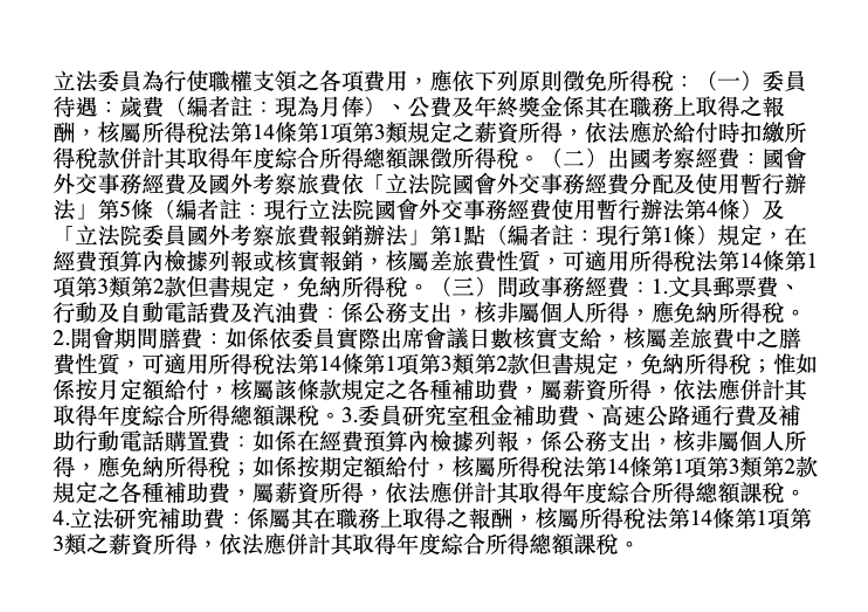
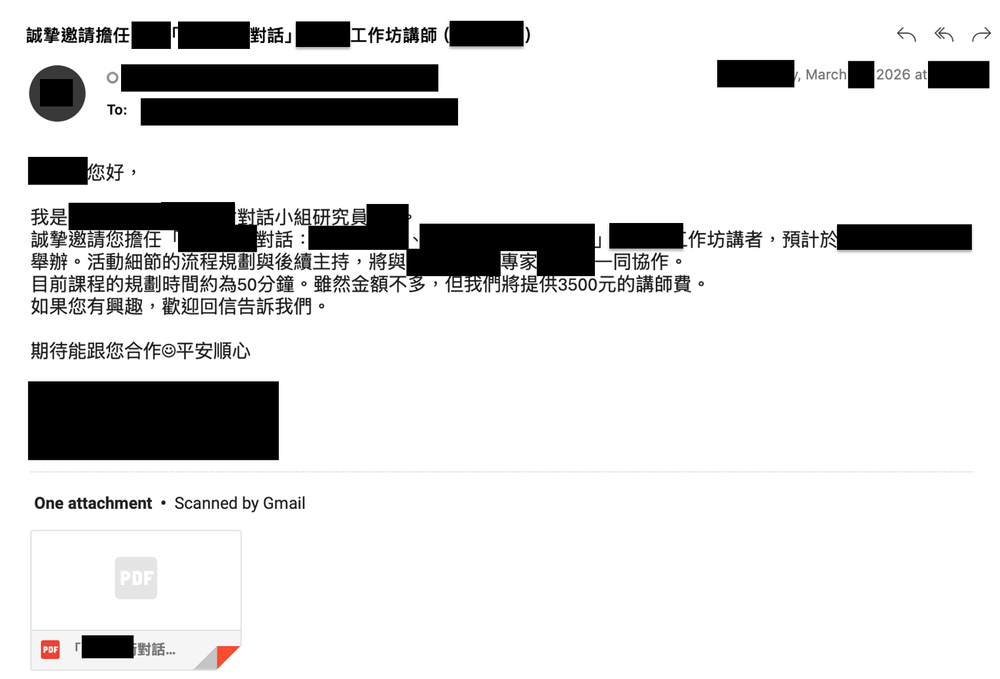
The attack starts in a more traditional way, with a convincing phishing email. UAT-11587 created highly targeted documents that suggest the attackers had researched their victims, including a fake workshop document about Taiwan’s information warfare and a document that closely copied a real Taiwan Ministry of Finance ruling about tax treatment for legislators.

“The document exactly reproduces a public Taiwan Ministry of Finance ruling to make the decoy appear credible.” conctinues the report. “Its subject strongly suggests that it was prepared for members of Taiwan’s public sector.”

In another case, the attackers reused a real Associated Press story about alleged Russian offers to the US over Venezuela. Matching malware samples appeared on VirusTotal two days after the original article was published.

The delivery trick is a simple but effective email spoofing technique that takes advantage of a gap many people overlook. The attackers sent the email through a legitimate provider, using one domain as the technical sender, while the visible From address showed the organization they were impersonating. SPF passed because the real sending domain was authorized, but DMARC detected the mismatch and failed. That still wasn’t enough to block the message. The impersonated domain had a DMARC policy set to monitoring rather than rejection, so the failed email still reached the inbox.

The Gmail trick is even more interesting. The attackers recreated Gmail’s normal attachment preview card almost pixel by pixel using images embedded in the email’s HTML. They then made the fake preview a link to a page controlled by the attackers. Open the email in Gmail and it looks just like the real thing because Gmail simply renders the HTML it receives. There is no exploit here. It’s just a very convincing copy of something users already trust.

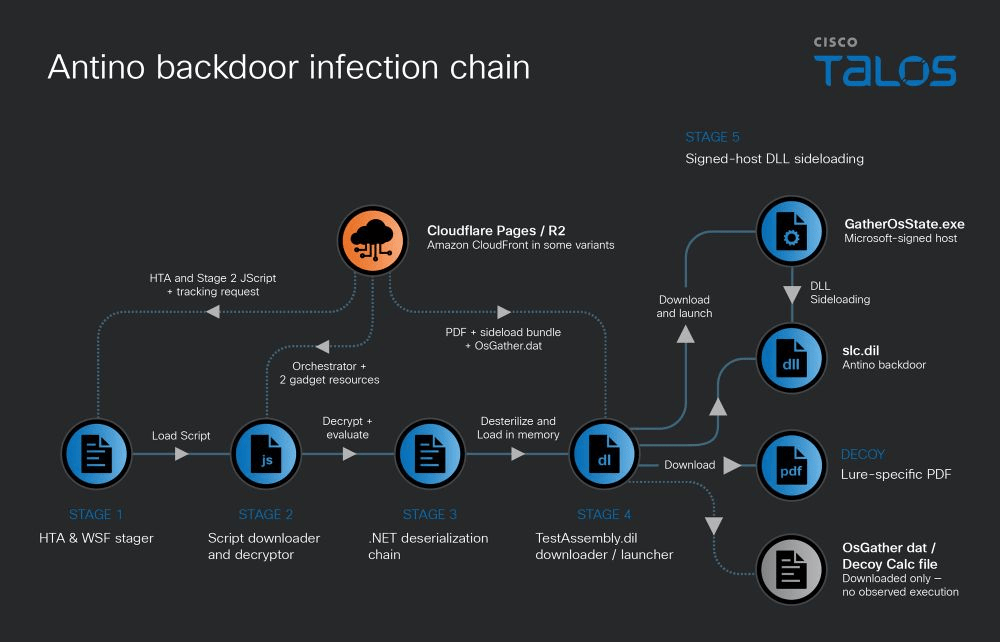
From that click, a five-stage chain kicks in, leaning on legitimate-looking HTA files, Windows Script Host, and a scripted .NET deserialization trick that abuses a known gadget chain to load malicious code inside a trusted process. The final stage sideloads Antino through a signed Microsoft diagnostic binary, meaning the thing dropping the backdoor onto disk is a tool Windows itself trusts by default. Cloudflare Pages, R2, and Amazon CloudFront carried almost every stage of this, which kept the traffic blending into ordinary HTTPS the whole way through.

Once Antino is running, it checks its Outlook mailbox for new commands every ten seconds. The commands and results are sent as structured JSON hidden inside specially formatted email subjects.

“The Antino backdoor receives commands through email messages. The implant actively pulls commands from the threat actor’s Outlook mailbox folder every 10 seconds. The protocol uses two message types: command emails contain tasking from the controller, while response emails contain the implant’s results.” states Talos. “Command messages are identified by the subject prefix command_req_[session_id] and responses by command_res_[session_id], as indicated in the HTTP GET request sent by Antino: “

A separate system is used to upload stolen files to one OneDrive folder and download attacker tools from another. Even the naming makes the attacker’s perspective clear: “uploads” are files sent to the victim, while “downloads” are files pulled back from the victim.

The attribution case leans on accumulated small details rather than any single smoking gun, which is honestly how these assessments should work. Decoy document metadata carries Simplified Chinese language tags and a UTC+8 timestamp, a combination more consistent with mainland China than Taiwan or Hong Kong, where Traditional Chinese dominates. Separately, ten different Antino builds reference a Rust package mirror built specifically to speed up dependency downloads inside mainland China, the kind of tooling choice a developer picks for convenience, not for disguise.

The victim list reads like a checklist of what an intelligence service would actually want: defense ministries, legislatures, foreign affairs offices, border and interior security agencies, plus the think tanks and civil society groups that tend to know things governments care about early. Around 350 compromised endpoints turned up across eight countries, with the largest single wave, roughly 57 new endpoints, hitting India over two days in June. That’s not noise. That’s a deliberate and sustained collection effort.

“Based on the development, preparation-environment, and targeting indicators detailed in this report, Talos assesses with high confidence that UAT-11587 is China-nexus.” the report concludes.

Follow me on Twitter: @securityaffairs and Facebook and Mastodon

Pierluigi Paganini

(SecurityAffairs – hacking, Antino backdoor)

Cryptocurrency exchange Bitget Says North Korea-Linked Hackers Stole $351.6 Million

Bitget says suspected North Korea-linked actors stole $351.6M from hot and warm wallets. Withdrawals were suspended while Mandiant investigates.

Cryptocurrency exchange Bitget says suspected North Korea-linked threat actors stole $351.6 million from a limited number of hot and warm wallets. The company detected unauthorized transfers on September 24 and temporarily suspended withdrawals.

At 18:31 UTC on September 24, 2026, Bitget’s security systems identified unauthorized transfers involving a limited number of hot wallets.

Our security team immediately activated emergency response procedures and began a full investigation.

Based on our current assessment,… https://t.co/7xF5xW0JQ1

— Bitget (@bitget) September 24, 2026

Bitget said customer balances, cold wallets and most platform assets remain secure. Mandiant and SlowMist are investigating the incident, while deposits and trading continue normally.

“We are currently working with independent third-party experts Mandiant and SlowMist for a full investigation. Our first priority is our users. User balances remain intact, and Bitget’s User Protection Fund covers the impact on this platform-wide incident.” the company added. “Bitget Wallet operates as a self-custodial wallet on a completely separate and independent infrastructure from Bitget Exchange and was not affected by this incident. Bitget Wallet users’ assets remain onchain under users’ control and remain unaffected.”

[UPDATES] We are currently working with independent third-party experts Mandiant and SlowMist for a full investigation.

Our first priority is our users. User balances remain intact, and Bitget's User Protection Fund covers the impact on this platform-wide incident.

Bitget…

— Bitget (@bitget) September 25, 2026

Bitget CEO Gracy Chen said the security breach affected ETH, XRP, BNB, AVAX, USDT and USDC across several blockchains. The attacker reportedly compromised a backend wallet system, spoofed transaction data and bypassed the authorization process to move funds. Bitget said affected blockchain foundations were contacted and some have frozen hacker wallets.

“We have contacted the foundations of all affected chains, and some foundations have confirmed the freezing of hacker wallet addresses,” Chen explained. “Based on IP behavior patterns and on-chain analysis, the attack method in this incident is highly consistent with known patterns of North Korean hacker organizations.”

Here is what we can confirm at this stage:

On the attack:
Our security team has made initial progress in tracing the source. The attacker compromised a critical backend system within our wallet infrastructure, used it to spoof transaction data, and triggered our authorization… https://t.co/5nINjwbXpC

— Gracy Chen @Bitget (@GracyBitget) September 25, 2026

Bitget is a cryptocurrency exchange and Web3 company founded in 2018. It provides services for buying, selling and trading digital assets, including spot and futures trading, copy trading and other financial products. The company has expanded beyond crypto into traditional markets and now describes itself as a “Universal Exchange.” Bitget says it serves more than 120 million users in over 150 countries and regions.

The attribution to North Korea-linked threat actors doesn’t surprise. According to Chainalysis, North Korean hackers stole at least $2.02 billion in cryptocurrency in 2025, bringing the estimated total stolen by DPRK-linked actors to $6.75 billion.

The thefts increasingly target crypto exchanges and other digital-asset services, with attackers using techniques ranging from sophisticated cyber intrusions to fake IT-worker identities.

Follow me on Twitter: @securityaffairs and Facebook and Mastodon

Pierluigi Paganini

(SecurityAffairs – hacking, Bitget)

August 2026 Cyber Attacks Statistics Infographic

A one-page visual briefing on August 2026's global cyber attack landscape: 218 confirmed incidents, a rising four-in-five share driven by profit-motivated crime, and a back-to-back spike that delivered 34 attacks in just two days.

August 2026 Cyber Attacks Statistics

August 2026 statistics report breaks down 218 confirmed cyber incidents by motivation, attack vector, initial access technique, and target sector. Financially motivated Cyber Crime drove more than 4 in 5 attacks, Malware remained the weapon of choice, and Information & Communication infrastructure bore the brunt of targeting across 70 countries.
❌