Entrar
US Seizes 1,000+ Domains Used to Illegally Stream FIFA World Cup
The U.S. Department of Justice has seized more than 1,000 illegal World Cup streaming domains accused of broadcasting FIFA World Cup 2026 matches without authorization, marking a major enforcement action against digital piracy during the tournament. The domains were seized in three separate actions under U.S. copyright law as part of Operation Offsides, an initiative targeting websites involved in unauthorized World Cup broadcasts.
The latest action includes nearly 400 websites seized by the end of June, according to the Department of Justice. The investigation was carried out by U.S. Immigration and Customs Enforcement Homeland Security Investigations (HSI) Washington Field Office and the National Intellectual Property Rights Coordination Center.
Illegal World Cup Streaming Domains Targeted
According to an affidavit filed in support of a seizure warrant in the U.S. District Court for the Eastern District of Virginia, the seized domains were used to offer copyright-protected content through real-time streams of 2026 World Cup matches as they were being played and first broadcast.
HSI special agents confirmed that the domains were actively broadcasting World Cup matches without authorization. The domains were identified with assistance from FIFA, with additional information provided by beIN Media Group, NBC Universal, the Motion Picture Association’s Alliance for Creativity and Entertainment (ACE), Ultimate Fighting Championship (UFC), and Warner Brothers.
FIFA holds the exclusive rights to sanction and stage the FIFA World Cup 2026, which is being hosted across multiple cities in the United States, Canada and Mexico.
Operation Offsides Targets Illegal Streaming
The U.S. action is part of Operation Offsides, which focuses on identifying and seizing websites facilitating unauthorized broadcasts of World Cup matches.
The operation is led by the National Intellectual Property Rights Coordination Center and is being conducted with HSI Washington, D.C., HSI Attaché offices, private sector organizations and law enforcement partners globally.
Assistant Attorney General A. Tysen Duva of the Justice Department’s Criminal Division said the effort to seize more than 1,000 domains was aimed at protecting intellectual property rights and reducing risks to consumers from malicious software associated with some illicit streaming services.
[caption id="attachment_113257" align="aligncenter" width="400"]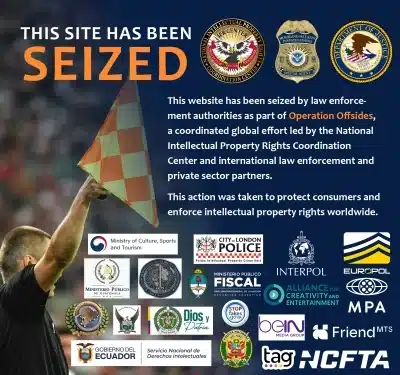 Source: The U.S. Department of Justice[/caption]
HSI Deputy Executive Associate Director Matthew Millhollin also warned that users accessing unauthorized streaming platforms could face risks including malware and payment information theft.
Operation Red Card Expands Global Crackdown
The U.S. enforcement action was accompanied by international efforts under Operation Red Card, which targeted digital piracy and counterfeiting connected to the World Cup across the Western Hemisphere.
The Justice Department’s International Computer Hacking and Intellectual Property (ICHIP) program coordinated enforcement efforts involving Argentina, Brazil, Chile, Colombia, the Dominican Republic, Ecuador, Paraguay and Peru.
The coordinated actions resulted in hundreds of illegal streaming sites being blocked, including 14 in Argentina, 223 in Ecuador, 28 in Peru, 309 in Brazil, 256 in the Dominican Republic and 1,140 in Colombia.
Colombian authorities also conducted 13 nationwide search-and-seizure operations targeting counterfeit sports apparel, resulting in 11 arrests and convictions.
Cybercrime Group Arrested in Colombia
On July 10, authorities launched Phase II of Operation Red Card in Colombia, conducting simultaneous operations in Bogotá, Soacha, Maríalabaja, Manatí and Sincerín.
An ICHIP-mentored cybercrime prosecutorial team from the Colombian Attorney General’s Office arrested four members of the cybercriminal group Los Ciberinfiltrados. According to the Justice Department, the group had illegally accessed telecommunications systems since 2024 and sold pirated streaming content, including World Cup matches.
The group allegedly used fraudulent credentials, VPNs, interception of security codes and manipulation of corporate system profiles to distribute the pirated content.
In Europe, ICHIP Bucharest also coordinated with Europol and international counterparts to address illegal streaming activities during the World Cup.
World Cup Streaming Crackdown Intensifies
The latest action follows a June 2026 announcement by the U.S. Department of Justice involving the seizure of nearly 400 websites accused of illegally broadcasting FIFA World Cup 2026 matches.
That earlier enforcement action, also conducted under Operation Offsides, targeted websites accused of copyright infringement by offering unauthorized live streams of World Cup matches for profit.
With more than 1,000 domains now seized in the U.S. actions, authorities continue to target unauthorized streaming platforms and digital piracy networks linked to the tournament.