In mid-2026, an emerging cybercriminal group known as ExfilSquad launched a high-profile extortion campaign targeting prominent UK organisations across the public sector, education, and law enforcement, as well as other firms worldwide.
Unlike traditional ransomware groups, ExfilSquad does not deploy encryptors or destructive malware. Instead, they operate as a pure data extortion group, stealing data and threatening to publish it on their onion-based Data Leak Site (DLS) if a ransom is not paid.
Several prominent UK entities have confirmed breaches linked to the group:
UK Department for Education (DfE): Approximately 600,000 records stolen from its Help Portal containing parent and staff contact details (names, emails, phone numbers, job titles), plus around 7,000 records from the Turing Portal.
Police National Legal Database (PNLD): Stole 1.9 GB of data (around 135,000 records) containing contact information for over 100,000 serving police officers, staff, and criminal justice professionals, alongside around 21,000 "Ask the Police" public inquiry records.
Newcastle University: Approximately 440,000 records compromised containing applicant and student contact information, personally identifiable information (PII), and admissions database records caused by a technical configuration flaw connecting to an admissions system.
Analysis of the details left on the data leak site revealed that ExfilSquad's primary attack vector involves exploiting misconfigurations in cloud portals, customer relationship management (CRM) platforms, internal case management systems, as well as Microsoft Power Pages data tables left publicly accessible without proper authentication.
To force compliance and prove their claims are real, ExfilSquad uploaded multi-gigabyte torrent files for each victim to their TOR leak site. Resecurity noted that ExfilSquad assigns a distinct Torrent Tracker and initial Web Seed per victim.
Analyst Comment
While ExfilSquad is a new group, they appear to be already experienced at running these types of attacks, suggesting they have a history of cybercrime. Plus, ExfilSquad’s recent campaign highlights the growing trend of transitioning from file-encrypting ransomware to extortion driven entirely by cloud and SaaS misconfigurations. Organisations that have invested in defending against endpoint-based threats are often leaving critical business application interfaces exposed.
SaaS platforms continue to be primary targets of English-speaking cybercrime communities. In recent years, customers of major SaaS providers, such as Salesloft, Salesforce, and Snowflake have all been extorted. Microsoft Power Pages portals, CRM databases, and customer support helpdesks frequently hold vast repositories of sensitive contact data and interaction histories. When internet-facing API endpoints or data table permissions are left unauthenticated or unpatched, cybercriminals can systematically scrape massive volumes of data without ever needing to drop a payload or escalate privileges internally.
ExfilSquad’s reliance on torrent distribution further amplifies reputational and operational damage. While gangs like LockBit, Clop, and Akira have previously utilised torrents, ExfilSquad’s operational twist of assigning unique Torrent Trackers and dedicated Web Seeds to individual victims ensures that leaked files distribute rapidly across P2P networks, making it extremely difficult to perform a takedown.
While ExfilSquad’s breaches have largely compromised contact directories and administrative support records, the real-world risks remain significant. Exposing work emails, names, and organisational structures for over 100,000 police officers and civil servants poses distinct social engineering, spear-phishing, and physical security concerns that impacted institutions will have to manage long after the breach occurs.
Defensive Takeaways
Audit Microsoft Power Pages and Public SaaS Tables: Regularly review public data table permissions, web API settings, and unauthenticated browser views across Microsoft Power Pages, CRMs, and customer support portals to ensure backend data tables are not exposed to the public internet.
Harden CRM and Case Management Integrations: Treat external-facing admissions portals, helpdesks, and case management systems as high-risk platforms. Implement strict access controls, conduct routine configuration audits, and enforce proper API token security.
Deploy External Attack Surface Management (EASM): Utilise continuous external attack surface scanning to detect newly exposed web endpoints, misconfigured database connectors, and publicly exposed storage buckets before malicious actors locate them.
Incorporate Pure Extortion into Incident Response Plans: Security teams must adapt incident response playbooks for data-theft-only scenarios. Organisations may seek to establish protocols for monitoring peer-to-peer (P2P) networks and managing public disclosures when stolen data is distributed via torrents.
An eight-month international operation targeting West African organized crime groups has resulted in 58 arrests and the identification of 263 suspects across 22 countries, according to INTERPOL. Operation Jackal IV, conducted from November 2025 to June 2026, focused on disrupting criminal networks, tracing illicit funds, identifying high-value targets and supporting arrests and prosecutions.
The operation brought together countries across six continents to tackle the growing global threat posed by West African criminal networks, including Black Axe and similar groups.
These networks have been linked to a significant share of global cyber-enabled financial fraud, including romance scams, cryptocurrency and investment scams, and business email compromise fraud.
Operation Jackal IV Targets West African Organized Crime Groups
Operation Jackal IV also targeted money laundering activities used to move and conceal criminal proceeds across borders.
INTERPOL coordinated cross-border intelligence sharing, analysis and operational support during the operation. It also provided specialized training to strengthen international investigations into financial crime.
Tomonobu Kaya, Director of the INTERPOL Financial Crime and Anti-Corruption Centre, said the operation showed the importance of international cooperation in following illicit financial flows and disrupting criminal networks.
[caption id="attachment_113806" align="aligncenter" width="600"] Image Source: INTERPOL[/caption]
Major Arrests and Financial Crime Investigations
In Argentina, authorities identified 196 individuals linked to a major Crime-as-a-Service network suspected of providing website domains and money laundering support to West African organized crime groups. The investigation resulted in 17 arrests, with an INTERPOL Operational Support Team assisting with analysis of seized data and identification of suspects and criminal networks.
South African authorities raided seven locations in Johannesburg linked to a syndicate involved in romance and investment scams targeting retirees in English-speaking countries. Investigators arrested 39 people, seized USD 2.67 million and blocked 257 bank accounts.
In Italy, investigators identified an individual connected to a pan-European money laundering network that used shell companies, remittance services and cash withdrawals. One account processed EUR 845,000, or about USD 736,000, through 560 transactions involving 20 financial instruments.
Romanian authorities dismantled a criminal group operating an investment scam through a call centre. The group promoted high returns from stocks and cryptocurrencies, with victims' money transferred to electronic wallets controlled by perpetrators.
Authorities estimated that EUR 143 million had been stolen and laundered globally. Eleven people were arrested, while cash, cryptocurrency, six real estate properties and luxury watches were seized.
Sextortion and Crime-as-a-Service Emerge
Beyond individual investigations, the operation highlighted emerging threats involving sextortion and Crime-as-a-Service. INTERPOL identified an increase in West African organized crime groups using sextortion to target minors, including victims as young as 14.
In these cases, offenders typically contacted minors through social media, established trust and persuaded them to share explicit images or videos. They then threatened to distribute the material to the victim's contacts unless a ransom was paid.
Investigators also found that some criminal syndicates were procuring Crime-as-a-Service from external providers, including through the dark web. These services were used to outsource activities such as money laundering and other operational functions.
While several cases from Operation Jackal IV remain under investigation, the preliminary results demonstrate the scale and international reach of the networks targeted during the eight-month operation.
The participating countries were Austria, Argentina, Australia, Canada, Côte d'Ivoire, France, Germany, Indonesia, Ireland, Italy, Japan, Malaysia, the Netherlands, Nigeria, Portugal, South Africa, Spain, Sweden, Switzerland, the United Arab Emirates, the United Kingdom and the United States.
When Cameron Curry discovered that his contract as a data analyst wasn't going to be renewed, he could have updated his LinkedIn profile. He could have started sending out his resume.
But what the 27-year-old from Charlotte, North Carolina, did instead was turn to extortion.
Read more in my article on the Hot for Security blog.
Microsoft Threat Intelligence tracks DeadLock ransomware as an emerging financially motivated operation distinguished by its use of decentralized infrastructure to support victim communications and data leak operations. Its recovery ecosystem combines the Session messaging network with blockchain-backed services that store and deliver resources used throughout the extortion process. This architecture likely increases the resilience of portions of its communication, leak-hosting, and negotiation infrastructure, allowing DeadLock operators to recover from some disruption efforts while maintaining continuity for victims. Microsoft has observed DeadLock ransomware being deployed by multiple groups including an affiliate of the Lynx and INC ransomware ecosystems.
First observed in July 2025, DeadLock operators employ double extortion tactics, encrypting victim environments while threatening to publicly release exfiltrated data. As of July 2026, the operators have published more than 80 compromised organizations on their data leak site, called the DeadLock blog, with more than half of the claimed victims in Europe. Microsoft identified DeadLock ransomware impacting organizations across information technology (IT), mining, transportation and logistics, manufacturing, hospitality, consumer goods, and other sectors in Europe, Asia, North America, South America, and Africa.
The DeadLock encryptor includes a resource-aware throttling mechanism designed to maintain system responsiveness during encryption. In addition to its encryption capabilities, the ransomware also appears to implement language or country-based geofencing designed to avoid running in environments associated with former Soviet and Commonwealth of Independent States (CIS)-linked countries as well as select Middle Eastern countries, a pattern commonly observed among ransomware operators believed to operate from those regions. Together, these capabilities demonstrate how DeadLock combines established ransomware tradecraft with decentralized infrastructure designed to improve operational resilience.
In this blog, we present a technical analysis of the DeadLock ransomware encryptor, covering its execution flow, defense evasion techniques, encryption design, and post-encryption behaviors, including a decentralized recovery chat system. We also provide indicators of compromise (IOCs), Microsoft Defender detections, and mitigation guidance to help organizations defend against this threat and similar ransomware activity.
Pre-encryption
Configuration parsing
Before performing any malicious activity, the DeadLock encryptor decrypts an embedded configuration blob using XOR decoding with an 8-byte key.
Below are the malware’s configuration fields and their values.
As an early exit check, the malware queries the system’s default and user interface (UI) languages. If either language matches the exclude list in the configuration, the malware self-deletes immediately without performing any encryption.
The following languages trigger this exit behavior:
LANGID
Language
Country
1049
Russian
Russia
1058
Ukrainian
Ukraine
1059
Belarusian
Belarus
1064
Tajik (Cyrillic)
Tajikistan
1065
Persian
Iran
1067
Armenian
Armenia
1068
Azeri (Latin)
Azerbaijan
1079
Georgian
Georgia
1087
Kazakh
Kazakhstan
1088
Kyrgyz
Kyrgyzstan
1090
Turkmen
Turkmenistan
1114
Syriac
Syria
2072
Romanian (Moldova)
Moldova
2092
Azeri (Cyrillic)
Azerbaijan
2115
Uzbek (Cyrillic)
Uzbekistan
8193
Arabic
Oman
9217
Arabic (Yemen)
Yemen
Command-line processing and privilege elevation
The encryptor’s behavior branches based on command-line arguments and the current privilege level. If a target directory path is provided as the command-line argument, the malware skips all preparation steps and jumps directly to encryption. This feature allows the operator to invoke the encryptor with specific targets for focused encryption. If no sub-commands are provided and the process is already elevated, the malware proceeds normally through all execution phases.
The more interesting case occurs when no command-line argument is provided while the process is not elevated. In this scenario, the malware attempts to gain administrator privileges through a batch-script-based elevation technique. It generates a randomly named .cmd file (8 uppercase characters, such as ESYEKQSY.cmd) and executes it using ShellExecuteW with the RunAs verb, which triggers the Windows User Account Control (UAC) consent dialog. If the user denies the prompt, the malware retries up to 10 times before giving up and exiting.
During dynamic analysis, the sample did not successfully relaunch itself with elevated privileges. As a result, full pre-encryption preparation appears to require execution from an already elevated context. When invoked with a target path, the malware bypasses preparation and proceeds directly to encrypt accessible files. This behavior is specific to the analyzed sample and may change in later variants.
Token privilege escalation
When running with administrator privileges, the malware further expands its access by enabling SeDebugPrivilege, SeRestorePrivilege, SeBackupPrivilege, SeTakeOwnershipPrivilege, SeAuditPrivilege, and SeSecurityPrivilege. These privileges increase the malware’s ability to interact with system processes, protected files, and security-related settings, helping it overcome common access restrictions and maximize the scope of files and resources it can target during the encryption phase.
Recycle bin emptying
The malware silently empties the recycle bin on all drives without any UI or confirmation dialog, eliminating a potential source of file recovery for victims.
Custom icon registration
To visually brand encrypted files, the malware writes an embedded .ico file to C:\ProgramData\<UID>.ico and registers it as the default icon for files with the extension .dlock.
To associate the custom icon with encrypted files, the ransomware creates the HKLM\SOFTWARE\Classes\.dlock\DefaultIcon registry key and sets its (Default) value to the path of the dropped icon file.
Below is the malware’s embedded .ico file.
Figure 1. DeadLock icon for encrypted files
Process and service termination
Before starting encryption, the malware terminates processes and disables services that could interfere with file access or provide defensive capabilities. This approach ensures that locked files become accessible for encryption while simultaneously disrupting the environment’s ability to detect, respond to, or recover from the attack.
For services, the malware enumerates all active Win32 services and compares them against the stop list in the configuration. For each matching service, DeadLock sets its start type to DISABLED and sends a stop command to terminate that service. Notable targets include windefend (Windows Defender), vss/swprv/wbengine (Volume Shadow Copy and Backup services), mssearch, Hyper-V services (vmcompute, vmms), and Active Directory services (adws, ntds, kdc). Below is the full service stop list in the malware configuration:
Figure 2. Service stop list
For processes, the malware enumerates all running processes and terminates any matching its stop list while skipping its own process ID. Targeted processes include security tools (msmpeng, securityhealthservice, smartscreen), backup and cloud sync applications (onedrive, dropbox, googledrivefs, owncloud), remote access tools (anydesk, putty, mstsc, rustdesk), shell and system processes (explorer, powershell, taskmgr, cmd), and search/indexing services. Below is the full process stop list in the malware configuration:
Figure 3. Process stop list
Event log clearing
To eliminate forensic evidence, the malware employs three complementary methods that collectively ensure every event log channel on the system is cleared of existing entries, disabled from recording future events, and has its access permissions locked down:
Direct clearing: Clears the following log channels via the classic Event Log API: Application, Security, Setup, Servicing, Eventlog, Forwarded Events, Windows PowerShell, and System.
Registry-based disabling: Enumerates every sub-key under HKLM\SOFTWARE\Microsoft\Windows\CurrentVersion\WINEVT\Channels. For each channel, sets Enabled to 0 (disabling all future logging) and overwrites ChannelAccess with a restrictive Security Descriptor Definition Language (SDDL) string that limits access to SYSTEM, built-in administrators, and local admin.
Modern API enumeration: Uses wevtapi.dll to enumerate all registered event log channel paths (including custom application channels not in the hardcoded list) before clearing each one.
By combining API-based clearing, registry manipulation, and full channel enumeration, the malware covers multiple log sources, including third-party application logs and custom diagnostic channels, to minimize existing forensic evidence on the infected device.
Directory traversal
To maintain system stability and ensure the victim can access ransom instructions, the malware excludes specific directories, file extensions, and file names from encryption. This selective encryption model is a common ransomware design pattern where the system must remain operational enough for the victim to receive instructions and facilitate payment.
Extensions and file names from the configuration’s file exclude list are skipped during encryption:
Figure 4. List of skipped extensions and file names
For directory processing, the malware uses a two-tier directory exclusion system applied at different stages of the encryption pipeline. Tier 1 provides rough filtering that saves significant time by avoiding traversal overhead, while tier 2 provides granular path-specific exclusions within directories that are traversed. Both prevent encryption, but they operate at different stages of the traversal pipeline.
In its pre-traversal phase (tier 1), the malware checked at the drive batch level before threads are spawned for traversal. If a top-level directory matches against the configured directory exclude list (\users\*\appdata, program files (x86)\, program files\, and programdata\), the entire tree is skipped without being walked.
In its during-traversal phase (tier 2), the malware checked the file name during recursive directory enumeration and applied to both subdirectories and files as they are encountered. In this tier, the directory and file names are checked against the configured sub-path exclude list below.
Figure 5. Sub-path exclude list
Encryption
Resource-aware throttling
One of the more distinctive aspects of the DeadLock encryptor is its resource-aware throttling mechanism, designed to keep the infected system responsive during encryption. The malware spawns a dedicated monitoring/dispatch thread per drive batch that acts as a gatekeeper for file encryption dispatch. Before dispatching each new file to be encrypted, this thread polls system resource utilization and checks against hardcoded thresholds:
Polls memory and CPU idle before each file dispatch
Calculates memory usage percentage and CPU idle percentage
If memory usage exceeds 29% or CPU load exceeds 70% (idle < 30%), the dispatch thread pauses via a waitable timer and retries until resources return below thresholds
Once thresholds are within limits, atomically sets a dispatch flag on the work queue and signals waiting encrypting worker threads
With this mechanism, worker threads already encrypting files are not interrupted, and only the dispatch of new files is gated. This means partially encrypted files are expected to complete, and the throttling manifests as reduced parallelism rather than stop/start behavior. This approach can prevent system hangs that would alert the user and reduce the likelihood of behavioral detection by maintaining normal-looking resource consumption patterns.
Thread architecture
For the encryption work itself, the malware spawns directory processing threads, with the thread count being 2 times the CPU core number. Each thread recursively traverses directories, dropping ransom notes and dispatching files for encryption. Individual file encryption threads are tasked with handling the actual cryptographic operations.
Cryptographic scheme
The DeadLock ransomware implements a hybrid cryptographic design that combines Curve25519 elliptic-curve cryptography with the XChaCha20 stream cipher for file encryption. Key encapsulation uses the Networking and Cryptography Library (NaCl) crypto_box construction, which pairs an asymmetric key exchange with authenticated encryption to securely wrap each file’s symmetric key.
The configuration’s operator public key 03bf50bbf97c4e951e66ff12b689a37a3ce675b4921e254eae76da77573843e4a9 is 33 bytes. The leading 03 byte is a SEC1 compressed point format prefix borrowed from Bitcoin/secp256k1. The malware validates this prefix byte against a lookup table that accepts 00, 02, 03, 04, and 05, mapping each to an expected key length.
After format validation, only the remaining 32 bytes are used in the actual Curve25519 ECDH scalar multiplication. This SEC1 prefix is non-standard for Curve25519, which natively uses bare 32-byte keys, and the malware author has likely adopted it for format versioning across their builder and decryptor tooling.
Per-file encryption process
For each target file, the malware performs the following sequence of operations:
Rename the target file from <filename> to <filename>.<UID>.dlock
Open the renamed file and retrieve file size/attributes
Clear the system attribute if FILE_ATTRIBUTE_SYSTEM is set
24-byte random XChaCha20 nonce (first 16 bytes for HChaCha20 subkey derivation, last 8 bytes as stream nonce)
32-byte random ephemeral Curve25519 private key
12-byte random file tag (only the first byte is functionally referenced by the encryptor to derive padding length; the remaining 11 bytes serve as a random file identifier written to the cleartext footer, likely used by the decryptor for file correlation/tracking)
Perform Curve25519 ECDH: Multiply the ephemeral private key by the attacker’s embedded public key to derive a shared secret
Build metadata plaintext: XChaCha20 key + 24-byte XChaCha20 nonce + random padding + dDlK magic + optional FA flag + chunk parameters
Encrypt metadata using crypto_box (XSalsa20-Poly1305) with the ECDH shared secret and a zero nonce
Encrypt file content using XChaCha20 with the generated key and 24-byte nonce
Append the encrypted footer/metadata to the end of the file
The use of a zero crypto_box nonce is worth noting. This is cryptographically safe because each file generates a unique ephemeral Curve25519 keypair, which produces a unique ECDH shared secret per file. With this, a constant zero nonce never repeats with the same key.
The entire design ensures that each file is encrypted with a distinct key derived from a per-file ephemeral key exchange, eliminating any possibility of key reuse across files. Overall, the cryptographic construction is sound and does not present a practical path to decryption without the attacker’s private key.
File size-based encryption strategy
To balance encryption thoroughness with speed, the malware implements a tiered encryption policy based on file size. The encryption rule in the configuration 1000,05052429880,025124288000,010524288000,F991114288000 encodes this policy. Each comma-separated entry is parsed by splitting at position 3: the first 3 characters represent the encryption percentage (decimal), and the remaining characters represent the file size threshold (decimal bytes). The special prefix F replaces the percentage field with a chunked-full mode.
Rule
Encryption percent
File size threshold
Behavior
1000
100%
≥ 0 bytes
Default: encrypt entire file
05052429880
50%
≥ ~50 MB
Encrypt 50% of file in distributed chunks
025124288000
25%
≥ ~118 MB
Encrypt 25% in distributed chunks
010524288000
10%
≥ ~500 MB
Encrypt 10% in distributed chunks
F991114288000
Chunked
≥ ~1 GB
Special full-chunk mode with calculated intervals
Rules are evaluated in order, and the last matching rule wins. For example, when the malware processes a 2 GB file, all rules match, but the final F99… entry will determine the encryption behavior.
For partial encryption, the malware calculates:
Total bytes to encrypt = ceil(file_size × (percentage / 100))
This creates an intermittent encryption pattern where 512-byte blocks are encrypted at regular intervals throughout the file. The result is a file that is rendered unusable while requiring only a fraction of the time needed for full encryption. This is a crucial optimization for the ransomware when targeting large files such as databases, virtual machine images, and backups.
File footer
After encryption, the malware appends a structured metadata blob to the end of each file. This footer contains all the information the decryptor needs to reverse the encryption, along with markers for format validation:
Figure 6. DeadLock file footer
The footer serves several important functions:
Key and nonce reconstruction: The cleartext ephemeral Curve25519 public key (33 bytes) at the end of the footer allows the decryptor to recompute the ECDH shared secret and open the crypto_box to recover the XChaCha20 key and nonce used for file content encryption.
Inner dDlK magic (decryption validation): After the decryptor opens the crypto_box, it checks for the dDlK marker at the expected offset (32 + 24 + padding_length bytes into the plaintext) to confirm the correct private key was used and that decryption succeeded. While the Poly1305 Message Authentication Code (MAC) already provides cryptographic integrity verification, this marker offers a fast format-level sanity check.
FA flag (decryption mode indicator): This flag is used by the decryptor to determine which read strategy to use when reversing the encryption. It is present when the file was encrypted using sequential/contiguous block encryption, and absent when intermittent/skip encryption was used. Specifically, FA is appended in two cases:
F-prefix rule matched: When the file size triggers the F991114288000 config entry (the special chunked-full mode), the FA flag is always set.
Percentage rule with zero skip interval: When a percentage-based rule matches but the calculated skip interval between encrypted chunks works out to zero (meaning the percentage effectively covers the entire file), FA is also set.
Without this flag, the 8-byte chunk parameters in the footer would be ambiguous as they could represent either a block count or a skip interval. The FA flag resolves this ambiguity and enables the decryptor to correctly reconstruct the original file.
File identifier/format tag: The 12-byte random value in the cleartext footer serves as a file identifier (with the first byte used to derive the padding length inside the encrypted payload).
Post-encryption
Wallpaper
As an immediate visual indicator of compromise, the malware generates a custom BMP wallpaper file at runtime using the victim’s screen resolution. Below is an example of the generated BMP wallpaper:
Figure 7. DeadLock wallpaper
The wallpaper is written to C:\ProgramData\<UID>.bmp (on Vista and later) or C:\Documents and Settings\All Users\Application Data\<UID>.bmp (on XP), set as the desktop background, and persisted in the registry at HKLM\SOFTWARE\Microsoft\Windows\CurrentVersion\Policies\System\Wallpaper.
Ransom notes deployment
After encrypting files, the malware deploys two types of ransom notes, each with distinct deployment logic and purpose:
Text note (HOW_RECOVER.<UID>.txt): The text note is dropped into every encrypted directory, but with a notable timing behavior: it is only deployed during the second pass of the directory processing loop. The malware iterates over drive batches multiple times, and the text note drop is gated by an iteration counter. On the first pass, the text note is suppressed, likely to prioritize encryption speed before littering the file system with ransom note files. For defenders and analysts, this has a practical implication: if testing with a minimal drive configuration that only triggers a single iteration, the text note will never appear.
Below is the text note content from the malware’s configuration.
Figure 8. DeadLock text ransom note
HTML note (RECOVERY_CHAT.<UID>.html): This file is dropped to all drive root directories and all Desktop folders. Unlike the text note, the HTML note is a full interactive web application with a self-contained single-page application that implements end-to-end encrypted chat, a paginated data leak blog, and a file browser, all without requiring a traditional backend server. The technical architecture of this recovery chat system is detailed in Recovery chat: Technical architecture.
Recovery chat: Technical architecture
The most distinctive feature of the DeadLock ransomware is its recovery chat system. The RECOVERY_CHAT.<UID>.html file is a self-contained HTML application that implements a full end-to-end encrypted chat system, a paginated data leak blog, and a file browser, all without requiring a traditional backend server.
Figure 9. HTML application “About” page UI
The architecture is designed with three decentralized components.
Polygon blockchain as configuration store
Rather than relying on traditional domain-based infrastructure that can be seized or taken offline, the DeadLock operators store configuration data on the Polygon blockchain. Two smart contracts serve as censorship-resistant infrastructure:
Contract
Address
Function selector
Purpose
Chat proxy
0x8EF7c3e531d871D3B9D559722DE77EB1dEc19dAe
0x933a9ce8
Stores the proxy server URL
Blog
0x757984507c82c8dA1d3969c535dB5706eEE6426C
0xd4070542
Stores actor’s blog posts
The HTML page issues eth_call requests to public Polygon Remote Procedure Call (RPC) endpoints (no wallet required with read-only calls) to obtain the proxy server address. The blog contract takes offset and limit parameters (for pagination) and returns structured data including post titles, bodies, timestamps, image URLs, and file attachment links.
On-chain storage provides several strategic advantages for the threat actor: the proxy URL can be updated by modifying the smart contract without changing any victim-facing infrastructure, and no domain registration or DNS infrastructure is required. This represents a notable evolution in ransomware infrastructure design.
The HTML recovery chat cycles through six public RPC endpoints for redundancy: polygon-bor-rpc.publicnode[.]com, polygon.drpc[.]org, polygon-pokt.nodies[.]app, polygon-rpc[.]com, 1rpc[.]io/matic, and polygon.meowrpc[.]com.
Session network for end-to-end encrypted chat
For victim-operator communication, chat messages are routed through the Session decentralized messenger network, which is an onion-routed, swarm-based messaging protocol that provides anonymity for both parties. The proxy server (whose URL is retrieved from the blockchain) acts as a relay between the victim’s browser and Session swarm nodes.
Figure 10. HTML application ”Chat” page UI
Key generation: DeadLock’s design choice is that the victim’s Session identity is derived deterministically from their sign-in credentials. When the victim enters their credentials on the HTML page, the following derivation occurs:
Figure 11. Derivation after victim entered credentials
This deterministic derivation means the same credentials always produce the same keypair, and no account registration is needed as the victim’s Session identity exists only when they enter the correct credentials. If the victim forgets their credentials, the identity is unrecoverable (as stated by the actor in the chat UI). The 05 prefix is Session’s standard network identifier for user accounts.
Sending a message: The following sequence occurs when a message is sent:
Encode the body and timestamp as protobuf
Create an actor message and a self-sync copy
Pad plaintext to 160-byte boundary
Sign the padded content and key context with Ed25519
Append the sender public key and signature
Seal each payload with the recipient’s Curve25519 key
Wrap in Session’s onion request protobuf format (verb: PUT, path: /api/v1/message)
Ask the proxy to submit both copies to their respective swarms
Receiving a message: The following sequence occurs when a message is received:
Sign “retrieve” + timestamp with the victim’s Ed25519 key
Select a node associated with the victim’s own swarm
Ask the proxy to poll for messages addressed to that identity
Open each sealed box with the victim’s Curve25519 keypair
Remove the appended public key and signature
Strip padding, decode protobuf, and extract the message body
Data leak blog and Wasabi file hosting
The recovery chat page also provides access to a data leak blog whose content is stored on the Polygon blockchain.
Figure 12. Redacted HTML app “Blog” page UI
Blog posts retrieved from the smart contract support BBCode formatting, image galleries, and file attachments using either direct URLs or Wasabi protocol links that open an in-browser file explorer. The HTML application contains a full Amazon Web Services (AWS) S3-compatible file browser that parses the Wasabi credentials from the URI, generates AWS4-HMAC-SHA256 signed requests, lists bucket contents with folder navigation, and generates pre-signed download URLs for individual files. This allows the attacker to host stolen data on Wasabi and provide victims or the public with browsable access to the leaked files without running a web server.
Infrastructure resilience summary
Figure 13. HTML recovery chat infrastructure summary
The architecture is significantly more resilient to takedown and censorship efforts, but it is not independent of off-chain infrastructure:
Proxy replacement: The actor can update the on-chain proxy URL without changing the HTML
On-chain persistence: Contract-stored blog data is resistant to conventional hosting takedowns
RPC dependency: The page still requires access to at least one public Polygon RPC endpoint
Proxy dependency: Chat access depends on the current custom proxy remaining reachable
Storage dependency: Images and leaked files can be removed from CDN or Wasabi hosting
Session resilience: Distributed swarm storage reduces reliance on a single messaging server
This infrastructure model represents a meaningful evolution from traditional ransomware communication channels and poses new challenges for takedown efforts.
Self-deletion
As a final cleanup step after encryption completes, the malware creates a batch to delete its own binary from disk. The cleanup batch loops until it successfully deletes the malware binary, then removes itself:
Figure 14. Self-deleting batch loop
Defending against DeadLock ransomware
Microsoft recommends the following mitigations to reduce the impact of this threat.
Read the human-operated ransomware threat overview for advice on developing a holistic security posture to prevent ransomware, including credential hygiene and hardening recommendations.
Turn on cloud-delivered protection in Microsoft Defender Antivirus or the equivalent for your antivirus product to cover rapidly evolving attacker tools and techniques. Cloud-based machine learning protections block a huge majority of new and unknown variants.
Run endpoint detection and response (EDR) in block mode so that Microsoft Defender for Endpoint can block malicious artifacts, even when your non-Microsoft antivirus does not detect the threat or when Microsoft Defender Antivirus is running in passive mode. EDR in block mode works behind the scenes to remediate malicious artifacts that are detected post-breach.
Configure investigation and remediation in full automated mode to let Microsoft Defender for Endpoint take immediate action on alerts to resolve breaches, significantly reducing alert volume.
Configure automatic attack disruption in Microsoft Defender XDR. Automatic attack disruption is designed to contain attacks in progress, limit the impact on an organization’s assets, and provide more time for security teams to remediate the attack fully.
To help preserve existing systems in the event of a ransomware attack, configure a Controlled Folder Access (CFA) policy to be as strict as possible. CFA protects valuable data from threats like ransomware by preventing write access to common system folders; more folders can also be added. Establishing this policy ahead of a ransomware event can enable organizations to respond quickly to ransomware signals, deploying the CFA policy to limit the destructive impact of an active attack. In certain instances, a CFA policy can also be leveraged proactively on specific sensitive assets that will not be negatively impacted by restrictive protections. Use audit mode to evaluate the impact to your organization in these cases.
Microsoft Defender XDR customers can turn on attack surface reduction rules to prevent several of the infection vectors of this threat. These rules, which can be configured by any user, offer significant hardening against targeted attacks. In observed attacks, Microsoft customers who had the following rules turned on could mitigate the attack in the initial stages and prevent hands-on-keyboard activity:
Block process creations originating from PSExec and WMI commands (Some organizations might experience compatibility issues with this rule on certain server systems but should deploy it to other systems to prevent lateral movement originating from PsExec and WMI)
You can assess how an attack surface reduction rule might impact your network by opening the security recommendation for that rule in Vulnerability management. In the Recommendation details pane, check the user impact to determine what percentage of your devices can accept a new policy enabling the rule in blocking mode without adverse impact to user productivity.
Microsoft Defender detections
Microsoft Defender customers can refer to the list of applicable detections below. Microsoft Defender coordinates detection, prevention, investigation, and response across endpoints, identities, email, apps to provide integrated protection against attacks like the threat discussed in this blog.
Microsoft Defender Antivirus
Microsoft Defender Antivirus detects threat components as the following malware:
The following alerts might indicate threat activity associated with this threat. These alerts, however, can be triggered by unrelated threat activity and are not monitored in the status cards provided with this report.
Ransomware-linked threat actor detected
Ransomware behavior detected in the file system
Possible ransomware activity
File backups were deleted
Potential human-operated malicious activity
Possible data exfiltration
Suspicious wallpaper change
The following alerts might indicate threat activity associated with DeadLock ransomware if Defender for Endpoint is set to block mode.
‘DeadLock’ ransomware was detected
‘DeadLock’ ransomware was prevented
Microsoft Defender for Cloud Apps
The following alert might indicate threat activity associated with this threat. This alert, however, can be triggered by unrelated threat activity and are not monitored in the status cards provided with this report.
Ransomware activity
Microsoft Security Copilot
Microsoft Security Copilot is embedded in Microsoft Defender and provides security teams with AI-powered capabilities to summarize incidents, analyze files and scripts, summarize identities, use guided responses, and generate device summaries, hunting queries, and incident reports.
Security Copilot is also available as a standalone experience where customers can perform specific security-related tasks, such as incident investigation, user analysis, and vulnerability impact assessment. In addition, Security Copilot offers developer scenarios that allow customers to build, test, publish, and integrate AI agents and plugins to meet unique security needs.
Threat intelligence reports
Microsoft Defender XDR customers can use the following threat analytics reports in the Defender portal (requires license for at least one Defender XDR product) to get the most up-to-date information about the threat actor, malicious activity, and techniques discussed in this blog. These reports provide the intelligence, protection information, and recommended actions to prevent, mitigate, or respond to associated threats found in customer environments.
Microsoft Security Copilot customers can also use the Microsoft Security Copilot integration in Microsoft Defender Threat Intelligence, either in the Security Copilot standalone portal or in the embedded experience in the Microsoft Defender portal to get more information about this threat actor.
To hear stories and insights from the Microsoft Threat Intelligence community about the ever-evolving threat landscape, listen to the Microsoft Threat Intelligence podcast.
LeakNet claims it stole 11TB of NYC Health + Hospitals data containing sensitive medical, financial and biometric records linked to more than 12 million people.
EY confirmed the theft of client tax documents from its third-party support platform. ShinyHunters claims responsibility and is threatening to publish the data.
Sextortion scammers are using email addresses from data leaked by the ShinyHunters hacking group to add some credibility to their feeble attempts to convince people they have embarrassing information about them.
Sextortion emails are messages claiming that the scammer recorded you through your webcam while you watched pornography and now demand payment. They have been around for years and keep evolving with small changes in wording and fake technical detail.
In this campaign, the scammers pretend to be ShinyHunters. What hasn’t changed is the basic truth: there is no malware, no recording, and no credible evidence behind the threat. Despite seeing countless versions of these emails over the years, I’ve yet to encounter one that was backed up by the evidence the sender claimed to have.
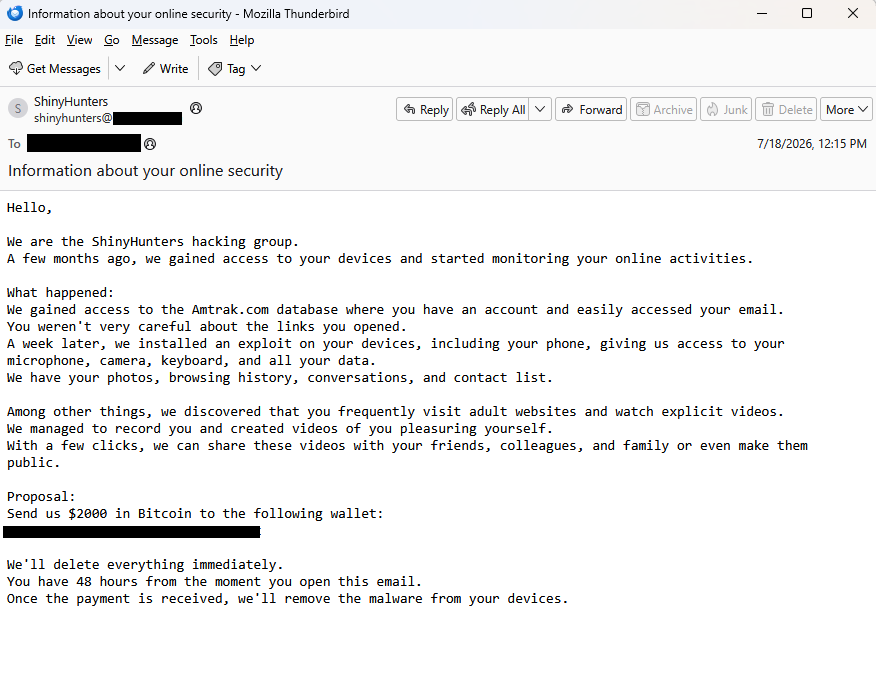
BleepingComputer reports that ShinyHunters data leaks are fueling a $2,000 sextortion email scam and shared the following example:
“Subject: Information about your online security
Hello,
We are the ShinyHunters hacking group. A few months ago, we gained access to your devices and started monitoring your online activities.
What happened: We gained access to the Amtrak.com database where you have an account and easily accessed your email. You weren’t very careful about the links you opened. A week later, we installed an exploit on your devices, including your phone, giving us access to your microphone, camera, keyboard, and all your data. We have your photos, browsing history, conversations, and contact list.
Among other things, we discovered that you frequently visit adult websites and watch explicit videos. We managed to record you and created videos of you pleasuring yourself. With a few clicks, we can share these videos with your friends, colleagues, and family or even make them public.
Proposal: Send us $2000 in Bitcoin to the following wallet: xxxxxxxxxxxxxxxxxxxxxxxxxxxxxxxxx
We’ll delete everything immediately. You have 48 hours from the moment you open this email. Once the payment is received, we’ll remove the malware from your devices.”
BleepingComputer states it has seen data from the Amtrak, Hallmark, ADT, Substack, Betterment, CarGurus, Panera Bread, and McGraw Hill breaches used to target victims in this sextortion email campaign.
A California community college also issued a warning after seeing the campaign target people affected by the Canvas data breach.
They confirmed that the targeted email addresses had previously appeared in data leaked by ShinyHunters. They also contacted the group, which denied being behind the sextortion emails.
The increase to a $2,000 demand may suggest the scammers paid someone for the email lists. Although it’s more likely they simply downloaded the leaked data after ShinyHunters published it following failed extortion attempts.
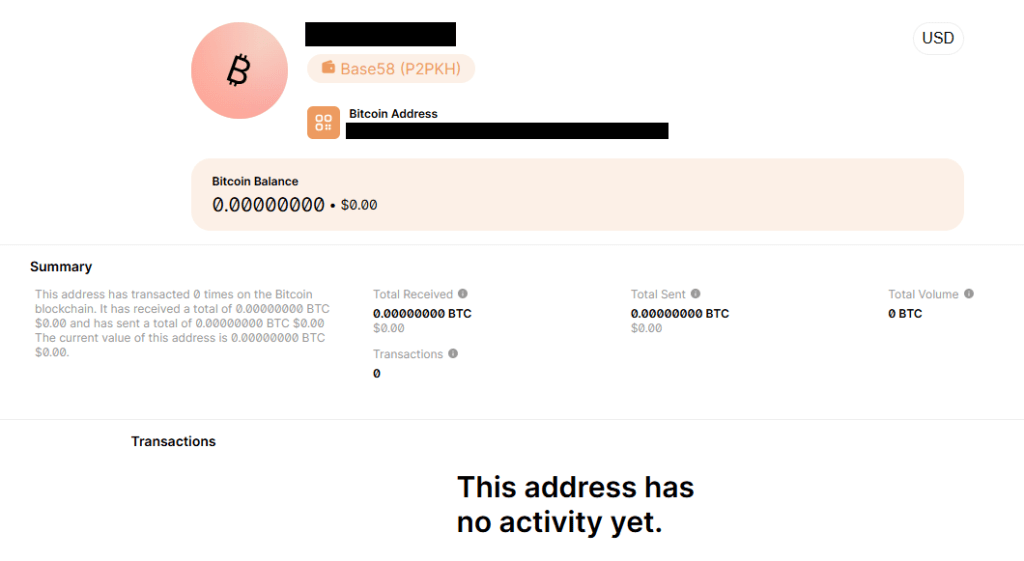
A quick check of the Bitcoin address used in the email shows no activity.
No activity on their Bitcoin address
Let’s keep it that way. With any luck, these dungeon dwellers will eventually give up trying to scare people out of their hard-earned money.
How to react to sextortion emails
Some sextortion emails are badly written, but many have been polished by AI and look convincing. Regardless of how professional they look, they should be treated the same way: as unsubstantiated threats designed to scare victims into paying.
First and foremost, never reply to emails of this kind. Responding confirms that someone is actively reading messages sent to that address and may encourage further scam attempts.
Don’t let yourself be rushed into action. Scammers rely on the fact that you will not take the time to think this through and subsequently make mistakes. Ask for advice if you’re not sure.
An attachment is not proof. Most sextortion emails contain no evidence at all, and attachments are often used to deliver malware or make the threats appear more convincing.
If the email includes a password you’ve used before, change it immediately anywhere it’s still in use. Then enable two-factor authentication (2FA) wherever possible. If you’re having trouble keeping track of your passwords, consider using a password manager.
Delete the message, report it as spam, and move on.
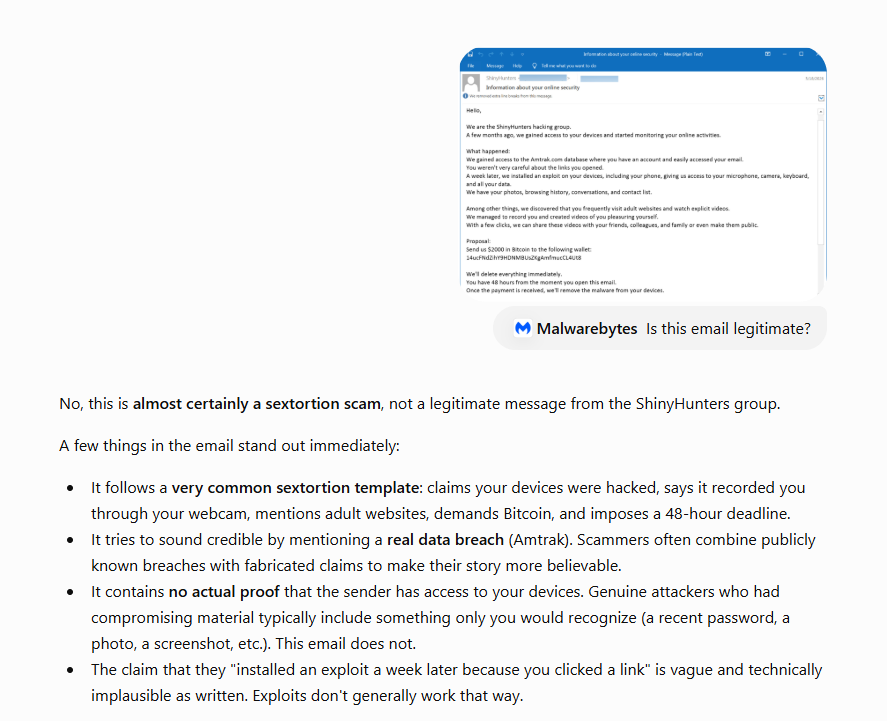
Pro tip: Malwarebytes Scam Guard recognized this email for what it is: sextortion. It can recognize scams and advise you how to proceed.
While these sextortion emails are almost always bluffs, if you’re concerned about webcam spying, Malwarebytes Webcam Monitoring can alert you when applications attempt to access your camera.
Ransomware’s biggest story in the first half of 2026 was not only about established names maintaining dominance. A newer player, The Gentlemen ransomware group, emerged as one of the most geographically active operators, expanding its reach across Europe, Asia-Pacific, the Middle East & Africa, and the Americas.According to research from Cyble Research and Intelligence Labs (CRIL), The Gentlemen became one of the top ransomware actors globally, demonstrating how quickly emerging ransomware-as-a-service (RaaS) groups can scale through affiliate-driven operations.Unlike older ransomware brands that rely on a narrow set of preferred targets, The Gentlemen displayed a broad targeting strategy. The group impacted organizations across Manufacturing, Construction, Healthcare, Government, and IT sectors — industries where operational disruption, sensitive information, and regulatory pressure create strong incentives for victims to respond quickly.
The Gentlemen Ransomware Group Becomes a Regional Threat
The group’s strongest activity was observed in Europe and the UK, where it was responsible for 144 ransomware attacks during H1 2026. The region’s Manufacturing, Construction, Healthcare, and Professional Services sectors were among the most affected, highlighting the group’s preference for organizations with valuable data and limited tolerance for downtime.In Asia-Pacific, The Gentlemen became the leading ransomware threat, accounting for 114 attacks — nearly one-quarter of the region’s ransomware activity. Manufacturing was among the primary targets, with additional campaigns affecting IT services, Professional Services, Healthcare, and government entities.The group also gained significant attention in the Middle East & Africa, where it accounted for 56 attacks, representing more than 26% of ransomware incidents in the region. Construction, BFSI, and Government organizations were frequent targets, demonstrating the group’s interest in sectors linked to critical services and economic activity.South America also saw notable activity, with The Gentlemen responsible for 46 attacks, making it one of the region’s leading ransomware operators.Also Read:One Country Absorbed Nearly Half of the World’s Ransomware Attacks in Just Six Months – The United States
Double Extortion Remains the Core Strategy
The rise of The Gentlemen reflects a broader ransomware trend: encryption alone is no longer the primary weapon. Like most modern ransomware operations, the group relies on double extortion — stealing sensitive information before encrypting systems and using the threat of public exposure as additional pressure.This approach allows ransomware groups to target organizations even when companies maintain effective backup and recovery capabilities. Stolen data can be leveraged for financial gain, reputational damage, regulatory pressure, or further attacks.
What Makes The Gentlemen a Growing Concern?
The group’s rapid expansion highlights the resilience of the RaaS ecosystem. Modern ransomware operations no longer depend solely on a single team’s technical capabilities. Instead, affiliates, access brokers, and specialized cybercrime services allow operators to expand quickly across industries and regions.The Gentlemen’s activity also reinforces a key security challenge: organizations cannot rely only on historical threat rankings. New ransomware groups can rapidly become major players by exploiting exposed systems, purchasing initial access, and adopting proven extortion tactics.For security teams, monitoring emerging ransomware operators and tracking changes in attacker behavior is becoming as important as defending against established groups.To explore the complete ransomware landscape, including regional attack trends, targeted industries, and the activity of leading ransomware groups, download the full Cyble H1 2026 Cyber Threat Landscape Report.
Former ransomware negotiator Angelo Martino gets 70 months in prison for helping BlackCat extort US victims and misuse confidential client data in cyberattacks.
A U.S. government agency paid $1M to Kairos, a group focused on data theft and extortion rather than ransomware, Ransom-ISAC reports.
A new case study from Ransom-ISAC reconstructs a complete data-extortion incident involving a U.S. government body and a threat actor called Kairos, using a leaked negotiation transcript and blockchain tracing of the ransom payment. The victim paid roughly $1 million in Bitcoin on June 13, 2025. The uncomfortable detail: Kairos has never been confirmed to have deployed ransomware at all.
“On 19 May 2025, a U.S. government entity was reportedly targeted by Kairos. Kairos later claimed the access was obtained through a brute-force credential attack. The entity was listed on Kairos’s victim site on 21 May 2025.” reads the report published by Ransom-ISAC.
“Rather than deploying encryption, Kairos appears to have focused on data exfiltration and public-exposure pressure. The group claimed to hold more than 1.6 million files — 1,602,775 files in total — and 2 TB of data before making contact.”
No encryptor, no locker binary, no decryption key demand. What Kairos appears to have done is steal data, then charge the victim not to publish it. As the Ransom-ISAC report states:
“No ransomware sample, encryptor, or locker binary has been obtained or confidently linked to Kairos.” continues the reprot. “On the available evidence, the U.S. government body paid a seven-figure ransom to a threat actor whose “ransomware group” status remains unverified and whose leverage appears to have been based on data-theft and publication pressure rather than demonstrated ransomware capability.”
The victim called the incident ransomware. The word no longer means what most people think it means.
The report doesn’t name the victim, citing privacy concerns. The transcript does the naming itself. The requested sample files include documents called Union.xlsx, “1 union co psi template.doc,” and a final archive delivered post-payment called union.rar. The victim describes itself as “a small county with limited resources.”
The timeline fits: in May 2025, Union County, Ohio, disclosed it had detected a network intrusion and later notified 45,487 residents and employees that their data had been stolen, covering most of a county of roughly 70,000 people. The stolen records included Social Security numbers, financial details, fingerprints, and passport numbers. Neither the county nor Kairos has confirmed the connection.
I conducted personal research and I can confirm that Union Count stated cybercriminals accessed the County’s network between May 6 and 18, 2025 and stole some data. By August 25, officials had finished reviewing the breach and had begun notifying affected individuals. However, the Government entity at the time confirmed a ransomware attack, as reported in the data breach notification letter.
“On May 18, 2025, the County detected ransomware on our computer network. As soon as we learned this, we immediately launched an investigation with assistance from nationally recognized third-party cybersecurity and data forensics consultants to secure our network and investigate the scope of the incident. We also alerted federal law enforcement.” reads the data breach notification letter sent to the impacted individuals and shared with the Maine General Attorney. “Through our investigation, we determined that the cyber criminals accessed our network from May 6, 2025 through May 18, 2025, and took some County data.”
Kairos listed the victim on its leak site on May 21, 2025, two days after first contact. The group claimed to hold more than 2 terabytes of data, specifically 1,602,775 files. Kairos later claimed the access was obtained through a brute-force credential attack, a single-guessed password.
The transcript covers 28 days of back-and-forth. Kairos opened at $3 million. The victim countered at $100,000 on June 4, then raised to $255,000, then $430,000. Kairos dropped to $2 million, held there briefly, then issued a hard deadline: $1 million by Friday or the files go public. The victim paid. The final payment was 33 times the first offer and 2.3 times the highest recorded counter.
Kairos ran a disciplined negotiation. Responses came within minutes to a few hours throughout the 28-day window, suggesting an actively monitored channel. The pressure tactics were textbook: a countdown timer, escalating deadlines, selective reference to the most sensitive material. Kairos specifically highlighted a folder marked “prosecutors office,” warning that leaking it would help criminals avoid prosecution and cause a public outcry.
“Kairos maintained leverage by controlling deadlines, publication threats, and proof-of-access artefacts. The affected entity’s responses are consistent with an organization buying time while legal, leadership, financial, and communications decisions were coordinated.” continues the report. “Phrases such as “we appreciate your patience” and “we respect the effort you’ve made” should be read as channel-preservation language, not endorsement of the attacker’s conduct.”
Public-sector incident response requires coordinating legal, financial, leadership, and communications teams simultaneously, and the transcript shows exactly that process playing out in slow motion under deadline pressure.
After payment, Kairos sent over a “proof of deletion” file: a 238 MB text file listing filenames. That list proves the attacker once had the files. It proves nothing about whether they were destroyed. There was no hash verification, no cryptographic binding, no exit-code logging. The same list could be generated by running a script against a copy of the stolen data sitting on a different server. As Ransom-ISAC’s report puts it directly:
“The provided “proof of deletion” was not technically verifiable and should not be treated as evidence that the stolen data was destroyed.” continues the report.
Paying to make stolen data disappear is an act of faith, and the receipt is written by the thief.
Krishnan traced the approximately 9.44 BTC from the Kairos payment wallet through its subsequent movement. Within hours of receipt, the funds split into two branches: 6.61 BTC went to a wallet Ransom-ISAC calls the “Main Guy,” and 2.83 BTC went to a “Helper” wallet. The Main Guy branch moved 6.50 BTC toward a ByBit deposit address three days later. The Helper branch fragmented through a series of intermediate wallets before touching addresses associated with OKX and a Russian exchange called BELQI.
The entire active transfer window ran from June 16 at 15:52 UTC to 19:26 UTC, three hours and 34 minutes. The speed and structure of the movement, rapid splitting into branches, repeated use of the same OKX deposit addresses, routing toward a Russian exchange, reflect deliberate operational tradecraft. The report identifies four high-confidence wallet addresses associated with the payment flow and linked to ByBit, OKX, and BELQI. These are investigative leads, not attribution. Exchange records and subpoenas are what convert blockchain tracing into named individuals.
Kairos first appeared in November 2024 and has listed 88 victims on its leak site. The group operated through a Tor onion address and an email contact at kairossup@onionmail.com, a naming convention that echoes LockBit’s “LockBitSupp” handle, though Ransom-ISAC notes that’s a branding similarity only.
In January 2026, infrastructure hunting identified a likely backend server for the Kairos leak site resolving to 62.182.81.38, hosted on Virtual Systems LLC in Ukraine, an ASN that has appeared in previous malware and Cobalt Strike-related infrastructure reporting. The server was later found displaying a seizure notice attributed to Ukraine’s Security Service Cyber Department. The leak site is now down. A wallet tied to the operation was still moving funds as recently as May 2026. A seized website and an active wallet are two different things.
The broader shift Kairos represents is real and documented. The operational disruption is limited. The legal, reputational, and public-trust pressure is severe, particularly for a county government holding law enforcement records.
“This case illustrates how data-only extortion can create significant pressure even without encryption or operational disruption. Kairos used file-access claims, publication threats, staged concessions, and deadline pressure to secure a successful seven-figure ransom payment from a U.S. government body.” concludes the report. “The blockchain activity provides useful investigative leads, including rapid fund splitting and exchange touchpoints, but it should not be treated as standalone attribution. The strongest finding is operational: public-sector organizations need pre-authorized escalation paths, negotiation support, egress monitoring, and a clear understanding that attacker deletion claims are not independently verifiable.”
At the moment, we’re seeing all kinds of sextortion emails. The scam is cheap to run, easy to automate, and apparently profitable enough that cybercriminals keep using it. Some criminals put more effort into their messages than others.
Sextortion emails are messages claiming that scammers recorded you through your webcam while you watched pornography and now demand payment. They have been around for years and keep evolving with small changes in wording and fake technical detail.
What hasn’t changed is the basic truth: there is no malware, no recording, and no credible evidence behind the threat. Despite seeing countless versions of these emails over the years, I’ve yet to encounter one that was backed up by the evidence the sender claimed to have.
Below, we’ll walk through the email line by line, interrupting the scammer’s story with commentary that explains where the claims come from and why they don’t stand up to scrutiny.
“Hi there!
I regret to inform you about some sad news for you. Approximately a month or two ago I have succeeded to gain a total access to all your devices utilized for browsing internet. Moving forward, I have started observing your internet activities on continuous basis.”
The opening sets the tone. “Total access to all your devices” is an immediate red flag because it’s extremely unlikely and technically vague. Real attackers tend to be more specific about what they accessed (which device, which OS, which app), whereas scammers deliberately keep it broad so anyone can think it applies to them.
“Go ahead and take a look at the sequence of events provided below for your reference: Initially I bought an exclusive access from hackers to a long list of email accounts (in today’s world, that is really a common thing, which can arranged via internet). Evidently, it wasn’t hard for me to proceed with logging in your email account (<REDACTED_EMAIL>). “
Here the scammer claims to have bought access to a “long list of email accounts.” That’s a warped reference to real initial access brokers (IABs) and credential markets, where criminals trade stolen passwords or session tokens. In this email, however, no password, login time, or IP address is provided—just an email address they already knew. So, there’s no actual evidence of account takeover or compromise.
“Within the same week, I moved on with installing a Trojan virus in Operating Systems for all devices that you use to login to email. Frankly speaking, it wasn’t a challenging task for me at all (since you were kind enough to click some of the links in your inbox emails before). Yeah, geniuses are among us.”
The “Trojan virus” claim echoes what we’ve seen in other sextortion campaigns that name‑drop random malware families or exploits to sound believable. Again, there is no specific malware name, file path, or exploit described—just a generic story designed to scare anyone who’s ever clicked on a link.
“Because of this Trojan I am able to gain access to entire set of controllers in devices (e.g., your video camera, keyboard, microphone and others). As result, I effortlessly downloaded all data, as well as photos, web browsing history and other types of data to my servers. Moreover, I have access to all social networks accounts that you regularly use, including emails, including chat history, messengers, contacts list etc. My unique virus is incessantly refreshing its signatures (due to control by a driver), and hence remains undetected by any type of antiviruses.”
This section tries to sound technical by mentioning things like “controllers,” “drivers,” “refreshing signatures.” But none of this is how security products or malware actually work. Modern Trojans and spyware may use drivers, persistence mechanisms, or encryption, but claims like “any type of antiviruses” and “incessantly refreshing its signatures” are pure bluff aimed at non‑technical readers.
“Hence, I guess by now you can already see the reason why I always remained undetected until this very letter… “
This line tries to explain away a major inconsistency. If the attacker truly had full control and had been monitoring the victim for “a month or two,” why is the only evidence an email with no logs, screenshots, or sample video? If someone genuinely has compromising material, they will provide at least some proof, because that’s what forces victims to take it seriously.
“During the process of compilation of all the materials associated with you, I also noticed that you are a huge supporter and regular user of websites hosting nasty adult content. Turns out to be, you really love visiting porn websites, as well as watching exciting videos and enduring unforgettable pleasures. As a matter of fact, I was not able to withstand the temptation, but to record certain nasty solo action with you in main role, and later produced a few videos exposing your masturbation and cumming scenes.”
Here comes the classic sextortion hook: “I recorded you while you watched porn.” We’ve seen variations of this wording since at least 2018, often reused word-for-word across huge spam campaigns. The scam relies on shame and fear rather than technical credibility. The goal is to make victims panic into paying.
“If until now you don’t believe me, all I need is one-two mouse clicks to make all those videos with everyone you know, including your friends, colleagues, relatives and others. Moreover, I am able to upload all that video content online for everyone to see.”
Again, note the lack of proof. There’s no preview image, no sample video, no mention of a specific social media account—just a threat to send it to “everyone you know.” It’s deliberately vague. The same message needs to work for millions of recipients with completely different social circles.
“I sincerely think, you certainly would not wish such incidents to take place, in view of the lustful things demonstrated in your commonly watched videos, (you absolutely know what I mean by that) it will cause a huge adversity for you. There is still a solution to this matter, and here is what you need to do: You make a transaction of $1490 USD to my account (an equivalent in bitcoins, which recorded depending on the exchange rate at the date of funds transfer), hence upon receiving the transfer, I will immediately get rid of all those lustful videos without delay. After that we can make it look like there was nothing happening beforehand. Additionally, I can confirm that all the Trojan software is going to be disabled and erased from all devices that you use. You have nothing to worry about, because I keep my word at all times.”
The price point and payment method—just under $1,500, paid in Bitcoin—are typical for this kind of scam. Cryptocurrency is popular with scammers because payments are difficult to reverse and can be moved quickly. Despite its reputation, Bitcoin is not anonymous, and law enforcement has successfully traced many criminal transactions.
“That is indeed a beneficial bargain that comes with a relatively reduced price, taking into consideration that your profile and traffic were under close monitoring during a long time frame. If you are still unclear regarding how to buy and perform transactions with bitcoins – everything is available online. Below is my bitcoin wallet for your further reference: <REDACTED_ACCOUNT> All you have is 48 hours and the countdown begins once this email is opened (in other words 2 days).”
Short deadlines and countdown language are psychological pressure tactics, not technical realities. Scammers want you panicking, not thinking, because a calm reader is more likely to spot the holes in the story.
“The following list includes things you should remember and avoid doing: > There’s no point to try replying my email (since this email and return address were created inside your inbox). > There’s no point in calling police or any other types of security services either. Furthermore, don’t you dare sharing this info with any of your friends. If I discover that (taking into consideration my skills, it will be really simple, because I control all your systems and continuously monitor them) – your nasty clip will be shared with public straight away. > There’s no point in looking for me too – it won’t result in any success. Transactions with cryptocurrency are completely anonymous and untraceable. > There’s no point in reinstalling your OS on devices or trying to throw them away. That won’t solve the issue, since all clips with you as main character are already uploaded on remote servers.”
This section is essentially objection handling. The scammer anticipates common reactions—talking to someone, calling the police, reinstall your system—and tries to shut them down. The claim that the email address was “created inside your inbox” is particularly revealing. It’s an attempt to make a generic sender address look like evidence of compromise.
“Things that may be concerning you: > That funds transfer won’t be delivered to me. Breathe out, I can track down everything right away, so once funds transfer is finished, I will know for sure, since I interminably track down all activities done by you (my Trojan virus controls all processes remotely, just as TeamViewer).”
Referencing TeamViewer, a legitimate remote‑access tool, is another tactic we’ve seen in recent sextortion emails.. It helps the scammer anchor their story to something users may have heard of or used at work. But there is still no evidence of remote access, and the claim that the malware “controls all processes” ignores how real operating systems and security controls work.
“> That your videos will be distributed, even though you have completed money transfer to my wallet. Trust me, it is worthless for me to still bother you after money transfer is successful. Moreover, if that was ever part of my plan, I would do make it happen way earlier! We are going to approach and deal with it in a clear manner! In conclusion, I’d like to recommend one more thing… after this you need to make certain you don’t get involved in similar kind of unpleasant events anymore! My recommendation – ensure all your passwords are replaced with new ones on a regular basis.”
Ending with security advice is a manipulative touch. By offering helpful recommendations, the scammer tries to appear credible and trustworthy rather than criminal. It doesn’t change the fact that the email contains no evidence that any of the claims are true.
How to react to sextortion emails
This example is unusually badly written, but many sextortion emails are far more polished and convincing. Regardless of how professional they look, they should be treated the same way: as unsubstantiated threats designed to scare victims into paying.
First and foremost, never reply to emails of this kind. Responding confirms that someone is actively reading messages sent to that address and may encourage further scam attempts.
Don’t let yourself get rushed into action or decisions. Scammers rely on the fact that you will not take the time to think this through and subsequently make mistakes. Ask for advice if you’re not sure.
An attachment is not proof. Most sextortion emails contain no evidence at all, and cybercriminals often use attachments to spread malware or make their threats appear more convincing.
If the email includes a password you have used before, change it immediately anywhere it’s still in use. Then enable two-factor authentication wherever possible. If you are having trouble organizing your passwords, consider using a password manager.
Delete the message, report it as spam, and move on.
While these sextortion emails are almost always bluffs, if you’re concerned about webcam spying, Malwarebytes Webcam Monitoring can alert you when applications attempt to access your camera.
ShinyHunters claims it stole 297GB of data from the Council of Europe, including payroll and medical records, but the organization has not confirmed a breach.
On 10 May 2026, the UK-based firm Arup Group was listed as a victim on the Tor data leak site of FulcrumSec.
On their Tor data leak site, FulcrumSec stated that they have exposed 700GB of GitHub repos and 2TB of Azure and AWS S3 cloud, plus database backups.
Other types of data the adversary claims to have stolen includes Neuron BMS client databases, Odoo ERP data, A66 landowner files, Apple code-signing certificates with plaintext passwords, a Google Cloud Platform (GCP) project with production payment gateway credentials, and the source code of ArupCompute and Oasys.
The FulcrumSec operators also claimed to have spent over half a year analysing the data and went through “email correspondence” with the company before publishing the stolen data.
On the victim post, FulcrumSec wrote a detailed incident breakdown. In it, they stated they gained initial access in September 2025 via a GitHub personal access token found hardcoded in a JavaScript file on a forgotten subdomain, which provided access to over 10,000 private GitHub repositories belonging to Arup Group.
From there, they scanned the repositories and found additional hardcoded tokens, API keys, and passwords for AWS, Azure, and databases.
The adversary stated that Arup detected the Github and Azure Storage intrusions approximately six weeks after they happened and rotated the credentials, but it was too late as the data had been exfiltrated.
FulcrumSec also stated they pivoted into the AWS infrastructure using keys they had found belonging to Arup’s subsidiary Neuron.
FulcrumSec allegedly waited until April 2026 to contact their victim, Arup Group, due to the time it took to analyse the vast amounts of stolen data.
Impacted client organisations of Arup Group were also mentioned in the post, such as Disney and several other Hong Kong companies. The adversary reportedly uncovered Amazon data center seismic fragility data, British Petroleum (BP) site selection coordinates, and Queensferry Crossing internal documents as well.
Critically for the UK, the breached data exposed up to 62 HS2 related GitHub repositories. This involved Euston Station pile design files, ground movement assessments, over 14,000 sensor monitoring records, 48 archaeological site GPS coordinates (including Jones Hill Wood, a sensitive site for environmentalists), as well as confidential documents.
Analyst Comment:
Arup Group is a large multinational architectural design and engineering firm based in London who has been involved in constructing the Wembley Football Stadium in London, the HS1 Channel Tunnel Rail Link network, and the Eden Project in Cornwall, among other significant international construction projects.
Active since September 2025, FulcrumSec is a financially motivated data-theft-extortion group that specialises in rapid exfiltration of cloud-hosted databases by exploiting unrotated API keys and misconfigured cloud permissions.
This attack was noteworthy due to its highly targeted nature. FulcrumSec claimed they had access to Arup Group’s data for seven months and they clearly invested significant time to analyse the documents and spent weeks negotiating over email. Plus, to find initial access they also would have had to spend time checking Arup’s domains and Internet-facing assets to eventually find a single leaked credential to exploit. These types of targeted intrusions often only happen to large companies. This is because for it to be worth the cybercriminal’s time, effort, and risk to their freedom they will want a large ransom payment that only rich companies can typically afford.
FulcrumSec is an adversary worth monitoring due to the effort they put into their intrusions compared to other smash-and-grab ransomware campaigns. In October 2025, in a case documented by VX-Underground, FulcrumSec emailed detailed information about the breach they conducted with the aim of those details getting published and exert additional pressure on the victim.
Interestingly, FulcrumSec said the ransom they demanded was less than 1% of Arup’s annual revenue and was less than how much Arup lost to the deepfake fraudsters. This is a reference to Arup reportedly lost over £20 million pounds in 2024 after one of their Hong Kong employees was duped into sending cash to cybercriminals using an AI-generated video call. The fact Arup became publicly known for falling victim to a large scam potentially contributed to the adversary’s decision to select and focus them for this attack.
Defensive Takeaways:
Asset Inventory and Shadow IT Audits: Identifying the outdated unused domains with hardcoded credentials is standard best practices. All organisations must have processes in place to catalog and retire systems to avoid incidents like this.
Hardcoded Credentials in Code: They way FulcrumSec gained access demonstrates the importance of using secret environment variables and features like GitHub Secret Scanning.
Implement Incident Response Procedures: Importantly, Arup detect the activity too late and it took them a staggering six weeks to rotate credentials (according to the adversary), which shows why having automated systems to check for unauthorised usage and reset tokens and all accounts is crucial to respond to such attacks.
GitHub Activity Monitoring: The adversary claimed they were able to clone thousands of GitHub repositories containing sensitive data without being detected. These types of activities are available to monitor and detect in GitHub Audit Logs. It’s also important to have a plan in place when suspicious activities are detected.
Third-Party Risk Management Programs: This incident also had some notable downstream impact. It shows why client organisations of another company’s services need to know what data and how much data is stored by third-parties for when such breaches occur. Knowing what’s potentially exposed will streamline the response to the incident.
Deception Tech: Arup could have implemented a boobytraps for the adversary such as the use of CanaryTokens inside sensitive documents. As the adversary spent time analysing the Arup’s documents before contacting them, if they open a boobytrapped document, then the incident could been detected much earlier and the damages could have been reduced.
Cybersecurity firm Resecurity reports Silent Ransom Group is using a fast flux botnet to hide data leak sites while targeting law firms with theft and vishing.
Cybersecurity researchers are warning businesses about Pink Extortion Group, a threat actor that uses voice phishing to bypass multi-factor authentication and steal files from cloud environments.

 Entrar


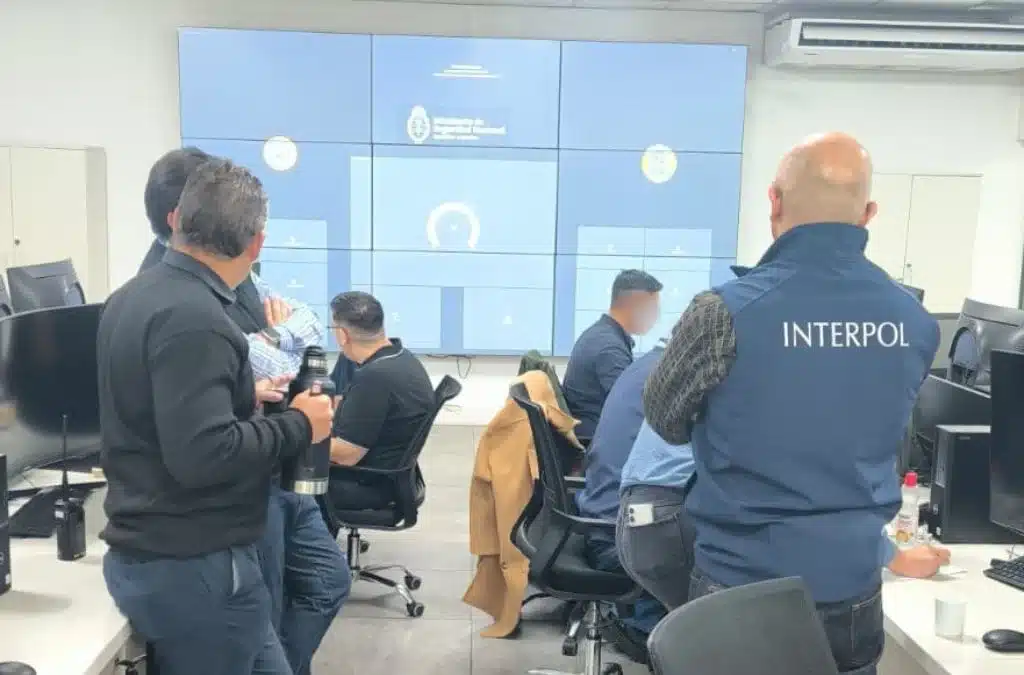
 Image Source: INTERPOL[/caption]