Visualização de leitura

AI Won’t Replace Cybersecurity Jobs, It’ll Replace the Toil – Harsha Reddy Explains What’s Next

AI, Cybersecurity, Harsha Reddy

As enterprises race to bolt AI onto every business process, security leaders are being forced to answer a harder question than "should we adopt it" — it's "who's accountable when it goes wrong." To unpack this, The Cyber Express sat down with Harsha Reddy, Head of Information Security at Veterinary Emergency Group (VEG).

With nearly two decades in security leadership — including senior roles at Lixil and American Standard before joining VEG — Harsha brings a practitioner's view of where AI is genuinely changing the CISO's job, and where it's mostly just hype and shadow adoption.

Watch the Full Interview:

Harsha Reddy Explains Why AI Will Replace Tasks, Not Defenders

Harsha pushes back on the narrative that AI will hollow out security teams, pointing to Gartner research showing that while most fields are projected to lose jobs to AI, cybersecurity is expected to gain them. In his view, the technology is mainly absorbing the "toil" — log review, alert triage, evidence gathering — that keeps analysts from actually defending.

Also listen to S1 Episode: Awareness and Education at Young Age is the Answer to Cybersecurity Skill Gap

“It's the analyst who refuses to use AI that will get replaced by an analyst who uses it,” he says.

On adoption, Reddy points to a 2024 Microsoft-LinkedIn survey in which most executives called AI critical to their business, yet a majority had no formal plan and most had employees already bringing in their own tools. That gap, he argues, is why so many organizations are now dealing with AI-related data leaks. "Many organizations started onboarding AI like software when they should be onboarding it like staff." His fix isn't more restrictions — blocking AI just pushes it into the shadows — but guardrails, an internal AI enablement committee, and measuring actual business value instead of token consumption.

The conversation also digs into deepfake-driven fraud, why training employees to spot deepfakes is “a losing bet” at machine speed, and how he decides when to greenlight a new AI tool versus telling a business unit “not yet.”

The conversation closes with our newly introduced rapid-fire round "Express Shots" — Claude vs. ChatGPT, passkeys vs. passwords, and Reddy's prediction for the biggest cybersecurity threat of 2030.

💾

Read the latest updates Firewall Daily news and insights on The Cyber Expres, your trusted source for cybersecurity and information technology updates."

Watch out for fake TikTok Shops trying to steal your money

TikTok Shop is a real, functioning e-commerce feature built into the TikTok app, allowing users to buy goods without ever leaving TikTok. As it’s grown in popularity, scammers have begun cloning its appearance.Storefronts that reproduce its look, its trust badges, and its category layout closely enough to pass a quick glance are showing up as entirely separate, unverified websites.

The short version

If a shopping site looks like TikTok Shop but you didn’t reach it from inside the actual TikTok app, treat it as an unknown third-party store, not an extension of TikTok. It might look like TikTok, but it’s the same risks as any sketchy online shop: paying for something that never arrives, or handing over card details to a site with no accountability behind it.

Fake TikTok Shops

Clone sites in this category tend to reproduce TikTok Shop’s homepage design closely enough that, at a glance, they could pass for the real thing.

They have matching color schemes, matching layout, and language borrowed directly from the platform, such as “curated products,” “trusted sellers,” and “secure service.”

Underneath, they typically show the same kind of reassurance badges the real platform uses: claims of platform-verified sellers, local delivery guarantees, and after-sales support windows.

A fake TikTok shop

None of that trust signaling is backed by anything. It’s copied language and copied visual design sitting on top of a site with no verified relationship to TikTok at all. Scammers borrow the legitimacy that TikTok Shop has built up, then use it to move products—or simply take payment—through a storefront TikTok has no oversight of.

Wholesale stores and fake loan offers

A related version of this scam leans into bulk or wholesale pricing, offering goods across categories like fashion, home, and beauty, again wrapped in TikTok’s name and logo. Some of these sites go a step further and add a consumer credit or “loan service” option directly into the site navigation, sitting alongside ordinary shopping categories.

A TikTop Shop "wholesale site" scam

A legitimate wholesale marketplace doesn’t typically need to offer consumer credit as a checkout feature. When it does, it’s worth treating as a separate red flag from the shopping itself. Loan applications typically ask for far more sensitive information than a purchase does, including identity documents, banking details, and other personal data. Handing that information to a site that’s already impersonating a major platform significantly increases the risk of fraud or identity theft.

The checkout is the real risk

Both scams point to the same underlying concern: it’s not really about whether the products are real. It’s about what happens when you enter payment information into a storefront with a fake identity and no accountability. The order may never arrive, leaving you out of pocket, and your payment details themselves could be stolen, reused, or resold.

How to stay safe

  • Only use TikTok Shop from inside the official TikTok app, not a link from an ad, DM, or search result.
  • Always check a website’s address before entering any payment information. A convincing homepage doesn’t mean a legitimate business sits behind it.
  • Be skeptical of any shopping site that also pushes a loan, credit line, or financing offer at checkout.
  • Pay with a credit card rather than a bank transfer where possible. It gives you a dispute path if the order never shows up.

Brand impersonation is one of the oldest tricks in e-commerce fraud. TikTok Shop’s badge system and trust language are simply the latest assets being borrowed.


Stop threats before they can do any harm.

Malwarebytes Browser Guard blocks phishing pages and malicious sites automatically. Free, one click to install. Add it to your browser →

Deepfake porn sites are going offline (re-air) (Lock and Code S07E12)

This week on the Lock and Code podcast…

If you weren’t taking deepfakes seriously before, it’s too late now to ignore them.

According to new research from Malwarebytes, one in three people who use AI every day said it’s okay to generate pornography of people without their consent.

Nearly 10 years ago, “deepfake” technology provided hobbyists and film editors with artificial intelligence (AI) tools to swap the face of one person onto the body of another. In its infancy, this technology brought silly film experiments like swapping Tom Cruise in Mission Impossible with Keanu Reeves. Today, this same technology produces something far more harmful—fake nude images of teenagers.

On the Lock and Code podcast today with host David Ruiz, we are re-visiting an interview from 2024, in which we spoke with a lawyer named David Chiu about his lawsuit against 16 deepfake nude generation websites.

The websites named in that lawsuit often needed just one image of a person to generate fake pornography. And while nearly everyone has at least one image of themselves online, even if they had hundreds, the path towards deletion is somewhat understood—start by deactivating and deleting popular social media accounts. But for teenagers today, raised mostly online, and who share images directly with friends and boyfriends and girlfriends and exes, it’s likely impossible to remove every visual trace of themselves. Also, they shouldn’t have to face this problem alone.

The Lock and Code podcast frequently discusses structural problems that require individual management. You have to skirt corporate data collection. You have to find the automated license plate readers in your hometown. You have to review every single message you get with a certain antagonism, to guard yourself against scams.

So, it’s rare to encounter a solution that benefits more than one person.

Chiu serves as the City Attorney for San Francisco, which means his department can file a lawsuit on behalf of not just the people of San Francisco, but also California, and that’s what his team did in going after the deepfake websites.

Since then, Chiu’s department has shut down 10 deepfake nude websites, and it received a settlement agreement from a company called Briver LLC to no longer operate any website that creates nonconsensual deepfake pornography.

And, as California goes, so goes the nation.

In May of last year, the Take It Down Act became effective as law in the United States, which criminalizes “revenge porn” and AI-generated nonconsensual intimate imagery. The law is not perfect but so far it is being used as intended. Last month, two men in the US were among the first to be charged with violating the Take It Down act for allegedly creating deepfake nudes that, according to the AP, “included both celebrities as well as private women, including recent high school graduates.”

Today, we revisit our conversation with San Francisco City Attorney David Chiu about the important fight against deepfake porn and the clear threat that his department found against the public.

“At least one of these websites specifically promotes the non-consensual nature of this. So, and I’ll just quote, ‘Imagine wasting time taking her out on dates when you can just use website X to get her nudes.'”

Tune in today to listen to the full conversation.

Show notes and credits:

Intro Music: “Spellbound” by Kevin MacLeod (incompetech.com)
Licensed under Creative Commons: By Attribution 4.0 License
http://creativecommons.org/licenses/by/4.0/
Outro Music: “Good God” by Wowa (unminus.com)


Listen up—Malwarebytes doesn’t just talk cybersecurity, we provide it.

Protect yourself from online attacks that threaten your identity, your files, your system, and your financial well-being with our exclusive offer for Malwarebytes Premium Security for Lock and Code listeners.

88% of people struggle to tell what’s real online

What would you trade for a technology that can do almost anything? For many people, the answer is clear: Everything they thought they could trust.

In a few, short years, Artificial Intelligence (AI) tools have granted people unfettered access to easier writing, faster image generation, quicker coding, and near-instantaneous answers, advice, and information—advantages they value and want. But the same tools that can spruce up a dating profile or reimagine an old photograph can also manipulate the broader world online, and people are noticing.

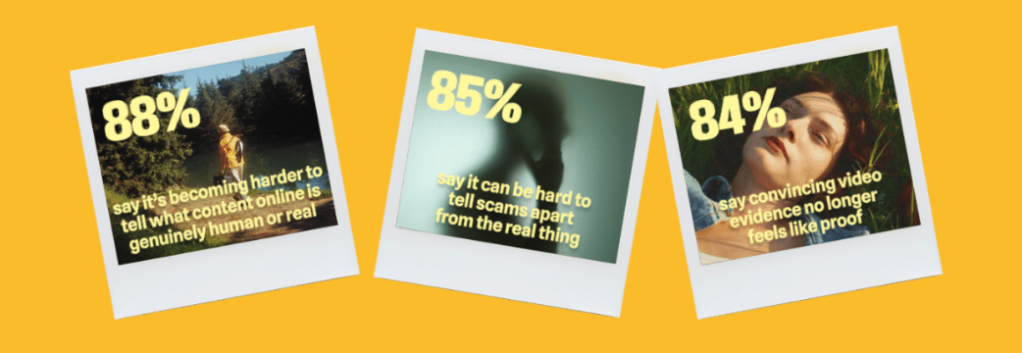
According to new research from Malwarebytes, 88% of people said it’s becoming harder to tell what content online is genuinely human or real, with 84% saying that “convincing video evidence” no longer feels like proof. Further, 85% said it can be hard to tell scams apart from the real thing—a major uptick from the 66% who said the same thing last year.

Statistics from the Face Value report

These are the first signs of AI’s counterfeit world. Replete with fake websites, fake products, fake videos, fake pictures, fake voices, and even fake people, it is threatening to swallow the web.

The latest report from Malwarebytes, Face value: How AI is reshaping trust, identity, and scams exposes the hidden cost of AI on the public: an excess of fraud that is dismantling trust in reality and in one another.

The damage arrives in large moments and small, from the US parent who said they “received a voicemail that sounded exactly like my son’s voice, saying he was in trouble and needed money for legal fees,” to the two entirely unrelated respondents fooled by the same AI-generated video of rabbits bouncing on a trampoline, to the individual worried about “my grandfather showing me AI slop and he thought it was real.”

For this research, Malwarebytes surveyed 1,500 adults aged 18 and older across the US, UK, Austria, Germany, and Switzerland about their uses, feelings, and concerns regarding AI. The sample was equally split for gender with a spread of ages, geographical regions, and race groups, and weighted to provide a balanced view.

The complete findings can be found in the full report:

Here are some of the key takeaways and findings:

  • 88% said it’s becoming harder to tell what content online is genuinely human or real
  • 84% said convincing video evidence no longer feels like proof 
  • 85% of people said it’s hard to tell a scam from the real thing (up from 66% last year)
  • 50% have experienced some form of AI fraud or scam, such as being misled by AI-generated photos of products or receiving a highly personalized scam message
  • 19% have specifically experienced some form of AI-driven identity harm, including the 10% who have had someone use AI to generate sexually explicit content of them without permission
  • 81% fear someone stealing their family’s likeness, yet only 13% have created a family codeword to guard against it
  • 67% worry about voice cloning, yet only 19% have turned off voicemail recordings to prevent it
  • 45% say it’s okay to use AI for personal emotional tasks (like writing wedding vows or a eulogy)
  • 34% say it’s okay to use AI to help create or improve a dating profile
  • One in three self-avowed daily users of AI said it’s okay to generate explicit images of someone without their consent 

Defeat would be the wrong lesson to take from all this. It is true now that the internet requires assistance, but there are plenty of safe places to seek help.

While Malwarebytes works to provide new tools, we’d like to remind both the AI anxious and the eager about the first rule of the internet: Remember the human. People’s voices, bodies, choices, and agency belong to them and them alone. 

As for every fake video, product, website, and image, understand that there’s help. No one needs to navigate an artificial internet alone. Whether through scam detection, identity protection, and simple awareness, people have more options than they may realize.

UK Regulator Ofcom Cracks Down on Viral Deepfake Nude Content

non-consensual intimate image

Ofcom has announced tougher measures aimed at stopping the spread of non-consensual intimate images and AI-generated deepfake abuse online, as the UK regulator pushes tech companies to strengthen user safety protections. The updated guidance, released Monday, will require platforms to do more to identify, detect, and remove illegal intimate content shared without consent. The changes are part of Ofcom’s strengthened Illegal Content Codes under the UK’s Online Safety Act and are expected to come into force in autumn 2026, subject to parliamentary approval. At the centre of the updated rules is the growing concern over deepfake intimate images, including AI-generated nude content and manipulated explicit media targeting women and girls online.

Tech Platforms Asked to Deploy Hash Matching Technology

Under the proposed measures, Ofcom is recommending that certain platforms and apps expand their use of automated detection systems known as “hash matching” technology to identify and block illegal intimate images before they spread further online. Hash matching works by converting harmful images into unique digital fingerprints, or hashes, which are then stored in a database. When users attempt to upload the same or similar content again, platforms can automatically detect and block the material. Ofcom specifically referenced the use of databases such as StopNCII, one of the leading systems designed to combat the spread of non-consensual intimate imagery online. The regulator said the move is aimed at providing stronger protections for women and girls who are increasingly being targeted through AI-enabled abuse and image manipulation. According to Ofcom, the updated recommendations, combined with new UK legislation banning “nudification tools,” could significantly reduce the circulation of harmful intimate content online.

UK Government Pushes Faster Removal of Non-Consensual Intimate image

The tougher stance follows recent action by the UK government to pressure technology companies into removing abusive content more quickly. Earlier this year, UK Prime Minister Keir Starmer backed legislation introducing heavy penalties for platforms that fail to promptly remove illegal intimate images. Under the law, companies may face substantial fines if they do not take down reported content within 48 hours. Authorities have also warned that services repeatedly failing to comply could face restrictions or blocking in the UK. The government said the rules are intended to prevent victims from repeatedly reporting the same harmful images while waiting for action from online platforms. The push for stricter enforcement comes amid rising global concern over the misuse of generative AI tools to create realistic explicit deepfake content without consent.

Deepfake Concerns Grew After Viral AI Image Abuse Cases

The UK government’s increased focus on deepfake intimate images follows widespread concern over reports that millions of manipulated nude images involving women and children circulated online through AI-powered tools and chatbots earlier this year. Regulators and child safety advocates have warned that the rapid growth of generative AI platforms has made it easier to create convincing fake explicit images, raising concerns around online abuse, harassment, and exploitation. Ofcom said technology companies must take greater responsibility for detecting harmful content and preventing its distribution across their platforms.

Ofcom Investigation Into Online Platforms Continues

The latest action also comes as Ofcom continues broader investigations into online platforms under the Online Safety Act.

In April, the regulator expanded an ongoing probe into Telegram, Teen Chat, and Chat Avenue over concerns linked to child sexual abuse material (CSAM) and online grooming.

According to Ofcom, the investigation began after receiving evidence suggesting that harmful content and predatory behaviour may have been taking place across these services.

A major focus of the investigation involves Telegram’s potential exposure to CSAM. Authorities said intelligence shared by the Canadian Centre for Child Protection indicated the alleged presence and distribution of abusive material on the platform.

Following its own assessment, Ofcom launched a formal investigation into whether Telegram may have failed to meet its legal responsibilities under the Online Safety Act.

The regulator stated that platforms offering user-to-user communication services are legally required to assess risks related to illegal content and implement safeguards to prevent its spread.

Smashing Security podcast #467: How ShinyHunters hacked the world’s biggest universities

Welcome to the largest educational data breach in history - affecting nearly 9,000 institutions, every Ivy League university, and 30 million students mid-finals. When Canvas's parent company refused to pay and announced they had deployed "security patches" instead, the hackers were less than impressed. So they came back through the cat flap. Meanwhile, a famous finance expert's face has been showing up on Facebook adverts promising hot stock tips and exclusive WhatsApp investment groups. Spoiler: it isn't him, the tips aren't real, and you're about to be scammed. Plus we chat to Mike Nichols of Elastic, about how the SOC isn't dying, attackers and defenders are both deploying AI agents, and how the real security crisis is no longer human users - it's the bots acting on their behalf. All this and more in episode 467 of the "Smashing Security" podcast with cybersecurity expert and keynote speaker Graham Cluley, and special guest Danny Palmer.

Smashing Security podcast #466: Meta sees everything, Copy Fail, and a deepfake gets hired

Meta's smart glasses promise privacy "designed for you" - but everything they record was being beamed off to workers in Nairobi to label by hand. When those workers blew the whistle, Meta sacked all 1,108 of them. Meanwhile, the IT press is in a frenzy over a new Linux bug called "Copy Fail" - complete with logo, dedicated website, and a marketing-friendly name. But is it really the disaster everyone's making it out to be? And in our featured interview, Jake Moore of ESET explains how he tricked a company into offering his deepfake clone a job - after a perfectly normal-looking video interview. All this and more in episode 466 of the "Smashing Security" podcast with cybersecurity expert and keynote speaker Graham Cluley, joined this week by special guest Paul Ducklin.

Are successful deepfake scams more common than we realize?

Many times a day worldwide, a boss asks one of their team members to perform a task during a video call. But is the person assigning tasks actually who they say they are? Or is it a deepfake? Instead of blindly following orders, employees must now ask themselves if they are becoming a victims of fraud.

Earlier this year, a finance worker found themselves talking on a video meeting with someone who looked and sounded just like their CFO. After the meeting was over, they then dutifully followed their boss’s instructions to send $200 million Hong Kong dollars, which equals $25 million.

But it wasn’t actually their boss — just an AI video representation called a deepfake. Later that day, the employee realized their terrible mistake after checking with the corporate offices of their multinational firm. They had been a victim of a deepfake scheme that defrauded the organization out of $25 million.

Businesses are often deepfake targets

The term deepfake refers to AI-created content — video, image, audio or text — that contains false or altered information, such as Taylor Swift promoting cookware and the infamous fake Tom Cruise. Even the recent hurricanes hitting the U.S. led to multiple deepfake images, including fake flooded Disney World photos and heartbreaking AI-generated pictures of people with their pets in floodwaters.

While deepfakes, also referred to as synthetic media, targeted at individuals typically serve to manipulate people, cyber criminals targeting businesses are looking for monetary gain. According to the CISA Contextualizing Deepfake Threats to Organizations information sheet, threats targeting businesses tend to fall into one of three categories: executive impersonation for brand manipulation, impersonation for financial gain or impersonation to gain access.

But the recent incident in Hong Kong wasn’t just one employee making a mistake. Deepfake schemes are becoming increasingly common for businesses. A recent Medus survey found that the majority (53%) of finance professionals have been targeted by attempted deepfake schemes. Even more concerning is the fact that more than 43% admitted to ultimately falling victim to the attack.

Watch Unmask the Deepfake

Are deepfake attacks underreported?

The key word from the Medus research is “admitted.”  And it raises a big question. Do people fail to report being a victim of a deepfake attack because they are embarrassed? The answer is probably.  After the fact, it seems obvious it was a fake to other people. And it’s tough to admit that you fell for an AI-generated image.  But the underreporting only adds to the shame and makes it easier for cyber criminals to get away with it.

Most people assume that they could spot a deepfake. But that’s not the case. The Center for Humans and Machines and CREED found a wide gap between people’s confidence in identifying a deepfake and their actual performance. Because many people overestimate their ability to identify a deepfake, it adds to the shame when someone falls victim, which likely leads to underreporting.

Why people fall for deepfake schemes

The employee who was tricked by the deepfake of the CFO to the tune of $25 million later admitted that when they first got the email supposedly from his CFO, the mention of a secret transaction made them wonder if the email was actually a phishing email. But once he got on the video, they recognized other members of his department in the video and decided it was authentic. However, the employee later learned that the video images of his department members were also deepfakes.

Many people who are victims overlook their concerns, questions and doubts. But what makes people, even those educated on deepfakes, push their concerns to the side and choose to believe an image is real? That’s the $1 million — or $25 million — question that we need to answer to prevent costly and damaging deepfake schemes in the future.

Sage Journals asked the question about who was more likely to fall for deepfakes and didn’t find any pattern around age or gender. However, older individuals may be more vulnerable to the scheme and have a hard time detecting it. Additionally, the researchers found that while awareness is a good starting point, it appears to have limited effectiveness in preventing people from falling for deepfakes.

However, computational neuroscientist Tijl Grootswagers of Western Sydney University likely hit the nail on the head as to the challenge of spotting a deepfake: it’s a brand new skill for each of us. We’ve learned to be skeptical of news stories and bias, but questioning the authenticity of an image we can see goes against our thought processes. Grootswagers told Science Magazine “In our lives, we never have to think about who is a real or a fake person. It’s not a task we’ve been trained on.”

Interestingly, Grootswagers discovered that our brains are better at detection without our intervention. He discovered that when people looked at a picture of a deepfake, the image resulted in a different electrical signal to the brain’s visual cortex than a legitimate image or video. When asked why, he wasn’t quite sure — maybe the signal never reached our consciousness due to interference from other brain regions, or maybe humans don’t recognize the signals that an image is fake because it’s a new task.

This means that each of us must begin to train our brain to consider that any image or video that we view could possibly be a deepfake. By asking this question each and every time we begin to act on content, we may be able to begin detecting our brain signals that are spotting the fakes before we can. And most importantly, if we do fall victim to a deepfake, especially at work, it’s key that each of us reports all instances. Only then can experts and authorities begin to curb the creation and proliferation.

The post Are successful deepfake scams more common than we realize? appeared first on Security Intelligence.

2024 trends: Were they accurate?

The new year always kicks off with a flood of prediction articles; then, 12 months later, our newsfeed is filled with wrap-up articles. But we are often left to wonder if experts got it right in January about how the year would unfold. As we close out 2024, let’s take a moment to go back and see if the crystal balls were working about how the year would play out in cybersecurity.

Here are five trends that were often predicted for 2024.

1. The use of artificial intelligence in cybersecurity will increase

As the year began, there was no doubt that artificial intelligence (AI) would be a main character in the year’s events — and that was right on the money. Many organizations began to use or continue using AI in their cybersecurity operations in a wide range of ways. For example, Microsoft’s internal response teams use a large language model to manage requests and tickets based on how they were handled previously, saving 20 hours per person each week.

As the world turned its attention over the summer to the Paris Olympics, the team responsible for keeping the Paris Olympics data, apps, systems and even physical buildings protected turned to AI. While 140 cyberattacks were linked to the Olympics, the teams’ efforts resulted in no disruption of the competitions.

Throughout the entire life cycle of the games, from before the opening ceremony to after the torch left Paris, cybersecurity teams used AI to secure critical information systems, protect sensitive data and raise awareness within the games’ ecosystem. Additionally, algorithmic video surveillance based in AI scanned video to detect abandoned bags, the presence of weapons, unusual crowd movements and fires.

2. Organizations will see more AI-based threats and attacks

Unfortunately, experts were right about cyber criminals also turning to AI technology to more effectively conduct attacks. Threat actors are using AI in a wide range of ways for data breaches and cyberattacks, including improved reconnaissance, better target profiling and lowering expertise required for conducting an attack. Because AI can automate many processes required for an attack, such as vulnerability scanning, exploitation and data exfiltration processes, more cyber criminals now have the skills for even more damaging attacks.

“Since the release of gen AI, attackers are increasingly employing tools along with large language models to carry out large-scale social engineering attacks, and Gartner predicts that by 2027, 17% of total cyberattacks/data leaks will involve generative AI,” wrote Gartner in an August 2024 press release.

IBM distinguished engineer Jeff Crume has no doubt that the trend of cyber criminals using AI for attacks will continue in 2025. He says that cyber professionals do a better job of authentication because attackers are finding it easier to log in than to hack in. While looking for bad grammar and spelling errors now works to spot phishing attacks, he expects that this will no longer work as AI-based phishing attacks hit mass distribution.

Explore cybersecurity services

3. An increase in deepfakes and deceptions

While experts correctly predicted that deepfakes would become more of a threat in 2024, it’s likely no one expected the scale of arguably the most shocking deepfake story of the year. At the beginning of 2024, attackers created a deepfake video call that led to an employee giving the cyber criminals $25 million, which showed the power and damage that deepfakes can cause. But the World Economic Forum expects that the trend will only increase, even declaring that over the next two years, AI-fueled disinformation will be the number one threat in the world.

Throughout the year, other deepfake incidents made headlines. Quantum AI, an AI company, was suspected by the Securities and Exchange Commission of using AI to generate deepfakes on social media to deceive the public that Elon Musk developed the company’s technology. Even the well-received Paris Olympics were not immune to deepfakes, with Russian Group Storm-1679 suspected of creating AI content to discredit the International Olympic Committee. As the year closed out, German citizens saw an increase in AI-based propaganda regarding the upcoming German elections in 2025, including text, images and video.

4. A growing impact of quantum computing on cybersecurity

Ray Harishankar, IBM Fellow, IBM Quantum Safe, predicted that in 2024, “harvest now, decrypt later” attacks would become more common. As the year moved forward, quantum computing became an increasingly top concern, especially the harvest-now attacks. In July, the Office of Management and Budget released the Report on Post-Quantum Cryptography, which urged organizations to prepare their systems and processes for advancements in quantum computing.

During the fall of 2024, the predictions of the quantum’s impact became even more urgent, as symmetric cryptography would be unsafe by 2029, with even asymmetric cryptography fully breakable by quantum technology by 2034.

“That does not mean, however, that the risks are five years away. The prospect of harvest-now, decrypt-later attacks is already a concern, making the post-quantum cryptography transition an urgent priority,” wrote Gartner.

 5. Recession of ransomware attacks

John Dwyer, former Head of Research at IBM X-Force, predicted we might face a ransomware recession as more companies pledged not to pay the ransom. While we wish we could declare this came true, the jury is still out, and likely, we won’t know for sure until all the data is collected from 2024.

However, Wired declared in the summer of 2024 that “ransomware showed no signs of slowing down in 2024 — despite increasing police crackdowns.” In December, Heather Wishart-Smith wrote in her Forbes article The Persistent Ransomware Threat: 2024 Trends and High-Profile Attacks about the increasing dual extortion technique of cyber criminals as an increasing trend in 2024.

All in all, the experts were largely on target with their 2024 predictions. And in the next few weeks, we will start the prediction game all over again as we wonder what’s in the cards for cybersecurity in 2025.

The post 2024 trends: Were they accurate? appeared first on Security Intelligence.

❌