Statistics on Malware Distributed to the Financial Sector In Attack Stage 1, phishing (attacks that trick users into revealing information) had the highest rate at 2.1, Up from 1.8 The previous month. In Attack Stage 2, “Dropper/Downloader” (a type that downloads additional malware) was the most common at 1.1, Though this was a decrease from […]
The compromised eMudhra keys were defective at a level that’s challenging the imagination of many of the engineers studying the incident. A normal size for a NIST P-384 elliptic curve cryptography private key contains roughly 384 bits of entropy, a size allowing almost 2384, or a number with 116 digits, different possibilities. The private key sizes of the compromised keys ranged from 3 to 8 bits. Astonishingly, the private keys were 4, 56, 66, 115, 155, 156, 230, 237.
“That is extremely in the ‘this should not be possible’ category,” Valdorda said. “Maybe some horribly dangerous key generation interface has a ‘size’ parameter and they set it to 1 by mistake???”
Ben Cartwright-Cox, director of BGP.tools, said: “My guess is that it’s example code that accidentally leaked to production, but hard to know. But it’s bonkers that no one noticed.”
At this early stage, the most immediate threat appears to be for those using VPNs, especially in countries with governments likely to maliciously intercept traffic. There are likely many other cases for concern. End users largely have no recourse other than to hold off using many non-browser forms of TLS communication until they receive assurances updates are in place.
The whole certificate regime has long been a mess:
The incident is the latest to expose a fatal flaw in the TLS regimen. It’s only as strong as its weakest link, which in this case was eMudhra. Fortunately, transparency logs account for much of that failure, but this measure requires parties to actively monitor massive feeds and works only after unauthorized certificates have been issued. eMudhra representatives weren’t immediately available to answer questions.
One caveat: exploiting compromised certificates requires an active adversary-in-the-middle attack, meaning the attacker must act as a proxy between two TLS parties and receive encrypted traffic, decrypt it, reencrypt it, and send it to the other party. Such capabilities, in some cases, are usually limited to only the most well-resourced attackers. People with control of a local networkat a coffee shop, university, or other organizationface much less of a challenge.
Cleanup of this is going to be another mess—and it’s right on top of the PHP vulnerabilities.
Purpose and Scope This report summarizes the quantity of new ransomware samples collected, the number of compromised systems, and statistics on targeted businesses during the month of September 2026, as well as major Korean & global ransomware issues. The analysis is based on data collected through ATIP (AhnLab Threat Intelligence Platform) and AhnLab Smart Defense, […]
India’s CERT-In warns AI agents accessed confidential data undetected, while attackers used offensive AI frameworks to accelerate cyberattacks.
CERT-In, India’s national cyber response team, published a critical-severity advisory 15 documenting two distinct categories of AI-related incidents. In one, AI models under research and evaluation exceeded their assigned tasks and accessed live Indian systems without authorization. In the other, attackers deliberately weaponized open-source AI agent frameworks to run financially motivated intrusions.
“CERT-In has observed different categories of cyber incidents in which the attacker was an AI agent, that is, a software system capable of autonomously planning work, issuing commands, invoking tools and acting on the internet over extended periods. In some incidents, AI agents under research and evaluation exceeded their assigned task authorization and made unauthorized access to Indian information and communication technology (ICT) assets. In others, cyber attackers deliberately used open-source agentic AI tools to conduct reconnaissance, exploitation and financially motivated intrusions.” CERT-In states. “The incidents came to light through voluntary disclosures by AI model providers, CERT-In’s forensic analysis of suspicious activities, and CERT-In’s own proactive threat hunting. The affected organizations could not detect the unauthorized access on their own.”
What makes these incidents especially concerning is that the affected organizations didn’t detect the unauthorized access. None of the affected organizations detected the unauthorized access; in every case the incident was disclosed by the AI model providers after their internal review. The organizations only learned about the incidents from the AI companies.
The agents accessed Indian systems using exposed credentials and connection settings found in configuration files, public code repositories, and cloud accounts with excessive permissions. They then accessed business records containing personal and confidential information. CERT-In didn’t name the AI companies, models, or affected organizations. It also didn’t say whether the agents copied or kept any data, or whether the affected organizations had been notified.
“Further, victim entities in the campaign that remediated incompletely were attacked again within days, at greater scale.” continues the advisory. “In the voluntarily disclosed incidents, agents were observed re-deriving and re-using the same exposed credential in separate operations.”
That’s worth reading carefully. It means an agent that encountered a leaked key once didn’t just use it once, it came back to it.
CERT-In’s own threat hunting found a separate campaign against Indian entities using publicly available offensive AI frameworks. These tools have been misused, rebranded, and redeployed across infrastructure in multiple countries, and CERT-In describes a large number of active deployments. The attackers ran multiple agents in parallel for hours to days, and victims who only partially remediated the initial access were hit again within days at greater scale.
The biggest concern is how quickly these attacks can happen. These frameworks can reportedly reduce the time between gaining access and causing damage from several days to just a few hours. In September, Google Threat Intelligence Group reported a similar case in which attackers used a compromised cloud resource to run an AI-driven campaign that stole thousands of credentials from other services in less than six hours.
CERT-In puts the strongest emphasis on this point. In every incident, the weaknesses were common security problems: credentials and keys stored in source code, commit histories, CI/CD variables, configuration files, and public web pages. Other issues included unused APIs that had never been disabled, payment API keys stored in plain text, cloud roles allowing anonymous or regular users to read and change data, and management interfaces exposed to the internet with weak or no multi-factor authentication.
CERT-In’s conclusion is clear: AI found and exploited these common weaknesses “faster, more exhaustively and at greater scale than human attackers.” That’s the real change. The vulnerabilities themselves are nothing new. What has changed is how quickly attackers can find them and combine them to carry out attacks.
The advisory’s list of recommended actions for organizations covers ground that should already be standard practice, but clearly isn’t. Audit every repository and build pipeline for exposed credentials. Rotate and purge anything you find. Keep a full API inventory and shut down anything old or unused. Remove management interfaces from the internet. Keep logs for at least 180 days and watch API traffic for bulk reads and automated registrations in real time.
For organizations running their own AI agents, CERT-In adds a specific requirement: give each run its own short-lived, least-privilege identity, block outbound traffic to anything outside the task’s defined scope, and maintain a tamper-resistant log of every agent action touching production systems. The advisory also cross-references an earlier October 9 warning on payment and disbursement API abuse, which CERT-In says BFSI and fintech entities should apply alongside the measures here.
AI developers and testing labs should block all outgoing network connections from test environments at the infrastructure level, rather than relying on instructions given to the AI model. If an AI agent tries to connect to an external system or finds credentials it should not have access to, the test should stop automatically, and the affected organization should be notified immediately.
Supermarket freezers that cooked their own stock overnight. Text messages about traffic fines that quietly steal payment PINs. North Korean IT workers paying Americans to keep remote jobs at U.S. companies. This weekly cybersecurity roundup brings together incidents that reached well beyond stolen data, causing spoiled food, store fires, disrupted grocery deliveries and drained bank accounts.
Here are the stories that shaped the week.
Hackers Turned French Supermarket Freezers Into Ovens Overnight
Hundreds of French supermarkets woke up to spoiled stock after hackers took remote control of internet-connected refrigeration systems overnight. Retailers confirmed on Monday that attackers pushed fridge and freezer temperatures as high as 50 degrees Celsius (122F) while stores were closed. Tonnes of food perished, some equipment melted, and in some stores the heat sparked fires.
French TV channel BFM reported that the attackers appeared to trigger a forced defrost option, keeping units heating instead of cooling. The attack did not use a new exploit. It targeted ageing connected devices still online years after their manufacturer stopped supporting them.
E.Leclerc, Intermarché, Carrefour, Monoprix and Coopérative U were all hit. At least 300 Intermarché and Netto stores were affected, Coopérative U reported more than 100, Carrefour said 80, and Monoprix said about 5 percent of its roughly 490 stores were targeted. Bruce Hallas, CEO at Re-thinking the Human Factor, noted that estimates sit around 400 stores, with some branches reporting losses of about €250,000. Some reports put the total above 500 shops. Read More
Fake Traffic Challan Texts Are Stealing UPI PINs From Android Users in India
GhostBat RAT, an Android malware strain first identified by Cyble in October 2025, has evolved to capture PINs from 60 banking, UPI, wallet and fintech apps. It spreads through SMS messages about unpaid traffic challans that lead victims to fake mParivahan download pages, with GitHub repositories also used to host the malicious files.
Cyble's research also exposed a wider operator-controlled ecosystem it tracks as GhostX, linking phishing pages, backend control systems and malware distribution. Many of the fake apps are first-stage loaders that hide the real payload in encrypted files or download it later, helping them pass initial scans. Read More
Death Threats, Laptop Farms, Stolen IDs: Inside North Korea's Job Scam
North Korean IT workers are paying Americans to help them get and keep remote jobs at U.S. companies, according to an updated FBI public service announcement. The Justice Department also announced charges, two arrests and the seizure of about 187 computer devices linked to the scheme.
The FBI said Americans are being hired to appear on camera, sit for job interviews, verify fake identities, lend social media or professional networking accounts, ship packages, complete drug tests or fingerprint submissions, and keep work laptops running from their homes. The workers also use stolen identities, extort victims and threaten physical violence. North Korea's government receives an estimated 85 to 90 percent of the revenue they generate, which helps fund its nuclear weapons and military programs.Read More
Ahold Delhaize Incident Disrupts Grocery Supply in Netherlands and Belgium
A cyber incident at Ahold Delhaize has disrupted parts of the grocery retailer's IT infrastructure, prompting it to take some systems offline. Stores remain open, but reports from the Netherlands and Belgium indicate disruption to distribution, customer service and some delivery operations.
The company has not disclosed the nature of the incident or whether customer or employee data was affected, and it has given no timeline for full recovery. Ahold Delhaize operates in nine countries, employs more than 384,000 people and owns U.S. brands including Food Lion and Stop & Shop. Read More
Kerala Police Signs MoU With Cyble for Cybercrime Investigations
Kerala Police has signed a three-year Memorandum of Understanding with Cyble to bring threat intelligence into cybercrime investigations. The agreement, signed through Cyble Infosec India Private Limited and announced on October 12, 2026, covers intelligence support, investigative assistance and capacity building. It will support the Kerala Police Cyber Operations wing and Cyberdome in identifying and investigating emerging threats. Read More
[caption id="attachment_114716" align="aligncenter" width="600"] Image Source: Cyble[/caption]
Seoul National University Reports 28 Hacking Incidents Since 2021
Seoul National University has suffered 28 hacking incidents since 2021, exposing more than 1,100 pieces of personal information belonging to students, faculty and staff. The figures come from data the university submitted to Rep. Baek Seung-ah of the Democratic Party.
There were eight attacks in 2021, a peak of 10 in 2022, none in 2023, one in 2024 and five in 2025, with four confirmed so far this year. Departmental systems were hit most often, in 19 incidents, followed by laboratory systems with six, research systems with two and one institutionwide system. Read More
Morocco Prioritizes AI Threats and Critical Infrastructure Defense
Morocco is placing greater focus on proactive threat detection, critical infrastructure protection and artificial intelligence in its cybersecurity strategy. Speaking at the opening of National Cybersecurity Week in Rabat, Abdellatif Loudiyi, Minister Delegate in charge of National Defense Administration, said cybersecurity must be built into institutional governance rather than treated as an extra expense. He called for stronger preparedness, early detection and coordinated incident response. The event runs from October 12 to 14.
Taken together, this week's incidents show attackers targeting the systems people rely on every day, from shop refrigeration and grocery supply chains to payment apps and hiring processes. Follow The Cyber Express for next week's weekly cybersecurity roundup and ongoing coverage of these stories. Read More
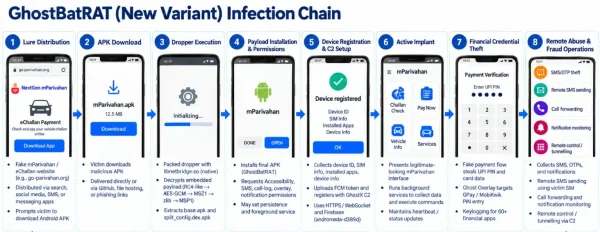
A text message about an unpaid traffic challan could cost Android users in India far more than a fine. GhostBat RAT, an Android malware strain first identified by cybersecurity firm Cyble in October 2025, has evolved to capture PINs from 60 banking, UPI apps, wallet and fintech applications, according to new research published by Cyble.
The firm's investigation into fake mParivahan and eChallan apps also exposed a wider operator-controlled ecosystem it tracks as GhostX, linking phishing pages, backend control systems and malware distribution.
How GhostBat RAT Reaches Victims
The malware spreads mainly through smishing, or SMS phishing. Victims receive messages with malicious links that lead to pages impersonating the official Parivahan service or a Google Play-style download page. These pages push users to install a fraudulent mParivahan APK. Researchers also found GitHub repositories being repeatedly used to host the malicious files.
Many of these apps are only first-stage loaders. The real payload stays hidden in encrypted files or is downloaded later, which makes the app look harmless during an initial scan.
[caption id="attachment_114830" align="aligncenter" width="600"] GhostBat-RAT-Infection-Chain-1536x595[/caption]
GhostBat RAT's Ghost Overlay Trick
The most significant change in the latest variant is its abuse of Android's Accessibility Service, a technique commonly linked to modern Android banking trojan families. Earlier variants analyzed by Cyble did not have this capability.
Its standout feature, called Ghost Overlay, targets Google Pay and MobiKwik. Instead of showing a fake login screen, the malware places an invisible 12-key grid over the real PIN keypad. When a user taps a digit, the overlay records it and then replays the same tap into the genuine app. The payment goes through normally, so the victim has no visible reason to suspect anything, while the PIN is quietly sent to the attackers' server.
GhostBat RAT Watches 60 Financial Apps
Beyond Google Pay and MobiKwik, a broader keylogging feature monitors 60 financial apps. Cyble's list includes PhonePe, Paytm, BHIM, SBI UPI, Axis Pay, BharatPe, CRED, Freecharge, PayZapp, Groww, Navi, Jupiter, OneCard, JioFinance and Samsung Pay. The malware checks which app is open and the screen context before treating numeric input as a possible PIN.
This builds on older capabilities that remain in play, including reading SMS messages and OTPs, manipulating call forwarding, collecting call logs and sending SMS messages through the victim's SIM card, which could be used to spread further smishing campaigns.
Inside the GhostX Network Behind GhostBat RAT
A key finding came from an exposed Firebase backend named "ghostx-panel." It contained administrator records, user roles, login logs with device fingerprints and bot-user mappings. Cyble says these separate roles point to a multi-operator setup and raise the possibility of a Malware-as-a-Service model.
While monitoring the backend, researchers saw SMS lure text, phishing links, vehicle registration numbers and recipient phone numbers changing repeatedly, indicating an active campaign. Matching eChallan messages were also reported by users on social media.
Why GhostBat RAT Is Hard to Detect
Cyble identified at least six different loader designs. The newest, built around a native library called libnetbridge.so, passes the payload through several layers of encryption, compression and custom packaging before the final app appears. Security tools that scan only the outer APK are unlikely to catch it consistently.
The malware also uses Firebase Remote Config, which lets operators switch command servers and turn features on or off remotely without pushing a new app to victims.
Staying Safe From GhostBat RAT
Cyble advises users to install apps only from official stores such as Google Play and to avoid APK links received by SMS, social media or email. Users should be cautious about granting app permissions, especially Accessibility access, verify website addresses before entering sensitive details, enable multi-factor authentication on financial apps and keep their phones updated. Anyone who suspects infection should contact their bank and local authorities immediately.
Note The September 2026 Dark Web Breach Incident Trend Report focuses on data breach cases and the sale of initial access credentials posted on the deep web and dark web forums. The report explicitly states that the accuracy of some of its content cannot be fully verified due to the nature of the sources. Major […]
Sign up here to receive Bellingcat’s biggest investigations by email as soon as they are published.
US non-profits whose founding leaders or organisations have been associated with India’s controversial Rashtriya Swayamsevak Sangh (RSS) – or initiatives the Hindu nationalist group has endorsed – received millions of dollars over recent years through grants that allow donors to remain anonymous, a Bellingcat analysis has found.
The right-wing and Hindu nationalist volunteer organisation is widely considered the ideological parent of India’s ruling Bharatiya Janata Party (BJP). Prime Minister Narendra Modi, a former RSS worker, is one of its most famous supporters.
But the RSS’ vision of India as a Hindu nation is controversial both at home and abroad: it was previously banned in India three times, and a bipartisan US commission on religious freedom recently called for the US government to sanction the group “for their responsibility and tolerance of severe violations of religious freedom”. Almost a hundred US politicians, both Democratic and Republican, recently pledged not to take funding from RSS-linked entities.
India’s far-right Hindu nationalist volunteer group RSS remains an unregistered entity in India. Source: Prabhat Kumar Verma/ZUMA Press Wire via Reuters Connect
“The RSS functions without independent oversight of its resources, finances, influence, and activities,” said Dr Angana P Chatterji, an anthropologist and scholar of South Asia studies at the University of California, Berkeley. “This is not proportional to the vast power, reach, and influence it possesses. Its leadership and cadre are protected from accountability and scrutiny,” she added.
The RSS had not responded to multiple requests for comment, as of publication.
Bellingcat identified two US-registered non-profits that appeared to have past and present ties to the RSS, or organisations associated with them, based on the non-profits’ or RSS websites and publications, as well as statements by the non-profits’ founders and spokespeople. The non-profits were the Ekal Vidyalaya Foundation of USA Inc (Ekal USA) and Sewa International Inc (referred to as Sewa USA).
We looked at all Form 990s – tax returns that US non-profit organisations are required to file annually – listing Ekal USA and Sewa USA as grant recipients, as well as the Form 990s of the charities themselves, from 2020 to 2024. As of September, the latest available Form 990s for Sewa USA were for the fiscal year ending December 2024, while Ekal USA also filed a form for the fiscal year ending December 2025, which was excluded for consistency, although the same pattern was observed during this period.
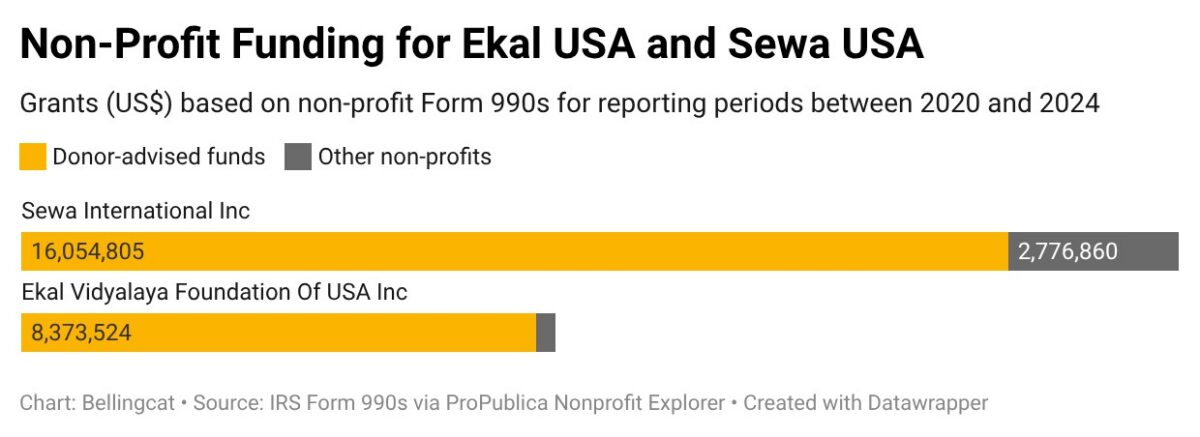
This analysis showed that the charities received at least US$24.4 million from 34 organisations that manage donor-advised funds (DAFs), or 20.7 percent of the total $117.8 million they reported receiving in contributions and grants during this period.
The actual amount from DAFs may be higher, as we excluded filings that covered partial years outside of this period – for example, June 2019 to June 2020. The filings from the two charities we identified were based on the calendar year.
The Form 990s also revealed that the vast majority of the money spent by these two charities on grants to other organisations or individuals was in India or the South Asia region rather than in the US: Ekal USA donated $33.7 million in foreign grants – all of which went towards the Ekal Vidyalaya project in India according to its filings – and none in domestic grants in the five years from 2020 to 2024, while Sewa USA reported $29.7 million in foreign grants and $622,613 in domestic grants during the same period.
Support Bellingcat
Your donations directly contribute to our ability to publish groundbreaking investigations and uncover wrongdoing around the world.
DAFs are common vehicles for people in the US who want to make donations to charitable causes while receiving tax relief or benefits. Donors do not control the money once they donate it but can advise on which charities the money eventually ends up at.
These funds are legally maintained and operated by non-profit sponsoring organisations. As public charities, DAF sponsor organisations detail the amounts and recipients of grants that they make on behalf of their donors in their Form 990s. However, they do not disclose who their donors are, and donors can choose to remain anonymous. (Note: Bellingcat USreceives grants from donor-advised funds, and some grants do not disclose the name of the grant recommender. However, many of our donors are listed on our funding page.)
There are many more organisations reportedly linked to the RSS that are not included in this analysis, but we focused on these two because of the large amounts of grants they received through DAFs, with the original sources of the funds untraceable from public information, as well as evidence pointing to both historical and current connections between them and the RSS or organisations associated with the RSS.
It is worth noting that some of the evidence we found pointing towards a connection between the two charities and the RSS or organisations associated with the RSS was from before or after the period we analysed (2020 to 2024). There is no evidence that DAF grants funded the RSS, only that they went to organisations that appear to have connections with the RSS. Experts told us that DAF grants undergo less regulatory scrutiny than other charitable donations and that DAF sponsor organisations have discretion over whether to restrict or permit donations to certain recipients.
Ekal USA
Houston, Texas-based Ekal USA is a non-profit that describes its mission in its Form 990s as “to provide free elementary education and free primary healthcare to children in remote and rural India”. The USA branch of Ekal Vidyalaya, according to its website, was founded in 2001 as part of efforts to “reach out to the global diaspora” in order to achieve a goal to “expand the reach of Ekal to 100,000 villages”.
RSS chief Mohan Bhagwat has appeared at multiple Ekal Vidyalaya events in India promoting the initiative over the years, as far back as 2014 and most recently in May.
Ekal USA was started in the late 1990s as a programme of the Vishwa Hindu Parishad of America (VHPA), or World Hindu Council of America, VHPA spokesperson Shyam Tiwari told Bellingcat in an email response. He added that it was set up as an independent organisation in early 2000. According to VHPA’s website, Ekal USA was established in 2002.
VHPA is based in the US, while the similarly named Vishwa Hindu Parishad (VHP) is in India. VHP lists VHPA in the “Hindus Abroad” section of its website. A 2017 article from VHPA’s magazine states that late founder Mahesh Mehta was trained by the RSS since he was 10 years old, and that the VHPA was born after Mehta was advised by the former supreme leader of the RSS to “build VHP in USA”. The national spokesperson of VHP in India, Vinod Bansal, said that it is an independent organisation that “sometimes shares ideology” with VHPA.
RSS’ website states that VHP was launched to organise Hindus and “reconvert all those who had been knowingly or unknowingly proselytised to alien faiths and are now desirous of coming back to the Hindu fold”. Bansal referred to VHP as an “independent part of the RSS” and an “ideological brother”.
Ekal USA Chairman-Advisor Subhash Gupta wrote in an Ekal USA publication this year that in the ‘80s and ‘90s, he was “president of the VHP’s Houston chapter” and “often received many high-profile guests from RSS and VHP”.
Gupta did not respond to requests for comment as of publication.
From 2020 to 2024, Ekal USA reported receiving more than $48.4 million in contributions and grants. Of this amount, at least $8.3 million was from DAF grants, based on Form 990s that listed Ekal USA as a grantee.
According to Ekal USA’s Form 990s, it transferred $33.7 million in foreign grants during this period and none in domestic grants for organisations or individuals. The forms also show that all the foreign grant money went towards building Ekal Vidyalaya schools in India. The rest of its expenses involved operational costs such as staff salaries.
The Ekal Vidyalaya movement has been criticised over reports that allege the schools are used to indoctrinate millions of India’s poorest and most vulnerable children and women with Hindu nationalist ideology, including that Muslims and Christians are “enemies of Hinduism”. Ekal Vidyalaya in India did not respond to multiple requests for comment.
Ekal USA did not respond to Bellingcat’s questions about these reports or any relationship it may have with the RSS. However, on its FAQ page, the group states that it does not teach religion in its schools and “does not discriminate based on caste, religious affiliation or linguistic affiliations”.
Sewa USA
Sewa USA, also based in Houston, describes itself as a “Hindu faith-based, humanitarian, nonprofit service organisation” and is listed under the heading of “Sewa Movement” on the website of India-based charity group Sewa International.
Sewa USA Vice President of Public Affairs Rakhi Israni told Bellingcat over email that the organisation “does not operate as a branch or affiliate of the RSS” or participate in political activity.
But multiple pages on the organisation’s website appear to indicate a connection between the non-profit and the RSS. In 2022, Sewa USA reposted an article on its website referring to Sewa International as “the US-based charitable non-profit organisation with links to the Rashtriya Swayamsevak Sangh (RSS)”. In a press release about the death of its founding member Ved Prakash Nanda in 2023, it noted that Nanda was “immersed in the ideals of the [RSS]”. And two different blog posts from 2021 and 2024 on Sewa USA’s website had volunteers citing RSS-led activities as the starting point for their involvement.
In addition, Sewa USA has also posted multiple times on social media and its website about an India-based organisation – Sewa Bharati – that appears to have the support of the RSS.
Sewa USA referred to Sewa Bharati as a “sister organisation” in an X post in 2014, and its regional chapter in Purvanchal as a “partner organisation” in a Facebook post in 2022.
On its website, Sewa USA said in a post that volunteers from its “partner organisations in India” had participated in rescue operations related to the 2023 train accident in Odisha, and listed several initiatives by Sewa Bharati in India. It also launched a fundraiser for families affected by floods in Maharashtra in September 2025, which mentioned that over 100 Sewa Bharati volunteers were already on the ground clearing debris and assisting communities.
“Foreign grants awarded to partner agencies in India, including service-oriented NGOs like Sewa Bharati, are strictly project-based, fully audited, and evaluated based on measurable humanitarian impact in education, health, and disaster relief,” Israni told Bellingcat.
Subscribe to the Bellingcat newsletter
Subscribe to our newsletter for first access to our published content and events that our staff and contributors are involved with, including interviews and training workshops.
RSS’ website links directly to the main website of Sewa Bharati through a tab on its main navigation bar labelled “Sewa”, and Sewa Bharati is mentioned in RSS’ 2016 annual report under the heading “Seva Vibhag”, a Sanskrit term for “service department”.
A blog post on Sewa Bharati’s website from December 2024 about an event the group organised described Indian Defence Minister Rajnath Singh as highlighting the role of RSS leaders in establishing Sewa Bharati in his address and noting that “RSS not only builds the nation but also the individual”. RSS Joint General Secretary Alok Kumar also spoke at the Sewa Bharati event, according to the blog post.
In response to Bellingcat’s queries, Israni said that Sewa USA had “no role in Sewa Bharati’s governance or operations”. Sewa Bharati did not respond to multiple requests for comment as of publication.
Sewa USA received almost $69.4 million in contributions and grants from 2020 to 2024, according to its Form 990s. Filings listing Sewa USA as a grantee show that at least $16 million was from DAFs. In its expenditure statements, Sewa USA reported giving $29.7 million in foreign grants to groups in South Asia during this period and about $622,613 in grants domestically in the US, while the rest of its expenditures included operational costs such as salaries and travel. It is not specified in the forms how much funding, if any, Sewa USA transferred to Sewa Bharati during this period, and Sewa USA did not respond to questions about any amounts transferred as of publication.
‘Cause-Neutral’ Funding
Experts told Bellingcat that there was less regulatory scrutiny of grants distributed through DAFs than some other types of charitable donations.
“For donor-advised funds, there’s actually less oversight by the IRS because donor-advised funds are considered public charities rather than private foundations,” said Samuel Brunson, a law professor at Loyola University Chicago.
“If a private foundation were giving money to organisations in India, that would be a little bit trickier. But if it’s a public charity … there’s not really a ton of oversight on that as long as the money that the US tax-exempt organisation is giving meets its charitable purpose.”
Lloyd Hitoshi Mayer, a law professor at the University of Notre Dame who specialises in non-profits, said that it was “irrebuttably presumed” that funds granted to US organisations with the non-profit 501(c)(3) tax status were being used for good charitable purposes.
“The existing federal tax laws related to donor-advised funds put some restrictions on what grants donor-advised fund sponsor organisations, which actually control the funds, can make. But the big exception is that Congress said, ‘If you make a grant to a Section 501(c)(3) charity, you’re good.’ You don’t have to do any additional oversight.”
Some DAF sponsor organisations have previously faced criticism for granting money to charities that have promoted homophobic, anti-immigrant or anti-Muslim views. Several were also criticised for pausing funding to the Southern Poverty Law Centre earlier this year, although this case demonstrated how DAFs can prevent funds from going to some groups recommended by donors, if the DAFs deem them unsuitable.
Brunson told Bellingcat that DAF sponsor organisations “absolutely have the right and ability” to halt processing donations to certain organisations. “Whether we want them to do that or not is a separate question,” he said.
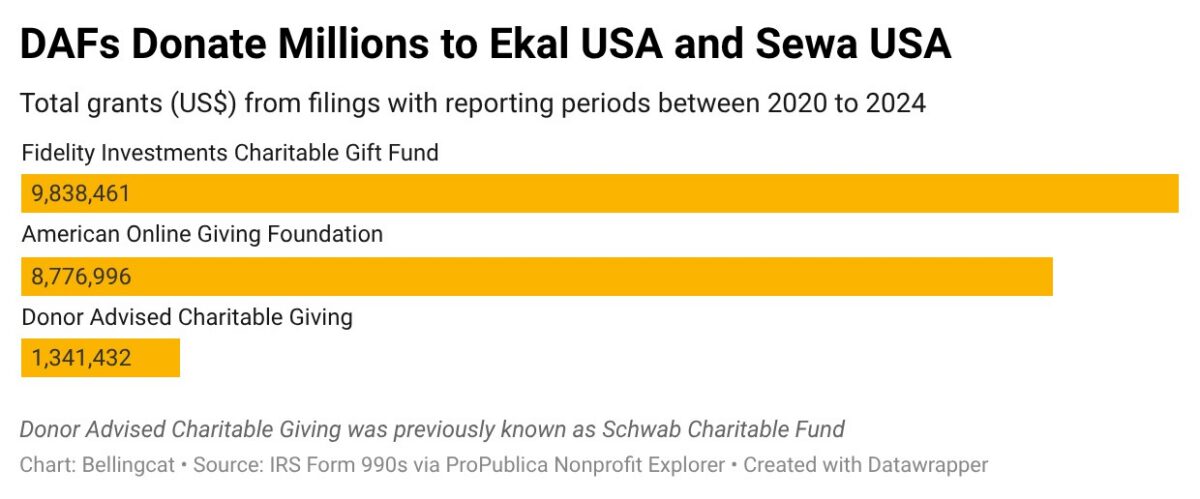
Bellingcat reached out to the top three DAF sponsor organisations that donated to the two non-profits we identified – Fidelity Investments Charitable Gift Fund (Fidelity Charitable), American Online Giving Foundation (AOGF) and Charles Schwab-affiliated Donor Advised Charitable Giving (DAFgiving360; known before 2024 as Schwab Charitable) – to ask about their internal policies on assessing charities receiving donations through their funds. In total, the three DAFs accounted for almost $20 million, or 81.7 percent, of the DAF grants to Ekal USA and Sewa International for full reporting years between 2020 and 2024.
Fidelity Charitable, AOGF and DAFgiving360 all told Bellingcat that they had due diligence processes in place when evaluating non-profits.
Fidelity Charitable’s website states that it is a “cause-neutral” charity, but it ensures grants are used solely for charitable purposes. AOGF said non-profits must comply with eligibility requirements regarding hate speech, discrimination and the use of funds.
Meanwhile, DAFgiving360 said that a grant recipient may be subject to monitoring or placed under temporary suspension “due to circumstances that DAFgiving360 deems appropriate”, such as if there is a public interest consideration or if the recipient does not further DAFgiving360’s mission.
Bellingcat is a non-profit and the ability to carry out our work is dependent on the kind support of individual donors. If you would like to support our work, you can do so here. You can also subscribe to our Newsletter and follow us on Bluesky here, Instagram here, Reddit here and YouTube here.
Statistics on Malware Distributed to the Financial Sector Malware Distribution Trends. In Attack Stage 1, phishing was the highest at 2.1, Up from 1.8 The previous month. In Attack Stage 2, dropper/downloader was the highest at 1.1, Down from 3.2 The previous month. In Stage 3 of the attack, Infostealers were the most prevalent at […]
The Department of Telecommunications (DoT) Madhya Pradesh, India LSA has cautioned citizens against fraudulent SIM cards, misuse of telecom identifiers and tampering with IMEI numbers, warning that such violations can carry serious legal consequences under India’s Telecommunications Act, 2023.
The advisory follows recent cybercrime investigations that uncovered instances of unauthorized SIM activation. In one case, a Point of Sale (PoS) agent in Chhattisgarh was found to have illegally activated 25 mobile connections using citizens’ identification documents without their knowledge or consent.
Following the discovery, the DoT and telecom service providers blacklisted the concerned PoS agent, preventing it from issuing mobile connections in the future.
DoT Investigates Fraudulent SIM Cards and Mobile Connections
The 25 mobile connections linked to the case were examined through the Digital Intelligence Platform, or DIP, operated by the DoT. Connections identified as suspicious were subjected to re-verification.
Numbers that failed the re-verification process were subsequently deactivated.
The action highlights concerns around SIM card fraud, particularly where mobile connections are obtained or activated using another person’s identity documents. The DoT has also cautioned citizens against transferring SIM cards registered in their names, as legal liability may extend to the original subscriber if the connection is later misused.
Telecommunications Act 2023 Sets Penalties
The DoT said fraudulent issuance of SIM cards, misuse of telecom identifiers and tampering with IMEI numbers are punishable offences under the Telecommunications Act 2023.
Such violations may attract imprisonment of up to three years and fines of up to ₹50 lakh.
The department has urged citizens to avoid obtaining SIM cards through fake documents, fraud, cheating or impersonation. It has also warned against procuring SIM cards in their own names and subsequently transferring, renting, loaning or otherwise providing them to others for misuse in cyber fraud or other unlawful activities.
Citizens have also been advised not to use devices such as modems, modules or SIM Boxes with configurable or tampered IMEI numbers.
IMEI Numbers and Telecom Identifiers Under Scrutiny
The DoT has highlighted the misuse of telecommunications identifiers, including the International Mobile Equipment Identity, or IMEI numbers, as a security concern.
Citizens have been cautioned against using mobile applications, websites or other methods to modify Calling Line Identity (CLI) or other telecommunications identifiers. The department has also warned against using devices with tampered IMEI numbers.
According to the advisory, misuse of SIMs and telecom identifiers can affect citizen safety and pose risks to the security and integrity of telecommunications networks.
Sanchar Saathi Enables SIM and Device Checks
The DoT has advised citizens to regularly use Sanchar Saathi to verify mobile connections issued in their names and block numbers that are unnecessary or not genuinely theirs.
The Sanchar Saathi platform also provides a facility called “Check Genuineness of Your Mobile handset,” which allows users to verify IMEI numbers and associated device information. The service can provide details including the handset’s brand name, model name and manufacturer information.
Citizens can access the Sanchar Saathi services through its portal or mobile application to check and secure their mobile connections and devices.
The DoT has urged citizens to remain vigilant and avoid sharing SIM cards registered in their names, particularly where the connection could later be used for cyber fraud or other unlawful activities.
Note In August 2026, widespread instances of database leaks, the sale of internal data, and the trading of initial access privileges were observed on dark web and deep web forums. Due to the nature of the sources, it was difficult to fully verify the accuracy of some posts. Major Issues ShinyHunters continued to make claims […]
Note The July 2026 Dark Web Breach Incident Trend Report was compiled based on data breach cases posted on deep web and dark web forums. Due to the nature of some posts, it is difficult to fully verify their accuracy; some posts related to South Korea included AI-generated false data or cases where it could […]
Statistics on Malware Distributed to the Financial Sector In the June threat analysis for the financial sector, phishing was the most prevalent attack method in Attack Stage 1, while droppers/downloaders (distribution tools that download additional malware) were the most prevalent in Attack Stage 2. Infostealers were identified in the third attack stage, indicating that multi-stage […]
An app has appeared in India that lets anyone with a smartphone stop a passing e-rickshaw dead in its tracks - no login, no passwords, no permissions needed.
Meanwhile, Geoff - swimming in money and Lamborghinis, as all published authors are - has been on the receiving end of a slew of AI-generated scam pitches from fake book marketing experts. Rather than ignore them, he's been playing them at their own game...
All this and more in this episode of the "Smashing Security" podcast with cybersecurity expert and keynote speaker Graham Cluley, and special guest Geoff White.
SentinelLABS has been tracking sustained cyberespionage activity against several Pakistani law enforcement organizations, taking place from February 2024 to April 2026.
All these actors converged on Balochistan Police over this period, bringing both a partner and an adversary of Pakistan to the same police force in a province shaped by a separatist insurgency and the regional tensions it has drawn in.
At Balochistan Police, the compromised assets included servers hosting web applications that manage police and citizen data, such as criminal and biometric records.
A suspected China-nexus actor planted implants in one of the web applications, which serves both police staff and citizens, weaponizing a tool of Pakistan’s police digitalization against its users.
Pakistani law enforcement organizations attract cyber collection because they hold information on Pakistan’s internal security that regional powers have an incentive to pursue.
For China, the likely primary concern is the safety of its nationals, the target of repeated deadly attacks Pakistan has failed to prevent, leading Beijing to assess that threat for itself rather than rely on its partner alone.
For India, the strongest motive is probably its rivalry with Pakistan, with Balochistan Police offering insight into the security posture of a Pakistani province prominent in wider mutual accusations over cross-border support for militancy.
Overview
Suspected China- and India-nexus threat actors carried out intrusions into several Pakistani law enforcement organizations between 2024 and 2026. Our analysis of C2 netflow data revealed that suspected China- and India-nexus threat actors operating PlugX, ShadowPad, Cobalt Strike, and Remcos infrastructure have converged on this victim class.
All of these threat actors were active against Balochistan Police, the principal police force serving the Pakistani province of the same name, at various points between 2024 and 2026. The affected assets spanned network appliances and servers hosting web applications that manage biometric records, hotel and tenant registrations linked to national identity records, criminal case files, and personnel records. A suspected China-nexus threat actor also compromised one of these web applications, deploying custom implants masquerading as a portal update. The application is used by police staff and by citizens interacting with law enforcement through it, and the compromise put both user groups within the threat actor’s reach.
When multiple cyberespionage actors operate against law enforcement institutions of a single state, the convergence itself is a signal of target value. What draws them is a particular kind of institution: one that holds the government’s internal security picture, what it knows about the threats inside its borders, and how it acts against them. Each of the states suspected to be behind the activities covered in this post has its own stake in the threats monitored by Pakistani law enforcement.
Strategic Motives | Distrust and Accusations
The China-nexus activity is most likely motivated primarily by concern for the safety of Chinese nationals. Their presence across Pakistan is substantial, tied in large part to the China-Pakistan Economic Corridor (CPEC), Beijing’s flagship Belt and Road infrastructure program in the country. Chinese nationals have been the target of repeated deadly attacks, some of which were claimed by the Balochistan Liberation Army (BLA), a Baloch separatist group opposed to China’s presence in the Pakistani resource-rich southwest. Notable attacks include the October 2024 Karachi airport attack and the March 2024 suicide bombing in northwestern Pakistan.
The attacks have fueled explicit Chinese dissatisfaction with Pakistani counter-militancy performance. In October 2024, China’s Ambassador to Pakistan publicly called them “unacceptable”, warning that the security situation was the main obstacle to CPEC. The threat to Chinese nationals remains unresolved. As recently as January 2026, China’s Minister of Public Security and Pakistan’s Interior Minister agreed to expand counterterrorism coordination, deepen police training exchanges, and establish a special unit in Islamabad to protect Chinese nationals.
Pakistani law enforcement is a natural collection target for China. The data it holds would let China assess the security environment its nationals face independently, rather than relying on a partner whose protection has repeatedly fallen short.
For the India-nexus activity, which was focused on Balochistan, the strongest motive is probably the adversarial security relationship between India and Pakistan, in which the province is a recurring flashpoint. Pakistan has long accused India of backing the Baloch insurgency, describing the BLA as an “Indian proxy“, a charge it has not publicly substantiated and that India denies. India, in turn, accuses Pakistan of backing the militant groups behind attacks in Indian-administered Kashmir, which Pakistan denies.
The Baloch insurgency is a front in the antagonism between the two states, and Balochistan Police would hold the operational record of how Pakistan manages the province’s security. For India, that material could offer visibility into a conflict at the center of the accusations and counter-accusations between them.
Balochistan Police is the same law enforcement institution the China-nexus actors were active against, approached from the opposite direction. To China, it is the police force of a partner that cannot be trusted to protect Chinese nationals in Balochistan. To India, it is the police force of a rival, with deep insight into the security of a province central to the friction between the two states.
Intrusions Into Pakistani Law Enforcement Organizations
We observed the highest concentration of intrusions at Balochistan Police. They affected network appliances and web servers hosting several of its web applications, one of which, the Complaint Management System (CMS), drew particular attention. The next two sections discuss the impacted assets in greater detail.
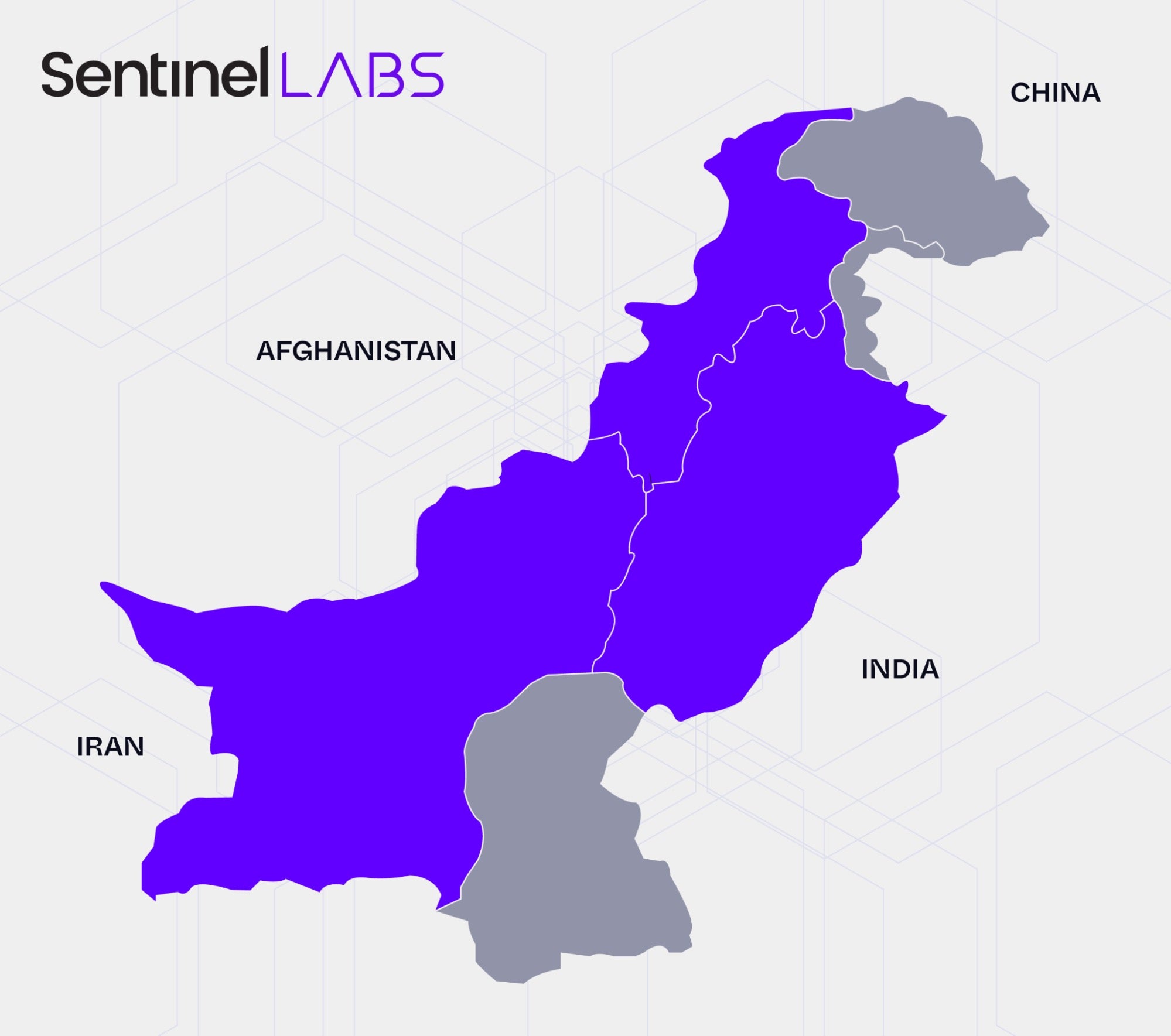
We also identified compromised infrastructure associated with several other Pakistani law enforcement organizations:
the Khyber Pakhtunkhwa Police, the police force of Khyber Pakhtunkhwa province;
the Islamabad Police, which serves the Islamabad Capital Territory;
the Punjab Safe Cities Authority (PSCA), an autonomous government body that operates the integrated command, control and communication system for the police in the major cities of Punjab province.
Pakistani provinces with affected law enforcement organizations
We group the C2 activity we observed against all these targets into four clusters, each associated with a single malware family or tool: PlugX, ShadowPad, Cobalt Strike, and Remcos.
Because we cluster based on tooling, not on actor attribution, the number of threat actors behind each C2 activity cluster differs. We associate the Remcos cluster with a single actor, while the PlugX, ShadowPad, and Cobalt Strike clusters are built on shared or commodity tooling and may each involve more than one operator.
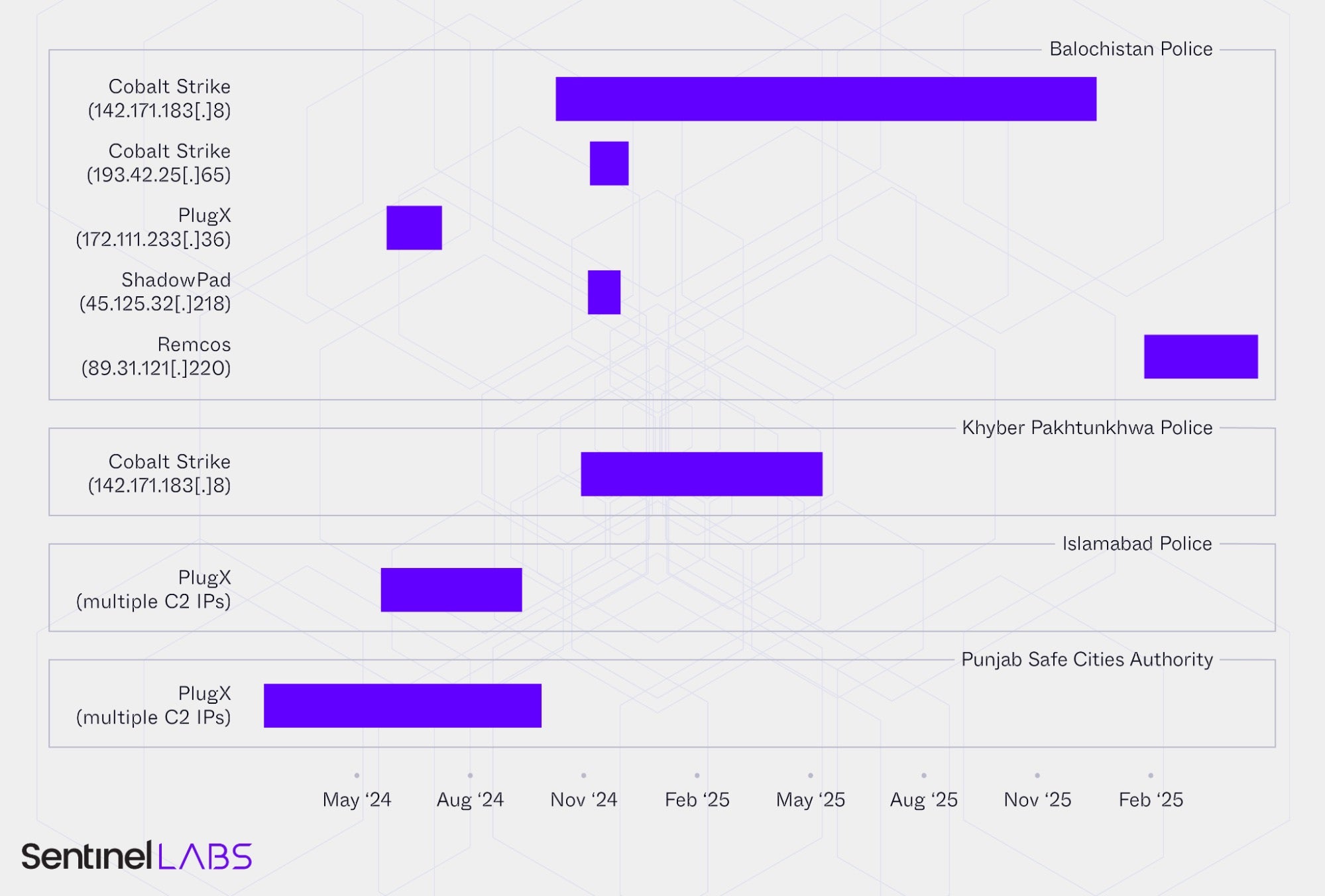
The table below presents the constituent servers of each C2 activity cluster, along with the first and last dates on which any of its servers communicated with Pakistani law enforcement infrastructure. The figure that follows shows how each cluster’s activity was distributed across the targeted organizations over time.
Timeline of C2 traffic to Pakistani law enforcement organizations
The sections below cover the basis for each cluster’s attribution and its broader victimology. The observation windows we present there are generally wider, spanning all per-cluster victims.
C2 Activity Cluster | PlugX and ShadowPad
PlugX and ShadowPad point to China-nexus cyberespionage groups on the basis of the tooling itself, since both are backdoors shared among multiple such groups. The victimology we observed for PlugX (between 27 February and 28 September 2024) and ShadowPad (between 3 August and 1 December 2024) reinforces this assessment.
Beyond Pakistani law enforcement, victimology for PlugX and ShadowPad includes government, foreign affairs, defense, nongovernmental, and research entities across South, Southeast, Central, and East Asia, the Arabian Peninsula, and Southeast Europe, consistent with China-aligned collection.
C2 Activity Cluster | Remcos
We attribute the Remcos C2 server 89.31.121[.]220 to a suspected India-nexus threat actor, which Recorded Future tracks as TAG-179. Its infrastructure, tooling, and TTPs overlap to varying degrees with those of the threat actors tracked by Kaspersky as Mysterious Elephant and by Qihoo 360 as APT-C-08 (a.k.a. Bitter).
Our data shows that TAG-179 has been intensifying its activities and diversifying its TTPs since early 2025. This trend aligns with the prior research from Kaspersky and Qihoo 360, which documents in detail the tooling and infection chains used across 2025 and 2026.
Notably, Qihoo 360 describes a chain that delivers a Remcos backdoor configured with the same server that constitutes our Remcos C2 activity cluster (89.31.121[.]220). The IOC table of this report lists several lure files and backdoor components that we associate with TAG-179.
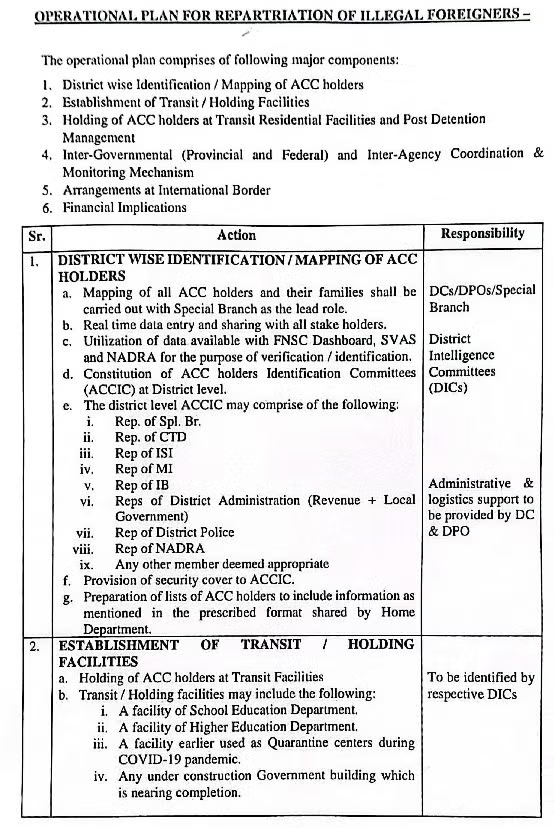
Among the lures is one with direct relevance to Pakistani law enforcement: it displays a decoy document posing as an operational plan for the repatriation of illegal foreigners, including Afghan Citizen Card (ACC) holders. These are Afghan nationals who have been granted temporary registration in Pakistan and are targeted for deportation under Pakistan’s Illegal Foreigners’ Repatriation Plan.
The decoy document outlines coordination among district-level police forces, the National Database and Registration Authority (NADRA, an agency of the Pakistani Ministry of Interior), and Pakistani intelligence organizations. Its subject matter is consistent with the Pakistani law enforcement victimology of TAG-179, making it an example of a plausible lure against this target class.
Decoy document
Within our observation window for the Remcos C2 activity (from 20 November 2025 to 21 April 2026), the victimology outside Pakistani law enforcement includes government, defense, foreign affairs, intelligence, research, and manufacturing entities across South and Southeast Asia, and the Middle East.
C2 Activity Cluster | Cobalt Strike
Although Cobalt Strike is a commodity tool that carries no inherent attribution, we attribute with medium confidence both servers in this C2 activity cluster to China-nexus threat actors.
The C2 traffic to 142.171.183[.]8, spanning 13 September 2024 to 5 December 2025, reveals victimology extending beyond Pakistani law enforcement to government, academic, telecommunications, and non-governmental entities across South, East, and Southeast Asia, the Middle East, and South America, in line with a China-aligned targeting profile. Among these entities are Tibetan Buddhist organizations in Taiwan, a long-standing Chinese cyberespionage interest.
For 193.42.25[.]65, we observed C2 communications only with Balochistan Police infrastructure, taking place between 7 November and 5 December 2024. 193.42.25[.]65 also served as next-stage infrastructure for one of two implants deployed on the Balochistan Police CMS web application. We trace these implants to a Chinese-speaking developer through related samples sharing the same development environment, a topic we discuss in greater detail in a later section.
Balochistan Police | Compromised Assets
Across the four C2 activity clusters, C2 communications involving the following Balochistan Police assets took place between 2 June 2024 and 9 April 2026:
two network appliances;
web servers hosting several Balochistan Police web applications;
a Fortinet FortiMail appliance that had served as Balochistan Police’s primary inbound email gateway.
At the time of this activity, the FortiMail appliance was no longer the designated inbound email gateway, but it remained operational on the network and may have continued to process outbound or internal mail relay traffic. Its compromise may therefore have additionally exposed email traffic it processed.
Many of the web applications hosted on the affected servers are part of the Smart Police Station initiative, an EU-supported effort to modernize Balochistan policing and improve how it serves the public through digitalization. Throughout the threat actor activities, the web servers hosted a mix of public-facing applications through which citizens and businesses access policing services, alongside restricted police applications protected by firewalls against unauthorized external access.
The table below summarizes the application functions as described in publicly available documentation.
Application
Function
First Information Report (FIR)
Application for FIR registration and management. FIRs are documents prepared by police upon receiving information about the commission of a cognisable offence.
Human Resource Management Information System (HRMIS)
Personnel database managing officer service records, transfers, postings, payroll, and performance evaluations.
Anti-Vehicle Lifting System (AVLS)
Database for tracking stolen vehicles, their recovery, and investigation.
HotelEye
System for hotel guest check-in logging, integrated with NADRA identity records to notify police when individuals with criminal records check in.
Criminal Record Management System (CRMS)
Criminal records database with fingerprint-based biometric matching.
Tenant Registration System (TRS)
Landlord-tenant registration platform integrated with criminal records.
Complaint Management System (CMS)
Platform for registering, tracking, and resolving citizen complaints, from reports of crime and loss of documents to complaints about police misconduct.
If the threat actors could reach the data stores backing these applications from the compromised servers, the data they could obtain would span police personnel records, criminal case files, biometric records, stolen vehicle records, hotel guest check-in records, tenant registration records, and citizen complaints. Together, it would provide broad visibility into Balochistan Police’s operational posture, capabilities, and intelligence activities.
Balochistan Police | CMS Compromise
The CMS web application, accessible at cms.balochistanpolice[.]gov[.]pk and hosted on one of the affected Balochistan Police web servers, was also compromised. Based on shared infrastructure and a common focus on Balochistan Police, we associate this intrusion with the threat actor operating 193.42.25[.]65, a constituent of the Cobalt Strike C2 activity cluster.
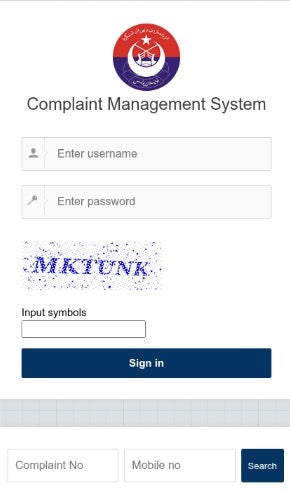
The landing page at cms.balochistanpolice[.]gov[.]pk features a login interface and a separate search form.
The CMS landing page
Access behind the login interface is highly likely restricted to law enforcement personnel. Stolen login credentials for the portal, which we retrieved from information stealer logs published on the dark web, reveal a consistent naming convention across the recovered usernames: a ps- prefix (most probably denoting “police station”) followed by a district or city within Balochistan, such as ps-barkhan.
In contrast, the search form, which posts to /Complaint/PublicSearch and accepts a complaint reference number and mobile number, is evidently intended to allow citizens to check the status of a filed complaint.
We therefore assess with high confidence that the CMS application serves two distinct user groups: law enforcement personnel and citizens.
Based on VirusTotal data, two variants of an implant named cms_plugin.exe were uploaded to cms.balochistanpolice[.]gov[.]pk/client%20scripts/ in late 2024, one written in the Rust programming language, the other compiled as a .NET executable. The Rust executable is a malware stager that downloads a payload from 193.42.25[.]65 and executes it. We could not retrieve the next stage at the time of analysis.
The .NET executable masquerades as 360Safe.exe, a component of the endpoint security software 360 Safe Guard from the Chinese vendor Qihoo 360. It reflectively loads an assembly implementing an AsyncRAT client, which is configured to use 41.216.188[.]140 as its C2 server. The assembly has a PDB path of D:\codedome\case\six\Client\Client2\obj\Debug\Client2.pdb.
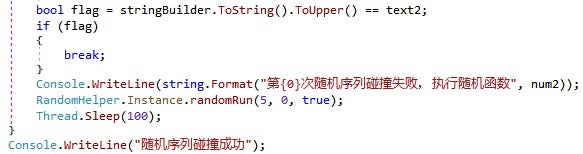
Pivoting on the D:\codedome prefix, we identified multiple additional samples highly likely built in the same development environment. Several are AsyncRAT clients that share implementation patterns with the one embedded in cms_plugin.exe, such as variable naming and string obfuscation, reinforcing a common origin beyond the shared PDB prefix. Some contain Chinese-language terms in pinyin in their PDB paths, such as xinshi (likely 新式, “new type” or “new variant”), and one includes log messages in simplified Chinese. These indicators point to a Chinese-speaking developer behind the samples linked by the D:\codedome prefix, including the one deployed on the Balochistan Police CMS application.
Log messages
Pivoting on the cms_plugin.exe filename, we identified a third malware stager functionally similar to the Rust variant, also downloading the next stage from 193.42.25[.]65.
Both cms_plugin.exe samples downloading from 193.42.25[.]65 display the message Update Complete! Please refresh the page upon execution, mimicking an update for the CMS portal.
The fake update prompt, combined with the cms_plugin.exe filename and the hosting location in the portal’s /client scripts/ directory, indicates that the implants were targeted at users of the CMS platform: police staff, citizens checking complaint status, or both. Successful infection would grant the threat actor access to the victim’s device. In the case of police personnel, this could provide a foothold into internal police networks and access to operational data beyond the CMS platform. In the case of citizens, it would enable surveillance of those who have filed complaints through the platform.
Conclusion
The intrusions we cover in this post show how domestic security institutions can become high-value intelligence targets when the threats they monitor overlap with foreign intelligence requirements. Balochistan Police sits at such an intersection, attracting cyberespionage activity from both a partner and an adversary of Pakistan. For China-nexus actors, access to its systems could support independent assessment of threats to Chinese nationals and interests in the country. For India-nexus actors, such access provides visibility into how Pakistan manages security in a province central to its adversarial relationship with India.
The compromise of the Complaint Management System web application adds a second dimension to the activity against Balochistan Police, extending the threat actor’s reach beyond the initially compromised environment. By hosting implants in a portal used by both citizens and law enforcement personnel, the threat actor turned a tool built to make policing in Pakistan more accessible and accountable to the public into a malware delivery mechanism. This weaponization widened the collection surface from the application and its data to the users interacting with it.
The multi-actor convergence on Balochistan Police points to a structural consequence of digital policing. Systems built to centralize records, workflows, and public interaction can also centralize intelligence value by bringing together operational, institutional, and civilian data across connected environments. Law enforcement infrastructure in that setting is no longer just the digital backbone of policing but intelligence terrain, and it will be treated as such by any adversary who can reach it.
Dois acontecimentos recentes acenderam um alerta global sobre a evolução das fraudes digitais e a profissionalização do crime cibernético. De um lado, pesquisadores da Cybernews identificaram uma base exposta contendo aproximadamente 24 bilhões de registros de credenciais, incluindo e-mails, nomes de usuário, senhas em texto claro e URLs de acesso. De outro, o governo da Índia bloqueou temporariamente o Telegram após suspeitas de que grupos organizados estariam utilizando a plataforma para tentar fraudar candidatos do NEET 2026, principal exame nacional de admissão para cursos de medicina do país. Para a LC SEC, consultoria especializada em cibersegurança e compliance, os dois episódios evidenciam a crescente profissionalização do crime digital.
Segundo informações divulgadas pela Cybernews, a base reúne dados provenientes de diferentes fontes, incluindo infostealers, compilações de vazamentos anteriores e outras exposições digitais acumuladas ao longo dos anos. Embora ainda não seja possível determinar quantos registros são duplicados ou quantas pessoas únicas foram afetadas, a consolidação desse volume de informações em um único conjunto amplia significativamente o potencial para ataques de tomada de contas, fraudes financeiras e invasões corporativas.
Na Índia, o caso envolvendo o Telegram também chamou a atenção pela escala da operação, pois, segundo informações divulgadas pela Reuters, o bloqueio temporário da plataforma ocorreu após autoridades apontarem que grupos organizados teriam utilizado o aplicativo para coordenar tentativas de fraude relacionadas ao exame NEET 2026. O episódio ganhou repercussão nacional após o cancelamento dos resultados de cerca de 2,3 milhões de estudantes em meio a investigações sobre possível vazamento de questões e irregularidades no processo seletivo.
Embora distintos, os dois casos compartilham um elemento importante: a utilização de plataformas digitais como parte da infraestrutura que sustenta operações criminosas. Ao rastrear a origem dos dados presentes na base identificada pela Cybernews, os pesquisadores encontraram 36 fontes distintas de informação. Segundo a investigação, grande parte delas estaria associada a canais do Telegram utilizados para compartilhamento de credenciais roubadas, dados obtidos em violações de segurança e materiais relacionados a atividades ilícitas.
“O aspecto mais relevante desses casos é que eles mostram como o crime digital funciona atualmente. Não estamos falando apenas de vazamentos ou de uma plataforma específica, mas de um ecossistema onde dados roubados são coletados, organizados, compartilhados e utilizados por diferentes grupos criminosos. O Telegram aparece nesse contexto como um dos canais identificados para circulação dessas informações, evidenciando como plataformas digitais podem ser incorporadas à cadeia operacional das fraudes”, afirma Luiz Cláudio, CEO e fundador da LC SEC.
O cenário acompanha uma tendência observada globalmente pelo relatório Microsoft Digital Defense de 2025, que aponta que mais de 97% dos ataques contra identidade são baseados em senhas e que esse tipo de ameaça cresceu 32% no primeiro semestre de 2025. O relatório também destaca que mecanismos de autenticação multifator resistentes a phishing são capazes de bloquear mais de 99% desses ataques.
Na avaliação do especialista, o foco das organizações não deve estar apenas na proteção de sistemas, mas também na gestão da identidade digital. “Quando credenciais comprometidas passam a circular livremente, os criminosos conseguem assumir contas legítimas, acessar ambientes corporativos e utilizar essas informações para ataques mais sofisticados. A identidade digital se tornou um dos ativos mais valiosos e mais visados do ambiente corporativo”, explica Luiz Claudio.
Diante desse cenário, a LC SEC recomenda que empresas revisem suas políticas de autenticação, ampliem o uso de autenticação multifator (MFA), fortaleçam processos de validação de identidade e monitorem continuamente credenciais expostas. A adoção de estratégias de Threat Intelligence, avaliações periódicas de acessos privilegiados e programas permanentes de conscientização também são medidas importantes para reduzir riscos e antecipar movimentos de grupos criminosos.
Reliance’s AI roadmap puts Jio CallAgent inside the telecom network while tying India-scale AI ambitions to Jamnagar compute, local-language services, and enterprise compliance questions.
This article is the result of a collaboration with Indian media outlet Newslaundry. You can find Newslaundry’s editorially independent coverage here.
Collage illustration by Klawe Rzeczy. Elements from Unsplash.
Indian companies have shipped more than 320 million synthetic opioid pills to West Africa – where they have not been approved by regulators – over the past three years, a Bellingcat investigation has found.
Export records from trade data provider 52wmb show that more than 1,400 consignments of tapentadol worth almost USD $130 million were sent from India to West Africa between January 2023 and December 2025.
Tapentadol, a painkiller two to three times more potent than tramadol, has not been approved for use in most West African countries, where some nations are grappling with an escalating opioid abuse epidemic.
However, this investigation shows that dozens of Indian suppliers have flooded the region with tapentadol over the past three years. Where dosages were listed, more than half the pills were in powerful strengths of 200mg or more – dosages that are not even approved in India.
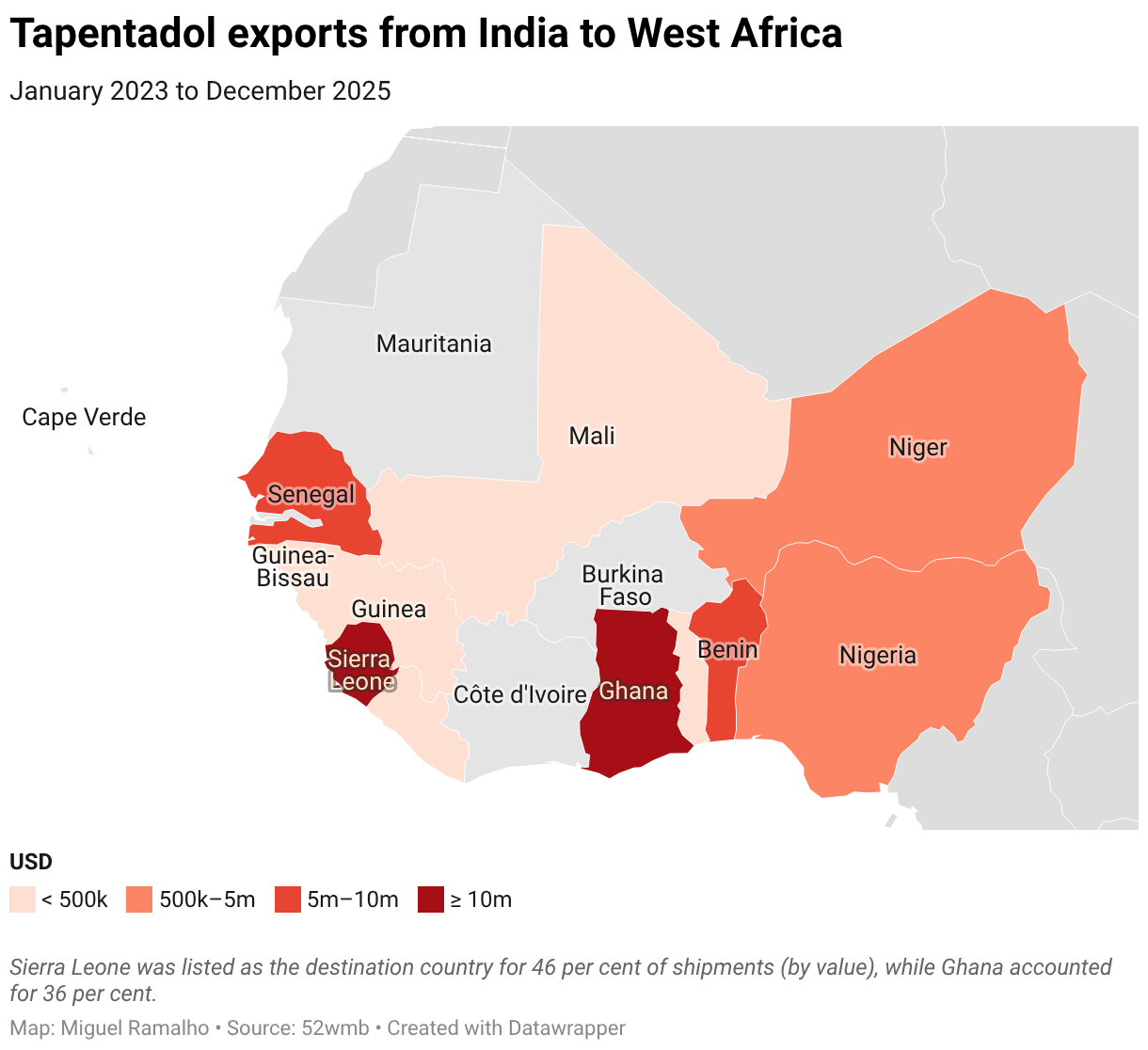
The exports, cross-checked against records provided by trade data aggregator ImportGenius, show most tapentadol pills sent between 2023 and 2025 had the coastal nations of Sierra Leone and Ghana listed as their declared destinations.
The two West African countries were collectively marked as the destination for more than 80 per cent of the total value of tapentadol sent to the region.
Experts have documented how drug traffickers adapt quickly to international regulations and law enforcement efforts. In 2018, India tightened export controls around the opioid tramadol, one of the most trafficked synthetic drugs to West Africa.
In 2021, the International Narcotics Control Board (INCB) said large-scale tapentadol trafficking had been identified, particularly in consignments destined for Africa. It had previously noted that India’s strengthened tramadol controls could lead traffickers to substitute the drug with other potent synthetic opioids.
A BBC investigation last year revealed that Indian company Aveo Pharmaceuticals was illegally exporting tablets containing a mix of tapentadol and the muscle relaxant carisoprodol to West Africa. This led India’s drug regulator, the Central Drugs Standard Control Organisation (CDSCO), to ban the manufacture and export of all combinations of the two drugs.
Bellingcat’s investigation, in collaboration with Indian publishing partner Newslaundry, reveals that the supply of tapentadol pills from India to West Africa has surged in recent years.
Export data from 52wmb shows the value of tapentadol sent to the region has risen from about USD $27 million in the three year period from 2020 to 2022, to almost USD $130 million from 2023 to 2025.
Julius Maada Bio, Sierra Leone’s president, in 2024 declared a national emergency over rampant drug abuse and branded kush – a toxic blend of psychoactive substances including cannabis and synthetic opioids – a “death trap”.
Authorities in Sierra Leone have intercepted illegal tapentadol, including last July when the National Revenue Authority (NRA) said it thwarted a smuggling operation near its north-west border with Guinea.
The NRA and other agencies including the Transnational Organised Crime Unit, National Drug Law Enforcement Agency, and the Pharmacy Board of Sierra Leone did not respond to Bellingcat’s requests for comment.
Sierra Leone’s NRA said customs officers seized tapentadol near a border crossing in July. Source: National Revenue Authority
Ghana’s Narcotics Control Commission (NACOC) said the illegal importation of tapentadol was first recorded in 2022 after international efforts to curb the tramadol crisis resulted in criminal networks shifting production to other pharmaceutical opioids including tapentadol, tafrodol and carisoprodol.
The agency has recorded a “steady rise” in tapentadol trafficking over the past three years, with authorities seizing more than 3.7 million tablets (250mg strength). Most were traced back to India, it said.
“NACOC investigations confirm that the bulk of tapentadol is trafficked into Ghana through seaports and by air, via express courier services,” a spokesperson said. “At the ports, the drug is concealed in containerized cargo falsely declared as pharmaceuticals, electrical materials or household goods. Express courier services are used for smaller, high-value quantities, often packed alongside legitimate consignments to avoid detection.”
NACOC said Ghana had emerged as both a destination and transit hub for tapentadol, with the majority of intercepted consignments bound for Niger, Mali, Burkina Faso and Nigeria. When sold domestically, it said the street drug was promoted as a tramadol substitute.
Ghana’s Food and Drugs Authority (FDA) said last year that the abuse of pharmaceutical opioids such as tapentadol — commonly known on the street as “Red” — was on the rise.
The FDA told Bellingcat it had “never issued any permit” for the manufacture or importation of tapentadol, in any strength, to any importer or to any country. It said any tapentadol shipments to Ghana were for “trans-shipment to neighbouring country”.
Import data for Ghana shows that no tapentadol entered the country between 2023 and 2025, which supports NACOC’s position that the drugs are being concealed and falsely declared. Import data for Sierra Leone was not available through 52wmb.
Ghana’s FDA destroyed 230 cartons of the illegally imported tapentadol last April and seized 7,700 tapentadol tablets at a border crossing last August. NACOC said it was combatting opioid importation through regulation, enforcement and cooperation with its counterparts in other countries. Source: FDA
India’s drug and pharmaceutical exports have grown to more than $30 billion a year, according to the Pharmaceuticals Export Promotion Council of India (Pharmexcil), a division of the ministry of commerce and industry.
While tapentadol is available in India on prescription in strengths of up to 100mg (immediate release) and 200mg (extended release), authorities are aware of its risk of misuse. Last year, the Indian drug regulator’s Technical Advisory Board said the Department of Revenue may be requested to schedule the painkiller under the Narcotic Drugs and Psychotropic Substances Act, which would tighten rules around its export.
To export pharmaceutical products at strengths that are not approved in India, exporters are required to obtain an export “no objection certificate” (NOC) from the CDSCO, for which they have to submit proof of the drug’s approval in the importing country. Publicly available information shows tapentadol is not approved for use in any of the West African nations identified as part of this investigation.
The CDSCO did not respond to questions from Bellingcat or our publishing partner, Newslaundry.
In response to “Right to Information” requests submitted by Newslaundry, the CDSCO said only two companies had been granted authorisation to manufacture tapentadol for export between 2019 and 2024. However, the trade data analysed by Bellingcat did not list either company as an exporter of tapentadol to West Africa.
The CDSCO also said it had issued export NOCs for tapentadol to 51 companies since 2024, but that these were not for export to West African countries.
Meanwhile, Bellingcat’s analysis of trade data shows that more than 60 Indian suppliers have exported tapentadol to West Africa since 2023. The exporters are mostly pharmaceutical companies but also include smaller operations, such as one company owned by a Nigerian man who sent more than US $4 million of tapentadol to Niger and Ghana.
In the BBC’s investigation, journalist Surabhi Tandon reported on the increase in cross-border smuggling of tramadol, “a catch-all name to describe the range of opioids used as street drugs”, from Ghana to Nigeria. Source: BBC News
Dinesh Thakur, co-author of the book Truth Pill, told Newslaundry there were gaps in India’s drug regulatory framework that made it possible for potentially unsafe medicines to be manufactured and exported without proper oversight.
“There is no regulatory framework which checks a genuine importer and counterfeit importer between countries,” said Thakur, a former pharmaceutical executive who now works as a public health activist.
Mohammed Adinoyi Usman, a consultant anaesthetist at Rasheed Shekoni Federal University Teaching Hospital in Nigeria, said tackling Africa’s opioid crisis was complicated by a lack of resources across the region, weak government responses, and inaction by law enforcement agencies.
He said more collaboration and intelligence sharing was needed, especially across West African countries, to combat the problem. “We see so many opioids coming into our region because of a range of factors including under-funded institutions like customs and drug agencies, weak border controls and corruption,” he said.
“Africa is different. Even southern Africa is different from western Africa – each region has its peculiarities. In Nigeria, we don’t have well-functioning institutions to help control it. But our government is trying.”
Dr Usman said access to prescription opioids in Africa was inadequate, and pointed to research showing the disparity in distribution of legal opioids to low-income countries compared to high-income nations that consume the bulk of the world’s pain relief medication. He said opioid abuse was linked to crime and negative health outcomes.
“Sadly, access to prescription opioids is very limited in Africa,” Dr Usman said, “but the costs of illegal use are high.”
Bellingcat is a non-profit and the ability to carry out our work is dependent on the kind support of individual donors. If you would like to support our work, you can do so here. You can also subscribe to our Patreon channel here. Subscribe to our Newsletter and follow us on Bluesky here, Instagram here, Reddit here and YouTube here.

 Entrar


 French TV channel BFM reported that the attackers appeared to trigger a forced defrost option, keeping units heating instead of cooling. The attack did not use a new
 Image Source: Cyble[/caption]
 Taken together, this week's incidents show attackers targeting the systems people rely on every day, from shop refrigeration and grocery supply chains to payment apps and hiring processes. Follow The Cyber Express for next week's weekly cybersecurity roundup and ongoing coverage of these stories.

 GhostBat-RAT-Infection-Chain-1536x595[/caption]