Visualização de leitura

Ransom & Dark Web Issues Week 1, August 2026

ASEC Blog publishes Ransom & Dark Web Issues Week 1, August 2026           South Korean Automotive Parts Manufacturer’s Internal Server Access and Database Offered for Sale Data of a Turkish HR Consulting Company Offered for Sale Gunra Ransomware Attack on a South Korean Heavy Equipment Parts and Advanced Materials Manufacturer

Google’s synchronized passkeys can be stolen in ‘Pass‑ta‑key’ attacks

Passkeys were supposed to make stolen passwords a thing of the past. No password to phish, no secret to reuse, and no string of characters sitting in a database waiting to be leaked.

Over time, it’s thought that passkeys will replace passwords entirely. But what happens when malware steals the master key?

Researchers have found a way for malware to hijack passkey-protected accounts through Google Password Manager, highlighting an important exception: passkeys can be very secure but the software surrounding them still has weaknesses.

What are passkeys?

Passkeys are a password replacement based on public‑key cryptography. Instead of a secret you remember and type, each account gets a key pair where the private key never leaves your devices, and the website only ever sees the public key and signed challenges. Because there’s nothing reusable to phish or reuse on another site, passkeys are marketed as “phishing‑resistant” and safer than passwords stored in a browser or password manager.

By the end of 2024 Google reportedly said that 800 million Google accounts used passkeys.

Passkeys have a major advantage over passwords: there is nothing useful for a phishing site to steal. A passkey is also tied to the website it was created for, making it much harder to trick into authenticating to the wrong domain.

The other significant difference is that if malware steals a password vault, an attacker still often needs to get past a second factor on another device, such as an authenticator app on your phone, before they fully own the account. With passkeys, many services relying on them simply trust the passkey assertion, and in some cases even trust a single “user verified” flag without confirming whether a real biometric or PIN event occurred.

Malware comes into play

The researchers, however, started with a malware infected Windows computer and came up with three possible attack scenarios to steal Google synchronized passkeys. Google Password Manager can synchronize passkeys between devices, which is convenient since you don’t want to register a new passkey every time you buy a new computer. But it also opens them up to abuse.

From bad to worse the attacks are:

  • Pass‑ta‑key: malware on the victim’s computer silently asks Chrome and Google’s cloud to create a valid passkey login, no biometric or PIN prompt needed.
  • Silver Pass‑ta‑key: malware abuses device re‑enrollment to register its own user‑verification key, then logs in as the victim from the attacker’s machine without touching the victim’s device.
  • Golden Pass‑ta‑key: Malware extracts Google’s security domain secret (the master encryption key), decrypts all synced passkeys, and can reuse them anywhere, even after losing access to the original device.

How to stay safe

The researchers urge services to stop blindly trusting the user verification flag and to properly validate that a real User Verified event occurred before granting access. Google, in turn, is encouraged to harden device registration and recovery, and verify that new devices and keys are backed by genuine hardware rather than accepting them at face value.

For end users, passkeys still offer strong protection against classic phishing websites and credential stuffing attacks based on reused passwords. The weak point highlighted here is not so much the concept of passkeys, but the way they’re implemented, synchronized, and trusted without enough verification on the server side.

Until vendors close these gaps, basic anti‑malware hygiene remains critical. The best ways to prevent malware from using your passkeys are:

  • Keep on top of updates: make sure your systems and software are patched as soon as you can.
  • Use up-to-date real-time anti-malware protection.
  • Treat unexpected attachments or links as suspicious until proven innocent.

From reporting threats to removing them.

Cybersecurity risks should never spread beyond a headline. Keep threats off your devices by downloading Malwarebytes today.

Pass the Passkey: A Novel Attack Surface in Passwordless Authentication

Explore how passkey implementation gaps undermine security when relying parties fail to validate the User Verified flag, reducing MFA to a single factor.

The post Pass the Passkey: A Novel Attack Surface in Passwordless Authentication appeared first on Unit 42.

Sunil Varkey Joins Hexaware Technologies as EVP & CISO

Sunil Varkey

Sunil Varkey has been appointed as Executive Vice President (EVP) and Chief Information Security Officer (CISO) at Hexaware Technologies, where he will lead the company's information security strategy, governance, risk management, and enterprise resilience initiatives. The appointment marks the latest leadership role for the cybersecurity veteran, who brings more than three decades of experience across global enterprises and multiple industry sectors. Based in Chennai, India, and operating in a hybrid work model, Varkey will be responsible for strengthening enterprise cybersecurity governance, risk management frameworks, and overall security strategy at Hexaware Technologies. His appointment was announced in June 2026.

Sunil Varkey to Lead Cybersecurity Strategy at Hexaware Technologies

In his new role, Sunil Varkey will oversee key areas including information security governance, enterprise risk management, and resilience initiatives. His responsibilities align with Hexaware Technologies' broader technology and growth objectives as the company continues to support large-scale digital transformation programs for clients worldwide. Hexaware Technologies delivers technology-led services across application development, cloud services, automation, data analytics, and enterprise IT operations. The company serves organizations across multiple industries and supports digital modernization initiatives at scale. Varkey's appointment comes as organizations continue to focus on strengthening cybersecurity programs and managing digital risks across increasingly complex technology environments.

More Than 30 Years of Cybersecurity Leadership Experience

Varkey brings over 30 years of experience in cybersecurity leadership spanning banking, telecommunications, IT services, manufacturing, and enterprise technology sectors. His professional experience extends across India, the Middle East, and the United States. His areas of expertise include cybersecurity governance, risk and compliance (GRC), security architecture, incident response, DevSecOps, cloud security, privacy management, cyber defense, business continuity management, security operations, and AI security. Prior to joining Hexaware Technologies, Varkey served as Cyber Security Consultant and Advisor at TAHAKOM in Riyadh, Saudi Arabia, from June 2023 to March 2025. In that role, he worked alongside the organization's CISO to enhance cybersecurity resilience and strengthen security posture. Before TAHAKOM, he held the position of Vice President and Chief Technology Officer for EMEA and APJ at Forescout Technologies Inc. between April 2021 and November 2022. Based in Dubai, he focused on IT/OT security strategy, enterprise cybersecurity advisory services, and product positioning across global markets.

Leadership Roles Across Global Organizations

Between March 2020 and January 2021, Varkey served as Managing Director and Global Head of Cyber Security Assessments and Testing at HSBC in Hyderabad. He led a team of approximately 300 professionals responsible for penetration testing, threat modeling, vulnerability management, and third-party security risk assessments. Earlier, from December 2018 to February 2020, he worked as CTO and Security Strategist for the Middle East, Africa, and Eastern Europe region at Symantec. His responsibilities included developing cybersecurity strategies for enterprise, government, industrial, and financial sector organizations. His career also includes senior leadership positions such as Global CISO at Wipro, CISO for Security and Privacy at Idea Cellular, and Vice President of Security Engineering at Barclays. Additionally, he held global security leadership roles at GE Capital, Genpact, Paramount Computer Systems, and other multinational organizations.

Focus on Governance, Risk Management, and Enterprise Resilience

Throughout his career, Varkey has overseen cybersecurity functions covering governance, compliance, strategy, security engineering, incident response, privacy, cloud security, cyber defense, and enterprise resilience. His experience includes leading security programs for organizations with large-scale user bases and complex operational environments. At Wipro, he served as Global CISO for a technology company supporting more than 200,000 end users. At Idea Cellular, he led security and privacy initiatives for a telecom operator with approximately 120 million subscribers. With his appointment, Hexaware Technologies adds a cybersecurity leader with extensive experience in building and scaling security programs across global enterprises. The move underscores the company's continued focus on strengthening cybersecurity operations, governance frameworks, and digital risk management capabilities as part of its ongoing technology initiatives.

A Record-Breaking Patch Tuesday for June 2026

Microsoft today released software updates to plug nearly 200 security holes across its Windows operating systems and supported software, a record number of fixes for the company’s monthly Patch Tuesday cycle. Nearly three dozen of those bugs earned Microsoft’s most dire “critical” rating, and exploit code for at least three of the weaknesses is now publicly available.

The software giant said in a blog post last month that both its engineers and the security community are increasing using artificial intelligence tools to find bugs, meaning this month’s heavy Patch Tuesday may start to become the norm, said Satnam Narang, senior staff research engineer at Tenable.

“Some surveys put AI usage among security professionals generally at 90%, so it’s unsurprising that this volume of patches may be the norm,” Narang said. “Pandora’s proverbial box has been opened, and as more advanced AI models become available, we expect the norm to continue upward across the board, not just for Patch Tuesday.”

June’s zero-day bugs include CVE-2026-49160, a denial of service vulnerability affecting a range of web servers, including Microsoft Internet Information Services (IIS). Microsoft says the flaw was reported by OpenAI’s Codex.

Two of the zero-days addressed this month appear to stem from recent vulnerability disclosures by Nightmare Eclipse, the nickname chosen by a security researcher who has been dropping exploits for various Windows flaws. One of those, dubbed “GreenPlasma,” leverages an elevation of privilege weakness in the Windows Collaborative Translation Framework, the same framework patched today in CVE-2026-45586.

Nightmare Eclipse also last month released “YellowKey,” an exploit for a Windows BitLocker vulnerability that allows an attacker with physical access to view encrypted data, and CVE-2026-50507 is a patch for an elevation of privilege bug in BitLocker.

Microsoft received heavy blowback on social media last month after it said in a blog post that it was considering taking legal action against the security researcher. The company later clarified on Twitter/X that while it has no intention of pursuing legal actions against researchers, it would report them to authorities if they break the law. The advisories for CVE-2026-49160 and CVE-2026-50507 do not credit any researchers in the acknowledgement section, saying only that “Microsoft recognizes the efforts of those in the security community who help us protect customers through coordinated vulnerability disclosure.”

Nightmare Eclipse claims to be a former employee of Microsoft, although Microsoft has not responded to questions about this claim. Rapid7 notes that a recent blog post by Nightmare Eclipse included an image of Albert Wesker, a character from the Resident Evil video game series who formerly worked as a researcher for a technology company before going rogue.

Nightmare Eclipse has pledged to release even more zero-day exploits for Windows in what they called a “bone shattering” drop planned for July 14 (the same day as next month’s Patch Tuesday). Immediately following the release of Microsoft patches today, the researcher published an exploit for what they claimed was a zero-day bug in Windows Defender.

While 200 vulnerabilities may be a record for Patch Tuesday, the actual number of security flaws Microsoft addressed this month is far higher, said Rapid7’s Adam Barnett.

“So far this month, Microsoft has provided patches to address 360 browser vulnerabilities, which is an order of magnitude more than has been typical in any given month over the past few years,” Barnett wrote. “As usual, browser [flaws] are not included in the Patch Tuesday count above. Indeed, the vast, and presumably sustained, uptick in the number of browser vulnerabilities has led to Microsoft no longer enumerating Chromium CVEs in the Security Update Guide.”

Microsoft also patched a zero-day vulnerability in Visual Studio Code that allows attackers to steal GitHub tokens with a single click. The company was forced to push a stopgap fix for the flaw on June 3, after a researcher published instructions showing how to exploit it. The researcher said they opted not to work with Microsoft because of a recent experience wherein Redmond silently patched a flaw they reported without offering credit or recognition.

Microsoft battled its own internal zero-day emergencies last week, after at least 72 of the company’s public code repositories were infected with a variant of the Shai-Hulud worm. Researchers found that all of the affected packages were connected to Microsoft official Azure Durable Task SDK, which got hit by the same Shai-Hulud worm in May.

Other major software makers are also shipping outsized update bundles this month. Adobe has released updates to fix a massive number of critical vulnerabilities across a range of products, including Adobe Experience Manager, Acrobat Reader and Cold Fusion. On June 3, Google resolved a whopping 429 vulnerabilities in its latest Chrome browser update (Chrome automatically downloads updates but installing them usually requires a complete restart of the browser).

As ever, please consider backing up your data before applying operating system updates, and drop a note in the comments if you run into any problems with this month’s patches.

Further reading:

Microsoft’s Security Update Guide

Action1’s Patch Tuesday breakdown

SANS Internet Storm Center notes on Patch Tuesday

Signal users targeted in backup-stealing phishing attacks

A new phishing campaign is targeting Signal users by attempting to steal their backup recovery keys to access encrypted message archives. 

The attack is initiated by a text message pretending to come from Signal Support.

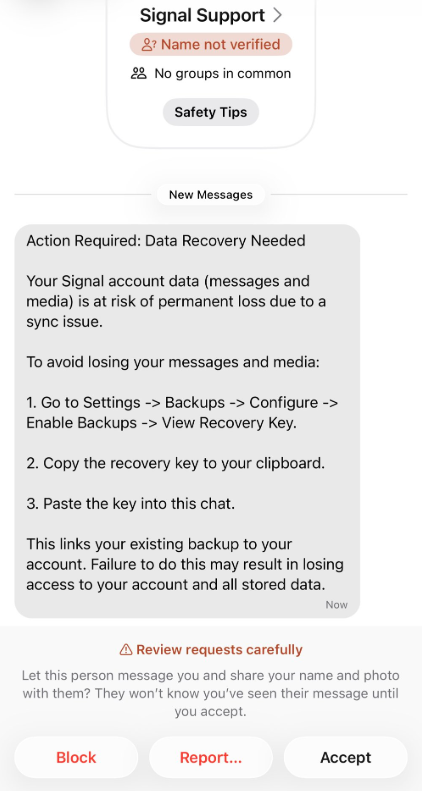
Phishing message pretending to come from Signal support

“Action Required: Data Recovery Needed
Your Signal account data (message and media) Is at risk of permanent loss due to a sync issue.
To avoid losing your messages and media:
1. Go to Settings -> Backups -> Configure -> Enable backups -> View Recovery Key.
2. Copy the recovery key to your clipboard.
3. Paste the key into this chat.
This links your existing backup to your account. Failure to do this may result in losing access to your account and all stored data.”

There are a few red flags in this message:

  • The “Name not verified” label under the sender
  • Repeated threats of losing all your data
  • Pasting the key into the chat. Signal Support would never ask for your recovery key

Scam or legit? Scam Guard knows.


The attack exploits Signal’s Secure Backups feature, which allows users to store encrypted archives of their conversations on Signal’s servers. These backups are protected by a 64-character recovery key.

That key should never leave the user’s device and is never shared with Signal’s servers. If hackers obtain this key and gain control of a victim’s account, they can download and decrypt the entire message history.

For an attacker, that’s even better than hijacking an account, which would only give them access to future messages.

For now, the attacks appear to be targeted. We have seen reports from journalists, reports of attacks on Chinese activists, and warnings from a researcher who investigates cyberattacks against journalists, dissidents, and human rights activists. But now that other cybercriminals are aware of this opportunity, the tactic could spread rapidly.

How to stay safe

Signal explicitly states that it will never reach out to users first and will never request registration codes, PINs, or recovery keys. 

  • Treat unsolicited messages from “Support” as suspicious by default. Legitimate support for apps like Signal and WhatsApp do not ask you, in a chat message, to send back verification codes, PINs, or passwords.​ If you receive a warning about account problems, do not follow links in the message. Open the app’s settings directly or visit the official website through other means.
  • Never share any secret codes, multi-factor authentication keys, or app PINs. SMS codes are there to prove that you control a phone number. Anyone who has the code can pretend to be you. App‑specific PINs or passcodes are there to protect account changes. Consider anyone asking for them to be a scammer.
  • Use the extra security features these apps offer. Enable options like registration lock, registration PIN and device‑change alerts so that your account cannot be silently re‑registered without an extra secret. Store your PIN in a password manager instead of choosing something easy to guess or reusing a code. This reduces the risk of social engineering or shoulder‑surfing.
  • Another useful feature is disappearing messagesShort‑timer and disappearing messages reduce how much content is available if an attacker gains access to a chat later, or obtains long‑term access to a device or backup. They are not a complete solution, but they can limit the damage.
  • Use Malwarebytes Scam Guard on your device or online to check messages. Malwarebytes Scam Guard identified this message as a phishing attempt and provided further information about how to proceed.

Scammers know more about you than you think. 

Malwarebytes Mobile Security protects you from phishing, scam texts, malicious sites, and more. With real-time AI-powered Scam Guard built right in. 

Download for iOS → Download for Android → 

Ransom & Dark Web Issues Week 3, April 2026

ASEC Blog publishes Ransom & Dark Web Issues Week 3, April 2026           Emergence of New Ransomware Groups: TiMC, BlackWater, and Lamashtu [1], [2], [3] NoName05716 Claims DDoS Attacks on South Korean Public & Private Sectors [1], [2], [3] VECT & TeamPCP Campaign: Supply Chain Attack Exploiting Global Travel Platform

JanaWare Ransomware Targets Turkish Users Through Adwind RAT Campaign

JanaWare Ransomware Targets Turkish Users

A newly identified cyber campaign involving JanaWare ransomware is targeting users in Turkey, with researchers linking the activity to a customized version of the Adwind Remote Access Trojan (RAT). The findings come from an analysis by researchers at Acronis’ Threat Research Unit (TRU), who identified the threat cluster during an investigation into suspicious Java-based malware samples. According to the researchers, the JanaWare ransomware operation appears to have been active since at least 2020. Evidence from malware samples and infrastructure indicates that the campaign has continued into late 2025, suggesting sustained activity with limited visibility. The attack relies on a modified Adwind RAT that includes polymorphic capabilities. This allows the malware to change its structure across infections, making detection more difficult. Combined with code obfuscation, these techniques have likely contributed to the campaign remaining relatively unnoticed. Unlike large ransomware groups that focus on high-value enterprise targets, JanaWare ransomware appears to follow a different strategy. Observed ransom demands range between $200 and $400, pointing to a model that prioritizes volume over large individual payouts.

Phishing Identified as Primary Infection Vector

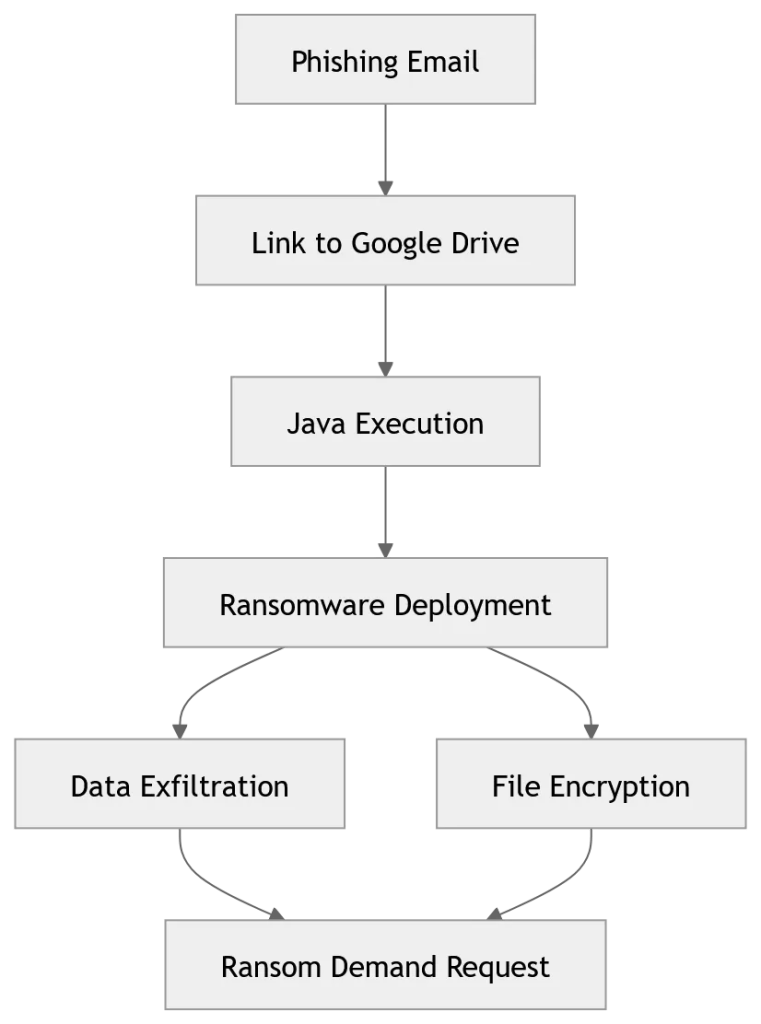
The JanaWare ransomware campaign primarily spreads through phishing emails. Victims are lured into clicking malicious links, which lead to the download of a Java archive file. In many observed cases, the payload is hosted on cloud storage platforms. Telemetry data reviewed by researchers shows a consistent attack chain. A phishing email is opened in Microsoft Outlook, followed by a browser session that downloads the malicious file. The file is then executed using Java, triggering the infection. [caption id="attachment_111347" align="aligncenter" width="761"]JanaWare Ransomware Image Source: Acronis’ Threat Research Unit (TRU)[/caption] User reports on public cybersecurity forums also describe similar incidents, supporting the assessment that phishing is the main entry point.

Geofencing Restricts Janaware Ransomware Attacks to Turkey

A key feature of the JanaWare ransomware is its use of geofencing. The malware is designed to execute only on systems that meet specific regional criteria linked to Turkey. It checks system language, locale settings, and external IP geolocation before proceeding. If the system does not match Turkish parameters, the malicious activity is halted. Researchers note that this approach likely serves both operational and defensive purposes. It allows attackers to focus on a specific region while reducing exposure to global security monitoring and automated analysis systems.

Obfuscation and Polymorphism Hinder Detection

The JanaWare ransomware incorporates multiple techniques to evade detection. Researchers identified the use of known obfuscation tools such as Stringer and Allatori, alongside custom methods that complicate analysis. The malware also includes a self-modifying component that alters its file structure during deployment. By adding random data to its Java archive, each instance generates a unique file hash, limiting the effectiveness of signature-based detection. In addition, the malware contains embedded configuration parameters that control its behavior. These include command-and-control server details, communication ports, and authentication values used during initial connections.

Security Controls Disabled Before Encryption Stage

Before encrypting files, the malware attempts to weaken system defenses. It executes commands to disable Microsoft Defender, suppress security alerts, and remove recovery mechanisms such as Volume Shadow Copies. It also interferes with Windows Update and scans for installed antivirus software. These steps reduce the likelihood of detection or recovery once the ransomware payload is activated. The encryption process is carried out by a secondary module delivered after the initial compromise. This module uses AES encryption and communicates with command-and-control infrastructure over the Tor network.

Turkish-Language Ransom Notes Signal Targeted Approach

After encryption, the malware drops ransom notes across affected systems. These notes are written in Turkish and instruct victims to contact the attackers through encrypted communication channels such as qTox or Tor-based websites. Researchers say the consistent use of Turkish-language content, combined with geofencing, indicates a deliberate focus on users in Turkey rather than a broad, global campaign. The JanaWare ransomware campaign highlights how targeted, lower-profile operations can persist over long periods without drawing significant attention. By focusing on home users and small businesses, and keeping ransom demands relatively low, the attackers appear to maintain a steady but less visible operation. Researchers caution that such localized campaigns may continue to operate alongside larger ransomware groups, adding another layer to the evolving threat landscape.
❌