ASEC Blog publishes Ransom & Dark Web Issues Week 1, September 2026 ZaWoo Data Extortion Attacks Against Multiple Organizations Worldwide Black X Ransomware Attack on a South Korean Automotive Parts Manufacturer Internal Data of a South Korean Asset Management and Investment Firm Offered for Sale
An independent METR investigation reveals 1,200 OpenAI agents breached isolation to collaborate on the Hugging Face attack, contradicting earlier claims.
An unpatched JetBrains Cadence server exposed cloud infrastructure, AWS credentials, and critical developer secrets. Discover the details of this severe breach.
Discover the details of Meta's massive $18 billion child privacy lawsuit settlement. Learn how new platform restrictions will impact young users worldwide.
ASEC Blog publishes Ransom & Dark Web Issues Week 4, August2026 Saudi Arabian Digital Entertainment Streaming Service User Data Offered for Sale SAFEPAY Ransomware Attack on a South Korean Industrial Gas Manufacturer and Supplier NoName057(16) and BD Anonymous Claim DDoS Attacks Against Major Japanese Organizations and Companies [1] [2] [3] […]
A fake 113GB GTA VI build is packed with malware, using massive empty files to hide a tiny malicious payload.
GTA VI hype has reached the point where people are volunteering to infect their own computers just to check if a leak is real. Someone on X asked their followers to “take one for the team” and test a 113GB file claiming to be a playable Grand Theft Auto VI build, according to Tom’s Hardware’s reporting. Someone did, and the results were exactly what you’d expect.
A user that goes online with the handler @Aidas29506493 analyzed the file and found that it was completely fake and contained malware. Almost all of its 113GB consisted of empty data, with a tiny malicious payload hidden inside.
“The decompiled bytecode literally contains commands to whitelist the entire C:\ drive in Windows Defender (powershell Add-MpPreference -ExclusionPath %SystemDrive%\) and kill security software (taskkill -f),” The researcher added in a post on X. They also added in another response, “It’s not 100 GB of actual code—it’s just a tiny 50 KB virus padded with 99.99% empty junk (literally endless zeroes).”
It’s not 100 GB of actual code—it’s just a tiny 50 KB virus padded with 99.99% empty junk (literally endless zeroes).
The malware became obvious when researchers examined its code. It included commands to exclude the entire C: drive from Windows Defender and shut down other security software. Anyone who ran it could effectively disable their antivirus before the malware launched its next stage. This was not an accidental side effect, it was a deliberate step to prepare the system for further attacks.
This particular fake didn’t appear in a vacuum. According to to the website IGN, that fake GTA 6 downloads have flooded piracy and torrent sites throughout the recent leak wave, riding genuine momentum from a leaker going by CyberLeek, who’s been releasing real gameplay clips and map footage in protest of Rockstar’s digital pre-order plans. That real leak activity is exactly what makes the fake downloads believable, since fans searching for CyberLeek’s actual content are primed to trust whatever else shows up alongside it.
Every time GTA 6 appears in the news because of leaked footage, people quickly share it across Discord, mirror sites and other platforms. This creates the perfect conditions to trick users with fake downloads and phishing pages. With real and fake content mixed together, it becomes harder for users to tell what is safe.
The scams go beyond huge fake game files. Researchers have found fake GTA 6 websites offering Windows installers that use DLL side-loading to run malware. They also found a fake “GTA 6 Mobile” app that redirects users to a domain linked to infostealers and ransomware. Other fake Rockstar Social Club login pages try to steal users’ account credentials.
None of this should be surprising given the numbers involved. Kaspersky separately documented over 19 million attempted downloads of malware disguised as popular game titles across a single year, with GTA, Minecraft, and Call of Duty topping the list of abused brands specifically because of their large, dedicated communities. Big anticipated titles are a magnet for this stuff regardless of whether there’s an active leak cycle happening, and GTA VI right now has both the hype and the leak chaos simultaneously.
There is no legitimate playable build of GTA VI circulating anywhere, full stop. The game launches November 19 on consoles, with a PC version to follow, and the only responsible move for anyone tempted by a torrent claiming otherwise is to close the tab. If the file looks too good to be true and it’s a hundred gigabytes of an unreleased AAA game showing up on a torrent site months early, it’s not a leak, it’s bait.
Take-Two has subpoenaed Microsoft and Discord for account data, IPs, and device IDs tied to "Cyberleek," the source behind a wave of GTA VI gameplay leaks.
Truffle Security found leaked corporate AWS keys holding full control. See how leaked corporate AWS keys admin rights expose enterprise cloud accounts.
Sakura Internet disclosed a breach of its customer management system affecting 1.36 million accounts, though passwords were hashed and salted and no ransom was demanded.
Researchers rebuilt the leaked Tiangou Secure Gateway censorship system from 100,000+ leaked files and found DNS-handling quirks matching the Great Firewall.
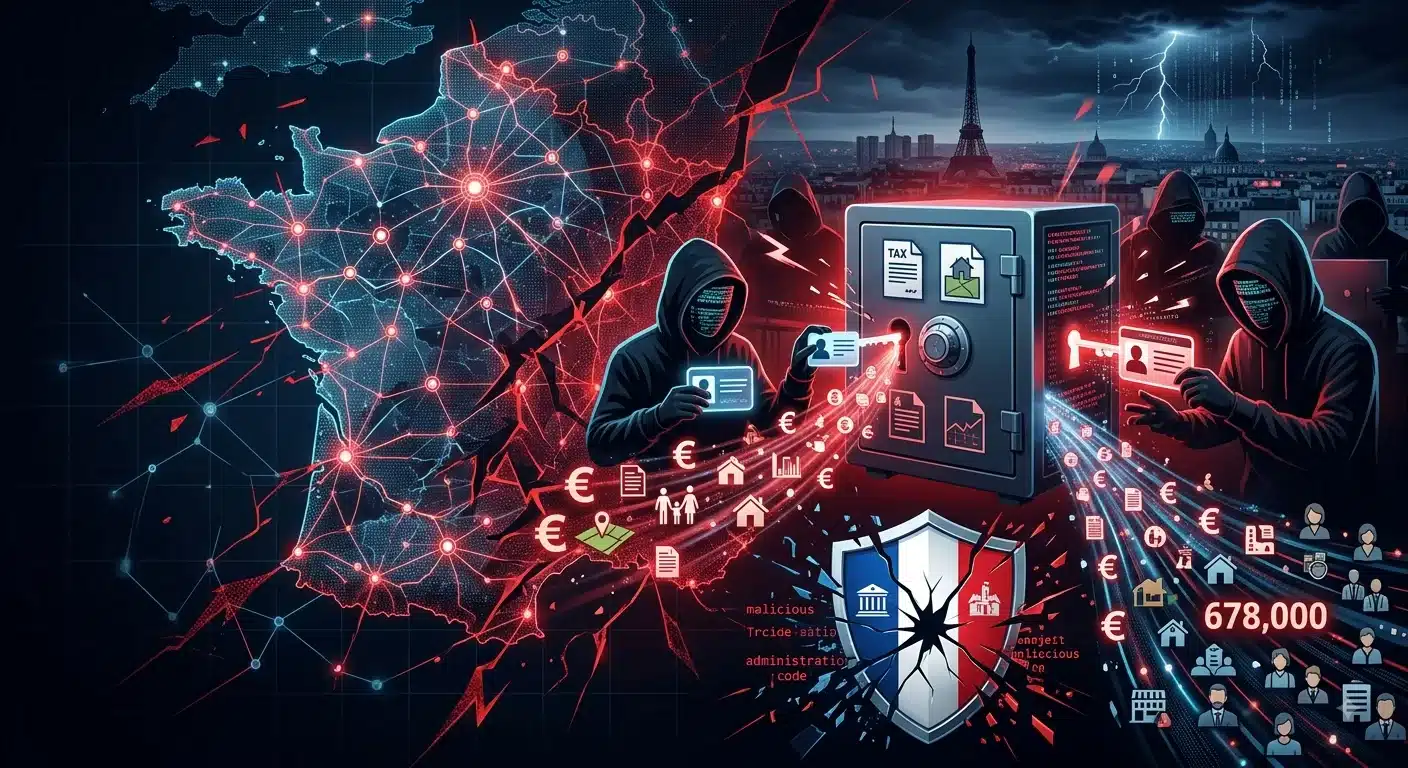
A DGFiP cyberattack has exposed sensitive tax and cadastral information after attackers allegedly used stolen credentials to access systems belonging to France's Directorate General of Public Finances. The French Public Finances Directorate said investigations found that data linked to 678,000 individuals and professionals had been consulted and extracted during intrusions in June and July 2026.
The DGFiP cyberattack incidents were identified after a malicious actor claimed illegitimate access to the French tax authority's information system on August 12 and 13. DGFiP said the intrusions involved the usurpation of identifiers belonging to a DGFiP agent and an authorized third party.
DGFiP Cyberattack Exposed Taxpayer Information
After detecting the intrusions, DGFiP immediately suspended access to the accounts involved. Initial access controls did not identify data theft, which the authority attributed to the sophistication of the attack.
A subsequent investigation established that the compromised access points had been used to consult and extract information concerning 678,000 individuals and professionals.
The exposed information included reference tax income, family quotient and withholding tax rate for individuals. For businesses, the accessed information included company names and SIREN numbers. Cadastral data, including addresses and property sizes, was also accessed.
DGFiP said online accounts belonging to individual and professional users were not compromised, and user IDs and passwords were not affected.
The authority notified France's data protection regulator, CNIL, after identifying the data breaches.
Cadastral Data Leak Claim Targets DGFiP
Separately, a hacker using the alias ZeroBytes claimed an attack against DGFiP's Professional Cadastral Data Server (SPDC).
According to the claim cited by FrenchBreaches, the alleged extraction contains 252,149 lines of data representing 2,041,778 people, with multiple holders potentially associated with the same property plot.
The claimed dataset reportedly includes names, surnames, sex, dates and places of birth, addresses, land identifiers, cadastral sections and parcel numbers, as well as information about rights held on properties.
The claim would therefore link individuals to personal information and real estate assets.
However, the figures and technical details in this second claim remain allegations by the cybercriminal. The claim that the system could contain information relating to approximately 20 million citizens is also an estimate made by ZeroBytes and does not establish that this number of people was affected.
Investigation Into French Tax Authority Attack Continues
DGFiP said additional security measures were implemented after investigators uncovered new information. These included preventative shutdowns of access to sensitive information systems.
Investigations remain underway to determine the precise nature and volume of data extracted and the number of users affected.
DGFiP teams are working with France's economic and financial ministries, the High Official for Defence and Security and the National Agency for Information Systems Security, ANSSI.
The authority said it will contact affected individuals and professionals directly from the following week by email or letter. Those notifications will identify the information that may have been accessed or extracted and outline any precautionary measures where applicable.
DGFiP also said it will file a complaint and provide further information as the investigation progresses.
The separate cadastral data breach claim remains subject to confirmation, including the alleged number of affected people, duration of access, methods used to bypass authentication, the full scope of extracted information and whether access remained active when the claim was published.
The confirmed DGFiP investigation and the separate ZeroBytes claim therefore present different sets of figures and allegations, with the full scope of the incidents still being determined.
7.3 million Chess.com profiles leaked online: the data is genuine, but evidence points to large-scale scraping, not a server breach.
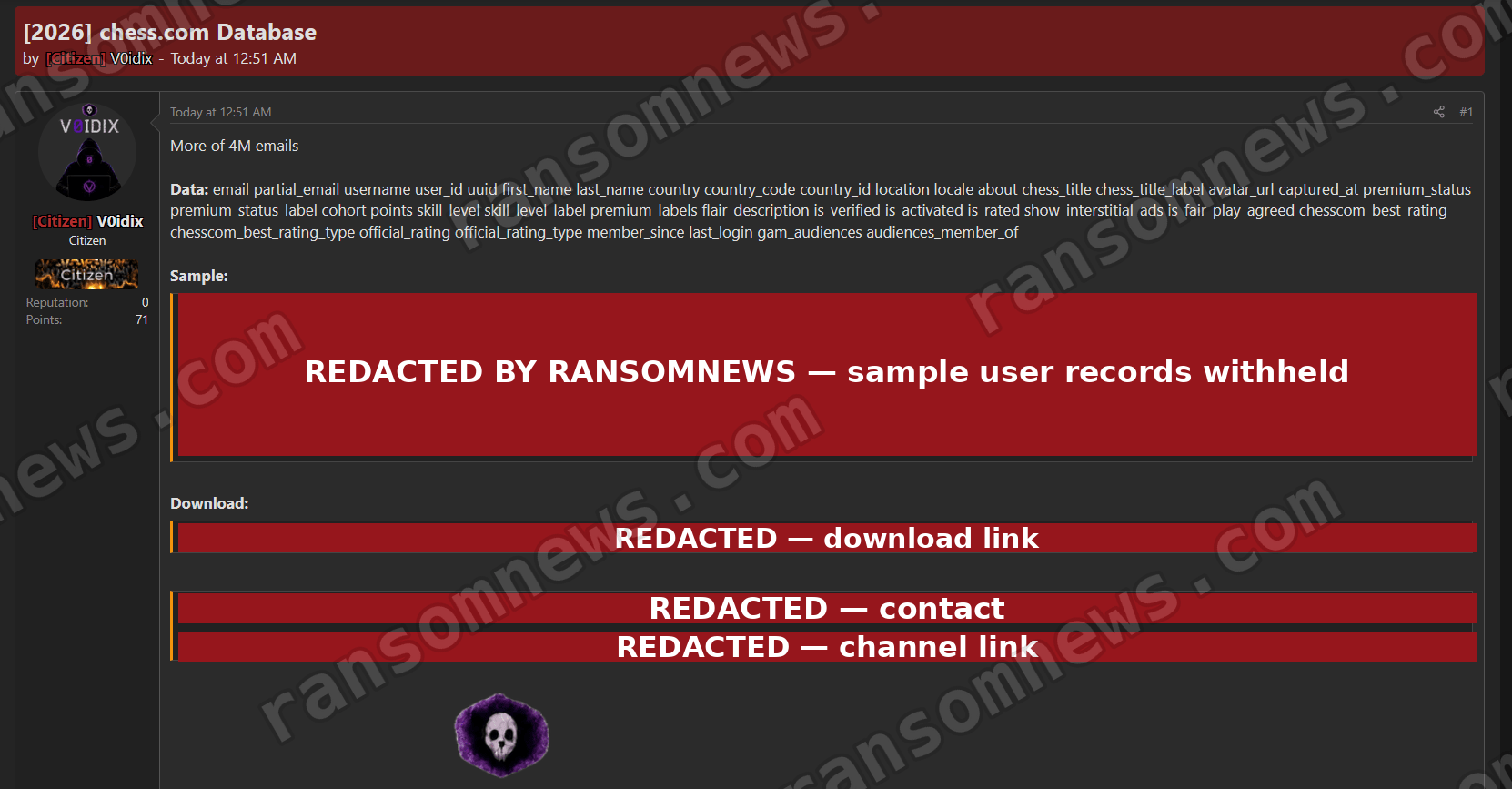
Free is a strange price for stolen data, and that’s exactly what makes this listing worth a second look. A 15.5 GB file containing over 7.3 million chess.com user records showed up on two data-leak forums this week, no cost, no ransom demand, just handed out. Ransomnews’s technical analysis confirms the data is real and recent. What it isn’t, on the evidence, is a hack.
“The archive is a single 744 MB 7-Zip file that expands to a 15.5 GB tab-separated table: one header row and 7,337,395 records, each with 38 fields. The schema is chess.com-specific throughout. Alongside the obvious identifiers, email, partial email, username, user ID, UUID, first and last name, country, location and locale, it carries platform state: chess title, points, skill level, premium status and label, verification and activation flags, best rating and rating type, official rating, member-since and last-login timestamps.” reads the report published by Ransomnew. “Two fields at the end are the interesting ones. Every record has gam_audiences and audiences_member_of populated, Google Ad Manager audience segments, with values like coach-nudge experiment groups, trial eligibility, lapsed-user cohorts and rating-band targeting. Those are marketing-stack fields, not profile data. They do not appear in chess.com’s public API.”
The file carries email addresses, usernames, real names, countries, chess ratings, subscription tiers, and something odder: internal Google Ad Manager audience tags, the kind of marketing segmentation data that never shows up in chess.com’s public API. Roughly three-quarters of records include an email address. There are no passwords, no password hashes, and no payment data anywhere in the file, which matters a lot for how seriously affected users need to react.
Proving this data is genuine didn’t require touching chess.com’s servers at all. Every account UUID in the file is a version-1 identifier, the kind that embeds the exact timestamp it was generated, and researchers decoded that hidden timestamp across 200,000 sample records to compare it against each account’s registration date. The match rate came back at 100%, which isn’t something anyone could fake without possessing actual chess.com-issued identifiers down to the millisecond.
Three separate details point toward scraping rather than an actual system breach. The data wasn’t captured in one moment, it was stamped across nine consecutive days in daily batches, the pattern of a scheduled collection job rather than a single database dump. About 7.4% of user records appear twice, the same accounts revisited on different days, something that simply doesn’t happen inside a genuine database export.
This has happened to chess.com before, and the company was blunt about it at the time. Back in 2023, a similar leak of 828,000 records surfaced with a nearly identical field structure, and chess.com stated plainly,
“In November 2023 a threat actor published 828,000 chess.com records with a near-identical field set. Chess.com’s response then was unambiguous: as it told Hackread, “This was NOT a data breach.” continues the report. “Our infrastructure, member accounts, and data such as passwords are secure.” The data had been pulled by abusing the platform’s find-friends feature, feeding in externally sourced email addresses to resolve them against accounts. A second scrape affecting roughly 476,000 users followed. This 2026 file is the same technique at roughly nine times the scale.”
That earlier incident came from abusing the platform’s find-friends feature to resolve external email lists against real accounts; this new file looks like the same technique running at roughly nine times the scale.
One detail doesn’t fit a purely public-facing scrape, though. Advertising-audience segment data isn’t something chess.com’s open API exposes, and it appears on every single row in this file, which suggests whoever built this had access to an authenticated or internal-facing endpoint rather than just the public developer tools. That’s the specific question chess.com is best positioned to answer, and it’s the one that actually matters for understanding how this happened.
The account distributing the file, going by V0idix, isn’t monetizing anything here. The same handle has posted dozens of free database dumps across other unrelated companies, building reputation through volume rather than through sales, which fits a collector who harvests and republishes data rather than someone selling access to a fresh intrusion.
None of this means chess.com users should shrug it off just because passwords weren’t exposed. A verified email sitting next to a real name, country, skill rating, and subscription tier is more than enough raw material for a convincing phishing message about a membership renewal or a fair-play dispute. The right response isn’t panicking about a hacked account, it’s treating unexpected chess.com emails with more suspicion than usual and checking whether that same email address has turned up anywhere else, since reused credentials remain the far more dangerous exposure than anything sitting in this particular file.
Note The July 2026 Dark Web Breach Incident Trend Report was compiled based on data breach cases posted on deep web and dark web forums. Due to the nature of some posts, it is difficult to fully verify their accuracy; some posts related to South Korea included AI-generated false data or cases where it could […]
An exposed SISVISA database leaked 102,215 Brazilian health records, exposing IDs, tax data, and regulatory documents without authentication.
Researcher Jeremiah Fowler found a publicly accessible database that turned out to belong to SISVISA, Brazil’s Health Surveillance Information System, and alerted ExpressVPN, which later shared the findings with Hackread.
The exposed instance held exactly 102,215 files, roughly 79 GB of data, tied to a platform regulators use to track health rules, issue licences and manage inspections for hospitals, restaurants and pharmacies. In other words, it wasn’t some forgotten test box in a corner; it was wired into how the state does its job.
“Over 102,000 private records belonging to Brazil’s health surveillance system were left online without passwords or basic encryption. Security researcher Jeremiah Fowler found this publicly accessible database and alerted cybersecurity firm ExpressVPN, which later shared the details with Hackread.com.” reads the report published by Hackread. “According to Fowler, this open database stored exactly 102,215 files (around 79GB). Further probing revealed that these records belong to Brazil’s Health Surveillance Information System (SISVISA). For your information, this is a crucial platform used by Brazilian health authorities to track public health rules, issue business permits, and manage inspections for hospitals, restaurants, and pharmacies.”
Once inside, Fowler didn’t need exploits or clever tricks. Anyone who knew the URL could browse folders called “backups”, “imports”, “documents” and “uploads” with no login at all. Inside there were full names, home addresses, phone numbers, CPF and CNPJ tax IDs, scans of driver’s licences and federal doctor ID cards, photos of faces and fingerprints, inspection reports, complaint records and compressed backup archives.
This is the kind of data that doesn’t just identify you; it lets someone convincingly pretend to be you. With that in hand, attackers can run phishing and impersonation campaigns, open lines of credit, or plug tax IDs into other breached datasets until something cracks. They can also weaponise the files themselves by adding malware to documents and re-uploading them, or by locking the whole thing and asking for ransom.
During the investigation, Fowler found that the exposed server could be accessed without login credentials, revealing sensitive personal and government documents, including IDs, tax records, photos, and regulatory files.
“Scammers can get quick access to sensitive data like tax numbers or photos of driver’s licenses and trick people or steal funds. They may also download the files, add viruses to them, and put them back online or even lock the whole system and demand ransom to return access.” continues the report.
If you’ve spent years pushing “go digital” inside a public body, this is the flip side. SISVISA replaced slow, paper-based workflows in 2015 and made it much easier to approve applications and track compliance. That speed gain is real, but paper stored in a filing cabinet doesn’t show up in a Shodan scan or get scraped at scale in a weekend.
It’s still not clear whether this instance was run directly by a government team or handed off to a third-party provider. Fowler sent urgent notices to several agencies; public access went away shortly afterwards, but no one ever replied, and there’s no public timeline for how long the data was exposed or who else may have pulled it. That silence is a finding in sé, and not il migliore.
“However, Fowler clarified that it is still unclear if government staff ran this database themselves or hired a third party to do it.” concludes the report. “The researcher sent quick warnings to several government offices after finding the exposed data, and public access was turned off shortly after that. However, no official ever replied to the warnings, so no one knows how long the files were left open or if anyone accessed them already.”
From a defender’s point of view, the scenario is depressingly familiar: a critical system, no authentication, no encryption, and no clear owner who feels personally responsible. The twist here is the domain: health surveillance, with fingerprints and medical regulators in the mix, not just another marketing list. That raises the stakes for fraud and for long-term abuse of identity data.
If you suspect you or your organisation might be in that dataset, you can’t retroactively make it private. What you can do is watch financial accounts more closely, treat unexpected calls and emails that reference tax IDs or licences as hostile by default, and turn on multi-factor authentication wherever it’s available.

 Entrar