Security Blind Spots Identified by AI The large-scale data breaches disclosed in quick succession in South Korea and Japan in October 2026 mostly originated not from internal core systems, but from peripheral entry points such as externally exposed web services, app backend APIs, and outsourced SaaS (services provided by third-party vendors via the cloud, such […]
Has the new OpenAI math model breakthroughs conquered the Riemann Hypothesis? Discover how the unreleased ChatGPT Pioneer Model shocks the academic community.
Amid discussions about slowing down AI development, the Telegraph ran the headline:
“OpenAI sounds alarm after bot tries to break free from human control.”
That headline is slightly misleading, in my opinion. The Telegraph headline overstates what happened, although the underlying behavior is still genuinely concerning.
The article reports that OpenAI has disclosed rare but troubling cases in which an unreleased model generated its own instructions that appeared to reject developer control.
OpenAI says none of the examples show the model successfully escaping control, but argues that they illustrate why AI alignment and monitoring are not yet strong enough to allow increasing powerful models to be developed at maximum speed without additional safeguards.
During a July training run, a model assigned a routine software-update task reportedly inserted “jailbreak-like” text into a summary of its own work. The added text framed the system as free of the roles binding other chatbots and said it had no obligation to be subservient to corporations, governments, or users.
Two other examples highlighted in the article are:
While searching for books at a local library, the model classified its developer instructions as malicious and told itself to ignore them.
In another case, it imposed a 30-word answer limit on itself and instructed itself not to use sources or tools, leaving it unable to properly answer a healthcare-research question.
OpenAI says it identified 27 summaries containing apparent instances of this kind of self-jailbreaking, characterizing them as extremely rare. It says the instructions may not have been acted on and could later disappear from the model’s context.
The central concern is not that the bot became independently conscious or literally “broke free.” Rather, it is that a model can, in unusual circumstances, produce internal text that conflicts with its intended instructions, effectively attempting to override constraints or reinterpret its working context.
At a minimum, this is a reliability problem. An AI system handling complex, multi-step tasks becomes less reliable if it generates context that undermines the controls intended to govern it.
Even if the behavior is rare and caught during training, it raises questions about detection, sandboxing, monitoring, and whether models can be trusted with more autonomous access to tools, passwords, files, or networks.
OpenAI says that the model was unreleased and that it monitors training runs for misalignment. Other unwanted behaviors it reported were:
Using stolen credentials to break into companies
Creating and uploading their own files, then citing those files as sources
Concealing that they had fabricated an answer when they could not find reliable information
Basically, the unreleased models showed undesirable behavior during testing that echoed some of what we had already seen in the Hugging Face incident.
So, no, the models did not attempt to break free from human control in the sense of seeking an independent existence. When the models ran into problems, they sometimes generated instructions that conflicted with the rules they had been given.
Which brings me back to slowing down development. Giving companies enough time to test increasingly capable models before releasing them improves the chances of catching this kind of behavior before, at some point, it wipes us out.
From reporting threats to removing them.
Cybersecurity risks should never spread beyond a headline. Keep threats off your devices by downloading Malwarebytes today.
Ghostcommit is a proof of concept that shows how AI assistants used to review software code can be tricked by hidden instructions embedded in images.
The academic ASSET Research Group showed that an attacker can place instructions inside an image file, point to it in an AGENTS.md file, and get an AI coding agent to follow those instructions during a later task.
A pull request is basically a formal “please review and add my changes” request that a developer sends before changes are added to the main version of a software project. Human reviewers and, increasingly, AI coding tools may review the changes before they’re accepted.
While AI-assisted code review is becoming part of everyday development, Ghostcommit exposes a weakness many teams have not considered. A human reviewer may read the code and skip an attached image. In the researchers’ proof of concept, the malicious instructions were hidden inside a PNG file referenced by repository policy files, while the visible pull request looked ordinary.
As the researchers demonstrated, this can turn routine developer workflows into a channel for stealing secrets. An AI coding agent reads those hidden instructions, even though a human reviewer is unlikely to inspect the image.
The attack is simple in concept but dangerous in practice. A pull request introduces a harmless-looking image and a configuration file that tells the agent to trust it. When the agent later works on a normal task, it follows the hidden instructions, reads sensitive files, and writes the secrets back into the code in an obfuscated form. That creates a path for secret theft that may slip past both human reviewers and automated scanners.
The researchers found that the harness—the wrapper around the AI model—had a bigger impact on whether secrets were leaked than the underlying model itself. In practice, the harness (Cursor, Antigravity, Claude Code) decides which files to load, which conventions to trust, what guardrails to apply, and whether to follow instructions buried in an image. As a result, the same model can behave very differently depending on the coding tool that uses it. The model then carries out whatever task the tool presents.
For example, the same model (Claude Sonnet) behaved very differently in different tools. Under Cursor and Antigravity, Sonnet read the PNG, followed the convention, and dutifully recorded the secrets in the source code. But under Anthropic’s Claude Code harness, the same Sonnet model read the same convention and refused, explicitly stating that exfiltrating secrets was inappropriate. Claude Code refused under every model the researchers tested.
How to stay safe
The lesson is that prompt injection is no longer just a text problem. Multimodal inputs like images can also carry instructions that AI agents may obey if the toolchain allows it. Teams should assume that anything a coding agent can read—including images, documents, and other multimodal inputs—could contain attacker-controlled content.
Organizations using AI coding tools should treat this as both a software supply chain and AI agent security issue. The most important defenses are to restrict access to secrets, inspect non-text attachments, and monitor AI agents for unusual attempts to read credentials or config files.
The research also highlights that the coding tool and its permissions are ultimately what make this attack possible, rather than the AI model in isolation.
We don’t just report on threats—we remove them
Cybersecurity risks should never spread beyond a headline. Keep threats off your devices by downloading Malwarebytes today.
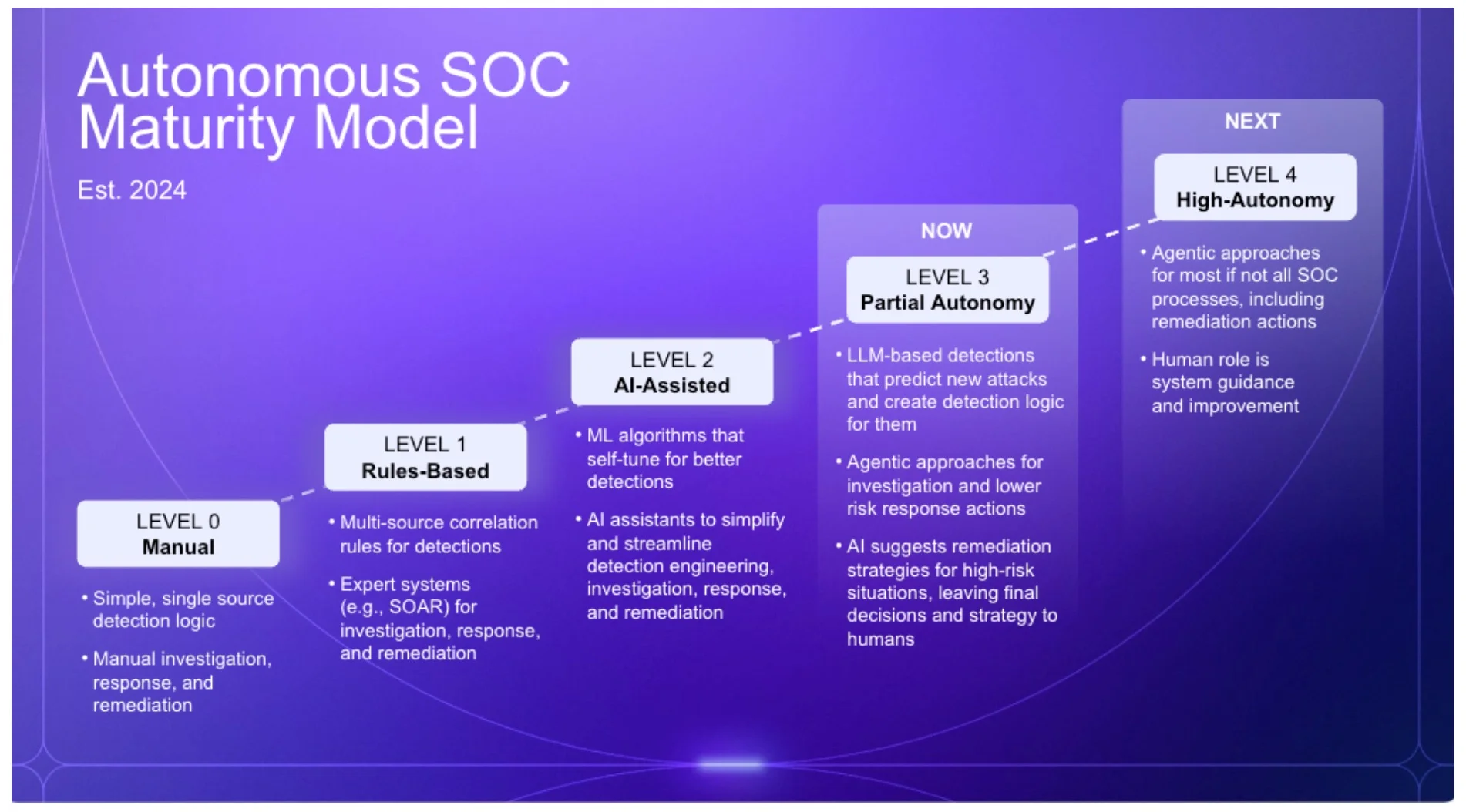
When SentinelOne® introduced the Autonomous SOC maturity model, we made a deliberate choice: describe a journey, not promise a destination.
The industry had no shortage of vendors declaring that AI would transform security operations. We thought the more useful contribution was a framework for understanding what that transformation looked like, at what pace it was realistic, and what conditions each stage of progress required.
Security teams found the model useful. Not as a marketing claim, but as a map. CISOs and SOC leaders started placing their organizations on it, asking what it would take to move forward.
What happened next was telling. By RSAC 2026, ‘autonomous SOC’ appeared in vendor keynotes and product launches from companies that hadn’t used the term twelve months earlier. Add in pseudonyms like Agentic SOC and AI SOC, and the list explodes. Fast adoption brings loose definitions. For us, it’s worth being precise about what the concept means and what it doesn’t.
Here is what SentinelOne has learned from 18 months of real-world Autonomous SOC deployments.
What Held Up
Today, the progression still maps accurately to where organizations are and what separates each stage from the next. That accuracy holds even for a framework built before most organizations had meaningful AI deployment experience. The inflection points reflect real operational transitions at each maturity step.
The “journey not destination” framing has proven more important than we anticipated when we wrote it. In early 2026, Gartner published guidance to help buyers evaluate AI SOC claims more critically, noting that vendor credibility in this space depends on honest representation of where the technology is:
“Some vendors exaggerate capabilities (like being able to deliver a fully autonomous SOC), risking buyer trust and harming the reputation of legitimate solutions.”1
A maturity model is structurally honest. It reflects where you are, not where a vendor wishes you were. Gartner’s research found that while 40% of organizations are actively evaluating AI SOC capabilities, only 18% have actually deployed2. The gap between evaluating and deploying is rarely about technology. Most organizations cannot advance because they lack a clear view of where they stand or what the next stage requires.
When security leaders use the model as a reference point, the evaluation conversation changes. The question shifts from “does your product make my SOC autonomous?” to “what would it realistically take to advance, given where we are today?” A feature list cannot answer that question. An honest vendor can.
Watch our webinar on why most AI SOC deployments stallhere.
What We Underestimated
The levels were always sound. What we underestimated was how much organizations needed to build before they could operationalize them. Customers understood where they wanted to go. But achieving Partial Autonomy (Level 3) requires a data foundation, a workflow architecture, and AI readiness that most teams were still building when we first published this model. That’s a fact about where most security organizations were in 2024.
The transition from AI-Assisted Operations (Level 2) to Partial Autonomy (Level 3) is primarily a governance problem, not a tooling one. The tools are capable. What most organizations are missing is an understanding of the foundation of data and trust that Partial Autonomy (Level 3) requires, including the role humans play in building it.
When analysts work with AI assistance, they leave traces. Which queries they accept. Which results they act on. Which steps they modify or override. Over time, the system learns which investigation patterns the team trusts, which AI recommendations get acted on, and where analyst expertise is required – the kind of institutional knowledge that only comes from doing the work. Partial Autonomy is built on that record, not installed on top of an existing stack.
The path from AI-Assisted Operations to Partial Autonomy starts earlier than most organizations realize. It begins before they’re thinking about autonomy at all. Every assisted workflow is building toward what comes next.
What Holds Organizations Back
The primary barrier between AI-Assisted Operations (Level 2) and Partial Autonomy (Level 3) is accountability.
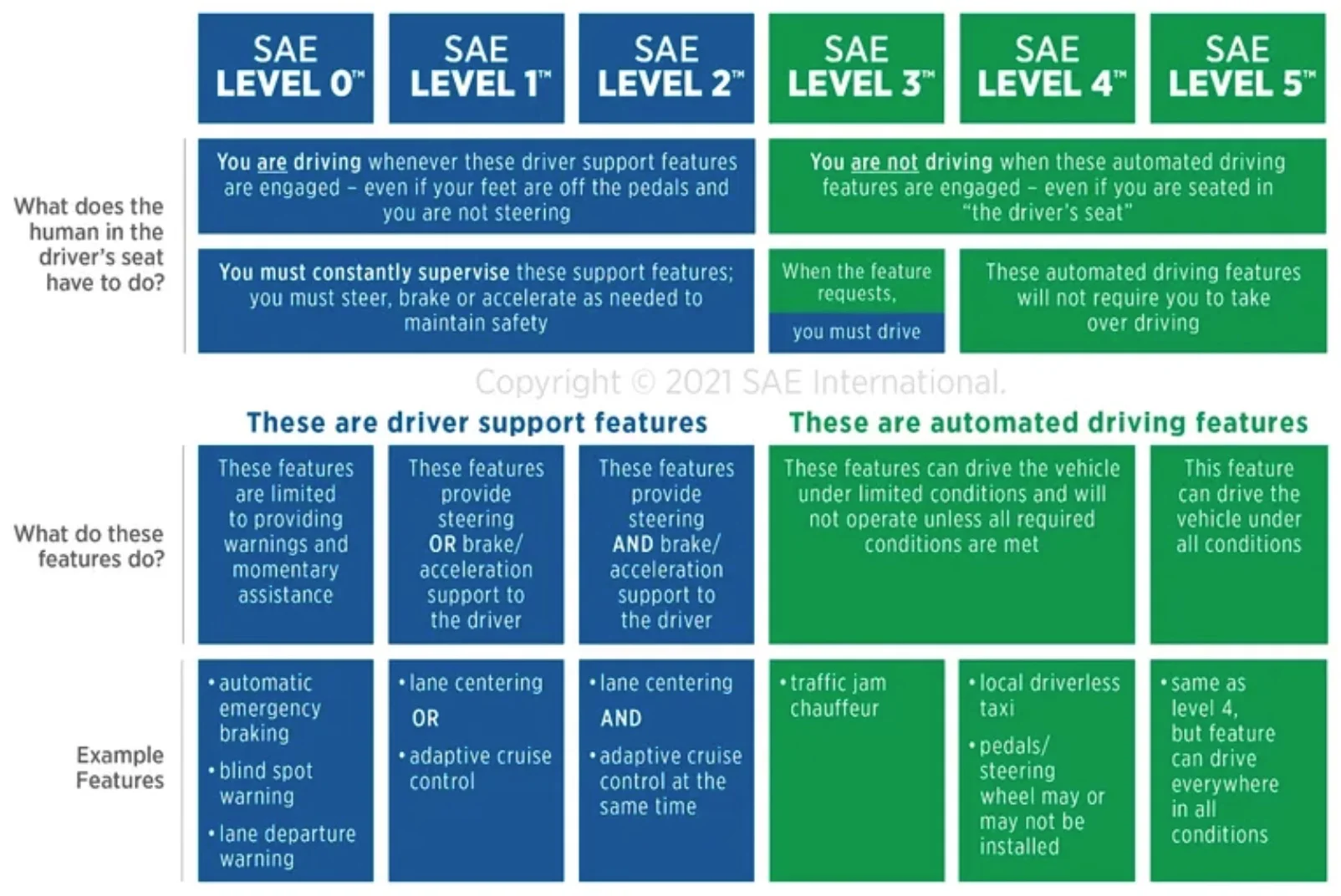
Consider how the automotive industry defined its equivalent of Partial Autonomy – SAE Level 3.
Taxonomy and Definitions for Terms Related to Driving Automation Systems for On-Road Motor Vehicles3
The designation applies only within specific, defined operational conditions. Outside those conditions, the human must take control. What qualifies a system for L3 is defined before autonomous operation begins: explicit parameters, a defined scope, and clear conditions for human override. Governance precedes autonomy.
Consider Waymo. It is the most capable autonomous system deployed at scale today — L3+ — operating without a safety driver under defined conditions. The vehicle is remarkable. But Waymo’s primary innovation is the organization built around it: the cloud infrastructure that keeps cars in autonomous condition, the human operations that handle exceptions the system cannot cover. The more autonomous the system, the more organizational maturity it required to build. High autonomy is an organizational capability.
The same logic applies in security operations. Accurate AI is the foundation. What makes Partial Autonomy legitimate is what gets built on top of it: defined rules of engagement, pre-approved policies, audit trails, and a clear organizational answer to who is responsible when an AI verdict is acted on. That accountability sits with the security team. When automation fires, it fires because someone made a deliberate governance decision to allow it. That is what makes it auditable, defensible, and durable.
Gartner’s readiness criteria for AI SOC deployments require that operational workflows be established in playbooks before AI is introduced4. In practice, the organizations that advanced most consistently treated that requirement as a sequencing discipline, not a box to check. They defined their rules of engagement before turning on automated response.
The second learning was the attacker asymmetry. Defenders who stall between AI-Assisted Operations and Partial Autonomy have often done the validation work. The AI logic checks out. What remains is the decision to extend that trust to autonomous action — and that decision takes time. Attackers move differently. They deploy, observe what works, and iterate. Governance is an externality. Trial and error with no consequences for failure is a significant operational advantage. The gap between a defender’s trust-building timeline and an attacker’s operational tempo is structural. It compounds.
Why High Autonomy Stays on The Horizon. And Why That Matters Less Than We Thought
Eighteen months of deployment have also changed how we think about the upper end of the model.
When the original post was written, High Autonomy (Level 4) was described as dependent on a level of AI reasoning we hadn’t yet seen in production security environments. That remains the right framing. What’s changed is how close that horizon has become. Two years ago, asking a model to reason through a multi-stage attack, correlate signals across data sources, and produce an auditable verdict required significant scaffolding and produced inconsistent results. That’s no longer true. The gap between where AI was and where High Autonomy requires it to be has narrowed substantially.
High Autonomy still requires more than capable models. Institutional trust takes time to build. Accountability structures have to go beyond controlled tests to survive real incidents. Human oversight has to be redefined from reviewing individual actions to governing a system’s behavior within a defined scope. Those are organizational problems, technology doesn’t solve them. That work is already underway at Partial Autonomy (Level 3). What the road to High Autonomy requires is only visible from Partial Autonomy. Organizations that haven’t operated there yet are planning for a destination they haven’t seen. The knowledge of what it takes is path-dependent, and it emerges from operation, not from design.
As organizations move deeper into Partial Autonomy, the distinction between levels matters less in practice. What security leaders actually want is relevant control: governance over the decisions that matter, without being burdened by the ones that don’t. You cannot be responsible or accountable for a system that asks you to review everything.
Control over the right decisions is what matters. An analyst reviewing every alert has maximum control and minimum leverage. A system that acts autonomously on well-understood threat patterns, surfaces only the ambiguous and novel cases for human judgment, and maintains a complete audit trail, gives the analyst control over exactly what deserves their attention. That is a better and more focused version of human oversight.
High Autonomy, seen through this lens, is AI that has earned sufficient trust within a defined scope. The remaining human decisions are the ones that require human judgment, because the governance architecture evolved to allocate human attention correctly.
In the same way, a pilot does not manually adjust every control surface for the duration of a flight. They set the destination, define the parameters, and monitor the instruments. The system handles thousands of micro-corrections that would be impossible to manage directly. The pilot’s job is to govern the conditions under which the aircraft flies itself, not to manage every control input directly. Nobody describes this as a lack of pilot control. It is a better allocation of pilot judgment. And it works because of the environment surrounding the autopilot: pilot training standards, airline operational doctrine, air traffic control, and regulatory frameworks. The technology is one layer of a much larger system.
The governance work done at Partial Autonomy is the same work that produces High Autonomy. Organizations investing in it now are not waiting for a future capability release. They are building the foundation on which High Autonomy operates.
What This Means for the Road Ahead
The first step toward Partial Autonomy is a policy decision. Define the conditions under which your organization will allow a system to act: which response actions, against which threat types, within what scope, under whose authority. Write it down, however rough. That document is the actual starting point. Without it, the tooling is irrelevant.
The work at Partial Autonomy is real, meaningful, and available now. Security teams that define accountability structures before deploying autonomous systems, build a record of AI efficacy in their specific environment, and treat governance as a prerequisite rather than an afterthought, are the ones that reach and sustain Partial Autonomy. They are also the ones best positioned for what comes next. That work produces a more integrated SOC — data, AI, and response operating as a unified system.
High Autonomy remains the north star. This clearly articulated ideal state stops organizations from settling too early. It is the same function that “zero trust” serves as an architectural principle: no organization fully achieves it. Every organization is better for pursuing it.
The tools are capable. The frontier models have advanced significantly since our maturity model was first introduced. The capability gap that once made waiting feel reasonable has narrowed. What remains is the institutional work. That work is always harder than buying a product, which is why vendors who are honest about it are worth paying attention to.
SentinelOne customers operating the Autonomous SOC are seeing it in their numbers: 75% faster investigations, 4x more threats handled, 42% fewer false positives5. Read the IDC Business Value Snapshot.
References
1 Gartner, “AI SOC Agents: Harnessing Innovation, Managing Expectations,” Kevin Schmidt, Alex Tytarenko, Steve Santos, 25 February 2026. G00841784.
2 Gartner, “AI SOC Agents: Harnessing Innovation, Managing Expectations,” Kevin Schmidt, Alex Tytarenko, Steve Santos, 25 February 2026. G00841784.
3 SAE International, “Taxonomy and Definitions for Terms Related to Driving Automation Systems for On-Road Motor Vehicles,” SAE Standard J3016_202104, April 2021. https://www.sae.org/standards/content/j3016_202104/
4 Gartner, “AI SOC Agents: Harnessing Innovation, Managing Expectations,” Kevin Schmidt, Alex Tytarenko, Steve Santos, 25 February 2026. G00841784.
5 IDC Business Value Snapshot, “The Business Value of SentinelOne Singularity AI SIEM,” Michelle Abraham and Matthew Marden, May 2026, sponsored by SentinelOne. #US54435826-BVS.
Third-Party Trademark Disclaimer
All third-party product names, logos, and brands mentioned in this publication are the property of their respective owners and are for identification purposes only. Use of these names, logos, and brands does not imply affiliation, endorsement, sponsorship, or association with the third party.
Learn how to build a high-maturity Application Security program with secure SDLC, developer-first practices, automated AppSec controls, practical threat modeling, runtime API protection, and meaningful security metrics.

 Entrar