Visualização de leitura

Loyalty points fraud is funding hacker holidays (Lock and Code S07E18)

This week on the Lock and Code podcast…

Crooks are taking a holiday. They’re counting on you to fund it.

For decades, cybercriminals have stolen roughly the same types of data. Biographical and personal details—like Social Security numbers, birthdates, addresses, and phone numbers—can be stolen to commit identity fraud. Credit card numbers, expiration dates, and CVC codes can be stolen to make fraudulent purchases. Usernames and passwords can, in the wrong hands, let a cybercriminal impersonate someone, steal sensitive photographs to later use for extortion, or abuse a reputation.

All of these attack models seek to turn sensitive or important data into currency. But an emerging form of digital fraud is targeting data that, when used strategically, practically is currency: Loyalty points.

Loyalty points programs are run by nearly every type of consumer-facing business today, from hotels to airlines to grocery stores to donut shops. As repeat customers accrue these points, they can exchange them for discounted prices on future purchases, cutting the costs of hotel stays, flights, rental cars, and even entire vacations.

But the value stored within these loyalty points makes them a high target for cybercrime, said Kim Sutherland, Global Head of Fraud and Identity at LexisNexis® Risk Solutions.

“Most loyalty currency is worth about one cent per point, and then there are premium programs that can be worth more than that,” Sutherland said, explaining that 100,000 airlines points, for example, can be worth $1,000 in the US. “Why criminals care so much about this is because most of us are not paying attention to our loyalty programs the same way we would our bank account.”

But diligence is much needed here, Sutherland said, noting that one Chicago teacher only learned that 240,000 of his airlines points had been stolen because he received a basic confirmation email about their use. In another example, a man’s airline miles were stolen and fraudulently used to book rental cars in New York and Memphis.

Today, on the Lock and Code podcast with host David Ruiz, we speak with Sutherland about loyalty points theft— how it happens, what companies are doing to protect customers, and what people can do to stay safe.

“Some of us don’t even know how to access those points, right? Or we don’t even know we’re accumulating them, but the fraudsters do.”

Tune in today to listen to the full conversation.

Show notes and credits:

Intro Music: “Spellbound” by Kevin MacLeod (incompetech.com)
Licensed under Creative Commons: By Attribution 4.0 License
http://creativecommons.org/licenses/by/4.0/
Outro Music: “Good God” by Wowa (unminus.com)


Listen up—Malwarebytes doesn’t just talk cybersecurity, we provide it.

Protect yourself from online attacks that threaten your identity, your files, your system, and your financial well-being with our exclusive offer for Malwarebytes Premium for Lock and Code listeners.

US Puts $10 Million Bounty on Alleged Iranian Cyber Chief

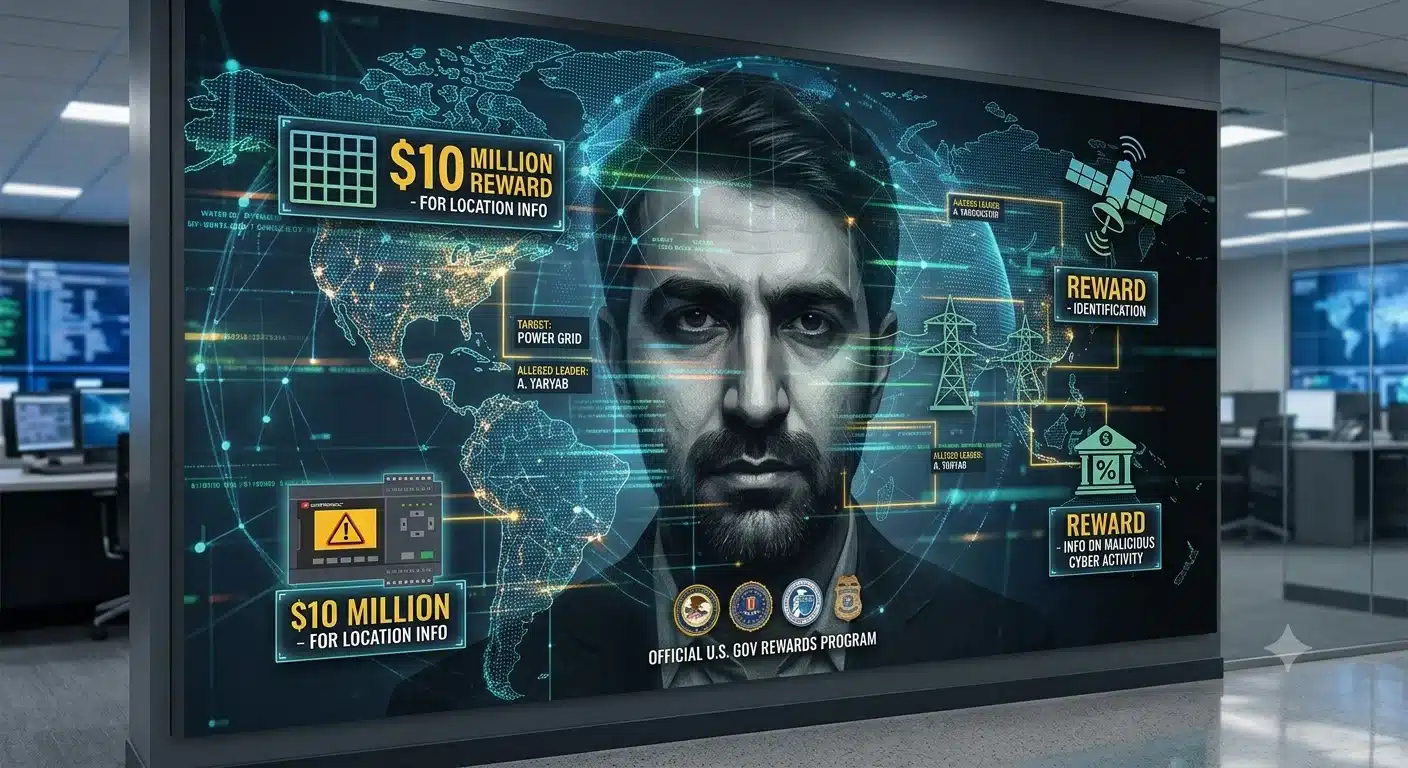
$10 Million Reward for Amir Yaryab

The U.S. State Department has posted a $10 million reward for Amir Yaryab, a senior Iranian official accused of leading the Islamic Revolutionary Guard Corps Cyber-Electronic Command (IRGC-CEC) Cyber Operations Command and directing multiple hacking groups targeting critical infrastructure across the United States, Europe and the Middle East. According to the Rewards for Justice program, Yaryab allegedly oversees cyber operations conducted by IRGC-CEC-affiliated groups including CyberAv3ngers, Dadeh Afzar Arman (DAA) and Mehrsam Andisheh Saz Nik (MASN). U.S. officials accuse these groups of using malware and conducting cyber and cyber-enabled information operations against civilian infrastructure worldwide.

$10 Million Reward for Amir Yaryab

The $10 million reward for Amir Yaryab seeks information leading to his identification or location. The offer applies to individuals acting at the direction or under the control of a foreign government who participate in malicious cyber activities against U.S. critical infrastructure in violation of the Computer Fraud and Abuse Act. [caption id="attachment_113961" align="aligncenter" width="600"]$10 million reward for Amir Yaryab Image Source: https://rewardsforjustice.net/[/caption] Yaryab is also accused of directing Shahid Hemmat and Shahid Shushtari, two groups linked to cyberattacks against U.S. organizations. The sectors allegedly targeted include defense, news, shipping, travel, energy, financial services and telecommunications. The six Iranian officials named in the advisory are linked to Iran's Islamic Revolutionary Guard Corps and its Cyber-Electronic Command.

Iranian Cyberattacks Target PLCs

The allegations also involve attacks against programmable logic controllers (PLCs), highlighting concerns around Iranian cyberattacks targeting industrial systems rather than focusing only on data theft. U.S. officials said Iranian-linked hackers compromised industrial control systems, specifically targeting the Vision series of PLCs manufactured by Israel-based Unitronics. These devices are used across water and wastewater, energy, food and beverage, manufacturing and healthcare sectors. The attackers exploited default credentials on the devices and left anti-Israel messages. Some of the compromises reportedly rendered the PLCs inoperative. The CyberAv3ngers group, which is linked to the IRGC-CEC, claimed responsibility for attacks against Unitronics Vision PLCs in October 2023. Beginning in November 2023, the group compromised default credentials in PLCs across the United States and left messages on the devices' digital screens.

CyberAv3ngers Attacks Critical Infrastructure

CyberAv3ngers has also claimed responsibility for attacks affecting other infrastructure. In October 2023, the group claimed it had breached ORPAK Systems, a provider of gas station solutions in Israel. The group said it had obtained the company's database and intended to publish it through its Telegram channel. The attack was reported to have disconnected 200 gasoline pumps from the system in the occupied Palestinian territories. In December 2023, CyberAv3ngers also claimed to possess and sell 1TB of data allegedly linked to Israel's electricity infrastructure. The group advertised the dataset for 5 Bitcoin, with an initial 100GB portion also offered at the same price.

U.S. Agencies Warn of PLC Cyberattacks

Concerns over critical infrastructure attacks involving PLCs continued into 2026. A joint advisory issued on April 7 by the FBI, CISA, NSA and other agencies warned that Iran-linked threat actors were actively exploiting internet-facing PLCs. The advisory said several organizations had experienced operational disruptions and financial losses after attackers interfered with industrial processes. The developments come amid broader U.S. actions against Iranian-linked cyber activity. The Justice Department accused Iran-connected hackers of breaching employee email accounts associated with the Department of Labor, the Federal Energy Regulatory Commission and multiple United Nations organizations. The Treasury Department also sanctioned Iranian nationals over cyberattacks targeting critical infrastructure. The State Department's reward offer places Amir Yaryab and the alleged activities of IRGC-CEC-linked groups at the center of the U.S. effort to identify individuals responsible for malicious cyber activity targeting critical infrastructure.

FBI Probes Service Selling 153M+ Drivers Licenses

A new identity theft service launched on the dark web this week is selling digital scans of more than 153 million drivers licenses from people in the United States and Canada. Based on interviews with individuals whose licenses are available for purchase on this service, it appears to be siphoning images collected by a widely-used identity verification company based in Louisiana. KrebsOnSecurity also has learned that the New Orleans field office of the Federal Bureau of Investigation (FBI) today launched an official inquiry into the source of the images.

A record available at this identity theft service that includes the drivers license for U.S. Defense Secretary Pete Hegseth, one of several high-ranking U.S. government officials whose drivers licenses can be found for sale.

On Monday, Aug. 31, a source alerted KrebsOnSecurity to a service advertised by a new user on the Russian cybercrime forum Exploit, offering access to digital scans of identity documents on more than 170 million people in North America. The source brought it to my attention because the proprietor of this identity theft service offered my Virginia drivers license as a free sample in their initial sales thread on Exploit.

The service, dubbed Nexus, claims to have more than 153 million drivers licenses for people in the United States and Canada, as well as more than 10 million identification cards; more than three million travel documents and/or international IDs; and at least 579,000 medical cards.

A quick look around Nexus finds they are likely not exaggerating about that 153 million number: Running a blank search in Nexus (with no search parameters entered) returns approximately 11.5 million pages of results, with roughly 15 results displayed per page. It includes documents from people in both Canada and the United States, but the bulk of these records are on Americans: searching for just Canadian drivers licenses returns approximately 1.1 million results, with the largest concentration from Ontario (473,673 records).

Curiously, the identity records include not only drivers licenses but also marijuana dispensary cards. Some of the records list their “source” as “CDL,” presumably short for “commercial drivers license.” Other records carry the source notation of “CAC,” which may refer to Common Access Cards, government issued identity cards that grant physical access to government buildings and secure rooms.

The people behind Nexus claim the license images are coming from an active breach at “a major identity verification company” whose customers include multiple Fortune 500 companies.

The record totals listed by the Nexus identity theft service. The number of drivers license records increased by nearly 400,000 in the span of just 24 hours.

“We have been continuously exfiltrating new data for over a year into our private database,” the service enthused in its introductory post on Exploit. “Records are available to preview before purchase with pertinent information redacted. Customer photos are displayed if available.”

Indeed, over the past 24 hours, the number of drivers license records listed as available in Nexus has increased by nearly 400,000, suggesting that freshly stolen license data is being harvested and uploaded to this service on a semi-regular basis.

The record featuring my drivers license includes six image files: three pairs of photos of the license’s front and back, a basic image scan, as well as infrared and ultraviolet versions of the same images. A date and timestamp is appended to each image file, and the timestamp on my license scan corresponds to a date in June 2025 when I took a flight to the midwest United States to attend a family funeral.

Some of the 153 million+ license scans — including mine — feature six image files with date and timestamps appended to the filenames. Not all records include photos, and some that do feature photos do not display the associated filenames.

Intent on discovering the source of this data, KrebsOnSecurity asked more than a dozen friends and family members for permission to search for their licenses in this service. Each person whose license could be found (nine of them) confirmed having traveled on or very close to the dates in the timestamps attached to their images. It is unclear what timezone these timestamps are in, but from reviewing car rental records shared by several people who helped with this research, it appears the timezone is set to Greenwich Mean Time (GMT).

At first, I thought the source of the data might have something to do with airports. However, that theory went out the window when it became apparent there were no passports in this data set. Also, only some of those who helped with this research said they showed their drivers license at the airport on the day of their travel. One person whose license was in Nexus hadn’t flown at all recently, but was renting a car from Hertz for several months around the date of their timestamp.

Two of those who agreed to help are federal employees who said they shared other forms of government identification when passing through airport security. However, those individuals each said they shared their state-issued drivers licenses later that day when renting vehicles at their respective destinations, and that both rented their cars from Hertz.

After finding a note in my calendar for the day of my June 2025 flight reminding me to bring my passport, I remembered that I also never actually shared my drivers license when I went through security at Reagan National Airport on that day because I did not yet have a Real ID, a security-enhanced drivers license that is now required by the Transportation Security Administration (TSA) for all domestic travel. Instead, I showed the TSA agent my government-issued U.S. passport.

Here’s where it gets interesting: I was able to find my mother’s drivers license in this service as well, and the timestamps for her images are just a few seconds apart from mine. That’s notable because we both handed our licenses to the Hertz rental car representative at the same time.

According to my mom, the only place she gave her drivers license to that day was the rental car company, and if memory serves that is also true for me. I don’t recall if the rental car representative inserted our licenses into any kind of machine, but I remember they held onto them for several minutes behind the counter while we were signing various forms. KrebsOnSecurity sought comment from Hertz and will update this story in the event they reply.

Zach Edwards is a well-known security and privacy researcher who recently launched a service called DecryptAds to help people better understand how online advertisers are tracking them. A scan of Edwards’s drivers license is available for purchase on this identity theft service, and Edwards said the timestamp on his record corresponds to the middle of a trip last month to Las Vegas for the annual DEFCON security conference.

Edwards told KrebsOnSecurity that although he did not rent a car in Vegas, he did hand over his license at the TSA checkpoint, at a marijuana dispensary in Vegas, and at his hotel (the Aria). But he said the only one of those three that for sure scanned his ID in some kind of device was the dispensary.

To enter Planet13’s weed dispensary in Las Vegas, one must pass through a red telephone booth. Image: Zach Edwards.

Edwards said the dispensary he visited that day was Planet13, a multi-state chain with stores in California, Florida, Illinois and Nevada. In 2022, the New Orleans-based identity provider idscan.net published a press release announcing an exclusive identity verification agreement with Planet13’s dispensaries nationally. IDScan says it processes ID verification for more than 1,000 marijuana dispensaries in 19 U.S. states.

The “trust” page of idscan.net states that the company provides identity verification services for numerous big brands, including Hertz, Target, Fedex, Motorola Solutions, the financial services giant Jack Henry, and Caesars Entertainment. And as idscan.net’s own documentation states, the technology scans IDs with both infrared and ultraviolet light. Idscan.net says the company’s systems and technology perform more than 21 million verifications monthly, at more than 20,000 locations around the world.

Image: idscan.net.

Contacted by KrebsOnSecurity, idscan.net said it was investigating the matter, but the company has not yet shared an official statement or a substantive reply to specific questions sent via email.

“At this point I’m not able to share any additional information, but the updates you have provided have been welcome, and helpful to our team’s investigation,” wrote Jillian Kossman, a marketing and operations leader at idscan.net.

During the course of my research for this story, word got around to the FBI that I was poking at the apparent source of this new identity theft service’s data. Probably they were tipped off when I shared with a trusted source that Nexus also is selling the drivers license information for the assistant director of the FBI (I did not find FBI Director Kash Patel’s license in Nexus).

Earlier this afternoon, I was added to a conference call with a half-dozen FBI agents, including senior leaders from the agency’s cyber division. During that call, the FBI shared that earlier today their New Orleans field office opened an official investigation into an apparent breach involving idscan.net.

Edwards said that as more in-person and online experiences require sharing drivers licenses, vendors who collect this sensitive data need to be held to a higher standard.

“This episode should further strengthen the resolve for people who are fighting back against online ID schemes which are requiring countless providers to ask for drivers licenses in order to access services under the guise of protecting kids,” Edwards told KrebsOnSecurity. “These systems are putting sensitive data into more and more 3rd party vendors, and we don’t have nearly the oversight to ensure they are safe.”

Larry Baldwin is principal intelligence researcher at the cybersecurity firm Cybera. Baldwin said a front and back scan of his drivers license available at Nexus contains timestamps that correspond to the date of a car rental from Hertz on a recent vacation.

Baldwin said the Nexus identity theft service presents multiple serious security and privacy threats, noting that state-issued drivers licenses are commonly used as proof of one’s identity when opening new lines of credit. Baldwin said the service could also dangerously expose many people who do not wish to be found but who cannot meaningfully change their appearance (or at least not enough to fool today’s AI-based image matching tools).

This category of people, he said, includes those fleeing domestic violence, and even people who have been assigned a whole new life and identity as part of the federal government’s witness protection program, which is generally reserved for criminal defendants in racketeering and conspiracy investigations who agree to cooperate with federal authorities.

“Just when it seems like we’re making some headway in improving authentication controls through drivers license verification systems, this happens and the very thing those improvements are dependent on are compromised,” Baldwin said.

Update, Sept. 2, 6:05 p.m. ET: A spokesperson for Caesars Entertainment said Caesars has not been a client of IDScan.net and has not used VeriScan since February 2025, despite IDScan.net listing them as a client on their website. That person said Caesars had no active VeriScan accounts at the time of the incident and did not authorize IDScan.net to retain data from its accounts, and that IDScan.net said the incident should have no impact on Caesars Entertainment.

Update, 8:56 p.m. ET: Shortly after this story was published, the Nexus identity theft service website vanished from the darkweb, replacing its login page with a plain text message that reads, “This service is no longer available.”

This is a potentially fast-moving story. Any changes or updates will be noted here along with a timestamp.

The Password Notebook Is Back — but Is It Actually Safer?

Password notebooks are making an unexpected comeback as infostealers and browser attacks revive debate over the safest way to store credentials.

The post The Password Notebook Is Back — but Is It Actually Safer? appeared first on TechRepublic.

Who’s Tracking You? Use This New Service to Find Out

It can be daunting to determine who’s responsible for showing ads on the websites we visit, or who’s harvesting data from the mobile apps we use every day. That information is already semi-public, but it is not easily parsed and traditionally much of it has remained walled away in the hands of large advertising platforms. Not anymore: A powerful and free new service called DecryptAds scrapes and correlates this adtech data and makes it simple to quickly learn a great deal about the entities that are tracking you.

A Decryptads summary of the advertising partnerships declared by espn.com.

The newly launched decryptads.com says it is constantly scraping the files that websites and apps make publicly available to disclose the companies that are permitted to run ads or collect user data. These files include:

ads.txt: all of the adtech companies and data brokers that may run ads or harvest data from the site;
app-ads.txt: entities that can harvest data from or display ads on mobile and smart TV apps;
buyers.json/sellers.json: the entities buying, selling or reselling ad inventory for a given site or app.

Zach Edwards is chief research officer for DecryptAds and a threat researcher at the security company Infoblox. Edwards said he and two other founders decided the service was needed because the adtech data in these files is generally only useful when it can be cross-referenced to build a more complete picture of the advertising ecosystem for each website or app.

“It’s an adtech tool but we’re trying to approach adtech from a security perspective,” Edwards said. “It’s really built for a lot of privacy and security use cases that have been dramatically underserved.”

Those use cases, he said, include tracking down the source of malicious ads that try to foist malware on targeted users, identifying ad networks located in adversarial nations, and detecting the fast growing swarms of AI-generated slop websites and apps. And as decryptads.com demonstrates, these potential security and privacy threats are near impossible to detect just by viewing a single apps.txt or app-ads.txt file.

“Supply-chain integrity issues rarely live in a single file,” the site explains. “They show up as broken cross-references between ads.txt, app-ads.txt, and sellers.json files; as cloned declaration sets across unrelated domains; as seller removals that only make sense when viewed across exchanges; and even as supply paths in bid logs that never actually appear in any given publisher’s authorized-seller list.”

A search in DecryptAds for the hugely popular sports network espn.com reveals 143 ad partners and 19 registered data broker domains are listed within its ads.txt and app-ads.txt files. That data broker information is gradually becoming available because four states — California, Oregon, Texas and Vermont — have recently passed laws requiring data brokers to register if they buy or sell data on consumers from those states. DecryptAds reports that almost half of those data brokers are collecting geolocation data from espn.com visitors who aren’t blocking ads, while another three disclose that they collect device fingerprints and sensitive personal information.

A visual representation of the complex ad supply chain declared by espn.com. Image: decryptads.com.

HIGH-RISK AD PARTNERS

DecryptAds also makes it easy to learn the beneficiaries and national origins of the advertising firms lurking in apps and websites, displaying a conspicuous warning when adtech partners of an app or website are based in “geo-risk” areas like China and Russia, or in countries with strong financial and political ties to both — such as Cyprus and the United Arab Emirates (UAE).

According to DecryptAds, espn.com works with four different advertising entities that are based in either Russia, China or the UAE, including the adtech firm Between Digital, which lists a New York address. However, the dossier on Between Digital flags them as a Russian firm, showing that their publisher offers (PDF) are processed through Alfa Bank, Russia’s largest private commercial bank and one of several financial institutions placed under U.S. sanctions in 2022 after Russia invaded Ukraine. KrebsOnSecurity sought comment from both Between Digital and the company’s founder, and will update this story in the event that either replies.

A search for several top U.S. military news websites — including armytimes.com, airforcetimes.com, defensenews.com, navytimes.com, marinecorpstimes.com and federaltimes.com — shows they all allow Between Digital to serve ads and track users, as well as two entities in the UAE and another in the ownership secrecy haven of Panama. DecryptAds reports that Between Digital is collecting ad data on approximately 55,000 partner websites.

The “Geo Risk” section of decryptads.com.

Pivoting on Between Digital’s app-ads.txt file reveals hundreds of domains featuring simple web-based games that are frequently interrupted by ads. Edwards said Between Digital’s own declarations show the company is listed as both a publisher and a reseller on approximately two-thirds of their portfolio.

“It means they are basically playing both sides of the bidding equation, which creates opportunities to direct client spend at your owned and operated properties or client infrastructure, essentially creating opportunities for conflicts of interest,” Edwards told KrebsOnSecurity. “The problem we have right now is that for years we’ve had almost no one policing these ads.txt and app-ads.txt files.”

The Opera Web browser remains quite popular, and probably many users are unaware that since 2016 it has been majority owned and controlled by the Chinese company Kunlun Tech (the operational headquarters of Opera remain in Oslo, Norway).

Opera.com’s profile at DecryptAds identifies 27 registered data brokers collecting information, including 15 adtech partners in the UAE, six in China, three in Cyprus, two in Russia and one each in Hong Kong and Ukraine. DecryptAds makes clear, however, that these companies represent just seven percent of the adtech partners specified in Opera.com’s ads.txt and app-ads.txt files.

LEGAL DOSSIERS

One feature of DecryptAds that sent this author down multiple hours-long research rabbit holes is its Legal Dossier lookup, which takes several minutes for each search but eventually churns out oodles of useful information about who owns a particular domain or app, when it was registered, and any aliases or relationships it may have to adtech companies and other websites or apps.

For example, last month KrebsOnSecurity wrote about researchers from Bitsight who found that an extremely popular line of TV streaming sticks called H96 quietly rent out each user’s Internet connection to strangers. Bitsight also discovered that when these devices aren’t being used to stream pirated video content, they are spoofing themselves as mobile phones clicking ads on AI-generated slop websites.

Bitsight concluded that the same Chinese company that made several of the malicious apps common to all of these H96 streaming sticks — the Fengwo Group — also also ran the network of ads and AI slop websites being clicked on by tens of thousands of these devices that are pretending to be mobile phones.

Examples of ad landing pages linked to the Fengwo Group. These sites were designed to show ads only to H96 devices that were spoofing their device type as mobile phones. Image: Bitsight.

A DecryptAds legal dossier on the (now dormant) Fengwo Group domain name for the AI slop website pictured on the left in the screenshot above (medicalbeautyhub dot com) shows it shares a seller ID (1674071) with a gaming website — giacoloredstones[.]com — which features yet another seller ID (103488000).

Pivoting on that latter seller ID reveals hundreds of active websites within Russia’s Yandex ad system featuring extremely low-quality games or simple utilities that pepper visitors with ads.

QUIET REMOVALS

Edwards said that when advertising networks suspect a given advertiser is engaged in unauthentic clicks or displaying malicious ads, very often those networks will quietly remove the offender from their list of approved partners without letting anyone else know about their suspicions.

This practice, he said, makes it easier for dodgy adtech firms to avoid accountability and continue victimizing others. To address that visibility gap, DecryptAds features a quiet removals feed that records and correlates all of the sellers.json removals across ad exchanges for the same seller domain or name.

A screenshot of the Quiet Removals Feed at decryptads.com.

“The way the adtech industry works, someone will write a report about ad fraud and only share it with their own clients and they won’t make it public,” Edwards said. “The ban is just removing them from the sellers.json file, but they told nobody. One day it was there, the next it was gone. So if you’re trying to navigate who is suspicious, that’s usually tough to do because there are a lot of adtech companies removing things all at once.”

MALVERTISING AND AI SLOP

Malvertising, the term given to the practice of inserting malicious ads that foist malware or redirect visitors to phishing pages, remains an all-too-frequent occurrence in the modern adtech industry. But Edwards said these malicious ads are far more commonly found now on newly generated AI slop websites than on high traffic destinations that typically employ a variety of technologies and third party tools to quickly flag bad ads.

“None of these slop AI content farms are paying for that kind of protection,” he said. “They’re just signing up the lowest quality partners, and it essentially becomes a greased rail to target the users of those sites with malicious ads. Most malvertising attacks don’t happen on espn.com or huffpost.com, but rather [on] some lower quality content farm and someone just went there because it came up in a search.”

Edwards said the AI slop websites are populated with machine-generated blog posts and images, and cover a wide array of themes from home improvement and decorating to food recipes, hunting, cars and consumer technology. He said organizations that get hit with malicious ads are often at a loss for what to do next, unaware that in most cases the answer is one of the entities listed inside the website’s ads.txt or app-ads.txt file.

“A lot of serious organizations are starting to understand that if we’re not breaking down this ad data, we’re not going to know who’s targeting government people with zero-click payloads on an almost daily basis,” he said.

Edwards maintains that truly getting a handle on the malvertising and AI slop problems will require more data-sharing by the major ad networks. Specifically, he says those platforms do not broadly share what’s known as the “supply chain object” or SCO, structured data attached to each advertising bid request that lets buyers see every seller, reseller and intermediary involved in passing an ad impression from the publisher to the final buyer.

“That SCO tells you who sold it or resold it, and who was the final entity that bought the impression that served that malware payload,” Edwards explained. “You may see the malicious zero-click redirection, but without the supply chain object — which is only served server side — you won’t know who targeted your people with malware and won’t have a way to try and prevent it properly. But if we can encourage the adtech industry to expose that SCO, it will get easier to find the culprit behind any one bad ad.”

DecryptAds also offers an application programming interface (API) that allows researchers to automate queries and integrate the site’s functionality into popular AI platforms.

WHAT CAN YOU DO?

The only sane reaction to the examples described above is to block all online ads outright. This approach is broadly endorsed by security experts because it also makes it more difficult for adtech firms and data brokers to build detailed profiles on you and track your movements around the web and in the real world.

However, much depends on how you normally prefer to browse the Internet, and how much trust you place in third party browser plugins and extensions. For those primarily surfing via a regular desktop or laptop Web browser, uBlock Origin Lite is an excellent free and well-maintained open source option. uBlock Origin also should work with mobile browsers like Firefox, but apparently only on Android-based devices.

Adblock Plus is a decent option for iPhone and iPad users. For power users, Adblock and uBlock Origin both support custom blocking rules from easylist.to, which publishes a frequently updated list that removes most advertisements from webpages.

The well established browser extension NoScript blocks all non-approved Javascript code, and it generally does a fine job blocking most ads from loading. However, script blockers like NoScript may not be suitable for average users who don’t enjoy constantly having to referee which scripts should be allowed to load so that each site displays properly.

More technically inclined/adventuresome readers should strongly consider a hardware approach to blocking ads at the local network level, because that is easily the cheapest, most secure and scalable way to do it. A tiny, low-cost and broadly available computer known as a Raspberry Pi can be turned into a powerful ad blocker for all devices on a local network when fitted with a microSD memory card and a free program called Pi-hole. Once you’ve set it up properly and changed your router’s network settings to use the Pi-hole’s DNS sinkhole and DHCP servers, it should prevent ads from displaying on any devices connected to that network.

Bear in mind that ad blockers often do little to block ads and/or tracking that occurs from within mobile apps that users have chosen to install on their devices. Many websites now push users to install a mobile app, supposedly in order to more fully access and enjoy the site’s services and content. But in my experience, they’re not doing this because the user experience is somehow way better on the app (as LinkedIn tries to convince us non-app users several times a week via email). On the contrary, I find most mobile apps to be horribly designed, annoying, and/or completely unnecessary, and when given the option I will almost always choose to interact with a website or service directly in a Web browser.

No, the cold truth is that big web destinations tend to get pushy with their apps because they make it easier for these companies to keep you on their platforms longer and to collect (and in many cases resell) far more precise data about who, what and where their users are. Also, companies pushing customers the hardest to install mobile apps always seem to liberally opt everyone in to having their data used to train large language models these days. So be cautious about the apps you install on your mobile devices (including any smart TVs!), and poke around their listings at DecryptAds if you want to learn more about their privacy practices and any relationships they may have to adtech firms.

UK Cybercrime Journal: Evolution of Courier Fraud Campaigns

What Happened

  • New data published by the City of London Police in June 2026 reveals that courier fraud losses exceeded £21 million in 2025, with individuals aged over 70 being heavily targeted. The highest concentration of these offenses was recorded in London and the Home Counties.
  • Cybercriminals and fraud syndicates are actively evolving their operational tactics, increasingly pivoting to messaging platforms like WhatsApp to contact their victims and remotely paying for third-party courier services to facilitate physical collections.
  • UK law enforcement also highlighted a dangerous shift in 2025 toward high-value physical goods. Victims are being systematically manipulated into visiting multiple jewellers over an extended period to purchase gold and expensive jewellery, which they then hand directly to fraud couriers.

Recent operational crackdowns by UK Regional Organised Crime Units (ROCUs) showcase the nationwide scale of these networks:

  • North West ROCU Operations (July 2026): Police executed coordinated search warrants in Huddersfield and Manchester, arresting two men (aged 21 and 25) on suspicion of Conspiracy to Defraud and Money Laundering. In this specific series, the suspects impersonated bank fraud departments, convinced a victim her card was compromised, sent a courier to collect it, and immediately exploit the physical card to make numerous fraudulent transactions.
  • North East ROCU (NEROCU) Sentencing (June 2026): A complex, cross-country courier fraud operation spanning March to May 2022 concluded with a prison sentence for a primary operative. The network targeted 14 separate victims, convincing them to hand over physical bank cards and PIN numbers under the guise of an internal "investigation" by their bank's fraud department. The group scammed a total of £56,000, which was then rapidly laundered through the high street purchase of smartphones, designer clothing, and luxury jewellery.

Analyst Comment

Courier fraud is effectively a hybrid cyber-physical social engineering campaign. While the final phase relies on a physical courier arriving at a victim’s doorstep, the initial approach relies heavily on psychological manipulation and email, message, or phone call-based deception.

This type of fraud is notable as it follows a structured cybercriminal playbook that bypasses detection systems and takes advantage of the vulnerable in society. The victim is instructed to bypass normal banking security controls by withdrawing cash, disclosing sensitive credentials (like PINs), or purchasing high-value physical commodities like gold or luxury jewellery. This makes it difficult to proactively detect and prevent.

The other concerning factor is the couriers themselves. According to reports, they can be an unwitting third-party courier service that is paid to go to the victim's home to collect the assets. Online services enable cybercriminals to organise these pickups remotely, lowering their risk of being caught.

The £21 million sizeable loss metric from 2025 shows how profitable this low-tech, high manipulation vector remains. The recent shift to targeting gold and luxury jewellery is a deliberate evasion tactic against traditional anti-money laundering (AML) and banking fraud detection algorithms. While banks have grown adept at flagging unusual rapid bank transfers, they cannot easily stop an account holder from physically withdrawing funds or using a card over several days at different brick-and-mortar luxury retailers. This tactic serves as a highly liquid physical laundering pipeline for these syndicates that remains a challenge to prevent.

Defensive Takeaways

  • Implement Bank Transfer and Purchase Outlier Alerts: Financial institutions can focus on further behavioural monitoring for elderly demographics, looking specifically for sudden, consecutive high-value transactions at physical luxury retail or jewellery establishments and flag patterns on unusual activity for review.
  • Public Awareness on Cross-Media Scams: Security awareness campaigns must make it clear that legitimate institutions, specifically the Police and Banking Fraud teams, will never send a courier to a residential address to collect cash, PIN numbers, bank cards, or purchased items.
  • Vetting of Courier Logistics: Commercial courier services are increasingly being abused as infrastructure by these threat groups. Logistics firms must implement logging and analysis systems to detect unusual residential pickups booked via suspicious accounts and forged identities.

Relevant Sources

  1. https://www.cityoflondon.police.uk/news/city-of-london/news/2026/june/over-70s-targeted-as-courier-fraud-exceeds-21-million-in-2025-with-london-and-home-counties-hit-hardest/
  2. https://www.rocu.police.uk/news/2026/july/two-suspected-fraudsters-arrested-after-cross-border-strikes/
  3. https://www.rocu.police.uk/news/2026/june/a-courier-fraud-conman-has-been-jailed/

CIO 100 Award winners spotlight IT’s power to transform

Each year the CIO 100 Awards showcase outstanding IT initiatives, and every year they illustrate the power and potential of technology to transform how people work, how organizations perform, and the value they offer to customers.

The 2026 cohort of winners is no different. Each one demonstrates how IT executives and their teams successfully move from ideation to deployment to scaling a solution for the future, overcoming challenges and driving adoption along the way to ensure their organization gets a return on its investment.

[ Interested in meeting and learning from all CIO 100 winners? Join us next week at CIO 100 Awards & Conference in Frisco, TX. Limited seats remain! Register here ]

The winning initiatives come from a range of industries and utilize a host of technologies to achieve their goals, as is the case annually. A growing proportion of these stand-out projects leverage artificial intelligence, raising the bar on the art of the possible for all IT departments.

The following 10 award-winning projects serve as representatives for the outstanding work done by all the 2026 honorees.

ABB democratizes AI agent creation and deployment

Organization: ABB

Project: ABBY — AI Agentic Platform for Workforce Transformation

IT leader: Vikke Kandell, CIO

IT leaders at ABB, a manufacturer, had some big hurdles to clear when it came to building an AI strategy.

They had to overcome employee fears that AI would take away jobs, the potentially high cost of AI vendor licenses, and pressure from investors, customers, and executives to advance the use of AI in the enterprise.

“We looked at this and asked, ‘How do we address all this?’ and build something that the company is proud of,” says Babu Kuttala, vice president of data analytics and AI.

The answer is ABBY, an AI agentic platform that enables employees to create and deploy specialized AI agents for specific business tasks.

To build ABBY, Kuttala and his team used best-of-breed LLMs (about 25 in total). They built a centralized orchestration layer using generative AI that integrates internal knowledge bases with external ecosystems, creating a unified platform where agents can access enterprise data, understand required actions, and execute tasks across multiple systems. And they created preconfigured skills so that employees could build agents tailored to their workflows without having to code.

ABBY was rolled out in 2025 to 100 users but is now used by 63,000 (more than 75% of the company’s workforce, Kuttala notes) with an average of 10,000-plus workers using it daily. IT continues to add LLMs and capabilities to expand use of ABBY even further, Kuttala says.

Belcorp modernizes manufacturing with Smart Factory

Organization: Belcorp

Project: QPlant — Smart Factory

IT leader: Venkat Gopalan, Chief Digital, Data, and Technology Officer

Legacy processes were limiting Belcorp’s ability to scale and compete. Its manufacturing relied on ERP-driven processes with limited shop-floor automation and weak connectivity across production, packaging, quality, and maintenance. The company depended heavily on manual records and post-process reconciliation, resulting in fragmented data, limited real-time insight, inefficiencies, and higher risks for errors.

Smart Factory changed all that. The IT initiative reimagined how manufacturing teams work “by creating a connected, data-driven environment where production, quality, maintenance, and operations are aligned around real-time information and standardized execution,” says Venkat Gopalan, chief digital, data, and technology officer.

At Smart Factory’s core is a manufacturing execution system that orchestrates production workflows, quality processes, and operational execution, he explains. IoT-enabled equipment integration and a centralized SCADA platform provide real-time visibility into shop-floor operations, while electronic batch records digitize production execution, strengthen traceability, and reinforce compliance by design.

Integrating those operational technologies with the company’s enterprise platforms was another critical component of success, Gopalan says, creating a trusted flow of real-time data across manufacturing, quality, maintenance, and business systems. “This connected architecture transformed isolated data into actionable insights, enabling faster decision-making, greater operational visibility, and continuous improvement across the manufacturing lifecycle,” he adds.

The initiative generated more than $1 million in financial benefits in its first year alone.

“Most importantly, Smart Factory established the digital foundation for the future of manufacturing at Belcorp,” Gopalan says. “With real-time operational data and connected systems now in place, we’re well positioned to accelerate advanced analytics, AI-driven optimization, predictive maintenance, and other Industry 4.0 capabilities that will continue delivering value for years to come.”

Cohesity replatforms post-acquisition for commercial growth

Organization: Cohesity

Project: Lead to Cash Replatforming Program (Veritas Integration)

IT leader: Brian Spanswick, CIO

Cohesity set an ambitious objective: Complete an enterprise-scale lead-to-cash replatform in under six months.

That’s a tight timeline for any replatforming initiative, but Cohesity’s project had another layer of complexity. It followed Cohesity’s December 2024 acquisition of Veritas, a company twice its size in revenue, leaving Cohesity to integrate the majority of a global enterprise revenue engine into its own operating model without disrupting customers, partners, or sellers.

“We had to bring the two companies together, merge the workforces together, and create an overall harmonized organization and operating infrastructure platform,” says Eric Brown, who as CFO and COO led the project.

The program migrated heavily customized CRM, CPQ, PRM, ERP, and subscription platforms (some of which were “very brittle, very bespoke,” Brown says) to a unified SaaS CRM, CPQ, and ERP environment with uninterrupted selling, billing, and partner operations.

This was no lift-and shift, Brown stresses. “It was a business process optimization project as well. We want to run very efficiently, so we questioned everything and used the migration process to simplify and streamline the business in every possible respect.”

The initiative enabled continuity for 13,000-plus customers, protected revenue during integration, and established a scalable commercial foundation for future growth.

Brown cites several factors that contributed to success. First, leadership was upfront about what it would take to meet the deadline, a process that involved carefully prioritizing the capabilities that would appear in the first iteration. Leadership also streamlined decision-making, establishing office hours that “ran with military precision” to handle issues. And the company selected a specialized partner, requiring its top talent be assigned to Cohesity.

Dairyland Power goes agentic to protect field crews

Organization: Dairyland Power Cooperative

Project: ODIN — Organizational Effectiveness Agentic AI

IT leader: Nate Melby, VP and CIO

Dairyland Power Cooperative had amassed a large collection of field observations, incident reports, near-misses, safety rules, and work methods that could yield insights into processes and practices that could help protect its workers.

But the insights were essentially out of reach, trapped in siloes.

Dairyland’s organizational effectiveness team turned to CIO Nate Melby for help unlocking those insights. Melby then turned to agentic AI, recognizing that the technology could address the team’s need to make better use of its data.

“This was about finding insights on how to work more safely,” Melby says. “It’s about preventing incidents.”

The collaboration between the two teams created ODIN, the first agentic AI implementation of its kind in the electric utility industry.

Focused on worker safety, ODIN autonomously connects the collective safety knowledge of the organization and delivers actionable insights directly to field crews at the moment work is planned.

ODIN was developed through a hybrid approach that combined an agentic AI platform and Dairyland’s internal private generative AI platform called VoltWrite. ODIN leverages LLMs, retrieval-augmented generation, and a coordinated swarm of autonomous agents.

Agents work together to analyze internal safety data, performance history, work practices, and safety rules and then synthesize the information into clear guidance on the safest way to perform specific tasks.

ODIN has produced results, including a reduction in OSHA recordable injuries and improvements in the quality and consistency of pre-job safety briefings.

ODIN was deployed in early 2025 for use by Dairyland’s workers in transmission construction and electrical maintenance, which are the highest-risk work areas. Dairyland is looking to expand ODIN’s use to other teams.

Dow’s digital sustainability ledger drives low-carbon sales

Organization: Dow

Project: Carbon Footprint Ledger

IT leader: Deb Bauler, Chief Information and Digital Officer

Executives at Dow consider the Carbon Footprint Ledger (CFL) as more than a technology or innovative carbon accounting methodology. According to Senior Global IT Director Jeremy Preston, CFL is “a digital business capability that enables Dow to translate sustainability investments into customer value.”

CFL transformed how Dow uses greenhouse gas emissions data. It combines a methodology aligned to international standards with an enterprise-scale digital platform. It also integrates manufacturing, supply chain, commercial, and sustainability data to generate product carbon footprints under enterprise-level governance and management at scale.

In doing so, Preston says it creates “a trusted, traceable link between low-carbon processes and raw materials implemented across its manufacturing network and the lower-carbon products customers seek.”

The technology team worked closely with sustainability and business teams, collaboratively developing the capabilities needed to reconstruct product genealogy, maintain end-to-end data lineage, track low-carbon attributes across interconnected manufacturing processes, and generate product carbon footprints that can support customer offerings and commercial transactions.

CFL was built on Dow’s Integrated Data Hub and in partnership with Boston Consulting Group and Databricks.

The core CFL platform is fully deployed and supports commercial transactions today.

Preston says CFL “enables Dow to turn sustainability investments into customer value, commercial differentiation, and new growth opportunities.” Dow reports that it has driven hundreds of millions of dollars in low-carbon product sales in 2025 and 2026.

The company is now expanding its use. “We are extending adoption across additional products, manufacturing networks, business segments, and customer use cases while continuing to enhance automation, analytics, and integration with commercial processes,” Preston says.

J&J transforms quality management with AI

Organization: Johnson & Johnson

Project: Q&C Strategy

IT leader: Michael Comprelli, Vice President, Head of Technology, Technical Operations, and Risk; Joel O’Connor, Head of Technology, Medtech Quality, and Compliance

Johnson & Johnson is using AI to transform quality management through its Q&C Strategy.

QuIn is an AI-powered digital assistant that fuses human expertise with machine learning, automation, and data-driven insights to boost efficiency, reliability, and worker impact. By embedding gen AI into core quality management systems processes, QuIn proactively gathers actionable insights, increases operational efficiency, and allows teams to focus on high-value, patient-centric work.

Cora is an innovative generative AI platform that provides regulatory intelligence monitoring, impact analysis, and augmented content revision. Cora assists with document analysis, compliance comparison, stakeholder analysis, policy/standard creation, procedural/document updates, and document comparison. Cora is purpose-built for regulated environments, validating outputs against source material and offering a user experience that instills trust in the outcome.

QuIn and Cora, which automate time-intensive tasks and democratize information access, are on track to deliver significant value, with J&J reporting more than $62 million in documented true cost savings by 2028 from QuIn alone. Cora delivered $2 million in cost efficiency in 2025 and will deliver a documented cost savings of $25 million by 2028.

“Our teams proved responsible AI can be applied meaningfully in a highly regulated environment without compromising the rigor, accountability, or human judgment that quality requires,” says Michael Comprelli, vice president, head of technology, technical operations, and risk.

He continues, saying that J&J “moved these ideas beyond experimentation and into products that employees use in their daily work. We did that by bringing together Quality expertise, product management, data engineering, architecture, cybersecurity, user-experience design and AI engineering around a common purpose.”

JLL brings intelligent automation to business services

Organization: JLL

Project: Business Service Digitization

IT leader: Pinak Dash, Global Head of JLL Business Services and Legal Technologies

JLL launched its digitization initiative to drive process redesign as well as systematic AI and RPA deployment across JLL Business Services (JBS).

The initiative was designed to address inefficiencies that hampered scalability and competitive positioning. It was also designed to eliminate manual processes that consumed thousands of hours across finance, HR, legal, procurement, marketing, research, IT, and lease administration.

Pinak Dash, global head of JBS and legal technologies, says the digitization initiative had a dual-strategy combining traditional digitization with generative AI innovation to hundreds of processes.

JLL lists three innovations critical to the program’s success.

First is a hybrid platform that integrates RPA with JLL’s proprietary AI platform called Falcon, which created intelligent automation that adapts and learns. It enables real-time process automation, intelligent document processing with automated extraction/validation, and smart decision-making for continuously optimizing workflows.

The second innovation is its use of ProHance for real-time process monitoring and enabling of data-driven optimization. Sensors capture granular productivity metrics, identify bottlenecks, and provide actionable insights for continuous improvement across automated and manual processes.

Third is its custom AI assistants and transaction agents. Falcon-powered assistants provide intelligent knowledge search while specialized agents execute complex transactions across enterprise SaaS platforms. These handle multisystem workflows, reducing human touchpoints while maintaining accuracy and compliance.

Dash says the initiative has delivered quantifiable benefits through improved efficiency, accuracy, and quality of services provided to clients.

“The initiative delivers on our business goals, makes us more efficient, provides customers better service, and it opens up the capabilities and bandwidth of our people to do what they like to do and to find innovative ways to serve our business,” he adds.

Nationwide partnership platform delivers efficiencies, business growth

Organization: Nationwide

Project: Enterprise Digital Platform (EDP)

IT leader: Michael Carrel, EVP and CTO

Nationwide’s new Enterprise Digital Platform (EDP) gives the company “a scalable way to connect with external partners quickly, securely, and consistently across all areas of our business,” says company EVP and CTO Michael Carrel.

He explains that “instead of treating every integration as a custom effort, EDP creates a common front door for digital products, documentation, onboarding and governance.”

That innovation has produced better experiences for the company’s partners. It saves time for Nationwide teams, partners, and customers. And it supports faster launch times for new products and enables growth across the business.

“EDP changed the model from fragmented, point-to-point integrations into an enterprise platform built around reusable digital products. That shift lets us support a range of integration options in one governed environment, meet partners at different stages of technical maturity, and add new capabilities over time without redesigning every relationship from scratch,” Carrel explains.

EDP uses cloud-native microservices, role-based access control, and advanced analytics. Nationwide IT created modular microservices to make EDP more scalable, resilient, and adaptable. And IT decoupled it from infrastructure-specific dependencies so that it would be a platform-agnostic developer portal. That, Carrel says, reduced operational constraints across environments.

Additionally, IT shifted from a user-specific model to role-based access, which improved security, simplified administration, and better served the needs of different audiences.

Meanwhile, robust analytics delivers visibility into platform usage and performance, which Carrel says helps ensure Nationwide continuously evolves the platform based on measurable outcomes.

The core platform is fully deployed, with Nationwide planning to expand it.

“Our Enterprise Digital Platform is more than a piece of technology,” Carrel notes, “it represents a strategic enabler to support growth objectives across Nationwide’s businesses.”

PITT Ohio fast-tracks shipment requests with AI assist

Organization: PITT Ohio

Project: No Touch Email (N@TE AI)

IT leader: Scott Sullivan, President and CEO (formerly CIO)

As PITT Ohio started its AI journey in 2024, the mandate was clear: Use the technology to solve “real problems,” says Ryan Carner, director of enterprise IT solutions.

“We wanted to hit the ground running and find a problem that was solvable,” Carner says, noting that the company also wanted to use the experience to build in-house AI skills. “The idea was to find a business case for AI that would be our first but not the only one.”

PITT Ohio leaders decided to tackle what Carner describes as a “mundane but very important task for how our business operates”: handling emails to the customer service team.

The need was significant. Customer service representatives were manually processing hundreds of pickup request emails daily, each requiring five to 15 minutes to interpret and re-enter shipment details into the company’s transportation management system (TMS). The emails were complicated, containing a lot of information submitted in nonstandardized ways and varying formats. This repetitive task consumed valuable time, introduced errors, and delayed customer response.

N@TE uses generative AI and natural language processing to transform unstructured email content into structured pickup orders automatically and in real-time. N@TE scans incoming emails, extracts key shipment data, and creates orders directly in the TMS via API integration. It operates seamlessly within existing workflows, requiring no change in customer behavior or retraining of staff.

PITT Ohio deployed N@TE in 2025, and the company also secured a patent for the product that year. N@TE has produced a 30-60X increase in processing speed, 99% accuracy in extracting and populating order data, and a 70% reduction in handling costs per pickup order.

SMU builds AI adoption through grassroots ambassador program

Organization: Southern Methodist University

Project: Scaling AI Without Scaling AI: Organizational AI Scaling Through Willingness

IT leader: Jason Warner, Associate CIO

Like executives in most organizations, leaders at Southern Methodist University encountered mixed attitudes about AI. Some workers had little interest in using the tech, others were afraid it would take jobs, still others were curious about what it could do.

Associate CIO Jason Warner and other leaders decided to leverage that last group, believing the best way to get SMU faculty and staff to embrace AI was to use enthusiasts to help smooth the way.

So, instead of treating AI as a conventional technology rollout, Warner and his colleagues built opt-in communities of practice known as the AI Coalition of the Willing and Operation Copilot.

The goal, Warner says, was to build institutional capability, reduce risk, and generate momentum.

“We knew the fastest way to scale AI was to scale the willingness of people to use the technology, and not talking to people about cost savings and the like,” Warner says, adding that willing users as great ambassadors and evangelists who showcase in formal and informal ways the technology’s potential for hesitant or skeptical colleagues.

Participating faculty members have access to a licensed ChatGPT account as long as they use it. Staff members have access to Copilot accounts after taking a self-paced training course and likewise must use it to keep that access.

Warner says these willing workers are demonstrating the benefits of AI (significant time reclamation, reduced cognitive load, improved quality of outputs, expanded professional capacity).

SMU is now moving to a single solution and scaling AI, confident that its use will deliver returns following in the footsteps of the early adopters.

Interested in meeting and learning from all CIO 100 winners? Join us next week at CIO 100 Awards & Conference in Frisco, TX. Limited seats remain! Register here 

The gen AI helping Aetna review millions of medical records

One of the biggest challenges companies like Aetna face every year is an annual HEDIS review of its records to identify gaps in care. For large national payors, the scale of the challenge is immense. So Aetna has deployed a gen AI-driven document intelligence platform that has reduced the need for manual review by 65%.

“We have a large group of amazing trained medical coders who do this every day,” says Nathan Frank, chief digital and technology officer at Aetna. “This is about making it easier for them by speeding up the process. Something that might have taken weeks or months we can now do in days.”

The Healthcare Effectiveness Data and Information Set (HEDIS) is a range of performance measures for the managed care industry. Developed and maintained by the nonprofit National Committee for Quality Assurance (NCQA), the first version of HEDIS was released in 1991.

Under the HEDIS measures, large managed care providers like Aetna review more than 10 million medical records annually to identify gaps in care. These gaps are missed or overdue preventative care or chronic disease management tests including missed cancer screenings, blood sugar tests for diabetics, eye exams, and immunizations. Closing these gaps improves patient outcomes, and health plans are measured in how well they perform. But processing medical records is no easy task.

“We’re talking about medical charts that have white space filled with handwritten notes,” Frank explains. It’s not just structured data, it’s lots of physical clinical documentation.”

Adding up the numbers

Frank says industry benchmarks for large providers indicate an annual review process that requires about 50,000 work weeks, equivalent to nearly 1,000 dedicated full-time employees. It would take a team of 50 reviewers more than 20 years to complete a single annual review using fully manual processes.

Enter AI Medical Chart Review, a platform developed by Aetna that leverages cloud services and gen AI to automatically extract clinically relevant data from records, and prioritize records based on the likelihood of measure closure and evidence strength.

“Large language models and gen AI give us the ability to train a model to decipher the charts, identify the high value codes, and build correlations,” Frank says.

In the space of about six months, Frank’s team ideated the platform, and designed and trained a PoC that was able to process millions of records in just two weeks. As a result, AI Medical Chart Review has earned Aetna a CIO 100 Award in IT innovation.

“Now we’ve gone through 14 million documents,” Franks says. “We’re seeing a reduction of manual effort, which is now being transitioned into other areas like quality control and making sure the automated chart review is working as expected.”

Behind the curtain

Using gen AI, the platform automatically ingests and analyzes unstructured medical records and clinical documents. And as part of that process, it identifies and extracts clinically relevant information for specific HEDIS measures like diagnosis codes, medication records, lab results, and visit documentation. With this data, the platform generates a prioritized set of records based on the likelihood of measure closure and strength of clinical evidence, which is then passed to human employees for review and validation.

Frank says the platform has increased gap closure rates (leading to improved Star Ratings and higher reimbursement), streamlined workflows, and enabled teams once dedicated to manual record review to shift focus to higher-value activities.

Frank says much of the speed and success in building the platform comes down to a shift in the way it approached the design and build process. Rather than exhaustively writing specifications and requirements, Aetna created a team that included engineers and subject matter experts who worked together to build out capabilities iteratively.

“It allowed us to move much faster, and having a business subject matter expert sitting in the same virtual or physical room with us got us a much better outcome,” Frank says. “The product model, our cloud compute model, and our AI governance model allow for quick reviews to make sure we’re using AI responsibly with the right guardrails. It’s increased the speed to get from product launch to go-live.”

He adds that small teams that don’t have to deal with a lot of bureaucracy are key to moving quickly.

“You need to design with security, compliance, and a responsible use of AI as core principles from day one,” he says. “Everything we do from a new build standpoint starts with thinking about how we make it cloud native, how we build with the right elasticity and speed, and how we optimize the cost.”

The most important element of all, he says, is a good relationship with your subject matter experts.

“You can have a great product manager and engineer, but you really need that business subject matter expert who’s excited about it, and who has a passion for transforming the process,” Frank says. “Once you put those three together, you’ll see amazing things like this happen all the time.”

Chick-fil-A loyalty accounts hijacked using stolen passwords

Fast-food chain Chick-fil-A is warning customers after attackers hijacked loyalty accounts using stolen passwords in a credential stuffing attack.

Chick-fil-A says it detected suspicious login activity against some Chick-fil-A One accounts in June and launched an investigation. The company later concluded that unauthorized parties ran an automated credential stuffing attack against its website and mobile app between June 17 and June 19, 2026, using usernames and passwords obtained from previous data breaches or other third‑party sources. Chick-fil-A says it reset passwords and ended active sessions for affected accounts while investigating the incident.

Credential stuffing is an attack where criminals take username–password pairs stolen from one service and automatically try them on many other websites and apps to see where they still work. Because many people reuse passwords, attackers often gain access to accounts without ever breaking into the company’s systems in the traditional sense.

So, some may conclude that there are two sides to this. On the one hand, customers who reuse passwords across multiple sites make credential stuffing attacks much more likely to succeed. On the other, companies also have a responsibility to put protections in place to detect and block automated credential stuffing attacks before accounts are compromised.

How it works

To understand how it works, we’ve created a typical scenario:

  • Cybercriminals obtain large lists of breached credentials from previous data breaches, dark web markets, or public dumps.
  • They use automated tools to fire those credentials at login endpoints for popular services like retailers, banks, and loyalty programs.
  • They take over accounts where the credentials still work, then siphon off stored value, personal data, or loyalty rewards, or resell the access to other criminals.

To a victim, this may seem like a breach at the company, but technically speaking, the cybercriminals already had the credentials and were able to enrich their database with additional information about the victims.


What do cybercriminals know about you?

Use Malwarebytes’ free Digital Footprint scan to see whether your personal information has been exposed online.

According to Chick-fil-A’s breach notifications, the attackers may have accessed a combination of:

  • Name and email address.
  • Chick-fil-A One membership number and mobile pay number.
  • QR codes associated with the account.
  • The balance of any Chick-fil-A credit, such as gift cards or rewards on the account.
  • The last four digits of the stored credit or debit card number.

If you saved more details in your Chick-fil-A One account, attackers may also have seen:

  • Birthdate (month and day).
  • Phone number.
  • Physical address.

Advice for Chick-fil-A customers

The real problem is that, over the years, we’ve designed and adopted a system that no longer works well for most people: passwords. We tell people not to reuse them and to use a password manager to keep track of unique passwords for every account. But for many people, password managers still seem complicated or untrustworthy. I’m afraid the same may turn out to be true for passkeys.

If you have or suspect you had a Chick-fil-A One account, you should act even if you haven’t received a letter.

  • Set a new, unique password for your Chick-fil-A One account that you do not use anywhere else. And if you’ve used the same password elsewhere, change it on those accounts too.
  • If you cannot log in because your account was locked or reset, follow Chick-fil-A’s recovery process.
  • Turn on multi-factor authentication (MFA) if you haven’t already. Chick-fil-A supports MFA for Chick-fil-A One accounts using a verified mobile phone number.
  • Be aware that attackers can use the exposed data to craft more convincing phishing messages and scams.

Something feel off? Check it before you click.  

Malwarebytes Scam Guard helps you analyze suspicious links, texts, and screenshots instantly.  

Available with Malwarebytes Premium Security for all your devices, and in the Malwarebytes app for iOS and Android.  

Try it free → 

EMEA Emerges as Global Hotspot for Financial Services DDoS Attacks

Financial Services DDoS Attacks

The global financial sector is facing a sharp rise in Financial Services DDoS Attacks, with cybercriminals increasingly targeting banks, payment systems, and online financial platforms through larger, longer, and more attacks, according to new research from Akamai. In its latest State of the Internet (SOTI) Security report titled AI-Empowered Botnets and API Visibility Gaps: Attack Trends in Financial Services, research warned that AI-powered botnets and politically motivated hacktivist groups are intensifying the cyber threat landscape for the banking and financial services industry. Researchers found that Financial Services DDoS Attacks have become more persistent and operationally disruptive, particularly across Layers 3 and 4 web and API infrastructure.

Financial Services DDoS Attacks Top the Chart

According to the report, financial services organizations are now the most targeted industry for web and API distributed denial-of-service attacks. Akamai revealed that the median duration of global Layers 3 and 4 Financial Services DDoS Attacks has increased by 738% since 2024. The company attributed the surge to AI-powered attack infrastructure and growing hacktivist activity, including campaigns linked to pro-Iran cyber groups. Security researchers said attackers are increasingly focusing on:
  • Online banking systems
  • Real-time payment platforms
  • API infrastructure
  • Customer-facing financial applications
The report noted that while financial institutions continue expanding digital banking and payment services, the growing reliance on APIs and cloud-connected infrastructure has also expanded the attack surface available to threat actors.

API-Related Cyber Risks Emerging as Major Security Weakness

One of the strongest findings in the report involved API-related cyber risks. According to reserach’s 2026 API Security Impact Study, 96% of financial service leaders surveyed reported at least one API security incident within the past year. That figure was the highest recorded among all industries included in the research. The report also found that:
  • 60% of all web attacks in 2025 targeted banking institutions
  • 83% of attacks against API endpoints focused on financial organizations
Researchers warned that APIs are increasingly becoming high-value targets because they support critical services such as digital payments, account management, authentication systems, and mobile banking applications. Steve Winterfeld, Advisory Chief Information Security Officer at Akamai, said APIs are now central to modern cyberattacks against financial institutions. “Cybercriminals and hacktivists continue to escalate DDoS from nuisance attacks to a sustained siege encompassing both hacktivism and cybercrime, and financial services are in the crosshairs,” Winterfeld said. He added that artificial intelligence is accelerating existing cybersecurity threats rather than replacing them.

AI Botnets Driving DDoS Campaigns

The report highlighted how AI-driven infrastructure is helping attackers automate and scale malicious operations more effectively. Researchers observed a 147% surge in advanced bot activity during late 2025. In one case study referenced by Akamai, nearly 96% of all traffic reaching a targeted website was identified as malicious scraping bot activity. The company warned that AI-powered botnets are making Financial Services DDoS Attacks more difficult to detect and mitigate because attackers can dynamically adapt attack patterns and traffic behavior. These botnets are also being used to:
  • Overwhelm infrastructure
  • Disrupt payment systems
  • Target APIs
  • Scrape sensitive data
  • Launch credential abuse campaigns
Cybersecurity experts have increasingly warned that AI-enabled automation allows threat actors to launch large-scale attacks with fewer technical resources.

Attack Patterns Differ Across Global Regions

Research also identified major regional differences in cyberattack patterns targeting financial institutions. The report found:
  • Europe, the Middle East, and Africa accounted for 62% of Layers 3 and 4 DDoS attacks
  • Asia-Pacific experienced 52% of Layer 7 DDoS attacks
  • North America recorded the highest volume of web attacks at 44%
Researchers said these differences reflect varying attacker strategies, infrastructure deployment patterns, and regional cybersecurity maturity levels. The report also revealed that nearly 80% of financial institutions experienced ransomware attacks during the past two years. However, fewer than half of surveyed organizations reported adopting advanced cybersecurity technologies capable of handling modern attack methods.

Growing Pressure on Financial Sector Cybersecurity

The latest findings add to growing concerns around operational resilience within the global financial industry. As banks and financial institutions continue accelerating digital transformation initiatives, cybersecurity teams are being forced to defend increasingly complex environments that rely heavily on APIs, cloud platforms, automated infrastructure, and third-party integrations. Research said organizations must improve visibility into APIs, strengthen DDoS mitigation strategies, and modernize threat detection capabilities to address the evolving threat landscape. The SOTI report also includes guidance on DNS security, DDoS mitigation practices, AI architecture security considerations, and insights from financial sector cybersecurity experts, including contributions from the FS-ISAC.

Targeted Cyberattack on Northern Ireland Schools Exposes Personal Data

Education Authority cyberattack

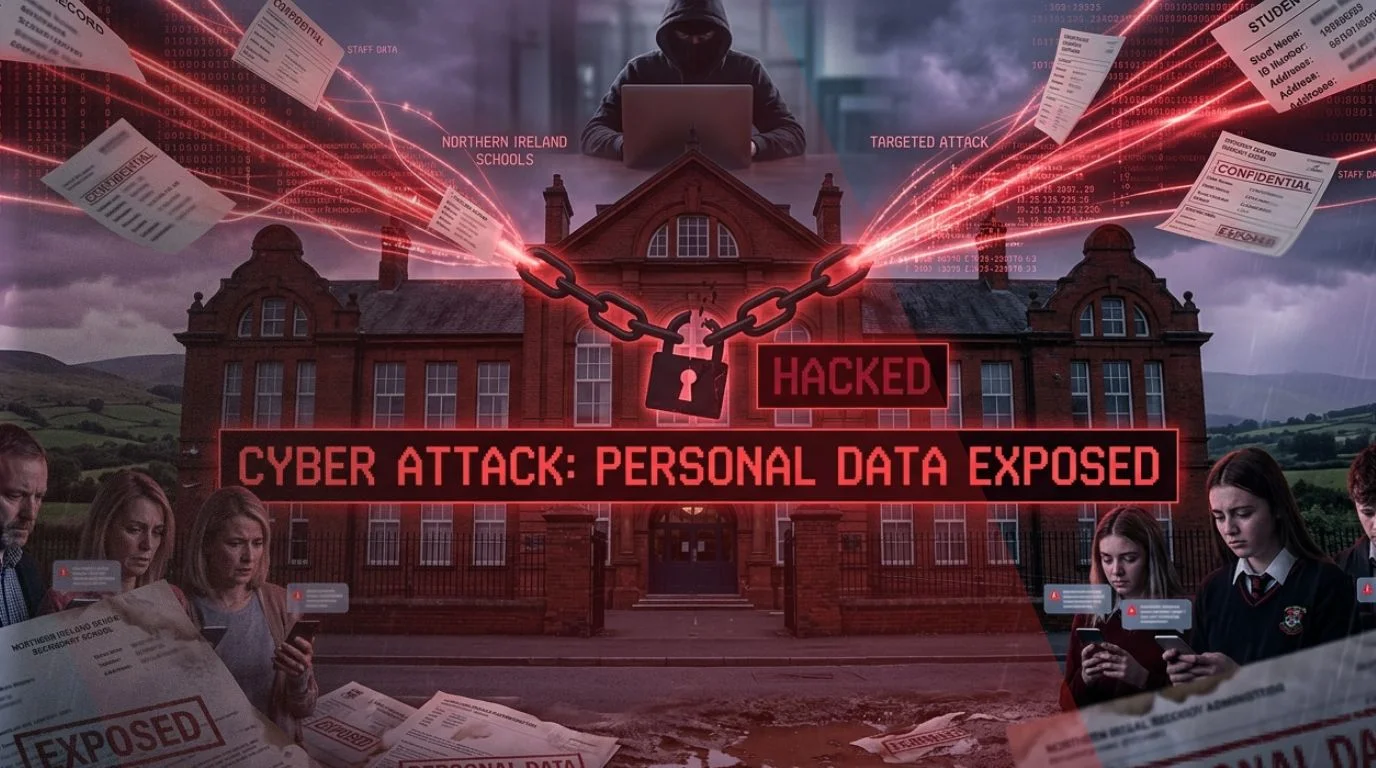
The Education Authority cyberattack investigation has confirmed that a recent incident involved a targeted attack on a small number of schools, leading to the compromise of some personal data. The update comes days after the incident was first reported, with new findings shedding light on the nature and impact of the breach. According to officials, the Education Authority cyberattack was identified on April 10, 2026, when authorities were alerted to suspicious activity affecting school systems. Forensic experts have since determined that attackers gained specific and targeted access to personal information linked to certain schools.

Targeted Nature of Education Authority Cyberattack

The latest findings indicate that the Education Authority cyberattack was not a widespread system breach but a focused attack on select institutions. Investigators confirmed that personal data was accessed in these cases, though the full extent of the compromised information has not yet been disclosed. Authorities had earlier stated that there was no evidence of data exfiltration or corruption. That assessment was based on initial findings, with officials noting at the time that the investigation was ongoing. The updated confirmation reflects the results of a more detailed forensic review, which required analysis across multiple systems. The breach is believed to have occurred before additional cybersecurity measures were implemented by the authority earlier this month.

Investigation and Law Enforcement Involvement

The Education Authority cyberattack is currently under active investigation, with law enforcement agencies involved. The Police Service of Northern Ireland and the Information Commissioner’s Office were notified immediately after forensic experts confirmed that personal data had been accessed. Officials stated that details of the incident are being disclosed publicly following an arrest made by the police. Prior to this development, authorities had withheld information to avoid interfering with ongoing investigations. The involvement of regulatory and law enforcement bodies highlights the seriousness of the Education Authority cyberattack, particularly given the sensitivity of data held by educational institutions.

Containment and System Recovery Efforts

System managers have assessed that the Education Authority cyberattack has been contained. Additional security measures were deployed as soon as the incident was detected, aimed at preventing further unauthorized access. Efforts are now focused on restoring normal operations. Work is ongoing to reconnect affected schools to the C2k system, which supports digital services across the education network. Officials said that restoring full functionality remains a priority while ensuring system security. The authority has also urged users to reset their C2k passwords as a precautionary step.

Notification of Affected Individuals

Authorities have confirmed that individuals whose personal data may have been compromised in the Education Authority cyberattack will be notified. The process of informing affected schools and individuals is currently underway and is being guided by the final findings of the investigation, along with advice from relevant authorities. Officials acknowledged the concern such incidents may cause and said efforts are being made to communicate with impacted parties as quickly as possible. At the same time, they noted that certain details cannot yet be disclosed publicly due to the ongoing police investigation. Further updates are expected once authorities are able to share more information without affecting the case.

Ongoing Monitoring and Next Steps

The Education Authority cyberattack remains under close monitoring as forensic analysis continues. Investigators are working to fully understand how the breach occurred and whether additional risks remain. While the incident appears to be contained, the confirmation of targeted access to personal data underscores the risks facing education systems, which often manage sensitive information across interconnected platforms. Authorities have indicated that further updates will be provided as the investigation progresses and more details become available.

Hackers Exploit Kali Forms Vulnerability to Take Over WordPress Sites

Kali Forms vulnerability

A recently disclosed Kali Forms vulnerability affecting a widely used WordPress plugin has escalated into an active security threat, enabling unauthenticated attackers to achieve Remote Code Execution on affected websites. The flaw impacts Kali Forms, a drag-and-drop form builder with more than 10,000 active installations, and has already been exploited in the wild shortly after public disclosure.  Security researchers reported that the vulnerability was first submitted on March 2, 2026, through a bug bounty program, identifying a critical Remote Code Execution issue in the Kali Forms vulnerability chain. The vendor released a patched version on March 20, 2026, and the issue was simultaneously added to the Wordfence Intelligence database. On the same day, attackers began actively exploiting it on scale. 

Timeline of the Kali Forms Vulnerability in the WordPress Plugin Ecosystem 

The Kali Forms vulnerability followed a rapid disclosure-to-exploitation cycle: 
  • March 2, 2026: Initial submission of the Remote Code Execution flaw via bug bounty reporting. 
  • March 5, 2026: Wordfence Premium, Care, and Response users received firewall protection. 
  • March 20, 2026: Patched version released; vulnerability publicly disclosed; attackers began exploiting the same day. 
  • April 4, 2026: Free Wordfence users received delayed firewall protection. 
  • April 4–10, 2026: Peak exploitation activity observed against the Kali Forms vulnerability. 
The patched release addressed the issue in version 2.4.10 of the WordPress plugin, while all versions up to and including 2.4.9 remained vulnerable. 

Technical Root Cause Behind the Kali Forms Vulnerability

The core of this WordPress plugin flaw lies in how user-supplied form data is processed and stored internally. The vulnerability resides in the form_process flow and the prepare_post_data() function, which incorrectly maps attacker-controlled input into internal placeholder storage without proper validation or allow-list restrictions.  These placeholders are later used in the _save_data() method, where unsafe execution occurs through call_user_func().  A simplified excerpt of the vulnerable logic includes: 
if (isset($this->placeholdered_data['{entryCounter}'])) {    $this->placeholdered_data['{entryCounter}'] =        call_user_func($this->placeholdered_data['{entryCounter}'], $this->post->ID); } 
Because the Kali Forms vulnerability allows attackers to fully control values like {entryCounter} and {thisPermalink}, an unauthenticated user can inject arbitrary PHP function names. These are then executed directly, resulting in Remote Code Execution (RCE) attacks.  Researchers noted that the lack of input restrictions in prepare_post_data() enables overwriting internal placeholders. As a result, attacker-controlled values flow directly into call_user_func(), making exploitation trivial once the request is submitted.  One observed abuse pattern demonstrates authentication bypass attempts using built-in WordPress functions. For example, attackers can assign: 
  • {entryCounter} = wp_set_auth_cookie  
  • formId = 1  
This leads to execution of wp_set_auth_cookie(1), which may log attackers in as the default administrator account if it exists, effectively turning the Kali Forms vulnerability into a full account takeover vector. 

Active Exploitation of the Kali Vulnerability in Real-world Attacks 

Telemetry from security monitoring shows that exploitation began immediately after disclosure. Attackers have been systematically targeting the WordPress plugin using automated requests to admin-ajax.php.  A representative exploit request includes: 
POST /wp-admin/admin-ajax.php HTTP/1.1 Content-Type: application/x-www-form-urlencoded action=kaliforms_form_process& data[formId]=1& data[nonce]=66ddddb2b7& data[entryCounter]=wp_set_auth_cookie 
This confirms how the Remote Code Execution flaw is triggered through manipulated form submission data.  Security systems recorded significant attack volume: 
  • Over 312,200 exploit attempts were blocked targeting the Kali Forms vulnerability. 
  • Heavy targeting was observed immediately after March 20, 2026 disclosure. 
  • Increased spike in activity between April 4 and April 10, 2026. 

Top Attacking IP Addresses Observed 

Threat intelligence identified several IPs responsible for large-scale exploitation attempts: 
  • 209.146.60.26 – over 152,000 blocked requests  
  • 49.156.40.126 – over 50,000  
  • 124.248.183.139 – over 26,000  
  • 202.56.2.126 – over 14,000  
  • 130.12.182.154 – over 11,000  
  • 104.28.160.197 – over 9,000  
  • 1.53.114.181 – over 5,700  
  • 157.15.40.74 – over 3,000  
  • 114.10.99.126 – over 2,500  
  • 83.147.12.83 – over 1,300  
These sources were repeatedly associated with exploitation attempts targeting the Kali Forms vulnerability in the affected WordPress plugin. 

Dark Web Article Contest Offers $10,000 for Exploit Writing on TierOne Forum

dark web article contest

In an unusual development within the underground cyber world, a dark web article contest has been announced on a well-known dark web forum, TierOne forum. The initiative is backed by a $10,000 prize pool. The contest places a spotlight on technical writing centered around vulnerability exploitation, offering insight into how knowledge is shared and rewarded in these spaces.  Traditionally, dark web forums have been linked to illicit activities such as trading stolen data, coordinating ransomware attacks, and distributing malware. However, this contest introduces a different dynamic, one that mirrors legitimate cybersecurity ecosystems, where researchers document findings and share exploit techniques.  

The Dark Web Article Contest Overview and Prize Structure 

According to an official announcement shared by an administrator on the forum, the post states: “Всем привет! Мы рады сообщить T1 erone [КОНКУРС СТАТЕЙ #1 - 2026]. Победители конкурса получают призы: 1 место 5.000$, 2 место - 3.000$, 3 место - 2.000$, [Призовой фонд 10.000$]. Прием статей начинается 13.04.2026 и заканчивается 14.05.2026.”   The announcement indicates that the dark web article contest will run from April 13, 2026, to May 14, 2026, with prize amounts set at $5,000 for first place, $3,000 for second place, and $2,000 for third place, making up a total prize pool of $10,000, reportedly sponsored by the ransomware group cry0. 

Topics Focused on Vulnerability Exploitation 

The contest invites submissions covering a wide range of advanced topics related to vulnerability exploitation with real-world applicability. These include: 
  • Remote Code Execution (RCE) through deserialization flaws in React and Node.js frameworks. 
  • Command injection attacks in APIs and backend systems. 
  • Insecure Direct Object Reference (IDOR) vulnerabilities in SaaS platforms. 
  • Server-Side Template Injection (SSTI) in modern templating engines. 
  • Exploitation of insecure deserialization in PHP and Java. 
  • Client-side RCE via Markdown or Office file rendering. 
  • Firmware attacks targeting routers and cameras. 
  • Privilege escalation techniques in RouterOS and similar systems. 
  • Exploitation methods for products from Cisco, MikroTik, Oracle, and Ubiquiti. 
  • Zero-day discovery in browser components like WebGPU and Blink. 
  • AI-assisted vulnerability discovery and reverse engineering. 
  • Techniques for bypassing AV and EDR security systems. 
  • Exploitation of Remote Procedure Call (RPC) mechanisms. 
For context, vulnerabilities such as RCE, IDOR, and SSTI allow attackers to execute arbitrary code or access restricted data, while firmware attacks enable persistent control over hardware devices. Similarly, AV/EDR bypass techniques are designed to evade detection by modern security solutions. 

Participation Rules and Requirements 

The TierOne forum has outlined strict guidelines for participants. Articles must be published within the forum’s designated section and include a specific prefix to qualify: 
  • Submissions must be posted under the Articles section with the prefix “[Contest]”. 
  • A link to the article must be shared in the contest thread with a participation note. 
  • All users are eligible, regardless of registration date or activity level. 
  • The use of multiple accounts is strictly prohibited. 
In addition, the contest enforces content quality standards: 
  • Articles must be original and based on the author’s own experience. 
  • Copy-pasted or reposted material is not allowed. 
  • Submissions should comprehensively cover the chosen topic, including tools, techniques, and methodologies. 
  • Minimum length requirement is at least one A4 page. 
  • Excessive filler content is discouraged. 
  • Including video demonstrations may improve chances of winning. 

A Glimpse into Dark Web Knowledge Sharing 

While the existence of such a contest may seem surprising, it notes a bigger trend within dark web forums. Beyond illegal marketplaces and data trading, these platforms also function as hubs for technical exchange, where members document and refine vulnerability exploitation techniques. In many ways, the structure resembles legitimate bug bounty programs and penetration testing workflows, where cybersecurity professionals publish detailed reports on discovered flaws. The key difference lies in the intent and environment in which this knowledge is applied. It is important to note that this article does not endorse participation in such activities. Instead, it aims to shed light on how these underground ecosystems operate. The TierOne forum contest highlights that even within the dark web, there are organized efforts to produce structured, experience-based technical content, albeit in a context that raises ethical and legal concerns.

Financial cyberthreats in 2025 and the outlook for 2026

In 2025, the financial cyberthreat landscape continued to evolve. While traditional PC banking malware declined in relative prevalence, this shift was offset by the rapid growth of credential theft by infostealers. Attackers increasingly relied on aggregation and reuse of stolen data, rather than developing entirely new malware capabilities.

To describe the financial threat landscape in 2025, we analyzed anonymized data on malicious activities detected on the devices of Kaspersky security product users and consensually provided to us through the Kaspersky Security Network (KSN), along with publicly available data and data on the dark web.

We analyzed the data for

  • financial phishing,
  • banking malware,
  • infostealers and the dark web.

Key findings

Phishing

Phishing activity in 2025 shifted toward e-commerce (14.17%) and digital services (16.15%), with attackers increasingly tailoring campaigns to regional trends and user behavior, making social engineering more targeted despite reduced focus on traditional banking lures.

Banking malware

Financial PC malware declined in prevalence but remained a persistent threat, with established families continuing to operate, while attackers increasingly prioritize credential access and indirect fraud over deploying complex banking Trojans. To the contrary, mobile banking malware continues growing, as we wrote in detail in our mobile malware report.

Infostealers and the dark web

Infostealers became a central driver of financial cybercrime, fueling a growing dark web economy where stolen credentials, payment data, and full identity profiles are traded at scale, enabling widespread and destructive fraud operations.

Financial phishing

In 2025, online fraudsters continued to lure users to phishing and scam pages that mimicked the websites of popular brands and financial organizations. Attackers leveraged increasingly convincing social engineering techniques and brand impersonation to exploit user trust. Rather than relying solely on volume, campaigns showed greater targeting and contextual adaptation, reflecting a maturation of phishing operations.

The distribution of top phishing categories in 2025 shows a clear shift toward digital platforms that aggregate multiple user activities, with web services (16.15%), online games (14.58%), and online stores (14.17%) leading globally. Compared to 2024, the rise of online games and the decline of social networks and banks indicate that attackers are increasingly targeting environments where users are more likely to take a risk or engage impulsively. Categories such as instant messaging apps and global internet portals remain significant phishing targets, reflecting their role as communication and access hubs that can be exploited for credential harvesting.

TOP 10 categories of organizations mimicked by phishing and scam pages that were blocked on home users’ devices, 2025 (download)

Regional patterns further reinforce the adaptive nature of phishing campaigns, showing that attackers closely align category targeting with local digital habits. For example, online stores dominate heavily in the Middle East.

TOP 10 categories of organizations mimicked by phishing and scam pages that were blocked on home users’ devices in the Middle East, 2025 (download)

Online games and instant messaging platforms feature more prominently in the CIS, suggesting a focus on younger or highly connected user bases.

TOP 10 categories of organizations mimicked by phishing and scam pages that were blocked on home users’ devices in the CIS, 2025 (download)

APAC demonstrates almost equal shares of online games and banks which signifies a combined approach targeting different users.

TOP 10 categories of organizations mimicked by phishing and scam pages that were blocked on home users’ devices in APAC, 2025 (download)

In Africa, a stronger emphasis on banks reflects the continued importance of traditional financial services. Most likely, this is due to the lower security level of the financial institutions in the region.

TOP 10 categories of organizations mimicked by phishing and scam pages that were blocked on home users’ devices in Africa, 2025 (download)

Whereas in LATAM, delivery companies appearing in the top categories indicate attackers exploiting the growth of e-commerce logistics.

TOP 10 categories of organizations mimicked by phishing and scam pages that were blocked on home users’ devices in Latin America, 2025 (download)

Europe presents a more balanced distribution across categories, pointing to diversified attack strategies.

TOP 10 categories of organizations mimicked by phishing and scam pages that were blocked on home users’ devices in Europe, 2025 (download)

Attackers actively localize their tactics to maximize relevance and effectiveness.

The distribution of financial phishing pages by category in 2025 reveals strong regional asymmetries that reflect both user behavior and attacker prioritization.

Globally, online stores dominated (48.45%), followed by banks (26.05%) and payment systems (25.50%). The decline in bank phishing may suggest that these services are becoming increasingly difficult to successfully impersonate, so fraudsters are turning to easier ways to access users’ finances.

However, this balance shifts significantly at the regional level.

In the Middle East, phishing is overwhelmingly concentrated on e-commerce (85.8%), indicating a heavy reliance on online retail lures, whereas in Africa, bank-related phishing leads (53.75%), which may indicate that user account security there is still insufficient. LATAM shows a more balanced distribution but with a higher share of online store targeting (46.30%), while APAC and Europe display a more even spread across all three categories, pointing to diversified attack strategies. These variations suggest that attackers are not operating uniformly but are instead adapting campaigns to regional digital habits, payment ecosystems, and trust patterns – maximizing effectiveness by aligning phishing content with the most commonly used financial services in each market.

Distribution of financial phishing pages by category and region, 2025 (download)

Online shopping scams

The distribution of organizations mimicked by phishing and scam pages in 2025 highlights a clear shift toward globally recognized digital service and e-commerce brands, with attackers prioritizing platforms that have large, active user bases and frequent payment interactions.

Netflix (28.42%) solidified its ranking as the most impersonated brand, followed by Apple (20.55%), Spotify (18.09%), and Amazon (17.85%). This reflects a move away from traditional retail-only targets toward subscription-based and ecosystem-driven services.

TOP 10 online shopping brands mimicked by phishing and scam pages, 2025 (download)

Regionally, this trend varies: Netflix dominates heavily in the Middle East, Apple leads in APAC, while Spotify ranks first across Europe, LATAM, and Africa. Although most of the top platforms are highly popular across different regions, we may suggest that the attackers tailor brand impersonation to regional popularity and user engagement.

Payment system phishing

Phishing campaigns are impersonating multiple payment ecosystems to maximize coverage. While PayPal was the most mimicked in 2024 with 37.53%, its share dropped to 14.10% in 2025. Mastercard, on the contrary, attracted cybercriminals’ attention, its share increasing from 30.54% to 33.45%, while Visa accounted for a significant 20.06% (last year, it wasn’t in the TOP 5), reinforcing the growing focus on widely used banking card networks. The continued presence of American Express (3.87%) and the increasing number of pages mimicking PayPay (11.72%) further highlight attacker experimentation and regional adaptation.

TOP 5 payment systems mimicked by phishing and scam pages, 2025 (download)

Financial malware

In 2025, the decline in users affected by financial PC malware continued. On the one hand, people continue to rely on mobile devices to manage their finances. On the other hand, some of the most prominent malware families that were initially designed as bankers had not used this functionality for years, so we excluded them from these statistics.

Changes in the number of unique users attacked by banking malware, by month, 2023–2025 (download)

Windows systems remained the primary platform targeted by attackers with financial malware. According to Kaspersky Security Bulletin, overall detections included 1,338,357 banking Trojan attacks globally from November 2024 to October 2025, though this number is also declining due to increasing focus on mobile vectors. Desktop threats continued to be distributed via traditional delivery methods like malicious emails, compromised websites, and droppers.

In 2025, Brazilian-origin families such as Grandoreiro (part of the Tetrade group) stood out for their constant activity and global reach. Despite a major law enforcement disruption in early 2024, Grandoreiro remained active in 2025, re-emerging with updated variants and continuing to operate. Other notable actors included Coyote and emerging families like Maverick, which abused WhatsApp for distribution while maintaining fileless techniques and overlaps with established Brazilian banking malware to steal credentials and enable fraudulent transactions on desktop banking platforms. Besides traditional bankers, other Brazilian malware families are worth mentioning, which specifically target relatively new and highly popular regional payment systems. One of the most prominent threats among these is GoPix Trojan focusing on the users of Brazilian Pix payment system. It is also capable of targeting local Boleto payment method, as well as stealing cryptocurrency.

There was also a surge in incidents in 2025 in which fraudsters targeted organizations through electronic document management (EDM) systems, for example, by substituting invoice details to trick victims into transferring funds. The Pure Trojan was most frequently encountered in such attacks. Attackers typically distribute it through targeted emails, using abbreviations of document names, software titles, or other accounting-related keywords in the headers of attached files. Globally in the corporate segment, Pure was detected 896 633 times over 2025, with over 64 thousand users attacked.

Contrary to PC banking malware, mobile banker attacks grew by 1.5 times in 2025 compared to the previous reporting period, which is consistent with their growth in 2024. They also saw a sharp surge in the number of unique installation packages. More statistics and trends on mobile banking malware can be found in our yearly mobile threat report.

Complementing traditional financial malware, infostealers played a significant role in enabling financial crime both on PCs and mobile devices by harvesting credentials, cookies, and autofill data from browsers and applications, which attackers then used for account takeovers or direct banking fraud. Kaspersky analyses pointed to a surge in infostealer detections (up by 59% globally on PCs), fueling credential-based attacks.

Financial cyberthreats on the dark web

The Kaspersky Digital Footprint Intelligence (DFI) team closely monitors infostealer activity on both PC and mobile devices to analyze emerging trends and assess the evolving tactics of cybercriminals.

Fraudsters especially target financial data such as payment cards, cryptocurrency wallets, login credentials and cookies for banking services, as well as documents stored on the victim’s device. The stolen data is collected in log files and shared on dark web resources, where they are bought, sold, or distributed freely and then used for financial fraud.

With access to financial data, fraudsters can gain control of users’ bank accounts and payment cards, and withdraw funds. Compromised accounts and cards are also frequently used in subsequent activities, turning the victims into intermediaries in a fraud scheme.

Compromised accounts

Kaspersky DFI found that in 2025, over one million online banking accounts (these are not Kaspersky product users) served by the world’s 100 largest banks fell victim to infostealers: their credentials were being freely shared on the dark web.

The countries with the highest median number of compromised accounts per bank were India, Spain, and Brazil.

The chart below shows the median number of compromised accounts per bank for the TOP 10 countries.

TOP 10 countries with the highest compromised account median (download)

Compromised payment cards

Seventy-four percent of payment cards that were compromised by infostealer malware, published on dark web resources and identified by the Digital Footprint Intelligence team in 2025, remained valid as of March 2026. This means that attackers could still use the cards that had been stolen months or even years prior.

It should be noted that the number of bank accounts and payment cards known to have been compromised by infostealers in 2025 will continue to rise, because fraudsters do not publish the log files immediately after the compromise but only after a delay of months or even years.

Data breaches

Regardless of the industry in which the target company operates, data breaches often expose users’ financial data, including payment card information, bank account details, transaction histories and other financial information. As a consequence, the compromised databases are sold and distributed on underground resources.

It should be noted that the threat is not limited to the exposure of financial information alone. Various identity documents and even seemingly public data, such as names, phone numbers and email addresses, can become a risk when they are published on the dark web. Such data attracts fraudsters’ attention and can be used in social engineering attacks to gain access to the user’s financial assets.

An example of a post offering a database

An example of a post offering a database

Sale of bank accounts and payment cards

The dark web often features services provided by stores that specialize in selling bank accounts and payment cards. Fraudsters typically obtain data for sale from a variety of sources, including infostealer logs and leaked databases, which are first repackaged and then combined.

Examples of a post (top) and a site (bottom) offering payment cards

Examples of a post (top) and a site (bottom) offering payment cards

Often, sellers offer complete victim profiles, referred to by fraudsters as “fullz”. These include not only bank accounts or payment cards but also identification documents, dates of birth, residential addresses, and other personal details. A full‑information package is usually more expensive than a payment card or a bank account alone.

Examples of a post (top) and a site (bottom) offering bank accounts

Examples of a post (top) and a site (bottom) offering bank accounts

Compiled databases

Fraudsters exploit various sources, including previously leaked databases, to compile new, thematic ones. Finance- and, in particular, cryptocurrency-related databases, are among the most popular. Compilations aimed at specific user groups, such as the elderly or wealthy people, are also of interest to cybercriminals.

Usually, thematic databases contain personal information about users, such as names, phone numbers, and email addresses. Fraudsters can use this data to launch social engineering attacks.

An example of a message offering compiled databases

An example of a message offering compiled databases

Creation of phishing websites

Phishing websites have become a powerful tool for the financial enrichment of fraudsters. Cybercriminals create fraudulent sites that masquerade as legitimate resources of companies operating in various industries. Gambling and retail sites remain among the most popular targets.

In order to obtain personal and financial information from unsuspecting users, adversaries seek out ways to create such phishing websites. Ready-made layouts and website copies are sold on the dark web and advertised as profitable tools. Moreover, fraudsters offer phishing website creation services.

Examples of posts offering creation of phishing websites

Examples of posts offering creation of phishing websites

Conclusion

The decline of traditional PC banking malware is not an indicator of reduced risk; rather, it highlights a redistribution of attacker effort toward more efficient methods targeting mobile devices, credential theft, and social engineering. Infostealers, in particular, are a force multiplier, enabling widespread compromise at scale.

Looking ahead to 2026, the financial threat landscape is expected to become even more data-driven and automated. Organizations must adapt by focusing on identity protection, real-time monitoring, and cross-channel threat intelligence, while users must remain vigilant against increasingly sophisticated and personalized attack techniques.

Hong Kong Police Can Force You to Reveal Your Encryption Keys

According to a new law, the Hong Kong police can demand that you reveal the encryption keys protecting your computer, phone, hard drives, etc.—even if you are just transiting the airport.

In a security alert dated March 26, the U.S. Consulate General said that, on March 23, 2026, Hong Kong authorities changed the rules governing enforcement of the National Security Law. Under the revised framework, police can require individuals to provide passwords or other assistance to access personal electronic devices, including cellphones and laptops.

The consulate warned that refusal to comply is now a criminal offense. It also said authorities have expanded powers to take and keep personal electronic devices as evidence if they claim the devices are linked to national security offenses.

❌