 Entrar
Automobile Camouflage to Hide from Flock Cameras
Not sure it’s practical, but it’s certainly striking.

Not sure it’s practical, but it’s certainly striking.
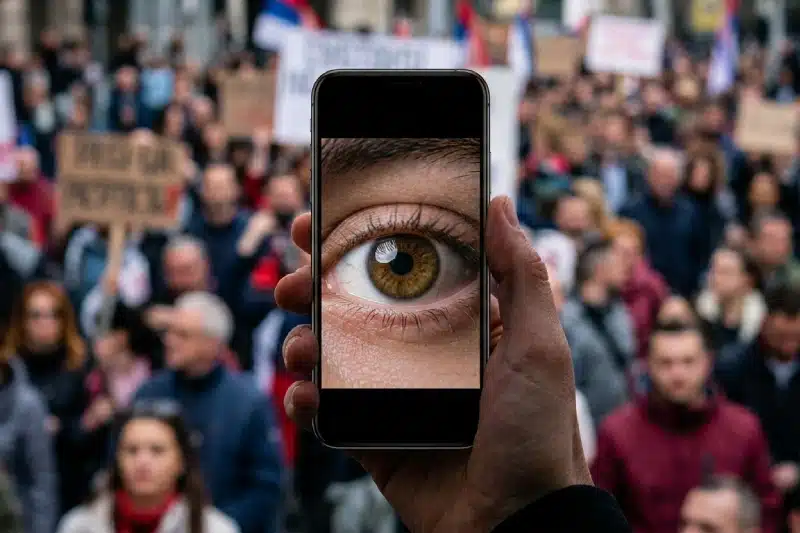
At least 14 people connected to Serbia's student protest movement and opposition politics have been targeted with mercenary spyware since early 2026, the Belgrade-based digital rights organization SHARE Foundation said, in what it called the largest documented wave of such targeting in the country.
The group said the cohort includes student movement members, civil society activists, a member of parliament and a local councilor. Forensic analysis was independently confirmed by the Citizen Lab at the University of Toronto and by Amnesty International's Security Lab.
Citizen Lab, in its own findings, said it verified an infection with NSO Group's Pegasus on the iPhone of a student activist who asked not to be named. High-confidence infection indicators span December 2025 through January 2026, delivered by a zero-click iMessage exploit that required no interaction from the target. Apple has since patched the underlying flaw; the fix shipped in iOS 18.4.1. Pegasus grants an operator access to notes, photographs and messages decrypted on the device, and can silently activate the microphone and camera.
Amnesty's Security Lab confirmed a new variant of NoviSpy, an Android implant first identified in Serbia in 2024, on two additional devices. SHARE said the rebuilt version was designed to evade the detection methods that exposed its predecessor.
The circumstances of two infections are what elevate the findings beyond routine spyware reporting. SHARE said one NoviSpy infection appeared after police seized a student's phone during questioning, and another after private messages from that device were published by a pro-government media outlet. Donncha Ó Cearbhaill, who heads Amnesty's Security Lab, said the evidence suggests "infections are being carried out during detention by Serbian authorities."
Suspicion centers on Serbia's Security Information Agency, or BIA. Amnesty's December 2024 report "A Digital Prison" found earlier NoviSpy samples configured to send collected data to IP addresses associated with BIA servers, and documented the agency's parallel use of Cellebrite extraction tools on journalists and activists. In March 2025, Amnesty reported that two journalists at the Balkan Investigative Reporting Network were targeted with Pegasus.
The current cases surfaced through Apple's threat notification wave of Aug. 13, which reached users in 110 countries. The timing is politically loaded. The targeting overlaps with protests that followed the November 2024 collapse of a railway station canopy in Novi Sad, spans local elections held March 29 in 10 municipalities, and precedes October parliamentary elections widely read as a test of the ruling Serbian Progressive Party.
Ana Toskic Cvetinovic, a legal expert cited in the reporting, noted that deploying intrusive software without judicial authorization is unlawful under Serbian law. SHARE published an analysis of the domestic legal framework in January arguing the same. Criminal complaints filed over the 2024 cases remain pending before Serbian courts, with no resolution.
NSO has been on the U.S. Commerce Department's Entity List since 2021.
Serbia is an accession candidate, the European Parliament has previously questioned the Commission over unlawful spyware use in the country, and the Commission published its 2026 enlargement country report in July. Amnesty's submission for that package raised surveillance directly.
Both groups urged at-risk users to enable Lockdown Mode on iOS or Advanced Protection on Android.

Comcast has added motion detection as a feature to its wireless routers:
The feature sends push notifications to users when motion is detected near a connected device, such as a TV or printer. It has different settings for when people are home, asleep, or away. The Xfinity app also lets users see live motion activity and a feed of recent activity.
Comcast acknowledges that the system has some limitations. Home size, layout, building materials, and the placement of the router and connected devices can all affect its ability to detect motion. Comcast says it does not guarantee its performance.
Sounds like a great surveillance tool. And also:
But the biggest privacy concern comes directly from Comcast’s own support page, which says information generated by WiFi Motion may be shared with third parties.
“Comcast may disclose information generated by your WiFi Motion to third parties without further notice to you in connection with any law enforcement investigation or proceeding, any dispute to which Comcast is a party, or pursuant to a court order or subpoena,” the page reads.

The New York Times has a long article (alt link) on surveillance systems aimed at babies. They are increasingly using AI.
Nanit and its rivals want to own 24/7 health tracking for the sub-four-foot set. And their already astonishing levels of baby data collection are just the beginning. Nanit recently raised $50 million from investors to expand its use of A.I. and use its camera to track speech and language development, motor skills and more, while extending its presence in children’s bedrooms into early adolescence.
The Kansas City-based cybersecurity researcher Bill Swearingen spent the past year doing something that sounds almost too simple to work: printing patterns, watching cameras fail to detect them, and repeating. TechCrunch reports that after roughly 31 million tests, he can now generate patterns on demand that block license plate readers and surveillance cameras from recognizing whatever the pattern covers, whether that’s a person or a vehicle.
The project is called noRecognition, and the core idea isn’t stealth in the traditional sense. The camera still records everything just fine. What breaks is the detection layer sitting on top of the footage, the software that flags license plates, tracks faces, or spots “activity of interest” across thousands of hours of video. Swearingen’s patterns don’t hide you from the lens; they make the algorithm looking through that lens shrug and move on.
Swearingen, co-founder of the SecKC meetup, said his project started for personal reasons. He became concerned about the growing number of surveillance cameras in his town and the possibility of being tracked while attending a protest.
What started as a simple experiment later became a reinforcement learning system. He taught the model to create patterns, learn from failures and keep improving. Over time, it learned how to avoid detection by several camera systems.
Every time a pattern failed and got detected, the system adjusted and tried again, eventually learning to defeat multiple detection algorithms simultaneously rather than just one at a time.
The research dashboard behind the project, published at sandbox.norecognition.org, goes considerably deeper into the numbers than the headline claim suggests, and it’s refreshingly upfront about what’s proven versus what isn’t. The team states its overall objective plainly as “one pattern that defeats every detector,” and by their own account that goal remains only partially met. Their strongest validated result against a detector extracted directly from a real deployed surveillance camera sits at 61.7% non-detection across held-out test subjects, a solid number, but nowhere near total, and still a digital simulation rather than a real-world fabric test.
That distinction matters more than it might seem. Most of the dashboard’s headline figures are explicitly labeled as digital, simulated results, meaning the pattern was tested against a virtual camera and printed ink model rather than an actual garment photographed by an actual camera in the field. The gap between “works in simulation” and “works when Donut Media wraps a real 2009 Toyota Yaris in it,” which is the physical test Swearingen ran live at DEF CON, is exactly the gap this kind of research has to close before anyone should treat it as a reliable, everyday privacy tool.
“On Friday at the Def Con cybersecurity conference in Las Vegas, Swearingen ran his first real-world test. With help from Donut Media, the test involved covering a 2009 Toyota Yaris with one of Swearingen’s newest patterns to see if the car would be invisible to detection by a Flock camera.” reports TechCrunch.
“We proved it was effective,” said Swearingen, though the wheels were a challenge. The video of the demo will be out in the next few weeks, said Donut Media.”
That DEF CON demo is where things got concrete. Swearingen covered a car in one of his newest patterns and tested it against a Flock Safety camera, the kind widely deployed for automated license plate reading across the US. He said the test proved effective, though the vehicle’s wheels turned out to be a persistent weak point, curved surfaces apparently don’t cooperate with flat printed patterns the way a car door does.

Swearingen is not publishing his best patterns because he does not want camera makers to easily find and block them. Instead, he is using crowdfunding to develop and sell printed products such as T-shirts and hoodies, with vehicle wraps possibly coming later.
It is still unclear whether the project will become a practical privacy tool for everyday users or remain mainly a DEF CON demonstration. Its real effectiveness will depend on how well the patterns work on real clothing, in different weather and camera conditions.
Follow me on Twitter: @securityaffairs and Facebook and Mastodon
(SecurityAffairs – hacking, Surveillance camera)
Federal court records show how far the FBI’s Pegasus review progressed — and why new US spyware reporting will still leave major gaps in government hacking transparency.
The post FBI Pegasus Records Expose a Blind Spot in US Spyware Oversight appeared first on TechRepublic.
U.S. courts will begin separately tracking spyware-based interceptions, giving the public new data on government hacking while leaving key gaps.
The post US Courts To Begin Publishing Spyware Records From 2029 appeared first on TechRepublic.

In May 2026, we discovered a new cyber-espionage campaign by the Armored Likho group, also known as Eagle Werewolf, that targets private individuals and organizations across various industries in Russia, including major corporations, the public sector, IT, and education. The attackers used a fake app as bait that mimics a service for donations. However, the most interesting part of this campaign isn’t the initial infection method – it’s the malicious implants the attackers use for cyber-espionage.
We’ve written previously about recent Armored Likho attacks, but our analysis shows that the campaign discussed below has more in common with the group’s activity from February. That said, the attackers have significantly expanded their arsenal.
During our research, we found a new cyber-espionage toolkit written in Rust: the Still Toolkit. One of its components, Still Sync, steals Telegram session data to gain ongoing access to the victim’s account. With this stolen data, attackers can leverage the Telegram API to automatically pull chat logs, media files, and other information from the account.
The second component, Still Audio, is an implant for covert audio surveillance. It analyzes the incoming audio stream, automatically detects speech, records conversations, and sends the recordings to a command-and-control server.
In this article, we’ll look at the initial infection method, how the new Still Toolkit components are built, and the technical details of how they operate.
Kaspersky products detect this threat as Trojan.Win64.Agent.* and HEUR:Backdoor.Win32.Generic.
Armored Likho’s malicious activity has been documented several times before: in November 2024, and in February and July 2026. The current campaign shows significant overlap with the November and February campaigns, which used malicious droppers disguised as documents and applications related to Starlink activation or fundraising efforts as the initial infection vector. This campaign also uses fundraising as its lure. At the same time, our research uncovered a number of new tools that point to the attackers expanding their capabilities.
The infection chain starts with an app that mimics a donation service. As of this writing, the app distribution method remains unknown. During our research, however, we obtained several samples posing as apps from different Russian foundations.
In reality, the app is a dropper. Its developers wrote it in Rust on top of the popular Tauri framework, and it has a graphical interface designed to deceive the user. After launch, it displays a login form that asks for a password, presumably one the attackers supplied.
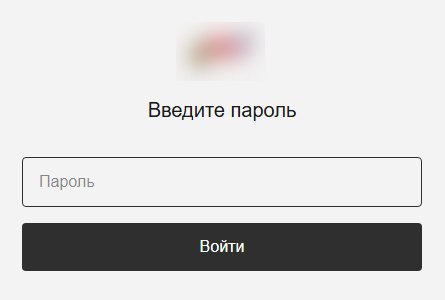
The login form
After the user enters a valid password, they see a catalog of donatable items. The app pulls item and category information from orderapiserver[.]info through the public/categories and public/products endpoints. A clickable catalog makes the app look legitimate. While the user browses the items, the dropper quietly decrypts and launches the payload for the next stage in the background.
Our analysis shows that the mechanism for decrypting the payload and launching subsequent stages hasn’t changed since the February campaign. However, we found a new cyber-espionage toolkit – the Still Toolkit – made up of two components: Still Sync and Still Audio.
Still Sync is a stealer written in Rust that steals Telegram session data. However, its capabilities don’t stop there. With this stolen data, Sync can log in to the victim’s account and pull messages and media files through the Telegram API.
Architecturally, Sync is an asynchronous application based on the Tokio library. It talks to the server over gRPC and serializes messages with FlatBuffers. It supports both HTTP and HTTPS as transport protocols; the URL of the command-and-control server determines which one it uses.
When Sync launches, the attackers set several environment variables. Before starting any malicious activity, the implant pulls configuration parameters from these:
https://tg4service[.]com:443.tdatatdata folder, if Telegram data encryption is enabled on the victim’s device.Sync also supports several command-line arguments:
--console: runs as a console application. If this parameter is absent, the implant creates a TReload service to keep running in the background.--version: prints version information and exits.--firefly: launches a trace thread that monitors the program’s operation. It writes error messages to a hidden file, bin, located in the same folder as the main executable.--db: turns on debug mode with detailed logging.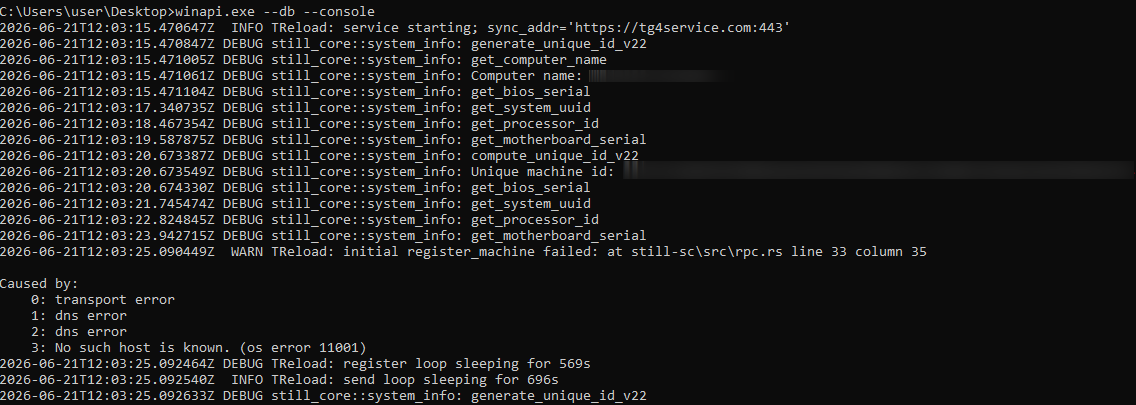
Example Still Sync logs
Once it launches, the malware begins registering the device with the C2 server. To do this, Sync collects the following information about the victim’s system:
The malware combines the collected data into a single string with a colon as the separator. It then hashes that string with SHA-256 and stores the resulting hash under the key sysmarker. Worth noting: other Armored Likho tools, AquilaRAT included, use this same hashing algorithm.
Sync then serializes a package containing all the collected information and the agent version, and sends it in a POST request to /still.rpc.Sync/RegisterMachine. The response contains a machine_id value, which Sync uses to identify itself in subsequent requests.
Once registration succeeds, Sync sends a POST request with the machine_id parameter to /still.rpc.Sync/GetMachineSettings. The server responds with the following settings:
tdata We’ll cover this feature in more detail below.These parameters have no default values, so Sync doesn’t perform any malicious actions until the registration and settings-retrieval processes both complete successfully.
Before stealing a Telegram session, Sync searches for the tdata folder, unless the STILL_SEND_PATH variable is already set. The list of search paths includes both standard and nonstandard directories, if the scan_portable option is turned on:
Sync then sends a POST request with a list of files from the tdata folder to the /still.rpc.Sync/CheckFiles endpoint. The server responds with the following values:
This lets the C2 server avoid re-receiving files it already has. In addition, if Sync can’t access files on disk through standard methods, it falls back on three mechanisms that abuse the SeBackupPrivilege privilege:
CreateFileW function using the FILE_FLAG_BACKUP_SEMANTICS parameterBeyond stealing Telegram session data, Sync can carry out full-scale collection of user information from the messaging app. When the fetch_telegram option is on, it launches a separate thread that authenticates to the chat app using the previously obtained tdata. Once authentication succeeds, Sync gains access to the account data and sends the following collected information to the server:
Still Audio is an audio surveillance implant written in Rust. Its main job is to analyze the incoming audio stream and start recording voice when certain conditions are met – we’ll cover those in the next section. Architecturally, Still Audio largely mirrors Sync and uses the same mechanisms for communicating with the C2 server.
On launch, Still Audio performs a sequence of actions:
libmp3lame.dll, a file stored inside the executable. This is a library used to encode audio data.--console command-line argument is absent, the implant creates a service named auxhost, connects to it, and continues running in the background.logfile.log, to write logs to.Next, Still Audio retrieves the C2 server address. As with Sync, it stores the URL in an environment variable – in this case, STILL_AUDIO_SYNC_ADDR. If that variable isn’t set, it falls back to STILL_SYNC_ADDR, which shows the two modules are compatible with each other. If neither variable is set, it uses the default URL, https://srwinservice[.]com.
Still Audio also uses the Dead Drop Resolver technique as a fallback mechanism for obtaining the C2 address. If the current server stays unreachable for three days, the tool tries to pull the current C2 URL from a GitHub repository. In the sample under analysis, we found the following URL for the page containing C2 information: hxxps://raw.githubusercontent[.]com/mmarln/pi-mono/refs/heads/main/packages/pods/src/array12.json
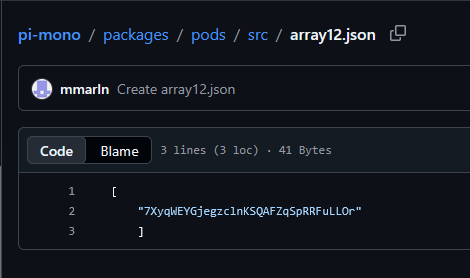
Encrypted C2 address inside the GitHub repository
The repository, a fork of a popular project, contains the server URL Base64-encoded and encrypted with the Blowfish algorithm in ECB mode, using the key 5c8e153228edd3c6cbf75684 (lowercase string). Older AquilaRAT samples use this exact same algorithm and key.
Once it obtains the current C2 address, the Audio module starts a registration process similar to Sync’s, but through a different endpoint:
/still.rpc.Audio/RegisterAudioMachine. Also, unlike Sync, Audio sends a list of available audio input devices along with the system information.
The server responds with settings for the implant:
Still Audio works with raw audio samples it captures directly from the input device. To detect voice activity, it implements an algorithm based on Root Mean Square (RMS), a lightweight signal-processing method that distinguishes speech from silence by measuring the audio signal’s average power over time. The implant doesn’t rely on any third-party libraries here; it implements all the calculations itself.
The implant compares the calculated RMS value against the vad_threshold parameter. If RMS meets or exceeds this threshold, recording starts. To avoid losing the beginning of the recording, Still Audio uses a pre-buffer, a size-limited buffer that stores samples from just before the current recording moment. A sequence of max_silence_duration samples (320 by default) with RMS values below the threshold signals the end of the recording. For example, with a standard headset running at a 44.1kHz sampling rate, recording stops after roughly 7ms of silence.
Interestingly, the Audio module makes no attempt to hide its use of the microphone: its name shows up in Windows settings. In the sample we examined, the file was saved to disk as IntAudio.exe, and it appeared in the list of apps using the microphone as “Intel Audio”:

The malicious module in the list of apps using the microphone
Before sending recordings to the server, the implant uses the libmp3lame library to encode the raw audio samples. It sends the recording files via a POST request to /tgfrg, adding a Client-Id header containing the machine_id obtained during registration to identify the device.
This campaign draws on a broad set of hosting providers and domains registered at different points in time, which suggests the attackers are trying to make their infrastructure harder to detect. We found no direct overlap in domains or IP addresses with the February campaign. Even so, the two infrastructures share some similarities:
| Domain | IP address | Registration date | ASN |
| orderapiserver[.]info | 187.127.153[.]38 | April 18, 2026 | 47583 |
| tg4service[.]com | 159.198.37[.]74 | October 4, 2025 | 22612 |
| srwinservice[.]com | 213.252.244[.]123 | March 19, 2026 | 61272 |
| screenserv[.]com | 23.26.237[.]250 | February 13, 2026 | 149440 |
| windowserv[.]net | 23.27.24[.]30 | February 10, 2026 | 149440 |
| managementapiservice[.]com | 188.212.124[.]178 | May 1, 2026 | 202448 |
| service8date[.]com | 145.223.69[.]143 | January 13, 2026 | 215311 |
| updateservs[.]com | 145.223.68[.]66 | December 23, 2025 | 215311 |
In this campaign, we’ve determined that the attackers’ primary targets are users in Russia. Most victims are private individuals, though the corporate sector, government organizations, IT companies, and educational institutions are also affected.
This campaign has been using both new tools and malware families documented in BI.ZONE’s February report. While some components turned up for the first time, they show significant code-level overlap with malicious tools seen in earlier Armored Likho campaigns. Based on these overlaps, along with additional technical artifacts, we’re highly confident the Armored Likho group is behind the campaign. The overlaps we identified include:
ICRYPTMP header, and the same multi-part encryption format.sysmarker value in older AquilaRAT samples and in the Still toolkit from the current campaign. The algorithms match down to the PowerShell commands used to collect system information.The campaign described in this post shows Armored Likho’s toolkit evolving, with the group steadily expanding its cyber-espionage capabilities. Beyond the components we already knew about, the attackers rolled out new modules that let them not only access Telegram data but also conduct audio surveillance on victims. Together, these capabilities significantly widen the range of information attackers can collect in a single compromise.
One point deserves particular attention: the new tools form a cohesive set, sharing similar architecture, C2 communication mechanisms, and common implementation elements. This points to the group building out its own tool ecosystem, designed for long-term use and further expansion.
The emergence of new, specialized modules shows the attackers aren’t just trying to preserve their existing capabilities – they’re working to make intelligence-gathering more effective by controlling multiple communication channels at once.
Additional information about this threat, indicators of compromise included, is available to customers of Kaspersky Threat Intelligence Reporting. Contact intelreports@kaspersky.com for more details.
File hashes
Droppers
C1D1EE16B92E6A138FFA048855F75D7D
17674B250D8B422A50A86C9FF207186D
62801F6223E860A7CCA271522E303B2D
Still Sync
68F0365D2FA8C828D012D8859E52A773
4BD7C352AE277B0E38D07BEEDD4DD507
D4BC09FB10EA2A5DC0BCBEEDA5E5AFDD
Still Audio
2CA8ADBAB98EBE305EACF272CF48F5A0
3AC41B097236A7723821848AE31EF141
439255736797BC88BD19F282449E0436
Domains
orderapiserver[.]info
tg4service[.]com
srwinservice[.]com
screenserv[.]com
windowserv[.]net
managementapiservice[.]com
service8date[.]com
updateservs[.]com

There are many companies manufacturing adversarial clothing designed to confuse facial recognition systems.
It’s a cool idea, but I worry that it’s mostly security theater:
“Our patterns play with that chaos, confuse algorithms and make it way harder to pin you down,” he said.
Bell, however, said “none of these products are tried and tested, and a lot of these surveillance technologies can deal with a little resistance … [but] even if the designs don’t necessarily work perfectly, fashion is also a visible sign of resistance.
“This is consumers collectively coming together to make a visible statement.”
Without serious testing, there is no reason to trust the technology. And even with testing, there is no reason to trust that a new version of the facial recognition software doesn’t break the anti-surveillance properties.
I don’t want people to mistakenly rely on this stuff.
Last month, the story broke (alternate link) that Madison Square Garden uses facial recognition software on everyone entering the facility, and—among other groups—flags activists that oppose using facial recognition.
Turns out that the system was shut off for Taylor Swift’s wedding.
Evan Greer—one of the people that MSG alerts on—comments:
Ironically, Swift herself has reportedly used facial recognition at her own concerts to identify stalkers. This “privacy for me, surveillance for thee” attitude feels like a perfect encapsulation of the future we’re already living in: one where wealthy elites can afford privacy, while the rest of us are forced to live in a corporate surveillance panopticon.
Whatever privacy measures Swift had in place for the wedding seems to have worked. No photos have leaked online.
Governments are switching, but I’m not sure it makes a difference:
…some municipalities, including Denver, Colorado, are ditching their Flock arrays. But keep in mind that if they’re only switching from Flock to another brand of license-plate readers, like Axon, it’s like a gambling addict trying to kick the habit by switching from FanDuel to DraftKings.
[…]
Despite what you may read on the Flock website, Axon cameras are pretty effective when it comes to hoovering up personal details that can go far beyond your license plate numbers. That means a municipality that opts for Axon cameras instead of Flock units won’t necessarily reduce the amount privacy its citizens lose through their use.
Yet another Israeli mass surveillance company:
Made by Israeli surveillance company Cognyte, the tech simulates a mobile phone tower, which forces nearby phones to connect to it. That enables cops to keep tabs on any phones in the vicinity whether they’re owned by a suspect in a case or not. Cognyte’s contract with the state of Texas reveals that the simulator, called FalcoNet, can be concealed within the vehicles, hidden in a backpack for on-foot missions or attached to a helicopter. It’s the same technology as the infamous Stingray, one of the original cell-site simulators made by defense giant L3Harris.
It’s a lot:
According to information obtained by The Tech, MIT is spending over $3 million on more than 500 AI surveillance cameras in academic buildings, residence halls, and outdoor areas along Memorial Drive. Installation of the new cameras, along with the wiring and infrastructure that will support them, began November 2025 and will likely continue until September 2026.
Technical specifications for the cameras suggest that they will be capable of collecting real-time face and object classification data, including detection of motion, loitering, crowds, face masks, and camera tampering. Individuals can also be automatically classified on the basis of clothing color, gender, and age, up to a distance of 35 feet (11 meters) from the camera. According to a statement from MIT spokesperson Kimberly Allen, any collected data is “retained up to 30 days,” unless an exception is granted.
[…]
Most of the new cameras, which are part of Hanwha’s Wisenet AI line, are marketed for their ability to identify and classify multiple objects with deep learning algorithms. They support resolutions ranging from 2MP to 4K while also recognizing faces, license plates, vehicles, and other objects in real time.
Nearly all cameras will accommodate a wide range of pan, tilt, rotate, and zoom motion and will be monitored continually with Ai-RGUS, an AI camera software.
Yikes.
New York will ban Meta and other smart glasses from all 1,240 state courts starting July 20 over privacy and recording concerns.
The post New York Bans Smart Glasses Across 1,240 Courts appeared first on TechRepublic.
In the near future, AI-powered surveillance systems will be able to track everything we do in public, and much of what we do in private. And if we do something wrong—shoplift, litter, jaywalk, you name it—the system will notice, retain it, tie it to your official government record, communicate that fact to you, and provide real-time alerts to any relevant authorities… and maybe also to the general public.
Think of these systems as automated speed cameras, but on steroids. Only they’ll enforce not just speed limits, but any other rule you can imagine. And you won’t receive a ticket weeks later by mail; you’ll be informed about and fined for your violation immediately.
These systems will combine powerful AI, public and private surveillance via real-time facial recognition technology and digital tracking, mass databases and highly personalized enforcement. If deployed at scale, they will have profound chilling effects not just on personal freedoms, but democracy and social progress itself.
China has been developing its surveillance infrastructure for years. The country has over 600 million surveillance cameras, increasingly powered by AI and facial recognition to enforce legal and social rules. Take the case of Lao Duan, a Chinese citizen blacklisted by the system after he lost his job and was unable to repay a series of loans. When he visited Beijing, the city’s AI surveillance system identified him by his face at a major intersection and displayed his face, name and citizen ID number on a large electronic billboard nearby with a message that he was an untrustworthy person. Similar systems are now being deployed across China and integrated with its infamous online monitoring, censorship and social credit systems.
AI surveillance is now being experimented with in North America, South America, Europe, Asia and Africa. According to a new report, the US Department of Homeland Security is rapidly increasing its use of AI-based surveillance, including facial recognition and the monitoring of social media accounts, to keep tabs on immigrants, dissidents, journalists, legal observers and protesters. While the systems are ostensibly used to maintain security and public safety, the real aim is often social control. Larry Ellison, CEO of Oracle—a powerful tech giant that works closely with the Trump administration—has said: “Citizens will be on their best behavior because we’re constantly recording and reporting.” The chilling effects are the point.
AI surveillance raises a range of public policy challenges: technical biases, unauditable systems, and inflexible automated law and social rule enforcement that can promote discrimination and undermine transparency, accountability and the rule of law. But we believe the most urgent and long-term impact will be its broader chilling effects.
In a new book, Chilling Effects: Repression, Conformity, and Power in the Digital Age, Jon Penney explains how surveillance, technology and power can be weaponized to influence behavior at scale. Surveillance, personalization, uncertainty and authority are all key mechanisms to increase the scale and impact of chilling effects. They cause people to self-censor their words and actions, to become more conformist and compliant and thus easier to manage and control. And the effects are additive: the more mechanisms employed, and the more powerful the form, the greater the chill.
Computerization has long allowed data collectors to track our locations, collect lists of whom we communicate with, and monitor our spending habits—unless we use cash. What’s new is an unprecedented fusion of each of these mechanisms, persistent and unrelenting. AI brings an analytical ability to spy on the contents of our communications, and to answer sophisticated questions about our whereabouts and activities: actions that previously required human analysts are now automated. The result will be a kind of supercharged societal level of chilling effects where fear, self-censorship and groupthink reign, and dissent, creativity and innovation become increasingly rare.
In this atmosphere of fear and conformity, risky ideas, social activism and self-reinvention—especially by disfavored groups and targeted populations—are also chilled. This will have long-term effects on social progress.
Consider the relatively recent societal normalization of same-sex relationships and the recreational use of marijuana. Over the decades, those ideas slowly progressed from being both immoral and illegal, to moral but still illegal, and finally to both moral and legal. But in order for any of that to happen, there had to be a counterculture that was able to experiment and eventually demonstrate to the world that morality could change over time. To the extent that AI surveillance chills this sort of experimentation in public or in private, social progress becomes impossible.
There are no real historical precursors to this; these technologies are too new. Even the most notorious and large-scale domestic surveillance program in US history, the FBI’s use of wiretapping, physical mail opening, informants and paper index cards to track alleged communists during the 1950s and 1960s, appears genuinely archaic in light of modern AI-enhanced surveillance. So does East Germany’s human-centric surveillance network during the cold war. Only science fiction, from the likes of George Orwell or Aldous Huxley, comes close. But even Big Brother’s “telescreen” feels decidedly mid-20th-century by comparison.
But we need not sit idly. Now that we recognize the danger of AI-enhanced mass surveillance, we can make the policy choices not to implement it. Bans on facial recognition and other forms of identification tech can slow development; robust new privacy and data protections can restrict data tracking and retention; AI regulations can curtail its most invasive uses; and structural reforms can help us scrutinize and break up powerful state/tech cartels that pave the way for technological excesses like AI surveillance.
The chill of AI-powered mass surveillance will suffocate the very foundations of healthy democratic societies. But we can still choose a different path.
This essay was written with Jon Penney, and originally appeared in The Guardian.
