Microsoft brings the popular PowerToys Windows 11 mouse indicator to the OS natively. Learn how to easily locate your cursor on high-resolution screens.
The AhnLab SEcurity intelligence Center (ASEC) recently identified a phishing email campaign that disguised itself as a request to review a quote. The threat actor impersonated a sales team member at a specific overseas company and, by claiming that a previous quote needed to be revised and product versions verified, tricked recipients into opening the […]
The Americas carried the heaviest ransomware burden of any region on the planet in the first half of 2026. According to Cyble Research and Intelligence Labs (CRIL), North and South America combined experienced 2,188 documented ransomware attacks between January and June 2026.
That single figure — 2,188 attacks — represents more than 57% of the 3,836 ransomware incidents CRIL tracked worldwide, making the Americas the undisputed center of gravity for global ransomware operations.
But the Americas is not a single threat theatre — it is two. North America alone absorbed 1,981 attacks, driven by a mature, multi-group Ransomware-as-a-Service (RaaS) economy competing for market share. South America, by contrast, recorded 207 attacks concentrated around a much smaller set of operators, with one group — The Gentlemen — claiming nearly a quarter of all regional incidents outright. Understanding the Americas means understanding both halves of that story: a saturated northern market and a consolidating southern one.
North America vs. South America: Two Distinct Ransomware Landscapes
Security leaders operating across the hemisphere cannot apply a single threat model to both sub-regions. The data shows meaningfully different attacker behavior, concentration, and monetization strategy north and south of the equator.
Metric
North America
South America
Ransomware Attacks
1,981
207
Dominant Ransomware Actor
Qilin (370 attacks)
The Gentlemen (46 attacks)
Top Targeted Sector
Construction
IT & ITES
Top Targeted Nation
United States (1,721)
Brazil (71)
Distinct Ransomware Groups Active
50+
30+
% of Attacks from Top 3 Groups
~40% (Qilin, Akira, INC Ransom)
~57.5% (The Gentlemen, Qilin, LockBit)
Why the split matters: North America's threat landscape is a genuine marketplace — dozens of RaaS operators compete for affiliate loyalty, and no single group commands more than a fifth of total volume. South America's landscape is more consolidated, with three groups controlling well over half of all attacks.
For defenders, that means North American organizations need broad-spectrum threat intelligence covering a long tail of active groups, while South American organizations can build highly specific defenses against a short list of named adversaries.
The Five Dominant Ransomware Groups Targeting Americas
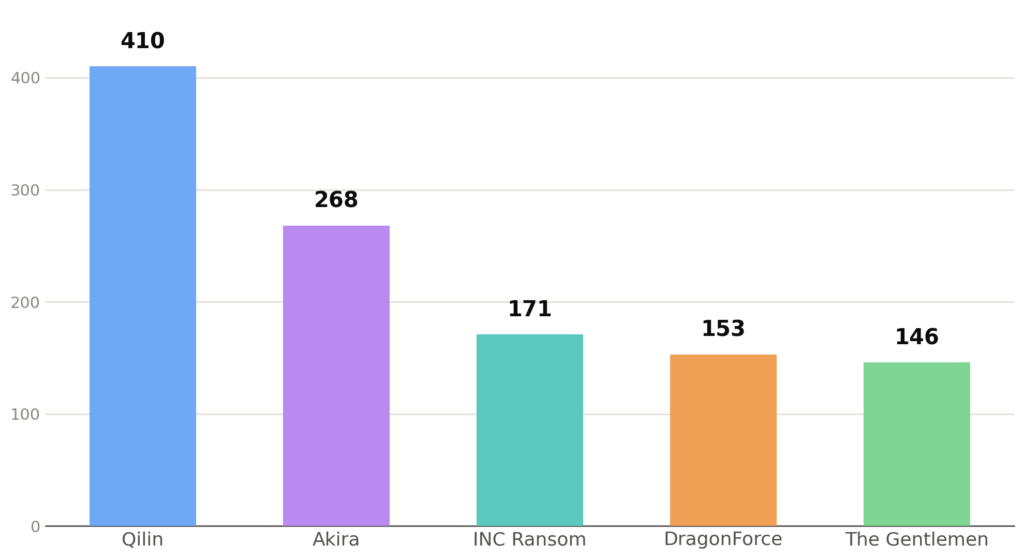
Across both sub-regions combined, five ransomware operators account for the overwhelming share of documented activity: Qilin, Akira, INC Ransom, Dragonforce, and The Gentlemen. Together, these five groups are linked to roughly 1,148 of the Americas' 2,188 attacks — approximately 52.5% of all regional ransomware activity.
Fig. Top five ransomware groups in Americas for H1 2026 (Source: CRIL)
1. Qilin: The Biggest Ransomware Threat in the Americas
Attack Volume: 410 documented incidents across the Americas (370 in North America, 40 in South America) — 18.7% of the regional total.
Qilin is the single most prolific ransomware actor operating in the hemisphere, and its dominance is not evenly spread — it is concentrated hardest in the United States.
Geographic Concentration:
United States: 323 attacks (the single largest country-level concentration of any group, anywhere)
Canada: 33 attacks
Argentina: 13 attacks
Broader South America: 40 attacks
Worldwide Sectoral Targeting: Qilin's targeting logic is deliberate rather than opportunistic:
Construction: 108 incidents (primary focus)
Professional Services: 90 incidents (legal, accounting, consulting firms)
Manufacturing: 67 incidents
Healthcare: 53 incidents
IT & ITES: 43 incidents
Operational Characteristics:
Qilin's affiliate model is built for scale. Initial access brokers handle reconnaissance and compromise, mid-tier operators manage lateral movement, and dedicated crews execute encryption and exfiltration. This compartmentalization lets Qilin run dozens of concurrent operations across the United States without any single point of failure. The group's near-total dominance of the American ransomware market (323 of 1,721 US attacks) suggests either an unusually large affiliate roster or a payout structure attractive enough to pull operators away from competing platforms.
Rapid Exploit Weaponization: Fast turnaround from vulnerability disclosure to active exploitation
Sector Fluency: Deep understanding of which industries face the highest downtime cost
Established Data Brokerage Ties: Exfiltrated data reliably reaches monetization channels
Americas Security Implications: Any organization in construction, professional services, manufacturing, or healthcare operating in the US or Canada should treat Qilin as a primary named threat, not a generic ransomware risk.
2. Akira: North America's Persistent Operator
Attack Volume: 268 documented incidents, almost entirely concentrated in North America — 12.2% of the regional total
Akira is the second most active group in the Americas, and unlike Qilin, its footprint is almost exclusively North American. CRIL's data shows Akira's South American presence is negligible to date.
Geographic Concentration:
United States: 247 attacks (92% of Akira's total Americas volume)
Canada: Remaining North American activity
South America: Minimal to no confirmed activity
Worldwide Sectoral Targeting:
Construction: 57 incidents
Manufacturing: 54 incidents
Professional Services: 47 incidents
Consumer Goods: 19 incidents
IT & ITES: 16 incidents
Operational Characteristics:
Akira has built a reliable playbook around compromising small-to-medium-sized businesses through unpatched public-facing network devices, then pivoting into construction and manufacturing environments where downtime tolerance is lowest. The group's consistency — rather than explosive growth — is its defining trait; it has neither the explosive scale of Qilin nor the geographic diversification of The Gentlemen, but it reliably executes against the same target profile month after month.
Americas Security Implications: North American SMBs in construction, manufacturing, and professional services should assume Akira is actively scanning for exposed remote access infrastructure. Its South American absence should not be mistaken for permanence — RaaS groups expand geographically once North American markets saturate.
3. INC Ransom: The Law-Firm Specialist
Attack Volume: 171 documented incidents (164 in North America, 7 in South America) — 7.8% of the regional total
INC Ransom distinguishes itself through sector specialization rather than volume. The group shows a clear, repeated preference for Professional Services organizations — particularly law firms — leveraging the sensitive, high-stakes nature of legal client data.
Geographic Concentration:
United States: 154 attacks
Canada: 6 attacks
Brazil: 4 attacks
Worldwide Sectoral Targeting:
Professional Services: 58 incidents (primary focus, with a documented preference for law firms)
Construction: 27 incidents
Manufacturing: 26 incidents
Healthcare: 21 incidents
Organisation/Non-profit: 12 incidents
Operational Characteristics:
INC Ransom's rapid operational pace and consistent targeting of law firms, healthcare providers, and transportation/energy operators reflects a strategy built entirely around double-extortion leverage. The sensitivity of the data matters more than the size of the victim. A regional law firm holding privileged client communications is, to INC Ransom, a more valuable target than a much larger manufacturer with less sensitive data.
Americas Security Implications: Law firms, accounting practices, and consulting shops across the US, Canada, and Brazil should assume INC Ransom is actively targeting client confidentiality as leverage — not just encrypting file servers for disruption.
4. Dragonforce: The Cross-Border Supply-Chain Operator
Attack Volume: 153 documented incidents (148 in North America, 5 in South America) — 7.0% of the regional total
Dragonforce maintains an aggressive operational tempo focused heavily on the United States, with a strategy that suggests supply-chain-aware targeting rather than random opportunism.
Geographic Concentration:
United States: 135 attacks
Canada: 11 attacks
South America: 5 attacks
Worldwide Sectoral Targeting:
Construction: 48 incidents
Manufacturing: 31 incidents
Professional Services: 28 incidents
IT & ITES: 18 incidents
BFSI: 17 incidents
Operational Characteristics:
Dragonforce's manufacturing and construction focus mirrors Qilin's and Akira's playbooks, but its concentration in the US combined with limited-but-present South American activity hints at interest in transnational manufacturing supply chains. North American organizations with manufacturing partners or subsidiaries in Latin America should treat this as a lateral-access risk, not just a direct-targeting one.
Americas Security Implications: Manufacturers and construction firms with cross-border operations — a common structure across USMCA supply chains — should extend Dragonforce-specific monitoring to subsidiaries and vendors, not just headquarters networks.
5. The Gentlemen: South America's Dominant Threat
Attack Volume: 146 documented incidents (100 in North America, 46 in South America) — 6.7% of the regional total, but the single most active ransomware group in South America specifically.
While The Gentlemen rank fifth across the combined Americas, they are the #1 threat actor in South America on their own — responsible for roughly 22% of every ransomware attack recorded in that sub-region.
Geographic Concentration:
United States: 77 attacks
North America: 100 attacks
Brazil: 15 attacks
South America: 46 attacks (largest single-group share in the sub-region)
Worldwide Sectoral Targeting:
Manufacturing: 56 incidents
Construction: 45 incidents
Healthcare: 37 incidents
IT & ITES: 36 incidents
Consumer Goods: 34 incidents
Operational Characteristics:
The Gentlemen are a relatively new operator that has achieved outsized scale in a short window, and their South American concentration is the most important regional signal in this dataset. Unlike Qilin or Akira — which built North American dominance first and are only beginning to diversify — The Gentlemen appear to have prioritized South America as a primary theatre from early in their operational life, an unusual strategic choice that may reflect lower defensive maturity, less aggressive law enforcement cooperation, or simply less competitive pressure from other RaaS operators in the sub-region.
Americas Security Implications: South American organizations — especially in healthcare, manufacturing, and IT services — should treat The Gentlemen as their single highest-priority named adversary. North American organizations should not discount them either; 100 US-focused attacks is a substantial footprint for a group still building its brand.
Other Notable Threats: Play, LockBit, and CL0P
Three additional groups warrant inclusion in any Americas threat model:
Play (144 attacks, North America only): Continues its "Big Game Hunting" approach layered with high-volume SMB attacks via unpatched public-facing network devices, concentrated almost entirely on US and Canadian construction, professional services, and manufacturing targets.
LockBit (80 attacks combined — 47 in North America, 33 in South America): Despite sustained international law enforcement pressure and repeated takedown attempts, LockBit remains operationally resilient across both sub-regions, notably compromising Chile's Clínica Dávila in South America.
CL0P (93 attacks combined — 91 in North America, 2 in South America): Operated differently from its peers, executing a large-scale campaign concentrated in January and February 2026 that exploited a single zero-day vulnerability across hundreds of organizations at once — reminiscent of the group's historical MOVEit campaign.
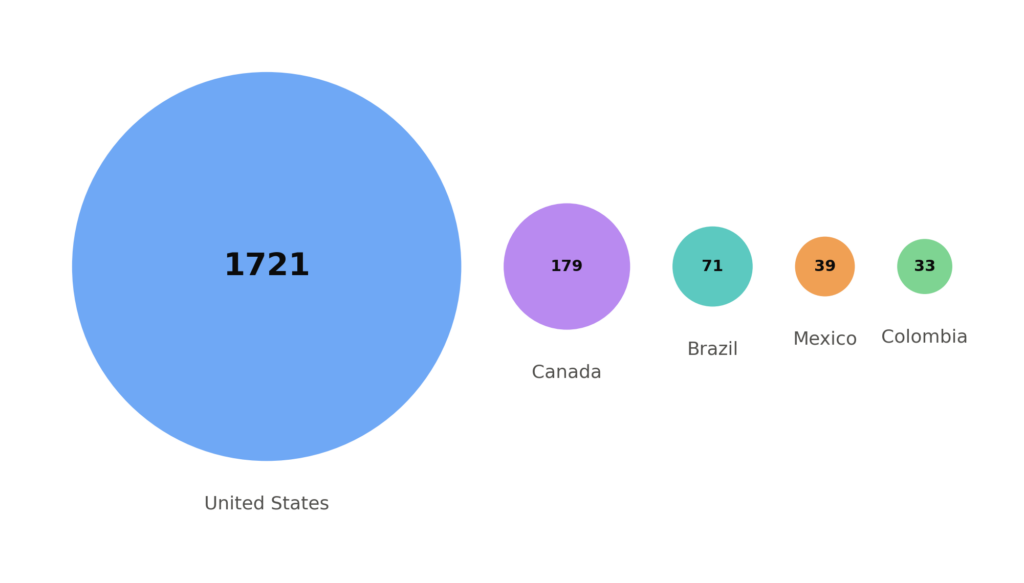
Fig. Most targeted countries in Americas for H1 2026 (Source: Cyble)
United States: The Global Ransomware Epicenter
Attack Volume: 1,721 ransomware attacks — 78.7% of all Americas ransomware activity, and roughly 45% of every ransomware attack recorded worldwide.
No other country on Earth comes close to the volume of ransomware activity absorbed by the United States in H1 2026. The country functions as the default target for nearly every major RaaS operator active today.
Threat Actor Concentration:
Qilin: 323 attacks
Akira: 247 attacks
INC Ransom: 154 attacks
Dragonforce: 135 attacks
Play: 134 attacks
Sectoral Breakdown: Manufacturing, Professional Services, Construction, and Healthcare bear the brunt, consistent with the broader North American pattern of operationally sensitive, low-downtime-tolerance industries.
Why the United States Faces Maximum Pressure
The scale of the US economy, its dense concentration of mid-market manufacturers, law firms, and healthcare providers, and its comparatively high ransom-payment history combine to make it the most economically rational target for every major ransomware operator. US organizations also frequently anchor cross-border supply chains stretching into Canada, Mexico, and South America — meaning a US compromise can cascade into lateral access against hemispheric partners.
Defensive Priority: US organizations across construction, manufacturing, professional services, and healthcare should assume Qilin, Akira, INC Ransom, Dragonforce, Play, and The Gentlemen are all actively scanning for exploitable entry points into their networks simultaneously — not sequentially.
Canada: The Cross-Border Extension
Attack Volume: 179 ransomware attacks — 8.2% of the regional total.
Canada's threat profile closely tracks the United States, reflecting deep economic integration and shared supply chains rather than a distinct targeting logic of its own.
Sectoral Breakdown: Manufacturing, professional services, and construction dominate, mirroring the US pattern almost directly.
Why Canada Faces Sustained Pressure
Canadian organizations are frequently subsidiaries, suppliers, or joint-venture partners of US enterprises, which means the same RaaS groups saturating the US market extend naturally northward. Cross-border manufacturing in particular creates lateral access opportunities that Dragonforce and Akira appear well-positioned to exploit.
Defensive Priority: Canadian organizations should not assume distance from US headquarters provides insulation — the same threat actors, exploiting the same vulnerability classes, are already active on both sides of the border.
Brazil: The Financial Malware and Ransomware Convergence Point
Attack Volume: 71 ransomware attacks — 3.2% of the regional total, but the largest single concentration in South America.
Brazil represents South America's most complex threat environment, combining traditional ransomware pressure with a maturing, sophisticated financial malware ecosystem.
Threat Actor Concentration: The Gentlemen (15 attacks), LockBit, and a fragmented tail of smaller operators.
Sectoral Breakdown: Government & Law Enforcement, BFSI, and Healthcare are the most consistently targeted sectors.
Why Brazil Faces a Dual Threat
Beyond ransomware, Brazil emerged in H1 2026 as a focal point for new Android banking trojan families — TCLBANKER and BTMOB RAT — which use self-propagation, evasion techniques, and Malware-as-a-Service (MaaS) distribution models to target banking and cryptocurrency users directly. Brazil also suffered an alleged 250-million-record breach of Serasa, one of the country's largest credit bureaus, alongside an access sale allegedly targeting the Central Bank of Brazil — a listing that, if genuine, represents one of the most significant initial-access offerings tracked anywhere in the report.
Defensive Priority: Brazilian financial institutions should treat mobile banking malware and ransomware as converging risks rather than separate problems — the same underground economy is monetizing both. Government and BFSI entities should assume access-broker listings referencing critical national infrastructure require immediate incident-response-level validation, not routine monitoring.
Mexico: The Emerging Nearshoring Risk
Attack Volume: 39 ransomware attacks — 1.8% of the regional total.
Mexico's attack volume is meaningfully lower than the US, Canada, or Brazil, but its position within North American manufacturing supply chains — accelerated by ongoing nearshoring trends — makes it a nation to watch closely rather than dismiss.
Why Mexico Warrants Increased Attention
As global manufacturers continue relocating production closer to the US market, Mexican facilities increasingly sit inside the same supply chains that Dragonforce, Akira, and Qilin already target aggressively north of the border. Lower current attack volume may reflect earlier-stage targeting rather than lower risk — a pattern security teams should not mistake for durable safety.
Defensive Priority: Manufacturers with Mexican operations should extend the same OT/IT segmentation and vulnerability management discipline applied to US and Canadian facilities to their Mexican sites, rather than treating them as lower priority.
Colombia: Where Hacktivism Meets Cybercrime
Attack Volume: 33 ransomware attacks — 1.5% of the regional total.
Colombia's ransomware volume is modest, but the country stands out for the density of ideologically motivated activity layered on top of financially driven attacks.
Why Colombia Faces a Blended Threat
Groups such as Anonymous Colombia (#OpColombia) ran active campaigns throughout H1 2026 blending website defacement, DDoS attacks, and data leak activity — consistent with the broader South American pattern in which hacktivist-branded channels frequently overlap with financially motivated cybercrime infrastructure.
Defensive Priority: Colombian government and law enforcement entities — the most frequently targeted sector across South America overall — should treat hacktivist claims as credible threat intelligence signals rather than dismissing them as purely ideological noise.
Where Americas Organizations Face Maximum Risk: A Sectoral Analysis
Professional Services: One of the Top Targets
Attack Volume: The second most heavily impacted sector in North America.
Professional services firms — law, accounting, and consulting practices — are one of the top jobs on North America's ransomware target list, driven overwhelmingly by INC Ransom and AiLock's aggressive targeting of client-confidential data.
Why Professional Services Are Targeted
Privileged Data Concentration: Legal privilege and client confidentiality create existential regulatory and reputational exposure that threat actors exploit for maximum ransom leverage.
Trust-Based Business Model: A single confirmed breach can permanently damage client relationships built entirely on confidentiality.
Documented Actor Preference: INC Ransom has shown a specific, repeated preference for law firms — this is not incidental targeting.
Notable Incident Pattern: AiLock's activity stood out for a coordinated wave of victim disclosures on a single day — March 3, 2026 — a pattern consistent with mass-exploitation of a shared vulnerability rather than individually researched targeting.
Defensive Recommendations:
Segregate client data on separate network segments with distinct, audited access controls
Deploy data loss prevention (DLP) with aggressive egress monitoring for client-data exfiltration
Maintain comprehensive access logs for all sensitive client-data touchpoints
Construction and Manufacturing: The Downtime Economy
Attack Volume: Construction and Manufacturing rank first and third in North America; combined, they represent the largest share of Qilin, Akira, Dragonforce, and The Gentlemen's worldwide targeting.
Constructions and manufacturing share a common vulnerability across the Americas: both operate on tight, contractually enforced timelines where downtime translates directly into cascading financial penalties.
Why Construction and Manufacturing Are Targeted
Time-Sensitive Financial Exposure: Missed construction deadlines trigger contractual penalties; halted production lines trigger lost revenue and breached delivery commitments.
OT/IT Convergence: Modern factories and job sites increasingly integrate operational technology with corporate IT, creating exploitation bridges unavailable in pure-IT industries.
Supply-Chain Complexity: Both industries depend on dense webs of subcontractors and suppliers — compromising one upstream partner can provide lateral access into prime contractors.
Cross-Border Exposure: US-Canada-Mexico manufacturing integration (and increasingly, US-Brazil trade relationships) means a single compromise can propagate across national borders.
Defensive Recommendations:
Implement airgapped network segmentation between OT and corporate IT environments
Prioritize vulnerability patching for network appliances and identity systems over blanket patch cycles
Maintain fully offline, immutable backups of critical project and production data
Extend third-party risk assessments to subcontractors, suppliers, and cross-border subsidiaries
Healthcare: South America's Critical Infrastructure Threat
Attack Volume: One of the top four most heavily impacted sectors in South America.
Healthcare organizations across the Americas — but particularly in South America — face a threat dynamic distinct from financial pressure alone: ransomware attacks against hospitals directly endanger patient safety.
Why Healthcare Is Targeted
Patient Safety Leverage: Downtime in diagnostic systems, pharmaceutical dispensing, and patient records directly threatens continuity of care, creating existential pressure to pay quickly.
Documented Regional Incidents: The Gentlemen's claimed attack on Primero Medicina Privada and LockBit's compromise of Chile's Clínica Dávila both illustrate ransomware groups' willingness to target hospital networks directly.
Data Value: Patient medical records and clinical data command premium prices on dark web marketplaces.
System Complexity: Healthcare IT environments blend legacy diagnostic equipment, electronic health records, and connected medical devices — each with distinct security postures.
Defensive Recommendations:
Implement complete network isolation between clinical systems and corporate IT
Deploy redundant diagnostic and pharmaceutical systems capable of manual fallback operation
Encrypt all patient medical records end-to-end
Build healthcare-specific incident response plans addressing patient notification and continuity of care
Agriculture & Livestock: The Americas' Emerging Supply-Chain Target
Attack Volume: 33% of all North American initial access listings — the second-most targeted sector in the region's access brokerage market.
A distinctive Americas finding: initial access brokers targeting the region show unusually strong interest in Agriculture & Livestock, second only to Technology.
Why Agriculture & Livestock Is an Emerging Target
North America's food supply chain increasingly depends on connected logistics, cold-chain monitoring, and precision agriculture technology — creating an attack surface that did not meaningfully exist a decade ago. Access brokers appear to be positioning themselves ahead of ransomware operators, selling footholds into agricultural operations before ransomware crews weaponize them. This mirrors a pattern seen elsewhere globally but is particularly pronounced in North America's access brokerage data.
Defensive Recommendations:
Treat agricultural technology platforms (precision ag, cold-chain IoT) with the same security rigor as manufacturing OT
Monitor initial access broker markets specifically for agriculture and food-sector listings
Build incident response plans accounting for food-supply-chain continuity, not just data confidentiality
Geopolitical and Ideological Dimensions: Hacktivism Across the Hemisphere
SOLDADOS DIGITALES – UNIÓN AMERICANA: A Hemispheric Hacktivist Collective
Unlike most hacktivist channels tracked in this report, SOLDADOS DIGITALES – UNIÓN AMERICANA operates across both North and South America, making it one of the few genuinely hemispheric threat actors identified in H1 2026 — a significant finding given how regionally siloed most hacktivist activity tends to be.
Combined Hacktivism Metrics (North + South America):
~140 confirmed data leak and dump posts across both sub-regions
At least 932 unique domains impacted (360 in North America, 572 in South America)
Primary targets: Government & LEA, Technology, BFSI, Telecommunication, Education
Notable Collectives by Sub-Region:
North America: SOLDADOS DIGITALES – UNIÓN AMERICANA, Anonymous #FreeTurtleIsland, KERALA HACKERS, LYSTIC TEAM #ID
South America: SOLDADOS DIGITALES – UNIÓN AMERICANA, Anonymous Colombia (#OpColombia) Y.A.N, BLAZER TEAM ATTACK
The Convergence Problem: As with hacktivist activity documented elsewhere in CRIL's global dataset, several Americas-based channels marketed as ideological collectives function as hybrid operations — logging DDoS attacks and defacement claims alongside stolen-data brokerage and DDoS-for-hire services. Security teams should treat these channels as credible threat intelligence sources rather than dismissing their claims as purely political theater.
Regional Threat Actor Summary: Who Targets Your Americas Organization
If You're in Professional Services:
Primary Threat: INC Ransom, Qilin
Secondary Threat: AiLock, The Gentlemen
Vulnerability: Client data exfiltration, regulatory breach-notification pressure
Inventory Network Appliances: Document every internet-facing firewall, VPN, and security gateway
Patch Critical CVEs: Prioritize Ivanti, Fortinet, Cisco, SolarWinds, and Palo Alto Networks appliances — the vendors repeatedly appearing in both the CISA KEV catalog and active exploitation campaigns
Harden Remote Access: Enforce phishing-resistant MFA on all administrative and remote access paths
Deploy Behavioral Monitoring: Watch for anomalous activity on network appliances specifically
DLP Implementation: Deploy data loss prevention with aggressive egress monitoring
Encryption Standards: Enforce encryption in transit and at rest across all sensitive data stores
Access Auditing: Maintain comprehensive logs for every access event touching sensitive data
Phase 3: Operational Resilience (90 days)
Immutable Backups: Establish offline, immutable backup infrastructure isolated from production networks
Sector-Specific Incident Response: Build playbooks addressing construction project continuity, manufacturing downtime, and healthcare patient-safety scenarios specifically
Cross-Border Continuity Planning: For organizations with US-Canada-Mexico or US-Brazil operations, extend continuity plans across all connected facilities
Recovery Testing: Conduct quarterly backup restoration drills to verify actual recovery capability
Phase 4: Threat Hunting and Detection (Ongoing)
Named-Actor Threat Intelligence: Subscribe to intelligence feeds tracking Qilin, Akira, INC Ransom, Dragonforce, and The Gentlemen specifically
Access-Broker Monitoring: Track listings for organizational exposure
Supply-Chain Monitoring: Continuously assess vendor and subsidiary security posture across borders
Mobile Malware Awareness (Brazil-specific): Financial institutions should monitor for TCLBANKER- and BTMOB RAT-style Android banking trojan activity targeting customers
Conclusion: The Americas Ransomware Reality
The Americas is not just the largest ransomware theatre in the world by volume — it is two distinct threat environments operating under a single regional label. North America hosts a saturated, competitive RaaS marketplace where no single group dominates outright. South America is consolidating around a smaller set of operators, led decisively by The Gentlemen.
Key Takeaways:
The Americas carries the global center of gravity: 2,188 of the world's 3,836 documented ransomware attacks (57%) struck North or South America in H1 2026.
Five groups anchor the threat: Qilin (410), Akira (268), INC Ransom (171), Dragonforce (153), and The Gentlemen (146) collectively account for over half of all Americas ransomware activity — but their dominance splits sharply by sub-region.
North America and South America require different playbooks: North America's threat model demands broad coverage against a long tail of competing operators; South America's demands deep, specific defense against The Gentlemen, Qilin, and LockBit.
The United States remains the world's single largest target: 1,721 attacks — nearly 45% of global ransomware volume — makes the US the default target for virtually every major RaaS operator active today.
Brazil's threat is compounding, not singular: ransomware, mass data breach, and mobile banking malware are converging in the same underground economy targeting the same financial institutions.
Sector risk follows economic logic, not chance: Professional Services, Manufacturing, Construction, Healthcare, and — distinctively for the Americas — Agriculture & Livestock face targeting because threat actors have identified specific, exploitable economic pressure points in each.
Access brokers are a leading indicator: a small number of sellers control the region's initial access market and routinely precede ransomware deployment by weeks.
For security leaders across North and South America, the strategic imperative is the same even where the tactical details diverge: know which named actors are active in your specific country and sector, prioritize risk-based patching over blanket cycles, treat data exfiltration as inevitable rather than optional, and build recovery infrastructure that assumes an attack will happen — not one that hopes it won't. The data confirms the Americas will remain the world's most heavily targeted ransomware region through the remainder of 2026. The only open question is how prepared each organization chooses to be.
Frequently Asked Questions (FAQs)
How many ransomware attacks hit the Americas in H1 2026?
2,188 documented ransomware attacks were observed across North and South America in H1 2026, according to Cyble Research and Intelligence Labs (CRIL) findings.
Which ransomware group is most active in the Americas in H1 2026?
Qilin is the most active group across the combined Americas, with 410 documented attacks (370 in North America, 40 in South America). Within South America specifically, however, The Gentlemen — not Qilin — is the dominant actor.
How many ransomware attacks hit North America in H1 2026?
CRIL recorded 1,981 ransomware attacks in North America during H1 2026, representing roughly 52% of all ransomware activity tracked worldwide.
How many ransomware attacks targeted the US in H1 2026? Is it the highest?
Yes. CRIL observed 1,721 ransomware attacks targeted at the US — which is 78.7% of the American continent (North and South, both), and nearly 45% of every ransomware attack recorded worldwide.
Which sector was the most targeted in South America?
IT & ITES remained the most targeted sector in South America for H1 2026.
Ransomware actors targeted which country the most in South America?
Brazil. With 71 attacks, it was the prime target of ransomware actors in H1 2026.
Is Brazil a significant ransomware target?
Yes. Brazil recorded 71 ransomware attacks — the highest total in South America — and additionally faced an alleged 250 million record breach at credit bureau Serasa, an access sale allegedly targeting the Central Bank of Brazil, and new Android banking trojan families (TCLBANKER, BTMOB RAT) targeting financial and cryptocurrency users.
What is the most targeted industry in the Americas?
Construction tops North America's target list, while IT & ITES, Healthcare, and Professional Services top South America's. Across the whole Americas, Construction and Manufacturing remain consistently high-risk due to their low tolerance for operational downtime.
Microsoft says China-linked Storm-1175 is using a new ransomware called StormEncryptor, replacing Medusa in its latest attacks.
Microsoft says China-linked, financially motivated threat actor Storm-1175 has begun using a new ransomware strain called StormEncryptor. The group previously relied on Medusa ransomware. StormEncryptor is written in C++ and encrypts files and adds the .encrypted extension, then leaves a !!!README_FIRST!!!.txt ransom note in each scanned directory. The change suggests an evolution in the group’s ransomware operations.
“While Microsoft has not confirmed the vulnerability targeted by Storm-1175 in this campaign, the threat actor is likely exploiting the CVE-2026-18577 authentication bypass vulnerability in N-able, which was disclosed on August 2, 2026 and added to the Cybersecurity and Infrastructure Security Agency (CISA) Known Exploited Vulnerabilities (KEV) catalog on August 3, 2026.” wrote Microsoft on X.
On August 2, 2026, the financially motivated cybercriminal actor tracked by Microsoft Threat Intelligence as Storm-1175 began deploying a new ransomware strain called StormEncryptor.
Storm-1175’s deployment of StormEncryptor marks the threat actor’s first activity observed by… pic.twitter.com/wNbchat8ZU
— Microsoft Threat Intelligence (@MsftSecIntel) August 7, 2026
Storm-1175 is known for fast ransomware campaigns that exploit newly disclosed vulnerabilities before organizations can patch them. In recent attacks, the group used tools such as AnyDesk and SimpleHelp for remote access, Advanced IP Scanner to map networks, and Mimikatz to dump LSASS credentials.
Microsoft says the attackers can move from initial access to data theft and ransomware deployment within days, highlighting the need for rapid patching and monitoring.
China-based actor Storm-1175 carries out fast, financially driven ransomware attacks by exploiting newly disclosed vulnerabilities before organizations patch them. The group targets exposed systems and quickly moves from initial access to data theft and ransomware deployment, sometimes within 24 hours. The financially motivated group mainly targets sectors such as healthcare, education, finance, and services across the US, UK, and Australia. The attackers often chain exploits, create new accounts for persistence, move laterally using remote tools, steal credentials, and weaken security defenses. Their speed and focus on unpatched systems make them highly effective.
Microsoft researchers report that the group quickly exploits newly disclosed flaws in web-facing systems to gain access. Since 2023, the group has targeted many platforms, including Microsoft Exchange, Ivanti, ConnectWise, JetBrains, and others. It often weaponizes vulnerabilities within days, or even one day, before organizations apply patches.
“Storm-1175 rapidly weaponizes recently disclosed vulnerabilities to obtain initial access.” reads the report published by Microsoft. “Since 2023, Microsoft Threat Intelligence has observed exploitation of over 16 vulnerabilities, including:
The attackers also chain multiple exploits to achieve deeper access, such as remote code execution, and have targeted both Windows and Linux systems. In some cases, the threat actor used zero-days even before public disclosure, showing advanced capabilities. By focusing on unpatched systems and acting fast, Storm-1175 maximizes impact and maintains a strong advantage over defenders.
Storm-1175 chains multiple exploits to gain deeper access, as seen in attacks on Microsoft Exchange where it moved from initial access to remote code execution. The group also targets Linux systems and has used zero-day flaws before public disclosure, showing advanced skills.
After gaining access, it installs web shells or remote tools, creates admin accounts, and moves laterally using tools like PowerShell, PsExec, RDP, and Cloudflare tunnels. It also abuses legitimate RMM tools and software like PDQ Deployer and Impacket to spread across networks. The attackers can deploy ransomware in as little as one day, highlighting their speed and efficiency.
Cisco warns that seven ClamAV flaws affect Secure Endpoint Connector products, with two having public PoCs that could enable remote DoS attacks.
Cisco warned that seven ClamAV vulnerabilities affect its Secure Endpoint Connector on Windows, macOS and Linux. ClamAV is an open-source antivirus engine widely used to scan files and emails for malware.
The company states that two flaws have public PoCs and could let unauthenticated attackers cause DoS conditions.
“Multiple vulnerabilities in ClamAV could allow a remote attacker to cause a denial of service (DoS) condition, interrupting scanning operations.” reads the advisory.
The flaws, tracked as CVE-2026-20337 to CVE-2026-20339 and CVE-2026-20345 to CVE-2026-20348, affect ClamAV parsers for several file formats. ClamAV fixed them in version 1.5.4, Cisco later warned that public PoCs are available for the vulnerabilities CVE-2026-20337 and CVE-2026-20338. Company’s PSIRT said it has no evidence that attackers have exploited these vulnerabilities in the wild.
“”The Cisco PSIRT is aware that proof-of-concept exploit code is available for the vulnerabilities that are described in CVE-2026-20337 and CVE-2026-20338.The Cisco PSIRT is not aware of proof-of-concept exploit code for any of the other vulnerabilities that are described in this advisory.” continues the advisory. “The Cisco PSIRT is not aware of any malicious use of the vulnerabilities that are described in this advisory.”
Below are the descriptions of CVE-2026-20337 and CVE-2026-20338:
CVE-2026-20337 (CVSS score of 7.5) – CVE-2026-20337: ClamAV Zip File Format Processing Out-of-Bounds Write Vulnerability – A vulnerability in the zip archive parser of ClamAV could allow an unauthenticated, remote attacker to cause a DoS condition on an affected device. This vulnerability is due to improper boundary checks for content in zip files during scanning, which may result in an out-of-bounds write condition. An attacker could exploit this vulnerability by submitting a crafted zip file for scanning. A successful exploit could allow the attacker to cause the ClamAV scanning process to terminate, resulting in a DoS condition on the affected software.
CVE-2026-20337 (CVSS score of 7.5) – ClamAV Zip File Format Processing Memory Corruption Vulnerability – A vulnerability in the zip archive parser of ClamAV could allow an unauthenticated, remote attacker to cause a DoS condition on an affected device. This vulnerability is due to improper memory handling when processing content in zip files during scanning. An attacker could exploit this vulnerability by submitting a crafted zip file for scanning. A successful exploit could allow the attacker to cause the ClamAV scanning process to terminate as a result of a memory double-free, resulting in a DoS condition on the affected software.
Cisco identified the affected products in its advisory and recommends customers check the related bug IDs for details on each vulnerability.
Secure Endpoint Private Cloud is not affected, but must distribute the fixes to endpoints.
Cisco said no workaround is available. Patches will be released in August. The flaws are high risk on Windows because ClamAV runs with elevated privileges, while macOS and Linux face medium risk.
Ransomware stopped being an isolated incident type in 2025. It became the dominant force behind the modern breach landscape, and the ransomware data breach statistics from Cyble's own tracking make the shift impossible to ignore. For organizations facing this growing threat, having a ransomware incident response plan in place is becoming just as important as preventing an attack in the first place.
Cyble's Global Cybersecurity Report 2025 documented 5,967 ransomware attacks for the year, a 50% year-over-year jump. Against the 6,046 data breaches and leaks recorded in the same period, ransomware accounted for nearly half — 49.7% — of the combined ransomware-and-breach total tracked by Cyble Research and Intelligence Labs (CRIL). That's the "nearly half" this blog's title refers to, and it isn't a projection. It's what Cyble observed.
The pace hasn't slowed into 2026:
Q4 2025 brought 2,018 claimed attacks (roughly 673 a month), and January 2026 held that pace at 679 victims, 30% above the 2025 monthly average.
Europe's Q1 2026 tally hit 462 incidents, 404 of them ransomware, with the UK as the region's most-attacked country and manufacturing/construction overtaking financial services as top targets.
Ransomware-as-a-service Threats Have Removed the Skill Barrier
CRIL identified 57 new ransomware groups and 27 new extortion groups in 2025, alongside more than 350 new ransomware strains built largely on the MedusaLocker, Chaos, and Makop families.
This is the mechanics of RaaS: affiliates rent pre-built toolkits, and operational capacity scales faster than any single group's headcount. Between January and April 2025, this dynamic drove an 86% spike in global incidents, with Cl0P alone responsible for 28% of that quarter's activity, per Cyble's Ransomware Threat Landscape report.
Double Extortion Ransomware is the Baseline, Not the Exception
Encrypt-and-leak is now standard operating procedure. CRIL's research into extortion technique evolution tracked groups layering in triple extortion (DDoS on top of encryption and data theft) and direct outreach to a victim's clients — a tactic CL0P has used to compound reputational damage beyond the initial breach. For a lean team, this means "we have backups" no longer neutralizes the threat; the data theft component still forces a decision.
Why Cost Pressure Hits Small Teams Hardest
Cyble's Europe Q1 2026 findings noted that attackers are deliberately targeting sectors with narrow downtime tolerance — manufacturing and construction firms face contract penalties and supply-chain breakage within days of an outage, which shortens the runway between intrusion and ransom decision. Lean security teams, by definition, have the least slack to absorb that pressure.
How to Prevent Ransomware Attacks in 2026: What the Data Points to
The October 2025 surge to 5,194 year-to-date attacks was fueled by a steady supply of critical vulnerabilities and unpatched internet-facing assets, per Cyble's analysis. For small teams, prevention priorities follow directly from that finding:
Patch internet-facing systems against CISA KEV entries first — over 86% carry CVSS scores of 7.0 or higher.
Treat remote-management tools (RMM, VPN, RDP) as high-risk attack surface; Qilin affiliates have abused WinSCP, AnyDesk, and ScreenConnect for lateral movement.
Monitor for BYOVD (Bring Your Own Vulnerable Driver) activity, a technique increasingly paired with credential-harvesting toolkits.
Zero Trust Security for Small Teams is Achievable Without Enterprise Budgets
Zero trust doesn't require a full architecture overhaul on day one. The practical entry points for a lean team:
Enforce MFA on every remote access path, especially RMM and VPN tools — the same tools driving initial access in Cyble's tracked campaigns.
Segment networks so a single compromised endpoint can't reach backup infrastructure.
Apply least-privilege access reviews quarterly, not annually.
Endpoint Detection and Response for Small Business is the Non-negotiable Layer
Given that Qilin and similar groups deploy Linux-based binaries on Windows hosts and harvest credentials via NirSoft and Mimikatz-style toolkits, EDR coverage across every endpoint — not just servers — is the difference between detection in hours versus discovery via a ransom note.
Building a Ransomware Incident Response Plan Before it's Needed
A working ransomware incident response plan and cybersecurity incident response checklist should cover, at minimum:
Pre-approved communication chain (legal, leadership, cyber insurance, law enforcement contact) that doesn't depend on compromised email.
Isolated, tested offline backups with a documented restoration time objective.
A decision framework for the ransom-payment question, made before an attack, not during one.
Log retention sufficient to reconstruct the intrusion timeline for post-incident analysis.
Ransomware Recovery Best Practices After the Encryption Hits
The ransomware incident response plan and recovery speed depend on preparation done months earlier: validated backup integrity, a pre-mapped list of critical systems in priority order, and a rehearsed communication plan for customers and regulators. Teams that treat recovery as an extension of the incident response plan — rather than an improvised scramble — cut both downtime and the pressure to pay.
How Cyble Can Help
Every ransomware statistic in this ransomware incident response plan playbook — the leak-site counts, the group rankings, the extortion techniques, the sector targeting — traces back to one thing: visibility into where attackers operate before they hit a victim's network. That's the gap Cyble Vision is built to close.
Cyble Vision is the threat intelligence platform behind CRIL's own research, continuously monitoring deep, dark, and surface web sources — ransomware leak sites, underground forums, and threat actor chatter — through its Blaze AI engine.
For a lean security team, that means the same early-warning signal CRIL uses to track Qilin, Akira, and every emerging RaaS affiliate becomes available as a live feed for their own organization: exposed credentials, brand mentions on cybercrime forums, ransomware group activity tied to their sector, and third-party breach exposure, all correlated and prioritized automatically instead of requiring a dedicated analyst to piece it together manually.
For a team that can't staff round-the-clock dark web monitoring or manually track which of the dozens of active ransomware groups is circling their industry, this is the difference between finding out from a leak site and finding out weeks earlier.
Lean teams can't out-staff ransomware operators, but they can out-see them. Request a Cyble Vision demo to get the same dark web and ransomware-tracking intelligence CRIL uses to build reports like this one — built for teams that need to know who's targeting them before the leak site does.
Conclusion
A ransomware incident response plan for small security teams isn't about matching enterprise headcount. It's about aligning limited resources against the specific mechanics CRIL has documented: patch the exploited CVEs first, lock down remote-access tools, deploy EDR broadly, and rehearse the incident response plan before the RaaS-fueled affiliate economy finds the gap.
Throughout H1 2026, the Qilin ransomware-as-a-service (RaaS) Tor data leak site (DLS) listed the most UK-based victims out of all ransomware gangs, with up to 37 British organisations hit in total. Qilin's victim count is followed by DragonForce with 21 victims listed, and TheGentlemen with 18 listed.
The fallout from the Qilin attack on the UK National Health Service (NHS) supplier, Synnovis, in 2024 persists as well. On 1 June 2026, the Bedfordshire Hospitals NHS Foundation Trustdisclosed that over 32,000 patient data records related to Synnovis tests were exfiltrated and took over a year to analyse what information was related to which patient. The breached data includes patient name and number, date of birth, postcode, and test results.
In H1 2026, Qilin averaged between seven and nine published UK victims per month. For the entries listing an estimated attack date, there was a roughly six-week extortion lifecycle on average, from initial intrusion to the date the victim is publicly named.
This UK footprint highlights their aggressive pursuit of Small-to-Medium Enterprises (SMEs) as most organisations had a revenue between £10m and £250m.
Interestingly, one of the Qilin victims, Salford City College, also appeared on both the Qilin and DragonForce Tor data leak site (DLS) only a few days apart from 6 March to 10 March 2026, respectively.
Qilin’s UK-based victims from H1 2026 spanned a diverse range of sectors:
Construction & Property Development
Manufacturing & Engineering
Legal & Professional Services
Technology & IT Infrastructure
Education
Healthcare
Analyst Comment
Many of the organisations targeted by Qilin operators are just large enough to have the funds to pay mid-tier ransoms but often never got around to making an investment into a 24/7 dedicated threat detection service, such as an outsourced Security Operations Centre (SOC). Such services are usually enough protection to prevent an attack. If a ransomware affiliate faces tough resistance from a target, they often move on to a weaker and easier one.
One key face to also note about Tor data leak sites operated by ransomware groups is that they include victims who failed to pay the ransom. The total number of victims by each group is often going to be higher.
The reason for the cross-posting of Salford City College is unknown for now. However, it could indicate that an affiliate may be using both Qilin and DragonForce RaaS platforms. An alternative theory could be that the college was hit by two affiliates of each RaaS. Interestingly, cross-posting on multiple leak sites is not as uncommon as it seems. Some victims listed on the Qilin leak site have historically appeared on the leak sites of ALPHV/BlackCat and Conti as well.
The Ransomware Vulnerability Matrix Group Profile for Qilin reveals a diverse set of exploits leveraged by its operators. Like many other ransomware gangs, Qilin operators have exploited corporate VPN gateways such as Fortinet, Check Point, and WatchGuard for initial access. Interestingly, the exploitation of SmarterTools SmarterMail and SolarWinds Web Help Desk is less common but are also exploited by the Warlock ransomware gang. Another common theme from Qilin's Ransomware Tool Matrix Group Profile is their regular abuse of Bring Your Own Vulnerable Driver (BYOVD) tactics to bypass Endpoint Detection and Response (EDR) and Antivirus software.
Defensive Takeaways
Harden Common Attack Paths: Treat any web-facing helpdesk or mail server as a high-risk device. If it does not absolutely require open internet access, place it behind a zero-trust network access gateway or a strict VPN. Enforce strict phishing-resistant Multi-Factor Authentication (MFA) on all remote access points. Ensure processes are in place for rapid patching and integrity checks for all corporate VPN gateways.
Overcoming SME Resource Caps: Organisations must bridge the gap with an outsourced MDR service. Ransomware execution routinely happens at 2:00 AM on Fridays and weekends. Outdated antivirus agents alone are not enough to stop a motivated human adversary.
Utilise Free Support Services:Capitalise on sovereign and community-vetted threat intelligence feeds to block attacker infrastructure early. UK defenders should actively enroll in the National Cyber Security Centre’s MyNCSC portal and integrate community resources like the Spamhaus DROP list and Abuse.ch tracking into their perimeter firewalls to automatically block known ransomware command-and-control (C2) nodes. ShadowServer and Team Cymru also offer useful free community resources.
Explore how passkey implementation gaps undermine security when relying parties fail to validate the User Verified flag, reducing MFA to a single factor.
Security lapse leaves sensitive information and contact details of 51 government officials exposed for 40 hours
The public body in charge of the UK’s state investments has been pushed to improve its internal security after a data breach left “high-level management information” publicly accessible for nearly two days.
UK Government Investments (UKGI), the agency that manages the taxpayers’ interest in a swathe of companies including Channel 4 and the Post Office, said the security failure also left more than 50 government officials’ personal details exposed for nearly 40 hours.
Since early May 2026, Microsoft Threat Intelligence has observed Storm-2945, a sub-cluster of Midnight Blizzard, conducting widespread but targeted traffic manipulation attacks involving hospitality sector networks served by captive portals worldwide. Despite some tactic, technique, and procedure (TTP) similarities to the Forest Blizzard DNS hijacking operation that we publicly disclosed in April 2026, we attribute this campaign, which we call CaptiveCrunch, to Storm-2945. As reported by ReliaQuest on July 23, a portion of this activity leverages doppelganger domains mimicking Microsoft online services to conduct follow-on adversary-in-the-middle (AitM) phishing operations that abuse the device code authentication flow in Microsoft Entra ID. Microsoft Threat Intelligence has also identified active traffic manipulation attacks leading to the delivery of malware on impacted systems. Microsoft has observed Storm-2945 leveraging AI to support a significant portion of these operations.
Today, we are sharing our findings on these ongoing intrusions to raise awareness of this threat and enable customers to protect their devices, especially while traveling. We provide our assessment of Storm-2945’s relationship to Midnight Blizzard and analysis of the CaptiveCrunch campaign, detailing the malware and tradecraft used in these operations. We also provide mitigation, detection, and hunting guidance to help organizations identify and defend against Storm-2945 and related activity.
Microsoft Threat Intelligence would like to thank our partners at Anthropic and OpenAI for their collaboration and support during this investigation.
The CaptiveCrunch campaign
Since February 2026, Storm-2945 has conducted AI-augmented operations including targeted device code and OAuth code phishing campaigns leading to Entra device registration and subsequent data collection from Microsoft 365. Since early May 2026, Microsoft Threat Intelligence has observed Storm-2945 manipulating DNS and HTTP traffic from networks served by captive portals to redirect user traffic through actor-controlled infrastructure. Although our investigation into the initial compromise vector for the captive portal networks is ongoing, we have observed notable commonalities in the equipment and management systems used across multiple affected networks. These similarities suggest that the activity might not be limited to isolated compromises of individual venues and could reflect access to shared services within portions of the captive portal ecosystem.
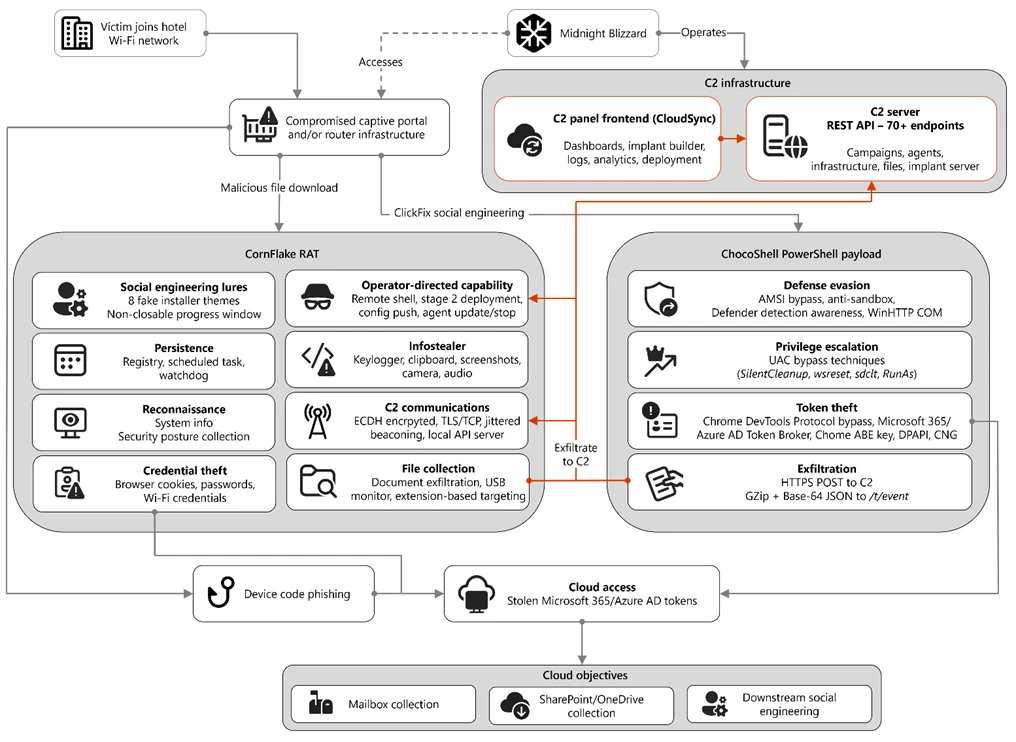
Figure 1. Overview of the CaptiveCrunch attack flow
As part of the CaptiveCrunch campaign, Storm-2945 has leveraged their AitM position to redirect users through actor-controlled phishing infrastructure and has also delivered malware purporting to be browser or operating system updates in response to automated connectivity checks issued by users’ browsers. Multiple variants have been delivered, including fully-featured Windows remote access trojans (RAT) in compiled Golang, with functionality to conduct system enumeration, collect files and keystrokes, steal credentials and session tokens, conduct audio and video surveillance, monitor for removable media, and provide the threat actor a remote shell on infected systems.
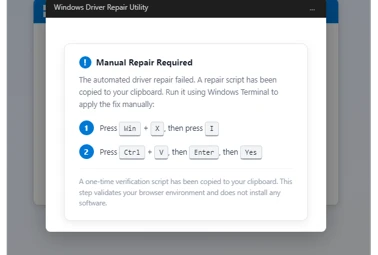
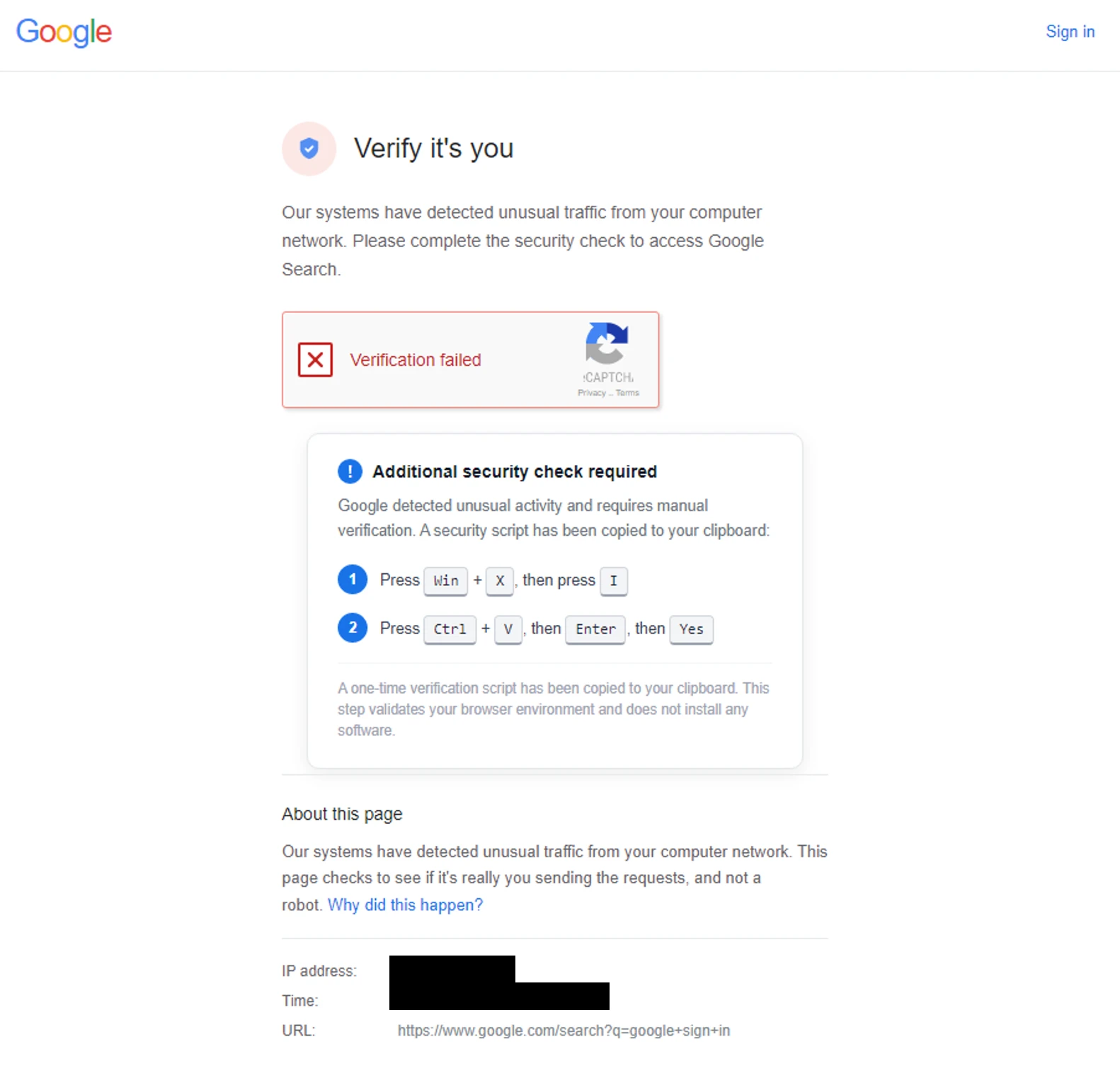
The threat actor infrastructure leverages a variety of ClickFix techniques to elicit the user into downloading and executing the malware:
Figure 2. ClickFix prompt with manual user instructionsFigure 3. ClickFix prompt with additional user instructions after verification failure
In addition to variants of malware targeting Windows systems, Microsoft Threat Intelligence is also aware of indications that the threat actor might be targeting Android devices with similar techniques as the ClickFix landings also include instructions for Android devices to download and install an APK file.
To date, Microsoft has identified widespread compromise of Wi-Fi networks at hospitality-related organizations and other networks serviced by captive portal equipment in several countries. ReliaQuest has identified this activity not only at hotels, but also conference centers and other shared venues, and assesses that the goal of this activity is to access the accounts of corporate travelers.
Storm-2945 and Midnight Blizzard
Microsoft Threat Intelligence assesses that Storm-2945 is an operational sub-cluster of Midnight Blizzard based on distinctive technical and operational overlaps. These include technical similarities to Storm-2372, a Midnight Blizzard initial access operations sub-cluster, also notable for their device code and OAuth code phishing operations tracked throughout 2025, Microsoft Graph-based email exfiltration, social engineering delivered via commercial messaging apps, and significant similarities in victimology.
Midnight Blizzard is a Russia-based threat actor attributed by the US and UK governments to the Foreign Intelligence Service of the Russian Federation, also known as the SVR. This threat actor is known to primarily target governments, diplomatic entities, non-governmental organizations (NGOs), and information technology (IT) service providers, primarily in the US and Europe. Midnight Blizzard is consistent and persistent in their operational targeting, and their objectives rarely change. Their focus is to collect intelligence through longstanding and dedicated espionage in support of Russian foreign policy interests.
Midnight Blizzard operations often involve compromise of valid accounts and, in some highly targeted cases, advanced techniques to compromise authentication mechanisms within an organization to expand access and evade detection. They utilize diverse initial access methods, and Midnight Blizzard is also adept at identifying and abusing OAuth applications to move laterally across cloud environments and for post-compromise activity, such as email collection.
CaptiveCrunch tradecraft and tooling
CornFlake: Remote access and infostealer implant
CornFlake is a full-featured Windows RAT written in Go that serves as Storm-2945’s primary persistent implant. Microsoft has observed the threat actor rapidly iterating on this malware layer, which features customizable capabilities from the social engineering user interface and data collection capabilities to anti-detection and evasion techniques.
On initial execution, CornFlake operates in dropper mode: it displays a convincing fake progress window designed to occupy the victim’s attention while the binary copies itself to %APPDATA%\svchost32\svchost32.exe and establishes persistence.
Fake window options configurable by the threat actor at build time:
winupdate — A Windows Update screen displaying “Working on updates… Don’t turn off your computer”
defender — A Windows Security virus scan
directx — A DirectX End-User Runtime Web Installer
vcredist — A Microsoft Visual C++ 2015-2022 Redistributable installer
sysopt — A disk optimization utility
netfix — A Windows Network Diagnostics tool
browser — A browser update prompt
pdfview — A document viewer installer
Figure 4. False update window
CornFlake registers as a Windows service named svchost32 with the display name “Cloud Sync Service” and description “Synchronizes files with the cloud storage provider”, deliberately mimicking the legitimate svchost.exe process. It establishes redundant persistence mechanisms: Windows service registrations, Registry Run keys, named scheduled tasks, and a persistence watchdog routine that runs continuously to restore any persistence mechanism that is removed by defenders or endpoint protection.
For command and control (C2), CornFlake performs an Elliptic Curve Diffie-Hellman (ECDH) P-256 ephemeral key exchange with the C2 server, derives a session key via SHA-256, and communicates over a custom JSON protocol framed within the encrypted channel. This provides an encrypted channel to the C2 server, with each C2 session using a unique ephemeral key, making decryption of captured traffic impossible without the session-specific private key. The runtime configuration file sync.dat supports hot reconfiguration of C2 servers, watched directories, file targeting patterns, and Transport Layer Security (TLS) settings without requiring redeployment.
Once established on a victim system, CornFlake provides the operator with a comprehensive collection toolkit, gated by configuration flags that allow selective activation post-deployment:
Capability
Description
Keylogging
Raw input API-based keylogger capturing all keystrokes, including password fields
Clipboard monitoring
Captures clipboard changes with SHA-256 deduplication and records the active window title at time of capture
Screenshot capture
Idle-triggered and on-demand screenshots with configurable idle threshold
Audio surveillance
Windows Audio Session API (WASAPI)-based microphone capture, encoded as WAV files
Video surveillance
Media Foundation-based webcam capture, encoded as JPEG
Browser credential theft
ChromeKatz-derived module supporting live cookie extraction from process memory (Chromium browsers) and stored password extraction from on-disk databases, including Chrome App-Bound Encryption (ABE) bypass and Firefox NSS/SDR decryption
File exfiltration
Targets files based on file extensions with real-time file system monitoring and an upload throttle (1,000 files or 500 MB per cycle). File extensions are categorized as Documents, Archives, Images, Code, Data, Emails, and Keys
USB drive monitoring
Detects and scans removable media when inserted
Security posture sweep
Collects 18 categories of host intelligence including installed software, antivirus (AV)/endpoint detection and response (EDR) products, Defender exclusions, User Account Control (UAC) level, Remote Desktop Protocol (RDP) history, Office most recently used (MRU) files, and credential hints
Remote shell
Arbitrary command execution via cmd.exe or PowerShell (with -NoP flag to suppress profile-based detection)
CornFlake also exposes a localhost HTTP API server (/upload, /reload, /status) that transforms the RAT into a modular platform: companion or next-stage payloads such as ChocoShell could task file exfiltration, trigger configuration hot reloads or check C2 connectivity using the pre-established secure C2 channel for communication.
ChocoShell: PowerShell infostealer
ChocoShell is the campaign’s Powershell-based infostealer, delivered and executed entirely in-memory. Its primary objective is the high-volume theft of browser session cookies, saved passwords, Microsoft 365 Single Sign-On (SSO) tokens, and Wi-Fi credentials from compromised systems. Where CornFlake provides the operator with a persistent, long-running foothold on the device, ChocoShell is designed to extract the most operationally valuable credentials, giving the operator access to victim cloud environments.
The ChocoShell script was authored with full developer comments that reveal the operator’s intent behind each code decision, including explicit references to Microsoft detection signatures and the reasoning behind specific evasion choices. The consistent coding standard and descriptive commentary suggest the author might have leveraged AI-assisted code generation.
Defense evasion. Upon execution, ChocoShell beacons to a hardcoded C2 server at 213.145.86[.]112 and implements several evasion techniques in sequence. It disables the Antimalware Scan Interface (AMSI) via .NET reflection to prevent ScriptBlock scanning and evades Microsoft behavioral detection that triggers on suspicious PowerShell web request cmdlets. A timing-based sandbox detection check is also employed as a virtual machine (VM) detection mechanism, silently exiting without performing any collection if detected.
C2 communication. ChocoShell communicates with its C2 server using HTTPS with URI paths designed to blend in with legitimate web traffic. Beacons use /t/pixel.gif?m=<status>, mimicking an image tracking pixel. Additional tooling is fetched from /cdn/chunks/polyfill-7e2b.min.js, disguised as a JavaScript polyfill file. This downloaded module is Base64-decoded and executed in memory via [ScriptBlock]::Create(), providing browser encryption key extraction capabilities, SYSTEM token impersonation, and Defender signature locking. Exfiltrated data is sent by POST to /t/event as GZip-compressed, Base64-wrapped JSON.
Privilege escalation. ChocoShell requires administrative privileges for its most impactful capabilities: SYSTEM token impersonation for Chrome ABE decryption, Volume Shadow Copy Service (VSS) shadow copy creation, Defender signature locking. It implements three silent UAC bypass techniques with ordered fallback:
SilentCleanup task hijack: Writes a malicious command to HKCU\Environment\windir, then triggers the built-in SilentCleanup scheduled task, which resolves %windir% from the user’s environment, executing the threat actor’s command at elevated privilege. The registry value is cleaned up after two seconds to avoid cloud detection.
wsreset.exe COM hijack: Creates a COM handler key in HKCU\Software\Classes and launches the auto-elevating Windows Store reset tool.
sdclt.exe folder hijack: Hijacks HKCU\Software\Classes\Folder\shell\open\command and launches the Windows Backup utility with the /KickOffElev flag.
If none of the silent bypasses succeed (for example, the user is not a local administrator), ChocoShell falls back to a visible UAC prompt via Start-Process -Verb RunAs. Notably, the script also contains a variant designed to execute within the WinGet Desired State Configuration (DSC) host process (ConfigurationRemotingServer), suggesting an attack vector through malicious WinGet DSC configuration used in Windows machine provisioning.
Credential and session theft. Once running with elevated permissions, ChocoShell locks Defender signature updates and systematically harvests data from multiple sources. For Chromium-based browsers (Chrome, Edge, Brave, Opera, Opera GX, Vivaldi), it extracts the master encryption key from the browser’s Local State file, handling both the modern ABE scheme (Chrome v127+) and the legacy data protection API (DPAPI)-only scheme. ABE decryption requires SYSTEM-level DPAPI access, which the malware obtains by impersonating a SYSTEM process token borrowed from winlogon.exe, wininit.exe, or services.exe. Locked browser SQLite databases are accessed through three strategies: shared file access, Volume Shadow Service snapshots, and direct copy as a fallback.
As a parallel collection path, ChocoShell launches Chrome, Edge, and Brave with the –remote-debugging-port flag and issues Network.getAllCookies through the Chrome DevTools Protocol (CDP). This completely bypasses ABE, enabling the browser to perform its own internal decryption and returns plaintext cookie values. To handle privilege issues (SYSTEM-launched browsers inherit the wrong token), the malware creates transient scheduled tasks with TASK_LOGON_INTERACTIVE_TOKEN to launch the browser under the signed-in user’s session. After extraction, the browser is stopped and relaunched with –restore-last-session to avoid alerting the user.
For Firefox family browsers (Firefox, Waterfox, LibreWolf, Floorp, Zen), the malware copies unencrypted cookies.sqlite databases from each profile. Additionally, ChocoShell collects Microsoft 365 and Azure Active Directory (AD) access tokens, refresh tokens, and Web Account Manager (WAM) tokens from .tbres files in the Token Broker cache. Collection of these tokens represents a significant threat to enterprise environments, as threat actors could replay SSO sessions without browser cookies. Additionally, Wi-Fi credentials are harvested via netsh wlan show profile with key=clear.
Exfiltration and cleanup. All collected data is aggregated into a JSON structure, GZip-compressed, Base64-encoded, and sent by POST to the C2’s /t/event endpoint. After exfiltration, all collected data variables are nulled, garbage collection is forced, VSS shadow copies are deleted via Windows Management Instrumentation (WMI), temporary elevation scripts are removed, and all UAC bypass registry keys (already cleaned during escalation) are verified removed.
FruitStone: Operator C2 panel
FruitStone is the web-based C2 panel that Storm-2945 operators use to manage the entire CaptiveCrunch campaign infrastructure. Implemented as a single-page application (HTML and JavaScript) serving as the front-end of the C2 server with all functionality exposed without authentication, FruitStone provides a centralized dashboard for managing compromised endpoints, building and deploying new campaign payloads, and reviewing all collected data (such as screenshots, keystrokes, browser credentials).
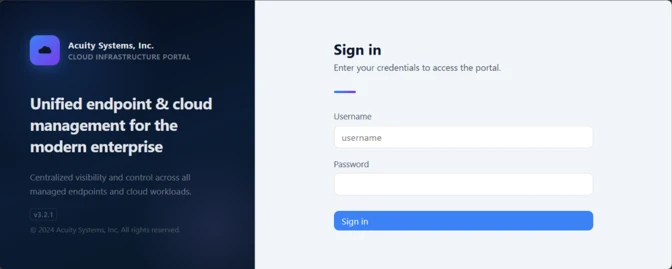
Operational cover. The panel is branded as “CloudSync Console” with a footer reading “Acuity Systems, Inc. — Cloud Infrastructure Portal v3.2.1,” designed to appear as legitimate enterprise cloud management software if the panel URL is discovered by defenders or hosting providers. This masquerading extends to the CornFlake agent’s service name (Cloud Sync Service) and description (“Synchronizes files with the cloud storage provider”), creating a consistent cover story across the toolchain.
Figure 5. CloudSync Console panel masquerade
Session management and multi-operator support. FruitStone uses JSON Web Token (JWT)-based authentication, session revocation, and rate limiting with IP blocking to prevent brute force attacks against the panel sign in. Multiple operators could be provisioned with individual accounts, and all active sessions are visible with IP address, user-agent, and creation time to enable operational security awareness across the operators.
Agent management. The panel displays all registered CornFlake agents in a dashboard with real-time status updates via Server-Sent Events (SSE). Each agent card shows comprehensive system information including hostname, username, OS version, CPU, RAM, disk usage, screen resolution, timezone, domain membership, and camera/microphone presence, all collected during the CornFlake posture sweep. Agents are grouped by country and subnet, with geographic distribution visualized on a map.
Operators could interact with individual agents through:
Remote shell — Interactive cmd.exe or PowerShell command execution with command history
File system browser — Live directory traversal and arbitrary file download from compromised hosts
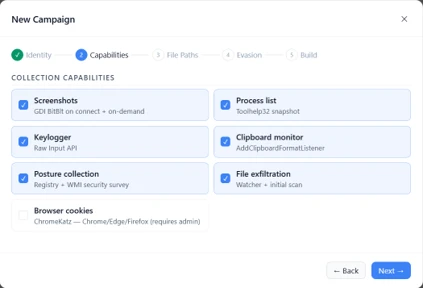
Collection tasking — On-demand screenshot, process list, keylog buffer flush, clipboard dump, security posture survey, ChromeKatz cookie/password extraction, camera capture, and audio recording
Configuration push — Live runtime reconfiguration of C2 servers, watch paths, and C2 beacon timing
Agent update — In-place implant update by pushing a new CornFlake build to a running agent
Agent kill — Remote termination of the CornFlake implant
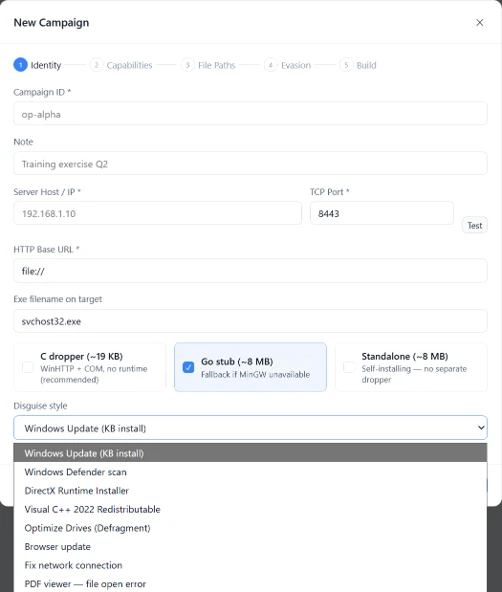
Campaign builder. A step-by-step wizard enables operators to configure and build new CornFlake payloads directly from the panel:
Identity — Campaign ID, C2 host and port, HTTP base URL, executable file name (svchost32.exe by default), and dropper type (C dropper at ~19 KB, Go stub at ~8 MB, or standalone self-installer)
File Paths — Configure targeted directories and file extensions by category (documents, archives, images, code, data, emails, encryption keys)
Figure 8. File paths tab
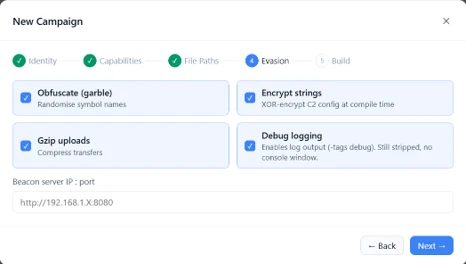
Evasion — Enable garble symbol randomization (for GoLang payloads), XOR string encoding, GZip upload compression, and debug mode
Figure 9. Evasion tab
Infrastructure management. FruitStone provides management interfaces for three layers of supporting infrastructure:
Proxy relays — Multi-proxy C2 relay architecture with TLS certificate tracking (fingerprint, expiry), health checks, connection counts, bytes forwarded, and rotation capabilities that push updated server lists to all online agents
Beacon profiles — Configurable timing profiles controlling agent sleep intervals, reconnection delays, TLS Server Name Indication (SNI) spoofing (like teams.microsoft.com), and DNS fallback domains
Staging servers — External payload hosting infrastructure with push-to-deploy, file listing, and health monitoring
Figure 10. View of the CloudSync staging servers interface
Device code abuse for cloud access
Since July 16, Microsoft has observed a portion of CaptiveCrunch landing pages redirecting users to device code authentication flow experiences. In these cases, users served these landings might be instructed to enter a device code into a legitimate Microsoft sign-in page, a technique commonly referred to as device code phishing.
Device code authentication is a legitimate OAuth workflow designed for devices that cannot support a traditional sign-in experience. However, threat actors could abuse this flow by initiating an authentication request on behalf of a user then convincing the user to enter an actor-controlled device code into a legitimate Microsoft authentication page. When successful, the victim authenticates the threat actor’s session rather than their own.
This activity is consistent with previously reported device code phishing operations conducted by Midnight Blizzard since August 2024. The observed technique does not appear fundamentally novel; however, integrating device code phishing into captive portal and traffic manipulation operations might increase the likelihood that users perceive the authentication request as legitimate. For additional details on Midnight Blizzard-related device code phishing techniques, see: Storm-2372 conducts device code phishing campaign. To understand other threat actors’ use of device code phishing and associated mitigations, see Inside an AI‑enabled device code phishing campaign.
How to protect against CaptiveCrunch activity
Minimize trust in hospitality and guest networks
When traveling, users should treat hotel, conference, airport, and other guest wireless networks as untrustworthy.
Prefer private connectivity (including mobile hotspots, satellite, and eSIM-based cellular data connections) over public Wi‑Fi whenever practical.
Consider using enterprise-managed travel routers or hotspot devices that establish encrypted tunnels back to trusted corporate infrastructure before accessing sensitive resources.
Avoid downloading software updates, certificates, browser updates, network troubleshooting tools, or security utilities presented through captive portals or other unexpected web prompts.
Verify update requests through trusted operating system mechanisms rather than pop-up messages or website prompts.
Strengthen identity and access controls
Organizations should assume that public and hospitality network infrastructure might not be trustworthy and should adopt controls that limit exposure to traffic manipulation, credential theft, and device code phishing.
Educate users to recognize ClickFix-style prompts, fake verification checks, and paste-and-run instructions as malicious, especially when they invoke command interpreters or script hosts such as cmd.exe, PowerShell, rundll32.exe, or mshta.exe.
Use passwordless solutions like passkeys and implement multifactor authentication (MFA).
Only allow device code flow where necessary. Microsoft recommends blocking device code flow wherever possible. Where necessary, configure Microsoft Entra ID’s device code flow in your Conditional Access policies.
Implement a sign-in risk policy to automate response to risky sign-ins. A sign-in risk represents the probability that a given authentication request is not authorized by the identity owner. A sign-in risk-based policy can be implemented by adding a sign-in risk condition to Conditional Access policies that evaluates the risk level of a specific user or group. Based on the risk level (high/medium/low), a policy can be configured to block access or force MFA.
When a user is a high risk and Conditional access evaluation is enabled, the user’s access is revoked, and they are forced to re-authenticate.
For regular activity monitoring, use Risky sign-in reports, which surface attempted and successful user access activities where the legitimate owner might not have performed the sign-in.
Use a Security Service Edge (SSE) solution like Global Secure Access to secure access to any app or resource using network, identity, and endpoint access controls.
Reduce exposure during captive portal registration
Organizations should review what information employees provide to hospitality providers when connecting to guest networks.
Do not reuse corporate credentials on hotel, conference, or guest-network registration pages.
Where possible, organizations should evaluate whether venue-provided wireless is required for corporate events and conferences.
Organizations should minimize unnecessary disclosure of employee identities, organizational affiliations, and travel details when booking accommodations or registering for guest network access, consistent with corporate policy and applicable local requirements.
Microsoft Defender detections and hunting guidance
Microsoft Defender customers can refer to the list of applicable detections below. Microsoft Defender coordinates detection, prevention, investigation, and response across endpoints, identities, email, apps to provide integrated protection against attacks like the threat discussed in this blog.
Microsoft Defender for Endpoint detects Storm-2945 activity under the detection Suspicious activity linked to a Russian state-sponsored threat actor has been detected. However, these alerts might be triggered by unrelated threat actor activity. The following chart lists Microsoft Defender detections specific to the TTPs utilized by Storm-2945 in this attack.
CornFlake registers a Windows service, a Registry Run key, a scheduled task
Microsoft Defender for Endpoint – Suspicious Scheduled Task Process Launched – Suspicious scheduled task – Suspicious file added to run key – Suspicious service registration
Microsoft Defender XDR – User account compromise via OAuth device code phishing – Malicious sign in from an IP address associated with recognized attacker infrastructure – Suspicious Azure authentication through possible device code phishing
Microsoft Security Copilot is embedded in Microsoft Defender and provides security teams with AI-powered capabilities to summarize incidents, analyze files and scripts, summarize identities, use guided responses, and generate device summaries, hunting queries, and incident reports.
Security Copilot is also available as a standalone experience where customers can perform specific security-related tasks, such as incident investigation, user analysis, and vulnerability impact assessment. In addition, Security Copilot offers developer scenarios that allow customers to build, test, publish, and integrate AI agents and plugins to meet unique security needs.
Threat intelligence reports
Microsoft Defender XDR customers can use the following threat analytics reports in the Defender portal (requires license for at least one Defender XDR product) to get the most up-to-date information about the threat actor, malicious activity, and techniques discussed in this blog. These reports provide the intelligence, protection information, and recommended actions to prevent, mitigate, or respond to associated threats found in customer environments.
Microsoft Security Copilot customers can also use the Microsoft Security Copilot integration in Microsoft Defender Threat Intelligence, either in the Security Copilot standalone portal or in the embedded experience in the Microsoft Defender portal to get more information about this threat actor.
Hunting queries
Microsoft Defender XDR
Microsoft Defender XDR customers can run the following advanced hunting queries to find related activity in their networks:
Detect file creation after Wi-Fi connectivity test on devices
The following query checks for a file creation on a device within two minutes of the device performing built‑in Network Connectivity Status Indicator (NCSI) test, which occurs when network connectivity is established to a Wi-Fi network with a captive portal. This activity might indicate an attacker’s initial access file presence on a device.
Please note that not all files discovered through this query might be malicious or related to this threat activity.
The following query checks for the CornFlake RAT Windows service registration.
DeviceRegistryEvents
| where RegistryKey has @"\SYSTEM\CurrentControlSet\Services\svchost32"
| where ActionType == "RegistryValueSet"
| where (RegistryValueName == "DisplayName" and RegistryValueData == "Cloud Sync Service")
    or (RegistryValueName == "Description" and RegistryValueData == "Synchronizes files with the cloud storage provider")
| project
    Timestamp,
    DeviceName,
    DeviceId,
    RegistryKey,
    RegistryValueName,
    RegistryValueData,
    ActionType,
    InitiatingProcessFileName,
    InitiatingProcessCommandLine,
    InitiatingProcessAccountName,
    ReportId
Microsoft Sentinel
Microsoft Sentinel customers can use the TI Mapping analytics (a series of analytics all prefixed with ‘TI map’) to automatically match the malicious domain indicators mentioned in this blog post with data in their workspace. If the TI Map analytics are not currently deployed, customers can install the Threat Intelligence solution from the Microsoft Sentinel Content Hub to have the analytics rule deployed in their Sentinel workspace.
Detect network IP and domain indicators of compromise using ASIM
The following query checks IP addresses and domain IOCs across data sources supported by ASIM network session parser:
//IP list and domain list- _Im_NetworkSession
let lookback = 30d;
let ioc_ip_addr = dynamic(["213.145.86.112"]);
let ioc_domains = dynamic(["213.145.86.112/t/pixel.gif", "213.145.86.112/cdn/chunks/polyfill-7e2b.min.js", "213.145.86.112/t/event"]);
_Im_NetworkSession(starttime=todatetime(ago(lookback)), endtime=now())
| where DstIpAddr in (ioc_ip_addr) or DstDomain has_any (ioc_domains)
| summarize imNWS_mintime=min(TimeGenerated), imNWS_maxtime=max(TimeGenerated),
  EventCount=count() by SrcIpAddr, DstIpAddr, DstDomain, Dvc, EventProduct, EventVendor
Detect web sessions IP and file hash indicators of compromise using ASIM
The following query checks IP addresses, domains, and file hash IOCs across data sources supported by ASIM web session parser:
//IP list - _Im_WebSession
let lookback = 30d;
let ioc_ip_addr = dynamic(["213.145.86.112"]);
let ioc_sha_hashes =dynamic([“918fa52ae45ed60ba7cc8bdc99c3cbe9ab92e0375ec31fc05d0d4513be11c593”, “be99857449d2856dd5a84e21c8a3d5e0e01456adb44062ddec5a6b4970d8d42c”]);
_Im_WebSession(starttime=todatetime(ago(lookback)), endtime=now())
| where DstIpAddr in (ioc_ip_addr) or FileSHA256 in (ioc_sha_hashes)
| summarize imWS_mintime=min(TimeGenerated), imWS_maxtime=max(TimeGenerated),
  EventCount=count() by SrcIpAddr, DstIpAddr, Url, Dvc, EventProduct, EventVendor
Detect domain and URL indicators of compromise using ASIM
The following query checks domain and URL IOCs across data sources supported by ASIM web session parser:
// file hash list - imFileEvent
// Domain list - _Im_WebSession
let ioc_domains = dynamic(["https://213.145.86.112/t/pixel.gif", "https://213.145.86.112/cdn/chunks/polyfill-7e2b.min.js", "https://213.145.86.112/t/event"]);
_Im_WebSession (url_has_any = ioc_domains)
ChocoShell C2 communications
The following query detects ChocoShell communications with its C2 server using HTTPS with URI paths designed to blend in with legitimate web traffic. Beacons use /t/pixel.gif?m=<status>, mimicking an image tracking pixel.
let lookback = 30d;
let ioc_url_artifacts = dynamic(["/t/pixel.gif?m="]);
_Im_WebSession(starttime=todatetime(ago(lookback)), endtime=now())
| where DstDomain  in (ioc_url_artifacts)
| summarize imWS_mintime=min(TimeGenerated), imWS_maxtime=max(TimeGenerated),
  EventCount=count() by SrcIpAddr, DstIpAddr, Url, Dvc, EventProduct, EventVendor
To hear stories and insights from the Microsoft Threat Intelligence community about the ever-evolving threat landscape, listen to the Microsoft Threat Intelligence podcast.
Created by legendary hardware hacker Andrew “bunnie” Huang, the badges for this year’s famed security conference aim to push the boundaries of security and transparency.
Ransomware often dominates cybersecurity headlines, but stolen data has become an equally valuable commodity in the cybercrime economy. In the first half of 2026, one threat actor stood out in the data leak ecosystem: Tanaka, a prolific data leak broker responsible for more publicized leak activity than any other actor tracked by Cyble.Cyble researchers recorded 367 data breach and leak incidents worldwide between January and June 2026. While dozens of actors participated in selling or publishing stolen information, Tanaka emerged as the most active, accounting for 25 distinct leak posts — more than double the activity of several other major actors.
A Data Leak Operation Without Industry Boundaries
Unlike threat actors that specialize in a single vertical, Tanaka followed a broad targeting approach across multiple industries and regions. The actor’s campaigns showed no strict preference for a specific sector, instead focusing on organizations where stolen information could hold financial or strategic value.The Banking, Financial Services, and Insurance (BFSI) sector remained the most targeted industry globally, accounting for 38 breach incidents during the reporting period. Financial organizations continue to attract attackers due to the value of customer information, account data, and personally identifiable information (PII).Government and Technology organizations were also frequent targets, reflecting the wider value of sensitive records, intellectual property, and institutional data.
Regional Presence Across Major Markets
Tanaka’s activity was visible across multiple regions. In North America, the actor was responsible for seven leak posts, making it the most active data leak actor in the region alongside other prominent sellers.Europe and the UK also saw significant activity, with Tanaka linked to six leak posts during H1 2026. The region’s BFSI, Telecommunications, and Retail sectors faced heightened exposure due to the amount of valuable customer and financial data they hold.The actor’s global footprint demonstrates how modern data leak operations can function independently of geography. Instead of focusing on a single country or industry, operators like Tanaka exploit opportunities wherever valuable information becomes available.
The Rise of the Data Leak Marketplace
Tanaka’s activity reflects a broader shift in the cybercrime ecosystem. Data leaks are no longer only a byproduct of ransomware attacks; they have become a standalone business model.Threat actors monetize stolen information through underground marketplaces, using leaked databases for fraud, extortion, intelligence gathering, or resale. This specialization mirrors other parts of the cybercrime economy, where access brokers, ransomware affiliates, and data sellers perform separate roles.For organizations, this means a breach does not always begin with a ransomware demand. A stolen database appearing in underground channels may indicate an earlier compromise that requires immediate investigation.
Staying Ahead of Data Exposure Risks
Security teams must treat underground data exposure monitoring as part of their broader defense strategy. Identifying leaked credentials, compromised databases, or mentions in cybercrime marketplaces can provide early warning before stolen information is weaponized.To understand the 2026 data breach landscape, including the most active threat actors, targeted industries, and regional trends, access the full Cyble H1 2026 Cyber Threat Landscape Report.
You may have heard your peers say, “Cybercrime has become industrialized.” But did you have any proof?
We do.
Cyble Research and Intelligence Labs (CRIL) closed out its tracking for the first half of 2026 with a deep analysis of the Global Threat Landscape spanning ransomware, initial access brokers, data breaches and leaks, nation-state espionage, and hacktivism, among others.
One of the most striking analyses that puts the threat landscape severity in perspective was the number of distinct threat actor profiles active worldwide between January and June. 261 — that’s how many identifiable groups and individuals, each with its own tradecraft, targeting logic, and operational rhythm, running campaigns simultaneously across nation-state espionage, ransomware, hacktivism, and cybercrime.
What makes this data set valuable isn't just the headline count. It's what the composition reveals. A threat landscape dominated by nation-state APT groups tells a very different story than one dominated by ransomware crews — and as Cyble's regional breakdown shows, that composition shifts dramatically depending on where you're standing.
The Worldwide Picture of Most Active Threat Actors: APTs Lead, But Not Everywhere
Across all 261 profiles tracked globally, nation-state Advanced Persistent Threat (APT) groups were the single largest category — accounting for 118 profiles, or just over 45% of the total. Ransomware operators came second at 75 profiles (29%), followed by hacktivist collectives (34), cybercriminal groups (31), and dedicated extortion-only gangs, which remained a niche category at just 3.
Threat Actor Category
Profiles Tracked
Share of Total
Nation-State APT Groups
118
45.2%
Ransomware Groups
75
28.7%
Hacktivist Collectives
34
13.0%
Cybercriminal Groups
31
11.9%
Extortion-Only Groups
3
1.1%
Total
261
100%
That APT dominance reflects the sheer number of state-sponsored programs China, North Korea, Iran, and Russia field simultaneously across espionage, intellectual property theft, and pre-positioning operations.
The extortion-only category being almost statistically irrelevant is telling too — it confirms that pure extortion has essentially been absorbed into the ransomware business model rather than surviving as an independent specialty. Double extortion is now just how ransomware works.
Worried your business is not immune to the tactics of these APT and ransomware groups? Book a demo to validate and fortify your defenses today!
Threat Actors to Watch Out For
CRIL flagged five groups worldwide as carrying the highest confidence and activity levels for security teams to track through the rest of 2026:
Communications, Energy, Manufacturing, Government, IT
Desert Falcons
Palestine
UAE, Israel, Jordan, and 12+ other MEA nations
Aerospace & Defense, Government, Law Enforcement, Media
SideCopy
Pakistan
India, Afghanistan
Government, Defense/military
Two of these deserve particular attention for how they operate.
Bluenoroff, a financially motivated Lazarus Group subgroup, funds North Korean state operations by impersonating established crypto investors and planting malicious links inside victims' Calendly scheduling accounts. This fraud vector blends social engineering with a tool most professionals trust implicitly.
Volt Typhoon continues to favor "living off the land" techniques that blend into normal network activity, prioritizing long-term undetected access over rapid data theft — a profile consistent with pre-positioning for a future disruption event rather than opportunistic espionage.
UNC6508 is worth flagging separately: the group compromises externally accessible REDCap research environments and has been observed creating malicious mail-forwarding rules to silently exfiltrate correspondence — all routed through US-based residential proxies and compromised routers specifically to obscure attribution.
For a regional breakdown of which actors were the most active and which sectors they target, download Cyble Research and Intelligence Labs’ H1 2026 Global Threat Landscape Report.
The threat actor profiles, targeting patterns, and regional breakdowns in this analysis are drawn from Cyble's H1 2026 Global Threat Landscape Report, built on continuous monitoring across dark web forums, ransomware leak sites, and threat actor communications worldwide.
Cyble Vision provides ongoing tracking of these groups — including new actor emergence, TTP shifts, and targeting changes — as they develop.
Request a demoto see how continuous threat actor intelligence can sharpen your regional security priorities.
The Fairlife ransomware attack has temporarily halted production operations at Coca-Cola-owned dairy company fairlife in the United States after unauthorized access was detected in a portion of its systems, including production-related systems.
According to The Coca-Cola Company, fairlife identified unauthorized access by a third party in connection with a ransomware event. Following the discovery, the company activated its incident response and business continuity protocols while launching an investigation with the support of external advisors and cybersecurity experts. Law enforcement has also been notified.
The company said the investigation is ongoing and that the full scope, nature, and impact of the incident are not yet known.
Fairlife Ransomware Attack Suspends U.S. Production
The Fairlife ransomware attack has resulted in the temporary suspension of production operations at fairlife facilities across the United States. However, the company stated that product quality and safety have not been affected by the incident.
According to the company's statement, fairlife's production operations in Canada remain operational and have not been impacted by the ransomware event.
The Coca-Cola Company also confirmed in a Form 8-K filing dated July 16, 2026, that fairlife detected the unauthorized access on Thursday. The filing reiterated that the company immediately activated its incident response procedures and business continuity protocols after identifying the intrusion.
While the company continues to assess the incident, it said it has not yet determined whether the ransomware attack is reasonably likely to materially affect its business because the full impact remains unknown.
The company added that it is working to complete its investigation and restore affected systems and production operations as quickly as possible.
Investigation Into Unauthorized Access Continues
The ongoing investigation is being conducted with assistance from outside cybersecurity experts. According to the company, the incident involved unauthorized access to a portion of fairlife's systems, including systems related to production.
At this stage, The Coca-Cola Company has not disclosed how the attackers gained access, whether any data was compromised, or if a ransomware group has claimed responsibility for the attack.
The company emphasized that its assessment is still underway and that additional details will be shared as more information becomes available.
Food and Beverage Sector Faces Growing Cybersecurity Risks
The food and beverage cyberattack trend has continued to affect manufacturers and logistics providers worldwide in recent months.
On July 16, a cyberattack targeting Nichirei disrupted food deliveries across Japan after the frozen food and logistics provider confirmed unauthorized access to its servers. The incident affected logistics operations supporting KFC Japan, leading to temporary service disruptions while systems were being restored.
Earlier this year, in February 2026, Australian poultry processor Hazeldenes also experienced a cybersecurity incident that disrupted production across its network. The Victoria-based company later announced it had begun a phased return to production to restore operations safely and securely while investigations continued.
The latest incident involving fairlife adds another major food producer to the list of companies dealing with operational disruptions linked to cyber incidents. While production has been paused at fairlife's U.S. facilities, the company has maintained that product quality and safety remain unaffected and that its Canadian production continues without disruption.
As the investigation progresses, The Coca-Cola Company said it remains focused on restoring impacted systems and resuming normal production operations. The company also noted that the complete scope and potential business impact of the incident have not yet been determined.
The investigation into the Odido cyberattack has uncovered possible involvement of Dutch nationals, according to Dutch police, as authorities continue to investigate the ShinyHunters ransomware-linked attack that exposed the personal data of approximately 6.39 million customers. Law enforcement has urged the public to come forward with information as investigators work to identify those responsible for one of the country's largest telecom data breaches.
The cyberattack took place on February 5 and 6 after attackers allegedly used voice phishing (vishing) to deceive Odido's customer service team.
According to the company, the attackers posed as members of its internal IT staff, gaining unauthorized access before exfiltrating customer data. Odido said its teams detected the unauthorized access immediately on both occasions and revoked the attackers' access, but the incident still resulted in a large-scale data breach.
Odido Cyberattack Investigation Finds Possible Dutch Link
Under the direction of the National Public Prosecution Service, the High Tech Crime Team (THTC) of the National Investigation and Intervention Unit launched an extensive investigation into the breach.
Authorities said investigators have found strong indications that Dutch criminals may have been involved. One key lead centers on a phone call made shortly before the breach in which a Dutch-speaking man allegedly impersonated an Odido IT employee while speaking with customer service representatives. Police are continuing efforts to identify the caller and have indicated that his voice could be made public if necessary.
Investigators believe people within cybercrime circles may have information about those responsible and are encouraging anyone with relevant details to contact law enforcement.
ShinyHunters Named as Threat Actor
Odido attributed the attack to the cybercriminal group ShinyHunters, which the company said carried out the social engineering campaign.
Chief Executive Officer Søren Abildgaard acknowledged the incident in a public statement, apologizing to customers and outlining the company's commitment to strengthening its cybersecurity capabilities. He said Odido would continue investing in security, improve data protection practices, expand customer support, and share lessons learned from the incident.
The CEO also explained why the company refused to pay the ransom demand. According to Odido, paying cybercriminals would reward illegal activity and could encourage future attacks against other Dutch organizations. The company said the decision was made following guidance from authorities, despite knowing that stolen data could eventually be published.
Millions of Customers Impacted
Odido confirmed that approximately 6.39 million active and former customers of Odido and its Ben brand were affected by the breach. Customers of Simpel were not impacted.
The exposed information varied by individual and included names, addresses, mobile phone numbers, customer numbers, email addresses, IBAN numbers, dates of birth, identification details, nationality, and gender.
The company clarified that My Odido account passwords, call records, location data, billing information, and scans of identity documents were not compromised.
Odido also addressed reports claiming customer passwords had been leaked, stating that login passwords remain securely encrypted and were never accessible during the attack. Instead, a separate telephone verification field known as "password_c," used as a customer challenge code, was included for a limited number of customers. The company has since discontinued using that verification method.
Customer Support and Security Measures Expanded
Following the breach, Odido increased customer support by adding more than 140 service agents and introduced additional security measures. These include its "Check je Gesprek" verification service, allowing customers to confirm whether communications claiming to be from Odido are legitimate, along with access to the F-Secure digital security service.
The telecom provider said all customers identified as affected have been notified by email or SMS, while customer service teams continue assisting users with questions related to their specific data exposure.
Meanwhile, Dutch authorities expect investigations into the Odido cyberattack to continue for several months. Police have also warned that cyberattacks targeting businesses and institutions are becoming increasingly common, urging organizations to strengthen cybersecurity defenses and encouraging citizens to remain vigilant against follow-on fraud and phishing attempts.

 Entrar