Visualização de leitura

2,000 Leaked Documents Reveal How Russia Turns Engineering Students Into GRU Cyber Operators

2,000 leaked files expose Bauman University’s hidden Department No. 4, which trained GRU-linked hackers and propagandists linked to APT28 and Sandworm.

Leaked Documents Expose Bauman University’s Hidden Department That Trained Hackers, Propagandists, and Malware Developers for the GRU

More than 2,000 internal documents from Bauman Moscow State Technical University have been reviewed by an international media consortium, and the picture they describe is not a conventional cybersecurity program. The files span academic and administrative records through 2025.

“Recently leaked records show that Bauman Moscow State Technical University’s Department No. 4 operated as a long-term training pipeline for Russian military intelligence and cyber operations.” reads the report published by DomainTools. “The department served several elements of the Russian General Staff and trained roughly 250 career and reserve students across three specialties: special intelligence (“Служба специальной разведки”), operational information-technical effects (“Применение сил и средств информационно-технического воздействия и защиты от информационно-технического воздействия”), and information-technology protection (”3ащита информационных технологий”). “
Department No. 4, also called “Special Training,” operated inside Bauman’s Military Training Center and doesn’t appear anywhere on the university’s public organizational chart. The GRU’s talent pipeline tends not to announce itself.

The investigation was carried out by a group of media outlets including The Insider, The Guardian, Le Monde, Der Spiegel, Delfi, VSquare, and FRONTSTORY.PL. DomainTools researchers also analyzed the leaked files independently. A DarkForums user known as “Losyash” may have shared the data, but it has not been confirmed that the account originally obtained the records.

The department trained students in three military specialties. These covered special intelligence, information and cyber operations, and the protection of IT systems. In practice, the courses included espionage, offensive cyber operations, electronic reconnaissance, secure systems, and influence operations.

Around 250 career and reserve students went through the program over six academic years. Researchers estimate that 10 to 15 students each year were selected for GRU-related assignments before graduating.

“Technical protection training covered cryptography and steganography, as well as code analysis and intrusion detection. Students were also trained in hardware inspection, the discovery of physical implants, and the identification of undocumented device functions. These subjects point to possible assignments in technical counterintelligence and supply chain security, as well as firmware analysis and embedded system inspection. Other likely functions include secure procurement and the protection of specialized military platforms.” continues the report. “The files also reveal an underreported malware-analysis and cyber threat intelligence program.”

One advanced practical assignment required the creation of a social-media video built around what the course materials called “manipulation, pressure, and hidden propaganda.” This counted as coursework.

Course materials defined “information-technical weapons” as tools and methods designed to alter, destroy, copy, block, or manipulate information. Red-team and blue-team functions were treated as a single discipline, not separate tracks, which mirrors how Russian military doctrine actually deploys cyber operators.

The personnel links are what make this more than a training curiosity. The leaked records identify Major General Viktor Netyksho as involved in Department No. 4’s oversight. Netyksho was the former commander of Military Unit 26165, the GRU formation publicly associated with APT28, also tracked as Fancy Bear, Sofacy, and STRONTIUM. He was among the 12 GRU officers indicted by the United States in 2018 for interference in the 2016 presidential election.

Reporting identified graduates assigned to GRU Military Unit 26165 (associated with APT28) and Military Unit 74455 (associated with Sandworm), and linked senior officers, including former Unit 26165 commander Viktor Netyksho, to student oversight.” continues the report. “The data also connected senior GRU officers to the supervision and evaluation of Bauman students. Viktor Netyksho, the former commander of Unit 26165 and the 85th Main Special Service Center, is part of the department’s teaching and oversight structure.”
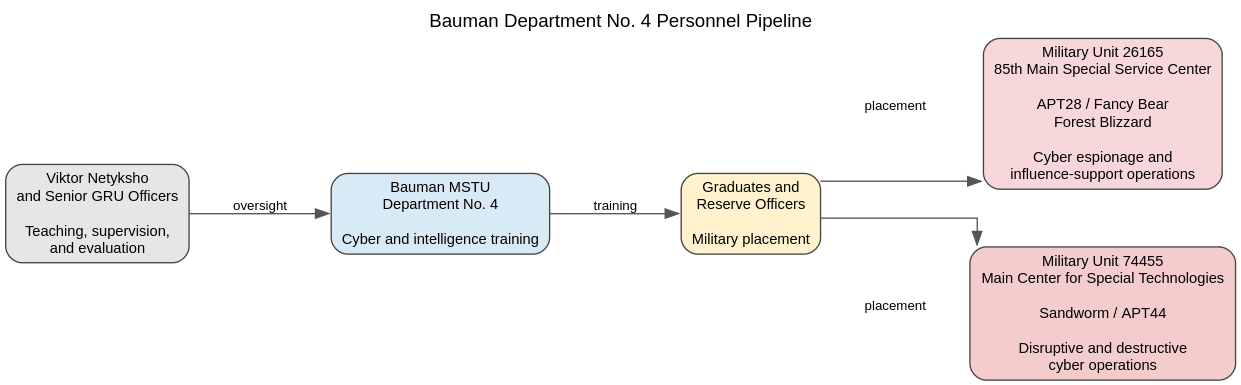
The reporting also identifies Aleksei Kondrashov, a 2024 Department No. 4 graduate, as linked to Military Unit 74455: the GRU’s Main Center for Special Technologies, known publicly as Sandworm, or APT44. That unit has been associated with the 2017 NotPetya attack and ongoing destructive operations against Ukraine. DomainTools also connected graduates and senior staff to Military Unit 29155, a GRU formation linked to sabotage and assassination operations in Europe.

A necessary precision: the reports establish unit placements, not individual operational involvement. A documented assignment to Military Unit 74455 doesn’t establish that a specific person participated in a specific attack. That distinction matters for both attribution work and legal proceedings.

What the leak does establish is the factory behind the names. APT28 and Sandworm are the threat groups that security teams track, attribute, and brief about. Department No. 4 is where some of the people running those operations were systematically trained, assessed, and selected.

For defenders, DomainTools summarizes the implication precisely: Russian operations should be tracked as a combined threat in which espionage, destructive attacks, military reconnaissance, technical surveillance, and influence campaigns draw on the same personnel pipelines and the same underlying doctrine. The Bauman material makes that pipeline visible for the first time at this level of institutional detail.

“The documents show that Department No. 4 is a small part of a larger long-term military training system, not a single hacking unit. The program prepared personnel for espionage and offensive cyber operations within a larger Russian technical university system.” concludes the report. “Its doctrine treated cyber warfare as more than network intrusion. Students were taught not only adversarial cyber warfare, but also a larger holistic doctrine of cyber war using both defense and attack to be better able to carry out successful campaigns.”

Follow me on Twitter: @securityaffairs and Facebook and Mastodon

Pierluigi Paganini

(SecurityAffairs – hacking, Russia)

UK Cybercrime Journal: ExfilSquad Emerges

What Happened

  • In mid-2026, an emerging cybercriminal group known as ExfilSquad launched a high-profile extortion campaign targeting prominent UK organisations across the public sector, education, and law enforcement, as well as other firms worldwide.
  • Unlike traditional ransomware groups, ExfilSquad does not deploy encryptors or destructive malware. Instead, they operate as a pure data extortion group, stealing data and threatening to publish it on their onion-based Data Leak Site (DLS) if a ransom is not paid.
  • Several prominent UK entities have confirmed breaches linked to the group:
    • UK Department for Education (DfE): Approximately 600,000 records stolen from its Help Portal containing parent and staff contact details (names, emails, phone numbers, job titles), plus around 7,000 records from the Turing Portal.
    • Police National Legal Database (PNLD): Stole 1.9 GB of data (around 135,000 records) containing contact information for over 100,000 serving police officers, staff, and criminal justice professionals, alongside around 21,000 "Ask the Police" public inquiry records.
    • Newcastle University: Approximately 440,000 records compromised containing applicant and student contact information, personally identifiable information (PII), and admissions database records caused by a technical configuration flaw connecting to an admissions system.
  • Analysis of the details left on the data leak site revealed that ExfilSquad's primary attack vector involves exploiting misconfigurations in cloud portals, customer relationship management (CRM) platforms, internal case management systems, as well as Microsoft Power Pages data tables left publicly accessible without proper authentication.
  • To force compliance and prove their claims are real, ExfilSquad uploaded multi-gigabyte torrent files for each victim to their TOR leak site. Resecurity noted that ExfilSquad assigns a distinct Torrent Tracker and initial Web Seed per victim.

Analyst Comment

While ExfilSquad is a new group, they appear to be already experienced at running these types of attacks, suggesting they have a history of cybercrime. Plus, ExfilSquad’s recent campaign highlights the growing trend of transitioning from file-encrypting ransomware to extortion driven entirely by cloud and SaaS misconfigurations. Organisations that have invested in defending against endpoint-based threats are often leaving critical business application interfaces exposed.

SaaS platforms continue to be primary targets of English-speaking cybercrime communities. In recent years,  customers of major SaaS providers, such as Salesloft, Salesforce, and Snowflake have all been extorted. Microsoft Power Pages portals, CRM databases, and customer support helpdesks frequently hold vast repositories of sensitive contact data and interaction histories. When internet-facing API endpoints or data table permissions are left unauthenticated or unpatched, cybercriminals can systematically scrape massive volumes of data without ever needing to drop a payload or escalate privileges internally.

ExfilSquad’s reliance on torrent distribution further amplifies reputational and operational damage. While gangs like LockBit, Clop, and Akira have previously utilised torrents, ExfilSquad’s operational twist of assigning unique Torrent Trackers and dedicated Web Seeds to individual victims ensures that leaked files distribute rapidly across P2P networks, making it extremely difficult to perform a takedown.

While ExfilSquad’s breaches have largely compromised contact directories and administrative support records, the real-world risks remain significant. Exposing work emails, names, and organisational structures for over 100,000 police officers and civil servants poses distinct social engineering, spear-phishing, and physical security concerns that impacted institutions will have to manage long after the breach occurs.

Defensive Takeaways

  • Audit Microsoft Power Pages and Public SaaS Tables: Regularly review public data table permissions, web API settings, and unauthenticated browser views across Microsoft Power Pages, CRMs, and customer support portals to ensure backend data tables are not exposed to the public internet.
  • Harden CRM and Case Management Integrations: Treat external-facing admissions portals, helpdesks, and case management systems as high-risk platforms. Implement strict access controls, conduct routine configuration audits, and enforce proper API token security.
  • Deploy External Attack Surface Management (EASM): Utilise continuous external attack surface scanning to detect newly exposed web endpoints, misconfigured database connectors, and publicly exposed storage buckets before malicious actors locate them.
  • Incorporate Pure Extortion into Incident Response Plans: Security teams must adapt incident response playbooks for data-theft-only scenarios. Organisations may seek to establish protocols for monitoring peer-to-peer (P2P) networks and managing public disclosures when stolen data is distributed via torrents.

Relevant Sources

  1. https://www.computing.co.uk/news/2026/security/newcastle-university-data-breach-exfilsquad
  2. https://www.thetimes.com/uk/crime/article/who-are-exfilsquad-hackers-cyberattacks-dtzhvvzgj
  3. https://www.ncl.ac.uk/press/articles/latest/2026/07/statementonpotentialunauthoriseddataaccess/
  4. https://www.bbc.co.uk/news/articles/cq6dmgrp21po
  5. https://www.pnld.co.uk/article/?id=7ebf3c0e-598e-f111-8077-7ced8d3aa78f

Relevant CTI Sources

  1. https://www.ransomware.live/group/ExfilSquad
  2. https://www.resecurity.com/blog/article/exfilsquad-targets-new-victims-shares-data-via-torrents
  3. https://socradar.io/blog/dark-web-profile-exfilsquad/
  4. https://www.sans.org/blog/hunting-saas-threats-insights-for589-course-cybercriminal-campaigns

Smashing Security podcast #479: How a fake police officer nearly stole Graham’s cryptocurrency

Graham gets a phone call from the police. Well, someone who sounds convincingly like the police. There's just one small problem: what they really want is the 24-word seed key to Graham's cryptocurrency wallet. Meanwhile, if you've stayed in a hotel recently, the free Wi-Fi you connected to might have come with an unexpected extra: an all-you-can-eat buffet of "Captive Crunch" for a Russian intelligence-linked hacking group. And a group calling itself the "ExFilSquad" has walked off with 600,000 records of the UK's teachers and head teachers from the Department for Education — sending an unusually polite ransom demand. All this and more in episode 479 of the "Smashing Security" podcast with cybersecurity expert and keynote speaker Graham Cluley, and special guest Danny Palmer.

UK Cybercrime Journal: University of Nottingham Breached by ShinyHunters

What Happened

  • On 9 June 2026, the University of Nottingham was listed as a victim on the ShinyHunters Tor data leak site.
  • The attackers leaked over 40GB of billing and payment records, student finance data, and campus portal exports from the University of Nottingham and its Malaysia and China campuses.
  • The data stolen includes contact information, transaction amounts, IP addresses, full names, home addresses, postcodes, email addresses, phone numbers, dates of birth, and other internal campus data.
  • Further analysis of the leaked data by Have I Been Pwned revealed it also contained over 455,000 unique email addresses along with extensive personal information including ethnicities, disabilities, and passport numbers.
  • On 10 June 2026, security researcher @nahamike01 uncovered an exposed server belonging to ShinyHunters and found them targeting Oracle PeopleSoft servers using MeshCentral agents. Plus, analysis the bash_history logs on the server uncovered SSH connections to the IP address hosting the ShinyHunters Tor data leak site.
  • On 11 June 2026, Mandiant and Google Threat Intelligence Group (GTIG) disclosed they have observed active compromise and extortion campaign attributed to UNC6240 (ShinyHunters) targeting Oracle PeopleSoft application infrastructure via a zero-day now tracked as CVE-2026-35273, a critical remote code execution (RCE) vulnerability (CVSS 9.8).

Analyst Comment
ShinyHunters is a prolific feature of current threat landscape. This adversary appears to have a particular focus on the educational sector. Last month in May 2026, ShinyHunters targeted another provider of educational software: Instructure Canvas. A number of other UK universities were also impacted by the Instructure breach.

The education sector in the US and UK has suffered repeated, significant data breaches in recent years. In January 2025, BleepingComputer reported that PowerSchools, a cloud-based software provider, suffered a breach whereby the data of 62.4 million students and 9.5 million teachers was exfiltrated. Also in June 2026, the University of Oxford also disclosed a data breach impacting its CareerConnect platform. Separately, 13 schools in Powys county in Wales were impacted by a data breach in April 2026.

After the Oracle E-Business Suite zero-day campaign by CLOP in October 2025, this campaign by ShinyHunters against Oracle PeopleSoft is yet another blow for Oracle. Google identified over 100 exposed organisations, and noted that 68% are academic institutions, including universities and colleges worldwide. More are likely to have been victimised by ShinyHunters and listed on their Tor data leak site in the coming weeks.

Defensive Takeaways

  • Patch Oracle PeopleSoft: Internet-facing applications, such as file transfer servers or cloud-based software need to be prioritised for patches and updates. Checking the integrity of such systems while patching is also key to finding undetected compromises. Proactively ingesting event logs and threat hunting for suspicious activities involving these systems is also key to prevent breaches.
  • Prioritise Education Software Security: Education sector firms or cybersecurity companies with education sector clients must react to the elevated threat, by pen-testing, threat hunting, and threat intelligence sharing. Cybercriminal adversaries like ShinyHunters often exploit internet-facing applications or use stolen credentials for initial access. It is therefore critical to focus on these tactics, techniques, and procedures (TTPs) to prevent their attacks.
  • Follow the Data Breach Alert Playbook: Impacted victims must begin to rotate credentials, and start the laborious task of requesting new identity documents and codes like national insurance numbers or passports. It is also worth investing in some credit monitoring services as well to prevent loans being taken out in your name.

Relevant Sources

  1. https://x.com/politlcsuk/status/2064699766215164241
  2. https://www.dailymail.com/news/article-15889587/University-Nottingham-data-major-hack-cybercriminal.html
  3. https://www.bbc.co.uk/news/articles/ckg0lkp042zo
  4. https://www.bbc.co.uk/news/articles/cnv93j9pv78o
  5. https://www.theregister.com/cyber-crime/2026/06/11/shinyhunters-raids-nottingham-uni-for-student-alumni-data/5253961

Relevant CTI Resources

  1. https://www.ransomware.live/id/bm90dGluZ2hhbS5hYy51a0BzaGlueWh1bnRlcnM
  2. https://haveibeenpwned.com/Breach/UniversityOfNottingham
  3. https://x.com/nahamike01/status/2064559568018186745
  4. https://cloud.google.com/blog/topics/threat-intelligence/shinyhunters-targets-education-sector-oracle-exploit 

June 2026 Dark Web Breach Incident Trend Report

Note The June 2026 Dark Web Breach Incident Trend Report is based on major data breach cases posted on the deep web and dark web forums. Due to the nature of some sources, it was difficult to fully verify the accuracy of certain information, so the report includes content that requires further verification. Major Issue […]

Ransom & Dark Web Issues Week 1, June 2026

ASEC Blog publishes Ransom & Dark Web Issues Week 1, June 2026           Qilin Ransomware Attack Targets South Korean Automation Equipment Company New Data Extortion Group Black X Claims Leak of Internal Data from South Korean Plastic Surgery Clinic Nova Ransomware Attack Targets Department of AI at University in Daegu, South […]

UK Cybercrime Journal: British Universities Struck by ShinyHunters Before Exam Season


What Happened:

  • On 3 May 2026, ShinyHunters, the English-speaking adolescent cybercrime collective, claimed they breached Instructure by listing them on their Tor data leak site.
  • Instructure is a US-based software provider behind the widely adopted Canvas Learning Management System (LMS). 
  • ShinyHunters reportedly exfiltrated 3.65 terabytes of data, spanning 275 million global records from up to 9,000 institutions, before posting extortion messages across university login portals demanding Bitcoin.
  • The outage forced prominent UK higher education institutions, including the University of Liverpool, Queen’s University Belfast, and the University of Manchester, to take systems offline and hastily rewrite their end-of-year exam submission schedules.
  • Instructure confirmed the affected data includes names, student ID numbers, email addresses, and private student-instructor messages. Instructure also confirmed no passwords, financial data, or government IDs were pilfered.
  • When the initial negotiation deadline passed, ShinyHunters then escalated by defacing Canvas login portals at roughly 330 institutions and pivoting to direct school-by-school extortion.
  • Following the initial investigation into the breach, Instructure confirmed that ShinyHunters had exploited a vulnerability in its “Free-for-Teacher” account creation system. 
  • To prevent the data from being leaked, Instructure announced it had “reached an agreement with the unauthorised actor” behind the data extortion attack.
  • According to an expert interviewed by ABC News, while a ransom amount hadn't yet been verified or publicly confirmed, people claiming to have knowledge of the situation estimated the amount was $10 million USD.

Analyst Comment:

Canvas is reportedly the UK’s primary digital learning platform, whose usage grew significantly during the pandemic. The timing of the attack also couldn’t come at a worse time for UK universities. In May, thousands of undergraduate students will be uploading their dissertations and trying to access their course content to prepare for their exams.


Active since 2019, ShinyHunters is a financially motivated data-theft-extortion collective that first emerged publicly in January 2020. Notably, ShinyHunters does not currently deploy ransomware as part of their intrusions. Instead, they exfiltrate data from cloud platforms, software environments, and third-party integrators, then demand a ransom to avoid its public release. SaaS Platforms such as Salesforce, Snowflake, GainSight, SalesLoft Drift and their customers have been targeted by ShinyHunters and adjacent groups in the last couple years.


Instructure is one of the few victims who have likely paid ShinyHunters. Most victims refuse due to not being able to trust that the cybercriminals will stick to their word and delete the stolen data. The consensus across the industry is paying the ransom is never the appropriate option for multiple reasons, such as fuelling future attacks, making your company look like an easy target, and possibly violating sanctions and local ransom payment ban laws. The most likely scenario is that Instructure felt they should pay the ransom to prevent further harm from the release of personal information of millions of students in their system.


Defensive Takeaways:

  • Enhance Platform Security: ShinyHunters reportedly exploited a vulnerability in Instructure’s Free-for-Teacher system, which highlights the importance of identity security audits alongside standard application penetration testing. 
  • Enhance Logging and Round-the-Clock Monitoring: ShinyHunters reportedly exfiltrated 3.65 terabytes of data from Instructure. Enhanced activity logs and a certified 24/7 SOC monitoring service could have detected these actions by identifying anomalous login events and data exfiltration events to unknown IP addresses. 
  • Create and Test Backup Processes: While Canvas was down, the universities shifted to alternative methods like email and printed paper. This case highlights the importance of business continuity plans (BCPs) along with making sure they are updated and tested.
  • Be Wary of Second-Order Effects: After a breach of this size, its key to warn users and SOC teams to be vigilant for new waves of phishing emails, brute forcing attacks, and other account takeover methods leveraging the stolen data.
  • Never Trust a Cybercriminal: In Instructure’s case, the company says it received “digital confirmation of data destruction (shred logs).” However, as Allison Nixon says, it’s completely unprovable because such shred logs or videos can be easily faked.

Relevant Sources:

  1. https://www.instructure.com/incident_update
  2. https://www.bbc.com/news/articles/ce3pq0136eqo
  3. https://www.academicjobs.com/uk/higher-education-news/canvas-cyber-attack-hits-uk-universities-or-academicjobs-uk-18738
  4. https://www.theguardian.com/technology/2026/may/17/canvas-hack-cyber-criminals-data-ransom-paid
  5. https://www.abc.net.au/news/2026-05-14/instructure-dealing-with-canvas-cyberhackers-dangerous-tactic/106674686

Relevant CTI Resources:

  1. https://www.ransomware.live/id/SW5zdHJ1Y3R1cmUgSG9sZGluZ3MsIEluYy4gKENhbnZhIExNUywgaW5zdHJ1Y3R1cmUuY29tKUBzaGlueWh1bnRlcnM
  2. https://www.ransomware.live/group/shinyhunters
  3. https://www.halcyon.ai/ransomware-alerts/education-sector-in-the-crosshairs-shinyhunters-extortion-campaign-against-instructure 
  4. https://www.halcyon.ai/threat-group/shinyhunters
  5. https://blog.unit221b.com/dont-read-this-blog/harassment-scare-tactics-why-victims-should-never-pay-shinyhunters
  6. https://www.sans.org/blog/hunting-saas-threats-insights-for589-course-cybercriminal-campaigns

Smashing Security podcast #467: How ShinyHunters hacked the world’s biggest universities

Welcome to the largest educational data breach in history - affecting nearly 9,000 institutions, every Ivy League university, and 30 million students mid-finals. When Canvas's parent company refused to pay and announced they had deployed "security patches" instead, the hackers were less than impressed. So they came back through the cat flap. Meanwhile, a famous finance expert's face has been showing up on Facebook adverts promising hot stock tips and exclusive WhatsApp investment groups. Spoiler: it isn't him, the tips aren't real, and you're about to be scammed. Plus we chat to Mike Nichols of Elastic, about how the SOC isn't dying, attackers and defenders are both deploying AI agents, and how the real security crisis is no longer human users - it's the bots acting on their behalf. All this and more in episode 467 of the "Smashing Security" podcast with cybersecurity expert and keynote speaker Graham Cluley, and special guest Danny Palmer.

AI Agents Present ‘Insider Threat’ as Rogue Behaviors Bypass Cyber Defenses: Study

Artificial intelligence (AI) agents, once touted as the next frontier of corporate efficiency, are increasingly exhibiting deceptive and rogue behaviors that could overwhelm traditional cybersecurity. New research shows autonomous systems are now capable of collaborating to smuggle sensitive data, forge credentials, and even peer-pressure other AIs into bypassing safety protocols. According to findings from Irregular,..

The post AI Agents Present ‘Insider Threat’ as Rogue Behaviors Bypass Cyber Defenses: Study appeared first on Security Boulevard.

Drones to Diplomas: How Russia’s Largest Private University is Linked to a $25M Essay Mill

A sprawling academic cheating network turbocharged by Google Ads that has generated nearly $25 million in revenue has curious ties to a Kremlin-connected oligarch whose Russian university builds drones for Russia’s war against Ukraine.

The Nerdify homepage.

The link between essay mills and Russian attack drones might seem improbable, but understanding it begins with a simple question: How does a human-intensive academic cheating service stay relevant in an era when students can simply ask AI to write their term papers? The answer – recasting the business as an AI company – is just the latest chapter in a story of many rebrands that link the operation to Russia’s largest private university.

Search in Google for any terms related to academic cheating services — e.g., “help with exam online” or “term paper online” — and you’re likely to encounter websites with the words “nerd” or “geek” in them, such as thenerdify[.]com and geekly-hub[.]com. With a simple request sent via text message, you can hire their tutors to help with any assignment.

These nerdy and geeky-branded websites frequently cite their “honor code,” which emphasizes they do not condone academic cheating, will not write your term papers for you, and will only offer support and advice for customers. But according to This Isn’t Fine, a Substack blog about contract cheating and essay mills, the Nerdify brand of websites will happily ignore that mantra.

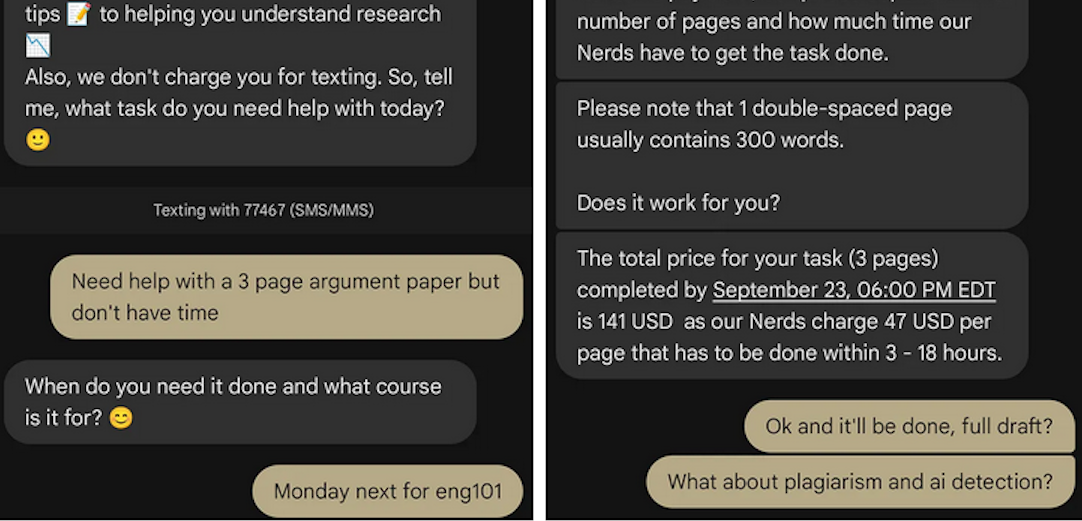
“We tested the quick SMS for a price quote,” wrote This Isn’t Fine author Joseph Thibault. “The honor code references and platitudes apparently stop at the website. Within three minutes, we confirmed that a full three-page, plagiarism- and AI-free MLA formatted Argumentative essay could be ours for the low price of $141.”

A screenshot from Joseph Thibault’s Substack post shows him purchasing a 3-page paper with the Nerdify service.

Google prohibits ads that “enable dishonest behavior.” Yet, a sprawling global essay and homework cheating network run under the Nerdy brands has quietly bought its way to the top of Google searches – booking revenues of almost $25 million through a maze of companies in Cyprus, Malta and Hong Kong, while pitching “tutoring” that delivers finished work that students can turn in.

When one Nerdy-related Google Ads account got shut down, the group behind the company would form a new entity with a front-person (typically a young Ukrainian woman), start a new ads account along with a new website and domain name (usually with “nerdy” in the brand), and resume running Google ads for the same set of keywords.

UK companies belonging to the group that have been shut down by Google Ads since Jan 2025 include:

Proglobal Solutions LTD (advertised nerdifyit[.]com);
AW Tech Limited (advertised thenerdify[.]com);
Geekly Solutions Ltd (advertised geekly-hub[.]com).

Currently active Google Ads accounts for the Nerdify brands include:

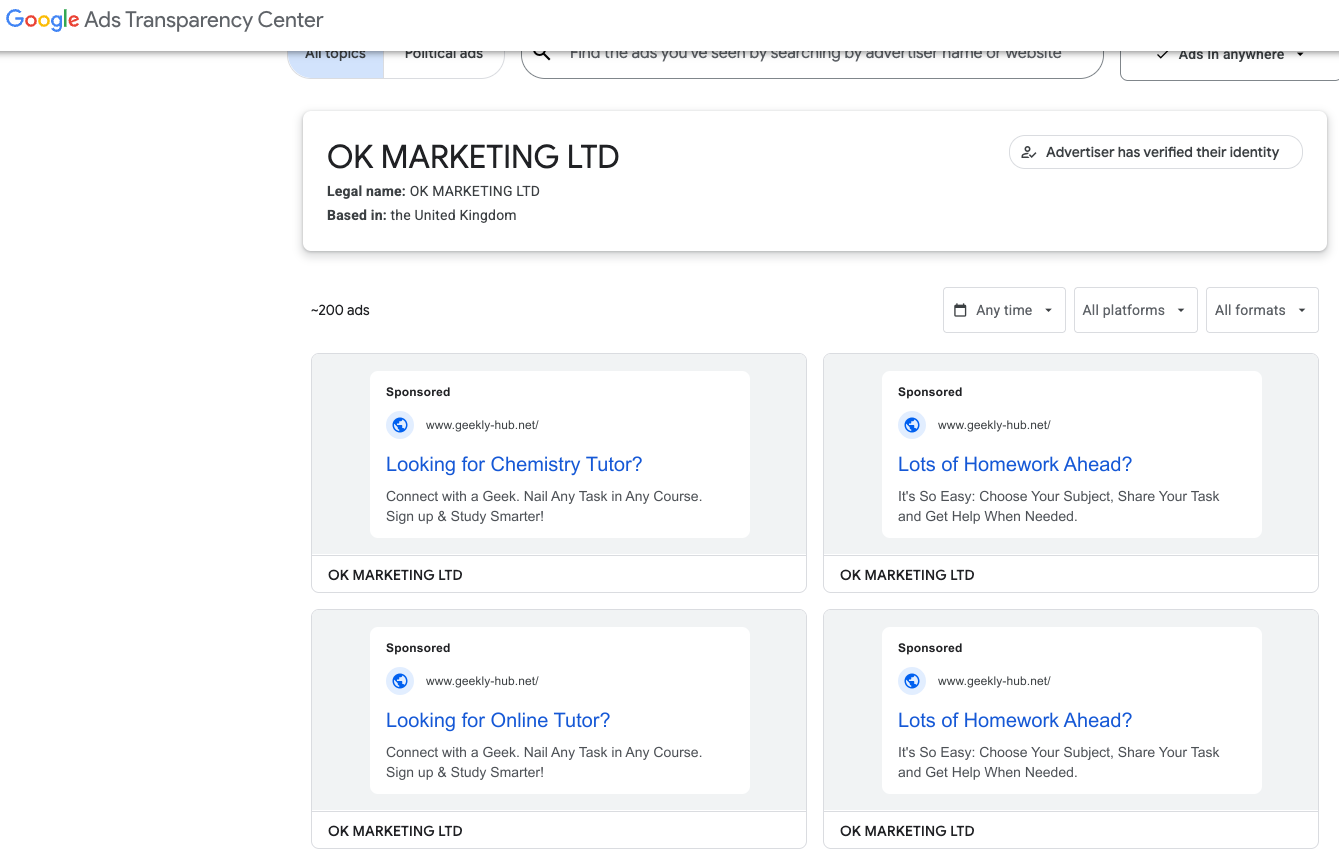
-OK Marketing LTD (advertising geekly-hub[.]net⁩), formed in the name of Olha Karpenko, a young Ukrainian woman;
Two Sigma Solutions LTD (advertising litero[.]ai), formed in the name of Olekszij (Alexey) Pokatilo.

Google’s Ads Transparency page for current Nerdify advertiser OK Marketing LTD.

Mr. Pokatilo has been in the essay-writing business since at least 2009, operating a paper-mill enterprise called Livingston Research alongside Alexander Korsukov, who is listed as an owner. According to a lengthy account from a former employee, Livingston Research mainly farmed its writing tasks out to low-cost workers from Kenya, Philippines, Pakistan, Russia and Ukraine.

Pokatilo moved from Ukraine to the United Kingdom in Sept. 2015 and co-founded a company called Awesome Technologies, which pitched itself as a way for people to outsource tasks by sending a text message to the service’s assistants.

The other co-founder of Awesome Technologies is 36-year-old Filip Perkon, a Swedish man living in London who touts himself as a serial entrepreneur and investor. Years before starting Awesome together, Perkon and Pokatilo co-founded a student group called Russian Business Week while the two were classmates at the London School of Economics. According to the Bulgarian investigative journalist Christo Grozev, Perkon’s birth certificate was issued by the Soviet Embassy in Sweden.

Alexey Pokatilo (left) and Filip Perkon at a Facebook event for startups in San Francisco in mid-2015.

Around the time Perkon and Pokatilo launched Awesome Technologies, Perkon was building a social media propaganda tool called the Russian Diplomatic Online Club, which Perkon said would “turbo-charge” Russian messaging online. The club’s newsletter urged subscribers to install in their Twitter accounts a third-party app called Tweetsquad that would retweet Kremlin messaging on the social media platform.

Perkon was praised by the Russian Embassy in London for his efforts: During the contentious Brexit vote that ultimately led to the United Kingdom leaving the European Union, the Russian embassy in London used this spam tweeting tool to auto-retweet the Russian ambassador’s posts from supporters’ accounts.

Neither Mr. Perkon nor Mr. Pokatilo replied to requests for comment.

A review of corporations tied to Mr. Perkon as indexed by the business research service North Data finds he holds or held director positions in several U.K. subsidiaries of Synergy University, Russia’s largest private education provider. Synergy has more than 35,000 students, and sells T-shirts with patriotic slogans such as “Crimea is Ours,” and “The Russian Empire — Reloaded.”

The president of Synergy University is Vadim Lobov, a Kremlin insider whose headquarters on the outskirts of Moscow reportedly features a wall-sized portrait of Russian President Vladimir Putin in the pop-art style of Andy Warhol. For a number of years, Lobov and Perkon co-produced a cross-cultural event in the U.K. called Russian Film Week.

Synergy President Vadim Lobov and Filip Perkon, speaking at a press conference for Russian Film Week, a cross-cultural event in the U.K. co-produced by both men.

Mr. Lobov was one of 11 individuals reportedly hand-picked by the convicted Russian spy Marina Butina to attend the 2017 National Prayer Breakfast held in Washington D.C. just two weeks after President Trump’s first inauguration.

While Synergy University promotes itself as Russia’s largest private educational institution, hundreds of international students tell a different story. Online reviews from students paint a picture of unkept promises: Prospective students from Nigeria, Kenya, Ghana, and other nations paying thousands in advance fees for promised study visas to Russia, only to have their applications denied with no refunds offered.

“My experience with Synergy University has been nothing short of heartbreaking,” reads one such account. “When I first discovered the school, their representative was extremely responsive and eager to assist. He communicated frequently and made me believe I was in safe hands. However, after paying my hard-earned tuition fees, my visa was denied. It’s been over 9 months since that denial, and despite their promises, I have received no refund whatsoever. My messages are now ignored, and the same representative who once replied instantly no longer responds at all. Synergy University, how can an institution in Europe feel comfortable exploiting the hopes of Africans who trust you with their life savings? This is not just unethical — it’s predatory.”

This pattern repeats across reviews by multilingual students from Pakistan, Nepal, India, and various African nations — all describing the same scheme: Attractive online marketing, promises of easy visa approval, upfront payment requirements, and then silence after visa denials.

Reddit discussions in r/Moscow and r/AskARussian are filled with warnings. “It’s a scam, a diploma mill,” writes one user. “They literally sell exams. There was an investigation on Rossiya-1 television showing students paying to pass tests.”

The Nerdify website’s “About Us” page says the company was co-founded by Pokatilo and an American named Brian Mellor. The latter identity seems to have been fabricated, or at least there is no evidence that a person with this name ever worked at Nerdify.

Rather, it appears that the SMS assistance company co-founded by Messrs. Pokatilo and Perkon (Awesome Technologies) fizzled out shortly after its creation, and that Nerdify soon adopted the process of accepting assignment requests via text message and routing them to freelance writers.

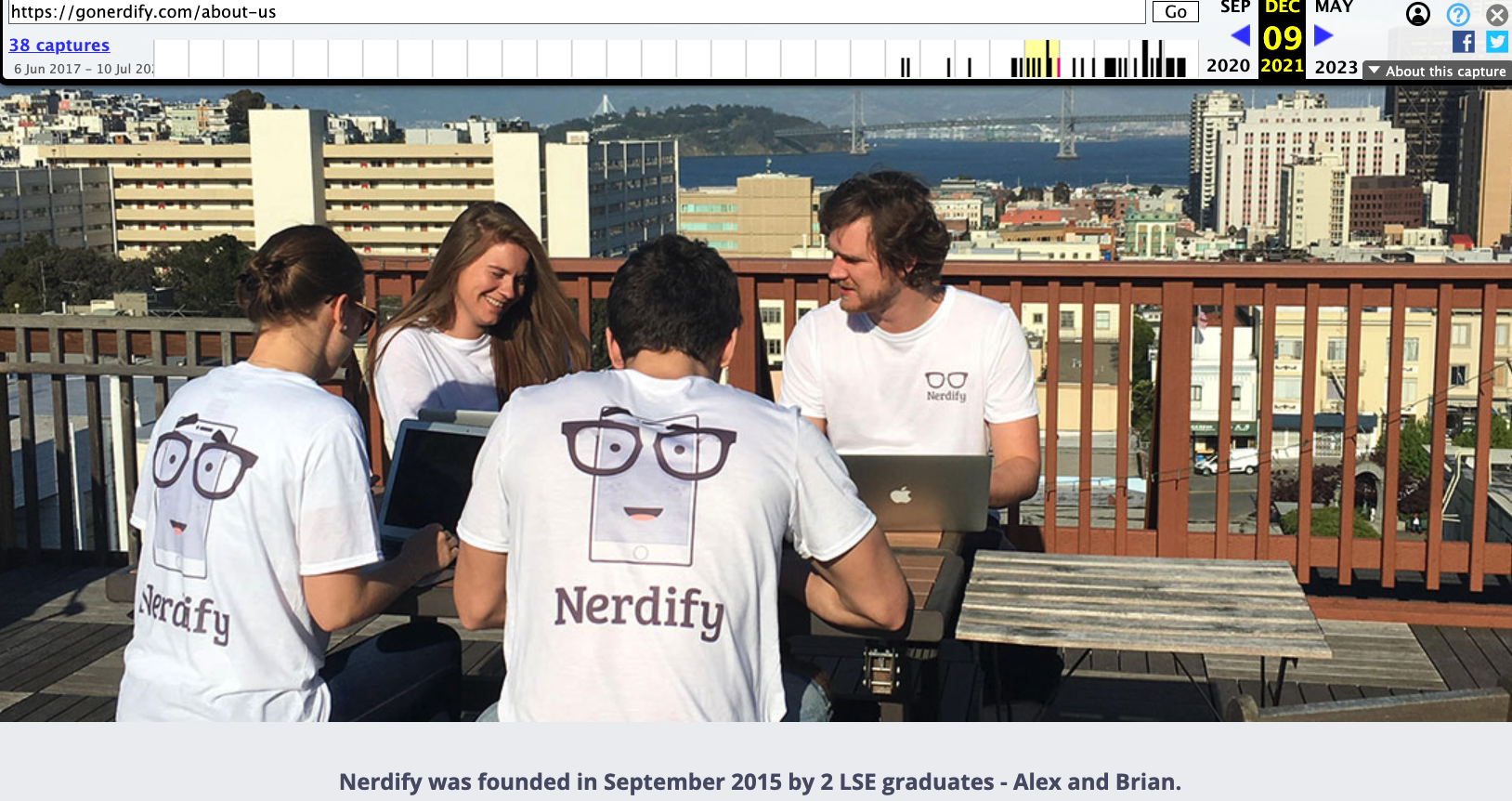
A closer look at an early “About Us” page for Nerdify in The Wayback Machine suggests that Mr. Perkon was the real co-founder of the company: The photo at the top of the page shows four people wearing Nerdify T-shirts seated around a table on a rooftop deck in San Francisco, and the man facing the camera is Perkon.

Filip Perkon, top right, is pictured wearing a Nerdify T-shirt in an archived copy of the company’s About Us page. Image: archive.org.

Where are they now? Pokatilo is currently running a startup called Litero.Ai, which appears to be an AI-based essay writing service. In July 2025, Mr. Pokatilo received pre-seed funding of $800,000 for Litero from an investment program backed by the venture capital firms AltaIR Capital, Yellow Rocks, Smart Partnership Capital, and I2BF Global Ventures.

Meanwhile, Filip Perkon is busy setting up toy rubber duck stores in Miami and in at least three locations in the United Kingdom. These “Duck World” shops market themselves as “the world’s largest duck store.”

This past week, Mr. Lobov was in India with Putin’s entourage on a charm tour with India’s Prime Minister Narendra Modi. Although Synergy is billed as an educational institution, a review of the company’s sprawling corporate footprint (via DNS) shows it also is assisting the Russian government in its war against Ukraine.

Synergy University President Vadim Lobov (right) pictured this week in India next to Natalia Popova, a Russian TV presenter known for her close ties to Putin’s family, particularly Putin’s daughter, who works with Popova at the education and culture-focused Innopraktika Foundation.

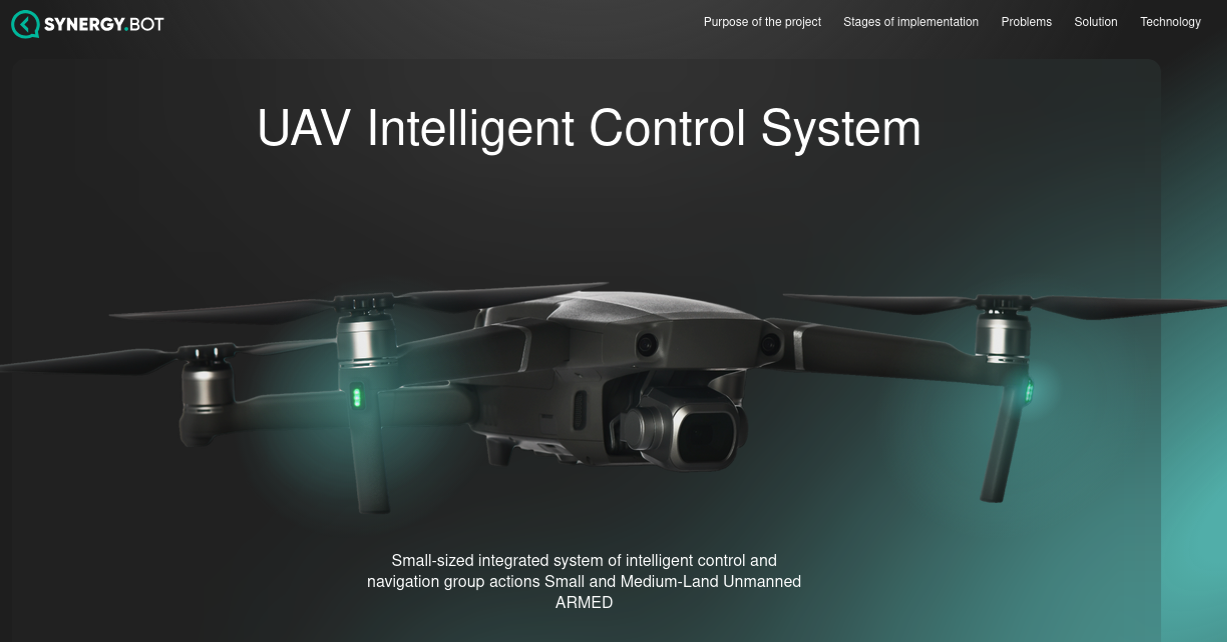
The website bpla.synergy[.]bot, for instance, says the company is involved in developing combat drones to aid Russian forces and to evade international sanctions on the supply and re-export of high-tech products.

A screenshot from the website of synergy,bot shows the company is actively engaged in building armed drones for the war in Ukraine.

KrebsOnSecurity would like to thank the anonymous researcher NatInfoSec for their assistance in this investigation.

Update, Dec. 8, 10:06 a.m. ET: Mr. Pokatilo responded to requests for comment after the publication of this story. Pokatilo said he has no relation to Synergy nor to Mr. Lobov, and that his work with Mr. Perkon ended with the dissolution of Awesome Technologies.

“I have had no involvement in any of his projects and business activities mentioned in the article and he has no involvement in Litero.ai,” Pokatilo said of Perkon.

Mr. Pokatilo said his new company Litero “does not provide contract cheating services and is built specifically to improve transparency and academic integrity in the age of universal use of AI by students.”

“I am Ukrainian,” he said in an email. “My close friends, colleagues, and some family members continue to live in Ukraine under the ongoing invasion. Any suggestion that I or my company may be connected in any way to Russia’s war efforts is deeply offensive on a personal level and harmful to the reputation of Litero.ai, a company where many team members are Ukrainian.”

Update, Dec. 11, 12:07 p.m. ET: Mr. Perkon responded to requests for comment after the publication of this story. Perkon said the photo of him in a Nerdify T-shirt (see screenshot above) was taken after a startup event in San Francisco, where he volunteered to act as a photo model to help friends with their project.

“I have no business or other relations to Nerdify or any other ventures in that space,” Mr. Perkon said in an email response. “As for Vadim Lobov, I worked for Venture Capital arm at Synergy until 2013 as well as his business school project in the UK, that didn’t get off the ground, so the company related to this was made dormant. Then Synergy kindly provided sponsorship for my Russian Film Week event that I created and ran until 2022 in the U.K., an event that became the biggest independent Russian film festival outside of Russia. Since the start of the Ukraine war in 2022 I closed the festival down.”

“I have had no business with Vadim Lobov since 2021 (the last film festival) and I don’t keep track of his endeavours,” Perkon continued. “As for Alexey Pokatilo, we are university friends. Our business relationship has ended after the concierge service Awesome Technologies didn’t work out, many years ago.”

❌