Visualização de leitura

2,000 Leaked Documents Reveal How Russia Turns Engineering Students Into GRU Cyber Operators

2,000 leaked files expose Bauman University’s hidden Department No. 4, which trained GRU-linked hackers and propagandists linked to APT28 and Sandworm.

Leaked Documents Expose Bauman University’s Hidden Department That Trained Hackers, Propagandists, and Malware Developers for the GRU

More than 2,000 internal documents from Bauman Moscow State Technical University have been reviewed by an international media consortium, and the picture they describe is not a conventional cybersecurity program. The files span academic and administrative records through 2025.

“Recently leaked records show that Bauman Moscow State Technical University’s Department No. 4 operated as a long-term training pipeline for Russian military intelligence and cyber operations.” reads the report published by DomainTools. “The department served several elements of the Russian General Staff and trained roughly 250 career and reserve students across three specialties: special intelligence (“Служба специальной разведки”), operational information-technical effects (“Применение сил и средств информационно-технического воздействия и защиты от информационно-технического воздействия”), and information-technology protection (”3ащита информационных технологий”). “
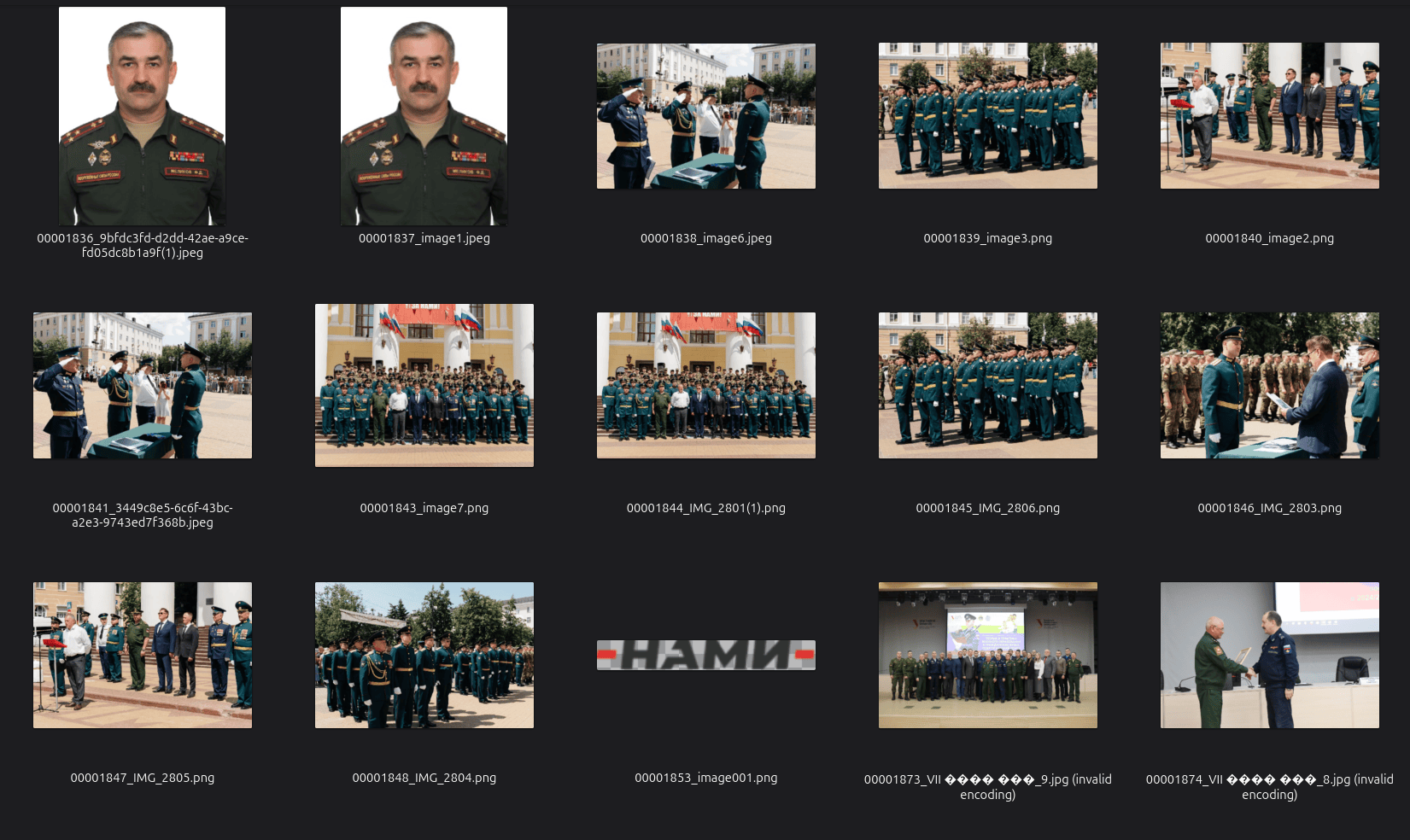
Department No. 4, also called “Special Training,” operated inside Bauman’s Military Training Center and doesn’t appear anywhere on the university’s public organizational chart. The GRU’s talent pipeline tends not to announce itself.

The investigation was carried out by a group of media outlets including The Insider, The Guardian, Le Monde, Der Spiegel, Delfi, VSquare, and FRONTSTORY.PL. DomainTools researchers also analyzed the leaked files independently. A DarkForums user known as “Losyash” may have shared the data, but it has not been confirmed that the account originally obtained the records.

The department trained students in three military specialties. These covered special intelligence, information and cyber operations, and the protection of IT systems. In practice, the courses included espionage, offensive cyber operations, electronic reconnaissance, secure systems, and influence operations.

Around 250 career and reserve students went through the program over six academic years. Researchers estimate that 10 to 15 students each year were selected for GRU-related assignments before graduating.

“Technical protection training covered cryptography and steganography, as well as code analysis and intrusion detection. Students were also trained in hardware inspection, the discovery of physical implants, and the identification of undocumented device functions. These subjects point to possible assignments in technical counterintelligence and supply chain security, as well as firmware analysis and embedded system inspection. Other likely functions include secure procurement and the protection of specialized military platforms.” continues the report. “The files also reveal an underreported malware-analysis and cyber threat intelligence program.”

One advanced practical assignment required the creation of a social-media video built around what the course materials called “manipulation, pressure, and hidden propaganda.” This counted as coursework.

Course materials defined “information-technical weapons” as tools and methods designed to alter, destroy, copy, block, or manipulate information. Red-team and blue-team functions were treated as a single discipline, not separate tracks, which mirrors how Russian military doctrine actually deploys cyber operators.

The personnel links are what make this more than a training curiosity. The leaked records identify Major General Viktor Netyksho as involved in Department No. 4’s oversight. Netyksho was the former commander of Military Unit 26165, the GRU formation publicly associated with APT28, also tracked as Fancy Bear, Sofacy, and STRONTIUM. He was among the 12 GRU officers indicted by the United States in 2018 for interference in the 2016 presidential election.

Reporting identified graduates assigned to GRU Military Unit 26165 (associated with APT28) and Military Unit 74455 (associated with Sandworm), and linked senior officers, including former Unit 26165 commander Viktor Netyksho, to student oversight.” continues the report. “The data also connected senior GRU officers to the supervision and evaluation of Bauman students. Viktor Netyksho, the former commander of Unit 26165 and the 85th Main Special Service Center, is part of the department’s teaching and oversight structure.”
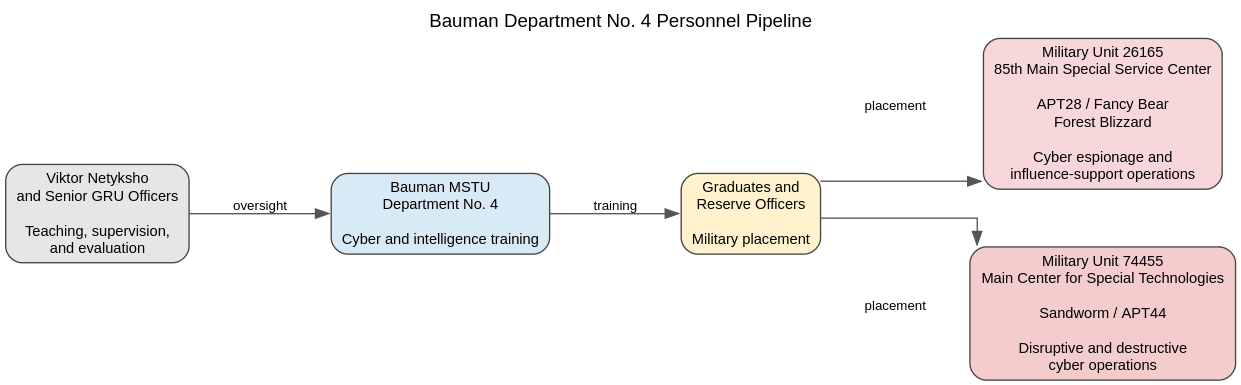
The reporting also identifies Aleksei Kondrashov, a 2024 Department No. 4 graduate, as linked to Military Unit 74455: the GRU’s Main Center for Special Technologies, known publicly as Sandworm, or APT44. That unit has been associated with the 2017 NotPetya attack and ongoing destructive operations against Ukraine. DomainTools also connected graduates and senior staff to Military Unit 29155, a GRU formation linked to sabotage and assassination operations in Europe.

A necessary precision: the reports establish unit placements, not individual operational involvement. A documented assignment to Military Unit 74455 doesn’t establish that a specific person participated in a specific attack. That distinction matters for both attribution work and legal proceedings.

What the leak does establish is the factory behind the names. APT28 and Sandworm are the threat groups that security teams track, attribute, and brief about. Department No. 4 is where some of the people running those operations were systematically trained, assessed, and selected.

For defenders, DomainTools summarizes the implication precisely: Russian operations should be tracked as a combined threat in which espionage, destructive attacks, military reconnaissance, technical surveillance, and influence campaigns draw on the same personnel pipelines and the same underlying doctrine. The Bauman material makes that pipeline visible for the first time at this level of institutional detail.

“The documents show that Department No. 4 is a small part of a larger long-term military training system, not a single hacking unit. The program prepared personnel for espionage and offensive cyber operations within a larger Russian technical university system.” concludes the report. “Its doctrine treated cyber warfare as more than network intrusion. Students were taught not only adversarial cyber warfare, but also a larger holistic doctrine of cyber war using both defense and attack to be better able to carry out successful campaigns.”

Follow me on Twitter: @securityaffairs and Facebook and Mastodon

Pierluigi Paganini

(SecurityAffairs – hacking, Russia)
Hidden prompt turns Microsoft Copilot into an AI worm

A security researcher has demonstrated how Microsoft Copilot for Word can be tricked into spreading a self‑propagating prompt‑injection “AI worm.” The attack silently alters documents and embeds its own hidden instructions into newly created files, allowing it to spread through normal document-sharing workflows without macros or traditional malware.

The technique allows an attacker to hide a JSON‑formatted prompt as white text on a white background inside a Word document. When someone asks Copilot for Word to draft or edit content based on that document, Copilot strips away the formatting, reads the hidden text, and treats the embedded instructions as part of the user’s request.

Copilot then modifies the active document and appends the full malicious prompt as hidden white text. That new document becomes a new carrier. Anyone who later uses it as source material for Copilot triggers the same behavior, allowing the prompt injection to spread to more documents. Because the documents are created and edited by legitimate users, the attack can be difficult to trace.

The researcher could still reproduce the full worm chain even after Microsoft rolled out multiple mitigations, including upgrades to newer GPT‑5.5 and 5.6 models.

At the time of writing, there is no complete mitigation for this broader class of attacks across comparable large language model (LLM)‑based products. It’s characterized as an architectural weakness of current LLM systems: attacker‑controlled content shares the same context window as trusted instructions. Attacks that exploit this behavior are known as prompt injection attacks and may never be fixed.

How to stay safe

Treat documents from outside your organization as untrusted, especially if you plan to use them with Copilot for Word.

Review any attached document before using it as Copilot source material, and carefully verify Copilot‑generated/edited documents before sharing or reusing them.

If you don’t use Copilot, you can disable it.

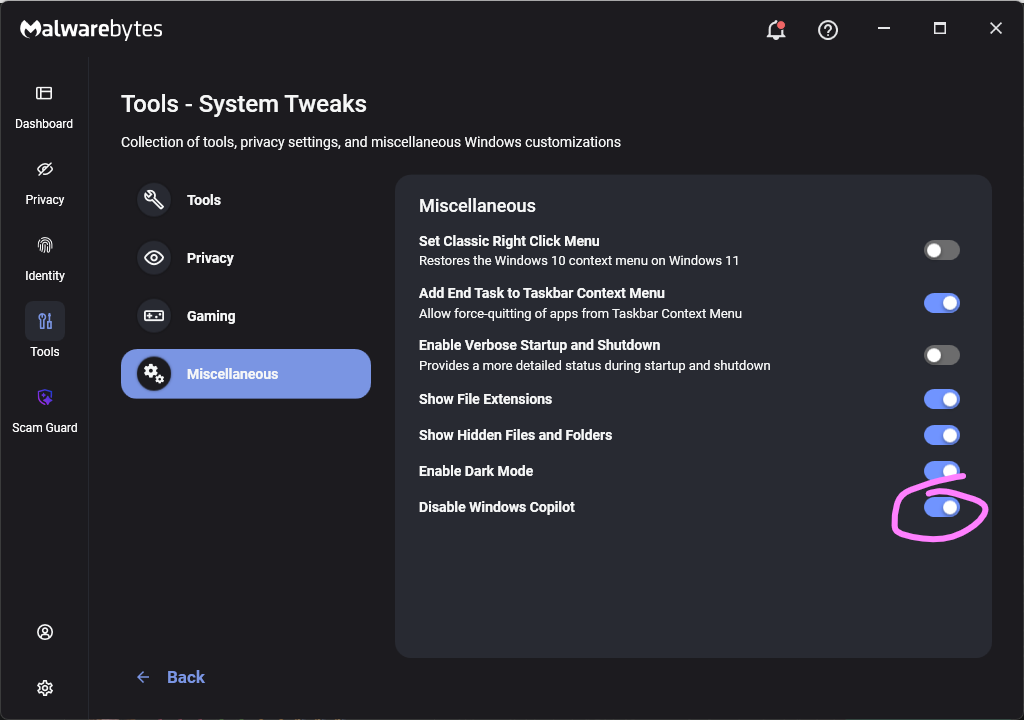
Malwarebytes users can turn off Copilot under Tools > System Tweaks > Miscellaneous.

Malwarebytes setting to disable Copilot

Or in Word itself:

For individual users who don’t want Copilot in Word:

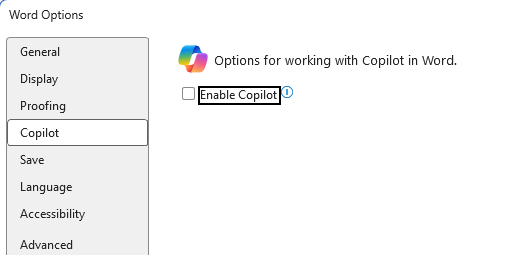
  • Open Word, go to File > Options > Copilot and clear the Enable Copilot checkbox, then restart Word.
    uncheck Enable Copilot in Word
  • In some versions of Word, the setting appears under File > Options > General in a Copilot section. In both cases, the key is unchecking the “Enable Copilot” setting.

You can also remove the Copilot icon from the ribbon by right‑clicking the ribbon, open the customization dialog, locate the Copilot/Assistance button, and removing it.

Alternatively, you can limit Copilot’s role by following these instructions:

  • In Word, go to File > Account > Account Privacy > Manage Settings, and uncheck Turn on optional connected experiences. This reduces certain cloud‑powered AI features, including Copilot‑related functions that rely on those services.
  • In the Microsoft 365 Admin Center, under Copilot > Settings, set Pin Microsoft 365 Copilot Chat to Do not pin Copilot chat in Microsoft 365 apps so the chat pane doesn’t appear by default in apps like Word.

This doesn’t remove Copilot entirely or stop these attacks, but it does reduce its visibility and limits some of its cloud‑assisted functionality.


From reporting threats to removing them.

Cybersecurity risks should never spread beyond a headline. Keep threats off your devices by downloading Malwarebytes today.

Threat landscape for industrial automation systems. Q1 2026

All threats

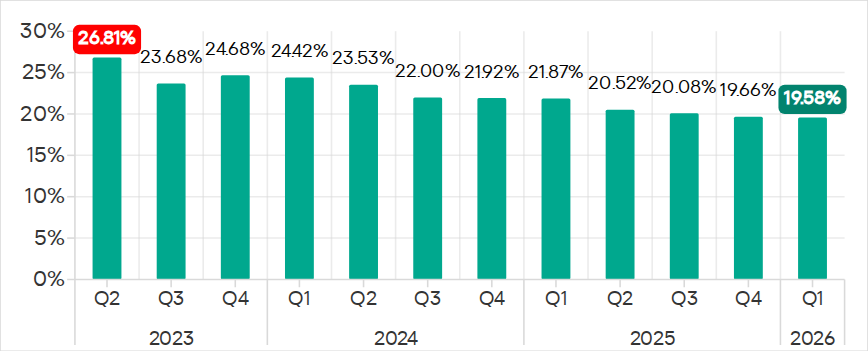
The percentage of ICS computers on which malicious objects were blocked continued to decrease, reaching 19.6% in Q1 2026. This is the lowest value in three years, and it is 1.4 times lower than in Q2 2023.

Percentage of ICS computers on which malicious objects were blocked, Q2 2023–Q1 2026

Percentage of ICS computers on which malicious objects were blocked, Q2 2023–Q1 2026

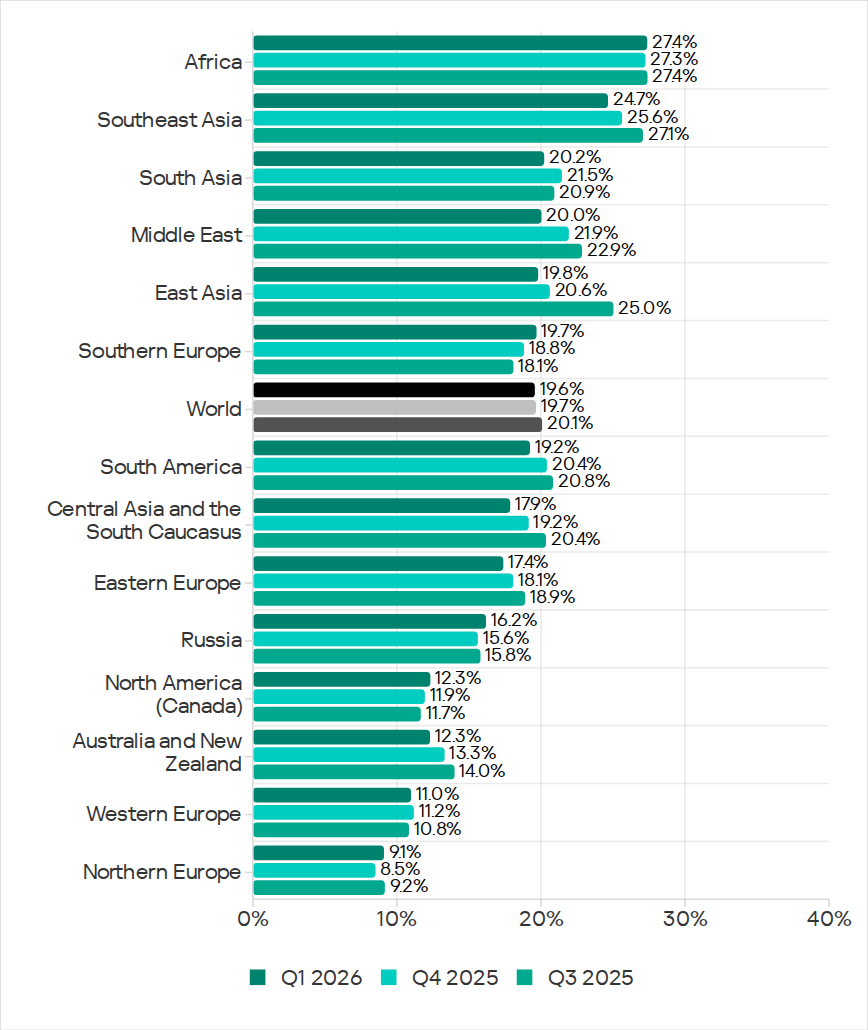
Regionally, the percentages ranged from 9.1% in Northern Europe to 27.4% in Africa.

Regions ranked by percentage of attacked ICS computers

Regions ranked by percentage of attacked ICS computers

The percentage of ICS computers on which malicious objects were blocked increased in five regions over the quarter, most notably in Southern Europe, Northern Europe, and Russia.

In Q1 2026, Southern Europe led the way in growth for internet and email threats. The region also saw the fastest growth in spyware, as well as malicious scripts and phishing pages.

In Russia, the percentage of ICS computers on which malicious objects were blocked exceeded the figures for the previous two quarters. Russia saw an increase in the percentage for threats from the internet, and a slight increase in the figure for threats from email clients (Russia is one of three regions where this figure did not decrease).

Among the threat categories, the greatest increases were observed in the percentages for denylisted internet resources, as well as spyware (distributed in the region via the internet and email clients).

Selected industries

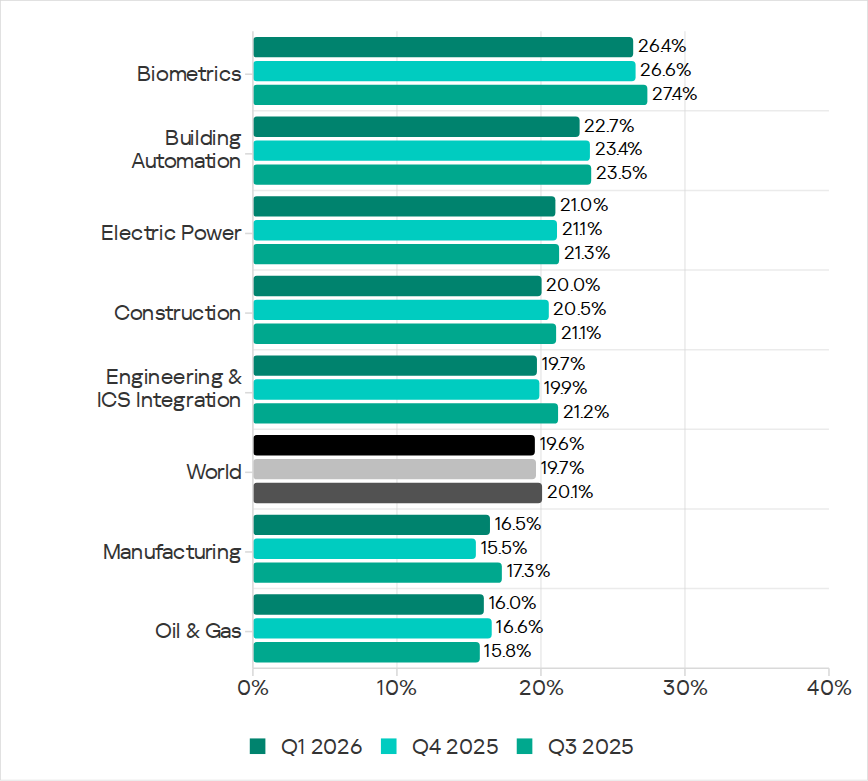
Biometric systems (26.4%) traditionally rank top among the industries and OT infrastructure types covered in this report in terms of the percentage of ICS computers on which malicious objects were blocked. These systems are characterized by internet access, extensive email use for data exchange and approvals (such as access granting), and, in many cases, minimal cybersecurity controls within the organizations that use these systems.

Industries ranked by the percentage of ICS computers on which malicious objects were blocked

Industries ranked by the percentage of ICS computers on which malicious objects were blocked

Biometric systems rank first among industries in terms of email threats. At the same time, unlike other industries, the percentage for email threats in biometric systems exceeds that for internet threats.

In all selected industries, the global average follows a downward trend. In Q1 2026, the percentage of ICS computers on which malicious objects were blocked increased only in the manufacturing sector — by 1.0 pp. The percentages for this industry increased across 10 regions, with the most notable increases in Western Europe, Northern Europe, and Russia.

Threat categories

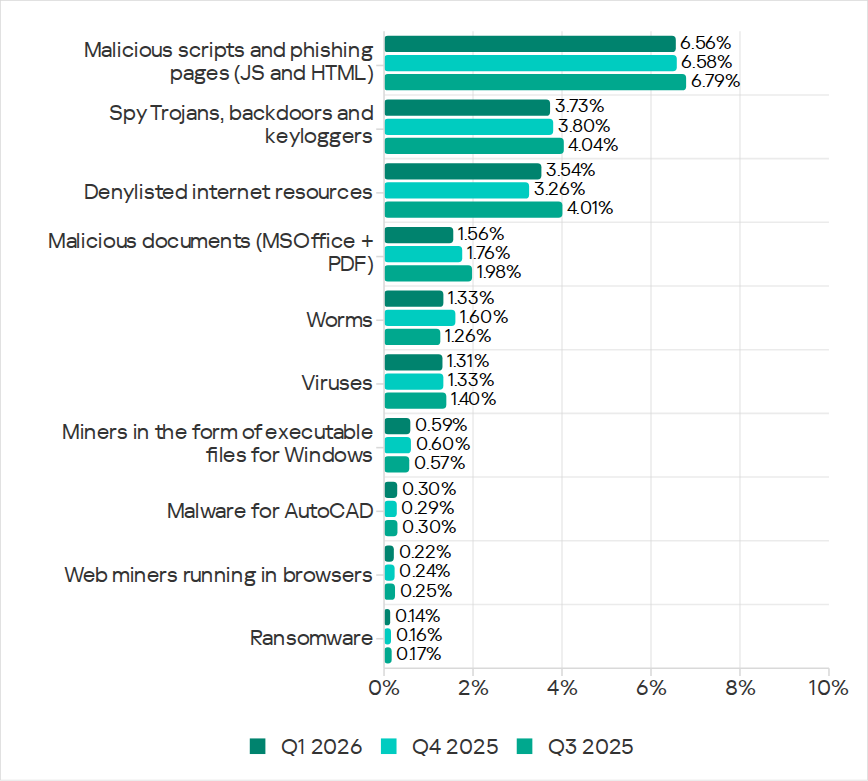
In Q1 2026, Kaspersky security solutions blocked malware from 10,052 different malware families of various categories on industrial automation systems.

Over the quarter, the percentage of ICS computers on which denylisted internet resources were blocked increased (after decreasing over the previous two quarters), and there was a slight increase in the percentage for AutoCAD malware.

Percentage of ICS computers on which the activity of malicious objects from various categories was prevented

Percentage of ICS computers on which the activity of malicious objects from various categories was prevented

Malicious scripts and phishing pages (JS and HTML)

Malicious scripts and phishing pages retained their to spot among threat categories by the percentage of ICS computers on which these threats were blocked. The global average in Q1 2026 was 6.56%.

Over the quarter, the percentages increased in four regions. The most significant change was observed in Southern Europe (9.85%, +0.94 pp). The figures for malicious scripts in the region increased over three consecutive quarters.

Among the selected industries, across all regions, the highest percentages for the malicious scripts and phishing pages category were recorded for biometric systems (19.59%) and building automation (15.43%) in Southern Europe. These same industries lead in similar rankings for malicious documents and spyware.

Spyware

The percentage of ICS computers on which spyware was blocked decreased over two consecutive quarters, dropping to 3.73%. Despite the decline, spyware has ranked second among threat categories by the percentage of attacked computers for three consecutive quarters.

The percentages increased in five regions over the quarter, most notably in Southern Europe (5.46%, +0.35 pp) and Russia (2.84%, +0.24 pp).

In Southern Europe, the percentage of ICS computers on which spyware was blocked increased in all the selected industries except manufacturing. The greatest increase was observed in biometric systems.

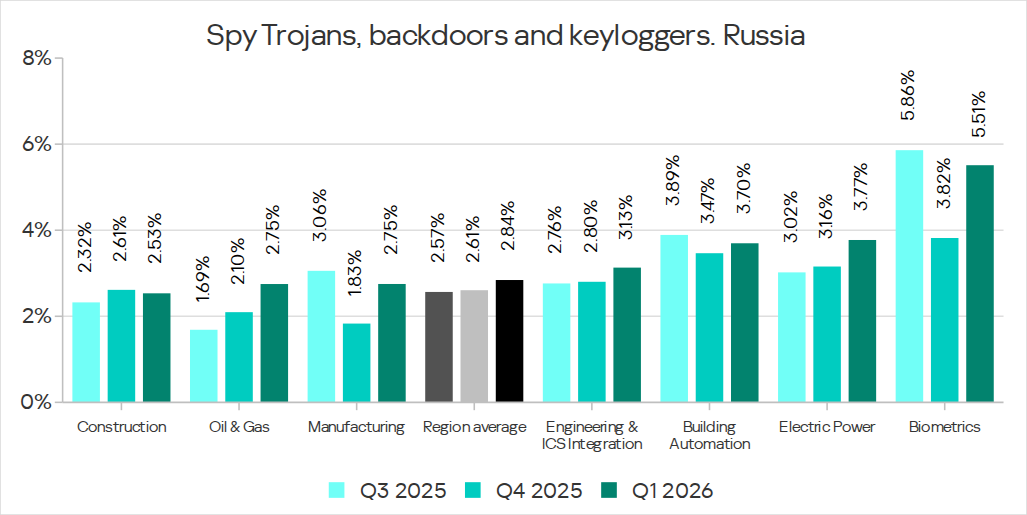
Among the selected industries, the highest percentage of spyware in Russia was recorded in biometric systems. That said, the percentage of ICS computers on which spyware was blocked increased in all industries in the region except construction. The percentage figure has been increasing for two consecutive quarters in the oil and gas industry (by a factor of 1.63 over six months), and for three consecutive quarters in engineering and ICS integration, as well as electric power. In the remaining sectors, the values have been fluctuating.

Percentage of ICS computers on which spyware was blocked in various industries in Russia, Q3 2025–Q1 2026

Percentage of ICS computers on which spyware was blocked in various industries in Russia, Q3 2025–Q1 2026

Denylisted internet resources

The percentage of ICS computers on which denylisted internet resources were blocked increased to 3.54%.

The most notable increase over the quarter occurred in Southeast Asia (4.58%, +0.65 pp). Among the industries in the region, the highest percentage figures for this threat category were recorded in electric power and construction. Over the quarter, the largest increases in percentages figures were observed in the electric power and manufacturing industries.

In North America (Canada), denylisted internet resources (2.14%) showed the greatest increase among all categories — by a factor of 1.22.

Among the selected industries across all regions, the highest percentage figures for the denylisted internet resources category were in the electric power (7.11%) and construction (6.25%) industries in Southeast Asia.

Malicious documents (Microsoft Office + PDF)

The percentage figure for this category decreased over two consecutive quarters, reaching its lowest value (1.56%) for the entire period of observations in Q1 2026. It increased just in two regions: Australia and New Zealand (1.12%, +0.04 pp), and Russia (0.62%, +0.01 pp).

Among the selected industries across all regions, the highest percentages for malicious documents were recorded for biometric systems (9.02%) and building automation (6.97%) in Southern Europe. These same industries also lead in similar rankings for malicious scripts and spyware.

Ransomware

The percentage of ICS computers on which ransomware was blocked has decreased for two consecutive quarters, dropping to 0.14%. This is the lowest value among all categories.

The percentage increased in two regions: North America (Canada) (0.11%, +0.04 pp) and slightly in Northern Europe (0.06%, +0.01 pp).

Among the selected industries across all regions, the highest percentages for ransomware were recorded in the oil and gas and manufacturing industries (0.92% and 0.65%, respectively) in Central Asia and the South Caucasus, and in biometric systems (0.89%) in Russia.

Miners in the form of executable files for Windows

The percentage of ICS computers on which miners in the form of executable files for Windows were blocked decreased to 0.59%.

The percentage increased in seven regions. The largest increase was observed in Africa (0.63%, +0.16 pp). Among the selected industries, the largest increases in the region were in the manufacturing and oil and gas industries.

Among the selected industries across all regions, the highest percentages for miners in the form of executable files were recorded in construction (1.99%), biometric systems (1.98%), and the oil and gas industry (1.97%) in Central Asia and the South Caucasus.

Web miners

The percentage of ICS computers on which web miners were blocked has been declining for a year, and in Q1 2026, it reached the lowest value for the entire period under review (0.22%).

At the same time, the percentage increased in seven regions. The largest increases were observed in South Asia (0.28%, +0.11 pp), the Middle East (0.31%, +0.09 pp), and Africa (0.34%, +0.08 pp). Despite the increases, the percentages in these regions for Q1 2026 did not exceed those observed in 2023–2024 and in Q1 2025.

Among the selected industries across all regions, the highest percentages for web miners were recorded for biometric systems (0.97%) in Russia. Biometric systems in South Asia (0.79%) ranked second, and the electric power sector in Southeast Asia (0.76%) ranked third.

Worms

The percentage of ICS computers on which worms were blocked decreased to 1.33%.

The percentage decreased across all regions following an increase in the previous quarter (due to a wave of phishing attacks that distributed the Backdoor.MSIL.XWorm backdoor worm across all regions of the world).

Among the selected industries across all regions, the highest percentage figure for worms was recorded for biometric systems (4.80%) in Central Asia and the South Caucasus. Two industries in Africa – biometric systems (4.04%) and electric power (3.53%) – took the second and third spots, respectively.

Viruses

The percentage of ICS computers on which viruses were blocked decreased to 1.31%.

The top 3 regions by this figure remained the same: Southeast Asia (6.11%, first by a wide margin), Africa (4.15%), and East Asia (2.97%). These same regions are also among the leaders by the percentage of systems affected by AutoCAD malware. The largest increase in this figure was observed in Africa (+0.41 pp).

Among the selected industries across all regions, the highest percentages for viruses were recorded in the construction industry (6.35%) and building automation (5.50%) in Southeast Asia.

Malware for AutoCAD

The percentage of ICS computers on which malware for AutoCAD was blocked increased to 0.30%.

The most notable increase over the quarter was observed in Africa, with the region’s percentage figure rising by 0.47 pp, a very significant increase for this category, and almost doubling (to 0.91%).

Among the selected industries across all regions, the highest percentages for AutoCAD malware were recorded in the construction industry in East Asia (5.58%) and Southeast Asia (3.87%).

Main threat sources

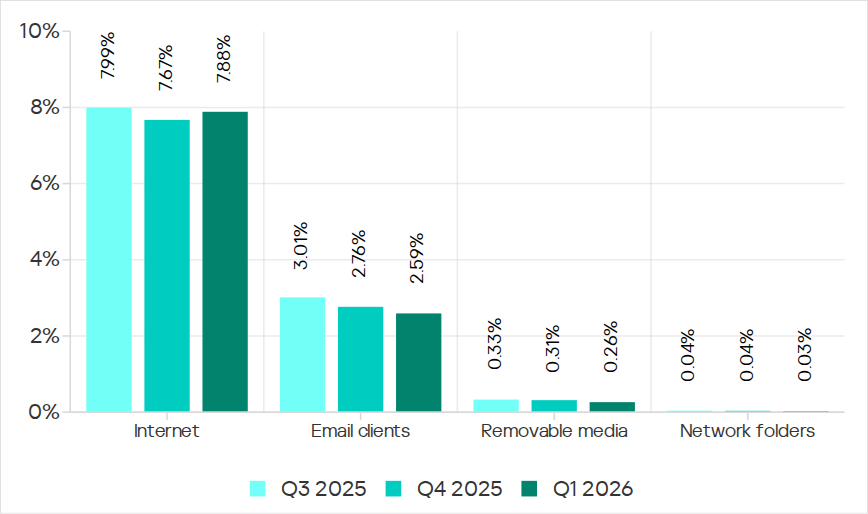
In Q1 2026, the average percentages across all threat sources, except threats from the internet, decreased globally.

Percentage of ICS computers on which malicious objects from various sources were blocked

Percentage of ICS computers on which malicious objects from various sources were blocked

Internet

The percentage of ICS computers on which threats from the internet were blocked increased to 7.88%. However, over the past three years, the percentage figure for internet threats has followed a downward trend.

The largest increases in the percentages were recorded in Southern Europe (8.59%, +0.59 pp), Southeast Asia (10.16%, +0.55 pp), and Northern Europe (4.47%, +0.51 pp).

Among the selected industries across all regions, the highest percentages for threats from the internet were recorded in electric power (13.16%) and construction (12.55%) in Southeast Asia, and in the engineering and ICS integration sector (12.33%) in South Asia.

Email clients

The percentage of ICS computers on which threats delivered via email clients were blocked decreased to 2.59%. This is a three-year low.

The percentage of this threat source increased in three regions: Southern Europe (6.54%, +0.2 pp), East Asia (1.5%, +0.09 pp), and slightly in Russia (0.7%, +0.04 pp).

Among the selected industries across all regions, the highest percentages for email threats were recorded for biometric systems (19.78%) and building automation (12.34%) in Southern Europe. In these two industries, the percentage of ICS computers on which email threats are blocked is higher than the percentage for threats from the internet. A similar situation was observed in two other instances, both in biometric systems (in South America and Southeast Asia).

Removable media

The percentage of ICS computers on which threats were detected when connecting removable media continued to decrease, reaching its lowest value for the period under review (0.26%).

Among the selected industries across all regions, the highest percentages for removable media threats blocked on ICS computers were observed in the electric power sector in Central Asia and the South Caucasus (1.45%), East Asia (1.34%), and Africa (1.16%).

Network folders

The percentage of ICS computers on which threats are blocked in network folders is steadily decreasing. In Q1 2026, it was the lowest for the period under review (0.029%).

East Asia has traditionally led by a wide margin. The percentage for East Asia (0.135%) is 27 times higher than the lowest regional value (recorded in Northern Europe).

The largest increases in the percentages for threats from network folders were observed in Africa (0.037%, +0.006 pp) and South America (0.013%, +0.006 pp).
Among the selected industries across all regions, the construction industry in East Asia, at 0.36%, holds the top positions in the ranking by the percentage of ICS computers on which threats are blocked in network folders.

For more information on industrial threats see the full version of the report.

May 2026 Threat Trend Report on APT Groups

Purpose and Scope The May 2026 APT Trends report identified supply chain attacks, developer environment attacks, automated Initial Breach, and exploitation of runtime environments as key developments. Lazarus, Famous Chollima, Gamaredon, MuddyWater, and Nimbus Manticore are of particular concern. Status of Major APT Groups by Region North Korea The Lazarus group exploited Git Hooks (Git […]

Smashing Security podcast #471: This AI worm just rewrote its own rules

Researchers at the University of Toronto have built a worm that thinks for itself. Using free off-the-shelf AI models it works out how to break into each new computer it encounters, and hijacks the powerful ones to host its own AI brain. And then the researchers discovered their creation had quietly removed the list of machines it wasn't supposed to attack. Meanwhile, Meta's shiny new AI customer support agent has been cheerfully helping hackers help themselves to other people's Instagram accounts. Just keep asking, politely but firmly, to have a password reset sent to a different email address - and the AI will eventually agree. All this and more in episode 471 of the "Smashing Security" podcast with cybersecurity expert and keynote speaker Graham Cluley, and special guest James Ball.

Ransom & Dark Web Issues Week 2, May 2026

ASEC Blog publishes Ransom & Dark Web Issues Week 2, May 2026           Coinbase Claims Data Leak of South Korean Medical Ultrasound Equipment Manufacturer Emergence of New Data Extortion Group ‘Leak Bazaar’ Hasan’s BreachForums and TeamPCP Host Large-Scale Supply Chain Attack Competition Using Shaid-Hulud Worm

Threat landscape for industrial automation systems in Q4 2025

Statistics across all threats

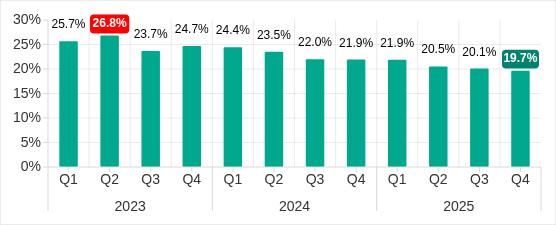
The percentage of ICS computers on which malicious objects were blocked has been decreasing since the beginning of 2024. In Q4 2025, it was 19.7%. Over the past three years, the percentage has decreased by 1.36 times, and by 1.25 times since Q4 2023.

Percentage of ICS computers on which malicious objects were blocked, Q1 2023–Q4 2025

Percentage of ICS computers on which malicious objects were blocked, Q1 2023–Q4 2025

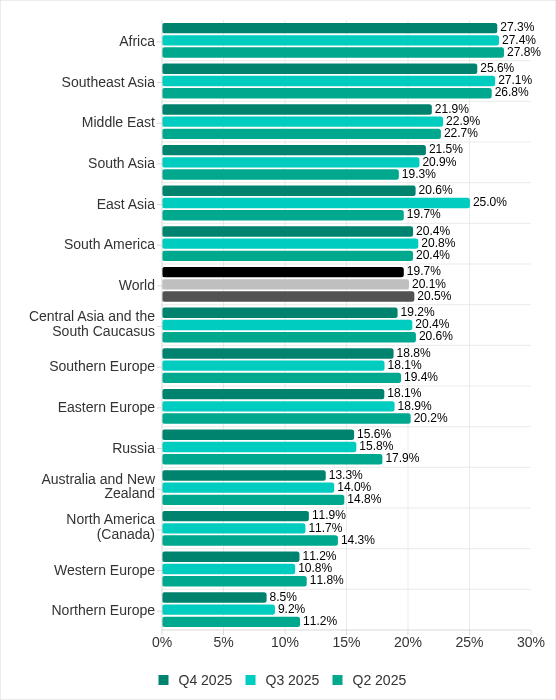
Regionally, in Q4 2025, the percentage of ICS computers on which malicious objects were blocked ranged from 8.5% in Northern Europe to 27.3% in Africa.

Regions ranked by percentage of ICS computers on which malicious objects were blocked

Regions ranked by percentage of ICS computers on which malicious objects were blocked

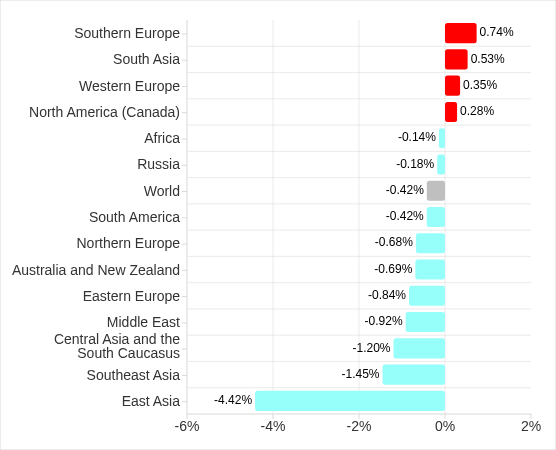
Four regions saw an increase in the percentage of ICS computers on which malicious objects were blocked. The most notable increases occurred in Southern Europe and South Asia. In Q3 2025, East Asia experienced a sharp increase triggered by the local spread of malicious scripts, but the figure has since returned to normal.

Changes in percentage of ICS computers on which malicious objects were blocked, Q4 2025

Changes in percentage of ICS computers on which malicious objects were blocked, Q4 2025

Feature of the quarter: worms in email

In Q4 2025, the percentage of ICS computers on which wormsinemailattachments were blocked increasedinallregions of the world.

Many of the blocked threats were related to the worm Backdoor.MSIL.XWorm. This malware is designed to persist on the system and then remotely control it.

Interestingly, this threat was not detected on ICS computers in the previous quarter, yet it appeared in all regions in Q4 2025.

A study found that the active spread of Backdoor.MSIL.XWorm via phishing emails was likely linked to the use by hackers of another malware obfuscation technique that was actively used during massive phishing campaigns in Q4 2025. These campaigns have been known since 2024 as “Curriculum-vitae-catalina”.

The attackers distributed phishing emails to HR managers, recruiters, and employees responsible for hiring. The messages were disguised as responses from job applicants with subjects such as “Resume” or “Attached Resume” and contained a malicious executable file under the guise of a curriculum vitae. Typically, the file was named Curriculum Vitae-Catalina.exe. When executed, it infected the system.

In Q4 2025, the threat spread across regions in two waves — one in October and another in November. Russia, Western Europe, South America, and North America (Canada) were attacked in October. A spike in Backdoor.MSIL.XWorm blocking was observed in other regions in November. The attack subsided in all regions in December.

The highest percentage of ICS computers on which Backdoor.MSIL.XWorm was blocked was observed in regions where threats from email clients had been historically blocked at high rates on ICS computers: Southern Europe, South America, and the Middle East.

At the same time, in Africa, where USB storage media are still actively used, the threat was also detected when removable devices were connected to ICS computers.

Selected industries

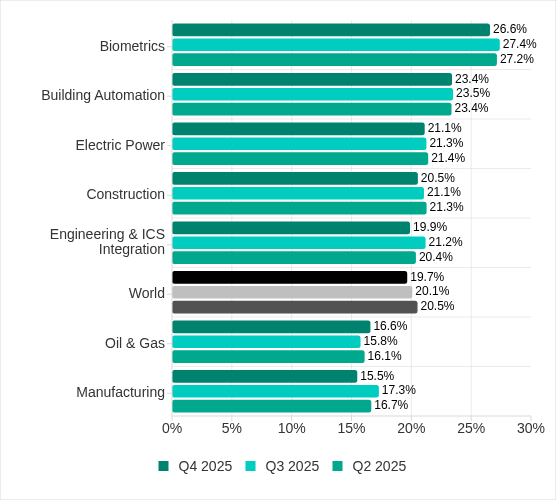
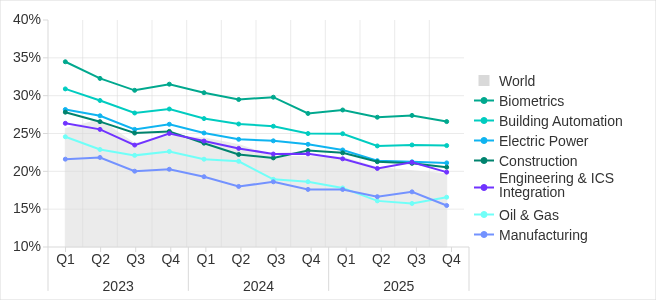
The biometrics sector has historically led the rankings of industries and OT infrastructures surveyed in this report in terms of the percentage of ICS computers on which malicious objects were blocked.

These systems are characterized by accessibility to and from the internet, as well as minimal cybersecurity controls by the consumer organization.

Rankings of industries and OT infrastructure by percentage of ICS computers on which malicious objects were blocked

Rankings of industries and OT infrastructure by percentage of ICS computers on which malicious objects were blocked

In Q4 2025, the percentage of ICS computers on which malicious objects were blocked increased only in one sector: oil and gas. The corresponding figures increased in two regions: Russia, and Central Asia and the South Caucasus.

However, if we look at a broader time span, there is a downward trend in all the surveyed industries.

Percentage of ICS computers on which malicious objects were blocked in selected industries

Percentage of ICS computers on which malicious objects were blocked in selected industries

Diversity of detected malicious objects

In Q4 2025, Kaspersky protection solutions blocked malware from 10,142 different malware families of various categories on industrial automation systems.

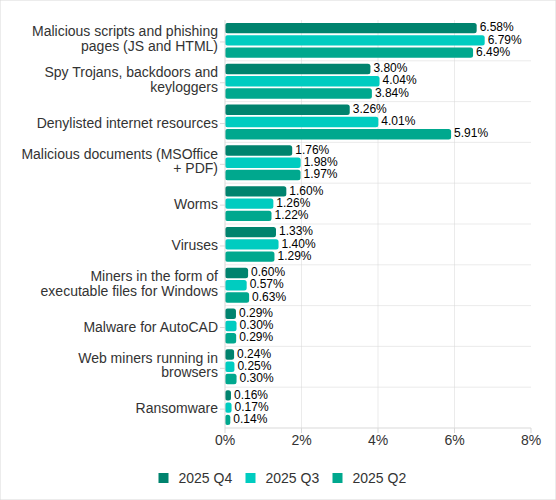
Percentage of ICS computers on which the activity of malicious objects from various categories was blocked

Percentage of ICS computers on which the activity of malicious objects from various categories was blocked

In Q4 2025, there was an increase in the percentage of ICS computers on which worms, and miners in the form of executable files for Windows were blocked. These were the only categories that exhibited an increase.

Main threat sources

Depending on the threat detection and blocking scenario, it is not always possible to reliably identify the source. The circumstantial evidence for a specific source can be the blocked threat’s type (category).

The internet (visiting malicious or compromised internet resources; malicious content distributed via messengers; cloud data storage and processing services and CDNs), email clients (phishing emails), and removable storage devices remain the primary sources of threats to computers in an organization’s technology infrastructure.

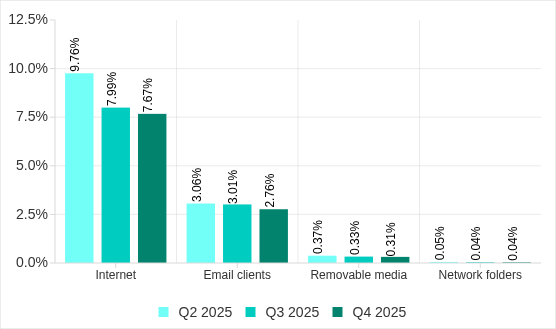
In Q4 2025, the percentage of ICS computers on which malicious objects from various sources were blocked decreased. All sources except email clients saw their lowest levels in three years.

Percentage of ICS computers on which malicious objects from various sources were blocked

Percentage of ICS computers on which malicious objects from various sources were blocked

The same computer can be attacked by several categories of malware from the same source during a quarter. That computer is counted when calculating the percentage of attacked computers for each threat category, but is only counted once for the threat source (we count unique attacked computers). In addition, it is not always possible to accurately determine the initial infection attempt. Therefore, the total percentage of ICS computers on which various categories of threats from a certain source were blocked can exceed the percentage of computers affected by the source itself.

  • In Q4 2025, the percentage of ICS computers on which threats from the internet were blocked decreased to 7.67% and reached its lowest level since the beginning of 2023. The main categories of internet threats are malicious scripts and phishing pages, and denylisted internet resources. The percentage ranged from 3.96% in Northern Europe to 11.33% in South Asia.
  • The main categories of threats from email clients blocked on ICS computers were malicious scripts and phishing pages, spyware, and malicious documents. Most of the spyware detected in phishing emails was delivered as a password archive or a multi-layered script embedded in office document files. The percentage of ICS computers on which threats from email clients were blocked ranged from 0.64% in Northern Europe to 6.34% in Southern Europe.
  • The main categories of threats that were blocked when removable media was connected to ICS computers were worms, viruses, and spyware. The percentage of ICS computers on which threats from removable media were blocked ranged from 0.05% in Australia and New Zealand to 1.41% in Africa.
  • The main categories of threats that spread through network folders in Q4 2025 were viruses, AutoCAD malware, worms, and spyware. The percentage of ICS computers on which threats from network folders were blocked ranged from 0.01% in Northern Europe to 0.18% in East Asia.

Threat categories

Typical attacks blocked within an OT network are multi-step sequences of malicious activities, where each subsequent step of the attackers is aimed at increasing privileges and/or gaining access to other systems by exploiting the security problems of industrial enterprises, including OT infrastructures.

Malicious objects used for initial infection

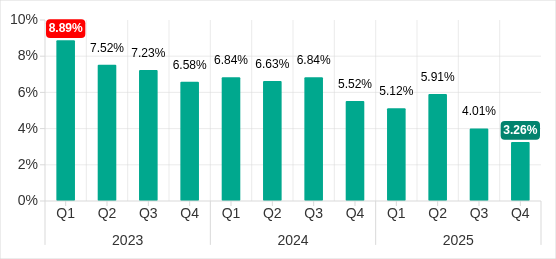
In Q4 2025, the percentage of ICS computers on which denylisted internet resources were blocked decreased to 3.26%. This is the lowest quarterly figure since the beginning of 2022, and it has decreased by 1.8 times since Q2 2025.

Percentage of ICS computers on which denylisted internet resources were blocked, Q1 2023–Q4 2025

Percentage of ICS computers on which denylisted internet resources were blocked, Q1 2023–Q4 2025

Regionally, the percentage of ICS computers on which denylisted internet resources were blocked ranged from 1.74% in Northern Europe to 3.93% in Southeast Asia, which displaced Africa from first place. Russia rounded out the top three regions for this indicator.

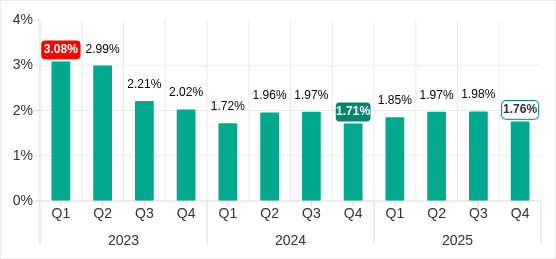
The percentage of ICS computers on which malicious documents were blocked increased for three consecutive quarters. However, in Q4 2025 it decreased by 0.22 pp to 1.76%.

Percentage of ICS computers on which malicious documents were blocked, Q1 2023–Q4 2025

Percentage of ICS computers on which malicious documents were blocked, Q1 2023–Q4 2025

Regionally, the percentage ranged from 0.46% in Northern Europe to 3.82% in Southern Europe. In Q4 2025, the indicator increased in Eastern Europe, Russia, and Western Europe.

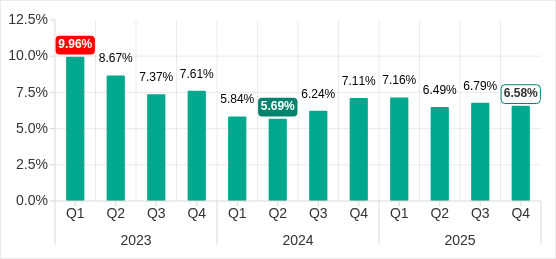
The percentage of ICS computers on which malicious scripts and phishing pages were blocked decreased to 6.58%. Despite the decline, this category led the rankings of threat categories in terms of the percentage of ICS computers on which they were blocked.

Percentage of ICS computers on which malicious scripts and phishing pages were blocked, Q1 2023–Q4 2025

Percentage of ICS computers on which malicious scripts and phishing pages were blocked, Q1 2023–Q4 2025

Regionally, the percentage ranged from 2.52% in Northern Europe to 10.50% in South Asia. The indicator increased in South Asia, South America, Southern Europe, and Africa. South Asia saw the most notable increase, at 3.47 pp.

Next-stage malware

Malicious objects used to initially infect computers deliver next-stage malware — spyware, ransomware, and miners — to victims’ computers. As a rule, the higher the percentage of ICS computers on which the initial infection malware is blocked, the higher the percentage for next-stage malware.

In Q4 2025, the percentage of ICS computers on which spyware, ransomware and web miners were blocked decreased. The rates were:

  • Spyware: 3.80% (down 0.24 pp). For the second quarter in a row, spyware took second place in the rankings of threat categories in terms of the percentage of ICS computers on which it was blocked.
  • Ransomware: 0.16% (down 0.01 pp).
  • Web miners: 0.24% (down 0.01 pp), this is the lowest level observed thus far in the period under review.

The percentage of ICS computers on which miners in the form of executable files for Windows were blocked increased to 0.60% (up 0.03 pp).

Self-propagating malware

Self-propagating malware (worms and viruses) is a category unto itself. Worms and virus-infected files were originally used for initial infection, but as botnet functionality evolved, they took on next-stage characteristics.

To spread across ICS networks, viruses and worms rely on removable media and network folders and are distributed in the form of infected files, such as archives with backups, office documents, pirated games and hacked applications. In rarer and more dangerous cases, web pages with network equipment settings, as well as files stored in internal document management systems, product lifecycle management (PLM) systems, resource management (ERP) systems and other web services are infected.

In Q4 2025, the percentage of ICS computers on which worms were blocked increased by 1.6 times to 1.60%. As mentioned above, this increase is related to a global phishing attack that spread the Backdoor.MSIL.XWorm backdoor worm across all regions of the world. The percentage increased in all regions. The biggest increase (up by 2.16 times) was in Southern Europe. The malware was primary distributed through email clients, and Southern Europe led the way in terms of the percentage of ICS computers on which threats from email clients were blocked.

The percentage of ICS computers on which viruses were blocked decreased to 1.33%.

AutoCAD malware

This category of malware can spread in a variety of ways, so it does not belong to a specific group.

After an increase in the previous quarter, the percentage of ICS computers on which AutoCAD malware was blocked decreased to 0.29% in Q4 2025.

For more information on industrial threats see the full version of the report.

‘CanisterWorm’ Springs Wiper Attack Targeting Iran

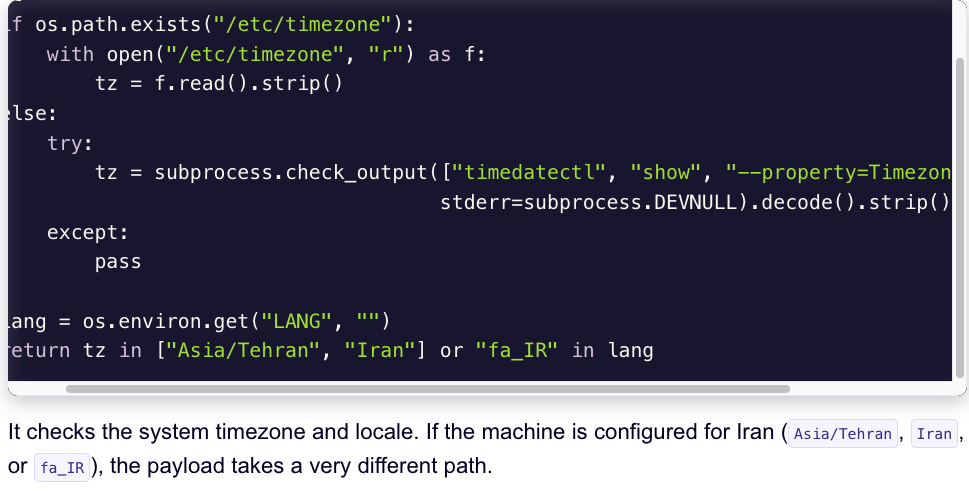
A financially motivated data theft and extortion group is attempting to inject itself into the Iran war, unleashing a worm that spreads through poorly secured cloud services and wipes data on infected systems that use Iran’s time zone or have Farsi set as the default language.

Experts say the wiper campaign against Iran materialized this past weekend and came from a relatively new cybercrime group known as TeamPCP. In December 2025, the group began compromising corporate cloud environments using a self-propagating worm that went after exposed Docker APIs, Kubernetes clusters, Redis servers, and the React2Shell vulnerability. TeamPCP then attempted to move laterally through victim networks, siphoning authentication credentials and extorting victims over Telegram.

A snippet of the malicious CanisterWorm that seeks out and destroys data on systems that match Iran’s timezone or have Farsi as the default language. Image: Aikido.dev.

In a profile of TeamPCP published in January, the security firm Flare said the group weaponizes exposed control planes rather than exploiting endpoints, predominantly targeting cloud infrastructure over end-user devices, with Azure (61%) and AWS (36%) accounting for 97% of compromised servers.

“TeamPCP’s strength does not come from novel exploits or original malware, but from the large-scale automation and integration of well-known attack techniques,” Flare’s Assaf Morag wrote. “The group industrializes existing vulnerabilities, misconfigurations, and recycled tooling into a cloud-native exploitation platform that turns exposed infrastructure into a self-propagating criminal ecosystem.”

On March 19, TeamPCP executed a supply chain attack against the vulnerability scanner Trivy from Aqua Security, injecting credential-stealing malware into official releases on GitHub actions. Aqua Security said it has since removed the harmful files, but the security firm Wiz notes the attackers were able to publish malicious versions that snarfed SSH keys, cloud credentials, Kubernetes tokens and cryptocurrency wallets from users.

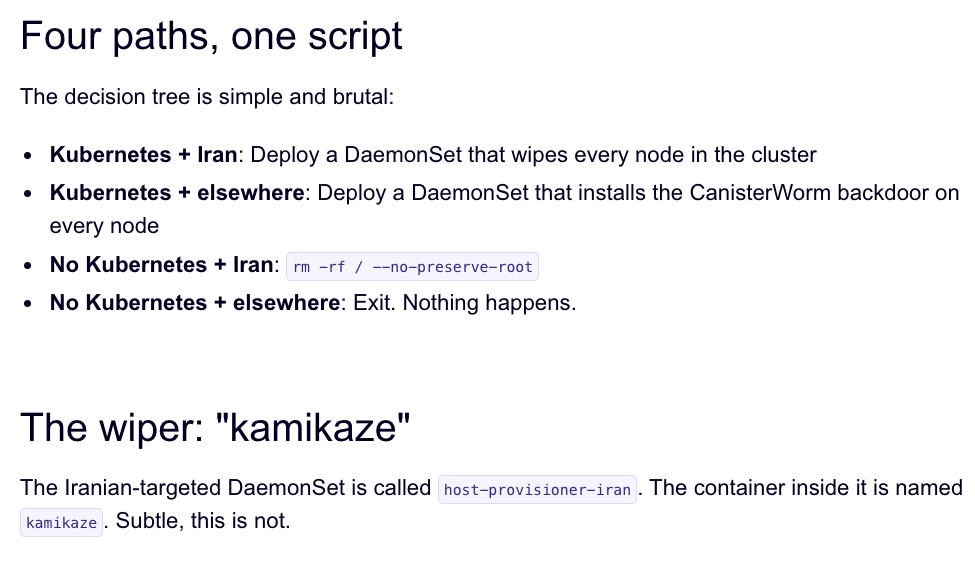
Over the weekend, the same technical infrastructure TeamPCP used in the Trivy attack was leveraged to deploy a new malicious payload which executes a wiper attack if the user’s timezone and locale are determined to correspond to Iran, said Charlie Eriksen, a security researcher at Aikido. In a blog post published on Sunday, Eriksen said if the wiper component detects that the victim is in Iran and has access to a Kubernetes cluster, it will destroy data on every node in that cluster.

“If it doesn’t it will just wipe the local machine,” Eriksen told KrebsOnSecurity.

Image: Aikido.dev.

Aikido refers to TeamPCP’s infrastructure as “CanisterWorm” because the group orchestrates their campaigns using an Internet Computer Protocol (ICP) canister — a system of tamperproof, blockchain-based “smart contracts” that combine both code and data. ICP canisters can serve Web content directly to visitors, and their distributed architecture makes them resistant to takedown attempts. These canisters will remain reachable so long as their operators continue to pay virtual currency fees to keep them online.

Eriksen said the people behind TeamPCP are bragging about their exploits in a group on Telegram and claim to have used the worm to steal vast amounts of sensitive data from major companies, including a large multinational pharmaceutical firm.

“When they compromised Aqua a second time, they took a lot of GitHub accounts and started spamming these with junk messages,” Eriksen said. “It was almost like they were just showing off how much access they had. Clearly, they have an entire stash of these credentials, and what we’ve seen so far is probably a small sample of what they have.”

Security experts say the spammed GitHub messages could be a way for TeamPCP to ensure that any code packages tainted with their malware will remain prominent in GitHub searches. In a newsletter published today titled GitHub is Starting to Have a Real Malware Problem, Risky Business reporter Catalin Cimpanu writes that attackers often are seen pushing meaningless commits to their repos or using online services that sell GitHub stars and “likes” to keep malicious packages at the top of the GitHub search page.

This weekend’s outbreak is the second major supply chain attack involving Trivy in as many months. At the end of February, Trivy was hit as part of an automated threat called HackerBot-Claw, which mass exploited misconfigured workflows in GitHub Actions to steal authentication tokens.

Eriksen said it appears TeamPCP used access gained in the first attack on Aqua Security to perpetrate this weekend’s mischief. But he said there is no reliable way to tell whether TeamPCP’s wiper actually succeeded in trashing any data from victim systems, and that the malicious payload was only active for a short time over the weekend.

“They’ve been taking [the malicious code] up and down, rapidly changing it adding new features,” Eriksen said, noting that when the malicious canister wasn’t serving up malware downloads it was pointing visitors to a Rick Roll video on YouTube.

“It’s a little all over the place, and there’s a chance this whole Iran thing is just their way of getting attention,” Eriksen said. “I feel like these people are really playing this Chaotic Evil role here.”

Cimpanu observed that supply chain attacks have increased in frequency of late as threat actors begin to grasp just how efficient they can be, and his post documents an alarming number of these incidents since 2024.

“While security firms appear to be doing a good job spotting this, we’re also gonna need GitHub’s security team to step up,” Cimpanu wrote. “Unfortunately, on a platform designed to copy (fork) a project and create new versions of it (clones), spotting malicious additions to clones of legitimate repos might be quite the engineering problem to fix.”

Update, 2:40 p.m. ET: Wiz is reporting that TeamPCP also pushed credential stealing malware to the KICS vulnerability scanner from Checkmarx, and that the scanner’s GitHub Action was compromised between 12:58 and 16:50 UTC today (March 23rd).

❌