❌

Visualização de leitura

Tracking a Sanctioned Russian Vessel’s West African Odyssey

Sign up here to receive Bellingcat’s biggest investigations by email as soon as they are published.

A sanctioned vessel that was previously reported to have transported weapons destined for Russian mercenaries has been traversing ports on the west coast of Africa since March, exhibiting what experts told Bellingcat  was an unusual set of movements and behaviours.

Patria (IMO: 9159921) has been sanctioned by the US, Ukraine and Canada.

Support Bellingcat

Your donations directly contribute to our ability to publish groundbreaking investigations and uncover wrongdoing around the world.

Radio France International (RFI) reported last year that it was one of two ships to deliver weapons to Conakry in Guinea that were intended for the Kremlin-controlled Africa Corps and their operations in Mali.

Satellite imagery and Automated Identification System (AIS) data from Lloyd’s List Intelligence shows Patria has shuttled between the Port of Douala in Cameroon and the Port of Owendo in Libreville, Gabon four times since March. 

It has also twice stopped in anchorage off the coast of Lagos, Nigeria: first in March and then again at the time of publication. Analysis shows the vessel also spent time in anchorage off the coast of Equatorial Guinea. 

The online news site, Modern Ghana, first reported Patria’s presence off the coast of Lagos in July after X-users @SONNAROW_OSINT and @RFNOSBlog picked up on Patria’s position.

It is not clear what Patria has delivered or picked up at these ports. Nor is it clear why it has spent so long going back and forth between them. But experts Bellingcat spoke to said the unusual patterns of behaviour raised numerous questions.

Charlie Brown, a former US Naval Officer and Senior Advisor at United Against Nuclear Iran said the combination of Patria’s repeated regional port calls, extended periods at anchor, and an apparent absence of a normal point-to-point trading cycle warranted scrutiny, especially as the ship is under sanction and is previously reported to have shipped arms. 

Tracking the Patria

Patria is a cargo vessel that has a distinct shape and features. Its bridge is located on the bow and it has a bright red deck that contrasts with its blue hull and two yellow cranes. 

At the end of the deck, the ship has a built-in ramp for vehicles (the Patria is a so-called roll on/roll off, or RoRo, vessel that is designed to transport wheeled vehicles). Its chimney is located next to the ramp.

Footage of the Patria, posted on Youtube on Jan 22, 2024. Credit: Hanro Shipping – Sakhalin Projects LLC / YouTube Channel @hanroship

This, in combination with the length of the ship (101 m), allowed Bellingcat to pick the vessel out in satellite imagery. AIS data helped us further track its long journey which began in the Sea of Japan, in Russia’s far-east, in January.

For the most part, we were able to match Patria’s AIS position with corresponding satellite imagery. We found no evidence of obvious spoofing incidents (where a ship intentionally broadcasts misleading AIS data) by the vessel during its months-long voyage, however, there were some instances where satellite images were not available and thus spoofing by the vessel cannot be completely ruled out.

MapLibre | Protomaps© OpenStreetMap contributors

Port of Olga, Russia

AIS data indicates that Patria loaded at the Port of Olga in the Sea of Japan between Jan. 21 and 23. Patria can also be seen on satellite imagery on these dates.
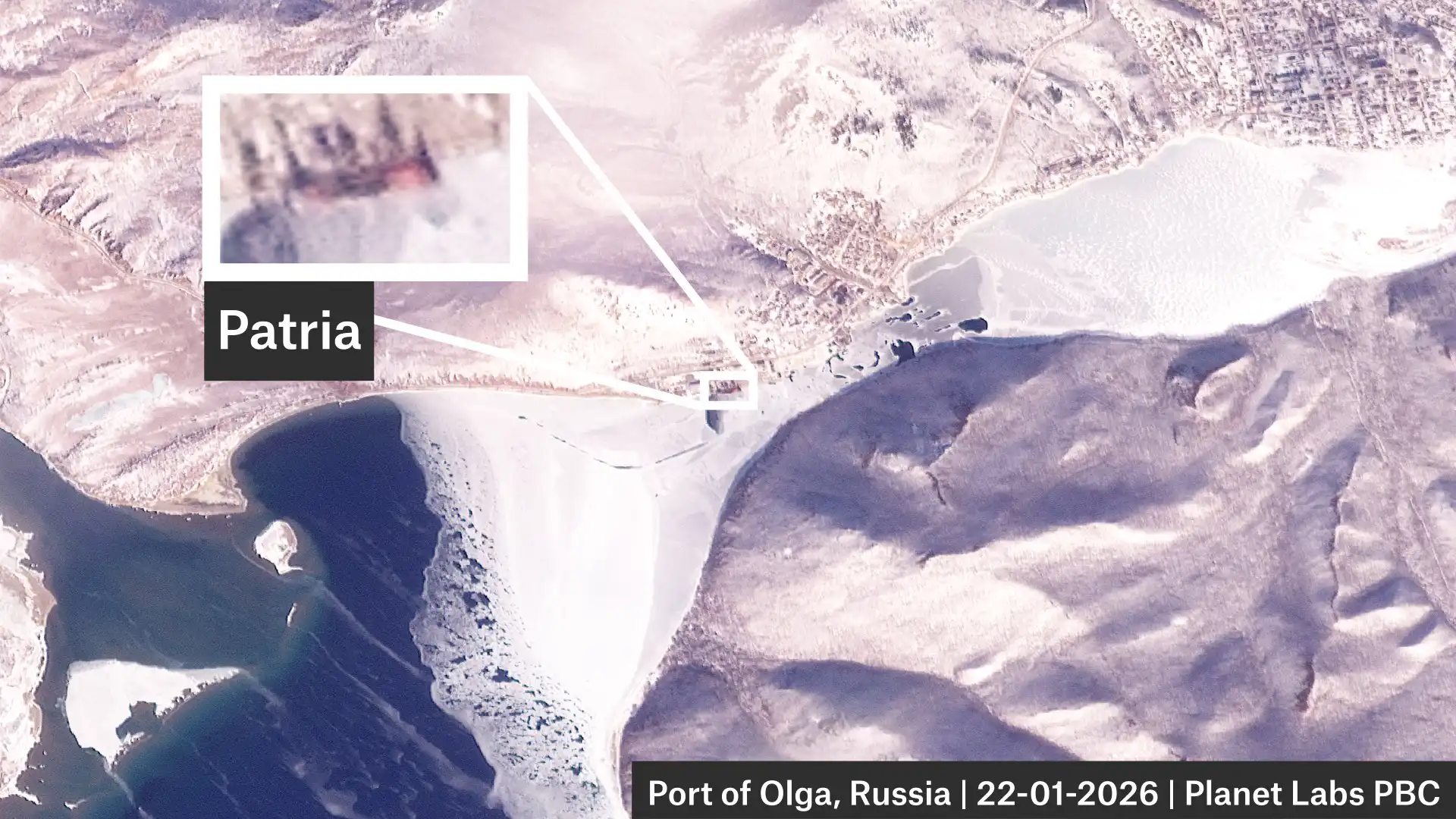
Credit: Planet Labs PBC.

Port of Douala, Cameroon

AIS data indicates that Patria unloaded some cargo in the Port of Douala between Mar. 11 and 12. Again, the ship can also be seen in satellite imagery on these dates.
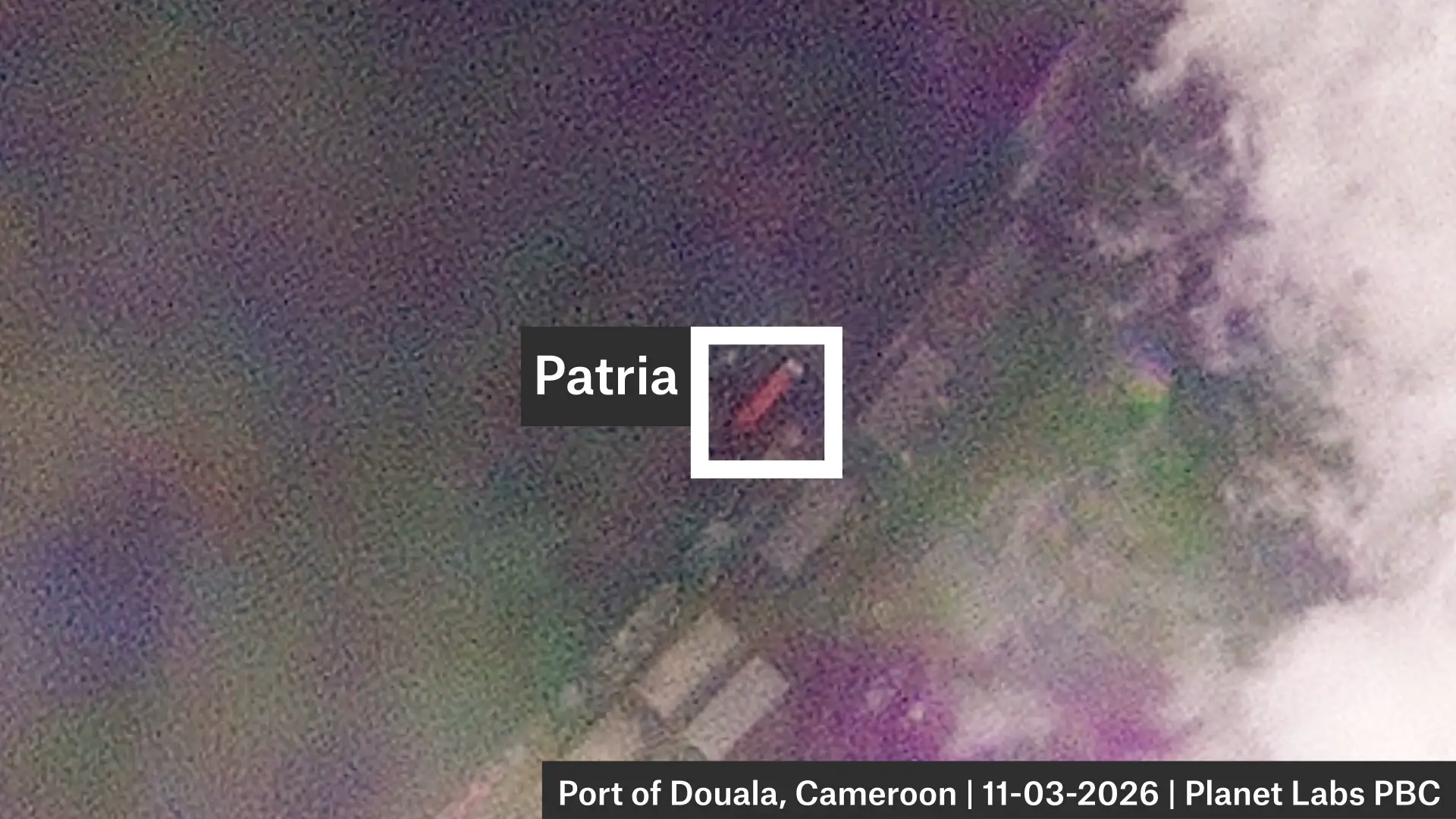
Credit: Planet Labs PBC.

Lagos Anchorage, Nigeria

AIS data indicates Patria anchored off the coast of Lagos from Mar. 14 to 15.

A Sentinel-2 image from the 15th appears to show another ship next to Patria. AIS data indicates that this is JS Gratitude, a bunkering tanker. This close proximity suggests that Patria was refuelling.
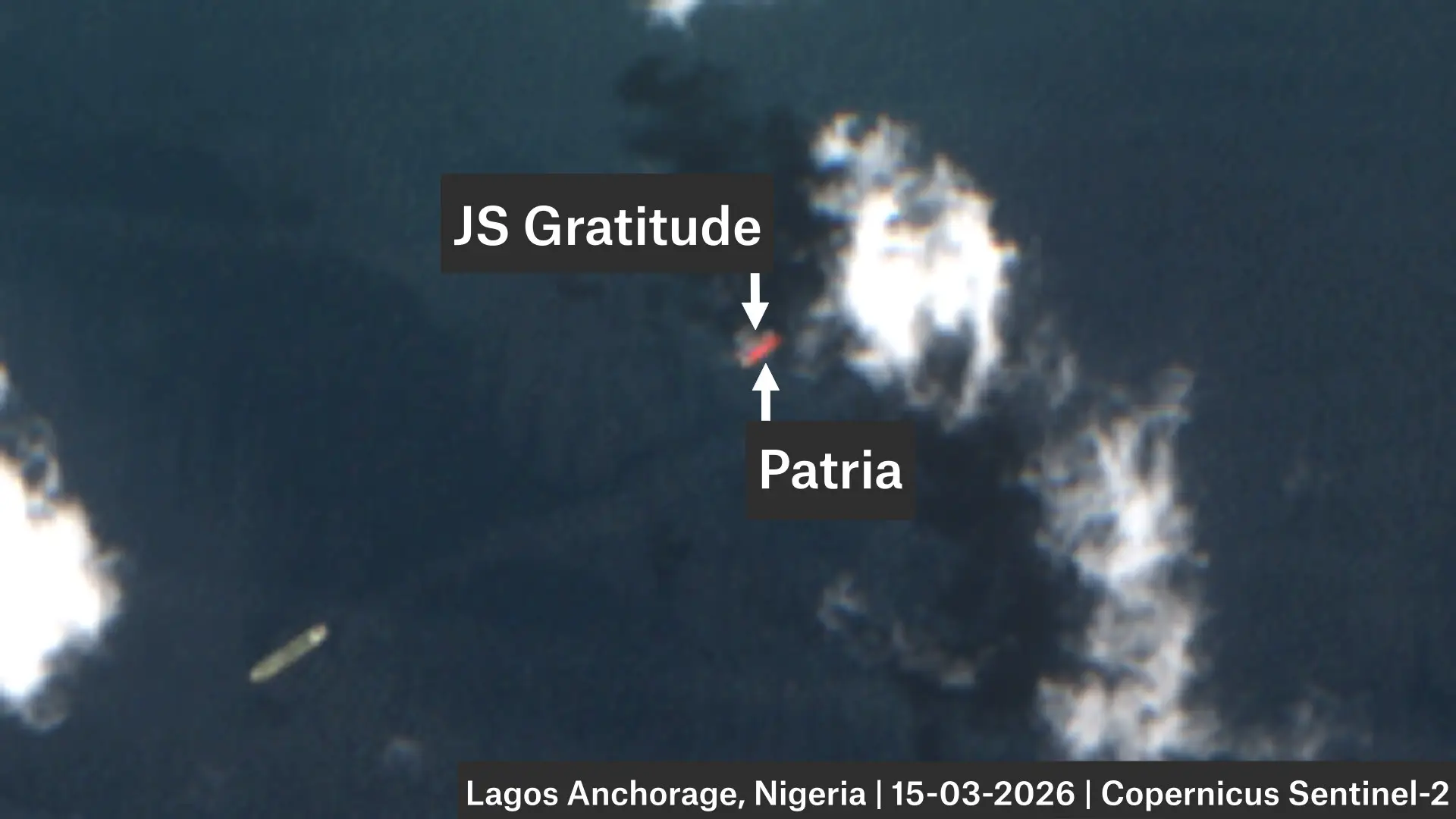
Credit: Contains modified Copernicus Sentinel data 2026.

Bata Anchorage, Equatorial Guinea

AIS data and satellite imagery indicate Patria stayed off the coast of Equatorial Guinea for several days.
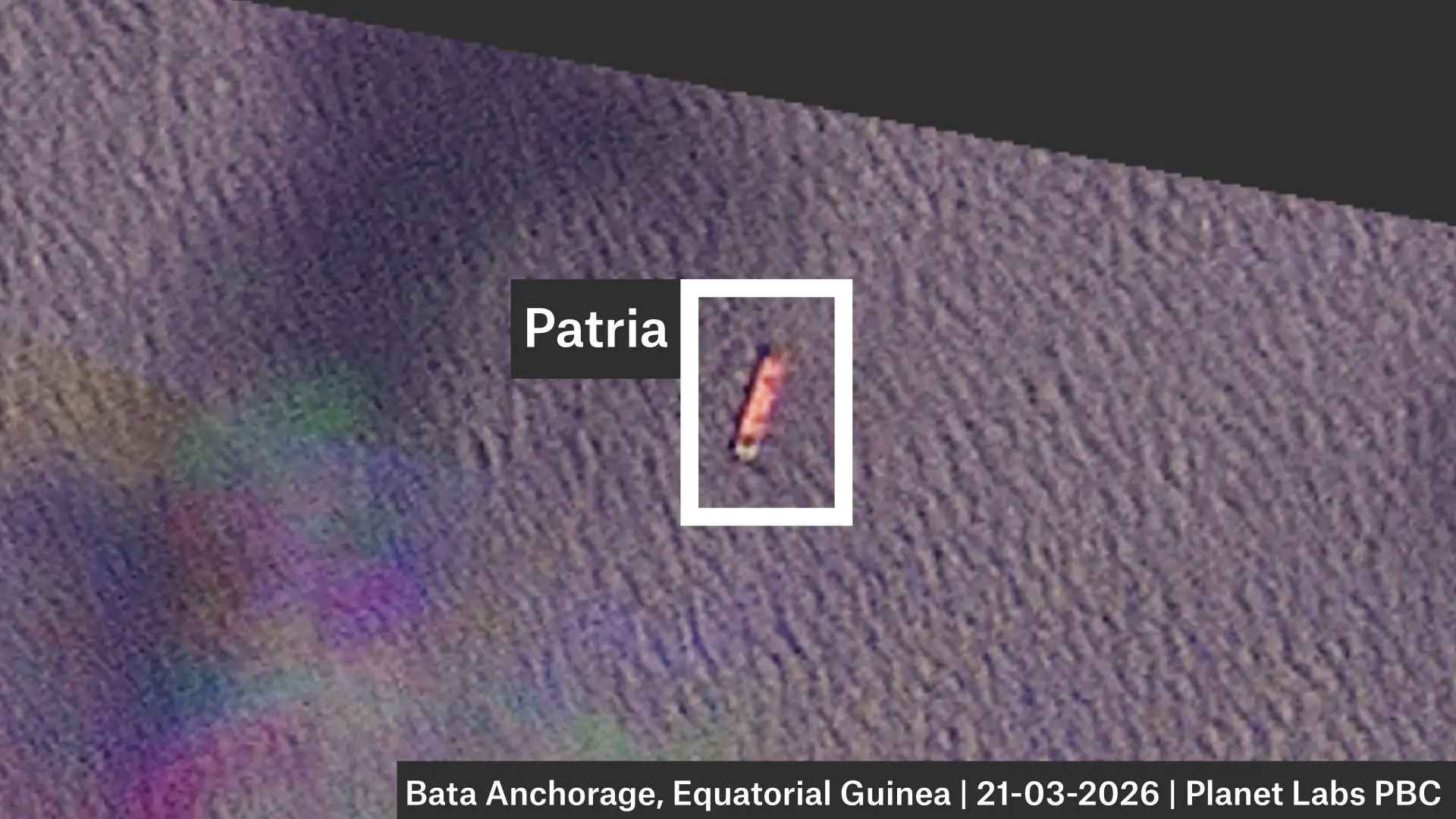
Credit: Planet Labs PBC.

Port of Owendo, Libreville, Gabon

AIS data and satellite imagery indicate Patria loaded at the Port of Owendo in Libreville after spending a few days off the coast.
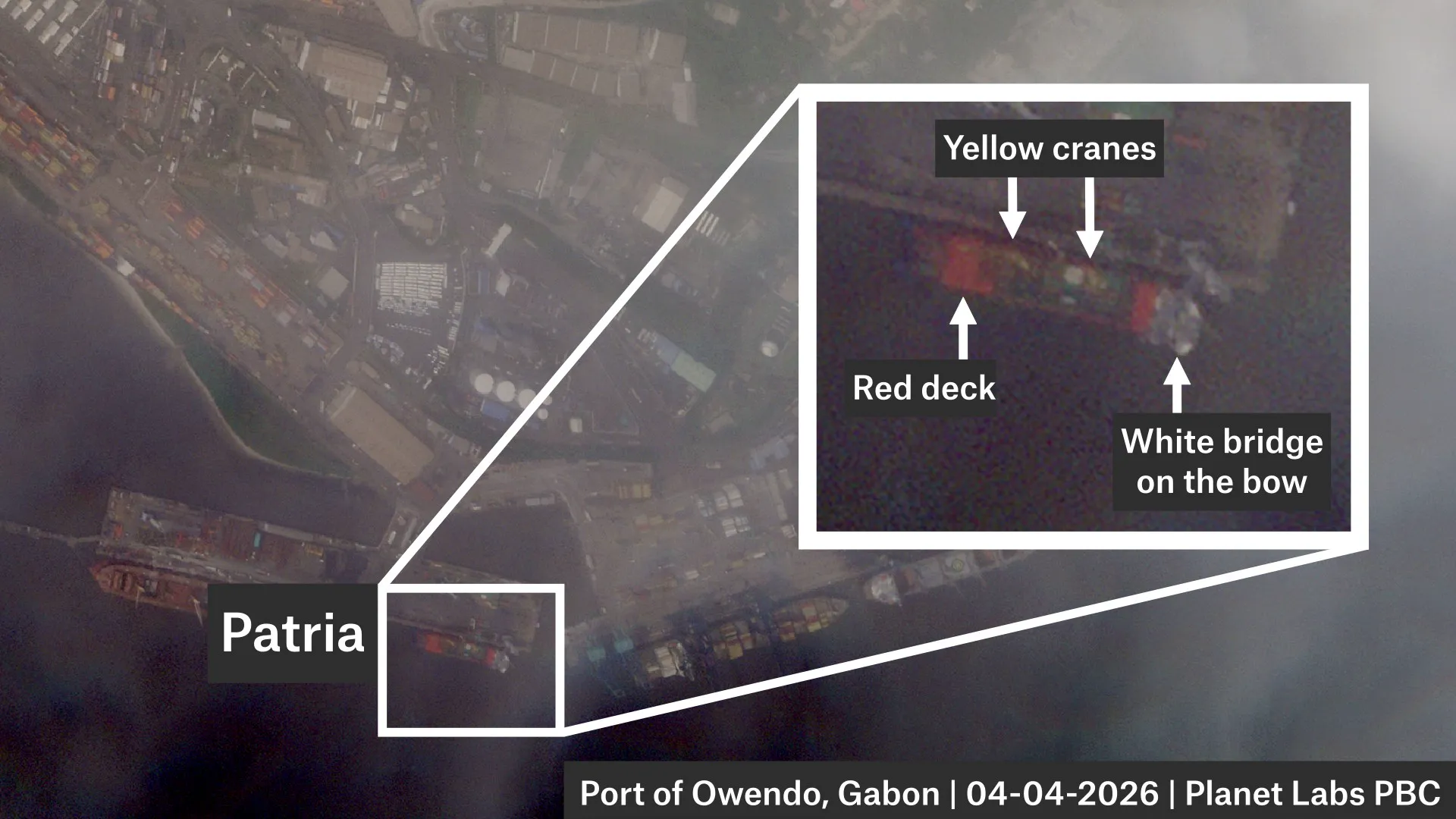
Credit: Planet Labs PBC.

Port of Douala, Cameroon

AIS data and satellite imagery indicate Patria stayed at the Douala Anchorage from Apr. 6 to 14, before unloading at the Port of Douala between Apr. 14 and 18.
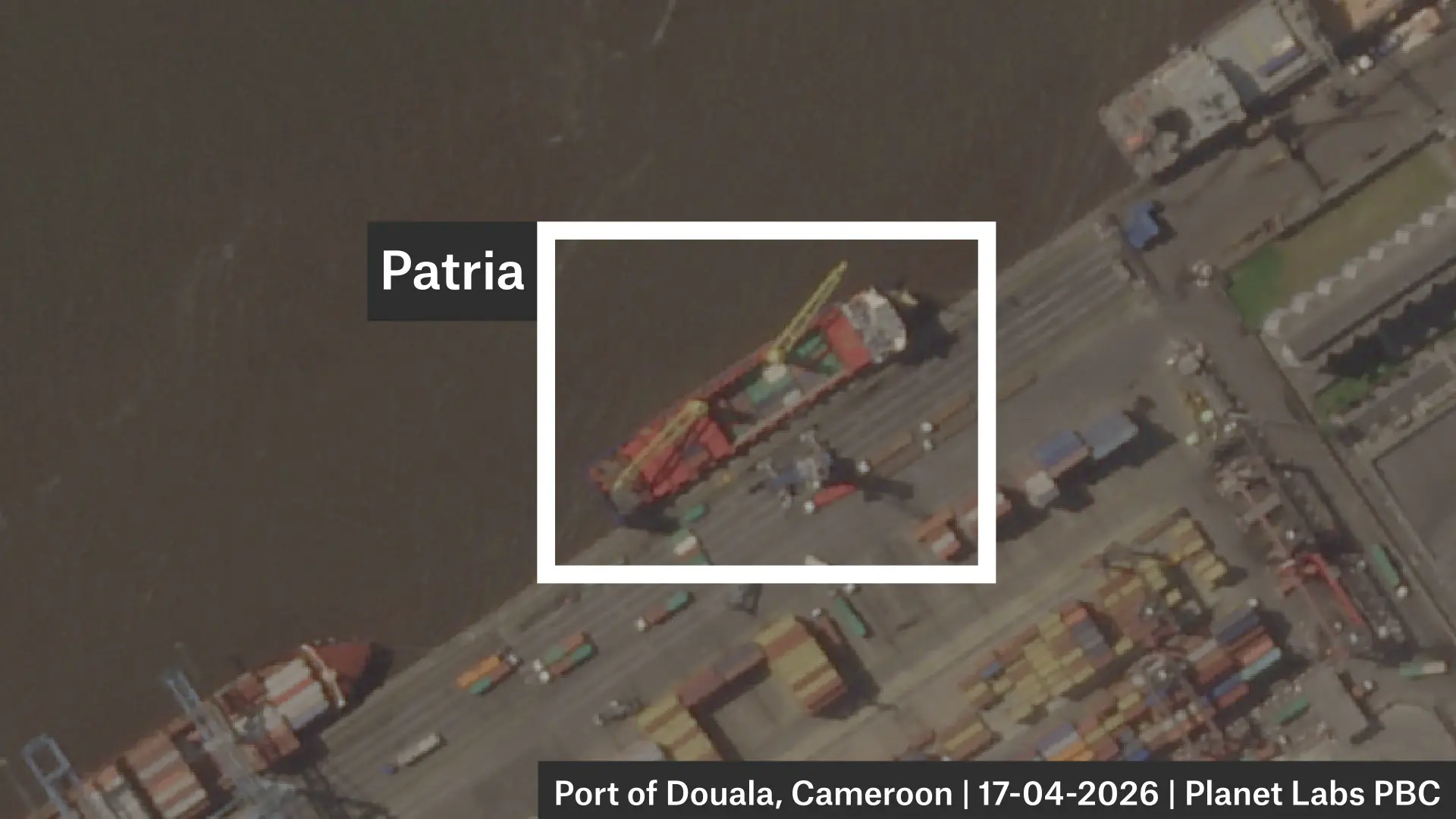
Credit: Planet Labs PBC.

Port of Owendo, Libreville, Gabon

AIS data suggests Patria loaded in Libreville again between Apr. 22 and 26.

Port of Douala, Cameroon

AIS data, supported by satellite imagery, indicates Patria stayed at the Douala Anchorage for nearly a month from Apr. 27 to May 21 before unloading in Douala from May 21 to 27.
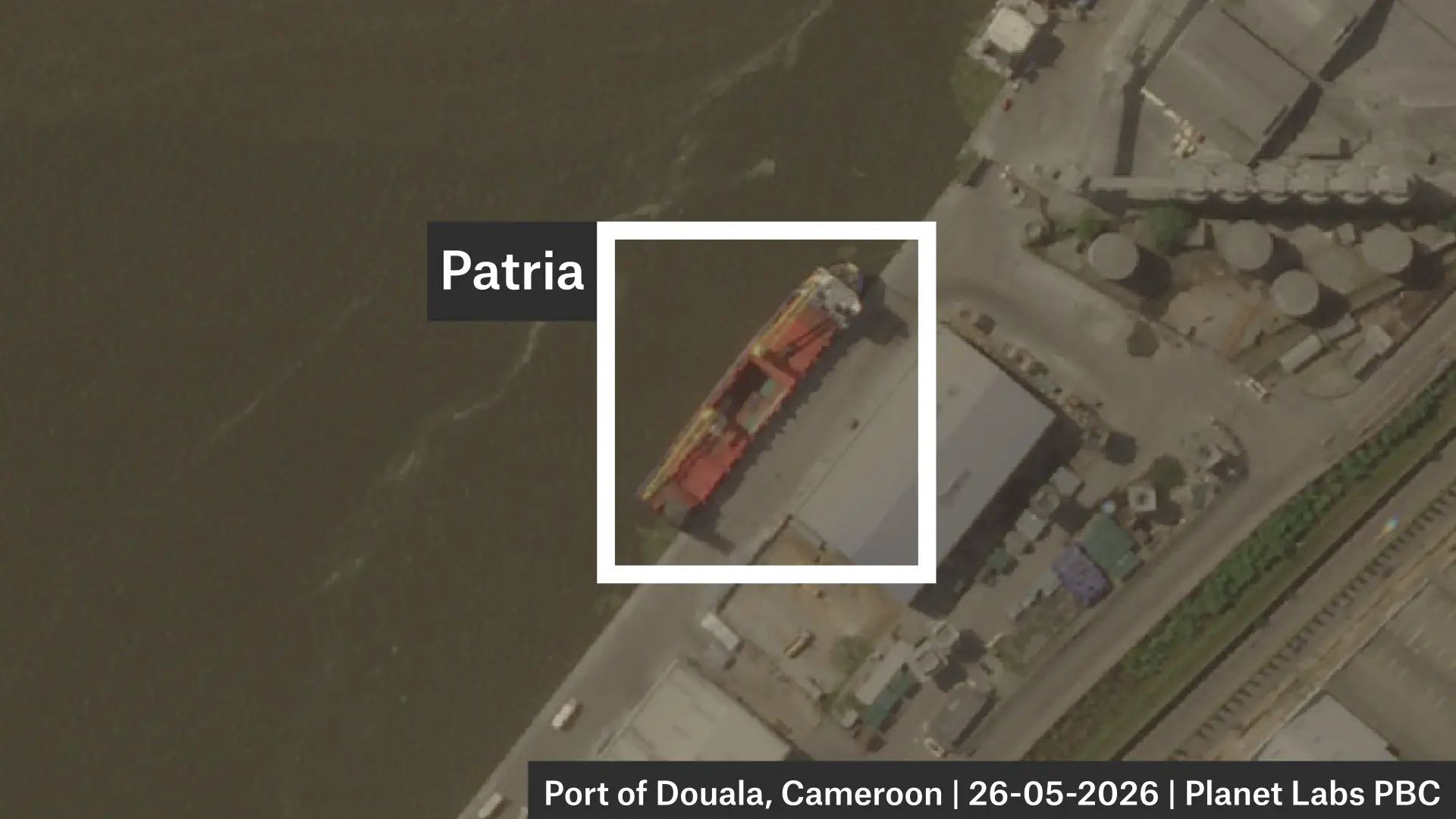
Credit: Planet Labs PBC.

A third trip between the Port of Owendo, Libreville to Douala, Cameroon

AIS data indicates, after nearly a month’s wait in Douala anchorage, Patria again loaded at Owendo before returning to Douala to unload.

A fourth trip between the Port of Owendo, Libreville to Douala, Cameroon

AIS data indicates Patria again loaded at Owendo before returning to Douala to unload.

Lagos Anchorage, Nigeria

AIS data indicates, after a short visit to the Libreville anchorage, Patria anchored off the coast of Lagos where it remained at the time of publication.
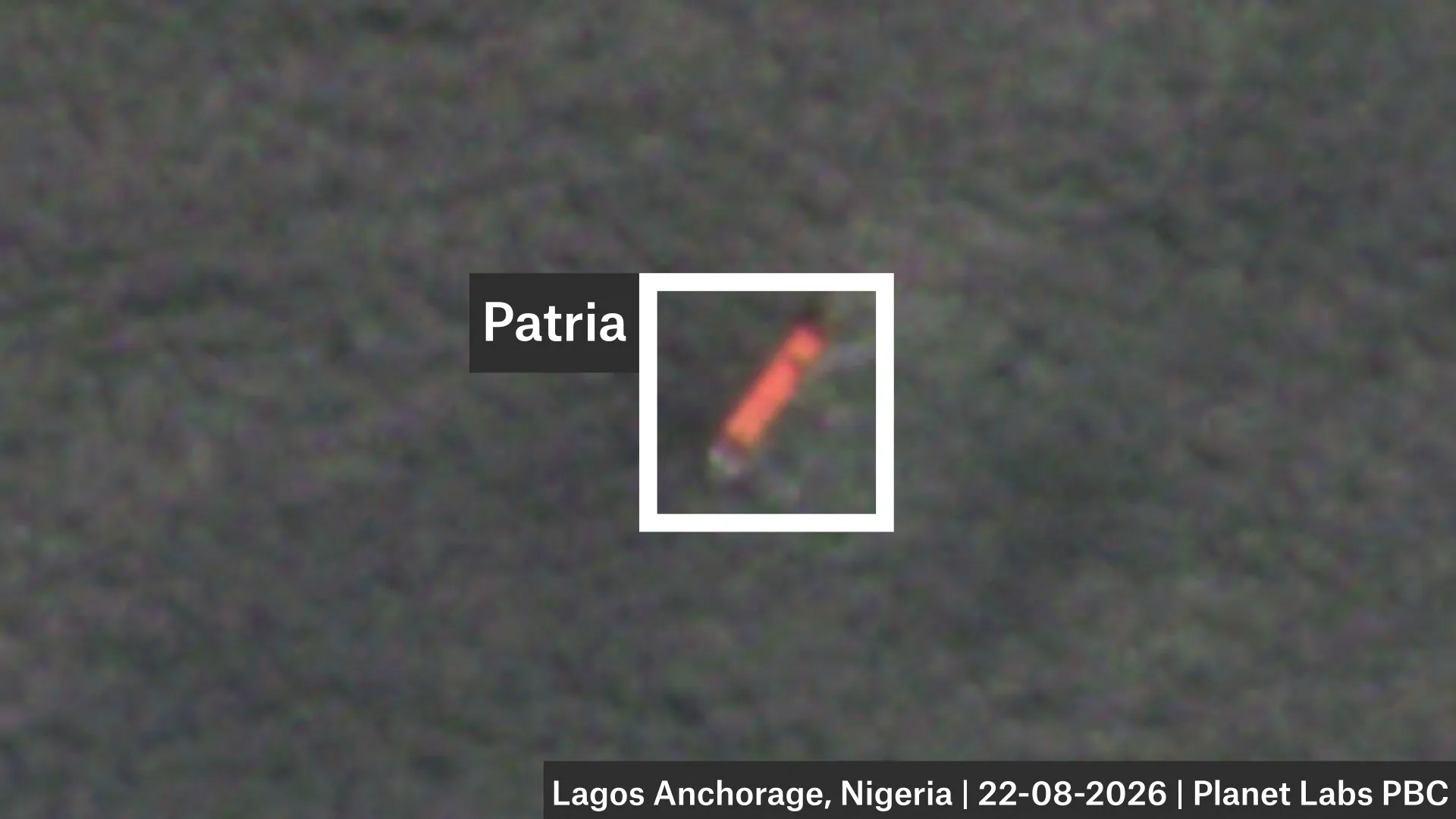
Credit: Planet Labs PBC.

Examining the Patria’s Draught

We reviewed the draught of the ship at each port visit and found that the ship’s draught always dropped after a stay at the Port of Douala, suggesting it was unloading there.

A ship’s “draught” is the distance from the bottom of the hull (the keel) to the waterline. When loaded, a ship is heavier and sits lower in the water (e.g. a draught of six metres) than when it is unloaded (e.g. a draught of four metres).

Draught is the depth of a ship below the waterline. 

In the period from March to July, the Patria made five port calls to Douala and each time the draught decreased. Conversely, it called four times at the Port of Owendo in Libreville, each time the draught increased, meaning the ship became heavier, suggesting it was loading.

The draught is self-reported by ships but usually when it arrives at ports this kind of data is checked – reporting accurate draught is also a safety issue for ships arriving and departing at ports. 

Bellingcat asked the ship’s owners, managers and both ports if items were being transferred from Libreville to Douala but did not receive a response at time of publication.

Brown, the former US Naval Officer and now a Senior Advisor at United Against Nuclear Iran, said Patria’s movements were unusual.

“A sanctioned vessel linked to a prior military logistics shipment spending nearly six months operating between a small cluster of West African ports, Douala, and Owendo, without returning to a clear commercial trading pattern warrants scrutiny,” Brown told us.  


“While innocent explanations such as mechanical issues, commercial disputes, lack of cargo, chartering delays, or prolonged maintenance are possible, the combination of repeated regional port calls, extended periods at anchor, and an apparent absence of a normal point-to-point trading cycle is atypical for a merchant vessel.” 

He added that the current period of more than 30 days at the Lagos Anchorage, in particular, is noteworthy. 

David Soud, Head of Research and Analysis at I.R Consilium also told Bellingcat that Patria’s prolonged Lagos Anchorage could have innocent explanations such as its need for ongoing repairs, or that its operators were out of money, but added that there could also be more calculated reasons and it was laying low for a while.

Bellingcat analysed AIS data from Lagos Anchorage and found that while there has been high congestion, no other RoRo or container vessel waited longer than 10 days to enter the port in the period that Patria has been at Lagos Anchorage. At time of writing, Patria has been in anchorage for more than 30 days.

Regarding the Patria’s apparent deliveries of cargo between Libreville in Gabon, and Douala in Cameroon, Soud told Bellingcat:

“Given the vessel’s history of transporting military equipment to African seaports for overland delivery to Russian and allied forces in the Sahel, it’s not out of the question that some form of supplies for Russian or other forces could be picked up in Gabon, whose government has developed a closer relationship with Moscow, to be discharged in Douala, which is the main entry point for goods going to Central African Republic.”

Bellingcat asked the Nigerian Ports Authority why Patria had been in anchorage for so long, whether it had applied to dock and whether the port was aware of its sanctioned status but did not receive a response at time of publication.

The ports of Douala in Cameroon and Owendo in Libreville, Gabon did not respond to Bellingcat’s requests for comment about the Patria’s visits and the cargo it was carrying.

Bellingcat also contacted the two companies connected to the vessel – Hanro Shipping and Sakhalin Shipping Company which are listed as the vessel’s owner and manager respectively in sanctions documents. We also contacted the company connected to JS Gratitude. We did not receive a response at time of publication.


Youri van der Weide, Galen Reich, Yörük Işık contributed to this report.

Cover image: Planet Lab image shows the Patria at the Port of Douala, Cameroon, on April 17, 2026. Credit: Planet Labs PBC.

Bellingcat is a non-profit and the ability to carry out our work is dependent on the kind support of individual donors. If you would like to support our work, you can do so here. Subscribe to our Newsletter and follow us on Bluesky here, Instagram here, Reddit here and YouTube here.

The post Tracking a Sanctioned Russian Vessel’s West African Odyssey appeared first on bellingcat.
Heading Off: New Technique Helps Track Grain Smuggling Expansion to Libya

On February 15, 2026, the bulk carrier, Grumant (IMO: 9385879) was pictured at the occupied Ukrainian Port of Feodosia on the Crimean peninsula. Satellite imagery suggests it had already been there for several days.  It appeared to stock up on grain before departing on a two-month-long journey eventually docking at the Port of Benghazi in Libya on April 18.

While there have been previous reports of grain shipments from occupied Ukraine arriving in Libya, this is only the second time a Russian ship has been observed delivering what the Ukrainian government describes as “stolen” grain to the country. The previous case involved the Damas Wave which travelled in January of last year to the port of Misrata which is under the control of the UN-recognised Government of National Unity (GNU). In addition to satellite imagery, Bellingcat deployed a new technique that analysed Grumant’s heading data which was contained in AIS information provided by Lloyd’s List Intelligence, to help confirm Grumant’s presence in Feodosia. 

Bellingcat has been tracking smuggled Ukrainian grain shipments as they find new markets, five of the ships we previously identified have since been sanctioned by the EU while another was sanctioned by the US Department of Treasury.

MapLibre | Protomaps© OpenStreetMap contributors

Bosphorus Strait

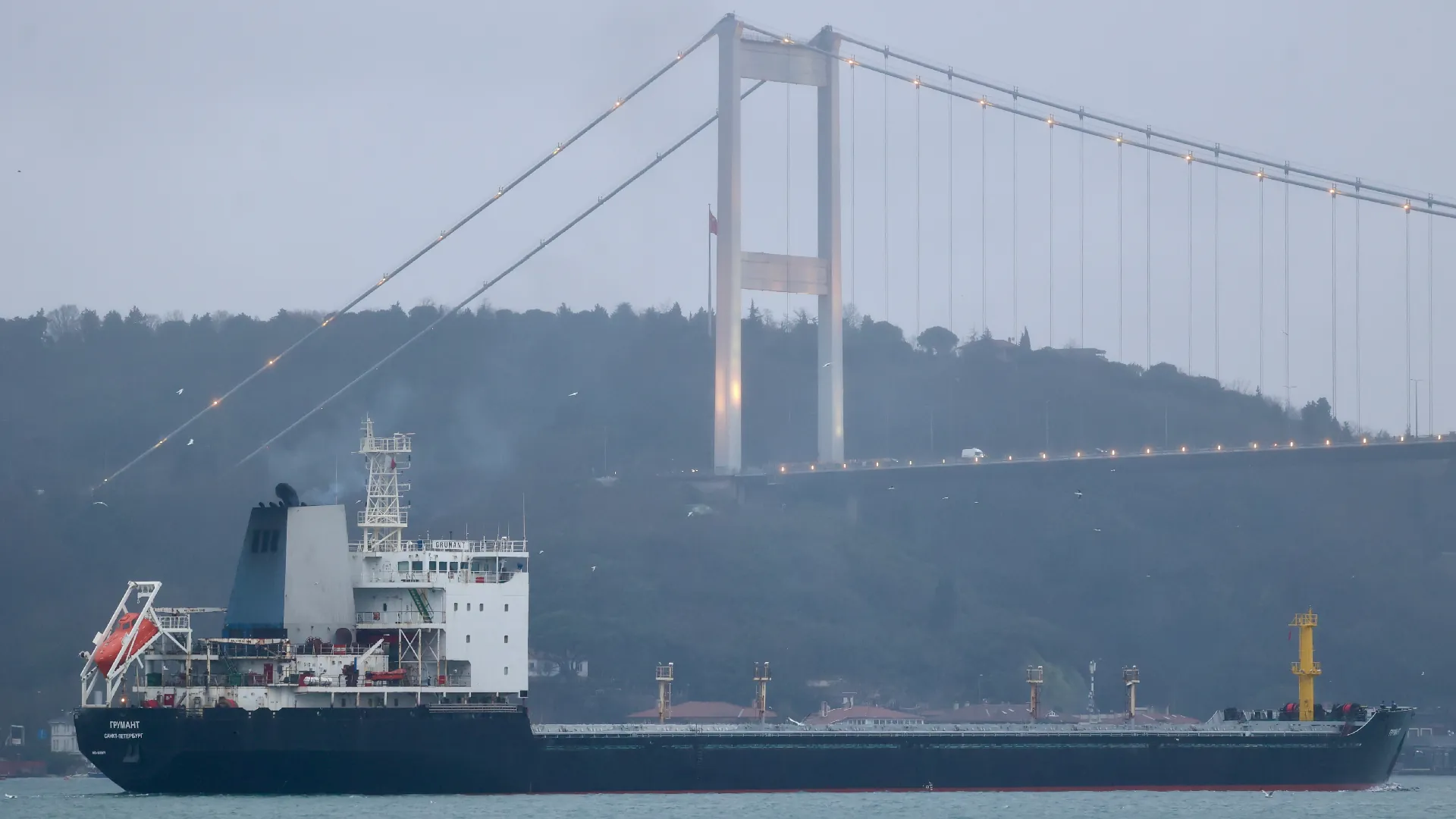
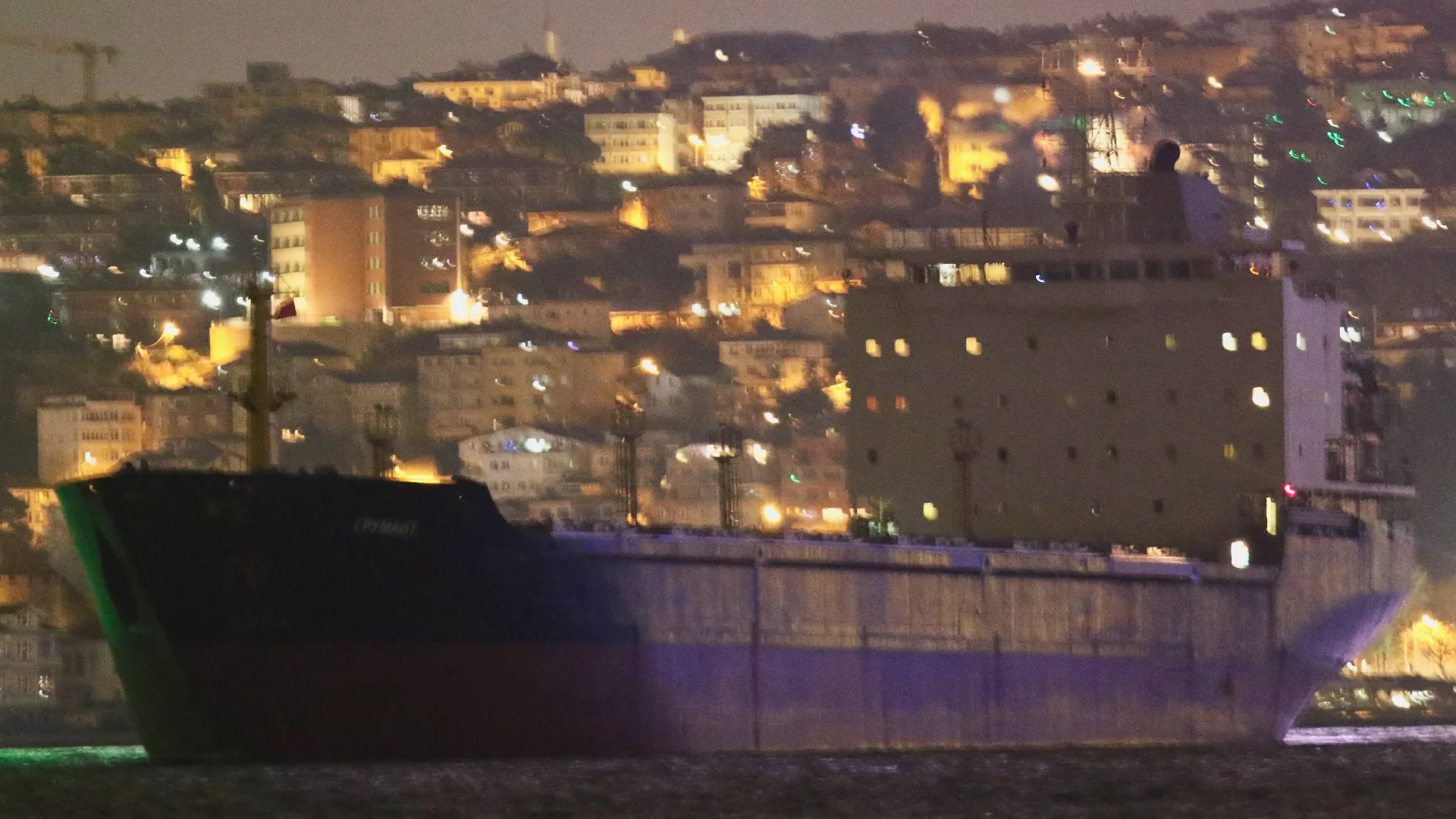
Grumant transits the Bosphorus Strait in the middle of the night.

Credit: Yörük Işık.

Black Sea

Grumant enters a region of the Black Sea known for GNSS interference, meaning that Grumant’s publicly reported Automated Identification System (AIS) position is unreliable.

Port of Feodosia

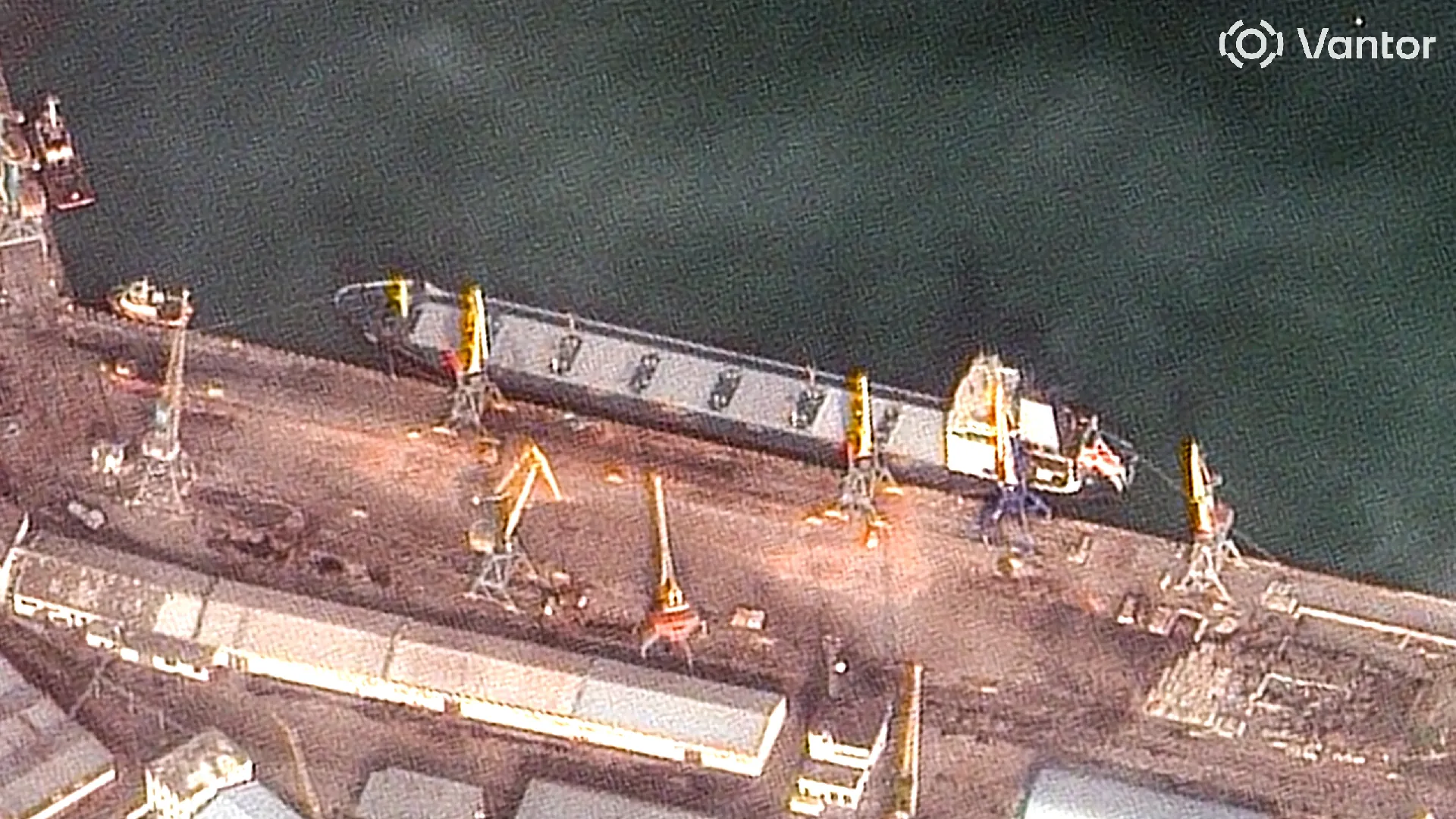
On February 15, a high resolution satellite image confirms the ship is docked at the port of Feodosia at berth No. 1 that is used for bulk and metal cargo. Matching features visible include Grumant’s grey decking, its seven hatches and bright yellow front mast. What appears to be leftover grain can be seen under the two port crates, immediately next to the ship.

Credit: Satellite image ©2026 Vantor.

Black Sea

Grumant exits the area of signal interference, meaning that its reported position on ship tracking services is now reliable again. Its AIS messages indicate it is travelling towards the Bosphorus.

Bosphorus Strait

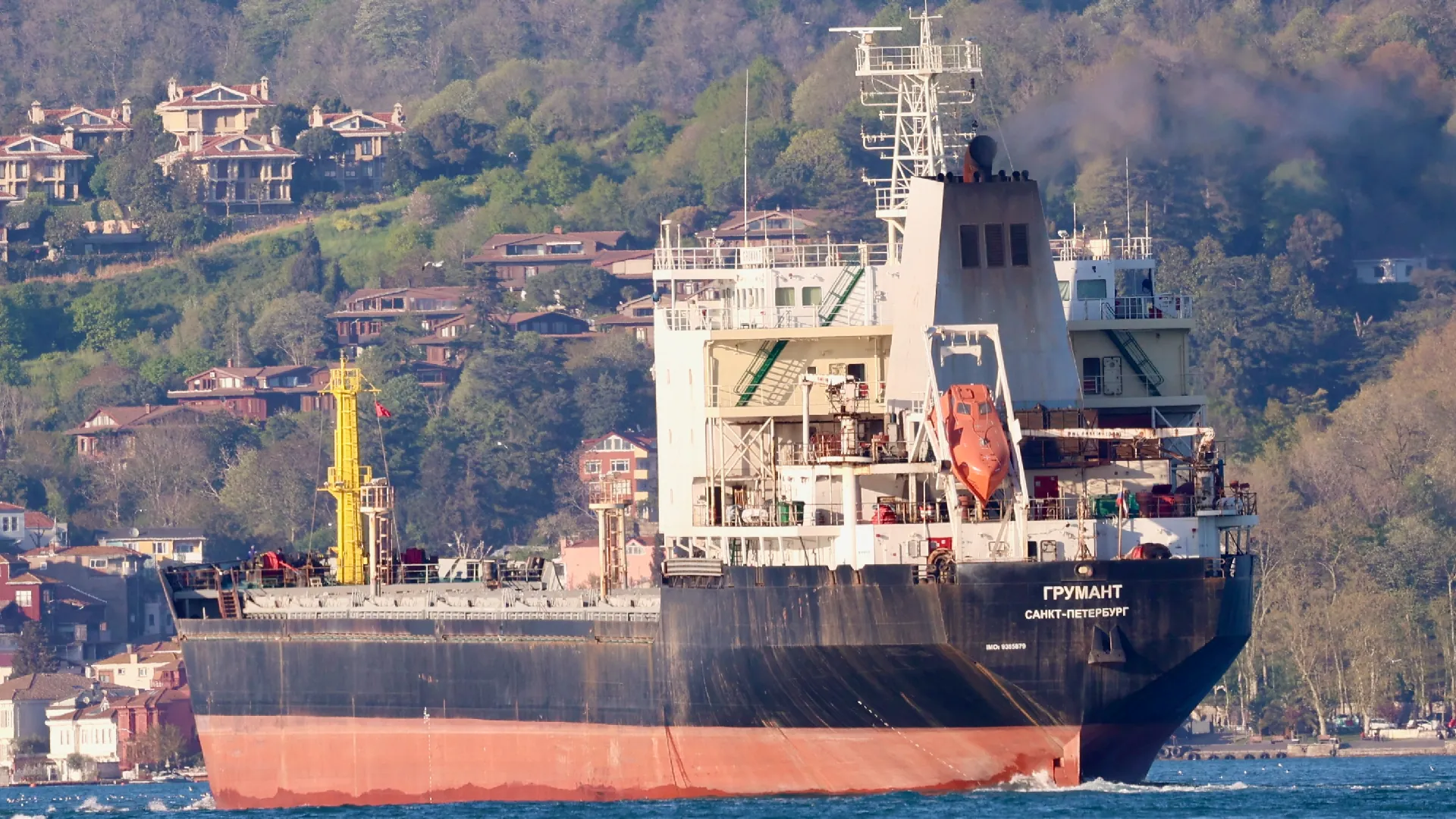
Grumant transits the Bosphorus Strait towards the Sea of Marmara. Judging by the draft, with no visible red paint on its hull, the ship appears to be fully laden.

Credit: Yörük Işık.

Izmir Anchorage

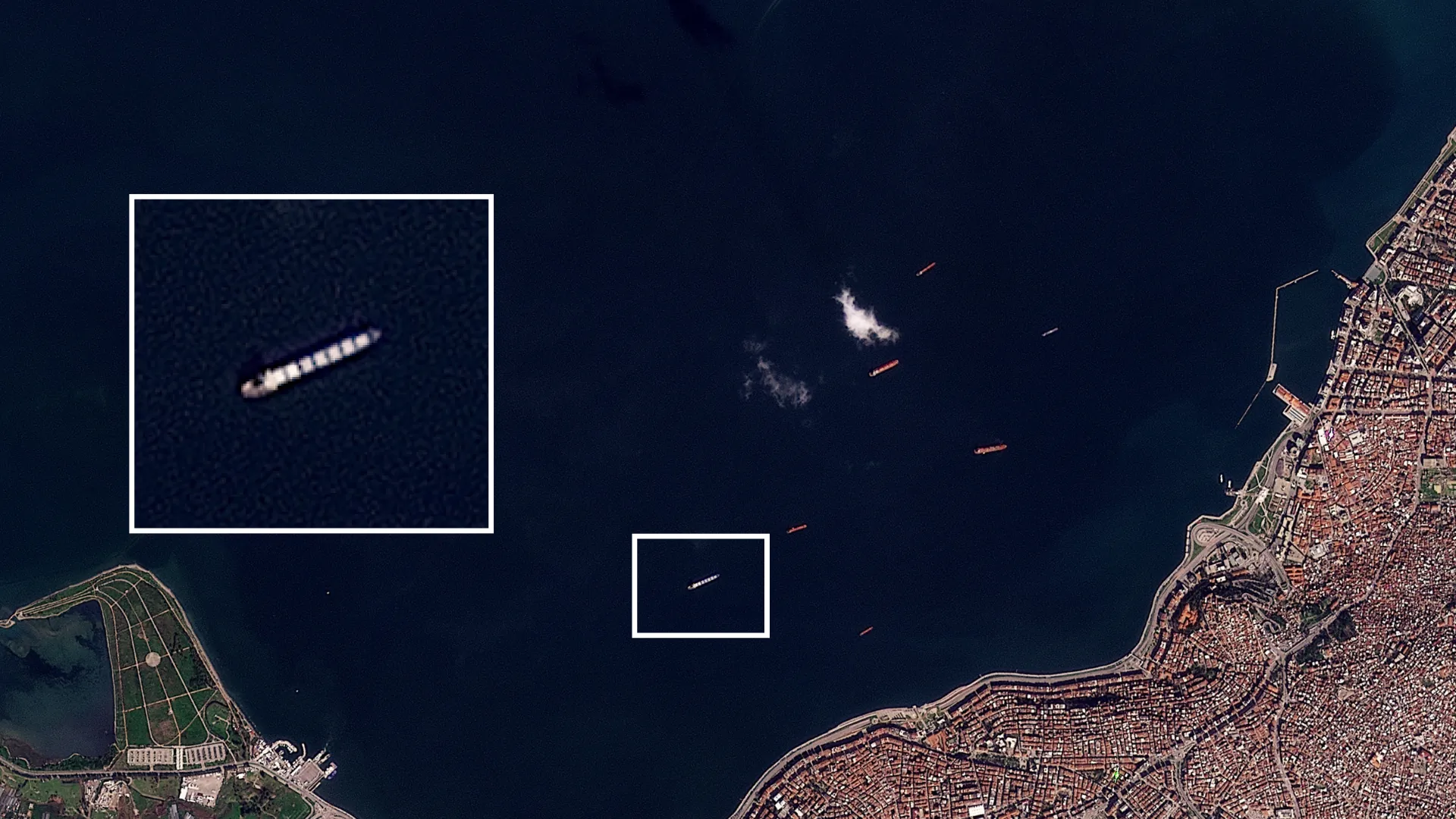
Grumant arrives in Izmir, Turkey on February 23 and anchors off the coast until March 13.

Over the course of three weeks, Grumant never enters the Port of Izmir. It is not known if it was denied entry. Bellingcat asked the port operators but did not receive a response before publication.

Credit: Planet Labs PBC.

Aliağa

Grumant then loiters off the coast of Aliağa, about 50 km from Izmir. It stays here until March 16, never entering the port. It again is not known if it was denied entry. Bellingcat asked the port operators but did not receive a response before publication.

Near Benghazi

Grumant arrives in Libyan waters and stays off the coast of Benghazi until April 1.

Libyan Waters

Grumant briefly leaves the coast of Benghazi, but returns a few days later.

Benghazi

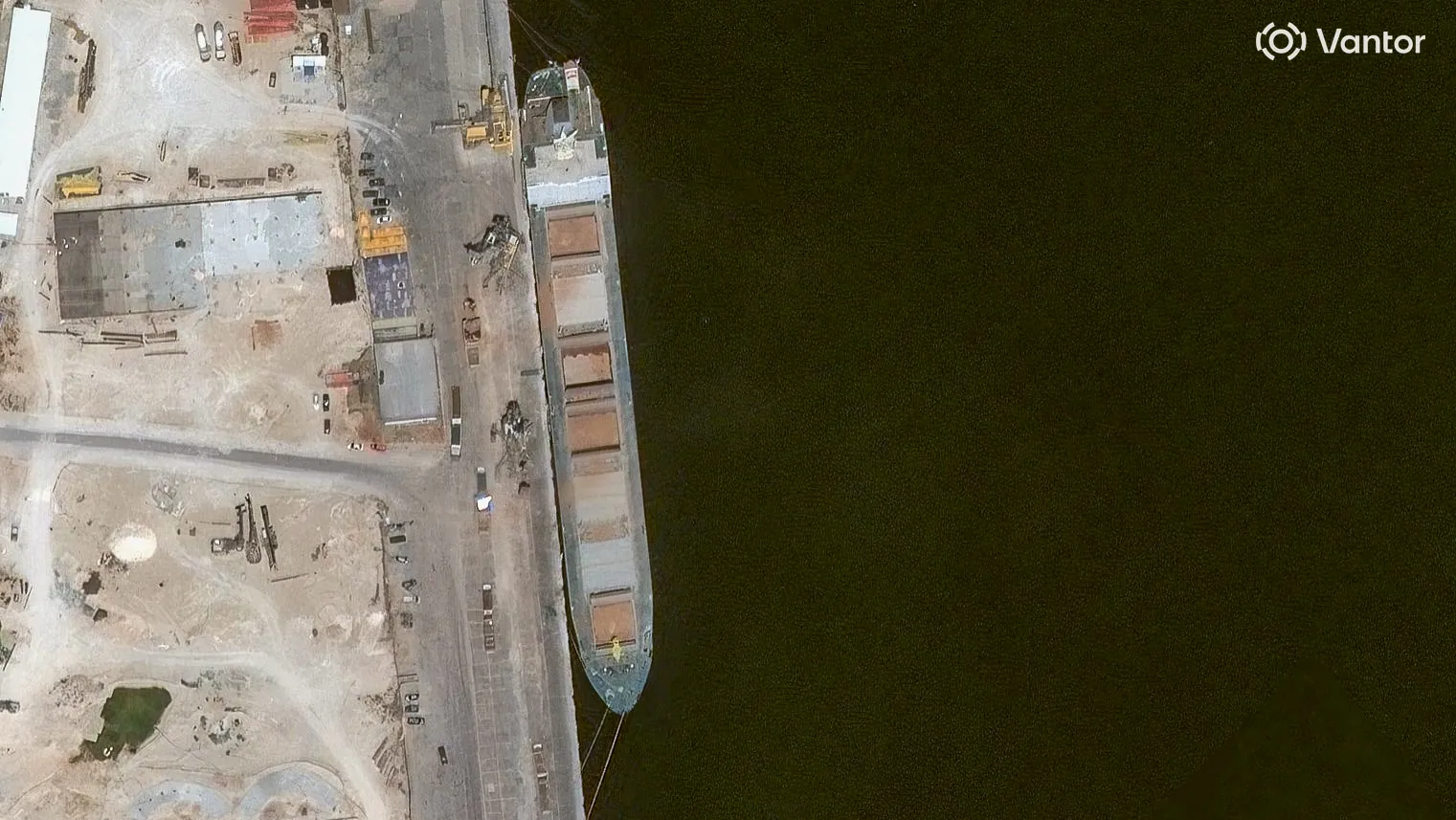
Grumant leaves the anchorage on April 18 and docks at the port of Benghazi where it unloads the grain. The ship was captured in a Vantor satellite image on April 20.

It leaves port on April 23, and heads back towards the Bosphorus.

Credit: Satellite image ©2026 Vantor.

Bosphorus Strait

After spending a few days off the coast of Tuzla, Grumant transits the Bosphorus towards the Black Sea.

Credit: Yörük Işık.

Lloyd’s List Intelligence has previously reported on the expansion of Russia’s grain smuggling operations, beyond the occupied port of Sevastopol to include Feodosia port. 

According to the Ukrainian activism, journalism and hacker group, Kiborg News, Grumant used deceptive shipping practices to deliver grain to Latakia, Syria in 2024. The report included several of Grumant’s shipping manifests, which showed it had repeatedly exported grain from Occupied Crimea to Syria. 

Heading Data Helps Locate Grumant

It is standard maritime practice that ships broadcast Automatic Identification System (AIS) messages which include a ship’s position, heading, and draught (among other information).

Because of longstanding Global Navigation Satellite System (GNSS) interference in parts of the Black Sea, the position data transmitted by an affected ship’s AIS system is often unreliable.

Between February 7 and February 19, 2026, data from Lloyd’s List Intelligence shows the Grumant transmitted 29 AIS messages, with unreliable positions in the vicinity of Feodosia. We know these positions are unreliable as they are erratic and some of them report the ship as being positioned on land.

Unreliable AIS positions – Grumant’s reported positions between February 7-19, 2026, via Lloyd’s List Seasearcher.

However, according to the IMO, the heading data transmitted by a ship’s AIS system must come from an onboard compass. A compass is unaffected by GNSS interference, meaning it is a more reliable source of information in these conditions.

Over the same dates, all 29 AIS messages reported the ship’s heading as 267 degrees or 268 degrees. The Port of Feodosia has a heading of 267.5 degrees. The close agreement between the ship’s heading and port heading strongly suggests that Grumant was moored at the port between February 7 and February 19, 2026.

We conducted an extra check of the heading data by reviewing satellite imagery available of berth 1 at Feodosia Port, which suggests that the same vessel was present on several days between February 6 and February 18. Imagery on Feb. 6 shows the port was empty in the morning and occupied in the afternoon. Grumant exited the area of GNSS interference on February 21, and berth 1 at the port was captured on satellite image on February 22 and appeared empty. The low resolution satellite imagery is only used as an additional check to see if a vessel is at the berth.

Timeline of open source observations related to Grumant’s presence (tick) or absence (cross) at Feodosia port. Empty entries indicate a lack of available data.
Sentinel-1 timelapse of Feodosia Port, Copernicus Sentinel data 2026. Annotations by Bellingcat.
PlanetScope timelapse of Feodosia Port, Planet Labs PBC. Annotations by Bellingcat.

Bellingcat checked all vessels transmitting AIS in the vicinity of Feodosia Port and found that Grumant was the only one that consistently transmitted a heading matching the Port of Feodosia over the period of interest.

We shared our research with Charlie Brown, a former US Naval Officer and Senior Advisor at United Against Nuclear Iran where he focuses on maritime sanctions enforcement and the tracking of illicit shipping. Brown told Bellingcat that while satellite imagery of vessels remained key for identification, when looking for reliable data in a spoofing environment it made sense to look at the various elements of AIS data to try and find some accurate information, despite GNSS spoofing.

“It’s quite standard for the independent gyro compass to be providing the heading […] I think the majority would not [be subject to spoofing] so it’s a good methodology to parse out the particular data and then make some inferences from that.”

“It’s neat to think of what can be derived from data that would otherwise be dirty or wrong. So there’s still some elements of use in there.”

He added that in theory there are probably some compasses that are subject to spoofing as well. 

He told Bellingcat that it was fair to say the heading data of the Grumant supported identification, but stressed the need to cross-reference with other data sources. 

While in this instance it has been possible to use AIS data to help verify the location of Grumant, it is relatively unusual to have access to this information. 

Ships that call to the occupied territories frequently disable their AIS transponders to do so.

This activity, known as “dark port calls”, is a common tactic for those engaging in illicit or sanctioned trades. 

Grumant does not transmit AIS messages from February 8 to 11, but this is the longest gap in data (see diagram above), with intermittent messages coming through after that point.

It is unclear why Grumant continued to transmit AIS during the period it was loading in Feodosia. 

A review of Lloyd’s List Intelligence data from January 2025 shows that on a previous voyage to the Black Sea the Grumant operated “dark” for 59 days.  

Visual Identification

On February 15, 2026, high resolution imagery showed Grumant docked in the Port of Feodosia. We compared it with other recent images of Grumant to confirm the match. 

The ship in the satellite image has a grey-coloured deck, which is uncommon enough for it to stand out. Many bulk carriers have cranes (including the ships we previously covered such as Krasnodar, Zafar and Zaid), Grumant does not have any. It also has seven hatches (openings for the grain) and a bright yellow front mast that matches the mast of Grumant (see the image of it transiting the Bosphorus). We can match the Grumant in the Feodosia image, not only to pictures of the Grumant shot from the ground, but also to the satellite image from Benghazi.

The length and breadth of the ship also matches that of the Grumant; 180 metres by 22.90 metres. 

Above: Image of the Grumant transiting the Bosphorus. (In yellow: the mast, red: the seven hatches, green: four vent masts, two on either side). Credit: Yörük Işık. Middle: Satellite image of the Grumant in Feodosia on February 15, 2026. (Matching elements are denoted in the same way as the image above). Bottom: Grumant captured at Benghazi port on April 20. Credit: Satellite image ©2026 Vantor. Annotations by Bellingcat.

Libya’s Relationship with Russia and Ukraine 

Libya has complicated internal dynamics with essentially two administrations in charge of different parts of the country – the Government of National Unity (GNU) in the west and the Libyan National Army (LNA) in the east.

In recent years, Russia has backed the LNA’s General Khalifa Haftar, based out of Benghazi, in the east of the country. But Jalel Harchaoui, a political scientist specialising in Libya with the Royal United Services Institute (RUSI), stressed that the two sides of this conflict, the LNA and the UN-recognised GNU, are not currently fighting. Instead they are in a flawed, multi-year truce.

Therefore, the east-west divide isn’t as clear-cut as during the civil war. While all shipments going to Benghazi and Tobruk are overseen by the LNA, not all shipments going to the city of Misrata (which is run by the GNU) are meant for the GNU-dominated part of the country. 

Harchaoui told Bellingcat: “the Tripoli government is in some regards pro-Ukraine, but if there’s business that can be done with Russia through the very opaque port of Misrata and all the right people get paid, the business is going to take place.”

That observation is potentially significant given at least one previously tracked vessel that went from occupied Ukraine to Libya docked in Misrata.

This was not the case of the Grumant, however, which arrived in an LNA-controlled part of the country. It is not known from open sources alone if the authorities in Libya or at the port in Benghazi knew the grain carried by Grumant had come from occupied Ukraine.

Bellingcat contacted the Benghazi-based LNA government and representatives of the Tripoli-based GNU government via the Libyan Embassy in The Netherlands. We also contacted the Port of Benghazi, Port of Imzir in Turkey as well as the Ukrainian and Russian authorities. Representatives of the LNA did not respond to requests for comment before publication, nor did the Port of Benghazi or Port of Izmir. The Libyan Embassy in The Netherlands replied to Bellingcat after publication, stating that Benghazi and eastern Libya are not under the authority or administrative control of the Government of National Unity and therefore they are not currently in a position to comment on Bellingcat’s findings.

Ukraine Continues to Pursue the “Shadow Grain Fleet”

“The port of Feodosia, located in the temporarily occupied Autonomous Republic of Crimea, is not under Ukrainian control, and any commercial activity conducted there is illegal,” the Ministry for Development of Communities and Territories of Ukraine and the Ministry of Foreign Affairs of Ukraine told Bellingcat in a joint response. 

They told us the loading of grain exported from the temporarily occupied territories is an illegal act and Russia was using ports as logistics centers to export stolen Ukrainian agricultural products.

“The expansion of such routes to third countries, in particular to North Africa, demonstrates Russia’s ongoing efforts to circumvent international sanctions and monetize resources stolen from the occupied Ukrainian territories.” 

The Ukrainian Ministry of Foreign Affairs sent information about Grumant’s (IMO: 9385879) “illegal activities” to the diplomatic missions in Great Britain, the Republic of Turkey and the Republic of Tunisia over the course of March to May this year, the ministries told Bellingcat. 

Ukraine is continuing to pursue legal action against Russia’s “shadow grain fleet” they told us. For instance, earlier this month a Swedish court approved the transfer of the Russian “shadow grain fleet” vessel CAFFA to Ukraine for investigation after it was arrested in Swedish waters. 

This case has set a new precedent, going beyond sanction and fines previously handed out to such vessels, and allowing for the detention and confiscation of a shadow fleet vessel in European jurisdictions, the ministries said.

According to Russian court documents Grumant’s previous owner Murmansk Shipping Company was dissolved and “Decision/Reshenie” LLC were listed as the International Safety Manager and operator of Grumant. Decision/Reshenie were also listed as the operator of Grumant in another court document, from an unrelated case. 

Bellingcat attempted to contact Decision/Reshenie to ask about Grumant’s grain shipment from Feodisia Port to Benghazi Port, but they had not responded at time of publication.


Youri van der Weide, Galen Reich, Yörük Işık and Bridget Diakun contributed to this report.

Cover image: Planet Lab image shows Grumant anchored off Izmir, Turkey on February 27. Credit: Planet Labs PBC.

Bellingcat is a non-profit and the ability to carry out our work is dependent on the kind support of individual donors. If you would like to support our work, you can do so here. You can also subscribe to our Patreon channel here. Subscribe to our Newsletter and follow us on Bluesky here, Instagram here, Reddit here and YouTube here.


The post Heading Off: New Technique Helps Track Grain Smuggling Expansion to Libya appeared first on bellingcat.

Agents of Chaos: Unpacking the Actions of Border Patrol Agents Across the US

This investigation is part of a collaboration between Bellingcat, Evident Media and CalMatters. You can watch Evident’s investigative video here, and read CalMatters’ report here.

In early January 2025, a gardener named Ernesto Campos was pulled over by Border Patrol agents in the city of Bakersfield, California. 

The agents were a long way from home: Bakersfield is over 240 miles (386km) from the US border with Mexico.

They were there as part of Operation Return to Sender, a Border Patrol surge in the city that acted as a portent of what was to come across the US in 2025.

Support Bellingcat

Your donations directly contribute to our ability to publish groundbreaking investigations and uncover wrongdoing around the world.

Video footage shows one agent threatening to break Campos’ car window as they believed he was transporting an undocumented individual. 

Campos filmed the agents, who he said slashed his tyres before arresting him and a passenger. The agents’ faces later appeared on local news reports detailing the incident.

Ten months later, two of the agents visible in footage recorded by Campos were filmed in Chicago as Border Patrol agents descended on the city for what was dubbed “Operation Midway Blitz”.

One was seen grabbing a man by the throat before slamming him to the ground with help from other agents.

@govpritzker.illinois.gov 37 and Kedzie, East Garfield, Illinois. This is assault.

[image or embed]

— Daniel Connerton (@lordnad.bsky.social) 4 October 2025 at 20:56

The other was seen punching a man in the face before pulling his gun on protesters in a Chicago suburb.

These confrontations were not isolated incidents.

An image from court documents shows a Border Patrol agent unholstering his gun at an incident in Evanston, Illinois.

A federal judge in Illinois said in November that the use of force by federal agents in Chicago – including the use of tear gas and other less lethal munitions on multiple occasions –  “shocks the conscience”.    

A restraining order issued by that Illinois judge was vacated on appeal earlier this month. But what took place on the streets of Chicago also happened in other locations, with some of the same agents involved.

Bellingcat has worked with our partners at Evident Media and CalMatters to analyse over 85 hours of social media and bodycam footage, as well as court documents and incident reports, to try to unpack the actions of Border Patrol agents across the country. 

With agents often masked and badge or identification numbers not always visible, understanding exactly who has enforced the immigration surges of the past year has been difficult. This, in turn, has made public questioning and accountability around use-of-force incidents challenging. 

Subscribe to the Bellingcat newsletter

Subscribe to our newsletter for first access to our published content and events that our staff and contributors are involved with, including interviews and training workshops.

Nonetheless, we observed over 25 agents who appeared in more than one city, either by recognising their faces or matching badge numbers that were visible on their vests or arm patches. Many were seen alongside former Border Patrol Commander at Large, Gregory Bovino, on at least one occasion. 

But this is likely just a fraction of the agents who moved around the country to take part in Border Patrol surges in cities like Los Angeles, Chicago and Minneapolis. When speaking to reporters in January, Border Czar Tom Homan said he had spoken to some agents who had “been in theatre for eight months”. Many wore masks in the videos viewed by Bellingcat, and it was not always possible to identify number patches from social media or bodycam footage alone.

Although some of the agents we logged appeared on neighbourhood walkabouts or in footage where little happened, others could be seen using force on multiple occasions. For this story, we have focused on the actions of five agents whom we have been able to identify and who appear to have repeatedly used force in at least two, but often more, locations. We have decided to name those we have been able to identify just as we would name any officer involved in incidents like those detailed. But these were by no means the only agents whom we saw using force across one or multiple cities.

The footage we analysed also appears to show a steady escalation of violence and confrontational incidents as 2025 progressed, culminating in widespread use-of-force incidents in Chicago and Minneapolis, where two people, Renee Good and Alex Pretti, were killed by Immigration and Customs Enforcement (ICE) and Border Patrol agents, respectively, in early 2026.

Agents on the Move

While former Border Patrol Commander at Large Gregory Bovino is no longer in a national role, some of the agents observed and documented for this report appear to have travelled from his El Centro sector over the past year.

These included agent Timothy Donahue and Georgy Simeon, who were filmed by Ernesto Campos in Bakersfield. Donahue was the agent who was subsequently pictured pointing his gun at citizens just outside Chicago after a traffic incident (Donahue stated in his incident report that his car was rammed by an activist – something also described in Illinois federal judge Sara Ellis’ opinion – although Donahue’s report made no mention of punching a man in the face or unholstering his weapon). It was Simeon, meanwhile, who was filmed slamming a man to the ground after grabbing him by the throat.

Donahue was also spotted in social media footage in Los Angeles in June last year pushing a citizen who was blocking his vehicle, as well as grabbing a man on an immigration raid inside a car wash.

The Chicago publication, Unraveled Press, previously reported that Donahue was the owner of a social media account that made seemingly racist and sexist posts. Bellingcat and others have checked this account and found that an old profile picture showed an image of Donahue. Bodycam footage from outside a detention centre near Chicago also showed Donahue tackle a journalist from Unraveled without apparent warning.

Footage from Donahue’s own bodycam on Oct. 3 also appears to show him compiling an incident report with ChatGPT. The possibility of CBP agents using ChatGPT to compile incident reports was addressed by Judge Ellis in her ruling issuing a restraining order in November. She wrote that using ChatGPT to write reports “undermines their credibility and may explain the inaccuracy of some reports filed by CBP officers”.

The evidence doesn’t enable us to determine if Donahue used ChatGPT to compile the Oct. 31 incident report in which he did not mention he punched a man and unholstered his gun. 

Bodycam footage released with court documents shows a Border Patrol agent using ChatGPT to compile an incident report. 

Our reporting partners CalMatters emailed and called Donahue prior to publication. The email received no response. Donahue answered his cellphone but said, “never, ever call my cellphone again,” and hung up.

Simeon did not respond to emailed questions prior to publication, and calls to a number listed under his name went unanswered. 

The Department of Homeland Security (DHS) did not respond to questions posed about the actions of Donahue and Simeon detailed in this report or the agency’s use-of-force policies. They also did not respond to questions about whether it was permissible for agents to use generative AI platforms like ChatGPT to compile incident reports.

While the actions of Donahue and Simeon made news reports in various cities, the pair were far from alone in having their actions filmed and documented across the country. 

Kristopher Hewson, a supervisory agent based out of Bovino’s El Centro sector, was seen on bodycam footage in Chicago spraying an individual who was being held down by agents with what he detailed in his incident report as oleoresin capsicum (OC), also known as pepper spray, from what appears to be just a few inches away. The individual was on the ground and had one hand behind his back, but agents could be heard asking for his other hand during the incident. Hewson said in his incident report (see here and here) that the individual had been resisting arrest, but he also stated that he deployed the pepper spray from two feet away. Bodycam footage (see below) showed the canister beside the individual’s head right after a burst of spray can be heard.

Bodycam footage shows an individual being held down before pepper spray is released while he remains on the ground. Annotations after 15 seconds made by Bellingcat.

Hewson, who wore a mask but was identifiable in several videos by the C-29 ID number on his uniform, was later spotted in Minneapolis. He also said his name during one incident that allowed us to find other bodycam footage releases that belonged to him. In one video, his mask slipped, which allowed us to compare his face to images on his social media accounts.

Court testimony revealed that he was present in Los Angeles during a Border Patrol surge in the city in the summer of 2025. He was also seen alongside Bovino on numerous occasions, including in Chicago, where Bovino can be heard greeting him by saying, “Hey, Hewson”, in one video captured by the filmmaker Jeff Perlman.

In bodycam footage from Chicago a man can be heard saying that the person Hewson pepper-sprayed was his son, who was just 15 years old. This appears to be backed up by an incident report showing the individual’s date of birth. A short time later, Hewson can be heard shouting “get back or you will be gassed” at a group of protesters immediately before deploying tear gas towards them. As he throws the canister, a person can be heard shouting, “You’re not de-escalating shit, bro”. Hewson stated in his incident report (see here and here) that he gave a warning that CS gas was coming, but he did not detail how that warning was virtually instantaneous. 

All of these actions came two weeks after a judge issued a temporary restraining order on Oct. 9, preventing agents from using chemical agents on protesters and journalists unless there was an imminent threat of physical danger to federal forces. While that order was lifted in March 2026, it was still in force during the incidents detailed in this story.

Hewson was seen in Minneapolis in early 2026 alongside Bovino. He was captured on footage marching towards and tackling a Target employee, a teenage US citizen, who was directing insults at agents. A melee ensued at the front door of the Target store before two people were handcuffed and taken away by agents. Hewson’s C-29 number was visible as he led one of the men away. Both of those arrested were later released.

Hewson was questioned as part of a preliminary injunction hearing in Chicago, where, among other things, he stated (pages 183 and 184) that protesters have the right to shout and even swear at officers as long as they aren’t impeding their ability to carry out their work. He also said during questioning that tear gas “doesn’t harm people” (page 189). Multiple individuals who were impacted by the release of gas and chemical irritants in Chicago stated otherwise in incidents detailed in Judge Ellis’ ruling. 

When reached on the phone by CalMatters, Hewson said he could not comment. DHS did not respond to questions posed about the actions of Hewson detailed in this report or the agency’s use-of-force policies.  

El Paso Agents

Hewson was present and visible in footage when ex-Border Patrol Commander at Large Bovino appeared to push and manhandle a protester who crossed his path on Nicollet Avenue in Minneapolis. 

Also beside Bovino and Hewson that day were two officers based out of El Paso bearing the ID numbers EZ-2 and EZ-17. Both of these agents are seen wearing vests of the Border Patrol Tactical Division (BORTAC), a specialised unit that, according to the CBP, has a selection process “designed to mirror aspects of the US Special Operations Forces’ selection courses”. 

Bellingcat and Evident Media previously reported how EZ-17 fired less lethal munitions at protesters from close range a day after Renee Good was shot and killed by an Immigration and Customs Enforcement (ICE) officer in Minneapolis.

EZ-17 was accompanied during that incident by EZ-2, who could be seen spraying a chemical irritant in the face of a man who appeared to have thrown a snowball at him. EZ-2 was also seen throwing two female protesters to the ground outside Roosevelt High School in Minneapolis on Jan. 7. 

Both EZ-17 and EZ-2 were present in Chicago. EZ-17 was seen passing a tear gas canister to Bovino at an incident in the city’s Little Village neighbourhood on Oct. 23. 

The Chicago publication, Unraveled, previously identified EZ-17 as Edgar Vazquez and EZ-2 as Michael Sveum. Bellingcat was able to corroborate these identifications using similar techniques. Firstly, for Vazquez we compared images on his Facebook page with footage from EZ-2’s bodycam, which showed Vazquez inside a vehicle without a mask.

Ernesto Vazquez photo taken from Facebook (left) and image taken from bodycam footage in Chicago (right). Source: CBP via Loevy.com

EZ-2 was identified in a similar manner. Bodycam footage from EZ-2 showed him looking at his phone. On the lockscreen was a picture of a man smiling and wearing a blue jacket. That same picture was posted on Sveum’s social media accounts and appeared to have been taken at an ultramarathon event whose organisers posted Sveum’s name alongside that same image.

Bodycam footage (left) shows a lockscreen with a picture of a man that matches images seen on archived posts from the social media accounts of Michael Sveum.

When reached by phone by CalMatters reporters, Vazquez said that he could not comment. Sveum hung up immediately after CalMatters’ reporter introduced himself. DHS did not respond to questions posed about the actions of Vazquez or Sveum detailed in this report or the agency’s use-of-force policies.   

Dozens of other incidents where agents appeared to escalate rather than de-escalate situations, as well as use force or less lethal munitions, were logged as part of this investigation. This included agents pointing guns at protesters (see here and here) as well as using violent force and less lethal munitions on protesters, journalists and bystanders.

Bovino himself appeared to instigate confrontations with people, such as in Chicago, when he can be seen throwing a man to the ground before agents pounce on him, although he stated during his Illinois deposition that he did not think such actions represented a use-of-force incident. 

The former Border Patrol Commander at Large told CalMatters that he could not speak to the media without DHS approval prior to publication of this story. Requests sent to DHS to speak with Bovino went unanswered.

‘Unusual and Beyond the Pale’

According to John Roth, a former DHS Inspector General, and Steve Burnell, a former DHS General Counsel, the events of the past year, involving masked agents descending on select cities, have eroded trust and credibility in DHS and law enforcement.

While both agreed that there had to be professional immigration enforcement operations, they said that has to be done in a way that is responsible and ensures accountability when lines are crossed. 

“This is sort of a scary Orwellian thing”, Roth said. “I don’t think the public understands how unusual and beyond the pale it is to have these roving sort of groups of masked agents, out there handling the public.”

Burnell said that the inability to identify agents carrying out their work as enforcement officers was a particular concern: “At the end of the day, ICE and everybody at DHS are public servants. They’re supposed to be working for the public. And, you know, if somebody is working for you, you should have a right to know who they are, and you should have a right to hold them accountable and protest what they’re doing.”

Roth and Burnell both served under President Barack Obama and during President Donald Trump’s first term. The pair have testified to Congress in recent months, raising the alarm about what they see as a dismantling of accountability at DHS. Prominent members of the US government, including President Trump, have offered repeated support to Border Patrol agents, even after the death of protesters such as Renee Good.

Our partners at Evident and CalMatters showed Roth and Burnell some of the footage described in this report. While they refrained from commenting on individual incidents, Roth described the footage generally as “difficult to watch”.

“The question I’d ask. Have [agents] inserted themselves into something that requires them to use force,” said Roth. “In which case that would be a violation of DHS policy,” he added, referring to use-of-force policies that detail how law enforcement officers may use force when no “reasonably, safe and feasible alternative appears to exist”.

“It’s actually DHS policy that you [are required] to attempt to de-escalate when that’s possible. I mean, they don’t have a duty to retreat, but they do have a duty not to insert themselves into a place where use of force is necessary,” Roth said.

Burnell described a lot of what has happened over the past year as a type of “dominance display”.

“It’s there to send a message. And that is not de-escalatory. It’s the opposite,” he said.

Bellingcat, CalMatters and Evident Media jointly sought to contact DHS as well as all of the agents mentioned in this story prior to publication. 

We asked DHS whether any of the incidents detailed in this report violated DHS use-of-force policies or whether those policies had been updated under the current administration. 

We also asked if DHS was taking any action or providing further training to agents to ensure the public’s constitutional rights are respected during immigration enforcement operations carried out by Border Patrol.

DHS did not respond before publication.


Youri van der Weide, Kolina Koltai and Eoghan Macguire from Bellingcat, as well as Sergio Olmos from CalMatters and Kevin Clancy from Evident Media, contributed reporting to this piece.

Bellingcat is a non-profit and the ability to carry out our work is dependent on the kind support of individual donors. If you would like to support our work, you can do so here. You can also subscribe to our Patreon channel here. Subscribe to our Newsletter and follow us on Bluesky here, Instagram here, Reddit here and YouTube here.

The post Agents of Chaos: Unpacking the Actions of Border Patrol Agents Across the US appeared first on bellingcat.

❌