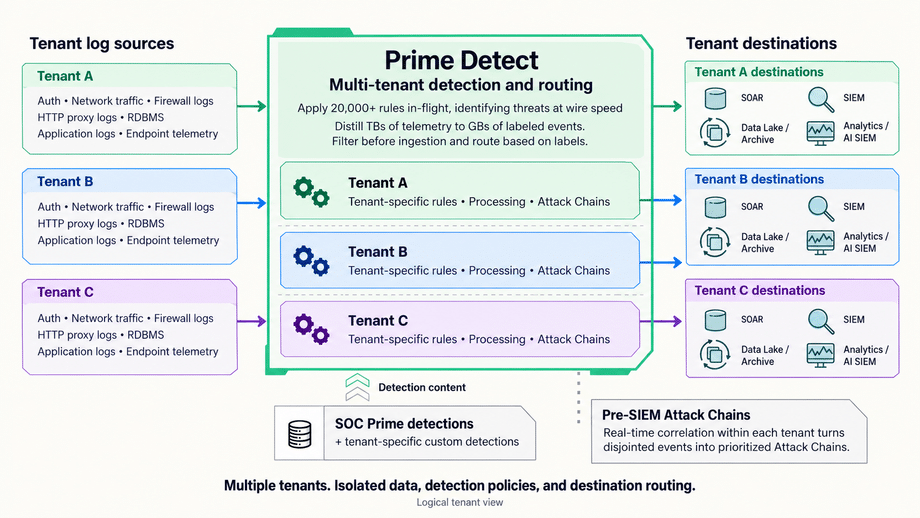
Prime Detect runs detection rules on your clients’ event streams before data reaches the SIEM. It applies Sigma rules to events in transit, tags each match with a severity and a MITRE ATT&CK technique, and links related matches into attack chains. In client testing, about 7% of telemetry was tagged.
MSSPs use Prime Detect to give every client the same 20,000+ detections regardless of which SIEM that client runs, to send less data into SIEMs they pay to operate, and to keep each client’s data inside its own pipeline. It works alongside the SIEMs you already run. It does not replace them.
An MSSP’s detection coverage is usually set by whatever each client’s SIEM can hold. That creates three problems that grow with every client you add.
Uneven coverage. Clients run different SIEMs with different rule limits. The same threat can be caught for one client and missed for another, depending on the platform underneath.
Ingest cost. Where you operate the SIEM, every event ingested is a cost against your margin, whether it carries a threat signal or not.
Engineering load. Your detection engineers spend their time porting and tuning the same rules across platforms instead of building the detections clients actually pay for.
Prime Detect moves detection upstream. Rules run on events as they stream through the pipeline, before any SIEM ingests them. Coverage depends on the compute you assign, not on each client’s SIEM. You then decide, per client, what reaches the SIEM.
What Prime Detect does
Detection in the stream
Applies Sigma rules to events in transit, before SIEM ingest
Runs 20,000+ detection rules plus your own custom detections, with no fixed rule ceiling
Tags every match with a severity and a MITRE ATT&CK technique
Links related matches into attack chains, so analysts see a sequence of activity instead of isolated alerts
Tagged telemetry you can route
Tags about 7% of telemetry, based on client testing
Sends tagged events to the SIEM and the rest to warm or cold storage, by your rules
Produces structured, ATT&CK-labeled events that AI triage and SOAR tools can use directly
Deployment and control
Runs on Kafka and Kubernetes you or your clients operate
Keeps data inside the pipeline, with no outbound connection required
Deploys air-gapped or in the cloud
Available open source or under an Enterprise license
How it fits with the SIEMs you already run
Prime Detect sits between the event pipeline and the SIEM. Nothing in the SIEM has to change, so it works across a mixed client base.
MSSPs typically deploy it in one of two ways:
Shared, multi-tenant: one Prime Detect deployment in your environment, with detections and routing set per tenant.
Per client: a deployment inside the client’s own infrastructure, for clients with strict data residency or air-gap requirements.
Rollout follows the same three steps either way:
Forward everything to the SIEM as today, with Detect tags added to matched events.
Add a SIEM index or dashboard that raises Detect-tagged events as high-priority alerts.
Once tuned, route untagged events to warm or cold storage to cut ingest.
What Prime Detect does not do
It does not replace the SIEM for centralized logging, search, investigation, or retention.
It does not decide whether an incident is significant or reportable. Your incident process makes that call.
It does not make data transfer decisions for you. Where data goes, and under which agreement, stays with your firm and your clients.
NIS2, DORA, HIPAA, and GDPR: where Prime Detect fits
MSSPs carry their own obligations and inherit their clients’. NIS2 defines managed security service providers in Article 6(40) and lists them in Annex I, so many MSSPs are covered entities in their own right. Prime Detect supports the detection side of each rule below. It does not discharge any of them alone.
Rule
What it requires
Where Prime Detect fits
NIS2 Art. 23
Early warning within 24 hours and incident notification within 72 hours of becoming aware of a significant incident
Surfaces chained activity earlier, so your team becomes aware sooner and has ATT&CK-mapped evidence for the notice
DORA Art. 28
Financial entities stay fully responsible for DORA compliance when they use ICT service providers
Gives your financial clients a per-tenant record of what was detected, which they need to show oversight of you
HIPAA 45 CFR 164.312(b)
Mechanisms that record and examine activity in systems containing ePHI
Examines every event in the stream and records matches with severity and technique. Logging and retention stay in the SIEM
HIPAA 45 CFR 164.308(b), 164.314(a)
Business associates report security incidents they become aware of to the covered entity
Tagged matches and attack chains give you the detail to report quickly and specifically
GDPR Ch. V (Arts. 44–49)
Transfers of personal data outside the EU/EEA only under Chapter V conditions, including onward transfers
Runs inside your or your client’s pipeline with no outbound connection, so detection itself adds no transfer
Sell coverage, not ingest
Most MSSPs price and staff around SIEM volume. That ties margin to how much data clients send, and ties coverage to which platform each client happens to run.
Prime Detect separates the two. Every client gets the same detection baseline. You send the SIEM only the events that matter. Each tenant gets an ATT&CK-mapped record of what you detected, which is the evidence regulated clients need to show oversight of their provider. Your engineers spend their time on the detections that set your service apart.
See it run. Watch Prime Detect work against a live event stream before you commit to a pilot. Request a demo, explore the live demo, or download the open source version to run it yourself.
FAQ
How can an MSSP keep detection capacity in step with client growth?
Take rule capacity out of each client’s SIEM. Prime Detect runs detections on the event stream, so coverage scales with the compute you assign, not with SIEM limits. Each new client gets the same 20,000+ detections, whether they run one SIEM or another.
What is the difference between pre-SIEM detection and direct SIEM ingestion?
With direct ingestion, logs go into the SIEM and detection rules run there. Pre-SIEM detection runs the rules on events in transit, before the SIEM ingests them. Prime Detect is a pre-SIEM detection layer. It tags matches and lets you send only high-priority events to the SIEM.
Can one Prime Detect deployment serve multiple clients?
Yes. MSSPs can run a shared multi-tenant deployment with detections and routing set per tenant. They can also deploy inside a client’s own infrastructure when data residency or an air gap requires it.
How is Prime Detect licensed for MSSPs?
Prime Detect is available open source or under an Enterprise license. Enterprise licensing for MSSPs is typically based on the number of clients served. Contact SOC Prime for pricing for your architecture.
What do NIS2 and DORA require of MSSPs?
NIS2 defines MSSPs and brings many of them into scope as covered entities. Under Article 23, they must give an early warning within 24 hours of becoming aware of a significant incident and a notification within 72 hours. Under DORA Article 28, financial clients remain fully responsible for their own compliance when they use an MSSP, so they will expect evidence of what you detect.
What does HIPAA require for audit trails and incident reporting?
The HIPAA Security Rule, 45 CFR 164.312(b), requires mechanisms that record and examine activity in systems containing electronic protected health information. Under 164.308(b) and 164.314(a), a business associate must report security incidents it becomes aware of to the covered entity, including breaches of unsecured protected health information.
Does pre-SIEM detection create GDPR data transfer issues?
Not by itself. Prime Detect runs inside your or your client’s pipeline and needs no outbound connection, so detection adds no transfer of personal data. Where the rest of the data goes, and under which Chapter V mechanism, remains your firm’s decision.
Will Prime Detect commoditize our detection engineering service?
It shifts where your engineers spend their time. Baseline coverage comes from the 20,000+ rule library, which SOC Prime keeps adding to. Your team can focus on client-specific detections, threat hunting, and tuning, which is the work clients see as your differentiator.
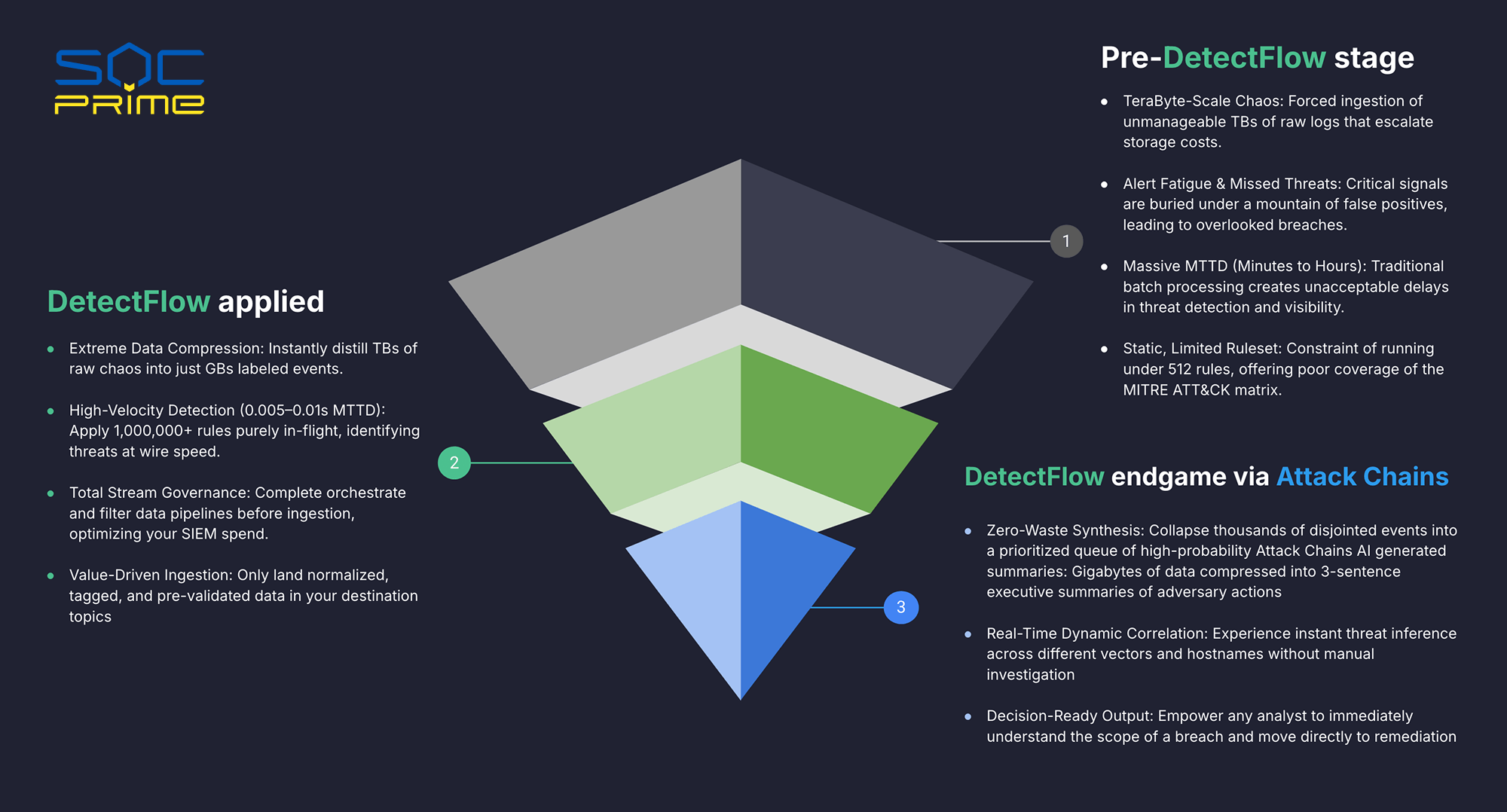
Prime Detect runs detection rules on your event stream before data reaches the SIEM. It applies Sigma rules to events in transit, tags each match with a severity and a MITRE ATT&CK technique, and links related matches into attack chains. In client testing, about 7% of telemetry was tagged. That is the slice worth sending to your SIEM.
Large organizations use Prime Detect to run 20,000+ detections without SIEM rule limits, cut what they pay to ingest, and keep a mapped record of what they detect for regulations such as DORA and NYDFS. It works alongside your existing SIEM. It does not replace it.
A SIEM runs detection rules against data it has already ingested and indexed. For a large bank, that model hits two limits.
Rule capacity. Most SIEM deployments run a few hundred active rules before search performance and cost become a problem. A team running 500 of them is choosing what not to see.
Ingest cost. Every event the SIEM ingests is an event you pay to store and search, whether or not it carries a threat signal.
Prime Detect moves detection upstream. Rules run against events as they stream through your Kafka pipeline, before ingest. Rule count is tied to the compute you give it, not to SIEM capacity. You then decide what reaches the SIEM based on what the rules found.
Regulators set the floor. DORA Article 10 requires mechanisms to promptly detect anomalous activity. NYDFS Part 500 requires larger covered entities to centralize logging and security alerting. Neither sets a rule count, but both expect you to show that your detection program works. More detections, each mapped to ATT&CK, give you broader coverage and a clearer record of it.
What Prime Detect does
Detection in the stream
Applies Sigma rules to events in transit, before SIEM ingest
Runs 20,000+ detection rules plus your own custom detections, with no fixed rule ceiling
Tags every match with a severity and a MITRE ATT&CK technique
Links related matches into attack chains, so analysts see a sequence of activity instead of isolated alerts
Tagged telemetry you can route
Tags about 7% of telemetry, based on client testing
Sends tagged events to the SIEM and the rest to warm or cold storage, by your rules
Produces structured, ATT&CK-labeled events that AI triage and SOAR tools can use directly
Deployment and control
Runs on the Kafka and Kubernetes your team already operates
Keeps data inside your pipeline, with no outbound connection required
Deploys air-gapped or in the cloud
Available open source as DetectFlow, or under an Enterprise license
How it fits with your existing SIEM
Prime Detect sits between your event pipeline and your SIEM. Nothing in the SIEM has to change. Most teams roll it out in three steps:
Forward everything to the SIEM as today, with Detect tags added to matched events.
Add a SIEM index or dashboard that raises Detect-tagged events as high-priority alerts.
Once tuned, route untagged events to warm or cold storage to cut ingest.
You can change the routing at any point as you learn what works in your environment.
What Prime Detect does not do
It does not replace your SIEM for centralized logging, search, investigation, or retention.
It does not satisfy the NYDFS centralized logging requirement on its own.
It does not decide whether an incident is material or reportable. Your team makes that call.
DORA, NYDFS, and SEC: where Prime Detect fits
These rules set detection, incident, testing, and disclosure duties for the banks they cover. Prime Detect supports the detection side of each. It does not discharge any of them alone.
Rule
What it requires
Where Prime Detect fits
DORA Art. 9
Continuously monitor the security and functioning of ICT systems
Runs detections on every event in the stream, not a sampled subset
DORA Art. 10
Mechanisms to promptly detect anomalous activity
Detects in transit, ahead of SIEM ingest and indexing
DORA Art. 17
An incident process to detect, manage, classify, and notify
Each match carries severity and ATT&CK technique, giving a structured basis for classification
DORA Art. 26
Threat-led penetration testing (TLPT) at least every 3 years, if designated
ATT&CK mapping shows which tested techniques you had detections for
NYDFS 500.14(b)
Class A companies: EDR plus centralized logging and security alerting
Adds detection coverage in front of your centralized logging. Does not replace it
NYDFS 500.17(a)
Notify the superintendent within 72 hours of determining an incident occurred
Surfaces chained activity earlier, so investigation can start sooner
SEC Form 8-K Item 1.05
Registrants: determine materiality without unreasonable delay, file within 4 business days of that determination
Attack chains give the team scoping evidence faster. The materiality call stays with you
The detection record examiners ask about
When an examiner asks how a bank detects threats, the answer is usually a list of SIEM rules. With Prime Detect, every detection is mapped to ATT&CK and tagged at the event level. You can show what you were watching for, what fired, and how related activity chained together.
That is the record DORA’s incident process and NYDFS’s 72-hour notice depend on. When an incident happens, the work of building it should already be done.
See it run. Watch Prime Detect work against a live event stream before you commit to a pilot. Use the default user name and passwords listed. Request a demo, explore the live demo, or download DetectFlow to run it yourself.
FAQ
What is pre-SIEM detection?
Pre-SIEM detection runs detection rules on events while they move through the data pipeline, before the SIEM ingests them. A SIEM-based model runs rules only on data the SIEM has already ingested. The difference is where the detection logic executes. Prime Detect is SOC Prime’s pre-SIEM detection layer
How can a bank run more detection rules without adding SIEM capacity?
Run the rules outside the SIEM. Prime Detect executes rules on the bank’s own Kafka and Kubernetes infrastructure, so rule count depends on that compute rather than SIEM limits. Banks can run 20,000+ rules instead of the few hundred a typical SIEM holds.
How much data does Prime Detect send to the SIEM?
That is your choice. In client testing, Prime Detect tagged about 7% of telemetry. Teams can send only tagged events to the SIEM and route the rest to lower-cost storage.
Does pre-SIEM detection satisfy NYDFS 500.14(b)?
No, not on its own. Section 500.14(b) requires Class A companies to centralize logging and security event alerting. Prime Detect adds detection in front of that system. It does not replace it.
How is Prime Detect different from a pipeline tool like Cribl?
Pipeline tools route, reduce, and transform data. Prime Detect runs detection logic on the data and tags what it finds. The two can run together: the pipeline shapes the stream, and Prime Detect identifies the threats in it.
Can Prime Detect run in an air-gapped environment?
Yes. Prime Detect runs inside your own pipeline and needs no outbound connection. It also supports cloud deployment.
Is Prime Detect open source?
Yes. The open source version is DetectFlow. SOC Prime also offers an Enterprise license.
Build versus buy is the decision about which threat detections a security team authors in-house and which it sources as ready-made detection content. The answer is almost never all build or all buy. Buy the commodity layer, build what is unique to your environment, and measure both sides by time-to-coverage: the elapsed time from a technique becoming public to a validated, firing detection running in your own stack.
Should my security team write our own detection rules or buy detection content?
Both. The split depends on four factors, not a preset ratio.
Commodity TTPs against common platforms, mappable to MITRE ATT&CK techniques
Staffing
Detection engineers on staff with authoring and maintenance capacity
No detection-engineering FTE, or FTE consumed by other work
Validation capacity
Team can prove rules fire and produce audit evidence
No validation pipeline
Time-to-coverage target
Tolerable window measured in weeks
Window measured in hours or days
Time-to-coverage is the factor the whole decision turns on. It measures the window between a technique becoming public and a validated, firing detection running in your environment. Every day inside that window is exposure the team chose to carry.
What does a detection engineer cost, fully loaded, and what does the backlog cost?
The answer is your own numbers. Every organization’s cost structure is different, and no external benchmark substitutes for your loaded cost, ramp timeline, or attrition rate. What matters is calculating it completely.
A fully loaded detection engineer costs more than a salary line. The total includes salary, benefits, tooling, training, and the management overhead a specialized hire carries.
Add the ramp period. A new engineer does not produce validated detections against your specific telemetry and SIEM configuration on day one, and the backlog grows while they ramp.
Add attrition. Detection engineers are scarce and mobile. Each departure restarts the ramp clock and takes environment-specific knowledge with it.
The backlog itself has a cost. Every rule that sits unwritten or unvalidated is a detection gap the environment runs with until someone writes, tests, and deploys it. Quantifying that carrying cost is difficult, which is why most teams skip it and why the gap persists. The worksheet at the end of this page provides the structure to calculate it.
How do small security teams keep detection rules current against new threats?
The constraint is time, not skill. Keeping hundreds or thousands of rules current while new techniques arrive continuously is a different workload from authoring them. A small team cannot do it at the speed new techniques emerge while also tuning rules, handling incidents, and maintaining the SIEM.
Three realities compound the problem:
Technique volume exceeds authoring capacity. Threat-intelligence feeds publish new techniques continuously. A team of one or two detection engineers cannot keep pace while handling everything else the SOC demands
Platform count multiplies build cost. Two SIEM or EDR platforms means every rule needs two implementations. Three platforms, three. Build cost scales linearly with targets.
Validation is the bottleneck. A rule that parses is not a rule that fires. Proving it fires on real or emulated events, and that it produces audit-grade evidence, is where the time goes. Without validation capacity, bought or built content is equally unproven.
Portable detection content addresses the commodity layer directly. Rules authored in a vendor-agnostic format like Sigma and translated to each target platform give small teams continuously updated coverage without authoring and maintaining every rule from scratch.
The team’s own engineers then focus on detections that require knowledge of the environment: custom applications, internal telemetry sources, and business logic no external library can anticipate. Vendor-agnostic content narrows the window between technique publication and deployed detection for the commodity layer, freeing constrained engineering capacity for the work only that team can do.
SOC Prime’s Advanced Threat Detection library supplies curated behavior rules for emerging threats, centrally managed, deployable at scale, and stored as Detection as Code.
What factors should I consider when calculating the cost of hiring detection engineers versus buying solutions?
Seven factors, each a cell in the cost model. Fill in each from your own data. Estimates carry risk: underestimating any single factor makes the whole model unreliable.
Hours or days from technique publication to validated deployed detection
Converts all the above into an operating requirement
When the total cost of building exceeds the cost of buying the commodity layer plus the cost of building only what is unique, the decision has made itself. No universal salary figure or ratio applies. The answer depends on your numbers.
How can I justify the investment in detection content to the board or budget committee?
Frame it as what it is: converting a variable, hard-to-retain hiring problem into a predictable subscription line. The board funds coverage, speed, and risk reduction. Present detection content as the mechanism that delivers them.
Detection engineering talent is scarce, hiring cycles are long, and attrition resets the ramp. A subscription to vendor-agnostic detection content converts part of that variable cost into a fixed line item the board can plan against.
Three metrics a board recognizes:
Time-to-coverage. The window between a technique becoming public and a validated, firing detection deployed in your environment. Buying the commodity layer compresses this window. Show the board the current window and the target.
Validated coverage against MITRE ATT&CK. The share of relevant ATT&CK techniques for which you have a detection proven to fire. Measurable, auditable, and comparable across reporting periods. Boards approve what they can track.
Avoided incremental hires. The engineering capacity that would need to be added to reach the same coverage and the same time-to-coverage through in-house authoring alone. Frame it as headcount you did not need to add
The ask is a subscription delivering measurable coverage gains at a speed the existing team cannot match, without adding headcount. Bought content augments capacity without replacing expertise: engineers stop re-authoring commodity rules that hundreds of other teams are writing independently and focus on investigation, tuning, incident response, and the detections only they can build.
What is the cost of the gap between technique publication and deployed detection?
The gap is the window during which a technique is known, published, and potentially in use, but your environment has no detection for it. The cost of that window is exposure: an attacker using a known technique can operate while no detection for that behavior is in place.
The gap has a shape:
Step
What happens
What adds time
Technique publication
A new TTP appears in a threat report or ATT&CK update
Nothing. The clock starts.
Rule authoring
A detection engineer writes a rule for your stack
Complexity, queue depth, competing priorities
Translation
The rule is rewritten for each additional platform
Every extra SIEM, EDR, or XDR target
Validation
The rule is tested to confirm it fires and controls false positives
Emulation environment availability
Deployment
The validated rule reaches production
Change-management process
Every step is sequential, so the gap is their sum. A backlog of unwritten rules means the gap for the next technique does not start at zero. It starts behind whatever is still waiting.
The gap compounds in three ways.
Incident response gets harder when initial detection was late. The attacker has had time to move laterally and establish persistence.
Audit and regulatory evidence suffers. The dated coverage report shows a gap for a technique that was publicly known.
Operational confidence erodes when the backlog grows faster than the team can work it. That signals a structural problem, not a temporary shortage.
Buying commodity detection content compresses the authoring and translation steps. It does not eliminate validation. The team still owns the last mile: confirming content fires in their environment and produces the evidence their auditors expect.
Shrinking the gap comes down to more authoring capacity or a content source that covers commodity techniques faster than the team can write and validate them in-house.
Where this does not hold
The buy side assumes commodity detection content exists for your platforms and that your environment accepts external content. Bought content substitutes for built content only within that boundary. Where the conditions fail, building is the only option.
Conditions where buying does not apply:
Proprietary telemetry. Detection logic tied to custom application logs, proprietary protocols, or internal-only data sources. No external vendor has visibility into what only your environment produces.
Classified or restricted environments. Environments requiring review and approval of external content before ingestion. The review process can negate the speed advantage.
Platform coverage gaps. Vendor content that does not translate to your SIEM, EDR, or XDR platform is inaccessible.
Sourcing and provenance constraints. Some compliance frameworks or internal policies require detection content authored by named, vetted individuals, or full provenance control over detection logic from authorship through deployment. Bought content carries the vendor’s provenance chain, and some audit frameworks treat that distinction as material. Verify whether your evidence requirements accept externally sourced content.
One case falls outside the decision entirely. A team without a functioning SIEM or a defined detection-engineering function is not ready for build versus buy at all. The question assumes a functioning detection program, so teams still establishing basic telemetry collection should address that first.
Buy the commodity layer where it works. Build what is unique, restricted, or unsupported. Measure both sides by time-to-coverage.
FAQ
Should my security team write our own detection rules or buy detection content?
Both. Buy the commodity layer of threat detections that cover widely shared TTPs against common platforms. Build the detections that require knowledge unique to your environment: custom applications, proprietary protocols, and internal telemetry sources. Measure the split by time-to-coverage.
How do small security teams keep their detection rules current against new threats?
With a source mix, a validation cadence, and a measured disclosure-to-detection window. Small teams cannot author and maintain commodity detections at the speed new techniques emerge while also handling incidents, tuning rules, and maintaining the SIEM. Sourcing the commodity layer as vendor-agnostic detection content frees constrained engineering capacity for the work only that team can do.
How can I justify the investment in detection content to the board or budget committee?
Present three metrics the board can track: time-to-coverage (technique publication to validated deployed detection), validated coverage against MITRE ATT&CK (the share of relevant techniques with proven detections), and avoided incremental hires (the capacity the team would need to add to reach equivalent coverage through in-house authoring alone).
What factors should I consider when calculating the cost of hiring detection engineers versus buying solutions?
Seven factors: loaded annual cost per engineer, ramp time to productivity on your stack, annual attrition rate and re-hire cost, backlog carrying cost, platform count (each SIEM, EDR, or XDR target multiplies build and maintenance cost), evidence burden (audit and regulatory documentation hours), and time-to-coverage target. Fill in each from your own data.
Does buying detection content replace the detection team?
Buying detection content changes what the team spends its time on. Engineers stop re-authoring commodity rules and focus on investigation, tuning, incident response, and detections that require environment-specific knowledge. Bought content augments capacity without replacing expertise.
Build-versus-buy worksheet
Use this worksheet to score your own environment. Fill in every cell from your own data. No cell should contain a guess. If you lack a number for a factor, that gap is itself a finding worth resolving before the decision.
Step 1: Inventory
Item
Your answer
SIEM, EDR, and XDR platforms in production
Detection engineers on staff (FTE)
Rules authored and validated per month (current rate)
Current backlog (unwritten or unvalidated rules)
Time-to-coverage today (technique published to detection deployed)
Time-to-coverage target
Validated MITRE ATT&CK coverage today (share of relevant techniques)
Validation capacity (5 = full pipeline, 1 = no validation process)
Time-to-coverage gap (5 = within target, 1 = weeks behind)
Platform complexity (5 = single platform, 1 = five or more)
Evidence burden (5 = minimal, 1 = heavy regulatory requirement)
Step 5: Decision
Answer these from the totals and scores above:
Does annual build cost exceed buy cost plus the cost of building only what is unique?
Does current time-to-coverage exceed the target?
Can the current team sustain the required authoring and validation cadence?
Then read the scores:
Most factors score 1 to 2: buying commodity detection content addresses the capacity gap.
Most factors score 4 to 5: the team has the capacity and uniqueness to build.
Mixed scores: buy the commodity layer, build what is unique, and measure both by time-to-coverage.
No preset ratio applies. The worksheet produces your answer.
SOC Prime’s Architect, an AI agent designed to build detections, tune them to your SIEM language, research threats, develop hunts and many other tools detection engineers need.
ATT&CK-based detection for a federal agency is the practice of deploying detection rules mapped to MITRE ATT&CK techniques, translating those rules to the agency’s own SIEM, and measuring coverage so the agency can produce auditable evidence that detection is working.
Federal agencies operate under executive orders, OMB memos, and performance goals that point to one operational outcome: detect adversary techniques against agency telemetry and produce evidence that detection is working.
Three components deliver that outcome. An ATT&CK-mapped detection content source provides the rules. A translation layer converts each rule to the native query language of the agency’s deployed SIEM, whether that is Microsoft Sentinel, Splunk, or Elastic. A coverage measurement loop proves which ATT&CK techniques are covered, which are not, and when coverage was last validated.
Without all three, an agency has either detection it cannot prove or proof it cannot act on. This page maps federal guidance to detection requirements and gives a federal buyer the questions to ask any detection content vendor.
What tools help implement ATT&CK-based detection quickly in a federal agency?
Three tool categories implement ATT&CK-based detection in a federal agency: a detection content source, a translation layer, and a coverage measurement loop. Each can come from a vendor, from open source, or from internal engineering. A federal buyer should evaluate each independently because each can come from a different provider.
Component
Function
Neutral examples
ATT&CK-mapped detection content source
Pre-written detection rules, each mapped to a MITRE ATT&CK technique
SOC Prime Prime Hunt, Sigma community rules, CISA detection signatures, native content packs from Microsoft Sentinel, Splunk, Elastic
Translation layer
Converts detection logic to the query language the agency’s SIEM runs
A content source alone is not detection capability, and a translation tool alone is not coverage. The measurement loop connects the two to evidence an auditor or inspector general can verify.
Detection content source. A library of rules mapped to MITRE ATT&CK technique IDs, authored and maintained at a cadence that keeps pace with published threat activity. Sources include internal detection engineering teams writing rules in Sigma, vendor-supplied content streams such as SOC Prime‘s detection content platform, the open-source Sigma rule community, and MITRE’s own ATT&CK repository.
Translation layer. Converts rules from a portable format into the native query syntax of the agency’s SIEM. For Microsoft Sentinel that means KQL. For Splunk, SPL. For Elastic, KQL or EQL. SOC Prime’s Uncoder handles this translation across platforms. Manual conversion and platform-native import tools are alternatives, though they carry a per-rule labor cost that compounds as rule volume grows.
Coverage measurement loop. Maps deployed rules back to the ATT&CK matrix and identifies technique gaps. MITRE’s ATT&CK Navigator is a free, widely used tool for this visualization. The loop is where the five evidence classes an inspector general looks for originate.
Those five evidence classes are the through-line of this page.
#
Evidence class
What it proves
1
Log sources collected
Which telemetry is ingested, from which systems, and that collection is continuous
2
Rules deployed
Each detection rule mapped to its ATT&CK technique and the obligation it supports, with a named owner
3
Proof of firing
Rules fired on real or emulated events and alerts reached responders
4
Change history
Who changed a rule, when, and why, with version control and a review trail
5
Dated coverage report
Point-in-time coverage with a date, so trend and currency are provable
A vendor may provide the content source and the translation layer. The measurement loop often requires the agency to configure its own reporting from ATT&CK Navigator exports, SIEM dashboards, or third-party coverage analytics. The measurement loop is the component agencies most commonly lack.
Prime Hunt’s read-only data audit maps the log sources an agency already collects to ATT&CK and lists the techniques with no telemetry behind them.
How does CISA and NSA threat-informed defense guidance translate into detection requirements?
Federal guidance prescribes outcomes, not specific detection tools. CISA, often jointly with NSA, publishes advisories and guidance that define what agencies must achieve in detection and monitoring. Mapping each guidance document to the detection capability it implies, and then to the evidence that capability produces, gives a program manager a traceable line from directive to operational proof.
Threat identification across the federal enterprise: CISA threat hunting and agency endpoint detection and response data (EO 14144 Sec. 3(c), redesignated Sec. 3(a) by EO 14306)
ATT&CK technique coverage against named threat actors and campaigns
Rules deployed against named techniques
One line carries the whole table: threat-informed defense guidance implies ATT&CK-mapped detections deployed against the agency’s own telemetry, and the five evidence classes prove the capability exists.
The OMB memo of 22 May 2026 replaced the M-21-31 EL0 through EL3 maturity tiers with a revised logging and visibility framework. The memo directed CISA to produce a Logging Reference Architecture under the new framework. Agencies that built logging programs around the old tiers should validate current posture against the 2026 memo.
MITRE ATT&CK is not mandated by any of these directives. It organizes the evidence so that coverage is measurable and technique gaps are nameable across all of them. A federal buyer who can produce the five evidence classes is defensible regardless of which specific directive applies.
How do you close APT technique gaps when cleared detection engineers cannot be hired fast enough?
Buy the commodity detection layer. Build the agency-specific layer.
Why federal detection hiring lags
Detection engineering in a federal agency carries constraints commercial teams do not face. Clearance requirements narrow the hiring pool. Onboarding timelines extend before a new hire touches production systems. Attrition forces a re-hire and re-ramp cycle that compounds the delay.
Source the commodity layer
Commodity TTPs, the techniques shared across APT groups and criminal actors on common platforms, are published by threat researchers and translated across SIEM platforms by vendor-agnostic content sources. An agency running Microsoft Sentinel, Splunk, or Elastic Security across different mission areas can source pre-written, pre-mapped detection logic for commodity techniques rather than authoring each rule in each query language.
Where cleared engineers add value
The agency’s cleared engineers then focus on what only they can do:
Detection logic against classified threat intelligence and agency-specific telemetry.
Tuning sourced content against the agency’s log sources and baseline behavior. Pre-written content produces false positives until tuned to the environment.
Validation. Every rule, bought or built, requires proof of firing in the agency’s own environment before it counts as deployed. A rule that parses is not a rule that fires.
Operational response. Detection without response is a dashboard. Cleared analysts investigate, contain, and remediate.
A subscription to a detection content source converts part of a variable hiring problem into a fixed operating expense, redirecting headcount to investigation, environment-specific tuning, validation, and incident response rather than re-creating detections the broader community has already written and tested.
Content sourcing augments detection engineering capacity. It does not replace cleared personnel and does not remove the need for validation and tuning. Any vendor claim that content sourcing removes the validation step deserves scrutiny.
How fast should an advisory become a deployed detection?
Measure the time from a CISA or NSA advisory to a validated, firing detection in the agency’s own SIEM. That window is the metric, and every federal agency should be able to report it for its most recent advisories. For comparison, SOC Prime publishes a 24-hour SLA for detection content against emerging threats.
Step
Action
Owner
1
Advisory published (CISA, NSA, or sector ISAC)
External
2
Detection logic authored or sourced covering named ATT&CK techniques
Content source or internal engineer
3
Rule translated to the agency’s SIEM query language and deployed
Translation layer or internal engineer
4
Rule validated: proof of firing against emulated or real events
Agency (always)
The window has three segments:
A rule is authored or sourced for the technique the advisory names.
The rule is translated into the native query language of the agency’s SIEM.
The rule is validated against the agency’s telemetry to confirm it fires and does not produce unacceptable false-positive volume.
Each segment is independently measurable, and the bottleneck varies by agency. Some source rules quickly but lack translation capacity for their specific SIEM dialect. Others translate quickly but lack validation infrastructure.
A detection content vendor compresses steps 2 and 3. Step 4 remains the agency’s responsibility regardless of content origin. A buyer evaluating any vendor’s speed claim should ask which of these three segments the stated timeline covers and which it does not.
Track the full window per advisory. Set an agency target. Report against it. Each advisory produces a dated record: advisory ID, techniques covered, detection rule IDs, date deployed, date validated. That record is auditable and demonstrates that the agency’s threat-informed defense posture is current.
What should a federal buyer ask a detection content vendor about deployment model, data handling and supply chain?
These questions apply to every detection content vendor, including SOC Prime. The answers are diligence inputs, not marketing differentiators.
Deployment model
Ask
Why it matters
What is the hosting model? Cloud, on-premises, hybrid?
Determines whether the platform can operate within the agency’s network boundary
What network connectivity does the platform require?
Outbound connectivity requirements affect placement in segmented or restricted networks
What access does the platform require to the agency’s SIEM or log infrastructure?
Access scope sets the blast radius if the vendor is compromised
How are detection content updates delivered and applied?
Push vs. pull, frequency, and the integrity mechanism on updates
Data handling
Ask
Why it matters
What data does the platform process? Detection content only, or agency telemetry?
Determines the data classification the platform must handle
Does the platform require raw log data, or does it operate on metadata alone?
Narrows the sensitivity of what the vendor can touch
Where is data processed and stored? What jurisdiction?
Affects data sovereignty and records-management requirements
How is the agency’s data segregated from other customers?
Multi-tenancy architecture determines whether cross-tenant exposure is possible
Supply chain and provenance
Ask
Why it matters
How is detection content authored? By whom? What vetting applies to contributors?
Source of the rules determines trust level and exposure to supply-chain risk
What review and validation process does content pass before delivery?
False-positive rate and detection quality depend on upstream QA
What provenance record travels with each detection rule?
Traceability from deployed rule to author and review record
Does the vendor publish a software bill of materials?
SBOM availability is a supply-chain transparency baseline
Neutral frameworks for evaluating vendor responses: NIST SP 800-161 Rev. 1 Update 1 (cybersecurity supply-chain risk management), SBOM minimum elements, and CISA’s Secure Software Development Attestation Form, which remains available although OMB M-26-05 (23 January 2026) rescinded the government-wide requirement to collect it.
Authorization posture
Ask
Why it matters
FedRAMP authorization status and impact level?
Determines whether the platform can process federal data at the required impact level
Agency-specific authorization to operate?
An ATO granted by another agency is informational, not transferable
A buyer should verify authorization status directly through the FedRAMP marketplace or the authorizing agency rather than relying on vendor statements alone.
Update cadence and lifecycle
Ask
Why it matters
How frequently is new detection content published?
Currency of coverage against emerging techniques
What is the timeline from technique publication to available detection, and which segments does it cover?
Scopes a vendor’s speed claim against the advisory-to-detection window above
How does the vendor retire or update outdated rules?
Rule lifecycle hygiene and drift control
What notification does the customer receive when a deployed rule changes?
Change-control visibility for the agency’s own audit trail
These questions are due diligence. A vendor that cannot answer them clearly is a risk the agency accepts without measurement.
Where this does not hold
This page addresses unclassified federal environments with standard network connectivity.
Out of scope:
Environment
Why it is excluded
Classified networks
Detection content sourcing in classified environments requires capabilities not verified for any vendor named on this page
Air-gapped or disconnected operations
No vendor’s ability to deliver detection content in disconnected environments is asserted here
Agency-unique telemetry
Agencies with telemetry sources outside standard SIEM log parsing may require detection logic no external content source provides
Agencies operating under environment-specific accreditation such as IL4, IL5, or IL6 impact levels under DoD should validate any vendor’s authorization status against the specific accreditation their environment requires. The buyer questions in the previous section still apply, but the thresholds for acceptable answers are higher.
The three-component model (content source, translation layer, measurement loop) applies in every environment. Whether a specific vendor can deliver in a classified or disconnected environment is a question the buyer verifies directly with the vendor and with the authorizing official.
FAQ
What tools can help implement ATT&CK-based detection quickly in a federal agency?
Three tool categories: an ATT&CK-mapped detection content source, a translation layer that converts rules to the agency’s SIEM query language, and a coverage measurement loop that maps deployed detections to ATT&CK techniques. Each can be vendor-supplied, open source, or built in-house. The measurement loop is the component agencies most commonly lack.
Can community-sourced detection content be trusted in a federal environment?
Trust depends on three factors: provenance (who authored the rule and under what vetting), review (what validation the rule passed before delivery), and validation in the agency’s own environment (proof the rule fires against the agency’s telemetry without unacceptable false positives). A rule’s origin is a risk input, not a disqualifier. Federal buyers should ask every vendor, including community-sourced platforms, what provenance record travels with each rule.
What evidence does an inspector general look for in a federal detection program?
Five evidence classes: log sources collected (which telemetry is ingested and that collection is continuous), rules deployed (each mapped to an ATT&CK technique and obligation with a named owner), proof of firing (rules fired on real or emulated events and alerts reached responders), change history (who changed a rule, when, and why), and a dated coverage report (point-in-time coverage with a date so trend is provable).
How should a federal agency measure the time from a CISA advisory to a deployed detection?
Track four steps per advisory: advisory published, detection logic authored or sourced, rule translated and deployed to the agency’s SIEM, and rule validated with proof of firing. Set an agency target for the full window. Record each advisory’s ID, techniques covered, rule IDs, date deployed, and date validated. That record is auditable.
Is MITRE ATT&CK required by federal cybersecurity directives?
No federal directive mandates MITRE ATT&CK by name. ATT&CK organizes detection evidence so coverage is measurable and technique gaps are nameable across directives. A federal buyer who can produce the five evidence classes (log sources, rules deployed, proof of firing, change history, dated coverage) is defensible against audits regardless of which directive applies.
A MITRE ATT&CK Audit by SOC Prime’s engineers assesses visibility and detection capability across the agency’s SIEM or EDR and returns the gaps with recommendations.
Regulatory detection obligations are the security outcomes that DORA, NIS2, PCI DSS v4.0.1, and the SEC disclosure rules require an organization to achieve and evidence through detection, monitoring, logging, and disclosure.
None of these four regimes prescribes a specific detection tool. Only DORA names detection as a standalone obligation. Each framework requires an outcome: timely detection, continuous monitoring, structured logging, or timely disclosure. Detection capability is what the evidence implies, not a control any regulator mandates by name.
MITRE ATT&CK organizes that evidence into a structure an auditor can query by adversary-behavior category. ATT&CK is not required by DORA, NIS2, PCI DSS, or the SEC rules.
DORA is lex specialis or a specific law that takes precedence over a general law. DORA Article 1(2) makes it a sector-specific Union legal act for the purposes of NIS2 Article 4. A financial entity in DORA scope applies DORA for ICT risk management and incident reporting. NIS2 reaches a bank’s non-financial supply chain, not the bank itself.
What detection evidence supports obligations under PCI DSS 4.0 and DORA?
Both PCI DSS v4.0.1 and DORA treat detection as a means to an evidentiary end. The regulation asks whether detections generate the records the monitoring obligation requires, not whether detections exist.
Five evidence classes carry that proof. Both regimes require them in substance.
Evidence class
PCI DSS v4.0.1
DORA
Log sources collected
Requirement 10: capture audit logs, retain history
Article 9(1): continuously monitor and control the security and functioning of ICT systems; Article 10(3): monitor user activity, ICT anomalies and ICT-related incidents
Rules deployed, with owner
Requirement 11: intrusion-detection/prevention, change-detection in place
Article 10: multiple layers of control, defined alert thresholds and criteria
Article 10: alerts fired and reached responsible staff
Change history
Requirement 11: change-and-tamper detection
Article 17: documented incident-management process with root-cause follow-up
Dated coverage report
Requirement 10.5.1: audit-log history retained for at least 12 months, the most recent three months immediately available (PCI SSC document library)
Article 10(1): detection mechanisms regularly tested in accordance with Article 25
PCI DSS v4.0 was retired on 31 December 2024 and PCI DSS v4.0.1 is the only active version (PCI SSC, June 2024). The 51 future-dated requirements became effective on 31 March 2025 (PCI SSC, August 2024). The H2 above uses “PCI DSS 4.0” to match the searcher’s query.
A detection rule that deploys but generates no auditable record is invisible to an assessor.
Which detection and monitoring obligations do DORA, NIS2, PCI DSS 4.0 and the SEC disclosure rules actually impose?
Each regime imposes an outcome obligation rather than a tool mandate. The table below maps each obligation to the detection evidence it implies.
Regime
Article or Requirement
Obligation
Detection evidence implied
DORA
Art 9(1), Art 10(3)
Continuously monitor and control the security and functioning of ICT systems (Art 9(1)); monitor user activity, ICT anomalies and ICT-related incidents (Art 10(3))
Log source inventory, continuous collection records
DORA
Art 10(1), (2)
Detect anomalous activities; multiple layers of control with alert thresholds and criteria, including automatic alerts to the staff in charge of incident response; detection mechanisms regularly tested under Article 25
Rule inventory with owners, threshold rationale, proof alerts reached responders, test records
DORA
Art 17
Detect, manage, and notify ICT-related incidents with root-cause follow-up
Process documentation, per-incident detection and handling records
Timestamped detection and classification record (initial notification within 4 hours of classifying the incident as major and no later than 24 hours after becoming aware; intermediate report within 72 hours of the initial notification; final report within one month of the intermediate report)
Risk-management measures including incident handling (point (b)) and policies to assess the effectiveness of the measures (point (f)); monitoring and logging duties sit in the implementing rules below, not in Article 21 itself
Documented measures, detection records
NIS2
Art 23(4)
Significant-incident notification
Early warning within 24 hours of becoming aware, incident notification within 72 hours, final report not later than one month after the incident notification
Log and monitor all access to system components and cardholder data
Audit logs reviewed at least daily (10.4.1), automated log review (10.4.1.1), retained log history (10.5.1), failures of critical security control systems detected, reported, and responded to promptly (10.7, 10.7.2); text in the PCI SSC document library
PCI DSS v4.0.1
Req 11
Test security of systems and networks regularly
Intrusion-detection and prevention records (11.5.1), change-detection alerts (11.5.2), payment-page change- and tamper-detection alerts (11.6.1)
Disclose material incidents within four business days of the materiality determination, which must itself be made without unreasonable delay after discovery (Form 8-K, Item 1.05)
Materiality-determination process, incident detection records
Describe the processes for assessing, identifying, and managing material cybersecurity risks in the annual 10-K (Item 1C)
Documented risk-identification process including detection capability
DORA (Regulation (EU) 2022/2554, in application since 17 January 2025) is directly applicable. Its reporting clocks are set by Delegated Regulation (EU) 2025/301: initial notification within 4 hours of classifying an incident as major and no later than 24 hours after becoming aware of it, an intermediate report within 72 hours of the initial notification, and a final report within one month of the intermediate report. Because the first clock starts at detection and classification, the incident timeline itself is auditable evidence.
NIS2 (Directive (EU) 2022/2555) binds through each Member State’s transposing law, not directly. The transposition deadline was 17 October 2024 (Article 41). On 7 May 2025 the European Commission sent reasoned opinions to 19 Member States for failing to notify full transposition, and on 8 July 2026 it referred Ireland, Spain, France and the Netherlands to the Court of Justice. On 20 January 2026 the Commission proposed amendments to NIS2 (COM(2026) 13) that touch Article 21(5) and add ransomware paragraphs to Article 23, leaving the Article 21(2) measures and the Article 23(4) reporting clocks unchanged. The obligation a buyer faces depends on its Member State’s transposing law.
Implementing Regulation (EU) 2024/2690, published on 18 October 2024 and in force from 7 November 2024, sets explicit monitoring and logging requirements (Annex section 3.2) for DNS service providers, TLD name registries, cloud computing, data centre, content delivery network, managed service and managed security service providers, online marketplaces, search engines, social networking platforms, and trust service providers. This reaches MSSPs as regulated entities in their own right, distinct from their customers’ obligations.
PCI DSS v4.0.1 is the only active version. Requirements 10 and 11 carry the detection and monitoring obligations.
SEC (final rule Release 33-11216, adopted 26 July 2023) is a disclosure and governance rule, not a detection-controls mandate. Detection is derivative: a registrant cannot determine materiality without the ability to detect and assess incidents. Compliance with Item 1.05 was required from 18 December 2023 for most registrants and from 15 June 2024 for smaller reporting companies.
What evidence do auditors typically look for to confirm that our detection systems are effective?
Five evidence classes recur across these regimes. A coverage percentage alone is not evidence for any of them.
#
Evidence class
What it proves
1
Log sources collected
Which telemetry is ingested, from which systems, and that collection is continuous. The auditor checks whether monitoring is running, not whether it was configured once.
2
Rules deployed
Detection rules in place, each mapped to the obligation it supports and to its ATT&CK technique where applicable, with an owner.
3
Proof of firing
Rules fired on real or emulated events and alerts reached responders. A deployed rule that has never fired is untested from the auditor’s standpoint.
4
Change history
Who changed a rule, when, and why: version control, a review trail, and a documented rationale for each change.
5
Dated coverage report
Point-in-time report with a date, so trend and currency are provable. An undated report proves nothing about when coverage existed.
ATT&CK functions as the crosswalk that makes this evidence queryable by adversary behavior. A technique ID is metadata attached to already-existing evidence (data sources, deployed rules, firing records) so that evidence becomes retrievable by behavior category. ATT&CK is not required by any of these four regimes. It organizes evidence against the obligations they impose.
Can you show an auditor who changed a rule, when, and why?
Detection-as-Code answers this. Every detection rule is a versioned artifact in source control. The change history records author, timestamp, review approval, and the reason for the change.
This trail maps to specific obligations:
DORA Article 17 requires a documented incident-management process with root-cause follow-up.
PCI DSS v4.0.1 Requirement 11 includes change-and-tamper detection.
The SEC’s Item 106 expects a registrant to describe its risk-identification processes.
Each framework asks whether the organization governs detection rules as controlled artifacts, not merely whether rules exist.
The operational test: given a rule that fired last quarter, can the team produce its complete lineage? Who wrote it, who reviewed it, when it was last modified, why, what obligation it maps to, and what technique it addresses. A detection-content platform that manages rules as versioned code produces this trail as a byproduct of normal operations.
Where rules are edited in a console without version control, the auditor has no provenance for the current rule state. Detection-as-Code governance removes that ambiguity by construction.
How does detection coverage become a compliance line item?
Detection capability tends to sit inside operations budgets, visible to the SOC manager, invisible to the CFO. Three facts make coverage a board conversation.
Reporting clocks start at detection. DORA’s 4-hour classification clock and the SEC’s four-business-day materiality clock both begin when the organization detects or becomes aware. Faster detection is the beginning of the compliance timeline.
Detection evidence is auditable. The five evidence classes above are what an auditor reviews. Producing them costs time and staff whether the team builds its own rules or subscribes to a detection-content source.
Time-to-coverage is measurable. The window between a technique becoming public and a validated detection firing in the organization’s own environment is trackable.
An engineering team requests detection capacity in terms of headcount and tooling. A compliance team requests it in terms of evidence production. The second framing ties detection spending to a regulatory obligation the board already tracks.
A SIEM posture audit produces the coverage map auditors ask for: rules mapped to MITRE ATT&CK, log sources mapped to the same matrix, and the gaps listed with a plan.
Not every obligation maps to detection. SEC Item 1.05 requires disclosure, not specific controls. NIS2 Article 21 and DORA both include supply-chain security, business continuity, and access management. None of these map to ATT&CK techniques. ATT&CK organizes the detection and monitoring subset, not the full compliance surface.
NIS2 transposition is incomplete. Where a Member State’s transposing law is not in force, NIS2 Articles 21 and 23 are not locally enforceable. The January 2026 proposed amendments do not renumber Articles 21 or 23.
The SEC rules are contested. The rescission petition against Item 1.05, filed 22 May 2025 by five banking and securities trade associations (SEC File No. 4-856), remains unresolved: as of 21 September 2026 the SEC has proposed no amendment to Item 1.05, although the petitioners renewed the request in an April 2026 comment letter under the Commission’s Regulation S-K review. A 21 May 2024 statement by Erik Gerding, then Director of the Division of Corporation Finance, clarified that Item 1.05 is reserved for incidents a registrant has determined to be material and encouraged disclosure of other incidents under a different item such as Item 8.01; the Division followed with Compliance and Disclosure Interpretations on 24 June 2024.
Sub-requirement numbers follow v4.0.1. The PCI DSS sub-requirements cited here (10.4.1, 10.4.1.1, 10.5.1, 10.7, 10.7.2, 11.5.1, 11.5.2, 11.6.1) use the v4.0.1 numbering; the standard itself is in the PCI SSC document library, and Requirement 10.7.2 applies to all entities from 31 March 2025.
ATT&CK is a crosswalk, not a regulatory obligation. Mapping detections to ATT&CK techniques organizes evidence. It does not discharge any regulatory obligation, and no framework examined here requires it.
DORA is lex specialis for financial entities. A bank in DORA scope does not apply NIS2 Articles 21 and 23 on top for its own ICT risk management and incident reporting. NIS2 reaches a bank’s non-financial supply chain, not the bank’s own ICT operations.
AUDIT EVIDENCE CHECKLIST: DETECTION OBLIGATIONS

1. LOG SOURCES COLLECTED

   [ ] Inventory of telemetry sources ingested

   [ ] Evidence of continuous collection (not point-in-time)

   [ ] Each source mapped to the systems, assets, and

       obligations it covers

2. RULES DEPLOYED

   [ ] Detection rules inventory with named owners

   [ ] Each rule mapped to the regulatory obligation it supports

   [ ] Each rule mapped to ATT&CK technique where applicable

       (crosswalk, not required by regulation)

   [ ] Alert thresholds documented with rationale

3. PROOF OF FIRING

   [ ] Evidence that rules fired on real or emulated events

   [ ] Records that alerts reached designated responders

   [ ] Dated test records for detection mechanisms

       (DORA Article 10)

4. CHANGE HISTORY

   [ ] Version control for every detection rule

       (Detection-as-Code)

   [ ] Author, reviewer, timestamp, and rationale per change

   [ ] Review and approval trail

   [ ] Change-and-tamper detection records

5. DATED COVERAGE REPORT

   [ ] Point-in-time coverage report with a date

   [ ] Coverage measured against prioritized technique set,

       not full ATT&CK matrix

   [ ] Trend data showing coverage over time

   [ ] Per-environment reporting (not one aggregate number)

REGIME-SPECIFIC ITEMS

   [ ] DORA: alert thresholds documented with rationale

       (Article 10)

   [ ] DORA: incident timestamps on the reporting clocks

       (4h from classification / 24h from awareness,

       72h intermediate, 1-month final)

   [ ] NIS2: evidence mapped to the transposed national law,

       not directive text alone

   [ ] PCI DSS v4.0.1: log retention per applicable

       sub-requirements

   [ ] SEC: documented materiality-determination process

       (Item 1.05)

   [ ] SEC: board oversight and management role described

       (Item 106)

NOTES

- ATT&CK is the crosswalk used to organize this evidence.

  It is not required by DORA, NIS2, PCI DSS, or SEC rules.

- DORA is lex specialis: a bank in DORA scope applies DORA,

  not NIS2 Articles 21 and 23, for ICT risk management.

- PCI DSS v4.0.1 is the only active version

  (v4.0 retired 31 December 2024).

- Every regulatory specific in this document is validated

  by ciso-cto-sme before publish.
FAQ
What detection evidence supports obligations under PCI DSS 4.0 and DORA?
Both regimes require evidence of ongoing detection and monitoring, not merely evidence that detection tools are deployed. The five evidence classes are: log sources collected, detection rules deployed with owners, proof those rules fire, change history with version control, and a dated coverage report. MITRE ATT&CK organizes this evidence by adversary-behavior category. ATT&CK is not required by either framework.
What evidence do auditors look for to confirm detection systems are effective?
Auditors look for five evidence classes: which telemetry sources are collected and that collection is continuous, detection rules mapped to obligations and ATT&CK techniques with named owners, proof those rules fire on real or emulated events, version-controlled change history for every rule, and a dated point-in-time coverage report. A coverage percentage alone, without the supporting records underneath it, is not evidence.
Does mapping detections to MITRE ATT&CK satisfy a regulator?
ATT&CK is the crosswalk that organizes detection evidence by adversary behavior. It makes evidence queryable and reportable by technique. It does not itself discharge any regulatory obligation. DORA, NIS2, PCI DSS, and the SEC rules ask for evidence of operation: monitoring, detection, logging, and disclosure. ATT&CK organizes that evidence. No framework examined here requires it.
What are the incident reporting timelines under DORA and NIS2?
Under DORA, Delegated Regulation (EU) 2025/301 sets the clocks for major incidents: initial notification within 4 hours of classifying the incident as major (no later than 24 hours after awareness), an intermediate report within 72 hours of the initial notification, and a final report within one month of the intermediate report. Under NIS2, significant incidents require an early warning within 24 hours of becoming aware, an incident notification within 72 hours, and a final report not later than one month after the incident notification. Both timelines start at detection, making the detection timestamp itself an auditable record.
SOC Prime’s Custom Content Engineering implements detections in your SIEM or EDR and provides high-level documentation of their purpose, function, and usage.
Detection validation is the practice of proving a detection rule still fires on the events it was written to catch. Detection decay is the silent failure of a rule that once worked, after a log source, schema, or parser changes underneath it. A rule that is deployed and enabled is not a rule that is proven to work.
How do you know a detection rule still works?
A rule works if it fires on a known event within a defined window. Everything else is an assumption.
Most teams treat “deployed and enabled” as the working state: the rule exists in the SIEM, it passes validation at deploy time, the coverage heatmap stays green. Execution status and coverage status both measure presence, not function. A rule that executes successfully against an empty result set looks identical, from the platform’s perspective, to a rule watching a quiet network. The dashboard stays green either way.
The honest evidence ladder has five tiers, weakest to strongest:
Tier
State
What it proves
What it does NOT prove
0
Asserted
The rule exists
Nothing about function
1
Lint-passed
Parses correctly, required blocks present, fields exist in the target schema
That it matches anything
2
Fixture-replayed
Matches recorded known-bad events, rejects paired benign fixtures (offline)
That the adversary’s real procedure emits this event in THIS environment’s OS and logging configuration
4
Production-fired
Triggered on real adversary or red-team activity with a disposition record
Top tier
A rule that parses is not a rule that matches. A rule that matches a test fixture is not a rule that fires in production. The gap between tier 1 and tier 3 is where silent failure lives: a rule can parse cleanly and reference valid fields while returning zero matches, because the field it keys on is empty, renamed, or now populated with different semantics than the rule was written to expect.
How do I know which of my detection rules have silently stopped working?
Compare each rule’s current fire rate to its own recent baseline. Alert on a collapse to zero, or a sustained drop far below that baseline over a defined window.
Known limitations: Fire-rate baselining fails for low-base-rate rules whose normal state is zero fires for weeks. A rule that legitimately fires twice a year cannot be watched by fire rate alone. This is why the next three signals exist.
Canary events
Inject a synthetic event known to match a rule. Confirm the rule fires end to end. This is a pattern, not a native product feature.
Canary events prove reach: the event survived collection, parsing, normalization, and the rule matched it. They do not prove behavior: a real adversary procedure may produce different telemetry than the canary assumed.
Periodic replay
Re-run a rule against historical data (real past events or a stored positive sample). Confirm it still alerts.
Replay must land in a tagged or non-paging sink. Without idempotency controls, validation replay creates duplicate incidents and pages the SOC.
Native support varies. Elastic Security (8.x+) has manual-run and gap-detection for detection rules. Splunk supports re-running a search over a historical time range. Microsoft Sentinel has no native analytics-rule replay.
Schema-drift alerts
Detect that the shape of incoming data changed (field renamed, removed, retyped, new enum value) before a rule silently breaks on it.
Platform
Drift detection surface
Splunk
CIM data-model audit views in Enterprise Security, field extractions
Microsoft Sentinel
SentinelHealth table, data collection health monitoring workbook. A column that stops being populated shows as rising null values, not a schema error
Fire-rate baselining is necessary and insufficient. Use all four.
Prime Hunt’s content audit auto-maps the rules you already run to MITRE ATT&CK, and its automated threat search looks for the latest TTPs across your connected environments without moving the data.
Five mechanisms cause silent decay. In every case the rule keeps executing, returns zero matches, and execution status stays green. No error is thrown, and the coverage heatmap does not move.
1. Log source version change. The source ships a new log version and changes the semantics of an existing field. Example: an identity provider collapses an authentication outcome from three states (success, failure, challenge) to two (success, failure). A rule that detects MFA bypass by looking for “success with no preceding challenge” can no longer distinguish normal MFA flow from a bypass. The rule still runs. The field still exists. Its meaning changed.
2. Field deprecation. The source stops emitting a field. The normalization mapping now produces null for that field. A rule filtering on that field returns zero rows because every value is null. The only visible symptom: null-rate on that field climbs from near zero toward full.
3. Schema change (field renamed or retyped). The source renames a field or changes its type. The normalization mapping still points at the old name or the old type coercion. Downstream, the normalized field is empty or wrong.
Concrete example: in 2019 Microsoft added the Device prefix to the Defender ATP advanced-hunting tables (ProcessCreationEvents became DeviceProcessEvents), ahead of the unified schema that later shipped as Microsoft 365 Defender and then Defender XDR. Saved portal queries and custom detections were converted automatically; queries run through the API or stored outside the portal kept the old names and stopped returning results (Microsoft’s migration guidance). Advanced-hunting queries against a renamed table return empty, not a hard error.
4. Parser change. The source changes its log format and the parser regex no longer matches. Events fall to the dead letter queue instead of reaching the detection layer. Any rule depending on fields from those events goes quiet because the events never arrive structured.
5. Source decommissioned. A log source is retired, migrated, or has audit logging switched off. Every rule that reads that source returns zero. If a freshness SLO watches the source, detection time is within minutes. If nothing watches it, the gap is discovered on the next audit or the next incident.
The textbook case for silent decay is Windows Event 4688 (process creation). It logs when Audit Process Creation is enabled, but the Process Command Line field is populated only when a separate Group Policy setting (“Include command line in process creation events”) is also enabled. If that policy is disabled, reverts on a policy refresh, lands on a new OU, or drops on a rebuilt gold image, every detection matching on command-line content silently stops matching.
The rule still parses. Event 4688 still arrives. The field the rule keys on is empty. Nothing errors. Reproducible by toggling the policy and re-running the rule against fresh 4688 events. (Splunk Lantern: Enabling process command line logging via GPO)
All five share one trait: green means broken, not quiet. Only data-plane signals (null-rate, parse-rate, source volume, fire-rate) reveal the failure.
How do I prove my detection rules would actually fire on a real attack in my environment before one happens?
Two proof legs are required. Neither alone is sufficient.
Leg 1: emulated real procedure (the behavior leg)
Run the actual technique against the environment, not a hand-built event, and confirm the rule fires against it. This proves the rule matches real adversary behavior.
Atomic Red Team. Per-technique atomic tests: isolated, repeatable procedures mapped to MITRE ATT&CK technique IDs. Run a single test (for example, T1059.001 PowerShell execution) and confirm the detection fires.
MITRE Caldera. Chained adversary emulation: multiple techniques execute in sequence to simulate a campaign. Confirm correlated detections fire in order.
Purple-team exercises. Highest-context validation. An operator executes the technique set while detection engineers observe.
Leg 2: buyer environment end to end (the reach leg)
Verify true positives in the live pipeline, with a pass record per rule. This proves the technique’s telemetry survives this estate’s collection, parsing, and normalization. A rule that works in the test lab and fails in production has demonstrated syntax, not reach.
A rule that fires on a synthetic test event has proven syntax and matching (tiers 1 and 2 on the evidence ladder). It has not proven that the adversary’s real procedure produces that event in this environment. The technique may not emit the event the rule expects on this OS version, this endpoint agent, or this logging configuration.
A rule never shown to fire against emulated behavior is presumed decorative until proven otherwise.
How do I decide which of my existing SIEM rules to retire without creating a blind spot?
Retirement is a coverage decision, not a cleanup task. Removing a rule without knowing what it uniquely covers is how blind spots form. Four inputs inform a defensible retirement, and one recorded decision closes it.
Fire history
Has the rule produced a true positive in a defined period? A rule with no true positives over the review window is a candidate, not a verdict. Some rules exist for techniques that are rare and high-impact. Check the data source health before concluding a rule is dead rather than unexercised.
Technique mapping
Which MITRE ATT&CK technique(s) does the rule cover? Without a mapping, you cannot assess whether retiring it creates a gap. If the rule is the only coverage for that technique, retirement creates a gap that must be filled before removal, or accepted and documented as a conscious risk.
Coverage overlap
Does another rule, or another data source, cover the same technique? Two rules both covering T1078 are not interchangeable if one reads identity-provider logs and the other reads endpoint telemetry. Overlap is technique-plus-data-source, not technique alone.
Data source status
Is the log source the rule depends on still active and populated? A rule against a decommissioned source produces nothing and can be retired without coverage loss.
The decision record
Detection-as-Code treats retirement as a versioned, reviewable change: a commit message, a diff, and a record, not a quiet deletion from the SIEM console. The retirement record names the rule, the technique(s) it covered, the coverage decision (covered elsewhere, accepted risk, or replaced), the date, and the author. A quarterly review cadence surfaces candidates. Prime Hunt provides a coverage and validation surface for mapping detection content to ATT&CK techniques across platforms.
Conditions that force retirement: the data source the rule depends on has been decommissioned, the technique is fully superseded by a more precise rule against the same data, or the rule produces only false positives after tuning and no redesign can fix it.
Retire stale detections. Do not suppress them. A suppressed rule inflates the rule count and creates a false sense of coverage.
What is a defensible validation cadence?
No external standard sets these frequencies. What follows is a practitioner recommendation. Each row pairs a calendar cadence with an event trigger, because decay is event-driven more than time-driven.
Sensor/agent upgrade, parser change, field rename, connector change
Pass record per rule + required-field null-rate in window
Stable source (network, firewall)
Atomic test + fire-rate baseline
Quarterly
Source format change, ingest routing change
Pass record + source-volume-in-band
Correlation / stateful rule
MITRE Caldera chained emulation
Quarterly, and on any constituent-rule change
Any change to a component rule or its data source
End-to-end fire with disposition
Compliance-tied rule
Emulation + documented true positive
Quarterly, audit-aligned
Regulation or control change
Dated evidence bundle
AI-drafted rule
Full ladder (lint, unit, emulation, FP baseline) before deploy, then its class cadence
Before every deploy
Re-draft, prompt or model change
Provenance record (what drafted, who reviewed) + fire proof
Two operational principles apply.
Fire-rate baselining, required-field null-rate monitoring, and source-volume bands are continuous. They run always rather than on a calendar, which is how you notice silent decay between scheduled validations.
Platform-native health views support this. Splunk exposes scheduler metadata in index=_internal and correlation-search execution in index=_audit. Sentinel exposes analytics-rule health in SentinelHealth. Elastic Security exposes rule execution status on the Monitoring tab (8.x+). Build the fire-rate baseline from these.
The event triggers in the table are not optional. A quarterly cadence that ignores a mid-quarter parser change misses the decay it exists to catch.
Where this does not hold
Behavioral analytics and ML-based detections do not have discrete rule logic to replay or fixture-test. Validation for a model that scores anomalies means testing its inputs (does the expected data still arrive, in the expected shape) and checking its output distribution, not replaying a Sigma fixture.
Threat intelligence indicator matching (hashes, IPs, domains) decays for a different reason. Indicators expire because the adversary rotates infrastructure, not because a schema changed. The validation question is freshness of the indicator feed, not whether the matching logic still parses.
Deception-based detections (honeypots, honeytokens, canary accounts) are their own validation surface. The test is whether interaction with the deceptive asset still generates the expected alert, which is closer to canary-event injection than to rule replay.
Schema-drift alerting is immature as a native feature. No major SIEM ships a packaged, rule-aware alert that says “a field your detection depends on just changed.” The data for drift detection exists (null-rate, mapping conflicts, CIM gaps). The wiring from field change to affected rule is manual today.
These cadences are not standards. No regulatory body or industry framework mandates specific detection validation frequencies. The cadences above are practitioner recommendations. Adjust them to your environment’s change velocity.
How do I know which of my detection rules have silently stopped working?
Four signals catch silently broken rules: fire-rate baselining against each rule’s own recent baseline, canary event injection end to end through the detection pipeline, periodic replay of stored positive samples, and schema-drift monitoring on required fields. Fire-rate baselining is the most common starting point. It fails for low-base-rate rules whose normal fire count is zero, which is why all four signals are needed together. Splunk, Microsoft Sentinel, and Elastic Security each expose fire-rate and execution health through native data surfaces described in the platform tables above. Prime Hunt provides a coverage and validation surface for mapping content to ATT&CK techniques.
How do I prove my detection rules would fire on a real attack before one happens?
Two proof legs, both required. First, run the actual technique against the environment using Atomic Red Team for per-technique tests or MITRE Caldera for chained adversary emulation, and confirm the detection fires. This is the behavior leg. Second, verify the rule fires end to end in the live pipeline with a pass record per rule. This is the reach leg. A rule that fires on a synthetic test event has proven syntax and matching. It has not proven that the adversary’s real procedure produces the same telemetry in this environment
How do I decide which SIEM rules to retire without creating a blind spot?
Four inputs make the decision defensible: the rule’s fire history over the review window, its MITRE ATT&CK technique mapping, whether another rule or data source covers the same technique, and whether the rule’s data source is still active. The retirement decision is recorded with Detection-as-Code discipline: rule name, technique covered, coverage rationale (covered elsewhere, accepted risk, or replaced), date, and author. A quarterly cadence surfaces candidates.
How often should detections be re-validated?
No external standard mandates specific detection validation frequencies. The cadence table above provides practitioner recommendations: monthly for rules against high-volatility sources (EDR, cloud audit, custom parsers), quarterly for stable sources (network, firewall), and before every deploy for AI-drafted rules. Event triggers are as important as the calendar: a parser change, sensor upgrade, or field rename triggers immediate re-validation regardless of the schedule. Fire-rate baselining and null-rate monitoring run continuously.
Detection rule portability is the practice of writing and managing threat-detection logic so it moves across SIEM, EDR, and XDR platforms without a full rewrite.
What happens to my detection rules when I migrate to a new SIEM platform?
Rules written in a platform’s native query language do not travel. SPL stays in Splunk. KQL stays in Microsoft Sentinel. YARA-L stays in Google SecOps. When you migrate, those rules must be rewritten or translated for the destination platform.
Translation fidelity depends on the construct, not the language pair. Two degradation axes decide what survives.
Axis 1: field mapping. Source field taxonomies (CIM, ASIM, ECS, OCSF, Sysmon-native, vendor-native) map incompletely. An unmapped or renamed field silently narrows or breaks the rule.
Axis 2: construct semantics. Aggregation and time-window semantics, sequence or transaction logic, regex dialect, and eval/lookup/join-style functions often have only partial analogues on the target platform. This axis carries the rewrite share.
Sigma rules are designed for translation. They are authored once and translated per backend via pySigma, sigma-cli, or Uncoder.
Translation is not preservation. Every translated rule still requires backend-specific validation against the destination’s parsed fields before it is trusted. A syntactically correct translation can reference fields the new platform never populates.
Telemetry pipeline routing is a separate mechanism. Routing a log stream to a new destination does not port the detection logic that ran on it. SPL stays SPL regardless of where the logs land.
What’s the difference between vendor-specific and vendor-agnostic detection rules?
A vendor-specific rule is an asset of the platform. A vendor-agnostic rule is an asset of the team.
Dimension
SPL (Splunk)
KQL (Microsoft Sentinel)
YARA-L (Google SecOps)
Sigma
Runs natively on
Splunk
Microsoft Sentinel
Google SecOps
None directly. Translates to all three plus IBM QRadar, Elastic, CrowdStrike, and others.
Moving it requires
Rewrite in the target language
Rewrite in the target language
Rewrite in the target language
Translation via pySigma/sigma-cli or Uncoder, then field-mapping validation
Who owns it
The Splunk deployment
The Sentinel workspace
The SecOps tenant
Your team, in version control
Multi-platform cost
Write N copies
Write N copies
Write N copies
Translate once per backend, validate once per backend
The cost difference shows up at migration and at multi-platform operation. Vendor-agnostic detection logic stays portable across your stack.
How do I migrate detection content from Splunk to Microsoft Sentinel?
Six steps. This is one of the harder language pairs because SPL and KQL differ on data model, field naming, and function semantics.
Inventory SPL rules. Export every saved search, alert, and correlation search. Record each rule’s data model dependencies (sourcetype, index, field names).
Classify by construct type. Sort rules into three bins: plain selection logic (ports clean), field-mapping-dependent (ports with mapping work), and correlation/stateful logic (expect a hand rewrite).
Translate via Sigma. Convert SPL rules to Sigma, then translate Sigma to KQL using pySigma with the Microsoft Sentinel backend, sigma-cli, or Uncoder. This handles syntax. It does not handle field mapping.
Map fields against the Sentinel schema. Align CIM field names to ASIM equivalents. Microsoft documents their schema at learn.microsoft.com. Every field in the translated rule must resolve to a column in the destination table.
Test on Sentinel tables. Run each translated rule against real ingested data. Keep a test event per rule so you can verify matching after any schema change.
Cut over with a parallel-run window. Run both platforms on the same log sources. Compare alert output. Retire the SPL version only after the KQL version fires on the same events.
Before cut-over, map the deployed rules on both platforms to MITRE ATT&CK techniques and compare the two maps, so a technique the migration drops shows up before cut-over, not after; SOC Prime’s MITRE ATT&CK Audit maps deployed detections and data sources to ATT&CK as a service.
Migrating a rule library? Explore SOC Prime’s Prime Architect for cross-platform rule translation, threat research, and detection engineering workflows.
What are the best practices for translating query languages like SPL to KQL?
Translate logic, not syntax. A character-by-character port produces fragile rules that reference fields the destination may not populate.
Map fields against the destination schema. Do not assume field names carry over. Splunk CIM and Sentinel ASIM are different contracts. The migration effort sits in the mapping between them.
Keep a test event per rule. A known-bad event paired with a known-benign event. If the translated rule does not match the bad and reject the benign, something broke in translation.
Review anything the translator flags. Automated translators handle plain selection logic well. Correlation rules, proprietary functions, and complex aggregations need human review.
Name your tools.Prime Architect translates Sigma into 65 detection languages, migrates between native query languages such as SPL and KQL, applies field-mapping presets for the environment you connect, and deploys from a governed rule repository into a supported target platform. The open-source Uncoder IO covers the translation step and can run self-hosted (source on GitHub). None of the three eliminates field-mapping validation.
Example: a simple process-creation rule translating EventCode=4688 and New_Process_Name (Splunk CIM) to EventID == 4688 and NewProcessName (Sentinel SecurityEvent table). Same fact, different field name per platform contract.
The SPL trailing-anchored wildcard becomes a KQL endswith operator. This pair works because it is a single-event field match. Correlation rules do not translate this cleanly.
How long does migrating a rule library take, and what drives it?
Three drivers determine effort.
Rule count. More rules, more validation cycles. Each translated rule needs a test run against the destination’s ingested data.
Custom fields and data model dependencies. Rules that reference vendor-specific fields, custom extractions, or lookup tables require per-field mapping work. The more customization in the source, the more hand work in the migration.
Validation effort. Every translated rule must be validated against the destination platform’s parsed fields. A syntactically correct translation can silently fail if the target schema does not populate the referenced field.
The honest deliverable from a migration assessment is a per-rule classification: ports clean, ports with mapping work, or requires a hand rewrite. A single time estimate for the whole library misrepresents the distribution of effort.
How do you avoid lock-in next time?
Three practices.
Author in Sigma. Write vendor-agnostic detection logic from the start. Sigma rules translate to every major SIEM, EDR, and XDR platform. Detection content sourced already in Sigma, such as the Sigma rules in SOC Prime’s Core, keeps the library portable from the first rule.
Keep logic in version control. Store your detection rules in Git alongside the field mappings and test events for each target backend. The rules travel with the team, not the platform.
Translate at deploy. Use pySigma, sigma-cli, or Uncoder to generate platform-native queries at deployment time. The source stays portable. The compiled output is disposable.
This separation means a platform migration changes the translation target, not the detection logic.
Is routing telemetry through a pipeline the same as porting your detections?
No. A telemetry pipeline (Cribl and similar tools) moves data. It does not move detection logic.
Routing a log stream from Splunk to Microsoft Sentinel through a pipeline delivers the events to a new destination. The SPL rules that ran on those events in Splunk do not follow. SPL stays SPL. The detection logic must still be translated or rewritten for the destination platform.
Pipeline routing solves the data-delivery problem. Detection portability solves the logic-translation problem. They are independent. A team that routes telemetry to a new SIEM without porting its detections has data in a new place and no rules to match on it.
The exception is a pipeline that runs the detections itself: SOC Prime’s Prime Detect applies rules in Sigma at the pipeline layer before the SIEM, and its open-source edition is on GitHub.
Where this does not hold
Not everything translates, even with Sigma. Four construct classes require hand rewrites on the destination platform.
Correlation and stateful logic. Count and value aggregation, temporal sequence, multi-event correlation. Sigma added correlation rule types in its v2 specification, but backend support varies per pySigma backend. Scheduling versus streaming execution also changes what a rule can express.
Some aggregation patterns. Threshold-over-window constructs and stats … by … span= patterns translate unevenly across platforms.
Schema-contingent field references. The same Sigma process_creation rule lands on a different field depending on the pipeline. On Sysmon it is Image. On Splunk Windows Security it is New_Process_Name. The translation is correct only against the schema actually deployed.
These constructs are where the per-rule classification matters most. Expect them to require manual validation and, in many cases, a ground-up rewrite.
[ ] Parallel-run window defined: both platforms ingesting same sources
[ ] Alert-output comparison criteria documented
[ ] Rollback plan defined: conditions for reverting to source platform
FAQ
What happens to my detection rules when I migrate to a new SIEM platform?
Platform-native rules do not travel. SPL, KQL, and YARA-L must be rewritten or translated for the destination platform. A rule authored in Sigma is translated once per backend, and every translated rule still needs validation against the destination’s parsed fields. Correlation, stateful logic, proprietary functions, and some aggregation patterns do not translate cleanly.
How do I migrate detection content from Splunk to Microsoft Sentinel?
Inventory the SPL rules, classify each by construct type, translate through Sigma with pySigma or Uncoder, map fields from the Splunk schema to the Sentinel schema, test each rule against real ingested Sentinel data, then cut over with a parallel-run window before retiring the SPL version. Microsoft documents the Sentinel schema at learn.microsoft.com.
What is the difference between vendor-specific and vendor-agnostic detection rules?
A vendor-specific rule is an asset of the platform it runs on. A vendor-agnostic rule authored in Sigma is an asset of the team, kept in version control and translated per backend. The cost difference shows up at migration and at multi-platform operation.
Does routing telemetry through a pipeline make my detections portable?
No. A telemetry pipeline moves data to a new destination. It does not move the detection logic that ran on it. SPL stays SPL wherever the logs land, so the rules still need translation or a rewrite.
What are the best practices for translating a query language like SPL to KQL?
Translate the logic, not the syntax. Map every field against the destination schema, keep a known-bad and a known-benign test event per rule, and review anything the translator flags, because correlation rules and proprietary functions need human review. pySigma, sigma-cli, and Uncoder handle Sigma translation, and none of them removes field-mapping validation.
Assess your existing SIEM coverage and create a plan for your transition by using Prime Hunt. Prime Hunt reviews all of your SIEM rules, identifies gaps and charts you on a course to complete coverage – critical work before a SIEM migration.
MITRE ATT&CK detection coverage is the ratio of adversary techniques your SOC can detect, validated against the technique set your threat model prioritizes, on the current framework version.
A coverage percentage means nothing without its denominator and proof method. Validated coverage counts techniques where a deployed detection rule fires against its required data source, divided by the techniques your SOC has prioritized, on ATT&CK v19 (released 2026-04-28). Every gap between that definition and the number on your slide is where the measurement breaks down. This page gives the method, the failure modes, and the questions that separate a vendor’s library figure from the coverage you actually run.
How do I measure my organization’s MITRE ATT&CK detection coverage?
Five steps, each measured per tactic, on ATT&CK v19:
Confirm the required log source for each mapped technique is collected and passing its contract gates: freshness, null-rate, and field-semantics. A source that flows but fails its contract does not count.
Step 3 is where most programs quietly lose ground: a log source can be technically ingested while its null-rate or schema drift makes the detections above it unreliable.
Step 4 matters because a rule that has never fired might never fire, whether from a logic error, a parser change, or a renamed field. Tools like ATT&CK Navigator, or a coverage-audit product like Prime Hunt, support the mapping and validation.
Count a technique that spans two tactics once per tactic, which is ATT&CK Navigator‘s default. This keeps percentages comparable across sources.
What does an ATT&CK coverage percentage actually count?
It counts techniques, not sub-techniques or procedures, and each carries different data dependencies.
T1078 (Valid Accounts) needs identity and authentication telemetry. Its cloud sub-technique T1078.004 (Cloud Accounts) adds cloud control-plane logs joined to the identity provider. A rule written against generic authentication logs alone leaves T1078.004 uncovered, so it covers only part of Valid Accounts.
A defensible program measures against its prioritized technique set, states the denominator, and calls the difference.
What’s the difference between a detection content vendor’s claimed ATT&CK coverage and the coverage actually deployed and validated in my environment?
Four independent measurements exist. They are not interchangeable, and only the last one describes what your SOC detects.
Coverage type
What it counts
Who reports it
Library
Techniques with at least one rule available in a vendor’s content catalog, unattached to any environment
The vendor
Deployed
Techniques with a mapped rule installed and enabled in your SIEM or XDR
Techniques whose ATT&CK-required data sources are actively ingesting and passing contract and quality gates
Your SOC platform or data team
Validated
Deployed rules proven to fire against real or simulated technique execution, through atomic testing or adversary emulation
Your SOC, via purple team or atomic testing
Coverage-analytics tools like CardinalOps and Prime Hunt reconcile claimed mappings against your live Splunk, Elastic, or Microsoft Sentinel environment, where the library-to-validated gap becomes visible.
Which ATT&CK techniques can I not detect because of the logs I am not collecting?
Detection depends on data. Without the required data source collected, no detection fires, regardless of how many rules you own.
Map each prioritized technique to the data components its ATT&CK detection strategy uses (ATT&CK v19.2; version 18 replaced per-technique data sources with detection strategies, analytics, and data components), then reconcile against what your environment actually collects. A technique with no collected source scores zero.
Technique
ATT&CK v19.2 detection strategy and data components
How do I find and close gaps in my MITRE ATT&CK detection coverage?
Close a gap by deploying a rule and proving it fires against a collected source. Adding a rule to a catalog does not close a gap.
Build a heatmap on ATT&CK v19 using ATT&CK Navigator.
Prioritize by threat model and which data sources already pass their gates.
Source or author the rule.
Validate it fires end to end using Atomic Red Team, MITRE Caldera, or AttackIQ.
Re-measure.
What changes when ATT&CK releases a new version?
The denominator changes. Recompute.
ATT&CK v19 (initially released April 28, 2026) split the former Defense Evasion tactic into two new tactics, Stealth and Defense Impairment. A percentage computed before that split cannot compare to one after, because the taxonomy changed, not only technique counts.
Re-map to the new structure, recompute per tactic, and publish the delta. Do not relabel the old number.
How should I report ATT&CK detection coverage to our board?
Report validated coverage, not library size. Three metrics belong in the board package:
Report line
What it shows
Owner
Validated coverage per collected source
Techniques proven to fire, grouped by the log source they depend on
Detection engineering
Gap list
Prioritized techniques with no firing rule or no collected source, each with a named owner
SOC manager
Time-to-coverage
Median and P90 days from technique publication to a deployed, proven detection, by technique class
SOC manager
Give the board three questions for any vendor: what is the coverage denominator, which log sources does it assume are collected, and which ATT&CK version is it computed on.
How long should it take my SOC to have a detection in production after a new attack technique goes public?
Measure time-to-coverage: from technique or procedure publication (t0) to a detection deployed and proven to fire in production (t1).
Track median and P90 by technique class, since a commodity technique and a novel procedure carry different windows. Set the target based on your own program maturity. A published vendor turnaround time describes that vendor’s pipeline, not yours; SOC Prime’s published figure is a 24-hour SLA for detection content against emerging threats.
Where this does not hold
A coverage percentage cannot demonstrate detection effectiveness when any of its inputs are unknown: whether each source passes its gates, whether each rule has fired, whether the denominator is a real threat-model set. A number that cannot confirm all three describes a catalog, not a defended environment.
Coverage measurement checklist
Rules inventoried and mapped to ATT&CK technique IDs (v19).
Required data source for each mapped technique collected and passing freshness, null-rate, and field-semantics gates.
Each rule proven to fire against a real or simulated execution.
Denominator: techniques prioritized for your threat model.
Coverage computed per tactic, each cross-tactic technique counted once per tactic.
Missing sources ranked by coverage added against ingest volume, licensing tier, parser effort, retention cost, and SLO reliability.
Board report shows validated coverage per source, gaps with owners, and time-to-coverage.
Coverage recomputed and the delta published on every ATT&CK version change.
FAQ
How do I measure my organization’s MITRE ATT&CK detection coverage?
Inventory deployed rules, map each to ATT&CK technique IDs, confirm each required data source is collected and passing quality gates, prove each rule fires against a test event, and compute the ratio per tactic on ATT&CK v19. ATT&CK Navigator, Atomic Red Team, and MITRE Caldera support the mapping and validation steps. Prime Hunt supports coverage audit across SIEM environments.
How do I find and close gaps in my MITRE ATT&CK detection coverage?
Build a heatmap of current coverage against your prioritized technique set, not the full ATT&CK matrix. Closing a gap means deploying a rule against a collected data source and proving the rule fires.
Which ATT&CK techniques can I not detect because of the logs I am not collecting?
Map each prioritized technique to its ATT&CK-required data source, then reconcile against the sources your environment actually collects. Any technique whose required data source is not collected scores zero regardless of rules owned. Rank missing sources by the coverage they unlock and the cost to ingest.
How long should it take my SOC to have a detection in production after a new attack technique goes public?
Track time-to-coverage: the interval from technique publication to a detection deployed and proven to fire in production. Measure median and P90 by technique class. Set the target based on your program maturity, not a vendor benchmark.
What is the difference between a vendor’s claimed ATT&CK coverage and validated coverage in my environment?
A vendor’s library figure counts techniques with at least one rule in the catalog. Validated coverage counts only techniques where a deployed rule fires against a collected data source in your environment. The buyer’s number is always the validated one.
How should I report ATT&CK detection coverage to our board?
Report three metrics: validated coverage per collected source, a prioritized gap list with named owners, and time-to-coverage for new techniques. Give the board three qualifying questions for any vendor number: what denominator, which collected log sources, and which ATT&CK version.
What changes when ATT&CK releases a new version?
The denominator changes. A percentage computed on a prior version is a different number. Re-map rules to the new taxonomy, recompute per tactic, and publish the delta. ATT&CK v19 (released 2026-04-28) split Defense Evasion into Stealth and Defense Impairment, making pre-v19 numbers incomparable without recomputation.
Is 100 percent ATT&CK coverage achievable or meaningful?
Some techniques require data sources your environment does not collect. Others describe procedures no single rule can detect. Expanding collection carries ingest volume, licensing, and retention cost. A defensible program targets its prioritized technique set and states the denominator rather than pursuing a total that has no operational definition.
Detection accuracy is a property of a rule evaluated against a specific estate’s telemetry and field mapping, never a property of the source or the format. Free Sigma rules and paid detection content share the same format. The differences that matter sit in maintenance cadence, validation depth, translation testing, and who is accountable when a rule breaks.
Are free community detection rule repositories good enough for enterprise use?
They are a legitimate baseline, not a complete program. SigmaHQ, the main community Sigma repository, is maintainer-reviewed, CI-tested, and carries a per-rule status field. SOC Prime helped popularize Sigma and contributes to the ecosystem through open-source projects including the Uncoder translation surface (source on GitHub) and the Roota detection language.
Where community repos stop short for enterprise teams is the operational weight they transfer. Enterprise sufficiency turns on four factors no community repository controls:
Maintenance cadence tied to your threat model
Validation against real telemetry in your pipeline
False-positive tuning for your estate’s noise profile
Accountability when a rule is wrong or stale
When a rule breaks after a schema change, no one outside your team owns the fix. A community repo gives you the starting logic. You own everything after deploy.
What are the main differences between open-source and paid detection rule sources?
Community Sigma, SIEM-bundled content, and curated paid content all express detection logic in the same or equivalent formats. The operational differences sit in maintenance, validation, translation, and accountability, and they come down to who does the pre-deployment work.
Pre-translated across targets, or translation tooling included
Accountability
Community volunteer effort, no contract
Vendor support channel
Named author or contractual SLA
Portability
High (Sigma is platform-agnostic)
Low (language and schema bound)
Varies by provider
Local tuning required
Yes
Yes
Yes (starting baseline may be broader)
Source choice changes the starting position. It does not remove the local work. Suricata, Snort, and YARA rules show the same source pattern in their own domains: community repositories supply a baseline, and the operational questions of maintenance, validation, and accountability recur.
Is it feasible to rely on free rule packs for comprehensive threat coverage in a SOC?
Feasible for a baseline, not sufficient as a standalone program. Free rule packs cover commonly observed techniques. They do not cover your specific threat model, your environment’s telemetry shape, or sector-targeted adversary procedures your vendor did not prioritize.
Coverage tracks priorities, not rule count
Coverage is a function of your prioritized ATT&CK techniques against actual data availability, not a property of any repository’s rule count. A SOC loading every rule from a community repo still has to fill gaps for unprioritized techniques, tune each rule against its own telemetry, and retire rules whose data sources have changed.
What do the detection rules bundled with my SIEM cover, and what do I still have to add and maintain myself?
Bundled content follows a consistent operational pattern across SIEM vendors, and the programs are named and checkable:
One vendor research team sets coverage.Splunk ships the Enterprise Security Content Update (ESCU) from the Splunk Threat Research Team. Microsoft Sentinel ships analytics-rule templates and solutions through the Content Hub. Elastic ships prebuilt detection rules from its openly published detection-rules repository.
Coverage tracks that team’s research priorities, not yours. What gets written, and when, depends on what the vendor’s researchers prioritize.
Updates arrive on the vendor’s release train. You receive new and revised rules when the vendor publishes them.
Logic is bound to one query language and one field schema. Splunk content is SPL over CIM. Sentinel content is KQL over Sentinel table schemas. Elastic content is KQL and EQL over ECS. Moving to a different SIEM means re-authoring every rule against a different language and field contract.
Splunk also provides additional authoring and community content through Splunk Detection Studio.
What you still own
Tuning against your telemetry (field population, noise profile, null rates on fields your rules depend on)
Gap-filling for ATT&CK techniques your threat model prioritizes and the vendor has not covered
Retirement of stale rules (decommissioned source, superseded logic, or silent-decay failures)
How much tuning do free Sigma rules need before they run cleanly in my SIEM compared with paid detection content?
Every detection rule needs tuning against your estate. The question is how much of that work the source already did.
Local exclusions are estate-specific
A community Sigma rule ships with correct detection logic and a falsepositives advisory block. It fires on every matching event, including the benign automation in your environment that triggers the same pattern. Tuning means adding exclusion filters from your own baseline: a specific parent process, a named service account, a known host. Those exclusions are estate-specific.
Suppression versus exception
The discipline that matters is suppression versus exception. A broad exclusion matching a service-account prefix suppresses the rule for any account whose name fits the pattern, including one an adversary deliberately named to match. A documented exclusion for an observed benign tuple is reviewable and auditable.
Paid content may ship with a broader set of pre-built exclusions based on telemetry from multiple production environments, which narrows the gap between “rule deployed” and “rule operationally quiet.” Your team still writes the local exceptions, and the final tuning state is always local.
Translate a community Sigma rule into your SIEM’s query language and see the mapped field names in the output with the free, open-source Uncoder.IO your AI agent that delivers across all aspects of detection engineering from rule creation to threat research.
Will a paid detection rule feed cut my team’s false positive load, or just add more alerts to triage?
False-positive rate is a property of a rule against your estate’s telemetry, not of where the rule came from. The same Sigma rule is precise on one estate and noisy on another, because the false-positive block is a starting point and the exception filter is always written locally.
What a paid feed changes
A paid feed tuned against a larger validation population will, on average, arrive with more informed exclusion lists. That narrows the tuning gap. It does not close it. SOC Prime cites one customer, Neurosoft, cutting its false-positive rate by up to 50 percent over the first six months on the platform (Rules for Alerting).
Add content only with a tuning plan
Adding any detection content without a tuning plan adds alerts. Paid content can lower initial tuning effort. The question to evaluate is whether the source’s pre-tuning gives your team a shorter path to operational quiet per rule.
Where do detection rules come from, and how many environments has each one run in?
Provenance, not corpus size, is the question that predicts operational value. A rule’s usefulness depends on who wrote it, what review it passed, whether it was tested against real telemetry, and whether someone maintains it after publication.
Source types at a glance
Source type
Authored by
Review standard
Typical validation depth
Community (SigmaHQ)
Individual contributors
Maintainer review, CI lint
Varies by rule
SIEM-bundled
Vendor research team
Vendor QA
Vendor test estate
Curated marketplace
Vetted researchers
Editorial and technical review
Multiple environments
In-house
Your detection engineers
Your process
Your environment only
Durability is the real distinction
Community rules in SigmaHQ pass through maintainer review and CI testing. SOC Prime’s Threat Bounty Program operates a paid contributor model with vetting and editorial review; its Threat Detection Marketplace lists 750,000+ detection rules, 28 vendor integrations, and 50+ rules added every day. The operational distinction is durability: rules with identified authorship, a documented review trail, and a contracted update cadence behave differently in your maintenance backlog than rules whose upkeep depends on volunteer availability.
Where this does not hold
This framework assumes Sigma-compatible, query-language detection rules against structured log telemetry. Several cases fall outside it.
Detection types with a different authoring and maintenance model:
Network-layer signatures. Suricata and Snort rules operate on packet inspection. Different authoring model, different tuning surface, different decay patterns.
File-indicator rules. YARA rules match binary or memory patterns. Maintenance tracks malware sample evolution, not log-schema drift.
Behavioral and ML detections. Models trained on environment baselines do not translate. They retrain.
Managed detection services. If a vendor has tuned rules specifically for your environment as part of a managed engagement, the tuning burden described above is part of the service scope.
Buyer situations where the source comparison shifts:
An environment no external population represents. A custom telemetry pipeline with proprietary log sources gains less from pre-tuned content, because the tuning was done against environments that do not resemble yours.
A detection engineering team that outpaces any feed. When the team can author, test, and maintain rules faster than an external feed delivers them, external content adds breadth, not a primary source.
The data-plane problem no feed solves. If required fields are null, if a schema change broke your parsing, or if a log source went dark, no detection content from any source fires.
A decision checklist for choosing detection rule sources
Factor
Evaluate
Why it matters
ATT&CK coverage
Does the source cover your prioritized ATT&CK techniques? Map its coverage to your technique priority list.
A high rule count is not coverage of the techniques your threat model prioritizes
Maintenance cadence
How fast are rules updated after a new TTP or schema change?
An unmaintained rule is a liability, not coverage
Validation method
Tested against emulated procedures, or only parsed for syntax?
A rule that parses is not a rule that fires
Validation population
How many production environments contributed to tuning?
Broader population catches more false-positive patterns
Pre-built exclusions
Does the source supply exclusions, and how deep?
Deeper starting exclusions shorten the path to operational quiet
Translation
Pre-translated and tested on your SIEM’s schema? pySigma still needs field validation.
Sigma translated by pySigma still needs field validation
Portability
Can you move your detection library to another platform?
Vendor-native content does not leave with you
Accountability
Who fixes it when it breaks? Contractual, vendor support, or community?
A contractual fix path and community support respond on very different timelines
Local tuning cost
How much engineering time per rule to fit your environment?
This cost exists for every source. The question is how much was already done
Most mature SOCs layer community rules, bundled content, curated feeds, and in-house detections. The discipline applied to all of them (validation, tuning, retirement) matters more than the source of any single rule.
SOC Prime’s Threat Detection Marketplace sources curated detection rules into your own repository or SOC Prime’s, with MITRE ATT&CK technique coverage tracked across the rules you deploy.
Are free community detection rule repositories good enough for enterprise use?
Community repositories such as SigmaHQ provide a legitimate, maintainer-reviewed baseline. Enterprise sufficiency depends on four factors: maintenance cadence tied to the threat model, validation against real telemetry, false-positive tuning for the local noise profile, and accountability when a rule breaks. Free repositories give you the starting logic. Your team owns everything after deployment.
What are the main differences between open-source and paid detection rule sources?
Community Sigma, SIEM-bundled, and paid content all express detection logic in the same or equivalent formats. The operational differences sit in maintenance cadence, validation depth, translation testing, and who is accountable when a rule is wrong or stale. The comparison table above maps each dimension by source type.
Is it feasible to rely on free rule packs for comprehensive threat coverage in a SOC?
Free rule packs cover commonly observed techniques and serve as a feasible baseline. They do not cover your specific threat model, your environment’s telemetry shape, or sector-targeted procedures your vendor did not prioritize. Coverage is a function of your prioritized techniques against actual data availability, not a property of any repository’s rule count.
How much tuning do free Sigma rules need before they run cleanly in my SIEM compared with paid detection content?
Every detection rule requires tuning against your estate, regardless of source. A community Sigma rule ships with correct logic and a falsepositives advisory block. Paid content may arrive with a broader set of pre-built exclusions based on telemetry from multiple environments, which narrows the gap between deployment and operational quiet. Your team writes the final local exceptions either way.
What do the detection rules bundled with my SIEM cover, and what do I still have to add and maintain myself?
Bundled content covers the techniques the vendor’s research team prioritized, updated on the vendor’s release schedule. You still own tuning against your telemetry, gap-filling for ATT&CK techniques your threat model prioritizes and the vendor has not covered, and retirement of stale rules whose data sources changed.
Will a paid detection rule feed cut my team’s false positive load, or just add more alerts to triage?
False-positive rate is a property of a rule against your estate’s telemetry, not of where the rule came from. A paid feed tuned against a larger validation population may arrive with more informed exclusion lists, which narrows initial tuning effort. Adding any detection content without a tuning plan adds alerts regardless of source.
Who is accountable when a community detection rule is wrong?
Accountability differs by source type. Community rules carry community support with no contract. SIEM-bundled content routes through the vendor’s support channel. Paid or curated content may include a contractual SLA or a named author with an update obligation. Evaluate the accountability chain as part of any detection source decision.
Multi-tenant detection operations is the practice of managing one source of vendor-agnostic detection logic, translated and tuned per tenant, so a book of customers running different SIEM platforms stays consistent, tunable, and reportable from a single governed source.
An MSSP running detection for dozens of tenants faces one structural question: does each customer get its own fork of every detection rule, or does a single governed source translate and tune per tenant? The answer determines operating cost, coverage reporting accuracy, and whether a change to the shared logic propagates at once or sits in a backlog of manual patches.
This page covers the detection-content layer of that model: one source of vendor-agnostic detection logic, managed centrally, translated and tuned per tenant. Hunters operates at the analytics-and-operations layer, a SOC and SIEM-alternative platform for MSSPs and MDR providers. ContraForce operates at the case-management and delivery-workflow layer, oriented to the Microsoft security stack (Microsoft Sentinel and Defender XDR). The detection-content source described here sits upstream, supplying the vendor-agnostic detection logic that execution, investigation, and reporting layers consume.
An MSSP is also a regulated entity in its own right. Commission Implementing Regulation (EU) 2024/2690, in force since 7 November 2024, sets monitoring and logging requirements (Annex section 3.2) for managed security service providers under NIS2. The MSSP’s own evidence obligation, not only its tenants’, drives how detection content is governed and reported.
How can a multi-tenant SOC keep detection logic consistent across customer environments running different SIEM platforms?
Write detection logic once in a vendor-agnostic format (Sigma). Translate it per tenant’s SIEM. Manage the source centrally.
The shared base artifact
The base is a single detection-logic artifact. Its logic condition is evaluated against a common, normalized schema rather than against any tenant’s raw log fields. This is what makes the same rule portable across Splunk, Microsoft Sentinel, Google SecOps, Elastic, and CrowdStrike without rewriting the detection logic itself.
Normalization maps source-specific fields to that shared schema while preserving their semantics. A rule written against the normalized field auth.result means the same thing regardless of which identity provider produced the event: auth.result resolves to {success, failure, challenge} per a named semantic contract, not per whatever the customer’s IdP calls the field.
The per-tenant overlay
Each tenant gets an overlay. The overlay carries the field mapping that translates that tenant’s raw source fields into the shared normalized schema, and the tuning parameters (thresholds, time windows, noise exclusions) fitted to that tenant’s environment. Base and overlay are versioned separately.
A logic update to the base propagates to every tenant whose overlay maps the required fields. A tuning change to one tenant’s overlay touches only that tenant.
Shared versus tenant-specific
What stays shared: the detection-logic condition, the semantic contract definitions the logic depends on, the MITRE ATT&CK technique tag, and the version and change history.
What is tenant-specific: the raw-to-normalized field mapping, contract validation status at runtime (pass or fail evaluated per tenant’s actual event stream, not a static property of the rule), platform-target translation, and tuning parameters.
How do you manage detection content across dozens of customer environments without forking it per customer?
One governed artifact per detection, not a fork per customer.
Forking the rule file per customer means maintaining independent copies of what should be one governed artifact. A logic fix or a new evasion-technique update must be manually reapplied to every fork. Forks drift, and the single versioned change history disappears.
When an auditor or a customer asks who changed this rule, when, and why, the answer needs to trace to one timeline. Divergent copies that may or may not reflect the same fix leave that question unanswerable. That is a governance and change-control failure, and it directly undermines the evidence trail that auditors depend on.
The base-plus-overlay model keeps one artifact governed:
Layer
Contains
Scope
Base (shared)
Detection-logic condition, semantic/temporal/correlation contract definitions, MITRE ATT&CK technique tag, version and change history
All tenants
Overlay (per tenant)
Raw-to-normalized field mapping, platform-target translation, thresholds, time windows, noise exclusions
One tenant
One change to the base logic propagates by construction. Only the mapping and tuning stay local. This is Detection-as-Code discipline applied to multi-tenant operations: rule changes are versioned, reviewed, and tracked as code artifacts. Deployment automation carries the updated base to every tenant whose overlay supports it.
Contract versioning governs the base. Changes must be versioned, and breaking changes require a new contract ID, so every tenant gets a reconcilable upgrade path rather than a silent break.
SOC Prime works with MDRs to design detection engineering operations from SIEM detections to reducing SIEM volume with Prime Detect.
How do you tune per customer without breaking the shared rule?
Tune at the overlay. The base rule stays fixed.
The overlay carries the tenant-specific configuration in two parts.
Field mapping. Each tenant’s source products name the same fact differently in the raw log, so the overlay translates those raw fields into the shared normalized schema. The mapping must independently satisfy the same semantic contract every other tenant shares.
A concrete failure shows why this matters. A tenant’s overlay maps its identity provider’s “MFA pending” outcome to the normalized value “failure” instead of “challenge.” The shared MFA-bypass detection logic, which looks for a successful login with no preceding challenge event, never sees a “challenge” value for that tenant. Every successful login flags as a bypass: a mass false positive for that one tenant, while the identical rule is correct for every other tenant whose overlay maps the enum correctly.
The rule never changed. The failure is entirely in the overlay, an overlay error masquerading as a rule bug.
Tuning parameters. Correlation time tolerances for linking related events, session-timeout and grace-period windows for authentication sequences, and noise exclusions. A tolerance set too tight misses real correlations. Set too loose, it joins unrelated events. These windows may need per-tenant adjustment for that tenant’s clock sync and latency characteristics.
The base rule’s detection-logic condition, evaluated against normalized fields, never changes for a single tenant. Contract validation status must be evaluated per tenant at runtime, not assumed from the rule or the source type.
How do I report MITRE ATT&CK detection coverage to each customer when every customer sends us different log sources?
Compute coverage per tenant against that tenant’s own prioritized technique set. Never report one library number across tenants. The full measurement method is described in the companion page on measuring MITRE ATT&CK detection coverage.
Coverage template:
Coverage (tenant) = techniques where [telemetry valid AND rule deployed AND rule proven to fire] divided by that tenant’s prioritized technique count.
When a technique counts as covered
A technique counts as covered only when all of these hold together:
Telemetry valid for this tenant. The required data source is collected, actively ingesting, passing the semantic, temporal, and correlation contracts, and meeting quality SLOs (null-rate, freshness). All of these are evaluated against this tenant’s actual event stream, not a source-type default.
Rule deployed and mapped to the technique. A Detection-as-Code inventory fact: which rule exists, which MITRE ATT&CK tag it carries, its version.
Rule has proof of firing. Fire-rate baselining, canary events, or atomic-test validation showing the rule produces alerts on real or emulated activity. A technique tag without a firing record is a label, not proof.
The denominator is that tenant’s own named, prioritized subset of ATT&CK techniques. Never the full ATT&CK matrix. Never the vendor’s rule-library size.
Reporting gap states
Report gap states distinctly, never as one collapsed number:
State
Meaning
Remediation
VALID
All gates pass, rule deployed, fired proof on file
Covered as of report date
INVALID
Required source not collected or not ingesting
Source enablement or ingestion repair
DEGRADED
Source collected but contract or quality SLO failing
Mapping, parser, or schema fix
Content gap
Telemetry valid, no rule mapped to technique
Content development
Do not collapse INVALID and DEGRADED into one “gap” number. Different failure modes require different remediations and produce different customer conversations.
Report with a date. Coverage is point-in-time.
What does content reuse do to margin and analyst training load?
Content reuse across tenants converts per-customer detection-engineering cost into a shared, amortized cost. When base detection logic is authored once and translated per tenant, the engineering cost spreads across the customer book.
Margin. Every tenant running the shared base avoids incremental detection-engineering hours. The margin improvement is structural. SOC Prime’s MDR partner program puts the saving at 4K hours per year on threat research and detection content coding.
Training load. One Detection-as-Code methodology. One normalized schema. One set of contract semantics. Analysts onboard against the shared model rather than against per-customer rule libraries with divergent naming, structure, and intent. When an analyst moves from one tenant’s queue to another, the detection logic, the schema, and the contracts are already familiar.
The honest objection. Shared detection content does not erase MSSP differentiation. Differentiation moves to tuning, response, and reporting. Tenant-specific overlays, response runbooks, and customer-facing reporting are where the MSSP’s value shows. A prospect who hears “shared content” and thinks “commodity” needs to see exactly where the custom work lives.
Regulatory driver. The MSSP’s own evidence obligation under NIS2, via Commission Implementing Regulation (EU) 2024/2690, requires monitoring and logging evidence from the MSSP itself, not only from its tenants. The shared model amortizes that evidence production.
Where this does not hold
The base-plus-overlay model assumes the base rule is written against a normalized schema that every tenant’s source product can satisfy. The model breaks under the following conditions.
Source products that do not emit required data. Different source products, or different versions of the same product, may not emit a required data component at all. No overlay fixes a structurally absent field. This is an INVALID gap, remediated by source enablement or upgrade.
Source availability. A tenant has not onboarded a required log source, or its ingestion has gone dark. The rule, mapping, and tuning may all be correct, and the affected techniques still go uncovered until the source flows again.
Correlation-tolerance mismatch. The shared default time tolerance may miss real correlations for a tenant with unusual clock sync or latency. Per-tenant tuning of correlation windows is required, not optional.
Unique threat models or data-residency constraints. A tenant with a genuinely unique threat profile may need custom detection logic the shared base does not contain. A constraint that prohibits sharing detection-logic artifacts across organizational boundaries has the same effect.
Tenant isolation is non-negotiable. The model shares detection LOGIC across tenants (rule text, contract definitions). It never shares tenant data, enrichment cache, alert state, or validation results across a tenant boundary. Any architecture where one tenant’s enrichment lookups or alert queue leaks into another’s is a priority-one incident by design. Logic sharing and data sharing are different claims.
Multi-tenant operating model checklist
Author and govern the base rule
Detection logic authored in a vendor-agnostic format (Sigma) against a normalized, contract-defined schema
Base rule separated from tenant overlay: detection logic, contract definitions, MITRE ATT&CK tag, and version history stay shared
Overlay per tenant carries field mapping, platform translation, and tuning parameters only, versioned separately from the base
Base rule changes propagate to every tenant by construction
Change history traces to one governed timeline per base rule, with overlay changes tracked per tenant
Contract versioning enforced: breaking changes carry a new contract ID
Validate mapping and platform translation
Field mappings satisfy the same semantic contract per tenant, with contract validation run at runtime against each tenant’s actual event stream
Platform translation validated per target SIEM (Splunk, Microsoft Sentinel, Google SecOps, Elastic Security, CrowdStrike)
Compute coverage per tenant
Coverage computed per tenant against that tenant’s prioritized ATT&CK technique set
Coverage numerator requires telemetry valid, rule deployed, and rule proven to fire, all true together
Gap states distinguished: VALID, INVALID (source missing), DEGRADED (source present, validation failing), and Content gap (telemetry valid, no rule mapped)
Tune, isolate, and report
Correlation time tolerances reviewed per tenant for clock sync and latency fit
Tuning adjusted in the overlay, never by forking the base rule
Tenant isolation enforced: no shared data, enrichment cache, alert state, or validation results across tenant boundaries
Coverage reported with a date, per tenant, never as one library number across the book
Analyst training aligned to the shared Detection-as-Code methodology, normalized schema, and contract semantics
FAQ
How can a multi-tenant SOC keep detection logic consistent across customer environments running different SIEM platforms?
Write detection logic once in Sigma, a vendor-agnostic format, and translate it per tenant’s SIEM. A base-plus-overlay model keeps the shared detection logic and MITRE ATT&CK technique mapping in one governed artifact, while each tenant’s overlay carries the field mapping, platform translation, and tuning parameters for that environment. This scopes to SIEM platforms (Splunk, Microsoft Sentinel, Google SecOps, Elastic, CrowdStrike). EDR as a deployment target is out of scope until per-platform support is verified.
How do I report MITRE ATT&CK detection coverage to each customer when every customer sends us different log sources?
Compute coverage per tenant against that tenant’s own prioritized ATT&CK technique set, never as one library number across the book. A technique counts as covered only when telemetry is valid for that tenant, a rule is deployed and mapped to the technique, and the rule has proof of firing. Report four distinct gap states: VALID, INVALID (source missing), DEGRADED (source collected but validation failing), and Content gap (telemetry valid, no rule mapped). Every coverage report carries a date.
Does shared detection content erase an MSSP’s differentiation?
Shared detection content shifts where differentiation lives. The MSSP’s distinct value moves to tenant-specific tuning, response runbooks, and customer-facing coverage reporting. Tenant overlays, response playbooks, and per-tenant coverage analysis are where the MSSP’s expertise shows to each customer.
At SOC Prime, we have spent over a decade making detection engineering easier for organizations of every size. Each year, as threats multiply and environments grow more complex, the traditional approach puts SOC Managers in an impossible position — responsible for coverage they cannot achieve with the tools and team they have. DetectFlow offers a path to deploying detections at scale without the engineering overhead. Here is what it solves:
Your team is drowning in noise, not finding threats: False positives overwhelm analysts and real signals get missed. Alert fatigue isn’t a people problem, it’s a systems problem
Your detection coverage has hard limits you can’t engineer around: Running under 512 rules means your team has blind spots across the MITRE ATT&CK matrix that no amount of headcount can close
By the time your team sees a threat, the attacker has already moved: Batch processing creates detection delays measured in minutes to hours, turning a containable incident into a breach
Your SIEM budget is consumed by data you never needed: Forced ingestion of raw logs at terabyte scale drives storage costs that are impossible to justify to leadership
DetectFlow Applied: Cut Costs and add Speed
DetectFlow fundamentally changes the economics and speed of threat detection. Rather than ingesting raw chaos and sorting it out later, DetectFlow:
compresses terabytes of raw log data into gigabytes of clean, labeled events (instantly, before anything touches your SIEM).
detection happens in-flight, at wire speed, applying 50,000+ in real time and driving mean time to detect down to 0.005–0.01 seconds
the entire data pipeline is governed and filtered before ingestion, so your SIEM only receives normalized, tagged, and pre-validated events resulting in dramatic optimization of your SIEM spend: you’re paying to store and analyze signal, not noise.
The Endgame: Attack Chains That Tell the Full Story
Where DetectFlow truly separates itself is in how it surfaces what matters. Instead of handing analysts thousands of disjointed, low-context alerts to manually correlate, DetectFlow:
collapses that noise into a prioritized queue of high-probability Attack Chains, complete with AI-generated executive summaries that condense gigabytes of adversary activity into a clear brief.
Threat inference happens in real time, automatically correlating activity across different vectors and hostnames without requiring any manual investigation.
The output isn’t a list of alerts: it’s a decision. Any analyst, regardless of experience level, can immediately understand the full scope of a breach and move directly to remediation.
To learn more about DetectFlow head to our overview page.
FAQ
How does DetectFlow reduce SIEM costs?
DetectFlow sits upstream of your SIEM, processing raw event streams before they are ever ingested. It compresses terabytes of raw log data down to roughly 7% of the original volume, filtering out the noise and passing only normalized, threat-tagged events into your SIEM. The result is that your SIEM licensing and storage costs are calculated against signal, not raw volume. For organizations ingesting at scale, that shift alone can be the difference between a sustainable security budget and one that is impossible to defend to a CFO.
What is MTTD and how does DetectFlow improve it?
MTTD (Mean Time to Detect) is the measure of how long it takes your team to identify an active threat after it begins. Traditional SIEM architectures rely on batch processing, which means detection queries run on a delay, often 15 minutes or more after an event occurs. DetectFlow applies detection rules in real time, directly against the live data stream, reducing MTTD to between 0.005 and 0.01 seconds. In practical terms, that is the difference between catching an attacker in the first move and discovering a breach after lateral movement has already occurred.
Why can’t we just add more detection rules to our SIEM?
Most enterprise SIEMs have a hard operational ceiling on how many rules can run simultaneously. Microsoft Sentinel, for example, caps at 512. Beyond the rule limit, every additional rule adds query overhead, slows detection, and increases costs. DetectFlow runs detection at the pipeline layer using Apache Flink, where it can apply tens of thousands of Sigma rules simultaneously without those constraints. That is what allows your team to close MITRE ATT&CK coverage gaps that are simply not addressable inside a SIEM architecture.
Does DetectFlow replace our existing SIEM?
No. DetectFlow integrates with your existing SIEM, it does not replace it. It sits in the Kafka pipeline layer before ingestion, and your SIEM receives cleaner, pre-enriched, threat-tagged events through the same connectors it already uses. Your analysts continue working in familiar dashboards. The change they notice is better data quality, fewer false positives, and faster investigations, not a new tool to learn.
What does “Attack Chains” mean and why does it matter for my team?
Attack Chains is how DetectFlow surfaces correlated threats rather than individual alerts. Instead of passing thousands of isolated events to your analysts for manual investigation, DetectFlow uses AI to collapse related activity across different vectors and hostnames into a single prioritized queue, with a three-sentence executive summary of what the adversary is doing. For a SOC Manager, that means your team is triaging a coherent story about an attack in progress, not a pile of disconnected signals that require hours of investigation before the picture becomes clear.

 Entrar