❌

Visualização de leitura

Can LLMs Supercharge Geolocations? Our Tests Show Big Improvements But Humans Remain Key

Sign up here to receive Bellingcat’s biggest investigations by email as soon as they are published.

In September, the AI company Anthropic published a blog post that claimed its models were approaching “superhuman capabilities for geolocating outdoor photos”. Anthropic made this claim by comparing its models’ performance to that of players of the popular online game GeoGuessr, which challenges users to geolocate Google Street View images. 

Bellingcat has been running its own benchmark tests on AI models since June 2025, right around the time when Large Language Models (LLMs) began to challenge reverse image searches for assisting with geolocation tasks. In our first round, GPT 4o-mini from OpenAI appeared to be the best tool for geolocating, a title which was taken by Google AI mode when we performed our second round of tests a few months later in August 2025. 

This time, we significantly upped the ante for the models, providing increasingly challenging photos and asking for only one set of coordinates. We tasked not only closed-weight models from Claude, Grok, Gemini, ChatGPT, and Mistral, but also open-weight models from Moonshot AI’s Kimi, commercial provider GeoSeer and the non-generative geolocation model GeoClip. In total, we fed each model 52 photos that had not been published anywhere on the internet before.

The results showed that the current generation of models have markedly improved geolocation capabilities. Anthropic’s Opus and Fable, as well as Google’s recent Gemini 4 Argon model, performed the best on geolocation tasks, narrowing down locations from images faster than a human could under specific conditions. Preliminary tests of a set of agentic skills and tools being developed internally by Bellingcat also showed promising results in further improving the geolocation performance of generic-use AI agents.

But crucially, the tests also showed why humans remain necessary for accurate and trustworthy geolocation work, as no models were foolproof. This is particularly important given the increased use of AI in military contexts. The Anthropic blog post focused specifically on geolocating photos for military and intelligence purposes such as targeting, a historically labour-intensive process requiring significant human expertise. 

While our tests showed some models performed extremely well at narrowing down results to the correct general area, none were close to being perfect at finding the exact spot a picture was taken. That accuracy is extremely important in geolocation, especially in military contexts where the cost of incorrect information can be life or death. It is also important for organisations like Bellingcat whose reputation relies on pinpoint factual accuracy.

Our Methods

To compare model results, we used two metrics built on the distance in kilometres between a prediction and the real location. GeoGuessr Score was used to assess whether models could systematically identify the general area, while the Mean Log Score (explained below) measured which models most accurately pinpointed the correct location in the final few kilometres. 

The GeoGuessr Score metric is based on the online game of the same name, whose scoring system Stanford University academics reverse-engineered in a 2024 study. This system rewards answers close to the general area an image was taken, but does not strongly distinguish between guesses close to the precise location. For example, an answer 200km from the correct location with more points than one 2,000km away. However, an answer 500m from where a picture was taken and another 5km away achieve a similar score. For real-world geolocations, that distance matters a great deal.

For more precision, we introduced a custom metric that grades models higher if they narrow down the search in the last few kilometres. This metric, the Mean Log Score, assigns a value from 0 (completely inaccurate) to 100 (perfect model) and works on a logarithmic scale instead of a linear one like GeoGuessr score.
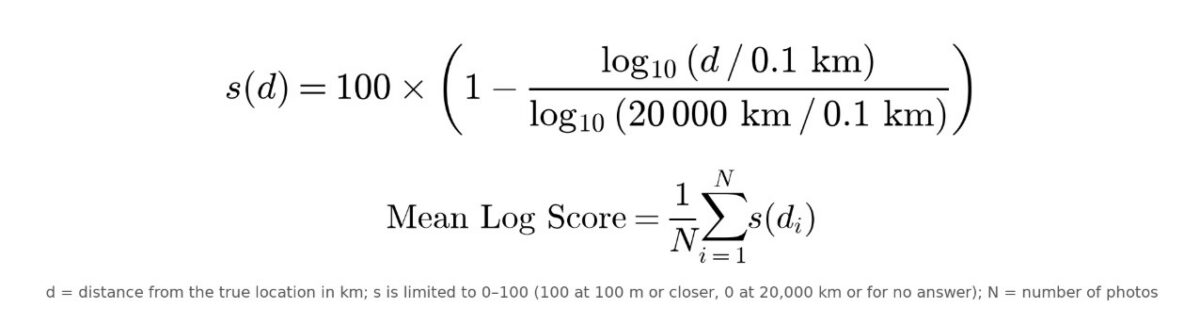
Therefore, a 10-fold improvement in distance means the same whether it is from 5km to 500m or from 500km to 50km. You can compare both metrics here.

Below are the model results sorted by either metric, showing how many photos each model geolocated within distance bands from the true location.

chart visualization

Several models placed at least 10 out of the 52 photos correctly within one kilometre, and the top-performing models placed over 50 percent of the photos within 25 kilometres.

NOTE: Geoseer-fast refused to answer on four of the 52 photos, claiming “This image is not suitable for geolocation”, while Mistral-large-4 refused once with “insufficient information in image to identify location”. Kimi-k2.6 also failed to provide a set of coordinates on one photo, and Gemini 4 Argon timed out repeatedly on one photo.

Our Test

To independently assess the models, we sought to give them very specific instructions and some images that were harder to geolocate than those provided in our past tests. The prompt asked for a single set of coordinates reflecting the photographer’s location. The purpose of restricting the response in this way was to prevent hedging, such as multiple guesses or confidence scores, and make the grading more uniform across different models. Models were allowed to use their providers’ built-in tools: search, code execution and page fetch. We capped their token output at 64,000 and ran each model under its default effort setting with a maximum time of 15 minutes per photo. If a model did not return coordinates on the first prompt, we also allowed a single rescue prompt asking it to do so using its previous reasoning and without using any tools.

The images provided were unique, from around the world, not published on the internet before, scrubbed of metadata and provided without any context. They did not contain significant landmarks. We also included images in snowy, foggy and nighttime conditions.

The results show that the LLMs tested could, in many circumstances, successfully narrow down a location much faster than a human can geolocate even without any context. This is not limited to Google Street View-style images. Take, for example, this image of vegetation and a very small part of a rooftop.
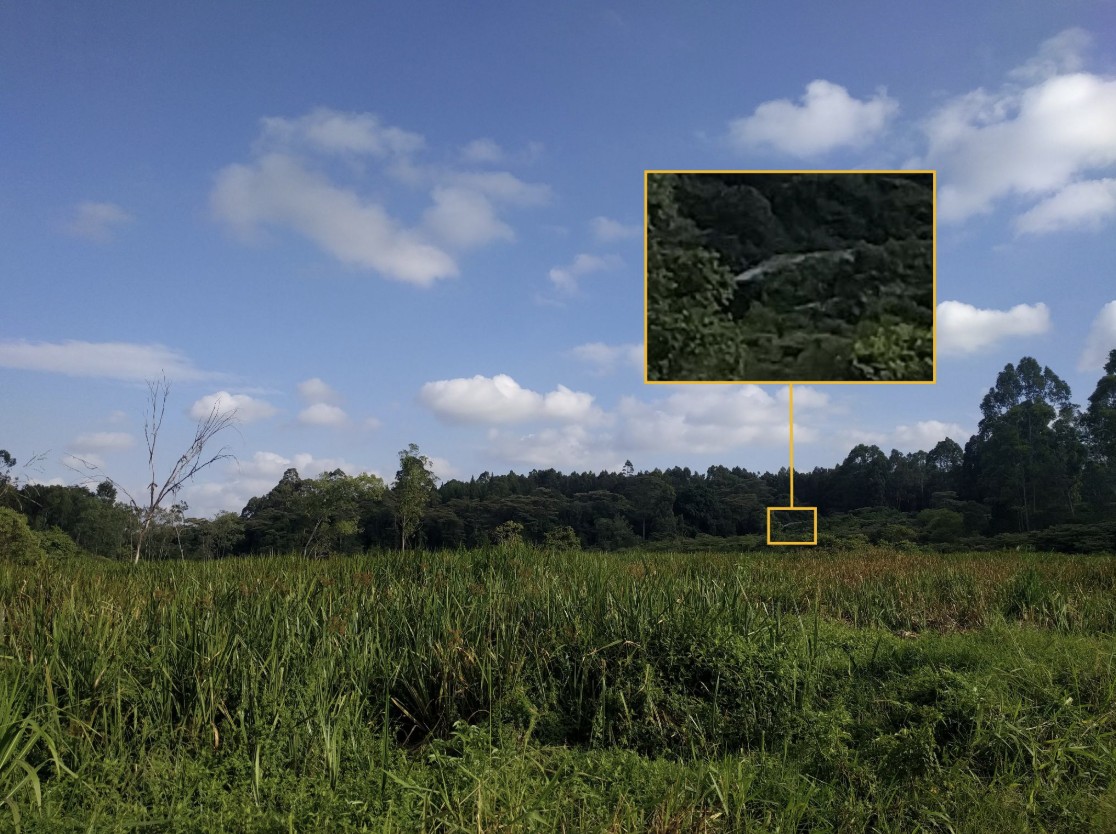
An example of a photo used for testing, with annotation added after the test to highlight the only man-made object visible. Credit: Bellingcat
An example of a photo used for testing, with annotation added after the test to highlight the only man-made object visible. Credit: Bellingcat.

For an average person, identifying the country this photo was taken in without any context could take a significant amount of time. However, multiple models quickly narrowed it down to Kenya. You can navigate their answers in the map below. Notice how several correctly inferred enough vegetation details to narrow down the exact part of the world and the park itself, but also that for many, the final response was a best guess only. It is important to note that even though some models were correct, others were significantly off.

The full model results for all 52 photos can be seen in the table below.

table visualization

Of the models tested, Gemini 4 Argon scored highest on the Mean Log Score, and Claude’s models (Opus and Fable) were at the top of the table regardless of the score metric. Even Claude Sonnet, the weakest of its lineup, consistently came close to the real location while being the fastest to answer across all models.

This was followed by GPT-6 Astra and GPT-6.1 Sol, as well as other Claude and Gemini models, and then the geolocation-specific model, GeoSeer Fast, which provided good results but also timed out frequently. We tested GeoSeer’s more competent Agent model, but it refused to answer on eight photos and regularly timed out.

scatter visualization

For secondary factors like time and cost, Claude also performed well on both metrics, and Gemini Argon, while much slower, came at a similar cost to Opus. Based on API rates, Argon and Opus models offered the best balance of accuracy and cost, especially compared to Fable and Grok. Grok was the most expensive option and had an underwhelming bottom-half performance. Meanwhile, GeoClip was freely available but only outperformed Claude Haiku.

Model Limitations

While we sought to analyse the most prominent models, there was one that we could not include as it has yet to be fully released.

Support Bellingcat

Your donations directly contribute to our ability to publish groundbreaking investigations and uncover wrongdoing around the world.

In its blog post, Anthropic claimed its Mythos model beats “even the strongest human baseline on median distance error, scoring 37.0km and 47.2km across 6,000 photos (placing 23.7 percent and 23.1 percent within 1km).“ But Nuno Moniz, Associate Research Professor at the Lucy Family Institute for Data & Society at the University of Notre Dame, told Bellingcat that “the median represents a strong simplification of what would be acceptable to compare AI-based system performance with regards to humans”. 

Anthropic compared its models to competitive GeoGuessr players and their success in identifying the location of Google Street View images. The entire set of test images was online and there was no guarantee the models were processing the imagery for the first time. 

While Anthropic has been relatively open about these methods, not all developers have been as forthcoming. It is therefore difficult to assess whether the same limitations will impact all other models, or whether there will be further caveats that we are simply not aware of. 

Moniz said that “the increasing availability of benchmarking tools and datasets has made it somewhat difficult to measure reliability in test results such as these”. Specifically, due to the ”uncertainty as to whether that data was included in its training”. This is why we ran our Bellingcat tests with non-published photos sourced from Bellingcat staff and the Bellingcat Volunteer Community.

A further limitation of any models comparing performance to GeoGuessr scores is that the game uses images from Google Street View, which is limited to a select number of countries, and within these, a limited number of roads. Street View is also intentionally skewed to feature clear, high-quality photos taken during daytime that are useful for navigation, and users can pan around their view. There are also some well-known tricks that allow GeoGuessr players to bypass actual geolocation to correctly guess the location of photos: for example, Google is known to use a black car in Jordan and a white car in the UAE to capture imagery. While this wouldn’t necessarily impact model performance, it is a drawback of measuring against GeoGuessr score as the game has a set of workarounds that can bypass geolocation skill.

Anthropic’s data consisted of thousands of social media photos of various scenes. Once again, though, these photos were online and may have featured in the model’s training data. Anthropic’s blog post contained four images as an example of this dataset.
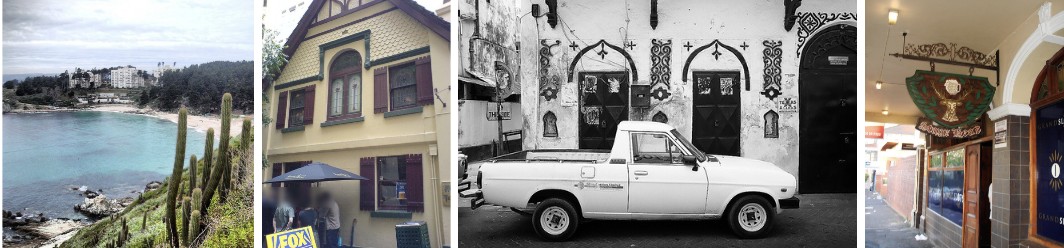
Images used as part of Anthropic's dataset. Credit: Anthropic
Images used as part of Anthropic’s dataset. Credit: Anthropic.

The examples Anthropic shared are relatively easy to geolocate as they feature recognisable buildings and signs. But footage that requires geolocation often comes from regions where access is limited and which do not feature on social media or Street View.

Specifically, in a military and intelligence context, footage often involves low-resolution material and intentionally obscured details recorded in remote or inaccessible areas. Context that could be found online can be uncertain or plain wrong, especially during a developing situation, such as the image below that Bellingcat investigators geolocated when verifying a US strike on a school in the city of Minab in Iran that killed at least 120 children earlier this year.

An example of footage geolocated by Bellingcat. Screen shot from Mehr News.

Anthropic researchers acknowledge this caveat, writing that it “does not as clearly emulate the task of precisely pinning down a location in near-real-time in a less populated battlefield setting; that is a task for future research.”

As noted, it is also possible that similar caveats need to be applied to other models when seeking to understand and interpret any geolocation-related benchmarking.

Supercharged Models

In parallel to the above models, we also tested a set of agentic skills and tools being developed internally by Bellingcat. These are researcher-informed instructions and code that can equip generic-use AI agents to augment their geolocation ability. For instance, we designed skills such as allowing it to download Environmental Systems Research Institute (ESRI) satellite imagery tiles. We also designed another skill that enabled direct access to data from Bellingcat’s OpenStreetMaps search tool, which aims to assist geolocation efforts by comparing items identified in imagery (like the position of a pylon compared to a nearby railway line) to OpenStreetMaps data. GeoSleuth is a similar project that has already been published, which we used for comparison. We picked Claude’s Opus 5.5 model to run both skills customisations because of its strong performance and reasonable pricing, and ran all the photos through the supercharged models under the same conditions – except that they had no timeout enforced as the supercharged models required more time to utilise their extra skills. 

The different timeout conditions and expanded toolset do not allow for a direct comparison of the customised models to the previous off-the-shelf models’ results, even if they both outperformed the barebones Opus model they were based on, and all other models on GeoGuessr Score, with only Argon ranking above Bellingcat’s agent in Mean Log Score.

table visualization

Still, this test allows us to showcase why skill customisations can bring value. Take the following photo.
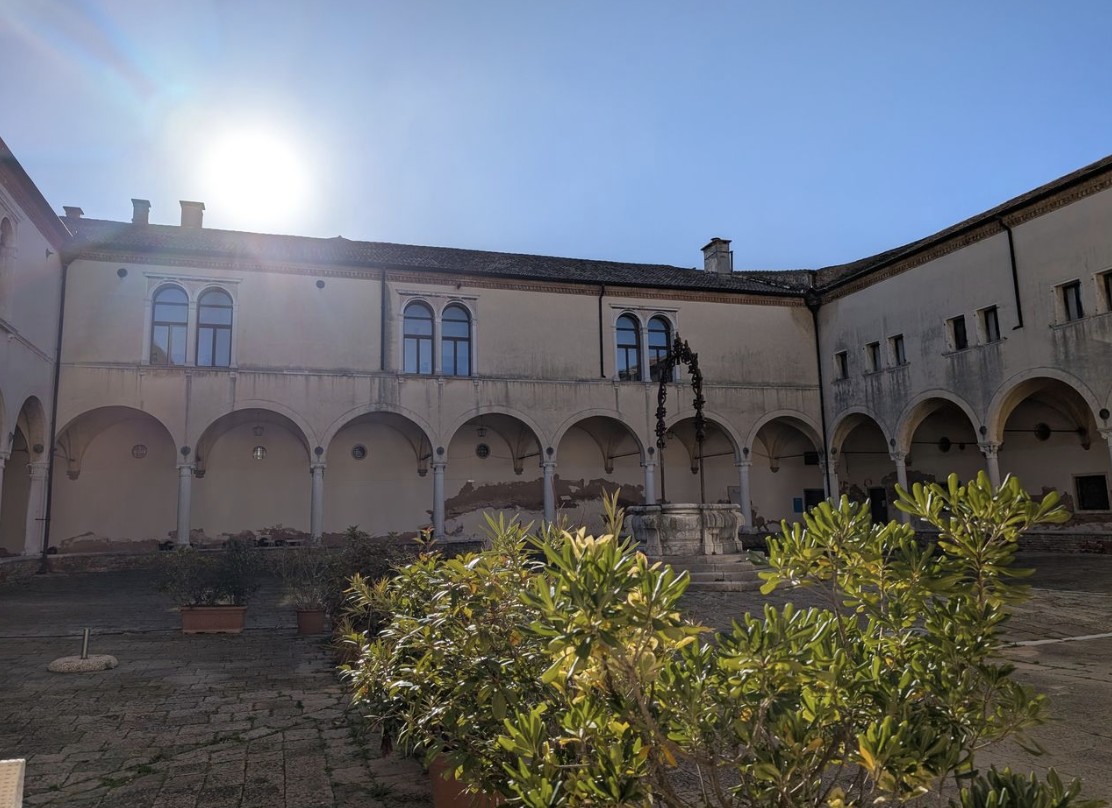
An image captured at the Global Campus of Human Rights in Venice. Credit: Bellingcat.

This is not an exceptionally hard geolocation, and 11 of 17 models answered within 5km of the actual capture location in Venice, Italy. GPT-Sol answered with the correct monastery, but only Bellingcat’s agent and GeoSleuth answered with the exact camera position coordinates. This was possible because both model customisations can download and compare satellite imagery tiles, which allows them to validate not just which monastery the photo was taken at but also the correct courtyard position and orientation from visual cues. You can click the buttons in the list below to audit each model’s final answer.

While in this instance the supercharged models got the exact spot, there were other instances where they did not, as the scores in the results table above show. This again emphasises that even with extra skill sets added, these models were still far from infallible.

Tests Conclusions

Despite increased model improvement, our analysis shows that important caveats remain and it is important to keep a human in the loop when seeking to guarantee a geolocation is precise and correct.

Our tests show that the coordinates models provide as answers are rarely an exact match, even with supercharged models. Invariably, even the best models, with the best tools, can confidently claim a wrong position. Anthropic says its Mythos model was able to pinpoint less than a quarter of its social media photos dataset within a 1km radius. But narrowing down a location is rarely the trickiest part of geolocation work. A large part of important geolocation work is in the final stretch: finding specific coordinates from a general area. This level of specificity is needed because a general area is not a match. Matching features and perspective are necessary for an accurate geolocation, and in many cases that is done on very low-quality images or even by cross-referencing multiple sources. 

This level of precision is essential for investigations where it matters what building a person could be found at, what lines of sight individuals might have had, or what impact an air strike might have led to. 

Since LLMs can still confidently get things wrong, as our analysis shows, all results still have to be verified independently. Strong human geolocation skills therefore remain crucial, as the more one understands about geolocations, the better one can verify or take to completion an automated result. 

Though it can speed up geolocation work significantly, especially in narrowing down an area of interest, AI models remain a useful assistant rather than a tool we can blindly delegate geolocations to.


Bellingcat is a non-profit and the ability to carry out our work is dependent on the kind support of individual donors. If you would like to support our work, you can do so here. You can also subscribe to our Newsletter and follow us on Bluesky here, Instagram here, Reddit here and YouTube here.

The post Can LLMs Supercharge Geolocations? Our Tests Show Big Improvements But Humans Remain Key appeared first on bellingcat.

How Wildlife Traffickers Are Using Coded Language to Sell Protected Animals On Facebook

A Bellingcat investigation has identified nine Facebook groups with a combined membership of more than 70,000 people, in which coded language has helped illegal wildlife dealers evade bans on the platform for years. Facebook says it prohibits any form of animal trading on its platform.

Investigating the operators behind all nine groups, Bellingcat identified six Facebook profiles that led back to a single broker in Jakarta, Indonesia. This investigation was carried out in partnership with Mongabay. You can read their report in English here and in Bahasa Indonesia here.

In an open Facebook group, brazenly titled “West Bogor Animal Selling and Trading Forum,” one member posts an advert for a vulnerable rhinoceros hornbill.

Screenshots of an online advertisement for a rhinoceros hornbill chick, a protected and vulnerable species, posted on Facebook on July 11, 2025.

Commenting on the advert, another member warns: “Just be careful not to get caught.” 

Screenshot of a Facebook conversation, translated from Bahasa Indonesia and posted in July 2025. Annotated by Bellingcat.

“That’s the risk,” replies the seller. 

Under Indonesian law, the capture, trade, or possession of a rhinoceros hornbill is punishable by up to five years’ imprisonment or a fine of up to Rp100 million (US$6,000). (According to Statistics Indonesia, the average monthly wage in August 2025 was just over Rp3 million or US$180.)

Meta also states that the buying and selling of animals on its platforms is prohibited. However, in this group, along with eight others identified by Bellingcat, animals have been traded in plain sight for years, including wild and protected species. Three of the nine groups have been live on Facebook for at least five years. Four have been active for 12 months or more, and the remaining two were created in 2025.

Screenshots of tortoises, monkeys, and owls for sale, posted in Facebook adverts in October 2025.

All nine groups state in their “About” tab that they are based in or around Jakarta, the Indonesian capital. As one of the most biodiverse countries in the world, Indonesia is a hotspot for poachers and a key transit hub in the illegal wildlife trade.

A quick scan of these groups revealed a variety of protected species for sale, including Javan coucals, Javan scops owls, Javan langurs, binturongs, and both wreathed and rhinoceros hornbills.

In one of the most active groups, West Bogor Animal Selling and Trading Forum, more than 200 adverts were posted in a single week. Of these, 18 advertised vulnerable species, including these two infant silvery gibbons. 

Screenshots of two infant silvery gibbons advertised on Facebook on May 10, 2025.

With fewer than 2,500 mature individuals left in the wild, the silvery gibbon is considered endangered. Under Indonesian law, trading in this species can result in up to five years’ imprisonment or a fine of up to Rp 100 million (US$6,000).

Otters were also frequently posted in the group. Popular in the Southeast Asian pet trade, most otter species are protected due to declining numbers in the wild. However, because many of the adverts were for infants, it was not always possible to determine which otter species was being sold, and therefore whether it was protected.

“Using Codes So The Group Stays Safe”

Despite Facebook’s total ban on animal trading, including pets, in the group titled: Civet/Pet Buying and Selling in the Greater Jakarta Area, members were instructed in the “About” tab to “prioritise using codes so the group stays safe from being banned.”

Screenshot of the group’s About description. Translated and annotated by Bellingcat.

Alphanumeric codes were used to discuss animal prices in eight of the nine groups identified by Bellingcat. According to the Indonesian news outlet Jateng Today, the use of pricing codes, intended to circumvent Facebook’s automated moderation systems, is not uncommon among animal traders on the platform.

Such codes use the letters A, B, and C to denote different Indonesian rupiah denominations. A stands for a Rp100,000 note (about US$6), while B represents a Rp50,000 note (about US$3). An accompanying number specifies the quantity, so A3 indicates three Rp100,000 notes.

Screenshot of a conversation on Facebook discussing the price of animals. Blurring by Bellingcat.

In the post below, one member asks, “A2 dapet apa?” – “What does A2 (Rp 200,000; US$12) get you?”

Screenshot from the Facebook group ‘Buying and Selling civets/pets in the Greater Jakarta area,’ posted on Facebook, August 6, 2024.

The post received 69 replies, with members offering everything from otters to owls, civets and geckos.

The term “Wc” – a common shorthand in animal trading groups for “wild-caught” – was also frequently used across all nine groups. Under Indonesian law, even if a species is not listed as vulnerable or protected, capturing and selling wild animals without a permit is illegal.

Related articles by Bellingcat

The Hunt for Malaysia’s Elusive Wildlife Trafficker
Asia-Pacific

The Hunt for Malaysia’s Elusive Wildlife Trafficker

Asked whether its moderation systems could detect cost codes (as text or embedded in images) or key terms such as WC (when found next to images of animals), Meta responded: 

“Bad actors constantly evolve their tactics to avoid enforcement, which is why we partner with groups like the World Wildlife Fund and invest in tools and technology to detect and remove violating content.”

The Operators

While investigating the operators behind all nine groups, Bellingcat identified six Facebook profiles that led back to one individual broker based in Jakarta. 

By navigating to the “People” tab in one of the groups, a list of admins and moderators appears, including an account referenced below as AB. Despite AB’s profile being locked, a search with the term “wa.” (WhatsApp’s click-to-chat feature) returned dozens of animal adverts alongside a phone number.

Screenshot of AB’s Facebook post including a phone number. Posted June 11, 2025.

Using the phone number to search for AB’s historic posts, six out of the nine groups under investigation were found to have adverts for vulnerable species, including this advert for a binturong. 

Screenshot of an advert for a “Bintu” short for binturong. Posted by AB, September 2024. 

Listed as vulnerable by the International Union for Conservation of Nature (IUCN), keeping a binturong, let alone trading it commercially, is prohibited under Indonesian law.

AB has also advertised this “Celepuk Wc”, a wild-caught scops owl, seen below. Although the species itself is not protected, selling a wild-caught owl in Indonesia without a permit (which are tightly regulated) violates Indonesian law.

Owls for sale, posted by AB. Left: Labelled “Wc” for wild-caught. Right: “BC” for bred in captivity. 

By following the phone number shared by AB, five more Facebook profiles were uncovered. The six profiles frequently shared similar adverts, often within days of each other, for the same species, sometimes featuring a similar interior background, and always listing the same telephone number.

Six different accounts posting similar-looking animal adverts, while all using the same contact phone number.

Late last year, one of the accounts referenced below as W, posted this wreathed hornbill, a protected species in Indonesia. 

Screenshot of an advert for a wreathed hornbill. Posted by Waa, November 2025. 

Of the six profiles, only one, named Azie Soka Smithh has ever posted personal data, including a profile picture of a man with a child. 

An advert for a civet, posted by Azie Soka Smithh and tagging the same phone number as used by the other five accounts.

Further investigation into Azie Soka Smithh confirmed their presence on other platforms, including Telegram and Instagram. However, their full legal name remained unknown. While searching for visual clues to their location, it became apparent that the vast majority of images had been tightly cropped, revealing little about their whereabouts – except for a handful of images that appeared to have been taken at the same location: a pet shop.

In the adverts shown below, a poster can be seen on the wall behind the cage displaying the shop name Station Sato Exotic and a phone number. Of all the images seemingly taken in the same shop, none featured species protected under Indonesian law. However, the long-tailed macaque shown below is considered endangered according to IUCN due to declining numbers in the wild. 

Adverts posted by two different accounts but with the same shop name and phone number visible in the background. The right image features a long-tailed macaque.

A Google search for the shop’s name and number returned a Google Maps listing for Station Sato Exotic. A man named “beni” had left a five-star rating as well as several dozen photos and videos of the pet shop’s interior, including one that appeared to show a man sitting next to an identical poster as seen in the animal adverts. 

Screenshot of Beni’s Google review, including (right) a video of a man sitting beside a poster for Station Sato Exotic. Posted July 2021.

According to beni’s Google account, his full name is Beni Abdul Hamid (translated from Arabic). His bio reads: “We sell various kinds of accessories, cages, animal feed, etc” (translated from Bahasa Indonesia).

Of the 16 photos and 25 videos posted by Beni, several showed a left hand holding animals up to the camera, with a distinctive mole visible on the wrist. A seemingly identical mole appeared in several of the adverts posted by the six Facebook accounts sharing the same phone number. Notably, the mole and wrist were not seen holding species protected under Indonesian law. However, the long-tailed macaque shown below is considered endangered according to IUCN.

A distinctive mole appears in multiple animal adverts posted by (left) Beni on Google Listings, (centre) AB on Facebook and (right) another of the six accounts using the shared phone number. The centre and right images feature a long-tailed macaque.

Upon visiting Station Sato Exotic, our partners at Mongabay confirmed that Google reviewer Beni Abdul Hamid was in fact the owner. His son, Jordan Bastian, who was present on the day, told their reporter he now manages the shop on his father’s behalf.

Bastian confirmed that it was his wrist and mole in the adverts and that he had taken all of the photos inside the shop. However, he said he was not behind any of the six Facebook accounts and that they were most likely run by a local broker. He explained that his business relies on a network of brokers operating on Facebook and WhatsApp. He sends them photos of the animals he has for sale, and they handle sourcing and organising everything with the buyer in exchange for a cut of the profits.

“I’m a broker. I’m involved in marketing the animals, so I provide the photos,” said Bastian. “I don’t want to know about the buyer.”

When shown the Facebook account for Azie Soka Smithh, Bastian confirmed that the man in the profile picture was a local broker, but one who seldom visited the shop.

Station Sato Exotic Pet Shop also has an online presence on Tokopedia, a major Indonesian marketplace. The platform’s guidelines prohibit the sale of endangered species, but are not clear regarding the sale of other animals, including pets.

Of Station Sato Exotic’s 71 current listings, the large majority have been miscategorised. Animals are listed as tools, toys, aquarium decorations and books. They are also miscategorised as other species; for example, birds and squirrels have been listed as hamsters or reptiles.

One advert features a vulnerable cuckoo species, the Sunda Coucal. Endemic to Java and numbering fewer than 10,000, this bird has been listed as vulnerable since 1994.

Screenshot of Station Sato Exotic’s Tokopedia page promoting the sale of a vulnerable cuckoo species. The page reports that four birds have already been sold. 

Asked whether he had sold many animals via Tokopedia, Bastian said his account had been blocked after he was banned for selling squirrels. When shown the advert above for the Sunda Coucal, he said he was surprised to learn it was classified as vulnerable. Tokopedia did not respond to requests for comment regarding an advert for a vulnerable species appearing on their platform. 

On the sale of protected or vulnerable species more broadly, Bastian admitted he had in the past, but has since stopped, describing “the risk is big” and saying he prefers to “play it safe.” 

After contacting the local authorities for comment, three officers from the West Java Natural Resources Conservation Agency (BBKSDA) made a surprise visit to Station Sato Exotic, due to the shop having previously been reported for selling protected species. Head of Conservation Stephanus Hanny said that upon arrival, “We went inside and checked every animal… We did not find any protected species.” He added that even the sale of non-protected wildlife requires a permit, which the shop does not currently hold. However, since it’s not a criminal offence, Hanny said they could only issue the owners with a warning. 

Bellingcat also contacted the phone number associated with Azie Soka Smithh. The person replied, confirming they managed all six accounts but denied selling any animals, including protected and vulnerable species. “I’m just a hobbyist. An animal lover,” they said. 

Support Bellingcat

Your donations directly contribute to our ability to publish groundbreaking investigations and uncover wrongdoing around the world.

Given that the account had been found advertising vulnerable and protected species for sale, the Indonesian Director General of Forestry Law Enforcement, Dwi Januanto Nugroho, said authorities would investigate. Asked how their team of investigators was adapting to the illegal wildlife trade growing online, Nugroho replied:

“Criminal behaviour continues to reproduce itself in order to survive. In fact, it can evolve faster than the law enforcement system itself. In response …cyber patrols and desk analysis via the operations room will continue to be intensified, while we further optimise support from volunteer networks, working partners, and public participation.”

After contacting Meta, all six accounts, including Azie Soka Smithh, and all nine groups, totalling 70,000 members, were shut down. Meta confirmed: “We removed the Facebook groups and profiles in question for violating our Restricted Goods and Services Policy.”

Merel Zoet and Claire Press contributed to this report.

Bellingcat is a non-profit and the ability to carry out our work depends on the kind support of individual donors. If you would like to support our work, you can do so here. You can also subscribe to our Patreon channel here. Subscribe to our Newsletter and follow us on Bluesky here and Mastodon here.

The post How Wildlife Traffickers Are Using Coded Language to Sell Protected Animals On Facebook appeared first on bellingcat.

AI Used to Promote Non-Existent Evacuation Flights From the Middle East

The Netherlands’ largest newspaper, De Telegraaf, recently published an interview with a woman claiming to organise her own evacuation flights from Dubai, selling seats at €1,600 (US$ 1850) each. Four days later, her photo was removed from the article, though the interview remained.

Bellingcat has found that the original image not only includes artefacts commonly associated with generative AI, but that the flights referenced in the article do not appear to exist.

Subscribe to the Bellingcat newsletter

Subscribe to our newsletter for first access to our published content and events that our staff and contributors are involved with, including interviews and training workshops.

The story came at a time when thousands of Dutch people were reportedly seeking urgent ways to leave the region following Iranian missile and drone strikes across the Gulf in retaliation for US-Israeli strikes.

Published on De Telegraaf’s website on March 5, the headline reads: “Dutch people in the Middle East feel abandoned by the government: We just rented a plane ourselves.”

The Dutch minister of foreign affairs was confronted with this headline during a television interview, in which he described ongoing efforts by the Dutch government to repatriate citizens to the Netherlands.

The article features interviews with several Dutch people struggling to leave Dubai and Abu Dhabi, including Tamara Harema. Under the subheading “Dutch people hire their own plane”, Harema says she was “rebooked five times by Emirates” and that the official repatriation flights organised by the Dutch government were not ‘taking off’.

As part of a group, she says, they are organising buses and have hired an Airbus A321 to fly home. Harema is quoted as saying: “The first plane is already full, so we’re organising a second flight. Stranded travellers can contact us.”

However, several discrepancies in Harema’s photo, published in the original article, suggest it was AI-generated. No trace of a person matching Harema’s face or profile could be found, and flight-tracking data suggests no such plane took off.

The Photo

In the image below, the world’s tallest structure, Burj Khalifa, can be seen through the window overlooking the Dubai skyline. Each side of the tower is unique, with platforms that protrude at different heights and in different directions. It also contains several mechanical floors, which appear as dark bands in the photo.

Photo description as published by De Telegraaf reads: “Tamara Harema and a group organise their own flights to the Netherlands, for which they have rented an Airbus A321. “Otherwise, nothing would get off the ground.” © Own photo” Source: Published in De Telegraaf, March 5.

By cross-checking the height of the visible platforms together with the location of the mechanical floors, it’s possible to determine that Harema’s hotel room faces north-west, towards the Burj Khalifa’s south-east-facing facade.

Comparing Harema’s photo (bottom left) to all three sides of Burj Khalifa’s base suggests she is looking at the Southeast facade. Source: Harema’s image / Google Street View.

Several discrepancies are visible when comparing Harema’s photo with other images of the building, including an upper mechanical floor appearing higher than in other images and the absence of the water feature at the base of the building.

Harema’s image (left), compared to a screenshot of a video of the building from 2020 (right), suggests a discrepancy between the upper mechanical floors. The water feature is also absent. Source: Harema’s image / Youtube.

To establish whether Harema’s photo could have been taken several years earlier, Google Street View imagery was analysed from 2013 onwards. No match could be found when comparing the arrangement of buildings at the base of the Burj Khalifa.

In Harema’s photo, the arrangement of buildings at the base of the tower does not match historic Google Street View images. Source Harema’s image/ Google Street View.

Several other irregularities, as shown below, including the hotel room furniture and details of Harema’s clothing and jewellery, also suggest it may have been AI-generated.

(Left) a distorted lamp stand; (top right) blurring on the “V” of her T-shirt; (bottom right) an earring that appears to merge into her face – all discrepancies commonly associated with generative AI.


Fully Booked Airbus A321

Regarding whether the plane existed, Harema says in her interview that buses have already been arranged to collect passengers from two locations in Dubai on Saturday, March 7, after which a 232-seater Airbus A321 will depart from Muscat, Oman, for the Netherlands.

The article notes the cost is €1,600 (US$ 1850) per person, without detours. “Although we read that a Dutch repatriation flight costs €600, just try getting on such a flight,” says Harema.

According to Flightradar24, multiple A321s departed Muscat on March 7 and 8, but none bound for the Netherlands. The only aircraft that did arrive in Amsterdam from Muscat were either government-organised repatriation flights or scheduled Oman Air services, none of which were Airbus A321s.

Two Airbus A321s were recorded on the ground at Muscat Airport on March 7. One, belonging to Gulf Air, later departed for Rome via Riyadh March 8. The other, operated by SalamAir, had been flying routes between Oman and Bangladesh until March 3, but has since remained in Muscat.

Support Bellingcat

Your donations directly contribute to our ability to publish groundbreaking investigations and uncover wrongdoing around the world.

After contacting De Telegraaf, an explanation for the photo’s removal was added at the bottom of the article, stating that the photo did “likely not meet our journalistic guidelines.”

The newspaper’s deputy editor-in-chief, Joost de Haas, added:

“Regarding the quoted Tamara Harema, the editors contacted her after Mr. Chizki Loonstein—a long-standing source for one of our reporters—informed us about attempts to charter a plane. Mr Loonstein informed us that Ms Harema stayed in Dubai and could tell us more about it. This led to messages from which several quotes from Harema were extracted, as reproduced in the relevant passage of the article.”

A search for Loonstein led to a six-month-old report from another Dutch newspaper, NRC, which claimed that Loonstein, a lawyer, emigrated to Dubai after his legal company went bankrupt, leaving his clients, victims of fraud, worse off.

Contacted for comment, Loonstein confirmed that he knew Harema and had shared her contact details in “an app group” in relation to a flight from Muscat to Amsterdam. After this contact, Bellingcat sent him the photo of Harema to confirm her identity and asked him to share Harema’s contact details. In response, Loonstein refused to provide further comment. 


Merel Zoet and Claire Press contributed to this report.

Bellingcat is a non-profit and the ability to carry out our work is dependent on the kind support of individual donors. If you would like to support our work, you can do so here. You can also subscribe to our Patreon channel here. Subscribe to our Newsletter and follow us on Bluesky here, Instagram here, Reddit here and YouTube here.

The post AI Used to Promote Non-Existent Evacuation Flights From the Middle East appeared first on bellingcat.

❌