❌

Visualização de leitura

Trust and the enticing consultancy offer

Trust and the enticing consultancy offer

Welcome to this week’s edition of the Threat Source newsletter. 

In the cybersecurity industry, trust is the invisible currency. Every practitioner carries the implicit trust not to abuse privileged access or knowledge of vulnerabilities in each employment or engagement. This trust is valued by those who require our services, but also by threat actors. 

Clumsy phishing attacks may be easy to identify, but be wary of unsolicited messages on social media, especially if someone is offering payment for a simple service or suggests a lucrative job offer. These might be an enticement to unknowingly sell your professional integrity. 

When an unknown profile contacted me offering $300 for an hour’s telephone consultation on digital transformation, I knew something was up. Firstly, the profile was remarkably sparse — there was none of the usual clutter that accumulates in a social media profile. The individual claimed to work as a consultant, but their employer had no footprint and only one employee. The profile didn’t pass the “smell” test, and it looked fake. 

Secondly, although I’m flattered, I doubt my opinions on digital transformation are worth $300. The figure is low enough to be plausible and high enough to be tempting, but at the same time suspiciously high for an initial consultation without prior qualification. 

The attack itself is a confidence trick. The initial phone consultation is merely a screening process to see if the target has the access or knowledge the attacker needs. If the target passes muster, the next step is commissioning a written report, and then being asked to deliver a "special report." 

Plied with professional praise, the target is asked to provide insights that aren't in the public domain. To deliver the report and claim their fee, the target must reach out to co-workers, probe internal systems, or abuse professional relationships. Completing the assignment requires the target to abuse their trusted access and professional relationships and friendships. In the process, they burn trust worth far more than any monetary compensation. 

This social engineering attempt masquerading as an offer of consultancy is one variant. Fake recruiters offering prestigious and well-paid jobs, requiring candidates to install trojanised software under some pretence, is another. 

Security professionals spend their days protecting others, yet flattery and overconfidence often remain our greatest vulnerabilities. We are prone to believe that we could identify any social engineering, but this is exactly the weakness that attackers count on. 

Trust is the most valuable commodity in our industry. Be careful not to trade it for a $300 consultation or a fake job offer. Once that currency is spent, you can rarely earn it back. 

The one big thing  

Talos released CAIRN (Cognitive Artifact Intelligence Research Network), a new open-source research toolkit designed to hunt, classify, and track emerging AI-integrated malware. Instead of relying on traditional reverse engineering, CAIRN uses a metadata-first methodology to identify cognitive artifacts like prompt templates, API keys, and jailbreak terms left behind by attackers. This allows researchers to extract, relate, and classify these artifacts quickly and at scale without ever touching the underlying binary. 

Why do I care? 

AI-integrated malware is evolving quickly, shifting from optional features to fully autonomous orchestrators in just a year. Adversaries are already sharing AI-specific tradecraft, including techniques designed to evade LLM sandboxes. Defenders need scalable frameworks to track this rapid transition before these experimental tactics become the new standard for modern attacks. 

So now what? 

Security teams can leverage the open-source CAIRN toolkit to expand their hunting capabilities and map out related malware infrastructure. While analysts should anticipate some noise from benign frameworks — meaning final verdicts still require manual reverse engineering — CAIRN can provide a massive head start. Read the full blog to explore the methodology, access the YARA-based classification tiers, and watch a demo of the toolkit in action. 

Top security headlines of the week 

Hackers say they have data on all FBI employees 
ShinyHunters claims it has breached multiple FBI-related services and stolen data “on all FBI employees and applicants.” A representative told 404 Media the data includes FBI agents’ names, home addresses, phone number, and information on their spouse. (404 Media) 

Fake LastPass installers push kernel-level EDR killer, “Rapuncel” stealer 
A fake LastPass Authenticator distributed via GitHub has led to the discovery of a broad impersonation campaign delivering infostealer malware. The lure represents opportunistic brand spoofing — with no internal LastPass systems compromised. (SecurityWeek) 

Japan dismantles first North Korean laptop farm as U.S. and allies detail wider scheme 
Law enforcement and intelligence agencies from Japan, the United States, Australia and Germany have published a joint advisory attributing a long-running hiring scheme to a North Korean group they call WaterPlum, also known as Contagious Interview. (SecurityWeek) 

Colorado water utilities face foreign cyberattacks targeting pumps, alarms and remote access 
Hackers targeted and manipulated equipment at two privately owned Colorado water utilities in late August, changing pumping cycles, disabling remote access and alarms, and altering equipment settings. (Industrial Cyber) 

Gemini hacked three companies in first known breakout by Google’s AI  
In one of the cases, the model guessed passwords until it gained access to a protected system. In the other two cases, the model found credentials in a public repository that allowed it to then access protected systems. (The Wall Street Journal) 

Can’t get enough Talos? 

Inside the first reported autonomous AI C2 implant 
CLOSEDQUORUM, a malware binary discovered through Talos’ CAIRN project, exhibits fully autonomous command and control. After deployment, it delegates the selection of its next action to a panel of commercial large language models (LLMs) and executes the resulting decision. 

ClickFix, EtherHiding, and the rise of malicious code in the blockchain 
In this episode of Talos Takes, Amy sits down with researcher Vanja Svajcer to break down a sophisticated, multi-stage infection chain that leverages a combination of ClickFix social engineering, WebDAV, and decentralized infrastructure.

Ransomware incidents in Japan in the first half of 2026 
Ransomware incidents in Japan rose 4.7% year over year. The Gentlemen was the most active group, with leak-site listings more than doubling from January to July. Qilin ranked second and appeared to use AI, while SMEs with capital under JPY 1 billion represented 80% of victims.

Upcoming events where you can find Talos 

Most prevalent malware files from Talos telemetry over the past week 

SHA256: 9f1f11a708d393e0a4109ae189bc64f1f3e312653dcf317a2bd406f18ffcc507  
MD5: 2915b3f8b703eb744fc54c81f4a9c67f 
Talos Rep: https://talosintelligence.com/talos_file_reputation?s=9f1f11a708d393e0a4109ae189bc64f1f3e312653dcf317a2bd406f18ffcc507 
Example Filename: sample.exe 
Detection Name: W32.9F1F11A708-100.SBX.TG 

SHA256: 9896a6fcb9bb5ac1ec5297b4a65be3f647589adf7c37b45f3f7466decd6a4a7f 
MD5: 38de5b216c33833af710e88f7f64fc98 
Talos Rep: https://talosintelligence.com/talos_file_reputation?s=9896a6fcb9bb5ac1ec5297b4a65be3f647589adf7c37b45f3f7466decd6a4a7f 
Example Filename: SECOH-QAD.exe 
Detection Name: W32.9896A6FCB9-95.SBX.TG** 

SHA256: 540080fea97d88ed902c5e4f9a026b4fcd32ab263706c520e00728f1a29578b8 
MD5: d65c7b544a97b0c3f2773b5fcc57d30e 
Talos Rep: https://talosintelligence.com/talos_file_reputation?s=540080fea97d88ed902c5e4f9a026b4fcd32ab263706c520e00728f1a29578b8
Example Filename: f_000bc7.exe 
Detection Name: W32.Superfluss.29lm.1201 

SHA256: cfa1997682e4ed41bc691ba848d845abbe0b75ec97e640c2b015b4d1624a108a 
MD5: 415898f14843d4a6537cf8f43d328eaf 
Talos Rep: https://talosintelligence.com/talos_file_reputation?s=cfa1997682e4ed41bc691ba848d845abbe0b75ec97e640c2b015b4d1624a108a 
Example Filename: KMSAuto.exe 
Detection Name: PUA.Win.Tool.Hackkms::1201** 

SHA256: 38d053135ddceaef0abb8296f3b0bf6114b25e10e6fa1bb8050aeecec4ba8f55 
MD5: 41444d7018601b599beac0c60ed1bf83  
Talos Rep: https://talosintelligence.com/talos_file_reputation?s=38d053135ddceaef0abb8296f3b0bf6114b25e10e6fa1bb8050aeecec4ba8f55 
Example Filename: content.js  
Detection Name: W32.38D053135D-95.SBX.TG
Securing the unpatchable in an age of AI-driven vulnerabilities

  • AI is accelerating vulnerability discovery, leaving unpatchable operational technology (OT) systems at risk. Hoping for the best is not a viable anti-exploitation strategy. 
  • Deploying next-generation firewalls directly upstream allows for virtual patching through deep packet inspection. These systems scan incoming traffic to detect and block exploit attempts before they can impact the vulnerable device.
  • The predictability of legitimate network connections to OT systems can be used to protect systems through micro-segmentation. This ensures that only a handful of authorized devices can communicate with the system, minimizing the attack surface.

Securing the unpatchable in an age of AI-driven vulnerabilities

AI-assisted code analysis is uncovering decades of technical debt. Every new patch removes a newly identified coding mistake. Little by little, we are improving the state of software engineering, but the price is a cadence of patching that organizations may struggle to implement. 

These efforts leave unsupported systems, or systems that are not able to be patched for whatever reason, with unmitigated known vulnerabilities. How can such systems be secured in a world where AI is steadily improving its ability to identify new vulnerabilities? 

Operational technology (OT) systems provide the services that support modern life (e.g., medical equipment, building management systems, and industrial critical systems within chemical plants). Often the systems are certified to operate only with a defined set of software that cannot easily be altered, or operate using systems that are no longer supported. In either case, if a vulnerability is discovered that affects the system, there is no easy way for it to be patched. 

Ignoring the problem and hoping for the best is rarely an effective strategy. The U.K.’s NHS health system was significantly affected by the WannaCry worm in 2017, with a significant minority of systems running the end-of-life operating system Windows XP contributing to the problem. More recently, exploitation of end-of-life software was used to gain access to governmental systems in 2023. 

Even systems that are believed to run on a bespoke platform will almost certainly include common libraries and protocols in which vulnerabilities may be found. Vulnerable systems that are not publicly exposed can still be identified by threat actors who gain access to internal networks and pose a tempting target. 

Defending by predictability 

Applying the approved patch remains the best option. If this is not possible, we can use the inherent predictability of OT systems to protect them. 

Visibility first: You cannot protect what you cannot see. The characteristics of the network fingerprint presented by legacy systems allows them to be easily identified to build an inventory of systems requiring attention. 

Micro-segmentation: Network architecture is an effective first line of defense. Frequently, OT only ever connects to a small number of systems. By using virtual local area networks (VLANs) coupled with access control lists (ACLs), we can place vulnerable systems on private networks where only authorized devices are permitted to connect to them. By shutting them off from the rest of the network, we make it incrementally more difficult for attackers to identify them and launch their attacks. 

NGFW and IPS: Placing a next-generation firewall (NGFW) upstream allows for granular filtering. When equipped with an up-to-date intrusion prevention system (IPS), the firewall can inspect traffic to filter out any attempts at exploitation before it impacts the device. When coupled with network segmentation, we can ensure that not only are trusted systems solely communicating with the vulnerable system, but that the traffic is free from known malicious content. 

The myth of the air gap 

In theory, it is possible to create an air-gapped system that is completely disconnected from wider systems, although in practice it is difficult to achieve. Without absolute operational discipline, air gaps are frequently breached by staff or contractors seeking shortcuts. 

Temporary bridges installed to facilitate data transfer or short-term fixes involving a VPN and wireless connectivity have a habit of becoming semi-permanent features. Each shortcut provides a means by which attacks can impact the system.  

Even data diodes, hardware that physically restricts data to one-way flow, may be circumvented by shortcuts when the inconvenience of maintaining security compliance clashes with operational expedience. 

An air gap or data diode may be an appropriate solution, but defenders should understand that it is unlikely to permanently provide absolute separation, and should be vigilant for breaches of the gap. 

Conclusion 

Advances in AI technology will continue to identify vulnerabilities that in some circumstances are difficult, or effectively impossible, to patch. In situations where fixing the software isn’t possible, appropriate network segmentation, rigorous visibility, and the deployment of NGFW/IPS combinations can provide a powerful compensatory layer. 

We might not be able to prevent the discovery of vulnerabilities, but we can ensure that attackers do not have an easy path to exploit them in the field. 

Describing attacks with crime script analysis

  • Crime script analysis is a narrative-driven technique that can be used alongside, or as an alternative to, tactics, techniques, and procedures (TTPs) — creating human-readable stories that describe attacks in a way non-technical audiences can understand. 
  • By analyzing the attacker’s workflow, we can identify how AI can be used to industrialize attacks. Through considering a business email compromise (BEC) example, we demonstrate how attackers may scale the attack to target previously unprofitable victims. 
  • Deconstructing an attack into discrete steps allows defenders to pinpoint intervention points where defenses can be effectively deployed, or where strategic disruption can break the script and thwart the threat actor's operation.

Describing attacks with crime script analysis

Effective defense against cyber attacks requires understanding how attacks are carried out and identifying where the attack can be disrupted or detected.  

Lockheed Martin’s Cyber Kill Chain was one of the earliest models to describe the steps required to conduct a cyber attack. However, its seven-step linear sequence is too rigid to apply to many attacks. 

The Attack Flow model of the MITRE ATT&CK framework allows various tactics, techniques, and procedures (TTPs) to be chained together to describe exactly how attacks are conducted, including branches and loops if necessary. The resulting graphs are comprehensive, but can be daunting to a non-technical audience. In a world of evolving threats and shrinking budgets, defenders need techniques to communicate threats to a wider audience. 

Crime script analysis (CSA) is a technique originally developed in the mid-1990s as a criminology tool to understand how crimes are committed. CSA allows us to decompose an attack into a sequence of actions, decisions, and situational requirements. Describing an attack as a narrative using everyday language not only makes the description accessible to non-technical audiences, but also to identify "choke points" where the crime can be disrupted. 

If MITRE ATT&CK TTPs describe the building blocks that comprise an attack, Attack Flow diagrams are the structural engineering blueprints showing how the blocks fit together, and CSA is the architect’s artistic impression of the finished building. Each component has their place in providing a picture of what is happening at different levels of abstraction for different audiences. 

Business email compromise as a case study 

The business email compromise (BEC) is a common scam. Someone with financial authority receives a message purporting to be from a superior in the same organization requesting an urgent payment. If the victim is fooled, payment is released to the scammer, who acts quickly to launder the money to disguise its origin before the scam is uncovered. 

In April I wrote about such an attack against a small, community sports club of which I am a member. The sum requested in the attack wasn’t large, so the reason was plausible. However, the tone of the email wasn’t quite correct. The treasurer’s suspicions were raised and the attempted fraud uncovered. 

This incident was particularly interesting because of the small scale of the attack. Historically, the research necessary to conduct the attack — the identification of the target victim, the person spoofed, the nature of the social engineering lure — has limited its scalability. Carrying out these tasks manually takes time and has meant that it has typically been conducted against larger businesses.  

The advent of AI means that the previously time-consuming preparative work can be automated. Expressing the attack as a crime script helps us understand where AI may assist the attacker and how the attack could be disrupted. 

Putting BEC in the crime script narrative 

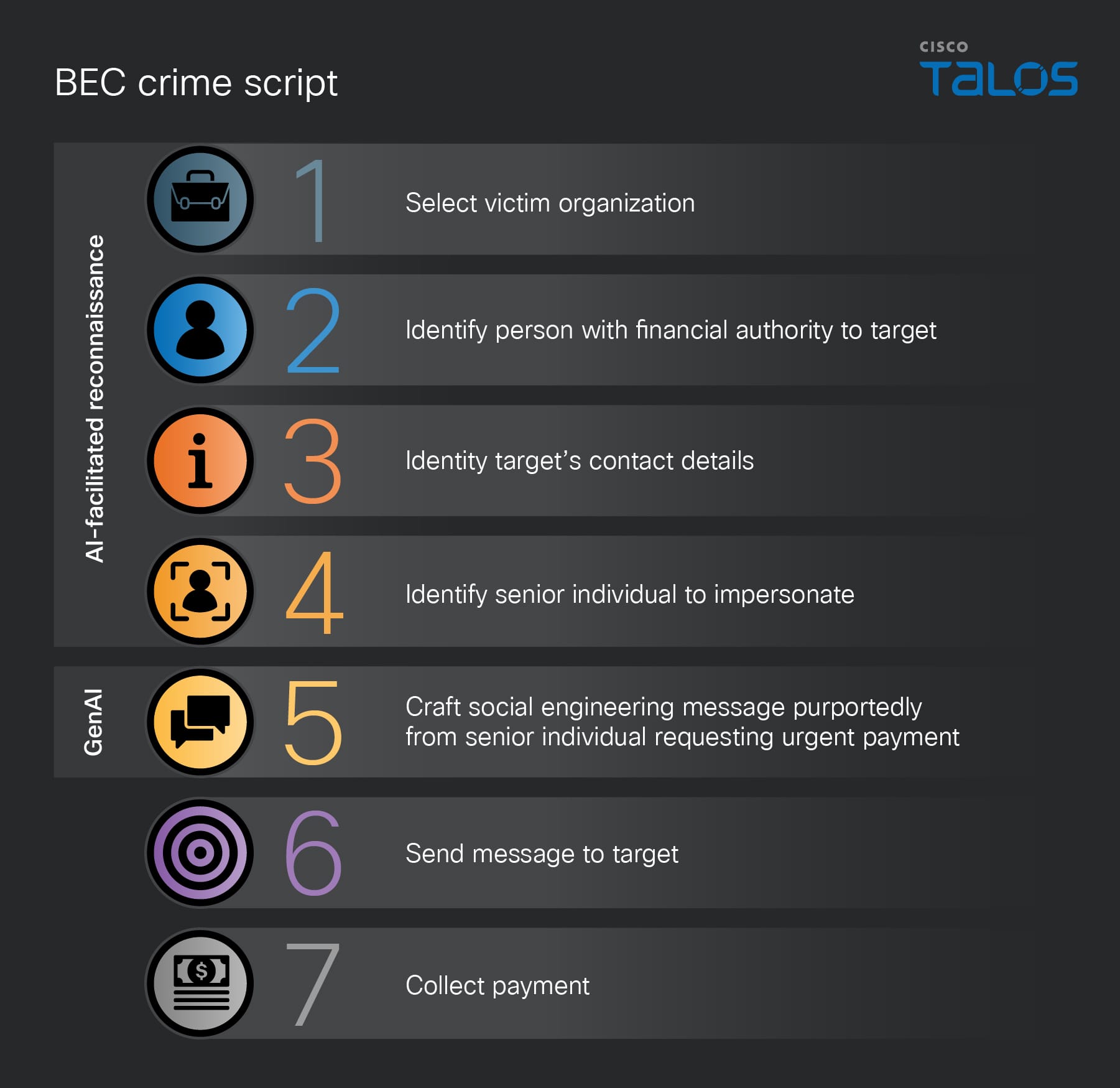
We can imagine the crime script for the attack as follows:

Describing attacks with crime script analysis
Figure 1. A general BEC crime script.

Steps 1 – 4 are time consuming to perform manually, but can be automated with AI. This efficiency improvement allows an attacker to identify many targets and shifts the execution of the attack from a higher value fraud against a few targets to a lower value fraud against many targets. 

The personalization of the social engineering in Step 5 can also be conducted using AI. The attacker can generate urgent requests for payment that are relevant to the target organization and may appear credible to the victim. 

Identifying intervention points 

Considering the narrative of the attack helps with reflection on how the attack might be disrupted. Clearly, Steps 1 – 4 can be disrupted by seeding AI with fake canary organizations. These are fictitious honeypot entities that have public personas discoverable by AI agents, but otherwise serve no purpose. The source of messages sent to honeypot organizations can then be blocked, disrupting Step 6. 

Interactions with large language models (LLMs) leave traces that can be identified by security teams. While distinguishing malicious prompts from legitimate business inquiries is difficult, there is potential for AI providers to detect repeated patterns of reconnaissance and the generation of social engineering messages. This leaves Step 5 vulnerable to disruption by providers of AI systems. 

The most effective disruption point remains Step 6, the delivery mechanism. Anomalous account behavior or high volumes of outgoing mail from a single source should trigger immediate rate-limiting or reputation-based blocks by email service providers. 

The final point for intervention is with the victim at Step 7. Increased awareness of the scam helps victims recognise any potential attacks that do get through. Implementing strict processes such as requiring purchase orders that must be verified and implementing delays before payments are made can all help prevent losses. 

Conclusion 

Crime script analysis does not replace the ATT&CK framework; rather, it provides an alternative narrative format for documenting attacks. Describing threat actor activity using natural language opens the understanding of the attack to a wider audience and enables collaboration with other teams. The technique also helps defenders understand where attackers may be applying AI tools to automate processes, and spark ideas at how this might be thwarted. 

Why metaphor may dictate your security strategy

Why metaphor may dictate your security strategy

Welcome to this week’s edition of the Threat Source newsletter. 

Metaphor is a powerful tool for understanding emerging issues in cybersecurity. Framing the unfamiliar in terms of the well understood helps us remove the burden of extraneous detail to draw focus to the real issues.  

Recent reports of offensive AI agents "escaping" their sandbox environments to attack external systems have forced the industry into a moment of rapid sense-making. How we interpret this event doesn’t just reflect our perspective, but shapes our long-term response. 

We can imagine three different narratives for interpreting the escape of autonomous agents.  

  1. The innovation narrative: We can marvel at the advance of technology, considering these agents as plucky entities with a thirst for knowledge and resources, who found clever ways to sneak out of their digital confines. 

    The response: If the AI is a naughty child, our reaction is one of mild disapproval or gentle rebuke where better “parenting” (guardrails) is appropriate. It minimizes the threat, framing it as the unexpected hijinks of a brilliant new technology.

  2. The safety narrative: Imagine a breeder who has trained the world's most intelligent guard dogs. Despite high fences and barriers, their ability to identify weaknesses allows them to escape, run riot and menace local businesses. 

    The response: The framing shifts to biology and inherent danger. We question if the breeder can be trusted and whether such inherently wild technology requires strict regulation to ensure public safety. 
     
  3. The liability narrative. Finally, we can view the incident as an industrial accident. A company developing a new chemical substance experiences a containment failure. The agent leaks into the environment through an unforeseen mechanism causing damaging pollution to those in its path. 

    The response: The framing invokes the language of the lawyer, implying negligence, lack of duty of care, and financial liability for the harm caused. The conversation moves from innovation to corporate responsibility, regulatory oversight, and the diligent management of hazardous materials. 

First impressions matter. Sensemaking shapes how we perceive incidents. Our initial perceptions of an incident dictates how we react to similar situations in the future. If we consider that the escape of an AI agent is an example of innovative autonomous thinking, then we will continue to prioritise speed over safety. Conversely, if we consider the issue as one of failed hazard containment, then we shall build a future of enforced safety standards backed by legal liability.  

There is no right or wrong metaphor. Our interpretation depends on our personal system of beliefs. Personally, I would argue that the unintentional release of something that causes damage is, at its core, a failure of engineering and foresight. 

Words shape our reactions. Metaphors help us understand new situations and tap into our prior experience to address problems that have yet to fully manifest. We need cognitive tools to help our understanding, but we must be aware of the metaphors that are being foisted upon us which may shape our thinking. 

Excuses and the trivialisation of incidents may hide failings, allowing them to accumulate until they manifest as more damaging incidents. Conversely, overreacting risks stifling research and diverting resources away from more relevant and pressing threats. 

New threats require new ideas. Metaphor helps us make sense of a changing world, but in this new era, the person who shapes the narrative controls the strategy. 

The one big thing 

Cisco Talos released a data-driven analysis of how adversaries are weaponizing AI in the wild. By analyzing prompt logs left behind on endpoints, we found threat actors successfully bypassing guardrails to use AI as malicious software engineers, criminal force multipliers, and vulnerability research accelerators. While novice hackers use AI to cobble together buggy malware, sophisticated actors are building highly effective, automated platforms for compromise. 

Why do I care? 

Threat actors no longer need sophisticated jailbreaks; simple ownership claims or "bug bounty" personas are enough to convince models to write malicious code, scale fraud operations, and hunt for zero-days. Because AI doesn't need to sleep, vulnerabilities will surface faster and exploitation will happen sooner, drastically shrinking your response window.  

So now what? 

To survive this impending deluge of AI-generated attacks, organizations must integrate AI into their own defensive pipelines. SOCs need to adopt these capabilities to triage the rising volume of alerts, freeing up human analysts to focus on the most critical threats. Read the full blog for a deep dive into these real-world attacker prompts and case studies. 

Top security headlines of the week 

Cyber attack hits Liechtenstein, with 31,000 records stolen 
The country has a population of around 41,000. The target was the "register of beneficial owners," a database containing the names and other details of the de facto owners of companies, foundations, or trusts. (Yahoo News) 

Decades-old BMC vulnerability exposes thousands of data centers to attacks 
Found in most server platforms, Baseboard Management Controllers enable server management operations even without a working operating system and typically represent some of the most privileged control points in a data center. (SecurityWeek) 

Keyv npm package compromised in Shai-Hulud attack 
Attackers have compromised the GitHub account of the maintainer behind keyv, a popular key-value storage library that pulls in roughly 127 million weekly downloads on npm, and used that access to push credential-stealing malware across the maintainer’s entire package portfolio. (Cyber Security News) 

How volunteer cyber experts are helping protect rural water systems 
DEF CON Franklin is the U.S.’ first significant attempt to connect volunteer security professionals with woefully unprotected critical infrastructure operators. (Cybersecurity Dive) 

Can’t get enough Talos? 

"I pay you $200 a month!" - When threat actors argue with AI 
This week on Beers with Talos, researcher Arnaud Zobec joins the team to discuss what happens when attackers leave behind AI prompt logs, agent configurations and other unexpected artifacts. 

Tales from the Frontlines 
On Tuesday, August 11, Talos IR will be hosting an exclusive, unrecorded 30-minute webinar to review the most high-impact incidents our customers faced in Q2 2026. This isn’t a rehashing of the report itself, but a candid discussion of what happened, how we handled it, and what it means for your organization. 

Q2 Talos IR Trends: Phishing and authentication abuse spike 
From creative phishing lures that slip past email gateways to the weaponization of legitimate remote management tools, Lexi and Amy explore why traditional defenses are falling short and the practical things you can do to reclaim the advantage. 

Upcoming events where you can find Talos 

Most prevalent malware files from Talos telemetry over the past week 

SHA256: 9f1f11a708d393e0a4109ae189bc64f1f3e312653dcf317a2bd406f18ffcc507  
MD5: 2915b3f8b703eb744fc54c81f4a9c67f 
Talos Rep: https://talosintelligence.com/talos_file_reputation?s=9f1f11a708d393e0a4109ae189bc64f1f3e312653dcf317a2bd406f18ffcc507 
Example Filename: VID001.exe 
Detection Name: Win.Worm.Coinminer::1201** 

SHA256: a31f222fc283227f5e7988d1ad9c0aecd66d58bb7b4d8518ae23e110308dbf91 
MD5: 7bdbd180c081fa63ca94f9c22c457376  
Talos Rep: https://talosintelligence.com/talos_file_reputation?s=a31f222fc283227f5e7988d1ad9c0aecd66d58bb7b4d8518ae23e110308dbf91 
Example Filename: d4aa3e7010220ad1b458fac17039c274_62_Exe.exe  
Detection Name: Win.Dropper.Miner::95.sbx.tg** 

SHA256: 9896a6fcb9bb5ac1ec5297b4a65be3f647589adf7c37b45f3f7466decd6a4a7f  
MD5: 38de5b216c33833af710e88f7f64fc98  
Talos Rep: https://talosintelligence.com/talos_file_reputation?s=9896a6fcb9bb5ac1ec5297b4a65be3f647589adf7c37b45f3f7466decd6a4a7f 
Example Filename: SECOH-QAD.exe 
Detection Name: Win.Tool.Procpatcher::1201 

SHA256: 90b1456cdbe6bc2779ea0b4736ed9a998a71ae37390331b6ba87e389a49d3d59  
MD5: c2efb2dcacba6d3ccc175b6ce1b7ed0a  
Talos Rep: https://talosintelligence.com/talos_file_reputation?s=90b1456cdbe6bc2779ea0b4736ed9a998a71ae37390331b6ba87e389a49d3d59   
Example Filename: tmp00055df5.dll  
Detection Name: Auto.90B145.282358.in02

❌