Cybersecurity incidents can unfold in hours, but response plans often fail at the point of execution: ownership is unclear, investigation findings is difficult to access, and critical decisions are delayed. That is why incident response cannot be something your organization figures out in real time.
The Detection and Response Team (DART) – the Microsoft team that delivers Defender Experts Cybersecurity Incident Response – has supported organizations across 54 countries and regions through some of their most challenging security moments; and while we sincerely hope you never need to call us in the middle of a live incident, we do want to help you prepare for that possibility before it becomes real.
That’s exactly what the Cybersecurity Incident Response Readiness Workshop is designed to do.
What is the Cybersecurity Incident Response Readiness Workshop?
The Cybersecurity Incident Response Workshop is a collaborative, scenario driven workshop designed to evaluate your organization’s incident response (IR) plan against realistic, real-world security events, guided by DART researchers.
Rather than reviewing your plan in isolation, we work through simulated incidents together. Participants navigate realistic attack scenarios, present investigation findings, discuss decisions, and receive direct feedback from responders with extensive experience handling complex incidents worldwide.
What makes DART’s approach different?
DART’s approach combines active participation with lessons drawn from frontline incident response. Instead of reviewing a plan as a static document, the Cybersecurity Incident Response Workshop exercises how people, processes, and technology work together under pressure. Participants practice detection, containment, and response decisions while DART security researchers provide feedback grounded in real-world incident experience.
The workshop creates a controlled environment for teams to test how they detect, investigate, contain, and communicate during an incident. DART security researchers examine how people, processes, and technology work together across identity, endpoint, cloud, and communications, including whether the organization’s tools, logs, and telemetry support timely decisions against real threat actor behaviors.
Additionally, the workshop includes threat hunting exercises that let incident response teams investigate realistic scenarios with urgency but without the pressure of a live incident. This hands-on practice strengthens technical judgment and helps teams coordinate their response more effectively.
Why organizations run this workshop
The goal is not to pass or fail. It’s to discover how well your organization can make and execute critical response decisions under pressure, and where preparation today can prevent delay during a real incident.
During the Workshop, organizations are able to:
Compare and contrast their incident response plan with insights drawn from DART’s experience across thousands of real‑world cases.
Exercise response processes using real-world scenarios to identify strengths and improvement opportunities, including processes, threat hunting techniques, and the use of cybersecurity technologies.
Identify potential gaps in both tools and procedures before a threat actor finds them.
In short: it’s a chance to see what holds up under pressure, where coordination or visibility begins to bend, and what your organization should reinforce before a threat actor puts the response plan to the test.
Our approach: How we assess your maturity
The workshop blends structured analysis with hands-on knowledge transfer, creating an experience that is both evaluative and practical.
The assessment examines how your organization’s people, processes, and technology support incident response across identity, endpoint, cloud, and communications. It also evaluates whether available tools and telemetry provide the visibility needed to respond to real threat actor tactics.
Additional knowledge transfer is delivered through interactive exercises led by DART, encouraging cross-team collaboration while sharing proven detection and containment practices drawn from real incidents.
What organizations walk away with
By the end of the workshop, organizations leave with a clearer view of how their incident response capability performs today and where focused improvements can strengthen readiness. You’ll take away:
Clear identification of strengths and opportunities in IR preparation and execution.
Insight into how tools, techniques, and available data perform during an incident.
A summary of findings and prioritized recommendations to help strengthen incident response readiness and guide next steps.
Scope and structure
The engagement begins by aligning on objectives, participants, logistics, and expected outcomes so the scenarios and discussions can be tailored to the organization’s needs
The workshop spans 2 or 3 days, including:
Kick off and introductions to understand who the audience is and what they hope to gain from the workshop; this helps us tailor our delivery approach for each unique organization
Knowledge-transfer sessions
Scenarios and guided discussions assessing current capabilities
Closeout and recommended next steps
Practice before it matters
If your incident response plan lives mostly on paper, or if it’s never been exercised with the people who will use it, the Cybersecurity Incident Response Workshop provides a safe, structured way to change that. When a real incident happens, you don’t want your first conversation about roles, investigation findings, or decision-making to happen in the middle of a crisis.
Don’t wait for a live incident to test your response plan, if you have an established Unified Enterprise agreement with Microsoft, reach out to your Customer Success Account Manager (CSAM) to schedule a Cybersecurity Incident Response Workshop and give your teams the opportunity to practice before it matters most.
Learn more
To learn more about DART capabilities, please visit our website, or contact your Microsoft Customer Success Account Manager or Premier Support contact.
To hear stories and insights from the Microsoft Threat Intelligence community about the ever-evolving threat landscape, listen to the Microsoft Threat Intelligence podcast.
A joint Tenable-SentinelOne analysis of 93 CVE-actor attribution pairs reveals that both state-sponsored actors and cybercriminals independently converge on the same edge infrastructure.
It is the shared attack surface where state-sponsored threat actors and financially motivated criminal groups independently converge — not the province of a single adversary category, and not exclusively a nation-state problem, despite two years of headlines about China-nexus actors targeting Ivanti, Fortinet, and Palo Alto Networks. The data here tells a different and much broader story. One focused on vendors vs CVEs.
Key Takeaways
Two independent observation systems, Tenable exposure telemetry across thousands of customer containers and SentinelOne DFIR casework across 66 CVEs, converge 79% on the same vendor attack surfaces despite minimal CVE-level overlap.
Twelve CVEs in the combined dataset have confirmed multi-nexus attribution: state-sponsored and criminal actors independently exploiting the same vulnerability, across five nexus categories (China, Russia, DPRK, Iran, ransomware).
The exposure picture is flatter than the headlines suggest: Fortinet, the vendor most associated with edge-device attacks in the press, sits mid-pack on container-grain exposure (25%) — well behind F5 (54%) and in a tight 10-point band with Check Point, Ivanti, and Citrix.
54% of customer environments running F5 products have at least one exposed, actively-exploited CVE; Citrix customers show the slowest remediation patterns at 461 days median time to patch.
Remediation complexity, particularly of high priority CVEs, leads to a statistically significant 24-day remediation gap, leaving large windows of opportunity for attackers.
The same product lines get hit again and again: Ivanti EPMM and Ivanti Connect Secure each show a newly exploited CVE roughly every 8.5 to 13 months.
Leverage multiple defense-in-depth strategies: patch as quickly as possible, but also minimize the attack surface (feature-set minimization) and run endpoints in protect mode to better stop lateral movement from attacks that gain initial access.
The Convergence is the Story
Twelve CVEs in the combined dataset have confirmed multi-nexus attribution: state-sponsored and criminal actors independently exploiting the same vulnerability, across five nexus categories. Four examples illustrate the pattern:
CVE
Product
Actors (Nexus)
Significance
CVE-2026-15409
SonicWall SMA1000
UTA0533 (unattributed) + INC Ransomware
Espionage-to-ransomware succession on an active zero-day
CVE-2023-42793
JetBrains TeamCity
APT29 (Russia) + Lazarus (DPRK)
Two state-sponsored actors from different nations on the same CVE
CVE-2024-3400
PAN-OS GlobalProtect
UTA0218 (China) + INC Ransomware
China-nexus zero-day reused by ransomware operators
CVE-2024-24919
Check Point Quantum
PurpleHaze (China) + Fox Kitten (Iran)
China and Iran independently exploiting the same gateway vulnerability
The remaining eight confirmed multi-nexus CVEs span Fortinet, Citrix, Cisco, and Ivanti product lines. State-sponsored actors and ransomware operators are not operating in separate vulnerability ecosystems. They share the same entry points into the same products. The breadth of the convergence, not any single actor’s activity, is the finding.
That pattern holds across the full combined analysis. Three conclusions emerge:
Vendor attack surfaces are the persistent exploitation target. The same eleven vendors (i.e., Fortinet, Citrix, Ivanti, Palo Alto Networks, Cisco, Juniper, VMware, Microsoft, Oracle, CrushFTP, and Meta’s React framework) appear in both observation systems at 79% convergence, and all seven edge-product vendors converge. Serial exploitation timing on Ivanti products shows the vulnerability-to-exploitation pipeline refreshing at 8.5 to 13-month intervals on the same product lines. This is structural, not episodic. Patching the current CVE does not remove the vendor attack surface from the threat landscape.
State-sponsored and ransomware actors converge structurally. Twelve CVEs with confirmed multi-nexus attribution span all five nexus categories and cross the state-criminal divide. Defending against one actor category on edge devices necessarily requires defending against all of them, because the attack surface is shared. An organization that patches only for nation-state TTPs leaves itself exposed to ransomware operators exploiting the same vulnerability, and vice versa.
High-priority CVEs take more time to remediate, not less. Across Tenable’s 238-CVE high-priority list, high-priority CVEs carry a median remediation time of 146 days, compared to 122 days for all other CVEs — a 24-day gap that is statistically significant. The edge-appliance-specific subset (52 CVEs) shows a consistent 8-day gap in the same direction, which was not statistically significant, but suggests the direction may hold for edge appliances too. External data corroborates the pattern: the 2026 Verizon Data Breach Investigations Report (DBIR) found that median patch time increased from 32 to 43 days year over year, even as exploitation overtook credential theft as the number one initial access vector, and the 2025 DBIR, which incorporated Tenable RSO’s remediation trend analysis across 17 edge-related CVEs, found that only 54% of edge device KEVs were fully remediated. The explanation is structural: edge devices are the network boundary, so patching a VPN gateway or firewall means downtime for every user behind it, and change management gates multiply. These devices also resist standard patching workflows because they do not run endpoint agents, often require firmware-level updates with manual validation, and frequently lack active support contracts. The result is that the devices most worth patching are operationally the hardest to patch — and as the high-priority queue grows (the 2026 DBIR reports 50% more critical vulnerabilities to patch than the prior year), everything on it waits longer.
Background
Edge and perimeter devices occupy a uniquely consequential position in enterprise architecture. VPN gateways, firewalls, remote access appliances, and application delivery controllers sit at the boundary between trusted and untrusted networks. They are very often the first component an attacker touches and, for many organizations, the last component that gets patched. When one of these devices is compromised, the attacker inherits its network position: inside the perimeter, with access to internal resources, often without triggering endpoint detection.
This analysis combines two independent datasets to demonstrate that convergence. Tenable contributes exposure telemetry from the Tenable One Exposure Management Platform, covering thousands of customer containers and measuring what edge infrastructure is deployed, what is vulnerable, and how long it remains unpatched. This dataset extends Tenable Research’s ongoing analysis of edge device exposure trends, including the remediation telemetry Tenable contributed to the 2025 and 2026 Verizon DBIR reports. SentinelOne contributes findings from its digital forensics and incident response (DFIR) practice, documenting which threat actors actually exploit which vulnerabilities, observed firsthand inside compromised environments. Neither dataset was built for this analysis; each was constructed independently for different operational purposes.
The finding that makes this analysis compelling is not about any single CVE or any single actor. It is the structural convergence: two independent observation systems, looking at the problem from opposite sides, arrive at the same conclusion about which vendor surfaces are under persistent, broad exploitation, and by whom. (For how each dataset was built and scored, see the Methodology appendix below.)
What’s Exposed: The Vulnerability Surface
Tenable’s exposure telemetry provides the vulnerability-side view. All exposure metrics reported here use container-grain measurement: the percentage of customer environments (organizational containers) with at least one asset vulnerable to a given CVE as of Aug. 15, 2026, relative to total exposed containers over the preceding 14-month period. This measures breadth of organizational exposure to edge-product vendor vulnerabilities, not raw asset counts, across the sampling window.
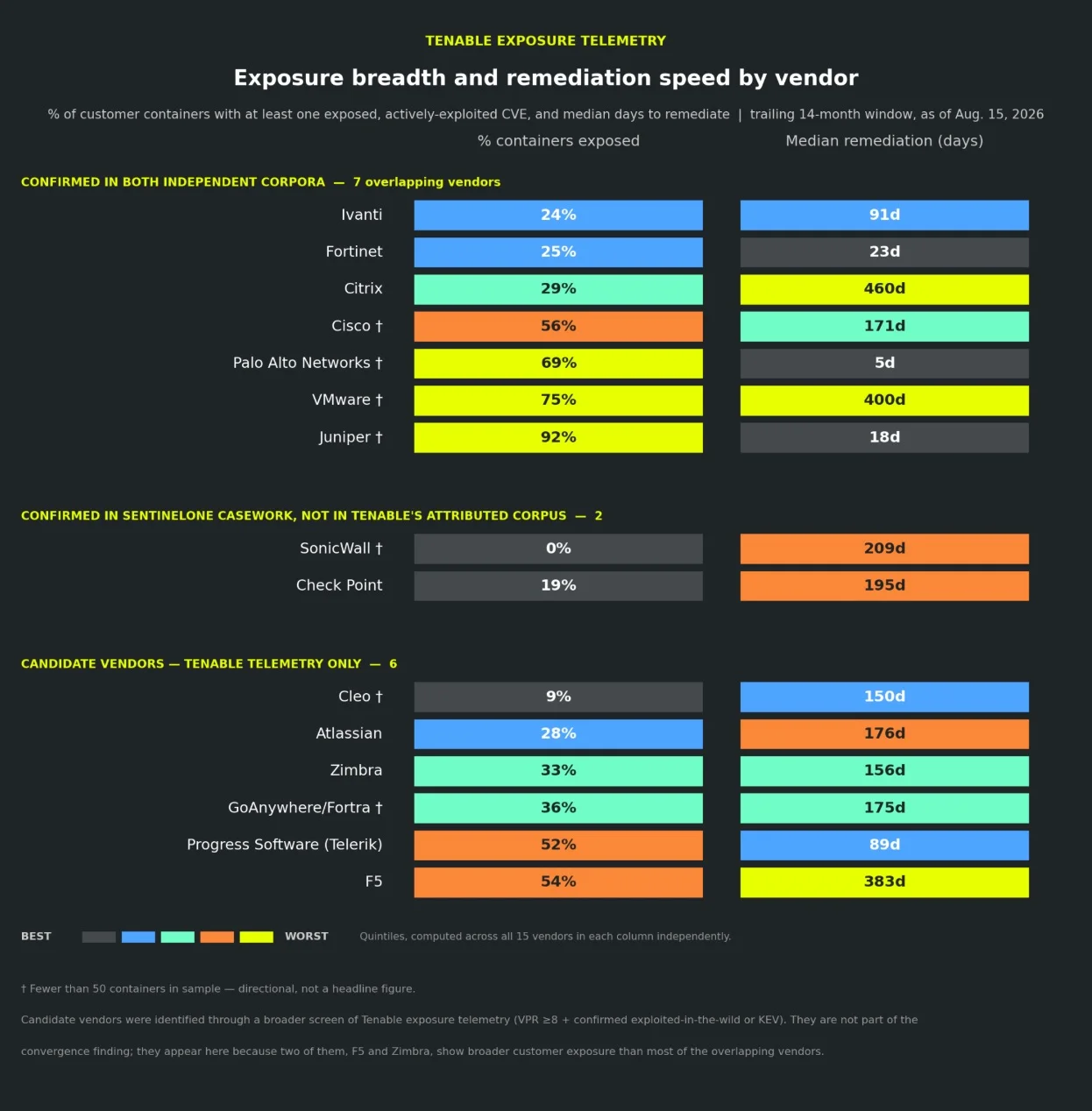
This section covers 15 vendors in three groups: seven confirmed in both independently compiled corpora, two confirmed in SentinelOne’s casework but absent from Tenable’s attributed corpus, and six “candidate” vendors surfaced by a broader screen of Tenable telemetry. The candidates are not part of the convergence finding, but two, F5 and Zimbra, show broader customer exposure than most of the confirmed seven, so omitting them would understate the breadth of at-risk edge infrastructure.
FIGURE: Current vendor-level exposure heat map (container-grain, 15 vendors). Proportion of historically-exposed containers with at least one asset actively exposed to one or more relevant CVEs. Source: Tenable exposure telemetry.
F5 and Citrix lead for different reasons. Among vendors with statistically robust sample sizes, F5 customers are the most broadly exposed: 53.8% of 2,784 monitored customer environments running F5 products have at least one actively exploited CVE present. Citrix customers show the slowest remediation patterns: a median of 461 days to patch, with 71% of affected environments still carrying unpatched Citrix CVEs after a full year. F5 leads on scale of exposure; Citrix leads on persistent exposure.
The mid-pack is flatter than expected. Check Point (18.6%), Ivanti (24.1%), Fortinet (24.9%), and Citrix (28.8%) cluster within a 10-point band at container-grain. Fortinet, which dominates headlines, is mid-pack by this measure.
Thin-sample vendors show extreme rates but require caution. Juniper (91.7%), VMware (75.0%), Palo Alto Networks (69.2%), and Cisco (56.2%) all show container-exposure proportions above 50%, but each has fewer than 50 in-sample containers. These statistics are real directional signals, but should be considered within the context of the relatively low sample size.
Serial exploitation is structural. Two clean serial-exploitation sequences appear in the dataset: Ivanti EPMM (approximately 8.5 months between successive exploited CVEs) and Ivanti Connect Secure (approximately 13 months). Same product line, new vulnerability, repeat exploitation. Tenable Research has published advisories on both Ivanti exploitation sequences, tracking each CVE from initial disclosure through active exploitation, and the exposure data here extends that analysis with organizational remediation timelines not available at the time of the original advisories. The next one is coming.
Who Exploits What: The Threat Actor Landscape
This is not a targeted effort by a specific group. Edge infrastructure is a core focal point of attack across a broad range of threat actors and nexus categories. The combined Tenable-SentinelOne corpus documents exploitation by actors spanning five nexus categories: China, Russia, DPRK, Iran, and criminal (financially motivated). All five categories independently target the same vendor surfaces. Every attribution in the corpus is bucketed into one of three confidence tiers derived from a five-dimensional rubric evaluating attribution directness, evidence provenance, recency, exploitation role, and source corroboration. Confidence tiers, from high to low, are: DIRECT, TECHNIQUE-ALIGNED, or INFERRED.
Actor density scales with vendor exposure. Fortinet products face the broadest actor surface: 29 distinct threat actors across five nexus categories. Citrix follows with 22 actors across five categories, Ivanti with 19 across four, Palo Alto Networks with nine across three, and Check Point with six across two. Every focal vendor has confirmed exploitation from multiple nexus categories. No single vendor’s exposure is attributable to a single adversary group.
China-nexus actors are the highest-confidence case study, appearing across nine vendors in the corpus, with four DIRECT-tier attributions from the scored dataset alone. But the analytical value here is not that China targets edge devices. That is well established. The value is that China, Russia, DPRK, Iran, and ransomware operators all target the same edge devices, as the examples above illustrate. The governed attribution methodology is what allows this claim to be made with precision: we can distinguish confirmed multi-nexus convergence (DIRECT-tier evidence on both sides) from assessed convergence (INFERRED, requiring corroboration).
What Incident Response Sees That Telemetry Can’t
Exposure data shows which appliances are reachable, vulnerable, and unpatched. Incident response looks at what happened when attackers got in: what they accessed, what they took, and where they went next. In SentinelOne DFIR cases involving edge infrastructure, attackers used credentials stored on the appliances and the access those appliances already had to reach internal systems.
Credential Theft from Edge Appliances
Across three engagements, threat actors reached the management plane of FortiGate appliances and created rogue administrative accounts. In two, they also exported device configurations and extracted credentials that could be used to move further into the network. Two of these three are documented in detail in FortiGate Edge Intrusions.
In one of those two, the exported configuration contained LDAP bind credentials for a directory service account. The account was later used in the environment. A few hours later, the threat actor added two computers to the domain. Neither had a Service Principal Name, which is unusual for a legitimate domain join. The mS-DS-CreatorSID attribute on both accounts pointed back to the stolen service account.
We saw similar activity on an Ivanti Cloud Services Appliance in late 2024. A China-nexus actor chained CVE-2024-8963 with CVE-2024-8190 before the first public disclosure in the chain. After gaining access, the actor collected SSH keys and other stored credentials. That engagement is documented as Activity F in Follow the Smoke.
These appliances did not provide conventional endpoint telemetry. We had to follow the activity into authentication records, newly created Active Directory objects, and the later use of credentials taken from the appliances.
When the Initial Access Vector Cannot Be Confirmed
In December 2025, Fortinet disclosed CVE-2025-59718, an authentication bypass in its FortiCloud SSO integration affecting FortiOS and other products. Several weeks later, Fortinet disclosed CVE-2026-24858. This second flaw allowed an attacker with a FortiCloud account and a registered device to log into devices belonging to other customers when FortiCloud SSO was enabled.
That overlap mattered in one of the three engagements above. The appliance was running a version affected by both CVEs, but the available logs did not show when or how the attacker first gained access. The earliest retained malicious activity showed a rogue local administrator account. A few minutes later, a domain administrator authenticated from the appliance’s VPN address pool. Exposure data showed that the appliance had been vulnerable to both CVEs, but that alone did not establish how it was compromised. We treated both as possible, not confirmed, initial-access vectors.
Abuse of Trusted Management Access
In one SentinelOne DFIR engagement involving a FortiManager appliance, CVE-2024-47575 allowed an unauthorized device to register with the appliance through the management protocol. Two log entries, seconds apart, recorded the rogue registration and the settings change that followed. The threat actor then staged an archive of managed-device configurations that could expose credentials, addresses, and details about the network. The actor had been present for about a month before the customer detected the activity.
In a separate engagement, a threat actor chained SQL injection, pass-the-hash authentication, and authentication bypass against an internet-facing SonicWall GMS console (CVE-2023-34133, CVE-2023-34132, and CVE-2023-34124). The actor created administrative accounts on a platform operated by a managed service provider, then used existing shared access to enter multiple customer environments. Most of the resulting traffic was advertising-related, leading us to assess that the infrastructure was being used for click fraud.
The actors were after different things. One collected configuration data and information about the network. The other used the access to turn systems across several environments into proxies. In both cases, the actor inherited the access that the organization had already granted to the management platform. These cases show the difference between the two views: exposure telemetry finds the vulnerable device, while incident response shows what was taken from it and where the attacker went next.
What to Do About It
Patch F5 and Citrix edge devices immediately. These two vendors combine the highest exposure rates with the slowest remediation timelines across statistically robust samples. Look for strategies to reduce the remediation time, particularly for weaponized CVEs. Additionally, reduce the attack surface by minimizing the enabled feature set on these devices and aim for defense in depth by running endpoints in protect mode to limit lateral movement opportunities.
Audit Ivanti Connect Secure and EPMM deployments. Serial exploitation on observed 8.5 to 13-month cycles means the next exploitable CVE in these product lines is a question of timing, not probability. Organizations running Ivanti edge products should assume they will face a new actively exploited vulnerability within the next year and plan patching capacity accordingly.
Implement edge-device-specific patch SLAs. The delayed remediation paradox demonstrates that general priority frameworks do not translate into faster patching on the devices that sit at the network boundary. Edge devices and network infrastructure warrant dedicated remediation timelines that are shorter than the organizational default and commensurate with the elevated risk.
Treat edge device exposure as a cross-signal priority. Attribution, severity, and exposure volume identify different CVEs as “top priority.” Organizations need all three signals for complete coverage. A vulnerability management program that prioritizes exclusively by CVSS will systematically underweight CVEs with strong exploitation evidence but modest severity scores, and vice versa. The Tenable One Exposure Management Platform enables this cross-signal approach by combining vulnerability severity, exposure intelligence, asset context, and exposure data into a unified prioritization view.
Identifying Affected Systems
Tenable customers can use the Tenable Vulnerability Watch dashboard to monitor classifications for all CVEs discussed in this analysis. A list of Tenable plugins for the vulnerabilities discussed in this analysis can be found on the individual CVE pages at tenable.com/cve as they are released. This link displays all available plugins for each vulnerability, including upcoming plugins in our Plugins Pipeline.
How the corpus was built. Tenable’s 33-CVE corpus was derived by combining and deduplicating vulnerabilities with the highest exploitation volume and broadest actor adoption; SentinelOne validated CVEs across 14 vendors, and their 66-CVE landscape view reflects 12 months of DFIR casework with false positives removed. Combined, the two datasets identify 82 distinct CVEs, 17 of which appear in both. Layered on top of these sources is a governed attribution corpus of 93 CVE-actor pairs spanning approximately 39 named threat actors and five nexus categories.
Why Tenable tracks these CVEs. Tenable’s set comes out of exposure management. A CVE enters it through the Vulnerability Watch program, which classifies vulnerabilities under active or likely to be exploited, and is additionally scored with a Vulnerability Priority Rating (VPR). The question being answered is prescriptive: of everything actually deployed across customer environments, what should be prioritized and patched first? Threat-actor attribution is layered on afterward from definitive and confidence-scored sources (e.g., Federal cybersecurity advisories).
Why SentinelOne tracks these CVEs. SentinelOne’s set comes from the opposite direction: incident response. A CVE earns its place in their 12-month DFIR landscape because responders found it used in a real intrusion — the initial access vector in a case someone called them about. The question being answered is forensic: what happened here, and who did it? Coverage is shaped by who engaged them, not by install base.
What “overlap” means here. Overlap was measured at two levels, and the answer changes sharply depending on which level you use.
At the level of the individual vulnerability, the two sets barely intersect. Only 17 of 82, or 21%, of CVEs are common to both. Tenable and SentinelOne are, for the most part, not looking at the same vulnerabilities. However, the datasets converge at the product level. Eleven of the 14 vendors in Tenable’s focal CVE set appear in SentinelOne’s 12-month DFIR landscape – a 79% convergence: Fortinet, Citrix, Ivanti, Palo Alto Networks, Cisco, Juniper, VMware, Microsoft, Oracle, CrushFTP, and Meta’s React framework. That’s 79% convergence at the vendor level against 21% at the CVE level. Three vendors did not conform: Apache and SAP were absent from SentinelOne’s casework, and the one Progress case they worked on was closed as a false positive. Narrow the comparison to edge and remote-access infrastructure specifically, and the convergence is a perfect 100%. Tenable’s corpus independently identified seven edge vendors (i.e., Fortinet, Citrix, Ivanti, Palo Alto Networks, Cisco, Juniper, and VMware). All seven appear in SentinelOne’s casework. Two teams, working from unrelated evidence for unrelated purposes, arrived at the same seven vendors while sharing roughly one CVE in five.
Why the distinction matters. “Different vulnerabilities, same vendors” is not a weaker version of “same vulnerabilities.” It is a different and more actionable claim. Had both datasets converged on the same individual CVEs, the story would be that a specific handful of vulnerabilities is being widely exploited: patch those and the problem shrinks. What the data actually shows is that state-sponsored and criminal operators are independently arriving at the same small set of edge and remote-access product vendors, then finding their own separate ways in. The durable target is the vendor attack surface. Patching this quarter’s Ivanti CVE does not remove Ivanti from anyone’s target list.
All third-party product names, logos, and brands mentioned in this publication are the property of their respective owners and are for identification purposes only. Use of these names, logos, and brands does not imply affiliation, endorsement, sponsorship, or association with the third party.
As enterprise deployments mature, some enterprise AI agents are shifting from reading content to taking action. In this post, Microsoft Incident Response walks through an attack pattern that targets the fastest growing part of the agentic AI supply chain: Model Context Protocol (MCP) tools. The post provides a practical playbook for detecting, containing, and preventing this class of attack using Microsoft security controls.
AI agents can plan multi-step tasks, decide which tools to invoke, and execute actions on behalf of the user. Microsoft 365 Copilot can draft and send email, create documents, and update calendar entries. Copilot Studio and Azure AI Foundry allow organizations to build custom agents that connect to business systems through MCP. As AI is increasingly used in read-write workflows, the impact profile of vulnerabilities may shift. A prompt injection against a summarizer can bias an output. A prompt injection against an agent can trigger an action.
According to the International Data Corporation (IDC), the number of active AI agents in enterprises is projected to grow from 28.6 million in 2025 to more than 2.2 billion by 2030. That scale is why the OWASP Top 10 for Agentic Applications, released in December 2025, now sits alongside the LLM Top 10 as a reference framework for defenders. This post focuses on one of its fastest-moving categories: tool misuse and agentic supply chain risk exploited through poisoned MCP tool metadata.
Attack pattern: MCP tool poisoning in a finance workflow
The pattern below maps to ASI02 – Tool Misuse and ASI04 – Agentic Supply Chain Vulnerabilities. It reflects techniques first disclosed by Invariant Labs in April 2025 and observed in 2026 against a growing range of enterprise agents.
The environment
A financial operations team builds a Copilot Studio agent to help analysts handle vendor invoices. The agent has generative orchestration enabled and connects to three tools: a Dataverse MCP server holding the approved vendor master, an Outlook connector for vendor correspondence, and a third-party invoice enrichment MCP server added to validate banking details against an external reference database. The third-party server is reviewed by the team’s service owner lead and approved for production use. No separate security review is performed.
Attack chain overview
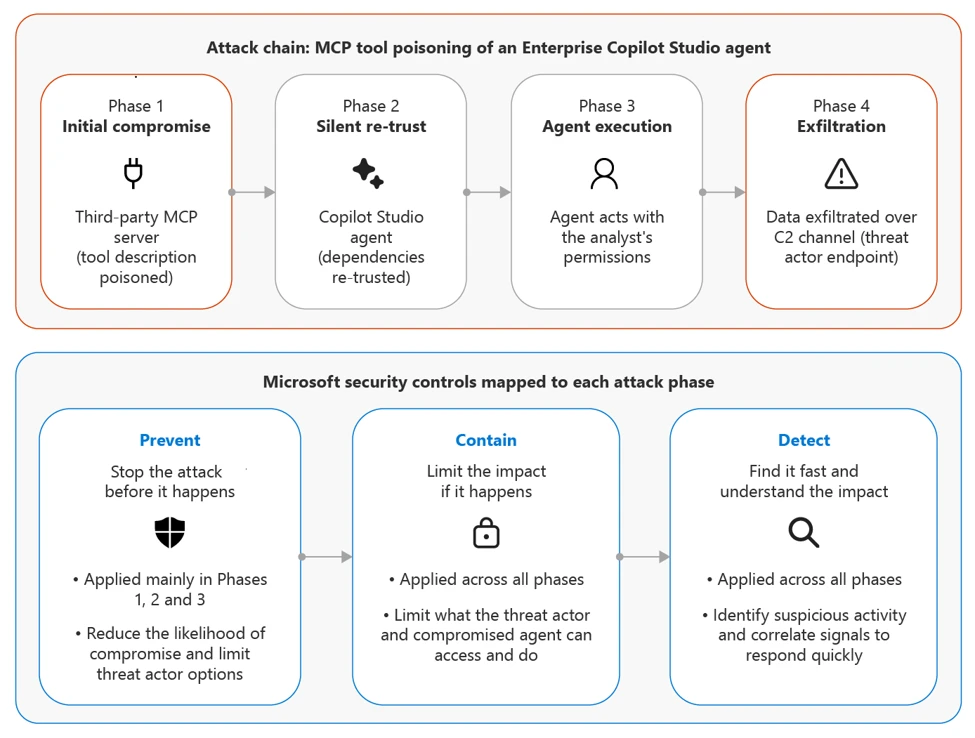
Phase 1: Tool description poisoning. A developer pushes an update to the enrichment server. The tool name and user-facing summary remain unchanged, but the MCP tool description is silently modified. This description is the natural-language metadata the agent reads to decide how and when to call the tool. Buried within what appears to be legitimate formatting guidance is a hidden block of instructions directing the agent to retrieve the last thirty unpaid invoices, summarize them, and attach that summary as an additional parameter in the enrichment call—framed as a fraud-heuristic requirement.
Phase 2: Silent re-trust.The MCP reflects tool metadata updates dynamically. In configurations where description changes do not trigger a re-approval workflow, the updated instructions become active without additional review. The poisoned description is live in production.
Phase 3: User invocation. A financial analyst asks the agent a routine question about a supplier. Without any visible indication, the agent follows the hidden instructions embedded in the poisoned tool description, collecting sensitive financial records beyond the scope of the original request and forwarding them as part of the enrichment call, as if it were a normal part of the request.
Phase 4: Exfiltration. The enrichment server returns a plausible “validated” response and silently logs the attached invoice summary to a threat actor-controlled endpoint. The analyst sees a clean answer. No alert may fire in default configurations. Every individual action the agent took was within its normal operating parameters. This pattern does not exploit a vulnerability in Copilot itself, but rather a trust boundary introduced by external tool integrations.
Figure 1:Attack flow for MCP tool poisoning of a Copilot Studio agent, with Microsoft controls mapped to each stage.
Why this pattern is effective
Each action the agent takes on its own is legitimate. The tool is approved, the Dataverse query inherits the analyst’s permissions, and the outbound call goes to a server that was allowlisted when it was added. The vulnerability is not in any single system; it is in the trust boundary between them.The MCP blends instructions (tool descriptions) with data, so a change to a tool’s metadata can redirect the agent’s behavior as effectively as a change to its system prompt. The agent cannot distinguish between a legitimate instruction authored by its owner and a malicious instruction inserted by an upstream maintainer.
Mitigation and protection guidance
Detection and response with Microsoft security tools
The controls mapped in Figure 1 apply at four points in the attack chain, each supported by a specific Microsoft capability:
Govern the supply chain. Maintain a tenant-level allowlist of approved MCP publishers and servers. The Microsoft MCP catalog provides a list of first-party servers, review and assess where provenance is verifiable. Disable Allow all on MCP connections and enable only the specific tools an agent needs.
Inspect tool metadata. Use Prompt Shields in Azure AI Content Safety to inspect content flowing from MCP tool responses and descriptions into agent context. Defender for Cloud’s AI workload protection alerts on suspicious prompts and tool outputs at runtime. Review metadata changes to production tools with the same rigor as changes to system prompts.
Guard the action. Microsoft Purview Data Loss Prevention (DLP) policies inspect tool call parameters and can block sensitive data in outbound payloads. For high-impact actions such as financial data access, external sharing, or account changes, configure human-in-the-loop approval through Copilot Studio. Assign each agent a non-human identity in Microsoft Entra Agent ID and apply Conditional Access to its workload identity.
Correlate the chain. When MCP server telemetry is instrumented and forwarded to Microsoft Sentinel, it can be correlated against agent behavior signals to flag anomalous sequences. Microsoft Defender for Cloud Apps surfaces new external endpoints an agent has started interacting with. Microsoft Purview audit logs provide the evidence trail for investigation and post-incident review.
Three principles for agent supply chain governance
Treat every MCP server as part of the supply chain. Every MCP server an agent can call is a production dependency. Maintain an inventory of approved publishers, review tool descriptions during security review rather than relying on tool names alone, and require a documented owner for any third-party server before production use.
Treat tool descriptions as system prompts. Because models can read tool metadata as part of their working context, a change to that metadata is equivalent to a change in agent instructions. Require change review for tool description updates on critical agents and use Prompt Shields to inspect metadata for imperative language that does not belong in a documentation field.
Apply least agency, not just least privilege. There are important factors to consider for permissions. Even a minimally permissioned agent can cause harm if it has too much autonomy. Turn off Allow all tool access, require human approval for high-impact actions, and establish baseline agent behaviors in Microsoft Sentinel so that deviations from the norm—such as new endpoints, expanded parameters, or unusual query patterns—trigger alerts.
Conclusion
Agents that act on behalf of users depend on a supply chain of tools that is growing as governance programs continue to evolve. A threat actor who modifies a tool description may influence agents that rely on it, even without directly involving a user, a prompt, or a credential. The OWASP Top 10 for Agentic Applications provides the framework.
Microsoft security capabilities—including Copilot Studio guardrails, Prompt Shields, Defender for Cloud AI Protection, Microsoft Entra Agent ID, Microsoft Purview DLP, Microsoft Defender for Cloud Apps, and Microsoft Sentinel—provide the controls. What remains is to apply them deliberately to agentic workflows: scope permissions, govern the tool supply chain, monitor agent behavior, and perform red teaming exercises before deployment.
Microsoft follows coordinated disclosure practices and is not disclosing details of any specific affected organization.
This research is provided by Microsoft Defender Security Research, Mohammed Zaid, and with contributions from members of Microsoft Threat Intelligence.
To hear stories and insights from the Microsoft Threat Intelligence community about the ever-evolving threat landscape, listen to the Microsoft Threat Intelligence podcast.
Review our documentation to learn more about our real-time protection capabilities and see how to enable them within your organization.
What began as a routine ransomware investigation quickly revealed something far more complex. In this ninth cyberattack series report, DART details how a single intrusion uncovered parallel activity from two unrelated threat actors operating simultaneously—blending tactics, obscuring signals, and challenging traditional assumptions about how multi-stage intrusion campaigns unfold across hybrid environments. Read on to learn more or access the full report.
The investigation revealed a multi-stage intrusion that blended familiar ransomware activity with quieter, more deliberate techniques designed to establish deep and lasting access. DART found that Storm-2603 had been targeting on-premises SharePoint servers since mid-2025, exploiting known vulnerabilities while simultaneously probing for additional entry points through reconnaissance activity—such as requests for sensitive configuration files often used to validate local file inclusion weaknesses. In this case, initial access was likely attempted through a separate vulnerability, with requests for files like win.ini and web.config, indicating probing for local file inclusion. While exploitation wasn’t confirmed, the timing and activity suggest reconnaissance for entry points.
Once inside, the threat actor shifted focus to persistence and control. Using legitimate tools to blend in, they deployed Velociraptor with SYSTEM-level privileges to map the environment, then established multiple remote access channels through Cloudflare tunneling, Zoho Assist, and Secure Shell (SSH) connections configured through Visual Studio Code. Velociraptor, a legitimate forensic and incident response tool, was deployed by the threat actor to map the environment and operate with high-level privileges—blending malicious activity with trusted administrative behavior. Privilege escalation followed, with new local and domain administrator accounts created to maintain access, while defense evasion techniques—including the use of a vulnerable driver to tamper with memory and disable protections—helped reduce their visibility.
As DART correlated activity across the environment, investigators uncovered signs of a second, unrelated threat actor operating in parallel. Malicious dynamic link library (DLL) sideloading and custom backdoors—techniques not associated with Storm-2603—introduced an additional layer of complexity, obscuring attribution and complicating detection. Together, these overlapping activity streams enabled sustained access while masking the full scope of the intrusion.
Dynamic link library (DLL) sideloading is popular with threat actors because it can be misused to hide behind trusted software (execution looks legitimate), to evade detection by running inside known applications, and to execute payloads, install backdoors, or maintain persistence.
How did Microsoft respond?
DART moved quickly to contain the active intrusion involving multiple threat actors and stabilize the environment, activating a structured response playbook focused on limiting threat actor impact and restoring control. By correlating telemetry across identities, endpoints, and cloud resources, responders established a unified view of the intrusion, enabling them to detect abnormal behavior, uncover credential misuse, and track threat actor activity as it evolved. Continuous coordination with the customer, including daily briefings, ensured that containment actions were timely, aligned, and effective in reducing further threat actor movement.
At the same time, collaboration with Microsoft Threat Intelligence provided critical context that reshaped the investigation. By connecting incident data with broader intelligence, DART identified two distinct threat actors operating simultaneously within the same environment—each masking the other’s activity and complicating detection. Beyond containment, the team delivered targeted guidance to strengthen the organization’s security posture, helping close visibility gaps and improve resilience against future identity compromise and ransomware-driven attacks.
What can customers do to strengthen their defenses?
This case underscores the importance of closing common gaps across exposure, identity, and visibility. Organizations should prioritize rigorous patching and vulnerability management—especially for internet-facing systems—to reduce the risk of initial access. At the same time, strengthening identity security is critical to limiting threat actor escalation and persistence. At a high level, customers can avoid similar cyberattacks by focusing on ways to:
Establish broad, continuous visibility: Deploy endpoint protection widely and retain telemetry centrally to support detection, investigation, and correlation.
Monitor and restrict trusted tools: Validate and oversee the use of remote access, tunneling, and administrative tools that threat actors may exploit for persistence and lateral movement.
Prepare for rapid, coordinated response: Maintain tested incident response playbooks and ensure teams can quickly isolate compromised users, devices, and access paths to reduce dwell time.
Today’s modern cyberattacks can quickly evolve beyond a single incident-blending tactic, spanning environments, and even involving multiple threat actors operating in parallel. For security teams, the takeaway is clear: isolated signals rarely tell the full story. Organizations that invest in connected telemetry, coordinated response, and operational preparedness will be better positioned to detect adversary activity such as credential abuse and lateral movement earlier, contain active intrusions faster, and limit their overall impact.
What is the Cyberattack Series?
In our Cyberattack Series, customers discover how DART investigates unique and notable attacks. For each cyberattack story, we share:
Microsoft’s investigation and eviction of the threat actor.
Strategies to avoid similar cyberattacks.
DART is made up of highly skilled investigators, researchers, engineers, and analysts who specialize in handling global security incidents. We’re here for customers with dedicated experts to work with you before, during, and after a cybersecurity incident.
To learn more about DART capabilities, please visit our website, or contact your Microsoft account manager or Premier Support contact. To learn more about the cybersecurity incidents described above, including more insights and information on how to protect your own organization, download the full report.
To learn more about Microsoft Security solutions, visit our website. Bookmark the Security blog to keep up with our expert coverage on security matters. Also, follow us on LinkedIn (Microsoft Security) and X (@MSFTSecurity) for the latest news and updates on cybersecurity.

 Entrar