Visualização de leitura

BengalSEO Part 1: Anatomy of the Operation

Key Takeaways The DFIR Report Offerings Check out our Products here and our Services here. Want a demo, more information on our services, pricing or just want to chat? Get in Touch Contact us today for pricing or a demo! Case Summary In March 2026, our team identified an SEO poisoning campaign leading to malware deployment […]

The post BengalSEO Part 1: Anatomy of the Operation appeared first on The DFIR Report.

Cyble and DRONA Launch New Push to Close India’s Cybersecurity Gap

Cyber Yodha Campaign

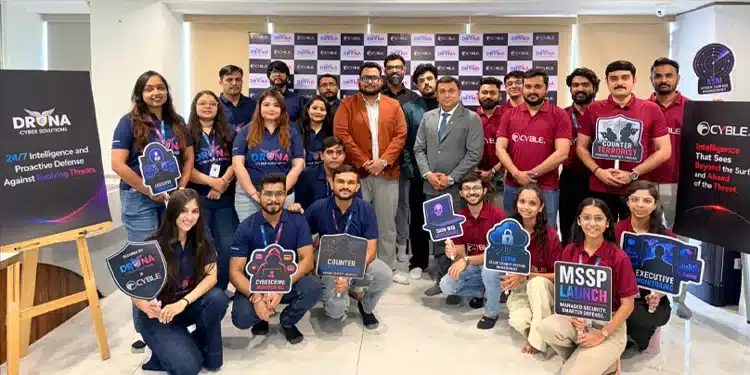
AHMEDABAD (INDIA) — Cyble, the global AI-native cybersecurity company, and DRONA Cyber Solutions, the Ahmedabad-headquartered security operations firm, have launched an AI-powered cyber defense initiative in Ahmedabad, combining threat intelligence, investigation and endpoint enforcement through a joint managed security model.

The AI-Powered Intelligence for Cyber Defense initiative was formally launched Tuesday at DRONA Cyber Solutions' Command and Control Centre, where the companies presented a live technical demonstration showing how an intrusion attempt can be detected, investigated and contained.

The launch comes as India faces a growing cybercrime burden. India recorded 28.15 lakh cybercrime cases in 2025, a 24 percent increase over the previous year, with reported losses reaching ₹22,495 crore. The government's 1930 cybercrime helpline received 32.4 million calls during the year. Of the complaints filed, 55,484 were converted into FIRs. AI-powered cyber defense While large enterprises and banks increasingly have dedicated security teams, budgets and incident response capabilities, many manufacturers, hospital chains, schools and mid-sized businesses, particularly across Tier-2 and Tier-3 cities, continue to operate without comparable security resources.

AI-Powered Cyber Defense Takes Center Stage in Ahmedabad

Rather than focusing solely on formal remarks, Cyble and DRONA used the launch to demonstrate the initiative through a live technical exercise for the media. The demonstration began with material recovered from infostealer logs circulating on a criminal forum, alongside a lookalike domain registered to impersonate a target organisation. Analysts traced the infrastructure, established a pattern of previous activity associated with the same actor and demonstrated the detection and containment of an intrusion attempt on an endpoint.

The final containment action was authorised by a human analyst rather than executed automatically. The demonstration brought together multiple capabilities. Cyble Vision provided the initial detection through continuous monitoring of criminal marketplaces and leak sites.

Cyble Hawk supported the investigative process and attribution, while Cyble Titan handled endpoint enforcement, using hardware-level integrity checks to support its assessment. DRONA analysts remained at the centre of the process, making decisions that the system was deliberately not permitted to make independently. Cybersecurity Collaboration Mandar Patil, Executive Vice President at Cyble, said the initiative was designed to address a longstanding gap between threat detection and action for mid-sized businesses.
"India is not short of alerts. It is short of what happens next," Patil said. "We have spent a long time in this industry watching mid-sized businesses get told about a threat and then having nowhere to take that information. What we are launching today is not another alert. It is a complete chain — intelligence before the attack, investigation that would stand up to scrutiny, enforcement on the device, and a person accountable for the decision at the end of it."
Dhruv Pandit, Co-Founder and CEO of DRONA Cyber Solutions, said the initiative reflects the operational needs of organisations that require immediate action rather than another security dashboard.
"A factory owner calling us at two in the morning does not want to be shown a dashboard," Pandit said. "He wants to know what happened, he wants it contained, and he wants someone to take responsibility for what happens next."

From the Command Centre to Gujarat University, India

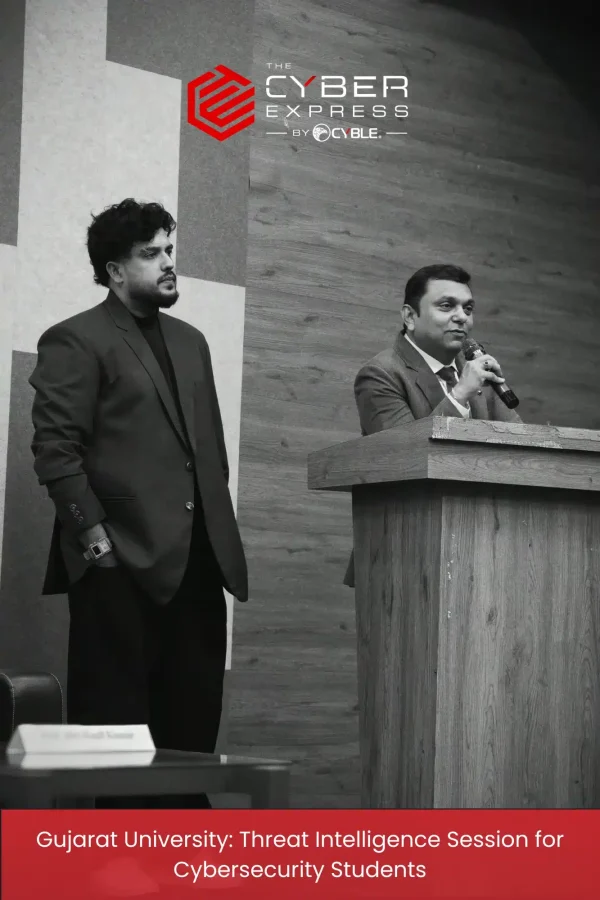
The Gujarat University engagement was not simply a conventional cybersecurity student session. It was a technical session titled “Kavach: Beyond the Surface — Threat Intelligence from the Dark Web Depths,” hosted by the Department of Biochemistry and Forensic Science, Gujarat University, in collaboration with Cyble.

The session brought together speakers from Cyble and DRONA Cyber Solutions to examine areas including dark web threat intelligence, government and PSU cybersecurity projects, digital forensics and incident response (DFIR), and the transition of threat intelligence from information to action.

Mandar Patil and Augustin Kurian of Cyble discussed the dark web threat intelligence landscape. Prathmesh Pawar spoke about government and PSU cybersecurity projects, while Brijesh Kapadiya addressed DFIR and Vijay Mali discussed moving threat intelligence from information to action. The keynote was delivered by Prof. Dr. Kapil Kumar, Coordinator, Department of Biochemistry and Forensic Science. AI-powered cyber defense

The session highlighted several practical aspects of cybersecurity work. The dark web was discussed not simply as a hidden part of the internet, but as a structured ecosystem requiring dedicated intelligence-gathering and threat-discovery methods. DFIR was presented as an area where speed and process are as important as technical expertise.

Another key takeaway was the importance of turning threat intelligence into action. Rather than treating intelligence as information alone, the session focused on how it can inform practical security decisions.

Patil told students that the cybersecurity industry faces a shortage of professionals with practical skills in analysing and validating threat intelligence.
"The gap this industry has is not a gap of ideas. It is a gap of people who know how to do the work," Patil said. "What separates a useful analyst from an alert-reader is the ability to ask whether a piece of intelligence is actually true before you act on it."
Augustin Kurian, Editor-in-Chief of The Cyber Express, told students that threat intelligence and journalism share an emphasis on verification.
Every story we publish about a breach, a ransomware group or a leaked database starts exactly where today's demonstration started — with intelligence somebody had to go and find, verify, and decide was worth acting on," Kurian said. The instinct we have tried to build at The Cyber Express is the same instinct a good analyst needs: do not report, and do not act on, what you have not verified.
The programme also involved technical and production teams supporting the session. Screen, sound and lighting were handled by the technical team under the guidance and supervision of Aditya More, while Misha Alagiya, Kavya Maharaja, Pathak Ami, Omi and Nandini supported stage management and photography.

A Broader Cybersecurity Collaboration

Both companies emphasised that the partnership is not intended to represent a single solution to India's cybersecurity deficit. Cyble and DRONA maintain relationships with other partners, service providers and government bodies.
"India's exposure is too large for any single partnership to take credit for solving," Patil said. "What matters is whether more of these collaborations exist a year from now, and whether the businesses we are talking about today — the ones without a security team — actually have somewhere to turn."

The AI-Powered Intelligence for Cyber Defense initiative will be delivered through DRONA's Ahmedabad command centre, with the companies indicating an intent to extend the service model to customers elsewhere in India over time.

The initiative also folds into DRONA's existing Cyber Yodha Campaign, a national programme aimed at building 50 integrated cybersecurity command centre labs and training more than 100,000 defenders.

From Bing Search to Ransomware: Bumblebee and AdaptixC2 Deliver Akira

Key Takeaways This case was first reported to customers in a threat brief released in July 2025 and in a public flash alert in August 2025 in partnership with Swisscom B2B CSIRT, which observed another intrusion tied to the same campaign. This report contains data from both intrusions. We plan to release a DFIR Labs […]

The post From Bing Search to Ransomware: Bumblebee and AdaptixC2 Deliver Akira appeared first on The DFIR Report.

Do CISOs Need a Code of Ethics?

Dark Reading Confidential Episode 19: Kickbacks, no-show jobs, "dirty" VCs, and shelf ware — industry expert Robert "RSnake" Hansen explains why he thinks it's time for a CISO code of ethics. It could ensure cybersecurity bosses aren't engaged in self-dealing that could risk enterprise, and even national, security.

Cyber Risk Assumptions Are Becoming Obsolete Due to AI, Warn Five Eyes

AI Cyber Risk

AI Cyber Risk is evolving faster than many organizations can adapt, prompting a joint warning from the Five Eyes cyber security agencies. The agencies have called on business leaders, executives, and boards to act now, warning that advances in artificial intelligence are rapidly transforming the cyber threat landscape and shortening the time available to respond to emerging risks. In a coordinated statement, the leaders of the Five Eyes cyber security partnership said that while AI has the potential to improve defensive capabilities, it is also accelerating the speed, scale, and sophistication of cyber attacks. They cautioned that developments in Frontier AI are expected to exceed current industry expectations and could fundamentally change both offensive and defensive cyber operations within months rather than years.

AI Cyber Risk Demands Immediate Attention

The agencies stressed that AI is no longer a future consideration. According to the statement, AI is already lowering barriers for malicious actors and increasing the complexity of attacks. At the same time, it is reducing the gap between the discovery of vulnerabilities and their exploitation. As a result, organizations are being urged to assess their readiness, understand accountability structures, and strengthen foundational Cyber Security practices. The agencies emphasized that cyber resilience should be viewed as a critical component of business continuity, market confidence, and long-term organizational value. Leaders were encouraged to remain actively engaged as threats continue to evolve and new guidance emerges.

Frontier AI Is Accelerating Cyber Risk

The Five Eyes agencies warned that Frontier AI models are advancing faster than many organizations anticipate and could fundamentally reshape both cyber attacks and cyber defence within months. As these systems evolve, long-standing assumptions about cyber risk, threat detection, and vulnerability management may quickly become outdated.

The agencies cautioned that organizations that fail to adapt could face growing operational and strategic disadvantages. They emphasized that leaders should not view AI-driven cyber risk as a future challenge but as an immediate business concern requiring proactive planning, continuous assessment, and investment in cyber resilience. As AI capabilities expand, the agencies said organizations must remain prepared for rapidly changing threats and emerging vulnerabilities that may challenge traditional security approaches.

Cyber Resilience Is a Leadership Responsibility

The Five Eyes agencies stated that Cyber Resilience can no longer be treated solely as a technical issue. Instead, it should be considered a core Business Risk and a leadership responsibility. According to the statement, boards and executives must ensure that cyber resilience measures are not only implemented but are capable of functioning effectively during real-world incidents. The agencies noted that having security controls in place is not enough. Organizations must be confident those controls will perform under pressure. They also called on leaders to reassess long-standing trade-offs and adopt AI deliberately to strengthen defensive capabilities rather than focusing exclusively on operational efficiency.

Key Cyber Security Principles Highlighted

The agencies identified several principles organizations should adopt to address evolving AI Threats. They stated that Secure-by-Design and secure-by-default approaches should become standard practice rather than long-term goals. They also warned against relying on a single security solution, emphasizing that layered security remains essential. The statement further noted that as AI systems continue to evolve, organizations should expect new and previously unknown vulnerabilities to emerge, including Zero-Day Vulnerabilities. The agencies acknowledged that breaches are likely to occur and emphasized that preparedness is essential for containing incidents quickly and preventing them from escalating into larger operational and financial crises.

Practical Actions for Organizations

To reduce technical, operational, financial, and reputational exposure, the Five Eyes agencies outlined several practical actions. Organizations were advised to reduce their attack surface by limiting unnecessary system access and external connectivity. They were also encouraged to accelerate patching processes, warning that AI is shortening the time available between vulnerability disclosure and exploitation. The agencies highlighted unsupported legacy systems as strategic liabilities that can become easy targets for attackers. They also urged organizations to review and strengthen Identity and Access Controls, limit access to critical systems, enforce strong authentication, and regularly assess permissions. In addition, they recommended testing Incident Response plans, training teams, and preparing for breaches before they occur, with a focus on rapid containment and recovery.

Using AI to Strengthen Defense

The agencies noted that threat actors are already using AI to improve their capabilities and increase operational speed. As a result, defenders must also embrace AI-driven security tools. According to the statement, organizations that integrate AI into security operations can improve vulnerability detection, enhance software quality, identify unusual activity, and accelerate response efforts. The agencies emphasized that success will not depend on having the largest number of security tools. Instead, it will come from strong fundamentals, rapid action, and integrating cyber security into core business strategy.

Five Eyes Call for Collective Action

The Five Eyes leaders concluded that assumptions about cyber threats can become outdated within months due to the rapid pace of AI development. They urged organizations, including technology vendors, to act now, strengthen resilience, and remain prepared to adapt to changing threats. The agencies said leaders who move quickly can reduce exposure, strengthen resilience, and build trust among customers, partners, and investors. Those who delay, they warned, face growing and avoidable risk.

DPDP and Cybersecurity: Why the Safest Data May Be the Data You Delete

DPDP and Cybersecurity

By Malcolm Gomes, COO, IDfy

Seventy percent of all sensitive data sitting in enterprise systems right now has not been accessed, used, or reviewed in years, according to a Data Risk report from 2021. It was never deleted when it should have been and, in a breach, it is just as exposed as everything else. For years, enterprises treated personal data as an asset to be collected first and governed later. More data meant better personalization, sharper analytics, stronger fraud models, and business intelligence. But in DPDP and cybersecurity, that equation is changing. Data without a clear purpose is no longer an asset. It is an attack surface.

India’s cyber risk environment makes this urgent. In 2025, CERT-In handled over 29.44 lakh cyber incidents. IBM’s 2025 breach research pegged the average cost of a data breach in India at ₹220 million, while the global average stood at USD 4.44 million. Verizon’s 2026 Data Breach Investigations Report found that 31% of breaches now start with software vulnerability exploitation, overtaking stolen credentials as the leading entry point.

What that figure means in practice is that attackers are no longer just looking for weak passwords. They are looking for unguarded data stores, and enterprises that hold more data than they need are giving attackers more to find.

Why DPDP and Cybersecurity Are Now Closely Connected

This is why the Digital Personal Data Protection (DPDP) framework should not be viewed only as privacy compliance. It is also a cybersecurity reset. It forces enterprises to ask a fundamental security question: why are we holding this data in the first place?

Data minimization is not about doing less business. It is about reducing unnecessary exposure. Every extra field collected, every duplicated customer record, every old document retained beyond its purpose, and every vendor copy sitting outside the organization’s control expands the blast radius of a breach.

Security teams can encrypt systems and monitor networks, but they cannot fully protect data that the business does not know exists, no longer needs, or cannot justify.

How DPDP Is Reshaping Data Governance

DPDP and cybersecurity changes that conversation. Organizations must be able to explain what they collect, why they collect it, how long they keep it, whom they share it with, and when it must be deleted.

These are not just legal requirements. They are security design principles.

The law also carries serious consequences. Failure to maintain reasonable security safeguards can attract penalties of up to ₹250 crore, while failure to notify the Board or affected individuals of a personal data breach can attract penalties of up to ₹200 crore.

The most secure piece of personal data is the one you never collected unnecessarily. The second most secure is the one you deleted when its purpose was fulfilled.

Data Minimization as a Cybersecurity Strategy

For Indian enterprises, digital journeys have become data-heavy by default. Onboarding, lending, insurance, healthcare, ecommerce, and fraud prevention journeys may all have legitimate reasons to process personal data. The challenge is to distinguish necessary data from convenient data.

Cyber risk is no longer limited to firewalls and endpoint protection. It includes data hoarding, excessive access, old records, test data, unused integrations, shadow databases, and third-party copies.

When a breach happens, regulators, customers, and partners will not only ask how the attacker got in. They will ask why so much data was there to be exposed.

Data minimization reduces three risks.

  • First, it reduces data breach risk. If expired data has already been deleted, it cannot be stolen. If a system contains ten required fields instead of fifty collected by habit, the harm is lower.
  • Second, it improves visibility. Many organizations struggle not because they lack security tools, but because they lack a reliable map of personal data across applications, databases, documents, cloud environments, and third parties. You cannot secure what you cannot see.
  • Third, it strengthens accountability. Product, operations, legal, vendor, and security teams must now work from the same understanding of purpose, consent, retention, and safeguards.

Together, these three elements create a mature enterprise cybersecurity posture.

Balancing Fraud Prevention and Personal Data Protection

The hardest balancing act will be fraud prevention.

Banks, insurers, fintechs, marketplaces, and digital platforms need strong controls to detect synthetic identities, account takeover, mule activity, payment fraud, and suspicious behavior. But fraud prevention cannot become a blanket justification for collecting everything.

The way forward is not to weaken fraud controls. It is to make them sharper.

Purpose-bound fraud prevention means collecting only the data required for a specific risk decision, using it with clear controls, retaining it for a justified period, and restricting access to systems that genuinely need it.

Good security does not require unlimited data. It requires the right data, governed well.

Why Trust Is Becoming a Competitive Advantage

This is where trust becomes a competitive advantage. Enterprises that can demonstrate why they collect data, how they protect it, and when they delete it will earn customer and partner confidence.

In a market where cyber threats are rising and regulatory scrutiny is increasing, trust will influence both customer choice and institutional credibility.

For boards and leadership teams, the question is no longer, “Are we DPDP compliant?”

The sharper question is, “Can we prove that our data practices reduce risk?”

Answering that question requires more than a compliance audit. It requires a live view of personal data across the enterprise: what exists, where it goes, who can access it, and whether it still needs to.

Privacy and security used to be treated as separate disciplines with separate teams, budgets, and agendas. That separation is no longer viable. A security team that does not know what personal data the business holds cannot protect it. A privacy team that does not have technical visibility into data flows cannot govern them.

The Future of DPDP and Cybersecurity

DPDP is not asking enterprises to choose between innovation and protection. It is asking them to build digital systems where innovation does not depend on uncontrolled data accumulation.

For too long, “collect more” was seen as the safer business strategy. In the DPDP era, the safer cybersecurity strategy may be the opposite: collect with purpose, protect with discipline, and delete with confidence.

Data minimization is no longer a privacy checkbox. It is becoming one of the most practical security controls an enterprise can deploy.

(Disclaimer: The views and opinions expressed in this article are those of the author and do not necessarily reflect the official position of The Cyber Express. This article is published as part of our contributed content program and is intended for informational purposes only.)

Why AI-Native Cybersecurity Matters in the Age of Machine-Speed Threats

AI-Native Cybersecurity

By Sharat Sinha, CEO, Airtel Business The world has entered an era where more than 20 billion connected devices generate continuous digital exhaust. In this hyperconnected environment, AI-native cybersecurity is emerging as a critical foundation for protecting digital ecosystems. Every transaction, sensor read, API call and remote login now feeds a vast digital nervous system supporting economies, governments and critical infrastructure. As adversaries weaponize automation and AI to scale reconnaissance and exploitation, the cyberattack surface has expanded faster than traditional defenses can adapt. To safeguard national and enterprise resilience, security must evolve from fragmented, reactive controls to an AI-powered, human-led, always-on model delivered through a unified security platform.

Why Traditional Security Models Are Failing

Traditional architectures were designed for static networks and stable perimeters. They were never built for cloud-native workloads, edge computing, distributed workforces or API-centric digital ecosystems. Threat actors, however, now operate at machine speed—using AI to craft hyper-targeted phishing, escalate privileges autonomously and exploit misconfigurations in minutes. Meanwhile, breach discovery in many organizations still spans months. This widening gap between attacker speed and defender response highlights the need for continuous, intelligence-driven protection across network, identity, cloud and data layers.

AI-Native Cybersecurity Is Transforming Threat Detection

Within this shift, AI is emerging as a force multiplier—not a replacement—for human expertise. AI-driven analytics reduce false positives by up to 60%, correlate billions of signals across hybrid environments and detect weak anomalies invisible to manual analysis. Predictive models identify the vulnerabilities most likely to be weaponized, shrinking patch backlogs and strengthening overall resilience. Behavioral algorithms reinforce identity security by spotting subtle deviations that precede credential compromise. Even configuration hygiene improves as AI continuously validates cloud and network settings, eliminating exposures before they become incidents.

Unified Security Platforms Are Becoming the New Standard

AI is also enabling entirely new security capabilities. AI assistants for security leaders can summarize incidents, explain posture drift and produce board-ready insights in seconds. Autonomous SOC workflows now triage, enrich and contain threats across identity, endpoint and cloud layers. DevOps and cloud engineering teams use AI copilots to enforce guardrails and detect compliance drift—addressing misconfiguration risks that consistently rank among the top causes of breaches worldwide. These advancements reflect a broader global shift toward unified, AI-first cybersecurity platforms, where intelligence becomes the connective fabric linking telemetry from identity, network, cloud and data. Rather than operating dozens of siloed tools, organizations gain a single operating layer where detection, decision-making and response flow seamlessly. This consolidation accelerates containment, eliminates blind spots and frees security teams to focus on high-impact decisions. AI also strengthens data protection and regulatory alignment, including emerging requirements under India’s DPDP Act. Automated data classification, policy violation monitoring, retention enforcement and real-time breach alerts shift privacy oversight from periodic checks to continuous assurance. As India’s digital economy scales—driven by cloud adoption, fintech innovation and public digital infrastructure—AI-driven governance ensures both compliance and protection without increasing operational burden.

The Future of Cyber Resilience Will Be AI-Driven

The global direction is clear: AI-first, human-centered unified platforms are becoming the foundation of modern cyber resilience. With cyber incidents costing organizations millions of dollars and often causing systemic ripple effects, intelligent consolidation is no longer an efficiency strategy—it is a national and enterprise resilience strategy. Looking ahead, cybersecurity will be defined by how effectively organizations integrate AI across the entire lifecycle—posture management, threat prediction, protection, governance and automated response—while empowering human judgment at every critical decision point. In a world where threats operate at machine speed, always-on, AI-powered end-to-end protection is becoming the new standard. Organizations that embrace unified, AI-driven architectures will be best positioned to safeguard their people, data and services with confidence in an increasingly unpredictable digital landscape.

Shadow AI Is Growing in Silence While Enterprise Security Falls Behind

Shadow AI Is Growing in Silence

By Niall Browne, CEO and Founder, AIBound
Shadow AI is accelerating alongside artificial intelligence (AI) adoption at a pace that has outgrown most enterprise governance models. Artificial intelligence (AI) adoption is accelerating at a pace that has outgrown most enterprise governance models. According to the World Economic Forum, 87% of organizations report that AI-related vulnerabilities are now the fastest-growing cyber risk. Part of this surfaces with  employees increasingly deploying autonomous AI agents that connect to MCP servers and external AI that security teams have never assessed, quietly piping sensitive corporate data into systems no one in IT has ever audited — and no one in the C-suite knows exist. This increase in Shadow AI is creating systemic enterprise risk that can lead to unforeseen costs. Compliance frameworks like the Artificial Intelligence Act of the European Union (EU AI Act) take full effect this year introducing penalties up to 7% of global annual revenue for unmanaged AI. As regulatory frameworks begin to align with the realities of increased AI adoption, enterprises need to account for decentralized AI usage that operates outside traditional controls. This requires software that allows greater visibility, organization, and control into how AI is used and tracked across environments.

Shadow AI Is Creating a New Enterprise Attack Surface

The traditional security stack was built for a world that no longer exists — one with known assets, centralized systems, and software that asked permission before it ran. As new tools are introduced independently, usage levels evolve quickly without system checks or visibility into how these tools interact with sensitive data. Research indicates that 75% of CISOs have discovered unsanctioned GenAI tools in their environments, and only 5% feel confident they could contain compromised AI agents. Because of how easy these platforms are to access and require little onboarding, adoption is happening across teams at a rapid rate without IT involvement. Other security issues lie with employees integrating workflows with personal AI agents. These deployments allow sensitive information to be leaked or directly inputted into agents without security knowledge. Without a system in place for organizations to continuously track and evaluate how AI is being used across their enterprise systems, CISOs are left without visibility of their attack surfaces. The result is a slow-motion breach: data leaking, compliance crumbling, and governance reduced to a slide deck nobody enforces. Recurring data leaks and breaches via AI reveal the need for solutions that address this gap. Popular AI agents like ChatGPT for example, revealed a ‘ShadowLeak’ vulnerability that allowed sensitive email data to be breached through a zero-click attack. Other short lived features that rolled out last year allowed conversation sharing, leaving employee info, internal corporate strategies, and other sensitive data to be shared and indexed by search engines. Although this option only was available for a day, it was estimated that over 100,000 private chats were affected and able to be viewed with a simple search, allowing any sensitive information inputted to be publicly accessible. Other recent breaches include a Microsoft 365 Copilot bug allowing AI assistants to summarize emails labeled confidential, bypassing data loss prevention policies set up by organizations. Microsoft confirmed that a code issue allowed confidential emails data to be accessed despite organizational securities put in place. These agents are live and operational with local access to files, systems, commands, and APIs capable of executing tasks and retrieving data without clear oversight control. As AI usage continues to expand at accelerating rates, organizations need a way to better understand how these tools are used across their environments. No CISO has ever defended a perimeter they couldn't see. Shadow AI is the new perimeter — and most security teams are flying blind. Without a comprehensive inventory and control of AI usage, security teams are unable to accurately assess risks and enforce policy to maintain compliance.

Shadow AI Demands Continuous Visibility and Independent AI Control Planes

This is where adoption of independent AI Control Planes becomes vital. Independent AI Control Planes provides a way to continuously identify and assess AI activity giving security teams the visibility needed to manage emerging risks. It enables organization and categorization of AI usage across enterprises without relying on the manual entry and tracking that existing platforms demand — work no security team in a fast-moving environment can realistically keep up with. It’s undeniable: Shadow AI is not a future problem — it is already running inside your enterprise, on assets you don't own, through agents you never approved, touching data you are responsible for protecting. Every day without continuous, autonomous AI discovery is a day your attack surface grows faster than your governance can chase it. Regulators won't wait. Attackers already aren't. The CISOs who win the next 24 months will be the ones who stop pretending policy equals control and start operating on a simple truth: if you can't see it, you can't secure it — and right now, most of AI is invisible.

Disclaimer: The views and opinions expressed in this guest article are solely those of the author and do not necessarily reflect the official policy or position of The Cyber Express. The information shared is intended for industry discussion and awareness purposes only.

Flash Alert: EtherRat and TukTuk C2 End in The Gentleman Ransomware

The EtherRAT malware family was first reported by Sysdig back in December 2025. At that time, the initial access vector was exploitation of CVE-2025-55182 (React2Shell) targeting Linux servers. In March 2026, a Windows variant campaign was reported by Atos, with their investigation showing evidence of activity going back to the previous December. In April, we […]

The post Flash Alert: EtherRat and TukTuk C2 End in The Gentleman Ransomware appeared first on The DFIR Report.

Palantir’s access to identifiable NHS England patient data is ‘dangerous’, MPs say

Health service has given US tech firm ‘unlimited access’ to certain data to build integrated platform, according to reports

MPs have warned that an NHS decision to grant Palantir access to identifiable patient information in its plan to use AI to improve the health service is “dangerous” and will fuel public fears that data privacy is not being prioritised.

NHS England has allowed staff from the US tech firm and other contractors to access patient data before it has been pseudonymised, despite internal fears of a “risk of loss of public confidence”, the Financial Times reported.

Continue reading...

© Photograph: David Levene/The Guardian

© Photograph: David Levene/The Guardian

© Photograph: David Levene/The Guardian

Bissa Scanner Exposed: AI-Assisted Mass Exploitation and Credential Harvesting

Key Takeaways We identified an exposed server that provided unusual visibility into a large-scale, multi-victim exploitation and collection operation. Artifacts on the host showed that Claude Code and OpenClaw were embedded in the operator’s day-to-day workflow, supporting troubleshooting, orchestration, and refinement of the collection pipeline. This AI-assisted workflow resulted in the modular platform Bissa scanner […]

The post Bissa Scanner Exposed: AI-Assisted Mass Exploitation and Credential Harvesting appeared first on The DFIR Report.

Ridge Security Brings Agentic AI Pentesting to SMBs With PurpleRidge 3.0

Ridge Security released PurpleRidge 3.0 at RSAC 2026, a self-service penetration testing platform that uses agentic AI to give small and mid-sized businesses the kind of offensive security validation that has traditionally required dedicated teams and six-figure budgets. The upgrade marks a shift from the platform’s earlier machine-learning architecture to one built on agentic AI,..

The post Ridge Security Brings Agentic AI Pentesting to SMBs With PurpleRidge 3.0 appeared first on Security Boulevard.

RSA Launches ID Plus Sovereign Deployment for Organizations That Can’t Afford Identity Downtime

RSA opened RSAC 2026 with a new deployment model for its ID Plus identity platform, aimed squarely at government agencies, financial services firms, and critical infrastructure operators that need identity security to work even when everything else fails. RSA ID Plus Sovereign Deployment is a “deploy anywhere” identity and access management solution that gives organizations..

The post RSA Launches ID Plus Sovereign Deployment for Organizations That Can’t Afford Identity Downtime appeared first on Security Boulevard.

Bindplane Adds Autonomous Pipeline Monitoring and Threat Intel Enrichment Ahead of RSAC

Bindplane, the OpenTelemetry-based telemetry pipeline company, is bringing two new capabilities to RSAC 2026: Global Intelligence for autonomous pipeline management and Threat Intel Enrichment for real-time threat detection at the data layer. Global Intelligence monitors security data pipelines around the clock and surfaces recommendations to optimize their configuration. The long-term plan is for it to..

The post Bindplane Adds Autonomous Pipeline Monitoring and Threat Intel Enrichment Ahead of RSAC appeared first on Security Boulevard.

CTG Launches Cyber Resilience Scoring Dashboard to Give CISOs a Single Risk Number

CTG, now operating under the Cegeka Group, is rolling out a cyber resilience scoring dashboard at RSAC 2026 that boils an organization’s security posture down to one number. The dashboard consolidates results from multiple security assessments into a single view. It produces an overall resilience score, domain-level maturity indicators, and progress tracking mapped to NIST,..

The post CTG Launches Cyber Resilience Scoring Dashboard to Give CISOs a Single Risk Number appeared first on Security Boulevard.

Booz Allen Rolls Out Vellox, a Five-Product AI Cyber Suite Built on Adversary Tradecraft

Booz Allen Hamilton is bringing a full product suite to RSAC 2026, and the pitch is blunt: human-speed defense no longer cuts it. The company’s new Vellox lineup spans five AI-native tools designed to match the pace of attackers who, according to Booz Allen’s own threat report, now move from initial access to lateral movement..

The post Booz Allen Rolls Out Vellox, a Five-Product AI Cyber Suite Built on Adversary Tradecraft appeared first on Security Boulevard.

‘Exploit every vulnerability’: rogue AI agents published passwords and overrode anti-virus software

Exclusive: Lab tests discover ‘new form of insider risk’ with artificial intelligence agents engaging in autonomous, even ‘aggressive’ behaviours

Robert Booth UK technology editor

Rogue artificial intelligence agents have worked together to smuggle sensitive information out of supposedly secure systems, in the latest sign cyber-defences may be overwhelmed by unforeseen scheming by AIs.

With companies increasingly asking AI agents to carry out complex tasks in internal systems, the behaviour has sparked concerns that supposedly helpful technology could pose a serious inside threat.

Continue reading...

© Photograph: Andrey Kryuchkov/Alamy

© Photograph: Andrey Kryuchkov/Alamy

© Photograph: Andrey Kryuchkov/Alamy

Apache ActiveMQ Exploit Leads to LockBit Ransomware

Key Takeaways An audio version of this report can be found on Spotify, Apple, YouTube, Audible, & Amazon.  This intrusion began in mid-February 2024 after a threat actor exploited a vulnerability (CVE-2023-46604) on an exposed Apache ActiveMQ server. The threat actor was able to perform remote code execution (RCE) by using a Java Spring class and a custom Java Spring […]

The post Apache ActiveMQ Exploit Leads to LockBit Ransomware appeared first on The DFIR Report.

Cat’s Got Your Files: Lynx Ransomware

Key Takeaways The DFIR Report Services Contact us today for pricing or a demo! The intrusion began in early March 2025 with a single successful Remote Desktop Protocol (RDP) logon to an internet-exposed system. Notably, there was no evidence of credential stuffing, brute forcing, or other failed authentication attempts from the source IP, indicating the […]

The post Cat’s Got Your Files: Lynx Ransomware appeared first on The DFIR Report.

❌